Tik Tok is a social media app that allows users to create and discover short videos made and posted by users. It’s popular because it combines teen users’ love for social media, music, and creative shorts. They love the authenticity of sharing and creating Tik Tok offers. Dangers are that kids may post and view sexualized or stunt videos and explicit songs, post videos of others without their permission, users are commonly ridiculed and cyberbullied, they may read lewd comments, and there is potential for public direct messaging. Be aware that popular Tik Tok influencers produce highly sexualized content and the “For You” autofeed commonly offers up content that most parents find inappropriate for child viewing. Plus, it’s so fun it’s addictive. Kids can spend hours scrolling endless content. As always, make sure you have familiarity with Tik Tok before you allow your child to use it. And, of course, add it to your free GKIS Connected Family Agreement as an “OK” or a “not yet,” so parameters, rules and regs, and etiquette issues are understood. (If you haven’t downloaded it yet, enter your name and email on our GetKidsInternetSafe home page and it will be emailed immediately). For a comprehensive tween/teen course on how to stay safe on social media, know what to watch out for, and how to apply amazing psychology wellness strategies, check out our GKIS Social Media Readiness Training Course. It gets the conversations started about the truths of Internet risk,. Also, y\ou won’t want to miss the parent setup tips at the end of this article. Our GKIS Sensible Guide provides information that parents need to know to make an informed decision.
What is Tik Tok?
Tik Tok is an app that allows users to create 15-second videos. It’s based on a previously popular app called Musical.ly, which is no longer available. Tik Tok users can post videos they saved on their phones and add sounds, parts of songs, special effects, and filters. Recently, Tik Tok added a new feature that allows users to record their reactions to other Tik Tok videos. The app also includes a feature that notifies users when they’ve spent more than two hours on the app. Users seem to value creativity and authenticity over likes.
How long has it been around and how popular is it?
Tik Tok is developed by ByteDance, a Chinese Internet technology company. It was first released in September 2016 for IOS and Android. Tik Tok’s global offices are located in Los Angeles, London, Dubai, and Tokyo, among other places. As of October 2018, Tik Tok was downloaded 80 million times in the US and 800 million times globally. It is free to use. ByteDance makes its money through advertisements integrated into the app.
How old is old enough for adoption?
Tik Tok’s Term of Service states, “If you are under age 13, you may only use the Services with the consent of your parent or legal guardian. Please be sure your parent or legal guardian has reviewed and discussed these Terms with you.” As you know from other GKIS Sensible Guides, 13 years old allows social media apps to be in compliance with the U.S.’s Children’s Online Privacy Protection Act (COPPA). It has nothing to do with child psychology. Nobody assessed that 13 years old is a healthy age for app adoption. That is up to you.
Before you make your decision, keep in mind that before 13 years old, kids still have limited ability to understand potential consequences and lack impulse control. In Dr. Bennett’s book, Screen Time in the Mean Time, she recommends no social media app adoption until at least the second semester of sixth grade, when kids have more social experience for creative problem solving and are no longer transitioning into middle school. (If the seventh grade is a transition year in your community, she recommends waiting until spring semester for the introduction). Most parents will find that, even at 13 years old, they are uncomfortable with their kids viewing the sexually explicit and sometimes cruel content easily available on Tik Tok. Follow a few popular Tik Tok influencers to sample what I’m talking about. Of course, every family circumstance is unique. We at GKIS believe that parents are the ultimate authority on your children’s unique traits and “fit” with Tik Tok.
Tik Tok In the News
In December 2019, the U.S. Army and U.S. Navy banned soldiers from using the Tik Tok app on government-owned phones due to concerns that content shared with ByteDance could be used to influence and surveil Americans. ByteDance reports that it stores U.S. user data in the U.S. with backups in Singapore, so it is not subject to Chinese law. But as a security expert told me, “It doesn’t matter where they store the data, it’s how they access it that counts. China is well known for having an excellent ability to steal private data from foreign countries.”
In February 2019, ByteDance was fined $5.7m by the U.S. Federal Trade Commission for illegally collecting personal information from children, like names, emails, addresses, and locations. in violation of COPPA. The FTC found that Tik Tok failed to delete content from underage children despite receiving thousands of complaints from parents. As a result of the FTC fine, Tik Tok created an experience for underage users which allows them to only access curated, clean videos and not have the ability to comment, search, or post their own videos. Kids can work around this by simply entering a false birthdate.
What are Tik Tok’s popular features?
After opening the app through your smartphone, you have the option of looking at the videos of those who you follow, what’s featured, and videos under hashtags.
You can follow friends and other Tik Tok users. Those you follow will show up under “following” on the home page of the app. With a simple scroll, you’ll be introduced to the thousands of videos Tik Tok users create. Just because you follow someone doesn’t necessarily mean they follow you back.
To make a Tik Tok video, click the square button with the plus sign. Once there, the app will ask you if you want 15 seconds, 60 seconds, or photo templates. You also have the option to add sounds, upload photos or videos, and add effects. Users can also adjust the speed and add filters. Tik Tok provides sound categories like “Trending,” “Country,” “Furry Friends,” “Sweat It Out,” and even “Munchies.”
There’s a search feature that allows users to browse through various hashtags. They can also search through categories like “top,” “videos,” “sounds,” and “hashtags.”
You can personalize your “For You” feed by ♥︎ing videos you like or choosing “not interested” on those you don’t.
Tik Tok nudges its users to go outside of their groups of friends by immediately introducing them to group challenges, theme hashtags, and videos based on a popular song.
What is included in the personal profile?
Tik Tok makes signing up to the app simple. You can sign up with an email, name, and phone number or through your Facebook, Google, Instagram, or Twitter accounts or through your Apple ID. From there, you can choose to sync your phone or Facebook contacts with Tik Tok to see if your friends also have an account.
Along with a personal profile photo of your choosing, your profile page can also contain your bio, the number of people you follow, who follows you, and how many Tik Tok videos you’ve liked. If you have uploaded Tik Tok videoes, they’re displayed on your profile too.
The top left has a button for searching for friends on the app. The top right is a button for the settings. When you click on “edit your profile,” you have the option of adding your Instagram username or your YouTube channel, which will be public to those who can see your profile.
What are the privacy and safety options?
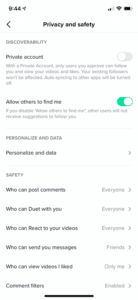
Many Tik Tok users love interacting with a large, global audience to spark creativity and enjoy fun feedback. As a clinical psychologist who sees how some of these collaborations with strangers can turn dangerous, I recommend a private account so you can approve or deny follower requests, and only users you’ve approved as followers can see your content. Of course, we encourage parents to discuss the pros and cons of use with their kids to reach a cooperative agreement.
To do this,
Click on the Settings button at the top right corner on your profile page.
Click on Privacy and Safety.
The first option is “Private Account” or “Allow others to find me.”
If you change an already-existing account to private, current followers will not be affected.
You can also remove or block followers at any time. Removing them disables their ability to direct message your teen. Blocking them stops them from interacting with or viewing your teen’s content at all.
Opting for Restricted Mode limits content that may be considered inappropriate. Users can also restrict comments to friends only or block them altogether. The can also disable messaging and disable duets.
Tik Tok offers a Screen Time Management mode with a passcode as one of their Digital Well Being offerings.
If you see inappropriate content while browsing the app, you have the option of reporting it within the app. We noticed that the report button is somewhat difficult to find in that it is hidden among other buttons.
As with most social media apps, the company collects information, including your name, email address, and phone number. They may also collect any messages you send through the app to friends. This is part of their privacy policy.
Tik Tok is rated a 12+ app store rating. This means you can block underage kids from onboarding the app with Gooogle and Apple parental controls. Tik Tok resources for parents include a Top Ten Tips for Parents primer, “You’re in Control,” safety educational videos, a Safety Center, and an ongoing blog series with helpful tips. The videos can be accessed directly in-app @TikTokTips.
What are the risks for use?
Constant Access
When kids are little, parents decide when playdates happen. Once Tik Tok is on board, keep in mind that your kids will have access to their friends whenever they have their device, and other Tik Tok users will have access to your kids. For many, that means 24/7 access. If you’re not OK with that, you’ll have to dock screens consistently or limit their access.
Inappropriate Content
Although the rules state that users younger than age thirteen shouldn’t be on Tik Tok without parental guidance, anyone can simply lie and accept the terms of conditions without informing their parents. Sometimes the content may not be filtered, and any kind of inappropriate content may pop up. Of particular concern is dangerous stunts, hate speech, and sexualized dancing to explicit music lyrics. Imagine watching your 12-year-old dancing sexy to lyrics that include the n-word, the f-word, p&^sy, and worse.
Cyberbullying
A fun video posted today can feel humiliating when viewed tomorrow. Since moderators can’t oversee all comments on the app, there is cyberbullying. Since being creative requires risk, public ridicule now or later is a real concern. Often the ridicule happens when the Tik Tok video is shared on other social media platforms, like Instagram or Twitter. The best way to prevent this would be to keep the account on private and add only people whom you know or are friends with. However, keep in mind that cyberbullies can always screenshot from a private account and share publicly. Users can turn off comments to prevent or stop cyberbullying on their content. Exclusion from posts about friend groups can also be hurtful. Imagine if your child is the one who was left out.
Trends & Attention-Seeking
Users can produce or view inappropriate Tik Tok’s and often try to attract large numbers of followers with poor posting or comment choices. For example, the trend for “Chop Chop Slide” involves kids filming their parents’ reactions to an unexpected string of very explicit lyrics. Many of these videos of their parents are likely shared without permission. To feed the need for likes, affiliative apps offer the purchase of likes for your posts and to buy more followers.
Stunts & Challenges
Most Tik Tok Challenges are incredibly skillful dance moves. You’ll also see kids singing along with their tongues out and clever facial expressions to vulgar lyrics alone and in groups. Like with the other social media platforms, you’ll also see some winners come up with something like the outlet challenge which involves shoving a penny in a charging cube for sparks. To see what I’m talking about, search YouTube for Best Tik Tok Compilations and prepare to be mesmerized for awhile. The talent Tik Tok inspires is amazing.
Online Predators
If your child’s profile is set to public, anybody signed into the app can view your child’s videos, comment, and message your child. The tech website, Motherboard, reported a large community of adults soliciting young Tik Tok users for nude photos and videos and even sent videos to the children. Lewd and hateful comments have been found on children’s videos. News reports say that, while Tik Tok has attempted to remove those comments after being reported, several inappropriate comments were left on videos. The owners of the accounts that left those comments were not suspended from Tik Tok and were allowed to continue commenting.
It’s Addictive!
Once you test the app, you’ll see how fun it is! It’s hard for users to resist the endless on-demand video content on the Discover page (indexed with hashtags) that is interactive, shocking, funny, creative, musical, and titillating. Be aware that popular Tik Tok influencers produce highly sexualized content and the “For You” autofeed offers up content that is similar to what has been viewed before. Kids spend hours scrolling endless content.
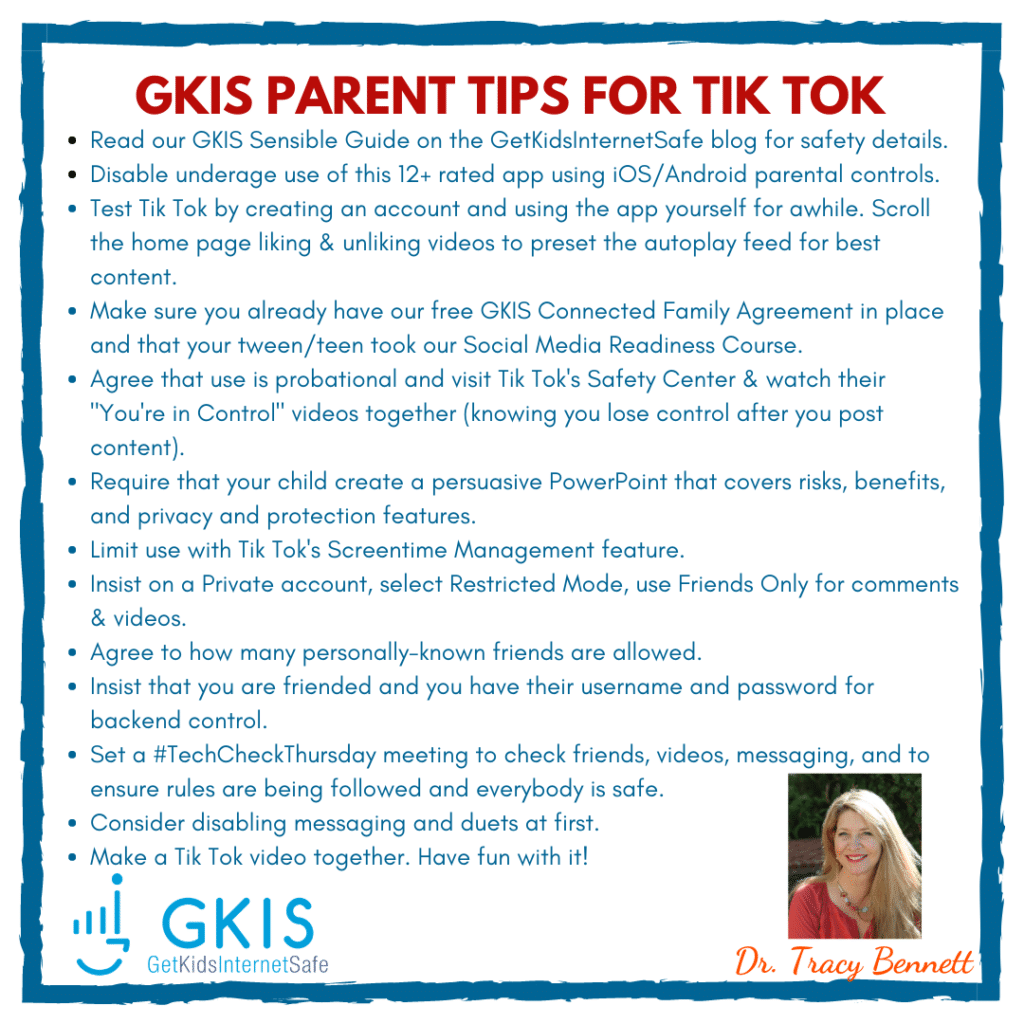
GKIS Parent Checklist for Tik Tok Use:
Disable underage use of this 12+ rated app using IOS & Android parental controls.
Test Tik Tok by creating an account and using the app yourself for awhile. It’s mind-blowing how creative users can be. It’s also helpful to search YouTube for Tik Tok compilations (e.g., “Tik Tok procreate compilations”).
Preset your chid’s account for best content by scrolling the home page liking appropriate videos & selecting “not interested” for inappropriate videos. Although it won’t keep them safe from viewing inappropriate content, it does preset the autoplay to a more positive autoplay pattern.
It’s also helpful to block influencers who commonly produce inappropriate content, while also “hearting” topics and influencers that match your child’s interests (e.g., singing, dancing, drawing, procreate, etc.).
Make sure you already have a digital contract in place (like our free GKIS Connected Family Agreement). Add it to your agreement as an “OK” or a “not yet,” so parameters, rules and regs, and etiquette issues are understood. (If you haven’t downloaded it yet, enter your name and email on our GetKidsInternetSafe home page and it will be emailed immediately.)
Agree that use is probational and visit Tik Tok’s Safety Center and watch their “You’re in Control” videos together (recognizing that once the content is posted, you no longer are in control).
Require your child to create a persuasive PowerPointthat covers risks, benefits, and privacy and protection features so you both know the in’s and out’s of Tik Tok’s features before you agree to it. For more information about how to create and judge a persuasive PowerPoint about a social media app along with other useful screen safety strategies, check out our Connected Family Online Course. The course was created to optimize healthy screen use while protecting kids and teens from digital injury. The best part about the course is it brings parents and kids closer with more cooperative negotiation around family screen rules. Once you agree on a trial, create a digital poster with a bullet list of the rules you agreed upon and tape it up in your home’s homework or computer space.
Limit use with Tik Tok’s Screentime Management feature.
Insist on a PRIVATE account so strangers can’t view your child’s posted videos, Select RESTRICTED MODE. Use FRIENDS ONLY for comments and videos.
Consider DISABLING messaging and duets at first.
Agree to how many personally-known friends are allowed at first to limit exposure while your child is gaining expertise and judgment. Remember, they WILL post, view, and message inappropriately no matter how great you parent. If that’s unacceptable to you, DON’T ALLOW TIK TOK.
Insist that you are friended and you have their username and password for backend control.
Set a #TechCheckThursday meeting to check friends, videos, messaging, and to ensure rules are being followed and everybody is safe. This will also keep the cooperative dialogue going.
Make a Tik Tok video together. Have fun with it!
GetKidsInternetSafe rates Tik Tok as a red-light app due to the easy access to strangers, inappropriate content, bad judgment while posting or live streaming, and potentially harmful comments. Because the app has millions of users, it is difficult for Tik Tok moderators to weed out all of the unacceptable content. But there is also a legitimate argument for creative and fun sharing with a private profile. If you do opt to allow Tik Tok, be sure and get your child’s username and password and monitor posts. Share our GKIS Parent Tips on your social media for friends and family. HERE’S THE LINK TO THE IMAGE
Thank you to CSUCI intern Makenzie Stancliff for co-authoring this article. For more help with social media. judgment and overall psychological health, you won’t want to miss our GKIS Social Media Readiness Training Course for tweens and teens.
I’m the mom psychologist who will help you GetKidsInternetSafe.
Parents in my practice and GetKidsInternetSafe subscribers commonly ask me about the impact of pornography on kids. They comment on how different today’s world is from when we were young. Most people even assume that kids today are more promiscuous than we were. But here is what you may be surprised to learn: even though today’s teens demonstrate more acceptance of casual and what we used to consider deviant sexual practices (like oral sex, anal sex, same-gender sex, and polyamory), teens are more sexually responsible than previous generations. In fact, despite popular misconceptions that teens are hooking up casually, the truth is they are “talking” more than dating and having sex later and with fewer partners than previous generations. They are also more likely to use contraception, resulting in teen pregnancy rates being at an all-time low. That gives me hope that, because of American’s more casual attitude toward sex, we are doing a better job at sex education and supervision. To that end, I’ve included this section of my book, Screen Time in the Mean Time: A Parenting Guide to Get Kids and Teens Internet Safe, free for GKIS blog readers. Hang on to your hats parents, no matter how open-minded you are, you are likely to find some of this information concerning and IMPORTANT!
Online pornography is popular and easily available. We don’t know how popular it actually is though, because a large number of pornography websites are reticent to share traffic numbers. Best estimates are that 13% of web searches are for online pornography.[i] What we do know is that the number of viewers and time spent viewing is growing. A particularly popular single pornographic site, Pornhub’s 2018 Year in Review reported:
“Visits to Pornhub totaled 33.5 billion over the course of 2018, an increase of 5 billion visits over 2017. That equates to a daily average of 92 million visitors and at the time of this writing, Pornhub’s daily visits now exceed 100 million. To put that into perspective, that’s as if the combined populations of Canada, Poland and Australia all visited Pornhub every day! …When they’re not busy watching videos, Pornhub’s users enjoy socializing, with nearly 64 million private messages sent and 7.9 million video comments left. … More than 141 million people took the time to vote for their favorite videos, which incidentally is more people than voted in the last U.S. presidential election.… Once again, the United States continues to be the country with the highest daily traffic to Pornhub, followed by the United Kingdom, India, Japan, Canada, France, and Germany.”[ii]
Furthermore, today’s online pornography is nothing like the images from our fathers’ Playboy magazines. Most pornographic videos are scripted to display fantastical versions of the sexual desires and prowess of men.[iii] Most often, that means scenes with women as sexual objects who are seemingly delighted to be the willing and passive victim of demeaning verbal and physical aggression, often by one or more men at a time. Porn content is rich with violent and fetish acts that bear little resemblance to loving intimacy. As customers satiate to milder versions of pornographic activity, clever content developers produce increasingly risqué content to keep their customers browsing. The top seven Pornhub searches for 2018 were lesbian, hentai, milf, stepmom, Japanese, mom, and teen.
With popularity and ease of access through mobile screens and gaming consoles, many kids and teens intentionally seek and are being accidentally exposed to, inappropriate sexual images and videos. Based on a set of EU studies, Kierkegaard (2008) states that children have access to Internet pornography at the average age of eleven years old.[iv] Not only are kids and teens seeking sexual content for titillation, but many kids are also relying on online pornography as their primary source of sexual education.[v] Alarmingly, I am seeing more and more kids intentionally seeking pornographic content and creating and exchanging nude images and videos. How often are children viewing porn, and, when they do, what kinds of harm may result from that exposure?
Estimates from research studies vary widely, most suggesting that a minority of adolescents actually access online pornography.[vi] However, in one study conducted in 2008 with 562 undergraduates, 93% of boys and 62% of girls reported that they were exposed to pornography during adolescence.[vii] In my clinical experience, it is quite common due to unfiltered smartphone and tablet use among younger children. Studies show that kids tend to consider what they see online as attractive, normative, and risk-free and may go as far as emulating it.[viii][ix] The online worlds of MMORPGs increasingly feature virtual sexual assault and pornographic behaviors, and popular television series deliver increasingly violent content and explicit themes.
Who is most at risk for online pornography consumption?
The typical adolescent online pornography user is a boy who is more pubertally advanced, a sensation-seeker, and has weak or troubled family relations.[x] Boys are more likely to be exposed at an earlier age, to see more images, to see more extreme images (e.g., rape, child pornography), and to view pornography more often; while girls reported more involuntary exposure.[xi]Statistics demonstrate that female viewing is going up every year. Pornhub’s 2018 Year in Review report stated, “2018 saw the proportion of female visitors to Pornhub grow to 29%, an increase of 3 percentage points over 2017.”[xii] Depression and rule-breaking are also risk factors.[xiii][xiv]
What affects does viewing pornography have on kids?
Research demonstrates that pornography use among children, teens, or adults has been associated with:
Cynical attitudes about intimacy, fidelity, and love[xv]
Desensitization and habituation with explicit content, meaning the user’s appetite changes over time from less extreme to more extreme forms of pornography to get the same intensity of enjoyment. This also validates deviant sex practices and potentially lowers inhibitions to engage in inappropriate sexual interactions online and offline[xvii]
Attitudes supporting violence against women[xviii]
More permissive sexual attitudes, especially in regard to the place of sex in relationships[xix][xx][xxi]
Greater experience with casual sexual behavior[xxii][xxiii]
More sexual aggression, both in terms of perpetration and victimization[xxv]
Three times more sexually aggressive behavior when exposed to nonviolent porn[xxvi]
Twenty-four times more sexually aggressive behavior when exposed to violent porn[xxvii]
A clinically impairing addiction, called Hypersexual Disorder.
Causal research would require purposely exposing children to pornographic content. Because that is not safe or ethical, all research studies about child exposure to online pornography are correlational. We cannot conclusively say whether online pornography causes certain attitudes or behaviors. Obviously, the correlation findings quoted above are concerning. Blocking kids from online pornography is common sense. Not only is viewing pornography an issue, but more active sexual role playing online also makes kids vulnerable to sexual predators. These attitudes and behaviors are impactful in the short term and may also lead to problematic life-long trauma and intimacy issues.[xxviii]
If this information is useful to you, please share it with friends and family. Too many of us bury our heads to the reality of online pornography and child access. There’s so much to know! If you are looking for a one-source guide to screen risk, benefit, and the parenting strategies that can strengthen your parent-child relationship while keeping them safer, pick up a copy of Screen Time in the Mean Time on Amazon. And for a step-by-step guide to setting up your home for enrichment and screen safety, you won’t want to miss my Connected Family Course. Parents tell me all the time how much they’ve appreciated having the information for prevention rather than hearing it AFTER they end up in my psychology office. Education matters!
I’m the mom psychologist who helps you GetKidsInternetSafe.
[iii]Brown, J., & L’Engle, K. (2009). “X-Rated: Sexual Attitudes & Behaviors Associated with U.S. Early Adolescents’ Exposure to Sexually Explicit Media.” Communication Research36, 129, 133.
[iv]Kierkegaard, S. (2008). Cybering, online grooming & age-play. Computer Law & Security Report, 24(1), 41–55.
[v]Kanuga, M. & Rosenfeld, W. (2004). “Adolescent Sexuality & the Internet: The Good, the Bad, & the URL.” Journal of Pediatrics & Adolescent Gynecology17, 117, 120
[vi]Peter, J., & Valkenburg, P. (2016): Adolescents & Pornography: A Review of 20 Years of Research, The Journal of Sex Research, DOI: 10.1080/00224499.2016.1143441
[vii]Sabina, Chiara, et al. “The Nature and Dynamics of Internet Pornography Exposure for Youth.” CyberPsychology & Behavior, vol. 11, no. 6, 2008, pp. 691–693., doi:10.1089/cpb.2007.0179.
[viii]Rich, M. (2005). “Sex Screen: The Dilemma of Media Exposure & Sexual Behavior.” Pediatrics116, 329, 330.
[ix]Zillmann, D. (2000). “Influence of Unrestrained Access to Erotica on Adolescents’ & Young Adults’ Dispositions Towards Sexuality.”Journal of Adolescent Health27, 41, 42.
[x]Peter, J. & Valkenburg, P. (2016): Adolescents & Pornography: A Review of 20 Years of Research, The Journal of Sex Research,DOI: 10.1080/00224499.2016.1143441
[xi]Sabina, Chiara, et al. “The Nature and Dynamics of Internet Pornography Exposure for Youth.” CyberPsychology & Behavior, vol. 11, no. 6, 2008, pp. 691–693., doi:10.1089/cpb.2007.0179.
[xiii]Wolak, J., Mitchell, K., & Finkelhor. D. (2007). “Unwanted & Wanted Exposure to Online Pornography in a National Sample of Youth Internet Users.” Pediatrics119.2: 247-57. Web.
[xiv]Ybarra, M., et al. (2011). “X-Rated Material & Perpetration of Sexually Aggressive Behavior Among Children & Adolescents: Is There a Link?” Aggressive Behavior37, 1, 3, 7.
[xv]Zillmann, D. (2000). “Influence of Unrestrained Access to Erotica on Adolescents’ & Young Adults’ Dispositions Towards Sexuality.”Journal of Adolescent Health27, 41, 42.
[xvi]Peter, J. & Valkenburg, P. (2016): Adolescents & Pornography: A Review of 20 Years of Research, The Journal of Sex Research, DOI: 10.1080/00224499.2016.1143441
[xvii]Zillmann, D. (2000). “Influence of Unrestrained Access to Erotica on Adolescents’ & Young Adults’ Dispositions Towards Sexuality.”Journal of Adolescent Health27, 41, 42.
[xviii]Hald, Gert, Martin, et al. (2009). “Pornography & Attitudes Supporting Violence Against Women: Revisiting the Relationship in Nonexperimental Studies.” Aggressive Behavior35, 1, 3, 5.
[xix]Peter, J., Valkenburg, P., & Schouten, A. (2006). Characteristics & motives of adolescents talking with strangers on the Internet. Cyberpsychology & Behavior, 9, 526–530.
[xx]Peter, J. & Valkenburg, P. (2016): Adolescents & Pornography: A Review of 20 Years of Research, The Journal of Sex Research, DOI: 10.1080/00224499.2016.1143441
[xxi]Zillmann, D. (2000). “Influence of Unrestrained Access to Erotica on Adolescents’ & Young Adults’ Dispositions Towards Sexuality.”Journal of Adolescent Health27, 41, 42.
[xxii]Peter, J. & Valkenburg, P. (2016): Adolescents & Pornography: A Review of 20 Years of Research, The Journal of Sex Research, DOI: 10.1080/00224499.2016.1143441
[xxiii]Zillmann, D. (2000). “Influence of Unrestrained Access to Erotica on Adolescents’ & Young Adults’ Dispositions Towards Sexuality.”Journal of Adolescent Health27, 41, 42.
[xxiv]Peter, J. & Valkenburg, P. (2016): Adolescents & Pornography: A Review of 20 Years of Research, The Journal of Sex Research, DOI: 10.1080/00224499.2016.1143441
[xxv]Peter, J. & Valkenburg, P. (2016): Adolescents & Pornography: A Review of 20 Years of Research, The Journal of Sex Research, DOI: 10.1080/00224499.2016.1143441
[xxvi]Ybarra, M., et al. (2011). “X-Rated Material & Perpetration of Sexually Aggressive Behavior Among Children & Adolescents: Is There a Link?” Aggressive Behavior37, 1, 3, 7.
[xxvii]Ybarra, M., et al. (2011). “X-Rated Material & Perpetration of Sexually Aggressive Behavior Among Children & Adolescents: Is There a Link?” Aggressive Behavior37, 1, 3, 7.
[xxviii]Villani, S. (2001). “Impact of Media on Children & Adolescents: A 10-Year Review of the Research.”Journal of the American Academy of Child & Adolescent Psychiatry40, 392, 399.
Instagram reports 1 billion monthly active users and more than 500 million daily users.[1] Most teens use social media for more than 6 hours per day.[2] Many social media users have shifted in intention, placing the highest importance on becoming insta-famous rather than sharing information with close friends. Insta-famousrefers to a person who is well-known on Instagram, reflected by thousands of followers and likes. Teens can become consumed in this virtual competition for internet popularity, sometimes leading to a destructive pattern described in my book, Screen Time in the Mean Time: A Parenting Guide to Get Kids and Teens Internet Safe, as compare and despair.
Insta-worthy? Self-Presentation Theory and Impression Management
Many Instagram users lurk profiles, consumed by other people’s lives and perfecting their virtual selves. According toself-presentation theory, people are motivated to present themselves to show off an ideal self and please their audience.[3]
Our frontis our best-stylized image. Our backstage is our true selves. Maintaining too many fronts can be overwhelming. Being great at impression management can be the difference between social media success or failure.
Shout Out for Shout Out
A SFS (Shout out For Shout out) is a branding strategy for optimal self-presentation on Instagram. It refers to teens posting someone else’s account to theirs and vice versa. The goal is to cooperatively promote their pages so both people gain more followers.
As self-presentation trends change in pop culture, so do trends online. In 2008, graphic t-shirts were the cool thing to wear to school. In 2015, hipsters ruled the school. And in 2019, the VSCO look was in. VSCOis the name of the popular app used to create fun colorful edits.
A “VSCO girl” has beach-wavy hair, carries around a hydro flask, has a scrunchie around their wrist, and shops at thrift stores and Urban Outfitters. My 13-year-old cousin shares, “Everyone wears skirts, Doc Martens, and scrunchies now. It’s so VSCO.”
Evolution and Optimal Distinctiveness
With popular editing apps such as VSCO or FaceTune, many social media users have unrealistic expectations for how attractive they should look in posts. Humans are social beings. We work best collaboratively. Social rewards like compliments, words of appreciation, affection, or being with a friend, are major behavioral motivators for young people.[3]
Seeking social reward and trying to achieve optimal distinctiveness (being unique but still super stylish) can be traced back to our ancestors. Belonging to a community meant being socially accepted and supported by a group of others. Many times, this meant life or death.
For teens today, that means walking a razor’s edge trying to look unique while still fitting in with peers. In this impossible quest, teens may be juggling several virtual and nonvirtual selves. Being too unique or too the same invites criticism and cyberbullying.
Getting social media likes rewards the brain with dopamine, the neurotransmitter released in the pleasure center.[2] Instagram programmers know it and bake it in so they can make more money.
Social media influencers are experts at achieving optimal distinctiveness. Viewers spend a lot of time and money trying to do the same. Views and likes result in millions of dollars in profit. This biological hack of social acceptance and connection makes the brand more profitable.
Risks of Social Media
Insta-Anxiety
The constant pressure to stay up to date with trends can cause compulsive online browsing and anxiety. Most teenagers do not have jobs to maintain the lifestyle that many YouTubers do. Social anxiety and the fear of being judged by peers can be overwhelming alongside daily social obstacles that teens face like bullying, hormonal changes, and self-judgment. Instead of fun, spontaneous sharing, teens can get caught up in compulsively second-guessing their posts or avoid sharing altogether.
According to recent studies, social media use has contributed to an increasing number of cases of social anxiety disorders in adolescents.[2] Untreated, anxiety can contribute to other mental health issues including depression, eating disorders, substance abuse, and even thoughts of suicide.
Social Anxiety Disorder Symptoms include:
Lack of desire to socialize
Being withdrawn
Feeling embarrassed or a deep fear of being judged by others
Low Self-Esteem
Forty-six percent of teen girls admit that social media makes them feel bad about themselves due to unrealistic standards.[2] Self-esteem is elevated when individuals are deemed popular by others. For example, having Facebook friends who are more responsive can satisfy psychological needs above and beyond the number of Facebook friends one has.[4]
Seeking Positive Feedback
We all like to know that people find us attractive. Social media, however, can impact us in ways we aren’t even aware of. For example, a 2018 study found that when young women received likes for sexy selfies, they were more likely to post similar photos again.[3]
Lack of Privacy
Teens don’t have the prefrontal brain development to anticipate consequences and engage in high order thinking. Subsequently, teens may not think ahead, instead focusing on the instant gratification of someone liking or commenting on their post. This can cause a habit of oversharing online. Eighty percent of people who commit crimes have taken information from social media sites.[5]
Ways to Improve Your Teen’s Emotional Reliance & Achieve Better Online Safety
To avoid triggering insta-anxiety, make sure your kids are neurologically, socially, and emotionally mature enough to manage risk. Although she says it depends on the child, Dr. Bennett recommends avoiding social media until the second semester of middle school.
Experts agree that Social Media Readiness Training is critical to help kids recognize risk, know how to ask for help, and self-manage use.
Use our free Connected Family Screen Agreement to set parameters and create a screen-friendly, cooperative dialogue. Just enter your email and name on our website, and it will be delivered directly to your email.
Create a customized filtering, tracking, and monitoring toolkit with the GKIS Screen Safety Toolkit. This course also offers smart parenting strategies, like making sure you have social media login information for back-end access.
Thank you to GKIS intern, Isabel Campos for alerting us about the risks of insta-anxiety. If you learned something, please share GKIS articles and tools with friends and family!
I’m the mom psychologist who will help you GetKidsInternetSafe.
[1] “Our Story.” Instagram, 26 Mar. 2019, instagram-press.com/our-story/.
[2] Granet, R. (2016, September 19). Living In Live Time: Social Media’s Impact On Girls. Retrieved from https://newyork.cbslocal.com/2016/09/19/social-media-use-teens/
[3] Bell, Beth T., Cassarly, Jennifer A., & Dunbar, Lucy. “Selfie-objectification: Self objectification and positive feedback (‘likes’) are associated with frequency of posting sexually objectifying self-images on social media.” Body Image, 26, 83–89. September 2018. https://doiorg.summit.csuci.edu/10.1016/j.bodyim.2018.06.005
[4] Burrow, A. L., & Rainone, N. (2016). How many likes did I get?: Purpose moderates links between positive social media feedback and self-esteem Journal of Experimental Social Psychology, 69, 232-236 https://doi.org/10.1016/j.jesp.2016.09.005
[5] Law Enforcement, Social Media and Your Privacy: How Your Data is Used to Solve Crimes. (2018, May 16). Retrieved from https://www.nextadvisor.com/law-enforcement-social-media-and-your- privacy-how-your-data-is-used-to-solve-crimes/
Now that I’m an “older” working mom, I love to share offline and online organization hacks and efficiency grabs that have saved me through the years. These organizational techniques were the difference between frazzled and peaceful at our house. With the overtasked lives we lead, most of us are guilty of brain fades and frantic searches while yelling and scolding overwhelmed kids. Even if you set up only one or two of these ideas, it may be the difference between fun family mornings versus a school day launched with tears and resentment.
Unclutter study spaces by setting up customized, distraction-free workspaces in niches and corners for each kid.
Kids in my practice often complain that the kitchen table is too distracting to get homework done quickly and neatly. The psychological research agrees. Studies reveal that fractured attention leads to irritability, wasted time, and poor grades. To optimize learning, set up a quiet corner office for each child. All it takes is a willingness and clever organization ideas and fresh accessories. Check out my GKIS Connected Family Online Course for a detailed blueprint for creating award-winning maker spaces with awesome Pinterest DIY ideas. A customized works station is a compelling magnet to get your kids creating in 3-dimensional space as a complement to screen learning. Ergonomic, body-healthy setups in the place of slouching on beds and couches avoid repetitive stress injuries to the neck, back, wrists, and hands.
Avoid missed soccer practices and study deadlines by setting up a digital family calendar.
Family schedules are chaos! Streamline communication and scheduling by color-coding child activities and setting up Family Share on Apple’s Family Calendar, Google’s Calendar, or Microsoft’s Outlook. Each member can share calendared activities and set up automatic reminders. Shared organization at a glance!
Just as you throw out old clothes your kids have grown out of, it’s also important to declutter digital spaces.
Schedule a fresh-start fall family meeting where everybody gathers with their mobile screen devices to trash apps and games they have grown out of.
Revisit (or grab) your free GKIS Connected Family Screen Agreement at GetKidsInternetSafe.com. This will help you set sensible rules like a digital curfew and create screen-free zones – including bedrooms and bathrooms.
Finally, teach cybersecurity measures from my Cybersecurity Red Flags Supplement. New this fall, you and your family members can tweak bad habits so don’t fall victim to bad actors online.
Cleanse social media profiles with an eye toward future reputation.
If your tween or teen is on social media already, you know the time-suck risks during school time. Help them sort out the necessary from the unnecessary by helping them avoid the bio-hack elements designed to capture their attention.
Consider limiting teens to only one or two social media apps to decrease wasted time due to mindless browsing and compulsive checking.
Insist that apps with visual notifications be on the second swipe screen on smartphones. That way they won’t get distracted by little red notifications and, instead, can batch their check-in times as research suggests is best.
And finally, delete old posted photos and unnecessary personal information from social media history. Sharing real-time with friends on a private profile is fun, but do you really want somebody lurking through your past photo-by-photo? Point out that other parents, relatives, teachers, coaches, future employers, and even college app administrators may be forming impressions based on your digital footprint. So instead of having an online resume populated by off-color jokes and sexualized photos, create a flattering stream of artistic works, philanthropic activities, sports activities, and fun friend and family time. A progressive, balanced, healthy life looks beautiful online – and may help you get a college placement or dream job instead of hinder it!
Reboot your Screen Safety Toolkit.
Each developmental stage offers unique online safety challenges. For example, little kids are best accommodated in a walled digital garden like YouTube Kids, and older kids need a little more digital space to explore and create. To parent well in the digital age, you need specially-selected free and third-party software tools to help you filter and block inappropriate content, set time-limits, monitor online activity use, remotely pause or offer rewards, and even locate and track the driving activities of your teen. If you get overwhelmed or need help figuring it all out, check out my GKIS Screen Safety Toolkit for tips, product recommendations, links to ISP and social media app safety guides, and free digital learning tools for best academic performance.
There you have it! Five quick and easy parenting hacks that will launch the school year with fun and success. Just as I recommend shoes live by the front door so you are not always searching, digital folders and organization tools will keep you dialed-in in your virtual life. Most importantly, set a peaceful intention with a six-second exhale for positivity and fun each morning before you enter the family’s living space. Parents must actively define the heart of the home. If we start the morning with a smile and warmth, our kids emotionally synch and return the joy. Soak in every chaotic and blissful moment!
I’m the mom psychologist who will help you GetKidsInternetSafe.
Also, if you are a local Southern Californian and need a little TLC to get started on your screen safety/fun parenting plan, join me for a morning of pampering and friendship.
Yesterday in response to the El Paso and Dayton mass shootings, President Trump stated, “We must stop the glorification of violence in our society. This includes the gruesome and grisly video games that are now commonplace. It is too easy today for troubled youth to surround themselves with a culture that celebrates violence. We must stop or substantially reduce this and it has to begin immediately.” In response, #videogamesarenottoblame started trending on social media. Talk show hosts came out in force stating that there are no research studies linking video games to mass shootings and youth in other countries play video games, yet they do not have mass shootings like America. Consistent with their argument, as video game playing has gone up, juvenile delinquency has gone down. Even Trump’s own 2018 school safety commission produced recommendations that do not support yesterday’s statement. But as founder of GetKidsInternetSafe, I’m behind the President on this one that the on-demand violent entertainment that proliferates American culture deserves serious discussion. Of course, video games are not the sole cause of hate crimes, nor is the research clean about video games causing violence. But that doesn’t mean it isn’t a contributing factor (among many) to making troubled people vulnerable to radicalization online.
In the wake of 31 additional innocent lives lost to senseless gun violence at the hands of extremists, we can all agree that we have reached a crisis point in the United States. The horrific violence of recent hate crimes demand that our leaders act with moral clarity and urgency of action. But they need our support to get this done. They cannot act decisively if everybody gets hysterical and arm-chair quarterbacks every statement of action. Instead of emotional one-sided arguments, let’s think through some of his points about violent entertainment and video games. After all, our kids are at virtual war several hours a day. It is common sense to consider that this may have negative impact on some of them…especially the psychologically vulnerable.
Violence for Profit: Passive Viewing of Television and Video
The United States has long been criticized as the dominant creator and celebrator of violent entertainment. Chalk it up to our fierce protection of the right to bear arms or our thirst for thrilling content, more and more Americans are fans of violent sports, television, movies, and video games. As adults gobble up violent content for entertainment, our children are too often exposed to violence early and often with little regard to the damage it may cause. Everybody is doing it. Right? Right. Yet it has been widely demonstrated that viewing screen violence, passively and interactively, causes aggressive and hostile behavior in children and adults. However, not everybody who watches violent TV or plays violent video games acts aggressively. How much is too much for children who are vulnerable due to immature brains?
First, we must accept that not all screen time is equal. Screen viewing can be passive (watching television and videos) or interactive (screen touch and video games). In regard to passive viewing of violent screen content, the American Psychological Association Council Policy Manual on Violence in Mass Media (1994) concludes from decades of research that there is correlative and causal risk. It specifically states:
On the basis of over 30 years of research and a sizeable number of experimental and field investigations, viewing mass media violence leads to increases in aggressive attitudes, values, and behavior, particularly in children, and has a long-lasting effect on behavior and personality, including criminal behavior;[i],[ii],[iii]
Viewing violence desensitizes the viewer to violence, resulting in calloused attitudes regarding violence toward others and a decreased likelihood to take action on behalf of a victim when violence occurs;[iv]
Viewing violence increases viewers’ tendencies for becoming involved with, or exposing themselves to, violence;
Viewing violence increases fear of becoming a victim of violence, with a resultant increase in self-protective behaviors and mistrust of others; and
Many children’s television programs and films contain some form of violence, and children’s access to adult-oriented media violence is increasing as a result of new technological advances.
These conclusions are particularly troubling when one considers that, despite these findings existing for decades, the Internet and screen technology has exploded access to on demand violent content for all ages. The younger the child, the more time viewed, and the intensity and applicability of the content, the more potential developmental impact. Research demonstrates that children who have not yet started talking are affected by screen viewing in ways parents cannot recognize and that impact changes month-to-month, year-to-year. Furthermore, even kids as young as infants who view alongside an older sibling or a parent may still be negatively affected by inappropriate content.
Violence for Profit: Gaming and Interactive Screen Use
All parents want their children to succeed and live happy lives. We’ve generally accepted that screens are part of it. But parents often wonder, how much impact does violent gaming content have on psychological process? Too often we are seeing school shooters reference violent video games in their pre-attack manifestos. Do we have anything to worry about?
The five main video game play genres include action, role-playing, simulation, strategy, and sports. Gaming ranges in content and interactivity from simple puzzle games to complex massive multiplayer online role-playing games (MMORPGs). In MMORPGs, a large number of people play online together as developed characters in complex, online lands with shared goals in real time. Platforms for gaming include smartphones, tablets, handheld gaming devices, computers, gaming consoles, and the developing market of virtual reality (wearable devices with sensors like a helmet, goggles, and gloves where users can “interact” with a three-dimensional environment) and augmented reality (computer-generated images superimposed on the player’s view of the real world, resulting in a realistic composite of real and virtual life).
Other new, immersive auditory and visual adjunct technologies include transmedia storytelling (story content presented across multiple platforms and formats using digital technology), mini-games (video games contained within video games), chrono- and geolocation (identifying the time and location of players), and object linking (embedded links that lead the player to sequential digital locations). With multibillions of dollars earned each year from the gaming market, gamevertising has also become increasingly prevalent. This means that games are being expertly designed for product placement and with manipulative neuropsychological principals built in to ensure that gamers stay online and spend more money.
Beyond education and entertainment, benefits that can be gained from playing video games include improvements in visual-spatial capabilities, reaction times, attention span, ability to process multiple target objects, and detail orientation,[v] as well as improved visual short-term memory, mental rotation, tracking, and toggling between tasks.[vi] Video games can also help with anxiety and mood and improve relaxation and improve problem solving, strategy building, goal setting, and cooperation with others.
Video games also have vocational applicability and can be customized for specific tasks, such as orienting and motivating employees, providing health care benefits like exercise or illness care, or teaching specialized skills like performing surgery or sporting ability.[vii] Some gamers compete in profitable e-sport tournaments in person and online, while others learn computer programming skills that can be marketable as a career specialty. Mastery of video games provides opportunity for increased confidence, social connection and networking, and self-esteem. Social benefits are particularly valuable for players who may be isolated by geographic remoteness or physical or mental disability.
Along with benefits come risks. Ninety-seven percent of teens play video games, and more than 85% of video games have violent content.[viii] As with all complex psychological phenomena, different effects happen in different situations with different people. Thus, issues like content, time spent playing, and player vulnerabilities due to family life or mental health must be taken into account when considering effect.[ix]This makes for messy factors to control for quality research and controversial opinions about the risks of violent video games.
Meta-analytic reviews of research have found that violent video games can cause aggressive behavior, aggressive thinking styles, and aggressive mood, as well as decreased empathy and prosocial behavior. In regard to the effect of violent video games on children, teens, and adults, the American Psychological Association Council Policy Manual Resolution on Violent Video Games (2015) concludes:
A convergence of research findings across multiple methods and multiple samples with multiple types of measurements demonstrates the association between violent video game use and both increases in aggressive behavior, aggressive affect, aggressive cognitions and decreases in prosocial behavior, empathy, and moral engagement;
All existing quantitative reviews of the violent video game literature have found a direct association between violent video game use and aggressive outcomes;
This body of research, including laboratory experiments that examine effects over short time spans following experimental manipulations and observational longitudinal studies lasting more than two years, demonstrates that these effects persist over at least some time spans;
Research suggests that the relation between violent video game use and increased aggressive outcomes remains after considering other known risk factors associated with aggressive outcomes;
Although the number of studies directly examining the association between the amount of violent video game use and amount of change in adverse outcomes is still limited, existing research suggests that higher amounts of exposure are associated with higher levels of aggression and other adverse outcomes;
Research demonstrates these effects are for children older than 10 years, adolescents, and young adults, but very little research has included children younger than 10 years;
Research has not adequately examined whether the association between violent video game use and aggressive outcomes differs for males and females;
Research has not adequately included samples representative of the current population demographics;
Research has not sufficiently examined the potential moderator effects of ethnicity, socioeconomic status, or culture; and
Many factors are known to be risk factors for increased aggressive behavior, aggressive cognition and aggressive affect, and reduced prosocial behavior, empathy and moral engagement, and violent video game use is one such risk factor.[x}
Not only do video games affect gamers in the immediate, but they can also lead to increased aggressive behavior later in life.[xi] Furthermore, some players become desensitized to their environment,[xii] increasingly spend more time gaming, and ultimately feel more connected to their virtual world than the real world around them. With new immersive technologies being introduced to younger and younger children every day, one can’t even imagine true cognitive and psychological impact over time.
Thus far, attempts to regulate and block violent video game content from minors have largely been unsuccessful. Since the 1972 release of the first popular video arcade game, Pong, parents have worried about the impact of video gaming on their children. Just like our kids, we have largely become desensitized to its impact. From 1976, when parents succeeded in getting the video game Death Race pulled from the shelf due to the little gravestone that appeared when a character was killed, to now, we’ve come a long way baby. Or have we?
In response to video game players committing violence, several lawsuits have been filed by private citizens and class actions claiming that video game manufacturers were negligent by selling violent content that is harmful to children. However, few have succeeded due to first amendment rights claims and insufficient evidence related to flawed research methodology or correlational rather than causal research. City ordinances attempting to limit violent gameplay by unaccompanied minors in public places have also largely failed. Law professors and psychologists continue to argue that the evidence is too flimsy to make solid claims that video games cause violence, particularly considering the fact that despite widespread gameplay, the rate of juvenile violent crime is at a thirty-year low.
A particularly impactful blow against state regulation was the United States Supreme Court ruling in Brown v. Entertainment Merchants Association (2011), which concluded by a seven to two opinion that the California law restricting the sale and distribution of violent video games to minors was unconstitutional. The ruling was based on first amendment rights, stating that “speech about violence is not obscene” and is “as much entitled to the protection of free speech as the best in literature.”
***
So, there you have it. Violent video games and entertainment are not turning us into gun-hungry zombies. Our avid gamers have friends, go to school, and love their families. We are not being infected en masse through our video consoles. But that doesn’t mean hours of violent play isn’t impacting us negatively, especially those vulnerable with growing brains or childhood trauma. Rather than arguing extreme positions and attacking issues of concern, let’s consider the idea that we can all do better. Four commonalities have been found among shooters; a history of childhood trauma, a situational crisis point, the study of previous shooters and searching for validation for their motives, and the means to carry out the hate crime.[xii] That leaves us with many potential entry points for intervention. Our first step is calm, generous, and intelligent dialogue. Let’s start acting like a community and make positive change. The finger-pointing is only a distraction.
I’m the mom psychologist who will help you GetKidsInternetSafe.
[i]Huston, A., Donnerstein, E., Fairchild, H., Feshbach, N., Katz, P., Murray, J., Rubinstein, E., Wilcox, B. & Zuckerman, D. (1992). Big World, Small Screen: The Role of Television in American Society. Lincoln, NE: University of Nebraska Press.
[ii]National Institute of Mental Health – NIMH (1982). Television & Behavior: Ten Years of Scientific Progress & Implications for the Eighties, Vol. 1. Rockville, MD: U.S. Department of Health & Human Services.
[iii]Murray, J. P. (1973). Television & violence: Implications of the Surgeon General’s research program. American Psychologist, Vol. 28, pp. 472-478.
[iv]Krahe, B., Moller, I., Kirwil, L., Huesmann, L., Felber, J., & Berger, A. (2011). Desensitization to Media Violence: Links with Habitual Media Violence Exposure, Aggressive Cognitions, & Aggressive Behavior. Journal of Personality & Social Psychology, Vol. 100, No. 4.
[v]Taylor, J. (2012, December 4). How Technology is Changing the Way Children Think & Focus. Retrieved October 18, 2012, from http://wwpsychologytoday.com/glog/the-power-prime/201212/how-technology-is-changing-the-say-children-think-and-focus
[vi]Holfeld, B., Cicha, J. & Ferraro, F. (2014). “Executive Function & Action Gaming among College Students.” Current Psychology Curr Psychol34.2: 376-88. Web.
[vii]Brown, S., Liebermann, D., Gemeny, B., Fan, Y., Wilson, D., & Pasta, D. (2009). Educational video game for juvenile diabetes: Results of a controlled trial. Vol. 22 (Issue 1), p. 77-89. Doi:10.3109/14639239709089835
[viii]NPD Group (2011). Kids & gaming, 2011. Port Washington, NY: The NPD Group, Inc.
[ix]Ferguson, C. (2011). Video Games & Youth Violence: A Prospective Analysis in Adolescents. Journal of Youth & Adolescence, Vol. 40, No. 4.
[x]Anderson, C., Ihori, Nobuko, Bushman, B., Rothstein, H., Shibuya, A., Swing, E., Sakamoto, A., & Saleem, M. (2010). Violent Video Game Effects on Aggression, Empathy, & Prosocial Behavior in Eastern & Western Countries: A Meta-Analytic Review. Psychological Bulletin, Vo. 126, No. 2.
[xi]Norcia, M. (2014, June 1). The Impact of Video Games. Retrieved October 26, 2014, from http://www.pamf.org/parenting-teens/general/media-web/videogames.html
Do you worry that you allow too much, or too little, screen time for your kids?
Have you read about digital injuries, like interaction with Internet predators, screen addiction, and neck and spine deformities, and worry you don’t know enough to spot risk in time to intervene?
Do you yell, punish, and lecture too often trying to keep them from doing what they beg to do online?
I did too! That’s why I started GetKidsInternetSafe 7 years ago. Yes, even psychologists find parenting challenging – especially nowadays with teens. When I started this legacy project, I was heartbroken and overwhelmed when my dad died and my mom succumbed to dementia. To get everything done and keep my kids happy, I was relying too much on Minecraft. The parents in my practice were doing the same…at the expense of the kids. I started to get freaked out.
But when I looked for digital safety tools and parenting strategies online for support, the best I could find was Dr. Phil saying to supervise all child screen use – as in, sit with them every time they were on screen. Because we all know that can’t happen, I did a deep-dive in the research, created my own screen safety parenting programs based on my 25+ years of momming and working with families, pooled resources of friends and colleagues, and founded GetKidsInternetSafe. Every day, I hear from families just like ours telling me how much they needed it and how much they appreciate it! A feel-good project, indeed.
If you who have been with me from the beginning, THANK YOU! I’ve appreciated your support more than you know. And for those who are new to GKIS or considering subscribing, you’ll want to know what’s happening with GKIS these days!
As a subscriber,
1. You receive your free Connected Family Screen Agreement, designed to inform and inspire you to cooperatively connect as a family and set reasonable and sensible online safety guidelines for kids and teens. It’s delivered in 4 weekly chunks so you don’t get overloaded. Slow, steady, and fun is the goal.
And of course, I never share your information with anyone. Please let me know if there’s anything you want to learn more about (or just to say hi!) by emailing me at DrTracy@DrTracyBennett.com.
Thanks again for being part of the GKIS community!
I’m the mom psychologist who will help you GetKidsInternetSafe.
Onward to More Awesome Parenting,
Tracy S. Bennett, Ph.D.
Mom, Clinical Psychologist, CSUCI Adjunct Faculty