Is your child sharing their location with hundreds of “friends” online? Are they unwillingly giving away personal information that can put their privacy in danger? Our GKIS tools can help with that. In this article, we cover the ways kids overshare online and provide insightful tips and strategies to keep your child safe.
The GKIS Mission
GKIS helps families achieve screen sanity, prevent digital injury, and form deeper, more meaningful relationships. We don’t have to give up screens to be safe. GKIS offers tools and strategies that keep the joys of childhood discovery alive for all of us in today’s overtasked world.
Oversharing
Teenagers love to share what they are doing online, whether it’s posting what they’re eating, uploading selfies, or posting pictures of their pet. Sharing daily life online is fairly common; we adults are guilty of it too. But sharing location data can be particularly dangerous for teens because it offers a bridge from online contacts meeting them online to meeting them offline.
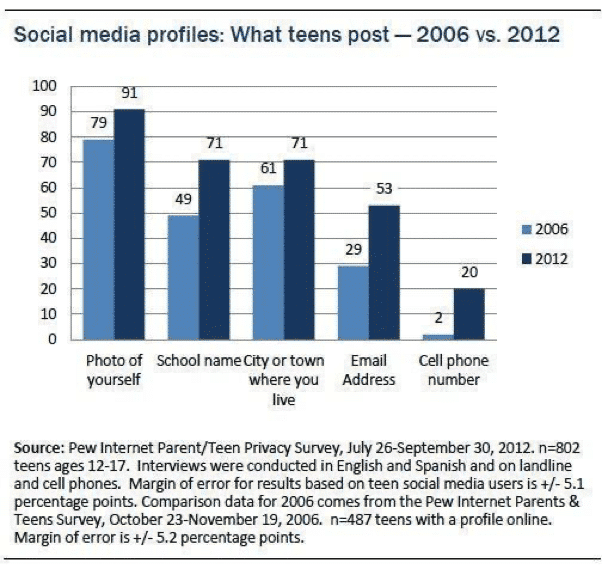
According to Pew Research Center, 71% of teens post their school name, 71% post the name of the city or town they live in, and 20% post their phone number.[1] Further, 36% of older teen’s Facebook friends are people they have never met in person.[2]
Although teens understand that oversharing can be dangerous, few have the life experience to understand exactly how it can be dangerous. When I was a teenager, the more “likes” I got on a photo or the more “friends” or “followers” I had on social media, the better I felt about myself and my online presence. I accepted friend requests from mutual friends who I had never met before, along with accepting requests from strangers. In my teenage mind, there wasn’t any harm in letting strangers see my online profiles. I felt that I would be okay as long as I wasn’t sending them my address. It didn’t occur to me that this data could be used to predict my location or even that anyone could have that kind of predatory intent.
Dr. Bennett shared a story with us where she worked on the production of the Lifetime TV show, I Catfished My Kid. In the show, producers created a poster board map (like detectives do) with yarn connecting the teens’ movements throughout the day for a week. With this data, they were able to predict daily habits like location, activities, and even who they hang out with.
How is Location Data Shared?
Instagram
One way location is shared on social media is through geotagged photos. A geotag is an electronic tag that assigns a geographical location to a photo or video posted on social media or other websites.[3] Geotags are commonly used to share what restaurant or city someone is in and are very popular on Instagram.
If your teen has a public profile and decides to post a photo on Instagram with a geotag, not only will their friends be able to see where they are, but users around the world can too. By simply clicking on that location’s tag, your teen’s photo will pop up as a current or recent visitor.
Another way location is shared on Instagram is by the use of hashtags. If your teen has a public profile and adds hashtags to their posts, their photos will show up as recent users of whatever hashtag they use, similar to the geotag feature. Hashtags are commonly used to have other users find their posts quicker and potentially gain more followers and traffic on their profile. However, that could be a privacy concern for younger users.
Facebook
The check-in feature on Facebook is similar to geotags. Facebook users “check-in” as an announcement to friends that they are visiting a particular location. Once checked-in, it appears on the user’s Facebook profile.
Snapchat
The SnapMap feature on Snapchat can also be a location risk. SnapMap allows your teen to share their location with their Snapchat friends every time they open the app. The SnapMap feature is a default, meaning it is automatically on so your teen might not even know that they are sharing their location. This is another privacy issue and may be a safety concern if your child accepts friend requests from strangers.[4]
Helpful Tips and Tools to Protect Your Child on Social Media
Set up a digital contact like our free Connected Family Screen Agreement and have ongoing, informative conversations with your kids about online safety. Our GKIS blog offers credible, interesting topics that will feed an ongoing agenda. Register for our Connected Family Screen Agreement to get on our weekly email list!
Set up your home to optimize best-use screen practices using our Connected Family Course for school-age kids.
Limit location sharing in Settings. On an iPhone, go to Settings and remove the location by clicking on the social media name > Location > select Never, Ask Next Time, While Using the App, or Always. You also have the option to turn off “Precise Location” meaning apps can only determine your approximate location
Don’t allow your child to have social media accounts until they are ready (we recommend after 13 years old or late middle school).
Require that your child set social media to private and only accept friend requests from family and friends they know in real life
Have your child change to the “Ghost Mode” on Snapchat (their location will no longer be viewable on SnapMap)
Thanks to CSUCI intern, Remi Ali Khan for researching common ways teens overshare on social media for this article.
I’m the mom psychologist who will help you GetKidsInternetSafe.
Onward to More Awesome Parenting,
Tracy S. Bennett, Ph.D.
Mom, Clinical Psychologist, CSUCI Adjunct Faculty
Photo Credits
Photo by Cottonbro from Pexels
Photo by Pixabay from Pexles
Photo by Pew Research Center
Works Cited
Deahl, D. (2017, June 23). Snapchat’s newest feature is also its biggest privacy threat. Retrieved November 04, 2020, from https://www.theverge.com/2017/6/23/15864552/snapchat-snap-map-privacy-threat
Dove, J. (2020, October 07). How to Remove Location Data From Your iPhone Photos in iOS 13. Retrieved November 04, 2020, from https://www.digitaltrends.com/mobile/how-to-remove-location-data-from-iphone-photos-in-ios-13/
Madden, M., Lenhart, A., Cortesi, S., Gasser, U., Duggan, M., Smith, A., & Beaton, M. (2020, August 17). Teens, Social Media, and Privacy. Retrieved November 04, 2020, from https://www.pewresearch.org/internet/2013/05/21/teens-social-media-and-privacy/
Oxford Languages and Google – English. (n.d.). Retrieved November 04, 2020, from https://languages.oup.com/google-dictionary-en/
Too much screen time can be harmful to our health. Findings suggest that, along with unhealthy diet and lack of exercise, increased screen time is a contributor to epidemic obesity among Americans. According to the CDC, 40% of adults and 18.5% of children in the United States are obese. Obesity increases the risk of developing other health conditions like diabetes, cancer, high blood pressure, heart disease, and stroke. But screen time isn’t all bad and can even help us get more active and track important health data. Today’s GKIS article offers recommendations for some awesome exercise apps that can help get you off the couch and on your feet for more healthy and fun fitness.
The Benefits of Exercise
Physical fitness is proven to have many physical health and mental health benefits. Exercise can improve sleep, reduce anxiety, and lift your mood, ultimately reducing the risk of depression. With busy schedules and limited access to gyms, we too often go without exercise. Luckily, there are hundreds of apps on our smart devices that make exercise enjoyable and easier, even on a tight schedule. Also, exercising with your family is a great way to teach kids important life skills and bond and stay connected!
Trending Exercise Apps that you (and we at GKIS) Love
Nike Training Club
A favorite of Dr. B’s, the Nike Training Club is a great free app that you and your family can enjoy at home. This app contains over 185 workouts for all levels including high-intensity training, yoga classes, and bodyweight workouts. Little to no equipment is required for most of the workouts, so you don’t have to stress about spending money on weights.
Here are some of the collections that are great for home:
Big Workouts for Small Spaces
For the Whole Family
Boost Your Mood
Rejuvenate with Yoga
Elevate Your Game
Other Features
In addition to the free workouts, Nike Training Club offers tips for nutrition, sleep, recovery, mindset, and wellness.
I have personally used this app, and I love it. Not only is it great because it is free, but the quality of what is being offered is fantastic. This app would be a perfect addition to your families’ devices and your daily routines!
Workouts and Exercises at Home
This fitness app is perfect for families with busy schedules because the workouts take only seven minutes. The app features a cute “Lazy Monster” character that guides you through up to 30 different exercises that require no equipment. All you have to do is set aside seven minutes of your day to try it out.
Other Features
Workouts and Exercises at Home allows you to create personalized workouts and track your progress. It currently costs $3.99 a week, but it is less than a gym membership and all of the workouts are planned for you. All you have to do is open the app. Workouts and Exercises at Home is an app that will make exercising fun for you and your family.
Gymondo: Fitness and Yoga
Gymondo is a fun fitness app that contains workouts under 30 minutes long. There are a variety of workouts to choose from like yoga, strength training, HIIT, mobility, and body weight. These workouts are available at any fitness level, so this would be perfect for anyone in your family.
Other Features
Gymondo is a free app, but the premium version gives you access to over 200 workouts, healthy recipes, and a nutrition plan. The premium version is only $7 a month, which is a good deal for all that is being offered. Get your family together and try this app out for free!
Seven
Seven is a high-quality fitness app that contains seven-minute workouts. This app is family-friendly and requires no equipment. All you need is seven minutes and some open space for a great, quick workout.
Other Features
Seven features daily challenges to keep you motivated to exercise every day. You can choose between 12 different instructors that will motivate you during your workout. You can also create workouts that are personalized for you and your family.
If you join The 7 Club, you get access to all the workouts and features on the app. One month costs $10, and one year costs $60. Seven is perfect for a quick workout in the morning, afternoon between zoom classes/meetings, or in the evening. All you have to do is set aside seven minutes for you and your family to get a good workout in.
A special thank you to Alisa Araiza for researching and co-writing this article. I hope that trying these apps will bring you closer to your family and make exercising enjoyable. For other ways to stay connected with your family, take a look at Dr. Bennett’s #TogetherAtHome Family-Friendly Activity Ideas on the GKIS website.
I’m the mom psychologist who will help you GetKidsInternetSafe.
Do you remember as a young child when you lost someone you loved? Whether it was your first dog or your grandma, the pain was definitely there. Many children are exposed to death in their early years initially from cartoons, tv shows, and movies. The complex concept of death is often difficult for kids to understand. Today’s GKIS article covers some basics about children, grief, and how to help them through it.
Every child will grieve at some point.
Whether we like it or not our children will have to face a time where they must grieve. One day their fish will die, their friend may pass, maybe even a grandparent will pass away. Parents are the most important touch-point during a time like this. Knowing how to manage it can make a big difference in child outcome.
When I was 10 years old the biggest person in my world would become a memory to me, my dad. On January 22, 2009, my dad lost his battle with stage-4 colon cancer. I remember it like it was yesterday, from my feelings to the headband I was wearing when I found out. The hurt and pain I felt knowing I would never be able to smell his hair pomade, take a Walmart trip with him just so I could sneak a J-14 magazine into the cart, or learn the game of football from him with dreams of playing for his favorite team, the Raiders. My dad was my world and just like that … he was gone.
For a long time growing up I was angry. I would act out and talk back to my mom, you name it I did it. I did not really understand how to deal with my emotions and felt that I needed to be strong for my mom and older sister. I would brush off his death like I did not care a single bit, but how could I not? My mom tried everything to help me, from taking me to therapy, encouraging me to play sports, and even retail therapy, but nothing made it better. Of course, I had many times where I was happy and laughing because yes, my life did go on, but I always felt a void in my heart.
Looking back now, I wish I could have understood the process more. Maybe with more support, my mom could have reached me better or helped me feel more understood. As I got older one of my goals was to become a children’s therapist, hoping to specialize in children who are grieving the loss of a loved one because I know first-hand how that feels. Every now and then when I think of a new way of grieving, I write it down. Writing today’s GKIS article helped me heal a little bit. I hope you find some of these helpful for you too.
Helping Your Child Overcome Grief
Try to go about your daily life as normal as possible.
Your child is already having to cope with the absence of somebody they loved. So rather than change other things in their life that they may miss as well, like friends or school, try to stick to your daily regimen.[1] The day after my dad passed away my mom encouraged me to go to my softball game. Although it was painful to see the empty seat next to my mom, it actually helped distract me for some much-needed temporary relief.
If past routines are too hard, start new ones!
If you are unable to stick to your daily routine because the pain of the missing loved one is just too great, creating new ideas may offer a fresh start. Anticipating events can be almost as much fun as doing them. When you come up with an idea, like building a sandbox, painting a room, or by making an outside fort, put it on the calendar. Give your child something to look forward to.
Show your child that you love them!
Be there for your child and remind them how much you love them each and every day by doing these small things:[1]
Leave them a small note in their sack lunch so they know you are always thinking of them.
Greet them with an enthusiastic smile and a hug in the morning.
Read them one too many stories and kiss them goodnight.
Treat them occasionally with an unexpected surprise from the store, like a cupcake or little toy.
Spend extra family time together, like on a hike or a special trip to their favorite ice cream shop
Leave love notes for them under their pillow.
It will be tough at times.
Dealing with the death of a loved one is difficult no matter what age you are. There are many complexities that come along with grieving and moving forward when losing someone you love. Although, you are probably just as heartbroken as your child, grief can manifest differently for different people. Although you will have challenging moments sometimes where you won’t know the next step, it’s okay. Breathe…you are not alone.
For extra coaching and support, it’s okay to ask for help from family, clergy, your child’s teacher, and even a psychologist. Sometimes children will speak more openly with someone they don’t have to worry may burst into tears themselves.
Teaching your child the concept of death may be challenging.
This is one thing about my dad’s death I struggled with for a long time. Like many young children who go through a loss of a loved one, I began to fear death and would constantly ask my mom if I was going to die too.
You will be asked a ton of questions
Children are curious and usually speak their minds with no filter. So, when asking about death
and loss be prepared to be asked very vague and challenging questions. Make sure you always give a thought out and complete explanation.
Questions you may get asked:
What is death?
Why do people die?
Where do they go when they die?
Will I die, too?
Can’t they come back?
It is important, in any which way you answer these questions, to keep it positive while also being straightforward with your child. Dr. Bennett calls it honesty with discretion. Kids get a lot of comfort if you tell them they’ll see their loved one again, but not for a very long time. Follow up that their loved one will always be with them, held close. It just won’t be as easy to see them.
Teach them the concept of death in a positive way. Be honest about your emotions while assuring them of their safety and that they are loved. Letting your children see you grieve sometimes will normalize healthy emotions. You don’t have to suppress emotion completely, all the time. It’s OK to be genuine and even accept soothing from them sometimes.
Still feel a disconnection.
Grief is a very normal and healthy process. However, kids and adults can sometimes sink into what psychologists call complicated bereavement. Complicated bereavement is grief that escalates into impairment and may benefit from professional clinical treatment. If you are wondering if it’s time to seek clinical help, ask yourself simple questions:
Are they sad more than half of the time?
Are they not eating or failing to gain or lose weight?
Are they having trouble sleeping or sleeping too much?
Are they complaining about intrusive thoughts or frequent nightmares?
Are they refusing to go to school or do homework?
Are they moving like they have no energy or agitated often?
Do they act tired, like they have no energy and can’t make decisions? Have they engaged in self-harm or threatened suicide?
Do’s and Don’ts When Helping Your Child Grieve
Do’s
Allow your child to grieve in their own way whether it be video games or crying into their pillow.
Mix curiosity with caring. This will not only show your child that you too are saddened by the loss, but it will also help your child express their feelings to you.
Separate your grief from theirs. It may sound selfish but, in this time, it will be beneficial to your child to see you hold yourself together as much as you can. They are in a foreign state of mind and will need to look up to you in how to move forward.
Be careful with your actions. Children are absorbent and pay close attention. Try not to grieve in ways that will not be beneficial to your child, like overindulging with alcohol, checking out, or having huge meltdowns in front of your child.
Praise! Oftentimes children develop new skills in this time of grieving. Be sure to mention how good they got at painting, you like their new makeup style, or even how easily they were able to pick up a sport.
Consider online support groups if there is a deficit of live support in your area.
Don’ts
Do not insist on a certain time or way to mourn. Everyone mourns in their own way.
Tell your child the truth, don’t say that their grandma is just sleeping or that their dog went on a walk. Kids can take things too literally and blame themselves or become afraid.[2]
Children need to be children. Don’t make them take on adult duties. Taking away their childhood will be seen as another loss for them.
Don’t be quick to punish. Your child may act out to elicit your attention. This sounds crazy but normalize their actions. This will help them stop this bad behavior.
Don’t knock the idea of support groups. Children being exposed to other children who are also experiencing loss may benefit from a sense of camaraderie.
If you live in California, Hawaii, or Idaho and need some warm, therapeutic support, Dr. Bennett offers teletherapy sessions. Go to DrTracyBennett.com for more information. A grieving child is not the only one to learn something new, you are too. Knowing how to help, nurture, and care for your child during this time is not easy but with simple steps, it can become second nature. Keep going and don’t give up on yourself, you’re doing great! Thanks to Danielle Rivera for contributing this GKIS article.
We all want easy money, especially teenagers. The website OnlyFans.com promises huge profit just by selling their uncovered bodies to men and women prowlers of the internet. This has become a phenomenon to young people all across every social media platform with advertisements to their personal accounts.
What is “OnlyFans.com?”
Onlyfans.com is a social media platform built for sharing nudes, displaying sexual actions live on a webcam, and share private calls with a person who is willing to pay extra[i]. Launched in 2016, it has sky rocketed within the last year, exceeded over 20 million registered users. This website states in terms and agreement that it is marketed for 18+ users, although users of all ages have been seen to be on this website. This website is gloried across twitter where people, young to old, gather and share tweets. It has become a popular topic amongst twitter often being marketed by users leaving their links on their profiles to get directly to their OnlyFans page.
Why create an OnlyFans account?
Money
Social media culture caters to the wealth addicted. We want to show off our nice shoes and fancy cars to prove we are somebody important. Everyone wants to get the next best thing as easy and fast as possible. The way OnlyFans has been marketed makes aspiring users believe they will become wealthy over night.
Fame
Social media influencers have become bigger than many movie stars to the younger generation. Young people crave the idea of becoming an influencer, trying to gain fame any way possible. OnlyFans offers this opportunity to users for their chance to go viral.
Sense of Empowerment
On OnlyFans, account owners charge consumers for services such as sexual actions performed, speaking sexual, and even taking nude photos of themselves to later sell all while being broadcasted live on the webcam. He/she will have to pay a fee according to the account owner’s expense. People who also own an OnlyFans account can gain a false sense of reassurance from other people by getting sucked into this idea that they are better undressed which can be harmful to a young teen who is barely developing their idea of what makes them feel confident.
Is OnlyFans.com safe?
Leaked Information
Many young girls have gotten their what was said to be confidential content leaked to the outside world by hackers who were able to get into their profiles and leak their videos [ii].
This can also help the viewers find out more information about OnlyFans webstars.
Stalking
OnlyFans.com is marketed as a safe pornographic website that has a lot of unsafe precautions when using it. There has been many cases where consumers have obsessively stalked OnlyFans account owners by directly messaging them abusive sexual content, as well as finding out where they live by stalking the specific user, searching their Twitter and Instagram to pin point exactly where they live.
Dangerous
Not only could this be a dangerous website for the user to use it could also be dangerous for the users family. There is a possibility your whole family could be put at risk if a viewer were to reveal where you lived,
Job at Risk
By using OnlyFans you could also be putting your job at risk. If your employer finds out about your use of this website they may not want their company to be represented in such way.
Family Separation
Your family may not be fond of the actions you take when using this website. This can cause there to be tension within the family which can lead to family separation.
While conducting my research on the web, I attempted to start a profile and it did not ask me for much verification regarding my age just a simple email, name, and password to create your account. I navigated through the website to get an insight on what the website looks like.
Why should parents be afraid of this website if typically its an 18+ user website?
Teens are especially prone to the appeal of looking sexy, sophisticated, and in control. OnlyFans preys on this vulnerability by glorifying this type of sex appeal which later down the line this can have a negative affect on a young teens well being by having these videos be linked to them for the rest of their time.
An eighteen year-old OnlyFan member, @xgabyv on twitter whose account is now suspended, reportedly earned $3,000 after having a profile live for only two days. Comments praising her photos included how “sexy she looked with her clothes off.”
While browsing around some more I came across a young girl, Alyssa Scott, age 18 charging for “1 on 1 screen time.” This 1 on 1 screen time meant that Alyssa Scott would be giving her services to one singular customer. She priced this at a much higher rate than her monthly subscription services doubling what she would gain from one monthly subscription.
How do I block sites like OnlyFans.com?
Our GKIS Screen Safety Toolkit [iii] offers easy navigation to parental control settings. It explains how to set up screen time management, filtering and blocking so that way your teen won’t have the ability to come across these when navigating through the web. You’ll be able to learn how to block certain social media platforms and set up alerts just in case your child does venture off into these unwanted websites. You can gain this knowledge and more all for the low cost of $37.
I would like young teens and parents to be more aware of this website and its purpose. I do not in any way have any judgement towards users who are on OnlyFans, but I do want to bring it to the attention of parents and their teenagers that this is not the only way to make money, feel confident, and have stardom. There are more teen friendly ways of doing so and I would hope that this article was able to help guide you into that direction.
A special thank you to Danielle Rivera for researching and co-writing this article. If you liked the article and you’re interested in learning more tips on how to be more aware of new websites developing that your child may be tapping into, check out our Screen Safety Toolkit on GKIS where you can learn what to look out for.
[ii] Harris, Margot (2020) Terabytes of Stolen Porn from ‘OnlyFans’ Was Leaked Online, and Creators Say It Represents a Larger Problem That Could Put Them in Danger
Surveys reveal that depression and anxiety have increased for adults, teens, and kids. It’s unclear what is causing these increases, but longer workdays and overtasked lives may be strong contributors. Increased screen time on video games, social media, video and movie streaming, texts, and emails can be super fun and even improve productivity. But too much screen time can also lead to a mental brownout, a type of anxious fatigue that we may not even recognize until it leads to mental illness. Giving up screens to avoid it simply isn’t possible for most of us. But the good news is we don’t have to! Learn how smartphone health and wellness apps can benefit you without having to give up screen time!
Mental Health
Did you know that anxiety, depression, self-harm, and suicide is up 78% among teens?[1] In fact, by some estimates 1 in 6 children between the ages of 2 and 8 have a mental, behavioral, or developmental disorder. Left untreated, child symptoms may lead to more issues in adulthood.
Among children ages 3 to 17:
4% or 6.1 million have been diagnosed with ADHD
4% or 4.5 million have been diagnosed with a behavior problem
1% or 4.4 million have been diagnosed with anxiety and
2% or 1.9 million have diagnosed with depression.
Boys are more likely than girls to experience a mental, behavioral, or developmental disorder.[2]
Social Media Impacts on Children’s Mental Health
Sleep Deprivation
Social media has various effects on mental health, especially in children. Dr. Bennett writes in her book, Screen Time in the Mean Time, says that she feels sleep deprivation is the most common contributor to mental health problems today. The blue light on devices interrupts the sleep pattern and makes it more difficult to fall asleep. Many people also develop a compulsive impulse to check notifications which can also delay sleep.[3] Teens with sleep deprivation demonstrate lower achievement motivation, more teacher-child relationship problems, a poorer academic self-concept, and poorer school performance.
Self-Comparison
Too often, we see the best sides of our friends on social media. After all, nobody wants to read about the doom and gloom of a breakup or the fight someone just had with their mother-in-law. Positive posting can lead to friends feeling left out and generally bad about how their lives don’t compare. The GKIS article The FOMO EFFECT: How Fun Friend Posts Can Lead to Clinical Anxiety provides more information on self-comparison.
Distraction
Social media poses a major risk of distractibility. We tend to go on an endless cycle of content on one social media app or we cycle between multiple social media apps. This causes us to spend a longer amount of time on social media and forget about what we are supposed to do in the “real world”.
Mental Health Apps
Dr. Bennett recommends mental health apps to her clients all of the time. Free and convenient, they can be a great addition to psychotherapy. Even for people who aren’t in treatment, mental health apps can help us get to where we want to be by offering mood-enhancing toolkits, mood monitoring, and breathing and meditation ideas.
Mental health apps are awesome in that they are convenient, inexpensive, and even free, and available. They can be a comfortable first-step to wellness prior to (or even while) seeking out help from a mental health professional.
CAUTION: Keep in mind possible privacy issues due to the risk of data breaching and the release of private information to third parties. Many psychologists also agree that the apps are not as effective as seeing a mental health professional.[4]
Here are some mental health apps that GKIS is happy to share with you:
Sanvello
Sanvello is an app that aims to help you relieve symptoms of depression or anxiety by providing a complex toolkit of strategies and resources. It allows you to record your mood and health activities in order to track patterns.
There is also a Sanvello peer community that allows users to share stories, encouragement, and personal insights on any topic. The Terms of Service state “You must be over 13 years of age to use the Services, and children under the age of 13 cannot use or register for the Services.”[5]
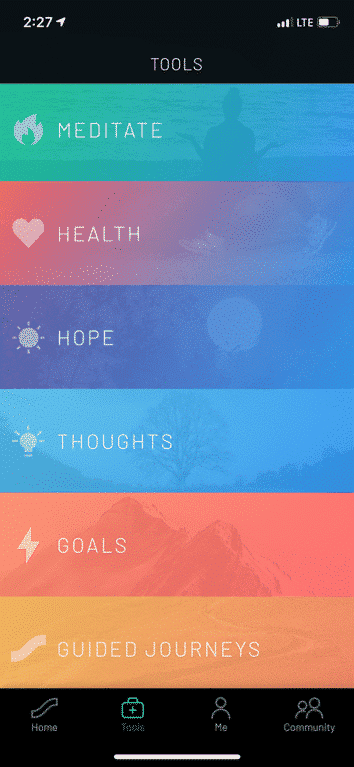
The toolkit provided by Sanvello includes:
Meditation: Lessons focus on specific topics like relaxing, mindfulness, stressful situations, and calm down.
Health: Helps you track health habits that may be affecting your moods such as exercise, drug use, and water or caffeine consumption.
Hope: This tool provides the user with a space to save photos, quotes, activities, and community content.
Thoughts: Provides a place for journaling, analyzing events that have occurred, or discovering characteristics that have contributed to a feeling.
Goals: Allows users to select a challenge such as reconnecting with a friend or saying hello to a stranger.
Guided Journeys: A series of journeys that encourage a user to accomplish something they have never done before.
Porchlight: Being There
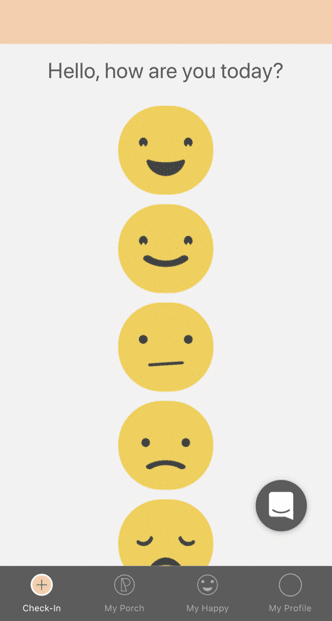
Porchlight is an app that is designed to allow loved ones to easily check in on each other’s mental health. The app prompts you to “check-in” once you enter the app where you can share your emotions using emoji. Users can connect with others which will send daily check-in notifications to the connected users. Porchlight provides prompts to check in with the connected users depending on what emotion they check in as.
Porchlight’s Terms of Service states “you must be 13 or older to register as a user or to use the app. If you are a minor, you must have your parents’ permission to donate through the App.”[6]
Headspace
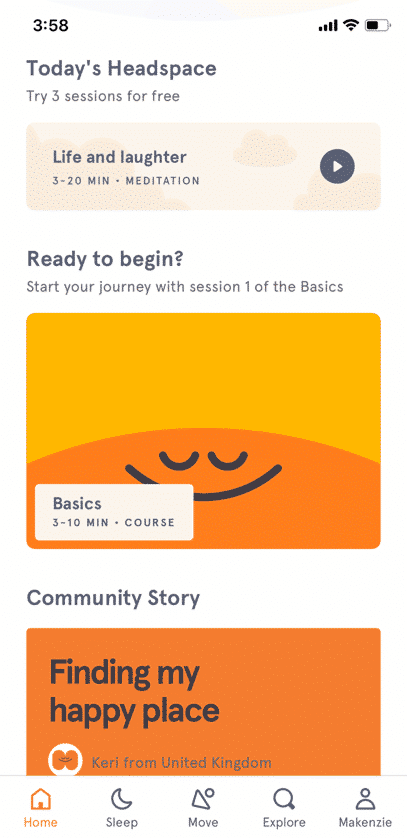
Headspace is an app that provides guided meditation exercises to help the user become healthier and happier. Headspace claims that it can increase happiness by 16% with just 10 days of use. It is also a popular app with over 60 million active users.
There are 4 main guides to mindfulness within the app:
The Wake Up: Daily short stories and small meditations to help you start your morning on a good start
Move Mode: Exercises to help strengthen mental and physical well-being
Sleep: Sleepcasts, music, and audio experiences to aid a restful night of sleep
Meditation: Teaches everyday mindfulness to help at any time of the day[7]
According to the Terms of Service for Headspace, “You must be 18 years of age, or the age of majority in your province, territory or country, to sign up as a registered user of the Products. Individuals under the age of 18, or the applicable age of majority, may utilize the Products only with the involvement and consent of a parent or legal guardian, under such person’s account and otherwise subject to these Terms.”[8]
Calm
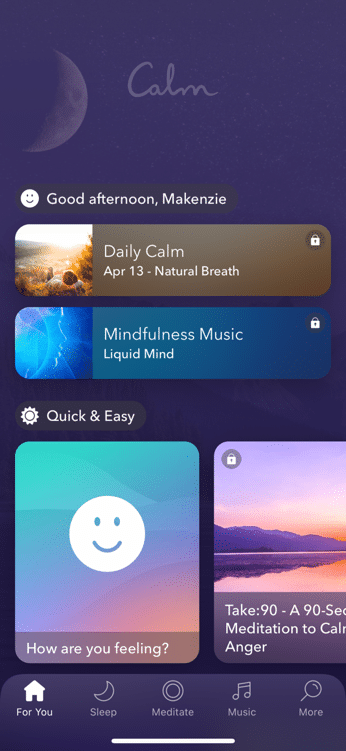
Calm is an app designed to assist users to develop healthy mental fitness, relax, and good sleep habits. The goal of the app is to introduce people to the benefits of mindfulness through meditation.
There are 6 different items of focus in the app:
Meditate: Teaches the skills of meditation
Sleep: Tools to have a restful sleep
Music: To help you relax, focus, or sleep
Body: Demonstrates mindful movement and stretching
Masterclass: Audio programs taught by experts
Scenes: Nature scenes and sounds to help relax and focus[9]
Calm’s Terms of Service state “you may only use the Services only if you are 13 years or older. To make a purchase via the Services, you must be 18 years or older and capable of forming a binding contract.”[10]
Thank you to CSUCI Intern, Makenzie Stancliff for providing insight on mental health apps. For more information about how electronics can impact our health, check out Dr. Bennett’s GKIS article, Is Wi-Fi Dangerous to Our Health?
I’m the mom psychologist who will help you GetKidsInternetSafe.
[1](n.d.). Retrieved from https://www.ajmc.com/focus-of-the-week/mental-health-issues-on-the-rise-among-adolescents-young-adults
[2]Data and Statistics on Children’s Mental Health. (2019, April 19). Retrieved from https://www.cdc.gov/childrensmentalhealth/data.html
[3] How does social media impact the mental health of young people? (2019, October 28). Retrieved from https://www.internetmatters.org/blog/2017/04/12/social-media-impact-mental-health-young-people/
[4]Technology and the Future of Mental Health Treatment. (n.d.). Retrieved from https://www.nimh.nih.gov/health/topics/technology-and-the-future-of-mental-health-treatment/index.shtml
[5]Home. (n.d.). Retrieved from https://www.sanvello.com/
[6]Being There. (n.d.). Retrieved from https://www.porchlightapp.io/
Fun trends on the YouTube Explore page attract audience attention and vet the best online content and influencers. To build child resilience and teach problem-solving and good judgment, we at GKIS encourage parents to carve out the time to share online interests and co-view YouTube channels with their kids. To help you get started (or continue) having fun online as a family, we’ve found some fun trends and creators that may be a great source of inspiration for developing new interests and hobbies. Having fun together and building digital fluency and an awareness of what’s hot and what’s not will help you build credibility with your kids. Even better, they will start to teach you about what’s out there, and, ultimately, work with you to make difficult online decisions. Our goal isn’t to shut your kids off from online discovery. Instead, we believe in family togetherness, online learning and discovery, and building child resiliency and safety – and having fun while you’re at it!
**CAUTION: GKIS has chosen these creators because of their family-friendly content and the variety of communities that they represent. Although we are excited to share these amazing creators, please keep in mind that some of them are more suitable for older teenagers due to their language and the nature of their content. Further, many of these creators have hours of videos that we did not sample. Please watch and decide for yourself the appropriateness of each channel for your unique child.
Mukbangs
A kind of video trend that has been popular in recent years has been Mukbang videos. Mukbangs, a trend originally popularized in South Korea, are videos where people eat large quantities of food while interacting with their audience [1].
These kinds of videos are popular with young people because they can be enjoyed as entertainment, to satisfy cravings, or to enjoy the creator’s style, humor, and personality.
We recommend you check out YouTuber Zach Choi. Zach, with almost 8 million subscribers, takes his viewers through his process of preparing for his mukbangs, consuming the food, and collaborates with other popular YouTube creators, both in and out of the Mukbang community.
In his videos, Zach silently eats large amounts of food with occasional captions that describe the foods or promotes the creators he features on his channel. Zach will often do a combination of a mukbang and an ASMR video. ASMR, or autonomous sensory meridian response, videos are videos that utilize audio and visuals in order to produce a tingling sensation that moves down the back and upper spine [2]. There are only certain people that get this “ASMR feeling”, and for them, videos like these can be very enjoyable to watch. Zach doesn’t seem to use inappropriate language, as he does not speak in his videos, or do sponsored content.
Technology Reviews
In the world of technology, YouTuber Marques Brownlee has made a name for himself with his thorough and unbiased technology reviews.
Marques is a creator who often trends on the YouTube Explore page and has over 10 million subscribers. For people interested in technology, watching Marques can be a good way to learn about the various features that go into different devices or simply get a professional opinion on what electronics to consider buying.
While Marques reviews technology, he does not promote buying the most recent devices or show bias towards certain brands. He simply reviews the newest technology on the market and gives his opinion on its features and performance.
For teens going into high school or college who need new devices for their academics, interested in creating content, or interested in studying technology, this is a great creator to watch. Marques very rarely does sponsored content and does not seem to use inappropriate language.
Food
In the food community, the brand Bon Appetit has created a popular platform on YouTube with a variety of series, all based on cooking.
Chefs from Bon Appetit post videos from their company test kitchen showing how to cook recipes from many different cuisines. What makes Bon Appetit different from your average Food Network cooking video are the chefs. While Bon Appetit’s crew of chefs provide detailed instructions on their recipes, they do so in a fun, humorous manner, letting their personalities naturally shine through and interacting with their fellow chefs in the test kitchen. This makes for some entertaining videos that have gained the attention of many young followers.
With fun and detailed videos, Bon Appetit has inspired this new generation to think twice about dining out and instead try something new in the kitchen. Two very popular series to check out are Gourmet Makes by chef Claire Saffitz and It’s Alive by chef Brad Leone. Bon Appetit does not seem to do sponsored content. This channel is recommended for an older audience, as some videos may contain explicit language.
Music
For people interested in music, the National Public Radio created a popular YouTube series called Tiny Desk Concert, dedicated to live performances from some of the most talented artists.
This YouTube series, which is on the NPR Music YouTube channel, posts new performances every month, with artists from varying genres and languages. These concerts differ from live performances, as they are played live with no prerecorded tracks or lip-syncing. Artists sing their songs live with either a band or by themselves with their preferred instrument in a small space that resembles an office desk, hence the name “Tiny Desk”, with a small studio audience.
This channel is great for young fans and music enthusiasts because it allows you to discover new artists every month, plus you can see your favorite artists perform their songs in new styles and see the different instruments and vocals it takes to best perform their music. NPR is careful with putting disclaimers in their videos for the artists that use explicit language, either in their songs or when speaking. This series does not do sponsorships, as they rely on donations from the public to keep the series going.
Charity
If you want to watch videos while contributing to a charitable cause, check out the YouTube channel Grandpa Kitchen.
This channel, with over 7 million subscribers, is a cooking channel created by a family in India to raise money for the local orphanage that they work for. The videos posted by this channel originally starred an older Indian gentleman lovingly referred to as “Grandpa” by subscribers. Grandpa would greet his subscribers and explain the meal he would be preparing for the orphans that day.
Grandpa cooked large quantities of food for all the orphans at his organization with the help of his grandsons. After Grandpa passed away, his grandsons took over the channel in order to continue the good work Grandpa started. Many families and fans from around the world have shared their support after Grandpa’s passing, and you can truly see how fans young and old were able to bond over watching Grandpa every week.
Although Grandpa is no longer with us, his grandsons continue to create videos with a similar format to Grandpa’s videos and continue to use the money earned from the channel to support the orphans with food, supplies, etc. These videos are in English, and the creators do not do sponsored content or use inappropriate language.
Discover Together
As we share these creators and communities, we encourage you and your children to discover new favorite communities and content to inspire you to create and discover beyond the screen. There are family-friendly creators in every community waiting to be discovered, all it takes is some time and patience.
Thanks to Alexandra Rosas-Ruiz for her research and help with writing this article. If you have questions about what your child is interested in on YouTube, try coaching sessions with Dr. B. These sessions, also offered online, can answer any specific questions on online safety and parenting in general. Sign up and receive special bonus products with your purchase.
I’m the mom psychologist who will help you GetKidsInternetSafe.