Is your child sharing their location with hundreds of “friends” online? Are they unwillingly giving away personal information that can put their privacy in danger? Our GKIS tools can help with that. In this article, we cover the ways kids overshare online and provide insightful tips and strategies to keep your child safe.
The GKIS Mission
GKIS helps families achieve screen sanity, prevent digital injury, and form deeper, more meaningful relationships. We don’t have to give up screens to be safe. GKIS offers tools and strategies that keep the joys of childhood discovery alive for all of us in today’s overtasked world.
Oversharing
Teenagers love to share what they are doing online, whether it’s posting what they’re eating, uploading selfies, or posting pictures of their pet. Sharing daily life online is fairly common; we adults are guilty of it too. But sharing location data can be particularly dangerous for teens because it offers a bridge from online contacts meeting them online to meeting them offline.
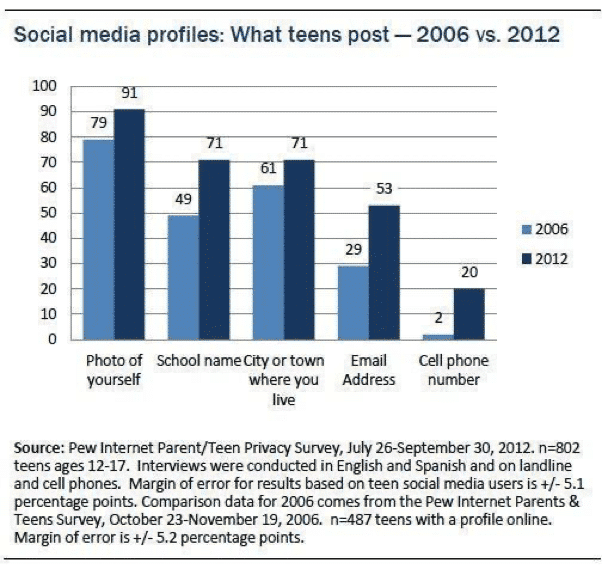
According to Pew Research Center, 71% of teens post their school name, 71% post the name of the city or town they live in, and 20% post their phone number.[1] Further, 36% of older teen’s Facebook friends are people they have never met in person.[2]
Although teens understand that oversharing can be dangerous, few have the life experience to understand exactly how it can be dangerous. When I was a teenager, the more “likes” I got on a photo or the more “friends” or “followers” I had on social media, the better I felt about myself and my online presence. I accepted friend requests from mutual friends who I had never met before, along with accepting requests from strangers. In my teenage mind, there wasn’t any harm in letting strangers see my online profiles. I felt that I would be okay as long as I wasn’t sending them my address. It didn’t occur to me that this data could be used to predict my location or even that anyone could have that kind of predatory intent.
Dr. Bennett shared a story with us where she worked on the production of the Lifetime TV show, I Catfished My Kid. In the show, producers created a poster board map (like detectives do) with yarn connecting the teens’ movements throughout the day for a week. With this data, they were able to predict daily habits like location, activities, and even who they hang out with.
How is Location Data Shared?
Instagram
One way location is shared on social media is through geotagged photos. A geotag is an electronic tag that assigns a geographical location to a photo or video posted on social media or other websites.[3] Geotags are commonly used to share what restaurant or city someone is in and are very popular on Instagram.
If your teen has a public profile and decides to post a photo on Instagram with a geotag, not only will their friends be able to see where they are, but users around the world can too. By simply clicking on that location’s tag, your teen’s photo will pop up as a current or recent visitor.
Another way location is shared on Instagram is by the use of hashtags. If your teen has a public profile and adds hashtags to their posts, their photos will show up as recent users of whatever hashtag they use, similar to the geotag feature. Hashtags are commonly used to have other users find their posts quicker and potentially gain more followers and traffic on their profile. However, that could be a privacy concern for younger users.
Facebook
The check-in feature on Facebook is similar to geotags. Facebook users “check-in” as an announcement to friends that they are visiting a particular location. Once checked-in, it appears on the user’s Facebook profile.
Snapchat
The SnapMap feature on Snapchat can also be a location risk. SnapMap allows your teen to share their location with their Snapchat friends every time they open the app. The SnapMap feature is a default, meaning it is automatically on so your teen might not even know that they are sharing their location. This is another privacy issue and may be a safety concern if your child accepts friend requests from strangers.[4]
Helpful Tips and Tools to Protect Your Child on Social Media
Set up a digital contact like our free Connected Family Screen Agreement and have ongoing, informative conversations with your kids about online safety. Our GKIS blog offers credible, interesting topics that will feed an ongoing agenda. Register for our Connected Family Screen Agreement to get on our weekly email list!
Set up your home to optimize best-use screen practices using our Connected Family Course for school-age kids.
Limit location sharing in Settings. On an iPhone, go to Settings and remove the location by clicking on the social media name > Location > select Never, Ask Next Time, While Using the App, or Always. You also have the option to turn off “Precise Location” meaning apps can only determine your approximate location
Don’t allow your child to have social media accounts until they are ready (we recommend after 13 years old or late middle school).
Require that your child set social media to private and only accept friend requests from family and friends they know in real life
Have your child change to the “Ghost Mode” on Snapchat (their location will no longer be viewable on SnapMap)
Thanks to CSUCI intern, Remi Ali Khan for researching common ways teens overshare on social media for this article.
I’m the mom psychologist who will help you GetKidsInternetSafe.
Onward to More Awesome Parenting,
Tracy S. Bennett, Ph.D.
Mom, Clinical Psychologist, CSUCI Adjunct Faculty
Photo Credits
Photo by Cottonbro from Pexels
Photo by Pixabay from Pexles
Photo by Pew Research Center
Works Cited
Deahl, D. (2017, June 23). Snapchat’s newest feature is also its biggest privacy threat. Retrieved November 04, 2020, from https://www.theverge.com/2017/6/23/15864552/snapchat-snap-map-privacy-threat
Dove, J. (2020, October 07). How to Remove Location Data From Your iPhone Photos in iOS 13. Retrieved November 04, 2020, from https://www.digitaltrends.com/mobile/how-to-remove-location-data-from-iphone-photos-in-ios-13/
Madden, M., Lenhart, A., Cortesi, S., Gasser, U., Duggan, M., Smith, A., & Beaton, M. (2020, August 17). Teens, Social Media, and Privacy. Retrieved November 04, 2020, from https://www.pewresearch.org/internet/2013/05/21/teens-social-media-and-privacy/
Oxford Languages and Google – English. (n.d.). Retrieved November 04, 2020, from https://languages.oup.com/google-dictionary-en/
I taught my kids all about online safety, and now they use it against me. I’m a screen safety expert and a psychologist, and I admit I’ve had a screwed up relationship with Facebook. It started out that it was such a new and cool forum to check out the lives of people you like and had genuinely lost touch with. It was so fun to see that college roommate who actually became a journalist…or that high school boyfriend who kicked his weed habit and seems to have a great marriage with happy, healthy kids. And how exciting to show everyone how great your kitchen remodel turned out and how your kids were rockin’ those new backpacks the first day of school. Early on, Facebook was a beautiful landscape of fresh faces and fun stories…kind of like the first 30 minutes of your ten-year high school reunion. But then, just like that high school reunion, people started revealing the other annoying sides of themselves.
You know what I mean by that. Your cousin who constantly brags about her relationship when you know she kicks her husband out every other month. Or that friend who sensationalizes other people’s tragedies by pretending she is totally distraught and constantly praying – and you know she’s only talked to them three times. Your bigoted Uncle Bob spews racist rhetoric, and you get drawn into ugly political debates and later have to delete your overzealous comments after the bloodshed. At some point in accumulated online trauma, Facebook wasn’t as fun anymore.
Our kids witnessed it. They posed for us and encouraged us to share at first. But after a while, they caught on that some of the humor parents shared about the challenges of parenting weren’t very nice. They realized that their beaming grin with braces and green, shiny pool hair after their fourth-grade summer wasn’t very flattering. They started to fear that their parents were using them to promote the family’s community image…and it felt kind of fake. They were feeling used to prop up a virtual ego that was kind of pathetic.
Besides, kids love to kill their parent’s joy. I’m the mother of three, ages 25, 17, and 15 years old. Nobody calls me out more brutally than my teenagers. They don’t even try to be nice about it. They started to tell me, in no uncertain terms, that I wasn’t to post photos of them anymore without their permission. And me begging them to post was humiliating, so I quit doing it.
Look, I’m not ashamed of being a crazy mom. I love my kids. I want to show others how awesome I think they are. I also know I’m not alone. I hear about these issues every day in my clinical office. Some parents do it anyway…but it damages the trust in the family. Others, like me, post about our adult lives outside of our kids. We know that our Facebook friends are a different tribe than our nonvirtual one. There’s overlap, sure, but we only have the opportunity to interact with some of them on Facebook, and we don’t want to give those relationships up.
Go ahead and troll me and tell me what a loser I am that I still post. But let’s be honest here. Most of us still use Facebook to at least check in with others. Some have gone Facebook free, and, like recovered smokers, they love to tell us how it’s made their lives more precious. It probably has, but for now, I’m still posting about travels and puppies and the occasional funny meme. I’ve hidden the Uncle Bobs and fake prayers while celebrating those I’m truly fond of and rooting for.
And as for the kids who are revolting due to sharenting…have at it you guys! Yes, many of you are hypocritical as you constantly post on Snapchat. You may even assert yourselves more to boss your parents around than because you have an actual concern. But the fact that you have a passionate opinion and the assertiveness to state it is the kind of resilience I believe in as a parenting expert. You are the best advocates for GetKidsInternetSafe. Because typically, the kids who speak up to their parents are not blindly obedient pleasers. They have informed opinions and well-honed voices of confident digital natives. That practiced voice of calm and intelligence may save them from a bad actor they run across online or in their three-dimensional lives. I think that, even though we want to share the parenting part of our lives with our friends, posting should require shared consent. Kids do have rights.
As for our family, with the exception of a few side profiles here and there, I have opted not to put my kids’ faces on my promotional materials for GetKidsInternetSafe. I also don’t share them on my Facebook profile or cover photos, because they are public and not private.
Occasionally, my kids throw me a bone and allow me to post pics of them here and there. But once they’re up for a bit, I typically delete them – kind of like a manually-disappearing-profile ala Snapchat for old people. The truth is, it creeps me out to have a running photo commentary of my life that weird acquaintances could excavate if they were lurking.
For parents of young kids, get ready. One day you’ll hear a protest about it. If you listen and respect their great reasons for not consenting, it’ll be a learning opportunity that will build up your relationship. If you blow them off and play the authority card, you’ll be squelching their voices. Either way, it’s annoying to be told what to do by a tween or teen. But honestly, I’d much rather watch my kid be an outspoken advocate for themselves than a compliant pleaser. Wouldn’t you?
Thanks to Thriveglobal.com for publishing this article.
I’m the mom psychologist who will help you GetKidsInternetSafe.