Ancestry.com launched their genealogy company in 1983, allowing millions of people to research their family history.[1] Since that time, Ancestry.com and similar companies like 23andMe have added additional features. You can find out your entire genetic code by simply taking their saliva swab test. Within a few short weeks, you will receive your genealogical makeup and access to their social media account. This allows you to “match” with previous individuals who have taken the test to find your genetic connection. Although these tests seem intriguing, they leave out one crucial aspect: unexpected matches. Here’s my story on how my unexpected match changed my life.
How does it work?
For $99 you can mail in a saliva sample and, six weeks later, receive your 99.9% accurate DNA report.[2] Features of Ancestry.com and 23andMe saliva swab test include:
An ethnicity estimate
Updates of new DNA matchups as new information comes out
Social media connection to members who have already taken the test
Estimated relationship to matches (sister, aunt, great-grandma, etc.)
Regions in which your DNA is predominant
It Can Happen to Anyone
Here is a personal experience from my GKIS intern, Kaitlin. In December 2018 I got a phone call from my father. He was happier than usual, and I could tell he had important news to share. He told me he had taken the Ancestry DNA swab test and received a notification stating an estimated relationship – his previously unknown twenty-seven-year-old daughter!
At first, I felt devastated for a woman who had missed out on a relationship with her biological father. I realized how lucky I was to have had my father in my life. My father was really sick and at the end of his life. Meeting this new person meant incorporating her into one of the hardest moments of my family’s life.
The timeline of when she was born and when my parents got married was extremely close. The family was shocked. The news created problems between my parents at the end of his life.
My newly discovered sister had reached out to someone she thought was her father years prior to the discovery of my father and was brutally rejected. She was traumatized from his reaction. Once Ancestry DNA became popular, she decided to take the test to find the answer to this life-long identity question.
Upon learning the news, I felt obligated to encourage their relationship while also comforting my mom. I was confused and didn’t know how to react. I reached out to my new sister, but she seemed more interested in getting to know her biological father than getting involved with me.
That didn’t bother me as much as how she reacted when my dad passed away this year. After not talking to each other, despite several attempts to get to know her, she said some extremely hurtful things about what my father would’ve wanted and how I wasn’t fulfilling his final wishes. It seemed she thought her six months with my father meant more than my twenty-four years. It broke my heart and left me feeling resentful towards my biological sister. Now that my father is gone, I honestly just wish he never took the test.
That’s what they don’t warn you about before taking these tests. The possibility of finding the information you might not be ready for.
Why don’t they warn us?
Both 23andMe and Ancestry craft their advertising to intrigue and draw customers in. Their entire marketing strategy is solely focused on finding your genetic makeup and finding yourself. Ironically, you might find an entirely new person as well.
Absolutely nothing is said about the risky possibilities.
I couldn’t even find a warning in the “What to expect from AncestryDNA” post on Ancestry.com.[3] Identity can be fragile, and learning something as life altering and traumatic as an unexpected connection can change your entire life[4] One can only imagine how hard it must be for people to find out the parent that raised them isn’t actually their biological parent. There is also a possibility of finding out about infidelity or sexual assault. There was even a news story about a woman finding out that her biological father was her mother’s infertility specialist!
We at GKIS believe that these companies owe their customers more than they’re giving. Customers would be better served if there was a warning about the serious and potentially unintended psychological consequences of the information provided. Preparing customers for the unexpected at least offers an opportunity for making an informed opinion.
Online Support Groups
If you’ve had a psychological trauma resulting from DNA testing, you don’t have to go through it alone. There are several Facebook support groups available. For example, the NPE Friends Fellowship is an organization dedicated to people who have received answers they weren’t expecting.[5] The goals of these groups include receiving recognition and validation and finding a supportive community of people who understand and help each other heal. These groups allow the option of anonymity, along with a vulnerability backed by trust amongst peers who have experienced similar stories.
Families are complicated and so are the reasons behind family secrets. My family decided to handle this with open arms and offer support for my new sister. If something like this has happened to you or a friend, here are some options for you:
Stay calm and supportive.
Talk it out with your family members.
Join a Facebook support group.
Consult with a clinical psychologist like Dr. Bennett!
In my private practice life, I maintain a fairly private existence. My focus in session is on my client, not on getting my social needs met. Coaching is the same – although it’s more directive and less intimate and uncovering. But with back and forth discussion, clients get to know me pretty well. They don’t learn the details about my life but do gather a lot from my sense of humor, occasional stories, and encouragement. I want us to get to know each other too. For GKIS to be useful for you, you need to be confident that I share your values and that my sources are credible. I need to know what questions you want answered and topics that you’d like to hear about. It doesn’t escape me that your time is very valuable. If you take the time to open articles, I want to make sure you get as much value and applicability as possible. Same with my books and online parenting courses. In today’s article, I’m going to tell you why I love GKIS so much – and why so many people tell me they love the message.
I’m at a transitional point in my life. I’m 50 years old, my dad is gone and my mom has severe dementia; I’m two years post-divorce, newly in love, and my oldest is engaged and my youngest is officially a teen. I’m at a stopping place where I’m finding myself again and deciding who I want to be when I grow up. It’s a time of new-found stillness and opportunity. I’m old enough to have the wisdom of experience and young enough to plan more adventures and re-create aspects of the woman I really want to be.
My kids still mostly accept my influence, and I’m no longer overtasked to the point of feeling buried. I’m traveling and exploring and openly celebrating without the self-consciousness I had in my younger years. I feel free and curious and energized. I’ve created a business that I’m proud of, with a unique balance of doing things I love as a healer and a teacher. GetKidsInternetSafe is my legacy-building project for helping families achieve true connection and screen safety. It’s about prevention more than treatment. It’s been eye-opening in ways I didn’t expect. Today I’d like to share with you the profound “Ah-ha” I uncovered during a group coaching session. I’m hoping it might move you to create magic moments of stillness in the coming days to help you create more meaning and have more fun in your life, as an individual and a parent. Who do you want to be when you grow up, or are you already there?
Last Saturday I was a creative branding workshop geared to make my business more vital, energizing, and meaningful. Our coach presented two exercises that really got me thinking. The first was to describe the last moment I was in true bliss.
Here’s what I came up with:
Late morning game drive. Perfect 68-degree weather, light breeze on our faces cruising down a red dirt road. Swaying waist-high golden blonde grass as far as the eye could see, a termite mound or a crop of gray rocks here and there. The hum of the engine and tiny jolts from a rocky road. Brad, our two companions from Salt Lake City, and I were on high alert scanning for animals. Our Masai warrior in his hot pink beanie had the windshield down scanning, always quietly scanning. Our jeep had no windows or doors, so it felt like we were flying with few obstructions blocking our view. Scanning, scanning, occasionally switching our internal lense from looking for the grey boulders in the distance that were elephants to the swaying kill in a tree for leopards to the black ears and cunning eyes from the head of a lion or hyena.
The anticipation we all felt seemed to sizzle between us…like somehow our joint efforts were combining into the thrill of patient discovery. We knew after days of tracking that our efforts would definitely payoff. Maybe it would take hours, maybe seconds. We might be treated with a sleek cheetah mom hunting with her two pouncing cubs. Or maybe we’d get to sit and coo at the adorable baby elephant rolling a log with her back foot. Maybe we’d see the gruesome site of a partially-eaten zebra hanging from a tree or the violence of a lion pack stalking and taking down an old water buffalo. The thrill of the beauty of Africa was absolutely intoxicating. I was in true meditative bliss. Hours of meditation spiked with the shock of powerful violence or the lazy relaxation of grazing zebras and wildebeest. I’ve never felt anything quite like that. I was as happy as I get.
Time up, exercise over. Brain shock.
We all looked up from our pens and paper, still kind of stoned from our blissful moment. Waiting with patient curiosity what our coach was going to do with this content…what this could possibly have to do with our businesses and well-honed mission statements.
Then she asked us to write down three things we loved to do as children.
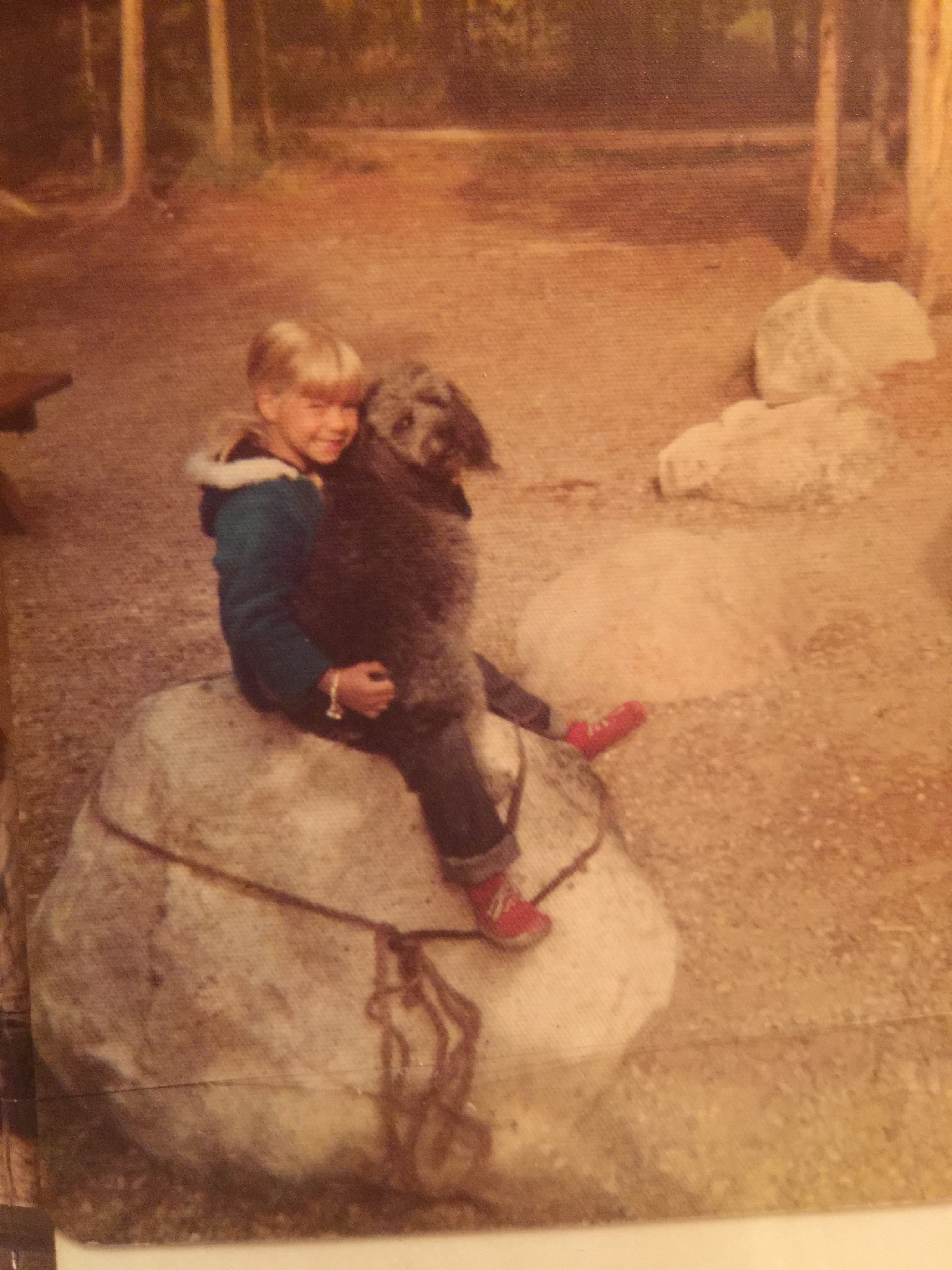
I wrote: take long drives after dinner, play speed games, and climb rocks camping with my BFF standard poodle, Ty.
Then she asked us to compare our bliss now and as kids to what we do in our businesses every day.
Blink.
I mean really, what does the miracle of the African savannah and childhood antics have to do with GKIS?
Blink. Blink.
You can tell me if I’ve lost my mind, because our coach Zhena makes us feel like that sometimes. But with her suggestion, I was struck all at once. My bliss in Tanzania was about the anticipation of thrilling discovery. Thrilling discovery is what childhood is all about. Discovery is why kids tear apart the house, ask incessant questions, and beg for screen time. Watching kids geek out over lady bugs and Mexican Train and Minecraft and Snapchat and Fortnight – that is what parenting is about. Watching our children play and joining them in it is about Discovery.
My work as a psychologist, teacher, writer, and researcher is the same type of discovery I loved on my after-dinner drives with my family. Imaginary mountain climbing on rocks while camping was about adventure. And speed games is pure connection and delight. Parenting and my work as a psychologist is not about this all day, every day. But all of those elements are woven into my job. I get the privilege of watching people discover the pathways from dark places to the light.
Since that blissful midmorning in sunny Africa, I have described that scene to clients in my office while I teach imagery and mindfulness – clients ranging from 6 years old to 76. Then they tell me a scene that is special to them. It’s a moment of connection in the therapy office. A moment where we share our bliss. It’s intimate and fun and connecting, not unlike how it feels to hang out and be truly present with your child. It’s what we are born to do…connect.
The truth is, the reason why screen time is so compelling is because it is ALL about discovery and connection. We can’t turn away from the stimulating, on-demand content. It’s intoxicating. It distracts us from everything and everybody. We get high on it.
That’s not all bad. Learning and discovery is amazing. But research also tells us that learning and discovery in the three-dimensional world outside of screen time is also necessary for balanced health and happiness. GKIS is about connection, discovery, and balance. It’s about supporting each other with strategies and tools to help us guide our kids through this maze of temptations on- and offline.
So, there it is. GKIS is my later-in-life adoption that allows me and my subscribers true discovery. And from my recent inner reflections, I’m reminded that kids hijack peace and quiet, organization, and self-care. Parenting is chaos in motion. It captures us in ways that no other activity does. For me, memories of taking care of my toddlers brings me gently delicious images of bedtime snuggles and kitchen dances. The impossible moments of trying to keep the house clean and stepping on llegos are far dimmer in my memory. Special moments are what you too will remember.
I hope you are inspired to take a moment and write about your recent moment of bliss. Maybe it was a steamy cup of tea early in the morning, or a walk with your best friend, or a snuggle with your child. Or maybe it was an exotic adventure like mine. Whatever your bliss, please take the time to notice it. Even better, create a magic 20 minutes of stillness once a week to curl up on the coach and read your weekly GKIS article. Reflect on how your family is growing and the gaps that GKIS ideas can help with. Journal. Make a gentle plan for progress. Screen safety certainly, but far more delicious are the magic moments of connection that you will have with your family.
I can’t wait to hear what you think of GKIS ideas in the comments of the blog, on FB and Instagram, or email me directly at DrTracy@DrTracyBennett.com.
I’m the mom psychologist who will help you GetKidsInternetSafe.
Raising kids in the digital age is tough. Not only are kids going through baffling developmental stages and life crises, so are their parents. Plus, each family member has a unique personality, belief system, and behavioral history that lead to varying “fits” between members at varying times. Throw that in a blender and you have a family. To make it more complicated, divorce peaks during trying times, upending everything even more. Divorce conflict, shared custody, and blended family issues can lead to exploitative and manipulative opportunities, especially with powerful mobile devices in-hand. My clients have benefitted from both using our free CONNECTED FAMILY SCREEN AGREEMENT. This digital contract gives both households sensible rules and strategies so kids have consistency and cooperative guidance. To align on parenting strategies and get more confident with setting rules and adopting parental controls, our weekly parent and family coaching videos delivered on the GETKIDSINTERNETSAFE APP is for you. Quick 5-minute videos a week allow you to tweak screen safety and positive parenting in your home in doable chunks. Demonstrating that you are consistently addressing screen safety looks great in court! Another option to help your tweens and teens directly build knowledge and psychological wellness with our SOCIAL MEDIA READINESS COURSE FOR TWEENS & TEENS. It’s like driver’s training but for the Internet.
In my twenty-six+ years as a clinical psychologist with a specialty in family transitions, I have run across practically every family situation you can imagine. Not only can divorce strain parent-child alliances, but fear can muddy parent judgment as they jockey to win child favor and aim to achieve parenting perfection in less-than-perfect times. With everybody distracted by their own emotional processes, consistency, and communication too often slip leaving kids vulnerable for risk.
Here are three fictional family stories that resemble actual situations to illustrate the complex factors that divorced families face.
Safety, Parental Alienation, & Home Privacy
Sally and Joe were married for fourteen years. They have two daughters, 13-year-old Maggie and 10-year-old Jacqueline. The marriage dissolved when Joe was discovered having an affair with Pamela. Sally shared too much information with the girls during her heartbreak, blaming Pamela for the breakup and begging Joe to make the marriage work even after discovery. Pamela and Joe married six months after the divorce was final and were granted shared custody of Maggie and Jacqueline as well as Pamela’s son and daughter.
Sally didn’t trust Joe and Pamela to take good enough care of the girls. She constantly worried about Joe not checking the girls’ homework, believed Joe and Pam drank too much, thought Pamela favored her own children and became particularly angry if Joe socialized with old friends. The girls felt protective of their mom and felt guilty leaving her during dad’s custodial time. They also wondered if mom’s fears were true and they were being unfairly treated and not adequately attended to.
Sally bought both girls mobile phones outfitted with the social media they wanted and encouraged them to call, text, and send images frequently with the hopes of gathering evidence she could use in family law court. She also posted accusatory memes about Joe and Pamela on her Facebook. If Joe set limits with the mobile phones, Sally argued the restriction prevented the girls from seeking appropriate help in an emergency situation, which further demonstrated to the girls that Joe was not protecting them.
In her cloud of grief, fear, and anger, Sally was committing parental alienation. Parental alienation is a pattern of psychological abuse toward a child by creating fear, disrespect, or hostility toward the other parent with the ultimate goal of parent-child estrangement. Parental alienation has been demonstrated to be detrimental to child mental and physical health and parent-child attachment. When caught in the destructive dynamic, family members are nearly incapable of post-traumatic growth, spinning helplessly for sometimes years in the eye of the storm.
Illegal Surveillance
John is a twelve-year-old who’s divorced parents have conflicting views on-screen use. John’s father allows him to use his phone and
other screen devices as much as he likes with no filtering or monitoring. His mother, on the other hand, does not allow him to use ANY screen devices. What John does not know is that his father secretly installed spyware on his mother’s devices during their divorce in order to gain information against her and has a history of domestic violence and pornography addiction. John’s mother has a restraining order against her ex-husband. She does not feel safe having mobile devices in her house that her ex-husband has purchased in case of spyware. She also worries about the online content her son has access to for fear of him becoming addicted like his father. John prefers to be at his father’s house because of the more permissive screen access and accuses his mom of being too uptight and paranoid. His dad laughs with him and agrees.
Consequating Dangerous Child Behavior
Dave and Laura have been divorced for two months and have two sons, 16-year-old Chad and 14-year-old Ian. After the divorce, both boys were living with their mother with weekends and certain holidays spent with their father. Chad has AD/HD and an anxiety disorder; Ian is in independent study due to oppositionality and defiance.
After suspecting Chad was using drugs, Dave demanded to see Chad’s phone. When Chad refused, Dave grabbed the phone and found photos of Chad smoking marijuana at a house party. A screaming conflict resulted. Chad stormed out the house and walked several miles back to his mother’s house where she then called Child Protective Services. Dave insisted that Laura take Chad’s screen devices away as a form of punishment. Laura disagreed thinking it would isolate Chad from his friends at a time he needed them most and bought Chad a new phone with no filtering or monitoring. Chad has chosen to live full time with Laura and refuses to talk to Dave. Ian feels caught in the middle.
Co-Parenting Strategies
Co-parenting can be difficult in all family types, but shared custody poses particularly ripe opportunities for exploitation and manipulation during a time when parents need to be particularly astute about the prevention of digital injury due to unchecked screen use. To launch a healthy and safe relationship with screen media, kids need warm, encouraging guidance from their parents.
Parents who set standards and praise without being overly critical have well-adjusted kids. Theorists call this authoritative parenting. Evidence demonstrates it is better than uninvolved, permissive, (overly accepting), or authoritarian (overly controlling) parenting styles.
Authoritative parents are proactive rather than reactive. They set the stage for success and respond calmly rather than ignoring or being overly punishing in response to destructive child behaviors. Children from authoritative home environments not only achieve more in school, but they also demonstrate a stronger willingness to seek out and master challenges for personal satisfaction.
In the stories above, the parents let their divorce conflicts interfere with their parenting judgment and slipped into authoritarian or permissive styles. While authoritarian parenting promotes a form of structure for the child, the harshness and rigidity can lead to parent and child aggression and can cause the child to have low self-esteem and minimized self-worth (Paul, 2011).
On the other hand, permissive parents are kind and accepting but don’t implement safety measures or uphold rules. Thus, children can become entitled, depressed, or anxious (Paul, 2011). Even parents who were once authoritative will sometimes escalate their tendencies in order to counterbalance the strategies used in the other custodial home. This leaves kids ping-ponging between sometimes hostile perspectives and varying rules for conduct. They will often choose the more permissive parent due to their inability to recognize the long-term implications of their behaviors.
In response to these challenges, family law courts often refer or order parents to use educational resources like co-parenting classes, schedule sessions with supportive professionals like child psychologists, therapeutic and legal mediators; or even order minor’s counsel to represent the children’s best interests. Parents may also be ordered into individual or reunification therapy which can lead to positive change.
When working with co-parents, I strive to empathize with the very real challenges of single parents and working through issues that make kids hard to handle. I remind them the situation is usually temporary. In most circumstances, grudges heal and parents recognize that parenting must take priority over vindictiveness. Kids will eventually see manipulation, often resulting in delayed insight. Nobody wins. Patience, empathy, grace, and kindness help kids heal. Sometimes we all need lots of nudges and gentle reminders, whether it comes from family, friends, lawyers, judges, or mental health professionals. Kids come first.
Thank you to Ventura family law lawyer extraordinaire Joel Bryant for the valuable information he contributed to this GKIS article and to CSUCI intern Allie Mattina for her research. To best understand the complex developmental factors of family life and learn effective screen safety strategies, check out Screen Time in the Mean Time: A Parenting Guide to Get Kids and Teens Internet Safe. Full of developmental brain facts and helpful tips and information, setting structure and sensible teaching conversations is a great start to family safety and stability.
I’m the mom psychologist who will help you GetKidsInternetSafe.
Screen technology provides amazing entertainment, convenience, and communication as well as a wide range of problems, particularly for kids and teens. Parents and professionals complain they can’t find the perfect tech toolbox to help. There are a lot of costly third-party solutions out there, but where do parents start? None seem to cover all the bases! Apple may have helped us by launching the Screen Time setting in the new iOS 12 update. Promising more speed, the ability to FaceTime up to 32 people at once, new personal animojis, stickers, and filters, augmented realities, easily sharable photos, searching, and shortcuts, Apple is committing to more “power” overall. Features that promise to help us control our use include auto turn-off Do Not Disturb, Instant Tuning to selectively turn off notifications, advanced shortcut and privacy features, and Screen Time tracking. Find out what you need to know in today’s GKIS article.
Tracking Your Usage
This update offers Screen Time, which will allow you to see which apps you use most often and how much time you spend on each activity with an easy-to-read bar graph and data count. Screen Time also allows parents to see which of your kids is the Twitter addict and which is up past their bedtime watching YouTube videos. You can monitor multiple devices linked to your iCloud account.
The Screen Time feature also tracks how many notifications you receive and from which apps they are coming from. Screen Time even tells you how many times you picked up your phone, a number that may surprise you.
Setting Limits
There are several limits that you will find with this update. If you see that social media is taking up a majority of your child’s day, you can set a timer on that category and for the entire day they will only have a set time to use their phones for that specific purpose. If your concern is about a certain app, like Snapchat, then you can just set a limit on that app alone.
Another useful tool is the Content and Privacy Restrictions, which allows you to monitor your child’s internet usage and their app store purchases. This is a simple way to ensure that your child is not viewing graphic or inappropriate internet content.
The last major setting that can be utilized by this new update is called Downtime. Downtime allows for you to schedule time for yourself or your family to disconnect from the distractions of your apps. This may sound a lot like Airplane mode, however the difference with Downtime is the ability to allow certain apps to continue to be used. Calls and texts come in automatically with Downtime, but if you can’t be without your emails you can allow that to remain active during this scheduled break.
Opportunity to Start Important Screen Time Conversations with Your Family
With the new Screen Time feature, your kids may feel like their privacy is being infringed upon, and you aren’t giving them enough space. However, we at GKIS feel that filtering inappropriate content and monitoring screen use is an important aspect of parenting, especially for younger kids and teens.
Rather than avoid the discussion and lock their screen use down, negotiate what seems reasonable for your family. Have spirited conversations. Share important facts about risk and benefits that you learned from GKIS articles. Team work builds stronger relationships.
There is no more influential tool for screen safety than a healthy parent-child relationship. Trust is earned on both sides. As stated in Dr. Bennett’s book, Screen Time in the Mean Time, your attachment to your child is a relationship built upon communication, negotiation, and fun. It’s important to ensure that your children’s privacy is something that is as important to you as it is to them, and that seeing where their time on their phones is spent is a way to look after their digital health and social well-being.
Recap
You can see which apps are the most used and for how long
You can set limits to specific apps and categories of apps
You can set content restrictions for internet and iTunes usage
You can set a bedtime for yourself and your children
Thanks to GKIS intern Adam Ramos for keeping us up on the latest! We at GKIS are big fans of Apple’s new Screen Time innovation. It is worth carving the time out of your chaotic parenting schedule to check this one out. It’s easy to use, free, and a giant step toward personal screen time accountability. Need support how to start these important family conversations, set your home up for safe screen use with handy tech tools, and get your family behind sensible rules? Check out the GKIS Home Starter Kit. In 10 easy steps and in as little as two hours, you can make several giant steps toward a closer relationship and better screen safety in your home.
I’m the mom psychologist who will help you GetKidsInternetSafe.
Are you fighting the homework wars? Wondering if screens during homework are helping or hurting grades? We can’t take screens away during homework time anymore. So much of it is online! Kids insist that tech helps them learn better. But does it? Today’s GKIS article covers who tech can help with learning and how it can interfere.
How We Learn
We have to have a good memory to earn good grades. To learn, we must encode, or anchor, that information into brain memory storage. This type of learning happens as we engage with the material over and over. Memories also encode while we sleep. Changing short-term memories into long-term memories happens through biochemical and electrical processes called consolidation.
Different types of memories store in different parts of the brain. Memorizing factual information (required to perform well on tests) primarily involves the part of the brain called the temporal cortex. Intentionally learning facts is called explicit memory.
Memorizing how to do something, like tie your shoes, is called procedural learning. It is stored in the areas of the brain that involve motor control. This kind of learning is called implicit memory.
Emotional memories (like those that occur in traumatic situations) are stored in multiple brain areas including our emotional center, the amygdala.
Research suggests that kids studying while watching TV may encode that information as procedural rather than factual data. Encoding in the wrong brain region makes fact retrieval at test time more difficult. How and where you study also makes a difference.
How to Facilitate Learning
To learn well, we must start with great brain health, get motivated, set up a good workstation, and follow best learning practices. Are you practicing these learning techniques?
Good self-care, brain health, and cognitive fitness are the foundations of learning engagement (like sleep, nutrition, exercise, and a positive mood)
A distraction-free study environment
Efforts toward mental engagement: attention and motivation
Putting the learning content in a variety of different formats (listening to a lecture, reading notes, writing notes, re-writing notes, watching videos, engaging in discussion, etc.)
Memorizing material in a variety of study environments
Making unique meaning of the material, such as generalizing and applying the concepts, especially with emotional connections
Repetition and practice
Avoid doing two tasks at once that require the same cognitive resources (don’t multitask)
Uninterrupted brain rest after each study session (mindfulness, meditation, time out in nature)
The Benefits of Screen Time for Learning
Screen devices can be amazing learning aids. Not only do they help us put the material in different formats, but they are fun and convenient to use! Here are some of the ways screen time benefits our learning.
With our screen devices, we have immediate, easy access to massive stores of information.
The biohacks built into our devices make learning fun. We are captured and motivated.
Online quizzes and testing help us immediately assess where we are with our learning.
Learning programs dish out progressively challenging content at a pace that matches our performance.
Screens give us access to others for group discussions and crowdsourcing problems.
Screens offer cool and create learning formats, like project management and brain mapping systems.
Gamifying content helps us learn and have fun!
Best Learning Strategies
1. Learn from the get-go.
Don’t waste a moment of studying. Be an active learner the minute you come into contact with the material. Actively engage with the content while you read the textbook, take notes in class, and watch the videos. Participating in class also helps deep processing of the material!
2. Learn while you format study materials.
Outline the text and rewrite and highlight your notes. Attend to and connect the main concepts. Leave out illustrative details so you have only essential material (fewer pages) to memorize.
3. Set the stage to study.
Block out sufficient study time over several days using a block-scheduling download from the Internet. Prepare yourself and your study space to optimize learning. Make sure you are comfortable and fit (fed, hydrated, rested) with a positive attitude about studying. Find a comfortable, non-distracting study location. Turn off your phone and other notifications and commit to studying only, no social media or Internet surfing.
4. Engage with content, don’t kill and drill.
For a student to learn effectively, they must engage with the content and integrate it into a meaningful framework. Students often make the mistake of mindlessly rehearsing isolated facts, thinking time spent is evidence of learning. Kill and drill is a waste of time and mind-numbingly punishing. Deeply processing information is the best way to learn.
5. Create learning pathways.
Each time we encode a fact into the hippocampal area (memory center) of our brain, we create a learning pathway to that content that can later be traveled for retrieval at test time. Increasing the number of pathways to that encoded fact is the process of effective learning.
In items 2 and 3 of this list, you already paved the initial pathways! The first pathways include when you listened to the lecture, wrote notes, read the textbook, answered the teacher’s questions, and formatted study materials.
To pave additional pathways to test content, find creative ways to further engage with and elaborate on the material while you study. The more emotionally and cognitively meaningful the material is for you, the easier it will be to learn. For example, use the Internet to view the study material in a variety of vivid formats, such as illustrative maps, diagrams, pictures, speeches, or videos. Link the information to emotionally meaningful memories or associated topics. Study from a variety of locations. Form a study group and talk with others about the content.
6. Rehearse the information and practice retrieving it and applying it just like you would at test time.
If the test is multiple-choice, make up questions that would lead to memorized facts. If the test is an essay, practice outlining and writing essays on that material.
7. Study small chunks of material at a time over several days, eventually linking the chunks together.
Don’t cram at the last minute. Your brain needs time to deeply process newly learned material. It will even process when you’re not actively studying, even in your sleep! That means it’s best to learn and rehearse chunks of material over several days. By test time, the chunks will come together for easy, A+ retrieval.
Fostering the love of learning is the best thing we can do with our kids, that means helping them learn better and achieve a healthy balance on- and off-screen. For more learning tips, view my free video, “How to Study Effectively: Metacognition in Action.”
I’m the mom psychologist who will help you GetYourKidsInternetSafe.