Four out of five GKIS interns this semester admit to visiting dangerous video chat sites as middle schoolers despite parent warnings. Could that mean it’s common these days? After surveying friends, we think so. Parents have no idea what kids are actually seeing and doing during these online chats. Today’s GKIS article is the real story from the mouth of a millennial, where I discuss how we worked around parent supervision and what actually happens in popular chat rooms. Learn what video chat rooms are, the dangers associated with them, red flags to look out for, and just how simple it is for your child to access them. With this information, you can parent smarter and prevent digital injury … our GetKidsInternetSafe mission.
Video Chat Rooms, Sites, and Apps
Video chat is a way to interact face-to-face with anyone around the world through webcams. Video chat rooms are on multiple platforms including online websites and apps on your child’s smartphone, computer, gaming system, or tablet.
To place a video chat call, all your child needs are internet access and a webcam. Video chat sites and apps can also include alternative ways of communication such as instant messaging and chatting through sharing photos. Video chat sites and apps randomly pair your child with another user.
The Most Popular Video Chat Websites and Apps
There are hundreds of video chat websites and apps that are easily accessible. Many video chat sites and apps are free, while others require purchase. The most popular sites include; Omegle.com, DirtyRoulette.com, ChatRandom.com, and Chatroullette.com.
Video chat sites accumulate millions of users a month, with the most popular being Omegle.com with a whopping 34,000,000 monthly visitors.[1] The most popular video chat apps for Android and IOS devices include Badoo, Telegram, and Azar. Similar to video chat websites, these apps are used by millions of people. The most popular video chat app is Badoo, with over 460 million users.
Why We Did It
Kids love discovery and novelty. Just as they would visit random neighborhoods in town if they could drive, they love to browse random neighborhoods on the internet if they have access. Get them with their friends and they’re even more reckless and bold. That is why we offer our GKIS Screen Safety Toolkit. Parents told us they felt overwhelmed by the number of parent-management tech options, so we made it easy for you. The GKIS Screen Safety Toolkit is a family-tested, outcome-based resource guide with our best recommendations, how-to information, and links to our favorite easy-to-onboard parental control systems. With the toolkit, you’ll be set to create the custom screen safety toolkit for your unique child. Managing your child’s access is a first step toward protecting them from dangerous choices.
Our parents didn’t have these resources. That’s why we were video chatting with strangers by middle school. When I was thirteen years old, using Omegle and Chatroulette was the fun thing to do. My friends and I would go on during sleepovers and after school hangouts. Occasionally, I would even access it late at night when I was alone in my bedroom.
We did it because it was funny and exciting. We were kids having face-to-face conversations with complete strangers; it was interesting to us. We felt like we were the ones in control, and we always felt relatively safe. Disgustingly, a majority of the random connections would connect us to older males masturbating in front of the webcam. They would continue touching themselves even when they could clearly see just how young we were.
In my personal experiences, whenever a creepy man would be touching himself, my friends and I would quickly hit the skip button in hopes to be connected with a clothed person we could talk to. But there were also times when we would chat with one of those perverts and let them know how disgusting it was.
Now that I’m in my 20s, I realize just how dangerous and repulsive our online experiences were. Luckily, nothing horrible happened to us. But if I or a friend would have shared enough information or decided to meet up with someone we met from Omegle or Chatroulette, it could have been devastating.
Dangers of Video Chatting with Predators
Psychological injury can result from children viewing sexual behaviors or being groomed by predators online. It’s not uncommon for kids to be coerced to reveal identifying information like where they live, where they go to school, and who their friends are. From there, some predators will persuade their victims to meet up in person, which can lead to a number of dangerous possibilities.
Red Flags That May Signal Risk
Your child interacting with a predator may go unnoticed, but there are a few red flags that you can look out for. For example, your child may be at risk if they
become secretive about what they were doing online or change screens the minute you walk into the room,
regularly deletes their browser history or their browser is typically on private browse,
spend a lot of time on the phone or computer, or
seem nervous when asked if the parent can check their history or search their phone.
For a more comprehensive list of child red flags, check out our Cybersecurity Red Flag Supplement. Three-tools-in-one, this supplement to your free Connected Family Agreement offers:
Our GKIS CYBERSECURITY SUPPLEMENT – Did you know that kids are the #1 targeted population for identity theft? That’s because the cybercriminal can benefit from fraudulent charges for years before the victim discovers it. Protect your family from hacking, scamming, malware, and phishing with our cybersecurity setup guide and best practices checklist (at home and while traveling).
PLUS
Our GKIS ONLINE SAFETY RED FLAGS FOR KIDS & TEENS – Parents in my clinical and coaching practices frequently ask me to teach their kids the red flags that may alert them to the tricks of online predators, hate groups, and cyberbullies. I offer you my clinical teaching list so you can educate your kids. Knowledge and assertiveness coaching are key elements of child resilience and good judgment online.
PLUS
Our GKIS ONLINE SAFETY RED FLAGS FOR PARENTS – Parents need to know the behavioral red flags that may signal their child is suffering a digital injury. This tool teaches parents what child behaviors to look for that may signal they are at risk – a tool I created from 25+ years of clinical practice. Being able to recognize behavioral red flags in your child may be the difference between stopping risk after one exposure versus not recognizing dangerous relationships and exposures until it’s too late.
With parent management tech tools, cybersecurity awareness, child education, and parenting tools to recognize risk, you are far better equipped to block anonymous strangers from predating on your kids.
Thanks to CSUCI intern, Remi Ali Khan for researching video chat websites and apps for this article.
I’m the mom psychologist who will help you GetKidsInternetSafe.
Onward to More Awesome Parenting,
Tracy S. Bennett, Ph.D.
Mom, Clinical Psychologist, CSUCI Adjunct Faculty
GetKidsInternetSafe.com
Photo Credits
Photo by Andrea Piacquido from Pexels
Photo by Julia Cameron from Pexels
Works Cited
[1] ChatHub. (2020, February 13). Top 12 Sites Like Omegle in 2020 (Ordered by popularity). Retrieved September 29, 2020, from https://blog.chathub.cam/top-12-sites-like-omegle/
Psychologists have successfully treated phobias for decades. Starting with education about what anxiety is, they then offer calming tools in preparation for exposure therapy. Exposure therapy is a form of therapy where the client and therapist focus on a specific fear and attempts to relax and gain control of the situation.[1] Initially, psychologists recommend imagining the thing their client is most afraid of. Then, over time, they work toward exposures of the event in real life. This can be difficult in situations where the real-life object can’t be found (like airplanes, spiders, and injection needles). Technology now has a solution for us. It’s called Virtual Reality Exposure.
Imagine being terrified of riding in an elevator. You sit in your therapist’s office with a headset and you are virtually walking into and riding an elevator. After several sessions with your therapist and the headset, you can walk into an elevator and ride it up several stories. Virtual reality is giving people the opportunity to overcome their phobias in the comfort and safety of their therapist’s office.
What is virtual reality?
Virtual reality projects an environment that feels real, but is not. Users wear a headset that resembles large goggles that have screens instead of lenses. Once the headset is on, users can only see what is being shown on the screens. They can no longer see anything around them. There are sensors in the headset that can tell when users move their heads. The screen view moves along with users heads to make it feel real.[2]
Top 10 Phobias
Phobias are extreme reactions to certain situations. Below are the 10 most common phobias among people
Arachnophobia: Fear of spiders
Ophidiophobia: Fear of snakes
Acrophobia: Fear of heights
Aerophobia: Fear of flying
Cynophobia: Fear of dogs
Astraphobia: Fear of thunder and lightening
Trypanophobia: Fear of injections
Social Phobia: Fear of social situations
Agoraphobia: Fear of being alone in a situation or place where escape is difficult
Virtual reality (VR) exposure therapy allows the client to face the object of their phobia through the headset while being in the safety of their therapist’s office. The therapist then coaches the client to manage anxiety during virtual reality exposure.
Benefits of VR Exposure Therapy
Gradual Exposure is More Tolerable
VR exposure is less triggering than real-life exposure. It’s an awesome second step, after imaginal exposure, to get them where they need to be before direct exposures.
Saves Time and Money
Real-life exposure therapy typically requires time and money to travel to different locations to treat the phobia. With virtual reality exposure therapy, travel is not needed since the therapy takes place in the therapist’s office – convenient, inexpensive, quick, and effective.
More Confidential
Any emotion elicited from the exposures will not occur in front of anyone besides their therapist.
Therapist Has More Control
The therapist can stop the simulation if necessary for the client. The therapist could also repeat the same simulation multiple times if the client needs it.
Less Risk
The simulation can end whenever the client needs to. For example, the client can easily get off the airplane in VR but in real life, the client would have to stay on the airplane once it has started taking off.[4]
I’m the mom psychologist who will help you GetKidsInternetSafe.
Onward to more awesome parenting,
Tracy S. Bennett, Ph.D.
Mom, Clinical Psychologist, CSUCI Adjunct Faculty
GetKidsInternetSafe.com
Works Cited
[1] exposure therapy. (n.d.). Retrieved from https://medical-dictionary.thefreedictionary.com/exposure therapy
[2] Emspak, J. (2016, March 22). What Is Virtual Reality? Retrieved from https://www.livescience.com/54116-virtual-reality.html
[3] Cherry, K. (2020, January 20). How Are the Most Common Phobias or Fears Treated? Retrieved from https://www.verywellmind.com/most-common-phobias-4136563
[4] Posted by Dr. Andrew Rosen, Rosen, D. A., & Anderson, J. (2017, April 7). Virtual Reality Therapy for Phobias. Retrieved from https://centerforanxietydisorders.com/virtual-reality-therapy-for-phobias/
Surveys reveal that depression and anxiety have increased for adults, teens, and kids. It’s unclear what is causing these increases, but longer workdays and overtasked lives may be strong contributors. Increased screen time on video games, social media, video and movie streaming, texts, and emails can be super fun and even improve productivity. But too much screen time can also lead to a mental brownout, a type of anxious fatigue that we may not even recognize until it leads to mental illness. Giving up screens to avoid it simply isn’t possible for most of us. But the good news is we don’t have to! Learn how smartphone health and wellness apps can benefit you without having to give up screen time!
Mental Health
Did you know that anxiety, depression, self-harm, and suicide is up 78% among teens?[1] In fact, by some estimates 1 in 6 children between the ages of 2 and 8 have a mental, behavioral, or developmental disorder. Left untreated, child symptoms may lead to more issues in adulthood.
Among children ages 3 to 17:
4% or 6.1 million have been diagnosed with ADHD
4% or 4.5 million have been diagnosed with a behavior problem
1% or 4.4 million have been diagnosed with anxiety and
2% or 1.9 million have diagnosed with depression.
Boys are more likely than girls to experience a mental, behavioral, or developmental disorder.[2]
Social Media Impacts on Children’s Mental Health
Sleep Deprivation
Social media has various effects on mental health, especially in children. Dr. Bennett writes in her book, Screen Time in the Mean Time, says that she feels sleep deprivation is the most common contributor to mental health problems today. The blue light on devices interrupts the sleep pattern and makes it more difficult to fall asleep. Many people also develop a compulsive impulse to check notifications which can also delay sleep.[3] Teens with sleep deprivation demonstrate lower achievement motivation, more teacher-child relationship problems, a poorer academic self-concept, and poorer school performance.
Self-Comparison
Too often, we see the best sides of our friends on social media. After all, nobody wants to read about the doom and gloom of a breakup or the fight someone just had with their mother-in-law. Positive posting can lead to friends feeling left out and generally bad about how their lives don’t compare. The GKIS article The FOMO EFFECT: How Fun Friend Posts Can Lead to Clinical Anxiety provides more information on self-comparison.
Distraction
Social media poses a major risk of distractibility. We tend to go on an endless cycle of content on one social media app or we cycle between multiple social media apps. This causes us to spend a longer amount of time on social media and forget about what we are supposed to do in the “real world”.
Mental Health Apps
Dr. Bennett recommends mental health apps to her clients all of the time. Free and convenient, they can be a great addition to psychotherapy. Even for people who aren’t in treatment, mental health apps can help us get to where we want to be by offering mood-enhancing toolkits, mood monitoring, and breathing and meditation ideas.
Mental health apps are awesome in that they are convenient, inexpensive, and even free, and available. They can be a comfortable first-step to wellness prior to (or even while) seeking out help from a mental health professional.
CAUTION: Keep in mind possible privacy issues due to the risk of data breaching and the release of private information to third parties. Many psychologists also agree that the apps are not as effective as seeing a mental health professional.[4]
Here are some mental health apps that GKIS is happy to share with you:
Sanvello
Sanvello is an app that aims to help you relieve symptoms of depression or anxiety by providing a complex toolkit of strategies and resources. It allows you to record your mood and health activities in order to track patterns.
There is also a Sanvello peer community that allows users to share stories, encouragement, and personal insights on any topic. The Terms of Service state “You must be over 13 years of age to use the Services, and children under the age of 13 cannot use or register for the Services.”[5]
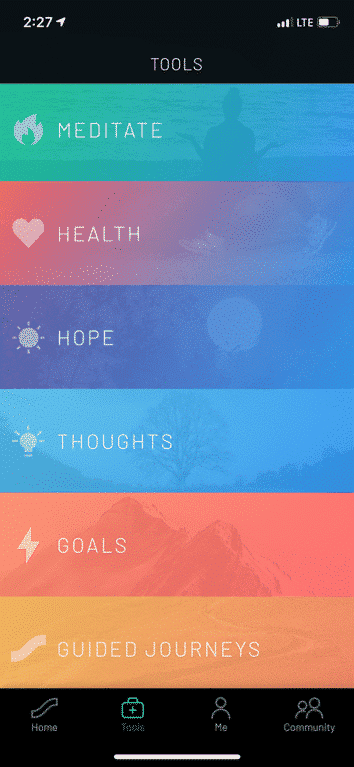
The toolkit provided by Sanvello includes:
Meditation: Lessons focus on specific topics like relaxing, mindfulness, stressful situations, and calm down.
Health: Helps you track health habits that may be affecting your moods such as exercise, drug use, and water or caffeine consumption.
Hope: This tool provides the user with a space to save photos, quotes, activities, and community content.
Thoughts: Provides a place for journaling, analyzing events that have occurred, or discovering characteristics that have contributed to a feeling.
Goals: Allows users to select a challenge such as reconnecting with a friend or saying hello to a stranger.
Guided Journeys: A series of journeys that encourage a user to accomplish something they have never done before.
Porchlight: Being There
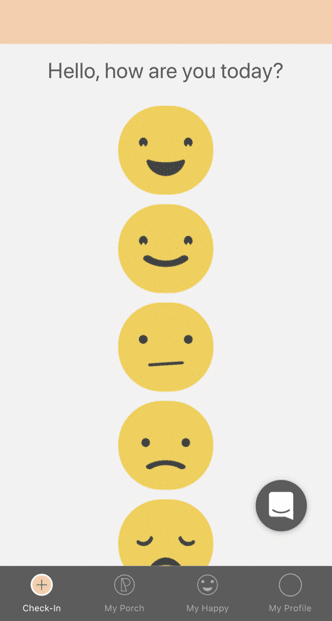
Porchlight is an app that is designed to allow loved ones to easily check in on each other’s mental health. The app prompts you to “check-in” once you enter the app where you can share your emotions using emoji. Users can connect with others which will send daily check-in notifications to the connected users. Porchlight provides prompts to check in with the connected users depending on what emotion they check in as.
Porchlight’s Terms of Service states “you must be 13 or older to register as a user or to use the app. If you are a minor, you must have your parents’ permission to donate through the App.”[6]
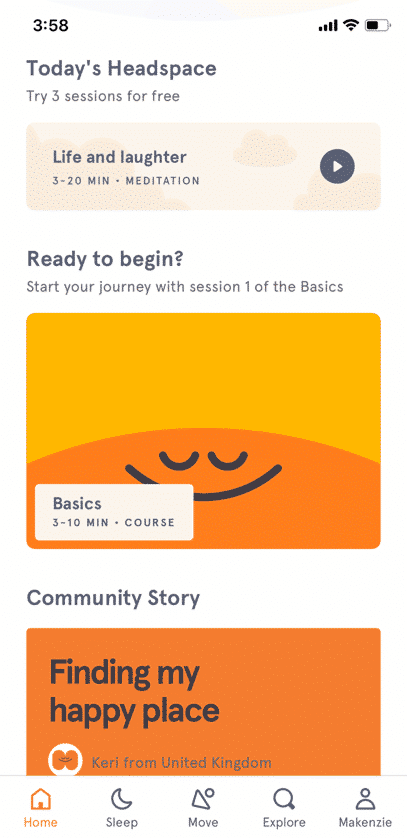
Headspace
Headspace is an app that provides guided meditation exercises to help the user become healthier and happier. Headspace claims that it can increase happiness by 16% with just 10 days of use. It is also a popular app with over 60 million active users.
There are 4 main guides to mindfulness within the app:
The Wake Up: Daily short stories and small meditations to help you start your morning on a good start
Move Mode: Exercises to help strengthen mental and physical well-being
Sleep: Sleepcasts, music, and audio experiences to aid a restful night of sleep
Meditation: Teaches everyday mindfulness to help at any time of the day[7]
According to the Terms of Service for Headspace, “You must be 18 years of age, or the age of majority in your province, territory or country, to sign up as a registered user of the Products. Individuals under the age of 18, or the applicable age of majority, may utilize the Products only with the involvement and consent of a parent or legal guardian, under such person’s account and otherwise subject to these Terms.”[8]
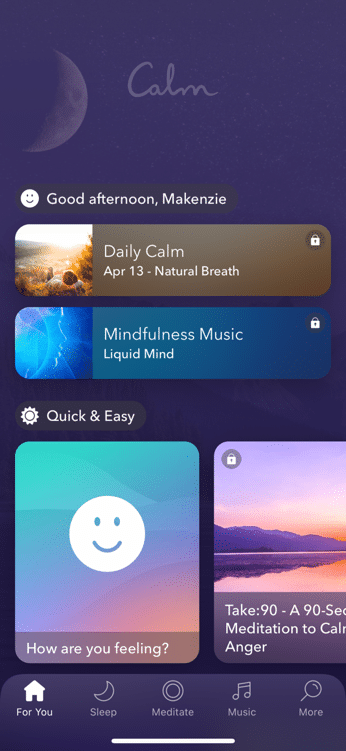
Calm
Calm is an app designed to assist users to develop healthy mental fitness, relax, and good sleep habits. The goal of the app is to introduce people to the benefits of mindfulness through meditation.
There are 6 different items of focus in the app:
Meditate: Teaches the skills of meditation
Sleep: Tools to have a restful sleep
Music: To help you relax, focus, or sleep
Body: Demonstrates mindful movement and stretching
Masterclass: Audio programs taught by experts
Scenes: Nature scenes and sounds to help relax and focus[9]
Calm’s Terms of Service state “you may only use the Services only if you are 13 years or older. To make a purchase via the Services, you must be 18 years or older and capable of forming a binding contract.”[10]
Thank you to CSUCI Intern, Makenzie Stancliff for providing insight on mental health apps. For more information about how electronics can impact our health, check out Dr. Bennett’s GKIS article, Is Wi-Fi Dangerous to Our Health?
I’m the mom psychologist who will help you GetKidsInternetSafe.
[1](n.d.). Retrieved from https://www.ajmc.com/focus-of-the-week/mental-health-issues-on-the-rise-among-adolescents-young-adults
[2]Data and Statistics on Children’s Mental Health. (2019, April 19). Retrieved from https://www.cdc.gov/childrensmentalhealth/data.html
[3] How does social media impact the mental health of young people? (2019, October 28). Retrieved from https://www.internetmatters.org/blog/2017/04/12/social-media-impact-mental-health-young-people/
[4]Technology and the Future of Mental Health Treatment. (n.d.). Retrieved from https://www.nimh.nih.gov/health/topics/technology-and-the-future-of-mental-health-treatment/index.shtml
[5]Home. (n.d.). Retrieved from https://www.sanvello.com/
[6]Being There. (n.d.). Retrieved from https://www.porchlightapp.io/
Fun trends on the YouTube Explore page attract audience attention and vet the best online content and influencers. To build child resilience and teach problem-solving and good judgment, we at GKIS encourage parents to carve out the time to share online interests and co-view YouTube channels with their kids. To help you get started (or continue) having fun online as a family, we’ve found some fun trends and creators that may be a great source of inspiration for developing new interests and hobbies. Having fun together and building digital fluency and an awareness of what’s hot and what’s not will help you build credibility with your kids. Even better, they will start to teach you about what’s out there, and, ultimately, work with you to make difficult online decisions. Our goal isn’t to shut your kids off from online discovery. Instead, we believe in family togetherness, online learning and discovery, and building child resiliency and safety – and having fun while you’re at it!
**CAUTION: GKIS has chosen these creators because of their family-friendly content and the variety of communities that they represent. Although we are excited to share these amazing creators, please keep in mind that some of them are more suitable for older teenagers due to their language and the nature of their content. Further, many of these creators have hours of videos that we did not sample. Please watch and decide for yourself the appropriateness of each channel for your unique child.
Mukbangs
A kind of video trend that has been popular in recent years has been Mukbang videos. Mukbangs, a trend originally popularized in South Korea, are videos where people eat large quantities of food while interacting with their audience [1].
These kinds of videos are popular with young people because they can be enjoyed as entertainment, to satisfy cravings, or to enjoy the creator’s style, humor, and personality.
We recommend you check out YouTuber Zach Choi. Zach, with almost 8 million subscribers, takes his viewers through his process of preparing for his mukbangs, consuming the food, and collaborates with other popular YouTube creators, both in and out of the Mukbang community.
In his videos, Zach silently eats large amounts of food with occasional captions that describe the foods or promotes the creators he features on his channel. Zach will often do a combination of a mukbang and an ASMR video. ASMR, or autonomous sensory meridian response, videos are videos that utilize audio and visuals in order to produce a tingling sensation that moves down the back and upper spine [2]. There are only certain people that get this “ASMR feeling”, and for them, videos like these can be very enjoyable to watch. Zach doesn’t seem to use inappropriate language, as he does not speak in his videos, or do sponsored content.
Technology Reviews
In the world of technology, YouTuber Marques Brownlee has made a name for himself with his thorough and unbiased technology reviews.
Marques is a creator who often trends on the YouTube Explore page and has over 10 million subscribers. For people interested in technology, watching Marques can be a good way to learn about the various features that go into different devices or simply get a professional opinion on what electronics to consider buying.
While Marques reviews technology, he does not promote buying the most recent devices or show bias towards certain brands. He simply reviews the newest technology on the market and gives his opinion on its features and performance.
For teens going into high school or college who need new devices for their academics, interested in creating content, or interested in studying technology, this is a great creator to watch. Marques very rarely does sponsored content and does not seem to use inappropriate language.
Food
In the food community, the brand Bon Appetit has created a popular platform on YouTube with a variety of series, all based on cooking.
Chefs from Bon Appetit post videos from their company test kitchen showing how to cook recipes from many different cuisines. What makes Bon Appetit different from your average Food Network cooking video are the chefs. While Bon Appetit’s crew of chefs provide detailed instructions on their recipes, they do so in a fun, humorous manner, letting their personalities naturally shine through and interacting with their fellow chefs in the test kitchen. This makes for some entertaining videos that have gained the attention of many young followers.
With fun and detailed videos, Bon Appetit has inspired this new generation to think twice about dining out and instead try something new in the kitchen. Two very popular series to check out are Gourmet Makes by chef Claire Saffitz and It’s Alive by chef Brad Leone. Bon Appetit does not seem to do sponsored content. This channel is recommended for an older audience, as some videos may contain explicit language.
Music
For people interested in music, the National Public Radio created a popular YouTube series called Tiny Desk Concert, dedicated to live performances from some of the most talented artists.
This YouTube series, which is on the NPR Music YouTube channel, posts new performances every month, with artists from varying genres and languages. These concerts differ from live performances, as they are played live with no prerecorded tracks or lip-syncing. Artists sing their songs live with either a band or by themselves with their preferred instrument in a small space that resembles an office desk, hence the name “Tiny Desk”, with a small studio audience.
This channel is great for young fans and music enthusiasts because it allows you to discover new artists every month, plus you can see your favorite artists perform their songs in new styles and see the different instruments and vocals it takes to best perform their music. NPR is careful with putting disclaimers in their videos for the artists that use explicit language, either in their songs or when speaking. This series does not do sponsorships, as they rely on donations from the public to keep the series going.
Charity
If you want to watch videos while contributing to a charitable cause, check out the YouTube channel Grandpa Kitchen.
This channel, with over 7 million subscribers, is a cooking channel created by a family in India to raise money for the local orphanage that they work for. The videos posted by this channel originally starred an older Indian gentleman lovingly referred to as “Grandpa” by subscribers. Grandpa would greet his subscribers and explain the meal he would be preparing for the orphans that day.
Grandpa cooked large quantities of food for all the orphans at his organization with the help of his grandsons. After Grandpa passed away, his grandsons took over the channel in order to continue the good work Grandpa started. Many families and fans from around the world have shared their support after Grandpa’s passing, and you can truly see how fans young and old were able to bond over watching Grandpa every week.
Although Grandpa is no longer with us, his grandsons continue to create videos with a similar format to Grandpa’s videos and continue to use the money earned from the channel to support the orphans with food, supplies, etc. These videos are in English, and the creators do not do sponsored content or use inappropriate language.
Discover Together
As we share these creators and communities, we encourage you and your children to discover new favorite communities and content to inspire you to create and discover beyond the screen. There are family-friendly creators in every community waiting to be discovered, all it takes is some time and patience.
Thanks to Alexandra Rosas-Ruiz for her research and help with writing this article. If you have questions about what your child is interested in on YouTube, try coaching sessions with Dr. B. These sessions, also offered online, can answer any specific questions on online safety and parenting in general. Sign up and receive special bonus products with your purchase.
I’m the mom psychologist who will help you GetKidsInternetSafe.
Instagram is one of the most popular social media apps among teens. It’s entertaining, easy to use, and offers different ways to create content to share with friends and family. Instagram is a great way to stay connected to others and share about your life. But besides following friends and family, there are many popular creators that can give your teens positive and inspirational content while scrolling through their Instagram feed.
What’s on Instagram
Instagram pages can either have dedicated themes or can be a mix of personal and themed content. Many popular Instagram users use their platform to keep fans updated on their personal lives and share positive and educational content. Because not all content is appropriate for kids and teens, we’re sharing seven (six plus a bonus) positive and influential Instagram pages that are safe for teens to enjoy. Although we’ve done our best to choose from the most family-friendly popular creators, check them out and decide for yourself whether they are a good fit for your teen.
Meet Our Favorite Creators
Entertainment
In entertainment, the Instagram page zachking creates entertaining and mesmerizing videos using special effects and editing.
Zach and his team choose and edit their videos in a way that makes his actions seem magical. Whether its defying the laws of physics, conjuring celebrities, or making things disappear or multiply, Zach’s content is entertaining and leaves you wondering how he does the different tricks in his posts.
Zach King is entertaining and inspiring for those interested in learning about video editing as a skill or even a career. Zach also posts about life with his wife and two sons. He’s done many collaborations with celebrities and fellow influencers and occasionally does sponsored content, marking sponsored videos with the hashtag “ad”. Zach does not seem to use explicit language or explicit images in his videos.
Design/Organization
In design and organization, author and TV personality mariekondo (Marie Kondo) is best known for her organizational methods and lifestyle tips. Marie’s page is full of beautiful photos and videos made to inspire people to declutter their spaces.
This page can be useful for young teens to see how they can best make use of their space and easily keep organized. Plus, it can be really beautiful and satisfying to see clean, organized, and well-decorated spaces.
Marie is a firm believer that your space, as well as the things in it, should “spark joy.”After scrolling her page, you’ll feel inspired to clear out the unnecessary clutter in your life to live happier and more stress-free.
Aside from her design and organizational content, Marie shares photos from her fans on how they’ve decluttered and decorated their spaces and also posts videos about her two children. Marie does not seem to use explicit language or do sponsored content. The content she promotes is of her own products and projects.
Journalism
In writing and journalism, the Instagram page humansofny is dedicated to sharing photos and stories from New York residents. This page publishes stories and interviews from different individuals, whether it be about their current situation in life or an impactful story that helped shape who they are.
This page does a great job displaying the joys and struggles of contributing New Yorkers. It also does a good job of representing diversity in race, gender, religion, and political ideologies. For teens, this page can be a way to learn from different people’s experiences. By combining the images of the residents and their stories, this page also serves as a reminder to not judge others based on their outward appearance.
Caution: humansofny is recommended for older teens, since it talks about heavy topics like assault, addiction, abuse, etc. This page does not seem to use explicit language or do sponsored content.
Food
In nutrition and food, the Instagram page pickuplimes, run by licensed dietician and YouTuber Sadia Badiei, is a popular page full of vegan recipes. Food pictures have long been popular on Instagram. On Sadia’s page, you can find her beautiful food pictures and her easy recipes, perfect for people who want to go vegan or simply have a desire to start eating a more plant-based diet.
As plant-based food becomes trendier, this page is great for teens to get recipe ideas and get inspired to cook healthy foods to try and live a healthier lifestyle. Besides recipes, Sadia’s page contains posts about her hobbies, her partner, and positive messages towards her fans. Sadia does not seem to do sponsored content or use explicit language. She mainly promotes her YouTube channel on her page with links to her YouTube videos in her posts and bio.
Travel/Nature
In nature and travel, the official National Geographic Instagram page, natgeo, posts pictures and stories from different countries and cultures around the world.
Like food pictures, travel and nature have also been a popular form of content on Instagram. The National Geographic’s page contains beautiful photographs and descriptions of the people and places depicted, educating their followers about different traditions, environments, plants, and animals around the world. Their posts often reflect the different events and news stories happening in our world today.
This page is full of interesting stories and beautiful imagery that can inspire your teens to research different countries and cultures, maybe even sparking an interest in traveling. It can also serve simply as a way to relax and read about different people and places. This page does not seem to do sponsored content or use explicit language.
Business/Nonprofits
Lastly, in business and nonprofits, the official Instagram page for the nonprofit organization Kiva, kiva.org, promotes the work of the organization and shares the true stories of the people this charity benefits.
Kiva is an organization that gives small loans and provides aid in accessing loans to individuals and small businesses around the world. Similar to the Humans of New York Instagram page, Kiva shares stories from these individuals and small businesses, specifically about their work starting their business, and how the aid from Kiva allowed them to grow and become more successful.
This is an inspirational page that shows the impact nonprofits can make in the lives of others and how the hard work and perseverance of these individuals helped them become successful business owners. This page does not seem to use explicit language or sponsored content, the page only promotes their organization.
Bonus Instagram Page for Parents
While your teen is enjoying the content from these creators, parents can enjoy the content from our new official GKIS Instagram Page. Get updates and notifications about our newest blog posts and catch up with Dr. B and our team of GKIS interns. Our Instagram page is a great resource for parenting tips and effective ways to keep your family safe online.
Thanks to Alexandra Rosas-Ruiz for her research and help with writing this article. To learn more about Instagram and how to best protect your teen on the app, check out our GKIS Sensible Parent’s Guide to Instagram. Learn about how to access Instagram’s different privacy options, trends, language, and our tips for keeping your teen safe on the app.
I’m the mom psychologist who will help you GetKidsInternetSafe.
Shallow and manipulative influencers, the toxic culture of materialism and vanity, vulgarity, pranks, and violence have earned YouTube a mixed reputation when it comes to acting in the best interest of young users. Parents talk of wanting to ban it, but they also recognize the benefits it can have on their kids. Plus, kids LOVE it! Beyond the questionable content, the platform offers opportunities for creativity, education, socialization, and entertainment that is safe for young audiences. Many popular influencers create content with their younger audience in mind, censoring their language and actively selecting appropriate topics. Join us in this exploration of some child-and-teen-friendly YouTube creators and their potential to inspire children to explore the world beyond their screens.
YouTube as a Source of Educational Inspiration
With channels featuring art, technology, beauty, music, or the environment, YouTube offers millions of opportunities to explore. Many online communities have gained popularity over the last few years, including those centered around makeup, comedy, cooking, DIY projects, dance, and video games. Shows like Bill Nye the Science Guy and Sesame Street produce videos to educate children about the wonders of the world. Many even inspire kids to explore their interests and experience the potential in the offscreen world around them.
If you haven’t yet allowed your kids access to a browser or haven’t yet put solid safe screen parameters in place, Dr. B is here to help. For help with home setup and sensible rules, you’ll love our GKIS Connected Family Course. For tech tool tips and referrals, our GKIS Screen Safety Toolkit is the course you need. If online courses are still new to you or you just can’t find the time to take one, Dr. B also offers one-to-one coaching for effortless implementation. At the click of a button, she can set up a video or phone call to help you get started. You’re not in this alone anymore. GKIS and Dr B are here to help.
Child-Friendly YouTube Influencers Your Whole Family Can Enjoy
Baking on YouTube
Like the Food Network, a large food-focused community on YouTube has become popular. One popular creator in this community is YouTuber Rosanna Pansino, a creator known for her baking videos. With over 11 million subscribers, Rosanna has the largest baking channel on YouTube and rose to fame with her recipes for making baked goods with various themes based on pop culture. Rosanna has a charming, energetic, and bubbly personality, and provides detailed instructions for her videos. Her content is classified as safe for children and teens. She does not use inappropriate language and is transparent about advertised products that sponsor her content.
Beauty on YouTube
In the beauty community, makeup artist Tati Westbrook is well known for her makeup looks and makeup reviews. Westbrook’s channel, with over 9 million subscribers, publishes videos mainly reviewing various makeup brands and products. Tati has a calm, soft personality and gives detailed and honest reviews and recommendations on the products she discusses. Tati makes sure to put disclaimers in her videos if a personal bias is present in reviews to be as transparent as she can to her viewers. Her content is suggested for older viewers, as there may occasionally be language and topics not suited for young children. Westbrook does promote her personal brand of beauty and wellness products on her channel.
Education through YouTube
In the educational community, the YouTube channel Crash Course, with over 10 million subscribers, has been used by students and teachers as an educational aid to learning different academic subjects. This channel, created by brothers John and Hank Green, produces videos covering various topics in subjects such as math, science, history, psychology, chemistry, and more. Videos are designed to be entertaining and educational and to help new learners better understand the subjects covered. Due to the topics they cover, some of the videos could discuss sexual or violent information not suitable for all ages.
Sports and Humor
YouTube team Dude Perfect, with almost 50 million subscribers, are best known for trick shot videos, or videos where they attempt challenging sports moves that require significant skill and luck to achieve. We at GKIS love how they inspire children to go play outside to reproduce incredible sports tricks of their own. We didn’t see evidence of inappropriate language, and they appear to disclose which of their videos are sponsored.
Gaming and Education
The Game Theorists YouTube channel is unique for creating content discussing different video game theories using research and reasoning. The creator of this channel, who goes by MatPat, has gained over 12 million subscribers by discussing his video game theories using humorous narrations, quality graphics, and his energetic and animated personality. Many of the games covered are popular among kids, such as Minecraft, Five Nights at Freddy’s, Pokémon, and Super Mario Brothers. This creator does occasionally use offensive language. Also, some of the games covered by this channel may have violent and frightening plots not suitable for children. This channel appears to disclose which content is sponsored.
Wilderness Survival on YouTube
YouTube channel Primitive Technology produces videos on how to build in nature for survival without utilizing modern technology. This channel, with over 10 million subscribers, is unique in the sense that it does not provide verbal narration. All instructions and commentary are provided in the closed captions of the video. The videos on this channel are characterized by still frames showing the environment around the creator, with audio of calm nature sounds. The closed captions give detailed descriptions of the materials used, such as the different plant species shown in videos, and give easy instructions for how to build the materials shown. Given that there is no narration in these videos, there is no explicit language or content on this channel. There are currently no identified sponsors, only advertisements for the creator’s book shown after videos.
Dr. Bennett’s Current Fav YouTube Channel
When I presented my idea for this article to our GKIS intern team, Dr. Bennett raved about her current favorite YouTube channel Liziqi. With over 8.96 million subscribers, this 29-year-old Chinese YouTube celebrity is known for creating fascinating food and handicraft preparation videos. Beautifully shot to soothing music, incredibly hardworking and talented Liziqi can be viewed wandering gracefully through the forests and countryside of Pingwu, Mianyang, Sichuan planting and harvesting corn, rice, and cotton (among other things), making handicrafts like colorful weaved clothing and baskets, and creating expertly staged traditional Chinese food. Once you get started watching, it’s easy to be mesmerized.
Although we are excited to share our awesome child-friendly YouTube finds, many of these creators have hours of videos that we did not sample. Please watch and decide for yourself the appropriateness of the creators on this list for your unique child.
How Can You Select and Curate Content for Your Child?
To further protect your child against harmful videos, especially for young children, consider downloading the YouTube Kids app. This version of YouTube was created to show the most family-friendly content offered on YouTube [i]. The app allows parents to have more control over what kind of videos they want to be suggested to their child and gives more options to block certain videos, creators, turn off the search options, and more to protect your child from inappropriate content [1].
If you decide to continue using the regular YouTube app, there are certain settings that can help protect your child from harmful content. In YouTube’s settings, there is a “Restricted Mode” option, which helps hide inappropriate content flagged by users [2]. You can also turn off the “Search” option for YouTube so your child cannot search for inappropriate videos, and can only view content suggested to them or posted by creators they have subscribed to.
With a little time, cooperation, and creativity, you too can explore and discover family-friendly YouTube channels to share. While there are good reasons to be vigilant of the dangers of YouTube, it’s important to remember the positive aspects too.
Thanks to Alexandra Rosas-Ruiz for her research and help with writing this article. Along with the creators listed above, there are many new creators and communities rising to fame on YouTube. Want to know what makes them so popular? Check out GKIS article, “Why Are YouTube Celebrities So Popular?”
I’m the mom psychologist who will help you GetKidsInternetSafe.