Tik Tok is a social media app that allows users to create and discover short videos made and posted by users. It’s popular because it combines teen users’ love for social media, music, and creative shorts. They love the authenticity of sharing and creating Tik Tok offers. Dangers are that kids may post and view sexualized or stunt videos and explicit songs, post videos of others without their permission, users are commonly ridiculed and cyberbullied, they may read lewd comments, and there is potential for public direct messaging. Be aware that popular Tik Tok influencers produce highly sexualized content and the “For You” autofeed commonly offers up content that most parents find inappropriate for child viewing. Plus, it’s so fun it’s addictive. Kids can spend hours scrolling endless content. As always, make sure you have familiarity with Tik Tok before you allow your child to use it. And, of course, add it to your free GKIS Connected Family Agreement as an “OK” or a “not yet,” so parameters, rules and regs, and etiquette issues are understood. (If you haven’t downloaded it yet, enter your name and email on our GetKidsInternetSafe home page and it will be emailed immediately). For a comprehensive tween/teen course on how to stay safe on social media, know what to watch out for, and how to apply amazing psychology wellness strategies, check out our GKIS Social Media Readiness Training Course. It gets the conversations started about the truths of Internet risk,. Also, y\ou won’t want to miss the parent setup tips at the end of this article. Our GKIS Sensible Guide provides information that parents need to know to make an informed decision.
What is Tik Tok?
Tik Tok is an app that allows users to create 15-second videos. It’s based on a previously popular app called Musical.ly, which is no longer available. Tik Tok users can post videos they saved on their phones and add sounds, parts of songs, special effects, and filters. Recently, Tik Tok added a new feature that allows users to record their reactions to other Tik Tok videos. The app also includes a feature that notifies users when they’ve spent more than two hours on the app. Users seem to value creativity and authenticity over likes.
How long has it been around and how popular is it?
Tik Tok is developed by ByteDance, a Chinese Internet technology company. It was first released in September 2016 for IOS and Android. Tik Tok’s global offices are located in Los Angeles, London, Dubai, and Tokyo, among other places. As of October 2018, Tik Tok was downloaded 80 million times in the US and 800 million times globally. It is free to use. ByteDance makes its money through advertisements integrated into the app.
How old is old enough for adoption?
Tik Tok’s Term of Service states, “If you are under age 13, you may only use the Services with the consent of your parent or legal guardian. Please be sure your parent or legal guardian has reviewed and discussed these Terms with you.” As you know from other GKIS Sensible Guides, 13 years old allows social media apps to be in compliance with the U.S.’s Children’s Online Privacy Protection Act (COPPA). It has nothing to do with child psychology. Nobody assessed that 13 years old is a healthy age for app adoption. That is up to you.
Before you make your decision, keep in mind that before 13 years old, kids still have limited ability to understand potential consequences and lack impulse control. In Dr. Bennett’s book, Screen Time in the Mean Time, she recommends no social media app adoption until at least the second semester of sixth grade, when kids have more social experience for creative problem solving and are no longer transitioning into middle school. (If the seventh grade is a transition year in your community, she recommends waiting until spring semester for the introduction). Most parents will find that, even at 13 years old, they are uncomfortable with their kids viewing the sexually explicit and sometimes cruel content easily available on Tik Tok. Follow a few popular Tik Tok influencers to sample what I’m talking about. Of course, every family circumstance is unique. We at GKIS believe that parents are the ultimate authority on your children’s unique traits and “fit” with Tik Tok.
Tik Tok In the News
In December 2019, the U.S. Army and U.S. Navy banned soldiers from using the Tik Tok app on government-owned phones due to concerns that content shared with ByteDance could be used to influence and surveil Americans. ByteDance reports that it stores U.S. user data in the U.S. with backups in Singapore, so it is not subject to Chinese law. But as a security expert told me, “It doesn’t matter where they store the data, it’s how they access it that counts. China is well known for having an excellent ability to steal private data from foreign countries.”
In February 2019, ByteDance was fined $5.7m by the U.S. Federal Trade Commission for illegally collecting personal information from children, like names, emails, addresses, and locations. in violation of COPPA. The FTC found that Tik Tok failed to delete content from underage children despite receiving thousands of complaints from parents. As a result of the FTC fine, Tik Tok created an experience for underage users which allows them to only access curated, clean videos and not have the ability to comment, search, or post their own videos. Kids can work around this by simply entering a false birthdate.
What are Tik Tok’s popular features?
After opening the app through your smartphone, you have the option of looking at the videos of those who you follow, what’s featured, and videos under hashtags.
You can follow friends and other Tik Tok users. Those you follow will show up under “following” on the home page of the app. With a simple scroll, you’ll be introduced to the thousands of videos Tik Tok users create. Just because you follow someone doesn’t necessarily mean they follow you back.
To make a Tik Tok video, click the square button with the plus sign. Once there, the app will ask you if you want 15 seconds, 60 seconds, or photo templates. You also have the option to add sounds, upload photos or videos, and add effects. Users can also adjust the speed and add filters. Tik Tok provides sound categories like “Trending,” “Country,” “Furry Friends,” “Sweat It Out,” and even “Munchies.”
There’s a search feature that allows users to browse through various hashtags. They can also search through categories like “top,” “videos,” “sounds,” and “hashtags.”
You can personalize your “For You” feed by ♥︎ing videos you like or choosing “not interested” on those you don’t.
Tik Tok nudges its users to go outside of their groups of friends by immediately introducing them to group challenges, theme hashtags, and videos based on a popular song.
What is included in the personal profile?
Tik Tok makes signing up to the app simple. You can sign up with an email, name, and phone number or through your Facebook, Google, Instagram, or Twitter accounts or through your Apple ID. From there, you can choose to sync your phone or Facebook contacts with Tik Tok to see if your friends also have an account.
Along with a personal profile photo of your choosing, your profile page can also contain your bio, the number of people you follow, who follows you, and how many Tik Tok videos you’ve liked. If you have uploaded Tik Tok videoes, they’re displayed on your profile too.
The top left has a button for searching for friends on the app. The top right is a button for the settings. When you click on “edit your profile,” you have the option of adding your Instagram username or your YouTube channel, which will be public to those who can see your profile.
What are the privacy and safety options?
Many Tik Tok users love interacting with a large, global audience to spark creativity and enjoy fun feedback. As a clinical psychologist who sees how some of these collaborations with strangers can turn dangerous, I recommend a private account so you can approve or deny follower requests, and only users you’ve approved as followers can see your content. Of course, we encourage parents to discuss the pros and cons of use with their kids to reach a cooperative agreement.
To do this,
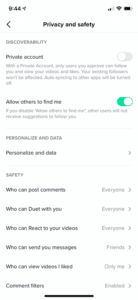
Click on the Settings button at the top right corner on your profile page.
Click on Privacy and Safety.
The first option is “Private Account” or “Allow others to find me.”
If you change an already-existing account to private, current followers will not be affected.
You can also remove or block followers at any time. Removing them disables their ability to direct message your teen. Blocking them stops them from interacting with or viewing your teen’s content at all.
Opting for Restricted Mode limits content that may be considered inappropriate. Users can also restrict comments to friends only or block them altogether. The can also disable messaging and disable duets.
Tik Tok offers a Screen Time Management mode with a passcode as one of their Digital Well Being offerings.
If you see inappropriate content while browsing the app, you have the option of reporting it within the app. We noticed that the report button is somewhat difficult to find in that it is hidden among other buttons.
As with most social media apps, the company collects information, including your name, email address, and phone number. They may also collect any messages you send through the app to friends. This is part of their privacy policy.
Tik Tok is rated a 12+ app store rating. This means you can block underage kids from onboarding the app with Gooogle and Apple parental controls. Tik Tok resources for parents include a Top Ten Tips for Parents primer, “You’re in Control,” safety educational videos, a Safety Center, and an ongoing blog series with helpful tips. The videos can be accessed directly in-app @TikTokTips.
What are the risks for use?
Constant Access
When kids are little, parents decide when playdates happen. Once Tik Tok is on board, keep in mind that your kids will have access to their friends whenever they have their device, and other Tik Tok users will have access to your kids. For many, that means 24/7 access. If you’re not OK with that, you’ll have to dock screens consistently or limit their access.
Inappropriate Content
Although the rules state that users younger than age thirteen shouldn’t be on Tik Tok without parental guidance, anyone can simply lie and accept the terms of conditions without informing their parents. Sometimes the content may not be filtered, and any kind of inappropriate content may pop up. Of particular concern is dangerous stunts, hate speech, and sexualized dancing to explicit music lyrics. Imagine watching your 12-year-old dancing sexy to lyrics that include the n-word, the f-word, p&^sy, and worse.
Cyberbullying
A fun video posted today can feel humiliating when viewed tomorrow. Since moderators can’t oversee all comments on the app, there is cyberbullying. Since being creative requires risk, public ridicule now or later is a real concern. Often the ridicule happens when the Tik Tok video is shared on other social media platforms, like Instagram or Twitter. The best way to prevent this would be to keep the account on private and add only people whom you know or are friends with. However, keep in mind that cyberbullies can always screenshot from a private account and share publicly. Users can turn off comments to prevent or stop cyberbullying on their content. Exclusion from posts about friend groups can also be hurtful. Imagine if your child is the one who was left out.
Trends & Attention-Seeking
Users can produce or view inappropriate Tik Tok’s and often try to attract large numbers of followers with poor posting or comment choices. For example, the trend for “Chop Chop Slide” involves kids filming their parents’ reactions to an unexpected string of very explicit lyrics. Many of these videos of their parents are likely shared without permission. To feed the need for likes, affiliative apps offer the purchase of likes for your posts and to buy more followers.
Stunts & Challenges
Most Tik Tok Challenges are incredibly skillful dance moves. You’ll also see kids singing along with their tongues out and clever facial expressions to vulgar lyrics alone and in groups. Like with the other social media platforms, you’ll also see some winners come up with something like the outlet challenge which involves shoving a penny in a charging cube for sparks. To see what I’m talking about, search YouTube for Best Tik Tok Compilations and prepare to be mesmerized for awhile. The talent Tik Tok inspires is amazing.
Online Predators
If your child’s profile is set to public, anybody signed into the app can view your child’s videos, comment, and message your child. The tech website, Motherboard, reported a large community of adults soliciting young Tik Tok users for nude photos and videos and even sent videos to the children. Lewd and hateful comments have been found on children’s videos. News reports say that, while Tik Tok has attempted to remove those comments after being reported, several inappropriate comments were left on videos. The owners of the accounts that left those comments were not suspended from Tik Tok and were allowed to continue commenting.
It’s Addictive!
Once you test the app, you’ll see how fun it is! It’s hard for users to resist the endless on-demand video content on the Discover page (indexed with hashtags) that is interactive, shocking, funny, creative, musical, and titillating. Be aware that popular Tik Tok influencers produce highly sexualized content and the “For You” autofeed offers up content that is similar to what has been viewed before. Kids spend hours scrolling endless content.
GKIS Parent Checklist for Tik Tok Use:
Disable underage use of this 12+ rated app using IOS & Android parental controls.
Test Tik Tok by creating an account and using the app yourself for awhile. It’s mind-blowing how creative users can be. It’s also helpful to search YouTube for Tik Tok compilations (e.g., “Tik Tok procreate compilations”).
Preset your chid’s account for best content by scrolling the home page liking appropriate videos & selecting “not interested” for inappropriate videos. Although it won’t keep them safe from viewing inappropriate content, it does preset the autoplay to a more positive autoplay pattern.
It’s also helpful to block influencers who commonly produce inappropriate content, while also “hearting” topics and influencers that match your child’s interests (e.g., singing, dancing, drawing, procreate, etc.).
Make sure you already have a digital contract in place (like our free GKIS Connected Family Agreement). Add it to your agreement as an “OK” or a “not yet,” so parameters, rules and regs, and etiquette issues are understood. (If you haven’t downloaded it yet, enter your name and email on our GetKidsInternetSafe home page and it will be emailed immediately.)
Agree that use is probational and visit Tik Tok’s Safety Center and watch their “You’re in Control” videos together (recognizing that once the content is posted, you no longer are in control).
Require your child to create a persuasive PowerPointthat covers risks, benefits, and privacy and protection features so you both know the in’s and out’s of Tik Tok’s features before you agree to it. For more information about how to create and judge a persuasive PowerPoint about a social media app along with other useful screen safety strategies, check out our Connected Family Online Course. The course was created to optimize healthy screen use while protecting kids and teens from digital injury. The best part about the course is it brings parents and kids closer with more cooperative negotiation around family screen rules. Once you agree on a trial, create a digital poster with a bullet list of the rules you agreed upon and tape it up in your home’s homework or computer space.
Limit use with Tik Tok’s Screentime Management feature.
Insist on a PRIVATE account so strangers can’t view your child’s posted videos, Select RESTRICTED MODE. Use FRIENDS ONLY for comments and videos.
Consider DISABLING messaging and duets at first.
Agree to how many personally-known friends are allowed at first to limit exposure while your child is gaining expertise and judgment. Remember, they WILL post, view, and message inappropriately no matter how great you parent. If that’s unacceptable to you, DON’T ALLOW TIK TOK.
Insist that you are friended and you have their username and password for backend control.
Set a #TechCheckThursday meeting to check friends, videos, messaging, and to ensure rules are being followed and everybody is safe. This will also keep the cooperative dialogue going.
Make a Tik Tok video together. Have fun with it!
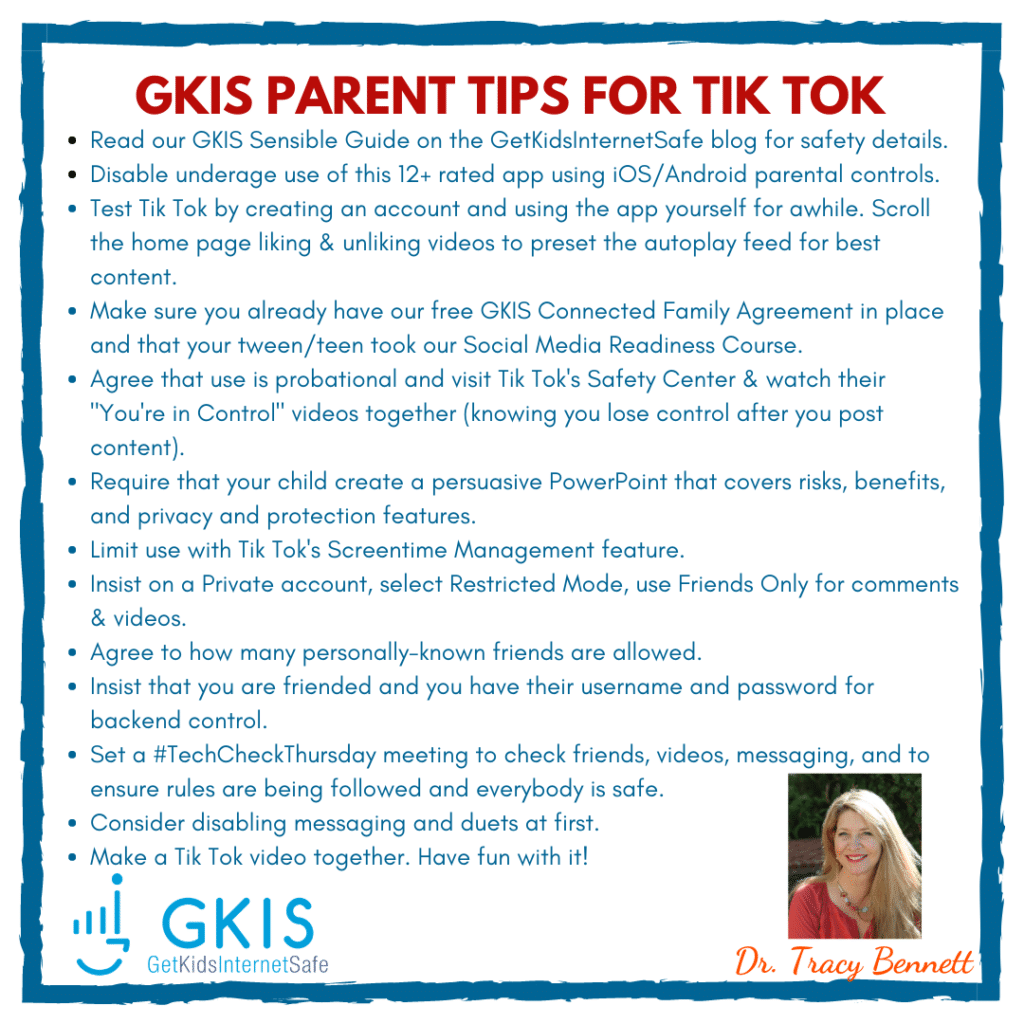
GetKidsInternetSafe rates Tik Tok as a red-light app due to the easy access to strangers, inappropriate content, bad judgment while posting or live streaming, and potentially harmful comments. Because the app has millions of users, it is difficult for Tik Tok moderators to weed out all of the unacceptable content. But there is also a legitimate argument for creative and fun sharing with a private profile. If you do opt to allow Tik Tok, be sure and get your child’s username and password and monitor posts. Share our GKIS Parent Tips on your social media for friends and family. HERE’S THE LINK TO THE IMAGE
Thank you to CSUCI intern Makenzie Stancliff for co-authoring this article. For more help with social media. judgment and overall psychological health, you won’t want to miss our GKIS Social Media Readiness Training Course for tweens and teens.
I’m the mom psychologist who will help you GetKidsInternetSafe.
When I clean house I like to talk on the phone. It keeps me from grumbling resentfully about why I spend so many hours a week moving other people’s stuff from one room to the other…as if I’m their SERVANT!
Anyway during one of those phone conversations, my friend told me something that has stuck with me and I feel compelled to clear it up. She said, “You know Tracy that the parents who see GetKidsInternetSafe (GKIS) suspect that you are that hyper-perfect mom who refuses your kids screen technology completely.” I choked on my packaged rice crispy treat, and then we cracked up.
Perhaps the irony hasn’t escaped you that I preach screen media limits through my ONLINE business. Moreover, I have seven (yes seven!) customized social media channels to help me.
And I have three happy, normal kids. I want them to stay that way. I don’t require that they live in a chemical-free room built of moss and dried twigs, drawing with repurposed berry ink and reading only the classics. That is only for #TechFreeTuesdays and #TechFreeThursdays.
The reason I created GKIS is because when I err (which is hardly ever), it is in the direction of being too generous with them. I mean technically, I love them too much. I work tirelessly for their care and am a shameless sucker for their begging. Dudes, I’m actually writing this article in an ear-shatteringly loud, massive volleyball complex that I drove two hours to get to at 5:30 am on a Sunday. I’d post a pic of the game, but the girls’ shorts are too short for public media (not kidding). And for the record, it’s intermission. That’s how much I love my kids.
It’s my love for them and my deep concern for all kids that motivated me to take on this enormous but important GKIS task. I’m not a perfect woman, but I do have some skills motivating and caring for little people. It’s what has allowed me to maintain a busy psychology practice for almost 20 years. From my office, I get the heart-piercing inside view of what all of us are going through and how we are coping.
Frankly fellow parents, we are in over our overly-scheduled, sleep-deprived heads when it comes to the rapid development of screen media technology. We are over-capitulating to slick marketing and our kids’ desperate pleas for the newest electronic device so quickly, that we don’t really know what the heck we are doing! We simply cannot keep up.
Let me just give you a rundown of the issues I’ve seen in my psychology office just within the last few months (details changed to protect confidentiality):
A 12 year-old who is obsessively communicating (and sexting) with an anorexic peer she met on a video game who is cutting and intermittently suicidal
A 14 year-old boy whose grades have been declining because he is logging into too many hours of online porn
A 17 year-old who is healing after he finally reported that his brother had been molesting him with fetish methods learned from online pornography when he was only 9 and 10 years old
A teen who faces expulsion due to videos she posted threatening a peer
A 10 year-old girl who was caught on a porn site and then later discovered to have had a social media account with sexually provocative memes and inviting comments
A 20 year-old who still acts out the dependence she had on her Internet predator from 12 to 14 years old
And a 17 year-old who is seeking psychostimulants because he has already experimented with practically every other class of drug that he expertly shopped for and marketed from his iPhone 6
Of course, some of these ages, genders, and details were tweaked to protect the identity of my patients. But the stories are not exaggerated. These are real children with devoted and fearful parents seeking my reassurance and consult.
The truth is, we don’t even know what all of this technology and inappropriate exposure is doing to our kids’ development. I personally have resorted to the purchase of chaotic herds of bunnies, chickens, pigs, and baby goats to distract my beautiful and precocious 13 year-old (not kidding), not to mention soccer and volleyball…
I’d give my children a life with a variety of healthy activities simply because I deeply want for them to feel awesome. And to do that, I must be a good enough mom. I want everything for them that I can comfortably (and sometimes not so comfortably) muster. That includes healthy distraction, balanced with quiet family time and a well-planned, sensible GKIS toolkit expertly designed for screen media safety.
Let’s face it, until they’ve moved into a home of their own, we will all sometimes worry that there’s a hint of desperation in our parenting generosity, desperation partially motivated by the frenetic bubbles of text messaging and the soft sound of a computer keyboard.
I’m the mom psychologist who will help you GetYourKidsInternetSafe.
I’ve just been through my first bomb scare. Thanks misguided middleschooler on Twitter and adult friend of a friend in Turkey who emailed the information back to responsible school personnel in California (at least that’s the mommy-rumor). Is the universe throwing me screen media crises just to keep me motivated or are they all happening to you guys too?
Mondays are the day I write from home. I’d just dropped off the kids and rushed through a quick walk with my best friend Nance when my phone rang. And by some miracle I actually picked it up to hear my thirteen year-old say with a mix of chirp and shake in her voice, “Mom, there’s a bomb scare at school. I’m fine. Please come pick me up. I’ve gotta go.” Then she hung up.
***
I pride myself in being calm, cool, and collected until all the information is in, but at that moment I was a few degrees left of totally freaked out. I’ve had a cold, I’m tired, and MY CHILD MAY BE IN DANGER. Reverse that for priority, but my point is I can’t sort through reason from emotion. While driving (sorry officer), I checked my messages. Sure enough, two minutes before my daughter called the principal of her school left a message saying:
“This morning at 7:13 am we were informed of a threat made against the school. We do not believe this is a credible threat, but we are taking precautionary measures to ensure the safety of students and staff. If you don’t feel comfortable with your child staying in school today, you can come to the back gate by the gymnasium and sign them out for the day. The children are safe with teachers on the blacktop. Again, these measures we are taking are precautionary, as we take all threats seriously. We will update you as more information is available. Thank you.”
I was nauseous. I just published an article titled Why Your Smartphone is a Nuclear Football, which details the ways lives get blown up with via text and social media. And now I sat gripping the steering wheel sorting out the degree of risk this Twitter-originating bomb threat had for my little girl. I was deadly calm outside with great potential for hysteria on the inside.
This has not been an easy three years for me. It started with my dad dying, the one witness to my life that was unconditionally loving and supportive. I managed his estate from 1,000 miles away amidst brutal family turmoil and a challenging lawsuit. Then my stepmother was diagnosed with cancer and underwent six months of horrific treatment before she died last summer. And while driving across the Mojave Desert to her deathbed, my mother was picked up by the police wandering demented and alone in a terrible neighborhood near the Mexican border four hours from home. I’d spent the past year desperately trying to convince her to let me get her treatment, only for her to refuse and being told by experts that I’d have to wait until she demonstrated true incapacity. It sucked in layers of suck. Not only was it a heartbreak to lose three parents at once, but to be responsible for tangles of legal and accounting nightmares. I can’t express how soul wrenchingly painfully exhausting it all was. Since then I’ve gone on to get conservatorship, secure her placement in memory care, and manage her estate, which included storing her belongings and selling her house. And that’s only half of it, but enough for you to get the picture. I was shouldering piles of emotional and time-consuming stressors with little opportunity for escape.
To make things more complicated, during this three-year drama my oldest daughter was struggling to cope with her involvement in the Isla Vista shooting and the loss of two young friends to freak violence. We have consistently worried about her safety away from home, because her privileged university neighborhood has been plagued by assaults, kidnappings, and burglaries.
In the midst of this personal turmoil, I continued my family and professional life while launching GetKidsInternetSafe.
You may be asking why in the world would I launch a business during such a difficult time? My answer is, “because I needed it.” I needed to be passionate about something that could make a big impact on a lot of lives. It simply made me feel better. While writing and setting up some impossibly complicated tech issue, I could shelf my pain and focus on something other than my emotional strain. It was the learning addiction I needed for true respite.
As my stressful projects are starting to wrap up, I’m grateful because I’m aware I need to heal from working too hard for too many. I’m getting my free time back and soaking in my blessings. And yet, life hasn’t gotten the memo. A bomb scare! Really? How many emotional and financial resources is Twitter costing us anyway?
After waiting in a long line to pick up my baby amongst tightly wound parents trying not to armchair quarterback about the school’s handling of the incident, I got her back. My blonde, gangly brilliant brown-eyed girl walked to me and giddily announced she and her friends want a beach day. Bomb scares come with perks it turns out.
Just like that, my fear evaporated. I brought her home and jealously watched as my oldest spontaneously planned a sisterly shopping and beach adventure, wishing I could go but knowing their bonding was bigger than my selfish need to join in the fun.
So now I’m doing what we psychologists call “emotionally debriefing” and writing to you, meaning I’m reflecting on my feelings and the situation that surrounded them wondering if I’m alone in the world or if others can relate. And I have to share with you guys that I’m still a little scared. Despite my optimism about people and our amazing kids, I have real concern that the power of screen media is taking us to places we’ve never been before, like middle school bomb scares. And maybe we are not doing enough.
I’m the mom psychologist who will help you GetYourKidsInternetSafe.
Earlier this week The Good Men Project published my article, “Hey Dad, Your Twelve Year-Old Daughter Has a “Nude Out,” and it’s getting some justified attention (over 20,000 views and 8,000 FB shares). As I watched the FaceBook share number rise, I realized that my title made the victim (the younger girl) the active agent instead of the predator (the older boy). Isn’t that kind of blaming the victim? Shouldn’t the boy be the agent in my title considering he is older, being coercive, and has intent to deceive in this scenario? But then again, predator is probably a harsh word for a goofy impulsive teenage boy, or is it? To make it more complicated, sometimes the girls are more willing to pose and distribute their “sexy” image than the boys are willing to receive it. Ultimately, both the boy and the girl may suffer serious moral and legal consequences. Join me in tackling this issue by considering what you want for your kids and how we might facilitate their delicate and important journey toward good judgment, compassionate morality, and sexual power.
Last week’s article detailed a spooky teen “trend” that I learned from teen clients in my private practice. This trend involves a well-traveled digital bridge between middle school girls and high school boys where high school boys deliberately plot and groom middle school girls to send sexy pictures via text. The boys then assign point values, share, and trade with their friends a la human Pokémon cards. Seriously, this topic makes me rant, and for good reason.
Admittedly, I’m somewhat conflicted in my feelings. On the one hand, I’m angry that a boy grooming a girl to expose herself on screen media at such a painfully tender age is manipulative, selfish, and potentially very damaging to both of them. And for the boy to share it without her consent is frankly criminal and makes him (and the girl) vulnerable to child pornography and revenge porn charges. But is it predatory? After all, let’s face it, teenage boys are pretty much drunk from a brain newly flooded with testosterone and their frontal lobe won’t be done developing until they’re around 23 years old. What’s more, the thousands of sexualized images of women, and to a lesser degree men, that bombard our kids on screen media everyday fuels this objectification. Even our adult culture has a long way to go to responsibly and sensibly deal with issues like intimacy and sexuality. The multi-billion dollar porn industry and lecherous sexual trolling on adult dating sites are testament to that.
I’m also angry with the girls for participating. What does it mean that so many young women willingly release images of their blossoming sexuality for praise, status, and attention? (Insert snarky comment about the queen of all sheep-wolves, Kim Kardashian, and her new bajillion-dollar-earning book of selfies here). Ugh. As parents, we want them to value all that they are, but not by posing languidly for the lecherous consumption of strangers. And unlike any time in history, it’s too easy to turn a confusingly sexy impulse into a consequence that may be in play for years to come. With this enormous technological power comes enormous risk. In such a complex digital landscape, kids need our involvement in their day to day decisions more than ever.
As a psychologist, I notice two glaring mistakes that parents make when dealing with these issues. First, they start too late. If you’re waiting until your kids are teens before you talk about gender, sexuality, and personal privacy rights, you are starting too late.
The second mistake parents make is they only challenge their daughters with discussion and leave their sons out of it. The digital bridge observation illuminates that we must teach girls AND boys to be respectful, nurturing, and responsible. Sexual education and social problem solving must happen with both genders. You’d be shocked how few boys raise their hands in my university class when we discuss who received sexual education in their homes. And the girls admit that most of their parents were only willing to awkwardly mutter quick comments about menstruation. There’s soooo much more to it than that!
In an effort to “walk the walk,” my husband and I staged a discussion about some of these issues over dinner last night. Although it admittedly deteriorated into goofy comments and sticky marshmallow spills on occasion, some awesome insights emerged.
My kids asked that I use discretion and not discuss their comments in a public article, but I loved the concept my Navy veteran husband used to help illuminate the issue of assertiveness and social responsibility. The quote comes from Lt. Col. Dave Grossman and Stephanie Rogish’s book, Sheepdog Meet Our Nation’s Warriors A Children’s and Educator’s Book:
If you have no capacity for violence then you are a healthy productive citizen: a sheep. If you have a capacity for violence and no empathy for your fellow citizens, then you have defined an aggressive sociopath—a wolf. But what if you have a capacity for violence, and a deep love for your fellow citizens? Then you are a sheepdog, a warrior, someone who is walking the hero’s path.
A little heavy for our thirteen year-old daughter and eleven year-old son perhaps? Initially, yes! In fact, at one point in the discussion my son looked at me and pleaded, “But I love wolves! Why can’t I be a wolf?” clearly missing the metaphorical value of Grossman’s insights. But we persevered in explaining to him what being a “good man” and a “good woman” means to us. We didn’t lecture. We listened and encouraged knowing that this discussion would happen over and over for years to come in many different forms. We taught them that “wrong” happens the moment you’ve hurt yourself or another human being, not just when you’re caught. Most of all, we reassured them that we will be there for them every step along the way, when they do things they are proud of and when they make mistakes. We reminded them that nobody can do this alone, and we are in it together.
Here are some of the points we considered that might facilitate your discussion with your family around the dinner table tonight:
People are far more than a body part. Behind every text, image, and idea is a human being with thoughts, feelings, and value. Treating yourself or others as an object instead of a person is demeaning.
Screen media is a powerful tool. Once your hit “send,” that text, image, or video can never be taken back. Consider if it would be OK to show it on the screen in a school assembly before you send it to anybody. And parents, if you need help don’t hesitate to reach out to the school administration or the police. They are well versed in these issues and have specially-trained personnel. It’s rarely a good idea to approach the other children involved or their parents for that matter.
Save private interactions for face-to-face relationships. If it’s on screen media, it’s unlikely to stay private.
Collecting “likes” is not love. Sometimes it’s even the opposite.
Represent yourself online just as you would offline. Character matters.
Although parents don’t want to admit it, romance and sex titillates people of all ages, even children. As adolescent hormones come online those pressures increase. The world gets all that much more overwhelming and confusing as teens learn to drive their new brains. A middle school girl recently told me that a boy came up to her and said, “I can’t decide if you’re a slut or a nerd.” This disclosure launched an important discussion about what those words mean and what he was trying to accomplish by demeaning her with them. From this discussion she insisted she would not cower like a sheep, and I promised to encourage boys not to be wolves. What do you want for your sons and daughters?
I’m the mom psychologist who will help you GetYourKidsInternetSafe.
Did you see the YouTube video of the Minnesota dad defending his 14-year-old Black-American daughter from racist Snapchat cyberbullies? It went viral and gained over 7 million views! Instead of standing by, he took matters into his own hands. Read today’s GKIS article and see if you agree with the way he handled it. Also, find out what we at GKIS think the internet hates.
How a Dad Defended his Daughter Against Cyberbullies
Bradley K’s daughter and her friend were sending Snapchat selfies to friends when freshman twin boys viewed them at a party and responded with racist, sexist giggling comments. She showed her parents who were horrified and recorded the snaps. They then tried to contact the boys’ parents on several occasions, even knocking on their door.
When the boys’ parents didn’t respond, Mr. K went to the police. The police investigated and shared Deron P’s (the dad of the boys) cell number with Bradley K. Mr. K left a message for the boys’ parents, only to receive a series of verbally abusive responses. Mr. K was furious and threatened to post the voicemails on YouTube. Mr. P reportedly replied, “I don’t care.”
So, Mr. K posted them.
The Fallout
After the publication of the YouTube naming Mr. P and the high school his boys attend, news reports stated that Mr. P lost his job and was admitted for detox from prescription pills and alcohol. The P family also released the following statement:
“The P family is not racist, nor do we use the “N” word lightly in our household. What happened was very unfortunate for both families, and we hope each family can heal and move on from this. There is no excuse for how Deron P acted, and nothing can take back the words he said to Brad K.”
Isn’t this dad bullying back?
Due to my experiences as a mother, clinical psychologist, and professor at CSUCI, I created GetKidsInternetSafe to support kids and parents in exactly this kind of situation, which are increasingly epidemic in our unregulated online culture. As a result of my expertise, people come to me for my specialized GKIS parenting programs and informational support. In this capacity, I received an email from a good friend with this news report asking what I thought of Bradley K’s posting. She said, “Isn’t this dad bullying back?”
Upon watching the video my heart goes out to Bradley and his daughter. He is clearly hurt and angry and has every reason to be. I’m a mother and I know the almost-crippling rage that burns when somebody hurts my child. I TOTALLY GET IT.
And the racist and sexist verbal abuse that this beautiful teenage girl had to endure…my thoughts play like a slide show of the hundreds of cyberbully stories I have helped young people process in my clinical office. I ache with empathy for the pain kids experience at the hands of their impulsive peers; pain that becomes woven into the tapestry of how they view themselves, their bodies, and their very identities. Like Mr. K, I am angry at the permanent damage that is being inflicted on our kids over screen media.
But here’s the kicker; I also treat the cyberbullies. In fact, more times than not, the victims have retaliated or acted badly on social media themselves. Victims often respond by perpetrating back or passing the abuse to another peer. And so on, and so on, and so on. Each child becomes a desensitized and sometimes monstrous participant, usually under parents’ noses.
What do you think of Mr. K’s choice to publicly air this incident?
He stated his intent for the Ps to “own” their racism. Considering the content of the statement released by the P family, that ownership simply did not happen. The children involved are now held up for public scrutiny for the public to debate this very real, very painful, and very common issue. The victims and cyberbullies will be forever paired with this shameful, brutal, and highly publicized incident.
I don’t vilify Mr. K for making the decision he did. He tried civilized means of resolution only to be verbally assaulted himself. Furthermore, he had no way of knowing he would get 7 MILLION views.
And my opinions about Mr. P? Clearly the man has serious substance abuse issues and wrestles with hate. My father taught me it is never OK to kick those who are already wounded. Assert myself, yes, but brutalize back, no. I’d like to think I wouldn’t make Mr. K’s choice myself. But having addiction in my family has taught me the hard way that addicts can provoke the worst from us.
My passionate feelings about this incident have little to do with the parents actually and more to do with the children. These boys are 15 years old! They were at a party showing off for friends harassing girls they didn’t know. They were clearly raised with ignorance and hate and verbal abuse. They were likely taught that this behavior is what men do. And any 10-minute Internet surf session shows us that this revolting behavior is modeled to our kids hundreds of times a day online. These goofball boys’ split-second decision has resulted in the financial ruin and public humiliation of their entire family; a piercing punishment indeed for 30 seconds of poor judgment.
Here is what you and your kids need to know about the Internet:
THE INTERNET HATES
The Internet hates privilege. It hates poverty. It hates women. It hates men. It hates puppies. It hates children. It hates race. It hates culture. It hates anybody and everybody, everywhere and all of the time. The Internet spews all that is inside of us – all that is vile, ugly, and hurtful – all that is loving, beautiful, and nurturing.
And kids get mixed up. They can be TERRIBLE at determining what is funny and what is brutal. Kids need to be taught humanity, generosity, and assertiveness. They need to be taught by those who most love and understand them, their family. They need to fail and succeed, only to fail again before they get it right.
And sadly, some parents are TERRIBLE at parenting. These parents need to be taught humanity, generosity, and assertiveness themselves. So many of us get lost in our jobs, our relationships, our finances, and our addictions. We all sometimes lose our way to some degree or another. We all need support and love and understanding to find our way back. Like our children, we need to fail and succeed, only to fail again before we get it right.
Mr. K is clearly an intelligent and loving man. Was it his responsibility to teach Mr. P? Was it the police officer’s job? Perhaps the school staff should have intervened more effectively.
I don’t know an easy answer to this. But I do know that our kids saw us buy an 86-year-old stranger and his wife their dinner this week for his birthday. We didn’t know him, and we asked that the server not point us out. But what a gift to us to see the old man light up when he was told about the gift. And to our delight, we watched the 20-year-old server love all on him (“He’s a regular!”) and then witness no fewer than six other people from the restaurant come and shake his hand.
Our kids watch us love on our pets, talk kindly to our neighbors, hug and kiss each other, and validate them when they feel hurt, angry, or confused about the actions of others. When they act terribly toward each other or others, we patiently reprimand them, encourage better problem-solving, and reassure them that it’s ok to make mistakes if you learn from them. Anger, frustration, and remorse are normal and must be validated rather than shamed. We make sure they know our values and challenge them to develop opinions of their own. We are not perfect parents, but our kids absolutely know we are there to listen and support them through success and failure.
Please, in the wake of tragic news events like this one, do the world a favor and take the opportunity today to pay a little kindness forward to somebody in your life, stranger or kin. Love and education are how we spread kindness, not public shaming and humiliation. And please, most of all, protect and guide the children, cyberbullies and victims alike. Their prefrontal lobes are not done developing until they are 23 years old! We have to lovingly guide them knowing that perfection is not a reasonable expectation of anybody, especially of impulsive teens.
I’m the mom psychologist who will help you GetKidsInternetSafe.