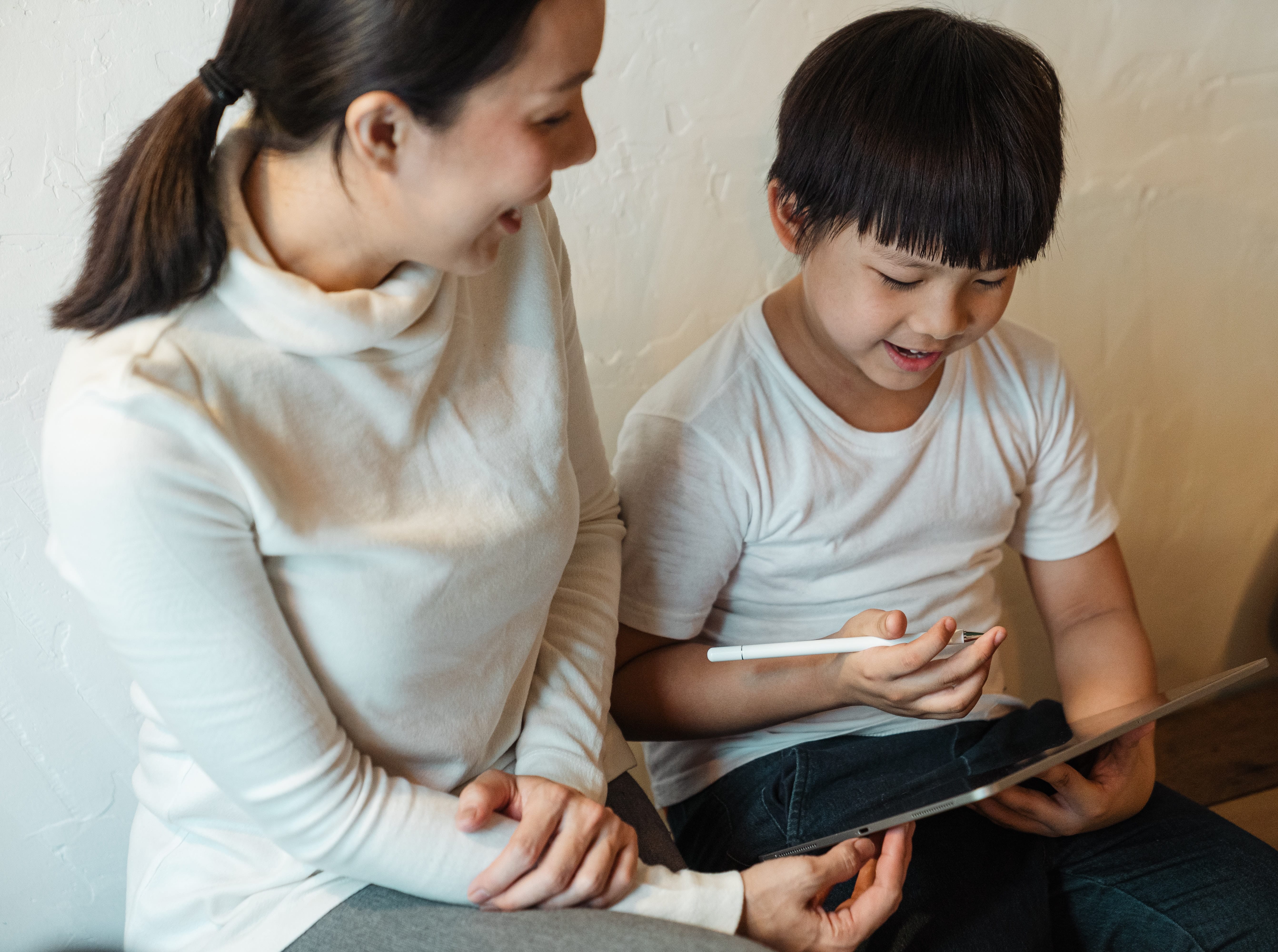
Ten percent of American children are estimated to have Attention-Deficit/Hyperactivity Disorder (ADHD). Children with ADHD often struggle in school because they get distracted and have difficulty following through. Kids with ADHD also tend to LOVE screen technology. Not only do screens offer them a world of on-demand discovery, but they can also gain expertise over time and earn much-needed social capital that they may have difficulty earning in real life. To help your family make their way through the world with a fun, positive connection and better screen safety, access Dr. Tracy Bennett’s expert parent and family coaching videos through our GKIS Screen Safety Essentials Course. In today’s GKIS article, we will discuss the benefits of technology and app recommendation for children with ADHD.
What is ADHD?
Attention-Deficit/Hyperactivity Disorder (ADHD) is one of the most common neurodevelopmental disorders of childhood. Children with ADHD have trouble paying attention, controlling their behavior, and can be very active as if driven by a motor.[1] ADHD can impact emotions, behaviors, and the ability to learn new things. It is usually diagnosed in childhood and often lasts into adulthood. About 60% to 85% of the children diagnosed with ADHD at a young age continue to have it as teens, although symptoms might change with age.[2]
The Three Types of ADHD
Inattentive Type
ADHD, Predominantly Inattentive Type is characterized by a daydreamer who has difficulty paying attention, listening, and following through with tasks. Children with this type of ADHD are often overlooked until late grade school because they are quiet and not disruptive. However, their ability to function to their true ability is impaired in all contexts of their lives. It has been shown that more girls are diagnosed with inattentive ADHD than boys.[3]
Symptoms of ADHD, Predominantly Inattentive Type
Often has trouble giving close attention to details and makes careless mistakes
Has difficulty sustaining attention to certain tasks or play activities
Frequently distracted and doesn’t seem to pay attention to those speaking directly to them
Often does not follow instructions and fails to complete tasks
Has difficulties organizing tasks and activities
Doesn’t enjoy and avoids activities that require them to use mental effort
Hyperactive-Impulsive Type
ADHD, Predominantly Hyperactive-Impulsive Type is characterized by a child who fidgets, has trouble staying in their seat, and talks a lot. It is hard for them to stay still for long. They tend to be impulsive and interrupt others. It is more common for a child with hyperactivity to have more accidents and sustain frequent injuries. They also tend to be identified at younger ages because of their acting out potential.
Symptoms of ADHD, Predominantly Hyperactive-Impulsive Type
Frequently fidgets with or taps hands or feet
Leaves the seat in situations when remaining seated is expected
Runs or climbs in situations where it is inappropriate
Is “on the go” and doesn’t seem to get tired
Talks excessively
Answers questions before the person has time to finish it
ADHD Combined Type
ADHD, Combined Type is characterized by a child that has trouble paying attention and difficulty sitting still and staying quiet. This is the most common type of ADHD. It is characterized by the symptoms from both the inattentive criteria list and the hyperactive-impulsive criteria list.
How Technology Helps Children With ADHD
Children with ADHD commonly struggle with time management, organization, and failure to focus. Technology and apps can help children with ADHD stay organized, reach their goals, and fight the urge to get distracted.
GKIS-Recommended Apps for Kids With ADHD
Rescue Time
Rescue Time is a web-based time management and analytics tool that helps children be more efficient and productive. One of the symptoms of ADHD is “distraction.” This app aims to prevent distractions and any possibilities of children getting scattered. It allows you to rate each activity from “very distractive” to “very productive” and sets goals for children while tracking progress. With all of that rescued time, be sure to plan fun family activities. For great ideas, check out Dr. B’s GKIS article, #TogetherAtHome Family-Friendly Activity Ideas
Roblox
Roblox is available for iOS and Android. It is a video game that is reported to strengthen planning skills, organization, and working memory as children learn as they go. Roblox is a game where people come together to create and imagine as they play. It is a fun game where the whole family can have fun. To learn more about the risks and benefits of Roblox, check out our The GKIS Sensible Parent’s Guide to Roblox.
News-O-Matic
News-O-Matic is available for iOS. It is a captivating app that delivers news in small chunks which is useful for older children with ADHD. The stories vary from funny to serious and have a read-aloud option for kids who struggle with reading.
Mindnode
Mindnode is available for iOS and it is designed to help children focus and be organized. It is an app that uses mind maps to help children visualize their thoughts. The map can be color-coded and contains images. Children with ADHD tend to be energetic; this app can help make sure that they stay concentrated.
Relaxation and Mindfulness Apps
Headspace
Headspace is a mindfulness app that helps children exercise, meditate, and visualize. This is beneficial because it helps them take a moment to focus and stay calm.
Toonia Colorbook
Toonia Colorbook is an app where children use coloring activities to help them relax. It can help children concentrate, calm down, and keep their minds balanced. Keeping the brain busy with something simple as coloring can have a relaxing effect.
Research reveals that social and emotional learning (SEL) improves grade school students’ engagement with the academic curriculum. With online learning, it is still unclear how students have been negatively impacted, but lack of teacher-student relationships and low motivations appear to be strong contributors. Furthermore, there has been speculation that the fear and isolation caused by the COVID-19 pandemic increased mental illness among children. Dr. Tracy Bennett, Founder of GetKidsInternetSafe, said she has never seen the quantity of clients looking for outpatient psychotherapy or such high severity levels among adults and kids in her 25-year career as a clinical psychologist. She added that, in response to the child; and family distress, teachers have been heroic in their creation, adoption, and application of SEL curricula. In service of the positives of screen use, today’s GKIS article recommends SEL apps that can be used at home as well as in the classroom.
The Benefits of Social and Emotional Learning
Improves Behavior and Academic Performance
SEL programs tend to target:
Self-awareness in recognizing emotions, strengths, and limitations
Self-management by controlling emotions and behaviors
Social awareness in gaining insight into others and building empathy towards diverse backgrounds
Relationship skills in forming and maintaining healthy relationships
Decision making in acting upon productive choices[1][3]
Students use SEL skills to protect against substance use, bullying, and school failures among other benefits. The ability of teachers and parents to form a safe care environment with SEL results in less emotional distress, fewer conduct problems, and improves test scores and grades among children.[1]
Do SEL programs work?
A long-term study by Taylor and colleagues (2017) collected 18 years’ worth of data from 46 studies to examine if SEL programs make a difference. The SEL programs had students apply learned skills to personal development, social relationships, ethical behaviors, and productive work at school. This increased subject physical and mental well-being into adulthood demonstrating a positive trend in future social relationships, graduate rates and attendance, and low numbers of arrests.[3]
A study by Jones and colleagues (2015) found similar conclusions. They measured kindergartens’ future wellness in education, employment, crime, substance abuse, and mental health. Their data showed:
High self-control at an early age
High task completion rate
Improves multi-skill management
Improves organizational skills
Improve noncognitive skills (e.g., motivation, integrity, and interpersonal interaction)[2]
Taylor et al. also found that a “one size fits all” SEL program is not as effective as one designed specifically for a selected student population and a selected outcome. For example, according to their study students with ethnic minority backgrounds developed better emotional coping skills with SEL. In contrast, poor-income students developed better school attachment and achievement. Other benefits for SEL included decreased substance use, risk-taking, and problem behaviors while improving positive relationships using social support and growth opportunities amongst minorities.[3]
Friendly and Productive Tools for Long Term Success
Achieve screen sanity and SEL skills with our own Screen Safety Essentials Course. To help your family form cooperative dialogue and teach critical problem-solving skills about your child’s online and offline life, we offer weekly coaching videos from our very own Parenting and Screen Safety Expert, Dr. Tracy Bennett. Designed for families with kids ages 8 to 16, our GKIS Screen Safety Essentials Course does the work for you. No more wondering what to say, which issues to cover, and how to stay relevant and consistent about screen safety and family connection.
Some of the resources the Screen Safety Essentials Course offers include:
✅ Weekly parents-only videos with the information and tools you need to earn the credibility to be their go-to expert
✅ Weekly family videos with insider and science-based teaching topics and fun family activities.
✅ Workbook pages and colorful infographic downloads
✅ Access to Dr. Bennett’s BEST webinars
✅ Psychological wellness and balance skills to avoid costly digital injuries
✅ Exclusive access to Dr. B and motivated parents like yourself on our private Facebook community page
✅ Options for private coaching with Dr. Bennett for extra support
✅ BONUS: Selected readings from our GKIS Blog articles and Dr. B’s book SCREEN TIME IN THE MEAN TIME
Safety, connection, less conflict, and so much more! Your first 30 days are totally free. Available through our GetKidsInternetSafe website.
Middle School Confidential
GKIS also recommends the Middle School Confidential app. Middle School Confidential offers a three-piece comic book series for ages 8-14 by Annie Fox and Matt Kindt. It covers lessons about character, problem-solving, friendships, and school situations. Quizzes, tips, real quotes from teens, and real-world resources support problem-solving and open dialogue skills between parents and children.[5] Specific tools like assertiveness and positive self-talk help users recognize and name emotions and build empathy.
The Positive Penguin application offers 5-minute meditation practices for child resilience. Developers incorporated funny sounds and game modes to set a friendly environment. According to their website, Positive Penguin is “the app designed to help children understand why they feel a certain feeling and behave in a productive way.” The app helps children transform negative thoughts and emotions into a more optimistic perspective.[6] Positive Penguin helps kids improve SEL communication and problem-solving skills.
Smiling Mind helps children seek mindfulness as a daily practice. Developed by psychologists and educators, this app encourages children ages 3 to 18 to reduce stress, tension, pressure, and challenges with a 10-minute meditation.[7] With daily check-ins, a meditation habit assists kids to form positive affirmations by thinking before they act.
Availability:
Apple App Store
Google Play Store.
Accomplishments
#22 in rank for Health & Fitness (as of 15 Feb 2021)
5 million users leading Meditation app for Australia
To improve communication and empathy skills in your family, grab your SEL app of choice today! Thanks to CSUCI intern, Christian Sandoval for his contributions to today’s GKIS article.
I’m the mom psychologist who will help you GetKidsInternetSafe.
Onward to More Awesome Parenting,
Tracy S. Bennett, Ph. D.
Mom, Clinical Psychologist, CSUCI Adjunct Faculty
GetKidsInternetSafe
[1] Durlak, J. A., Weissberg, R. P., Dymnicki, A. B., Taylor, R. D., & Schellinger, K. B. (2011). The impact of enhancing students’ social and emotional learning: A meta‐analysis of school‐based universal interventions. Child Development, 82(1), 405–432. https://doi-org.ezproxy.csuci.edu/10.1111/j.1467-8624.2010.01564.x
[2] Damon E. Jones, Mark Greenberg, and Max Crowley, 2015:
[3] Taylor, R. D., Oberle, E., Durlak, J. A., & Weissberg, R. P. (2017). Promoting positive youth development through school‐based social and emotional learning interventions: A meta‐analysis of follow‐up effects. Child Development, 88(4), 1156–1171. https://doi-org.ezproxy.csuci.edu/10.1111/cdev.12864
[4] Sawyer, M. G., Arney, F. M., Baghurst, P. A., Clark, J. J., Graetz, B. W., Kosky, R. J., et al. (2001). The mental health of young people in Australia: Key findings from the child and adolescent component of the national survey of mental health and well-being. Australian and New Zealand Journal of Psychiatry, 35, 806-814.
Three billion people use social media globally. We use it to stay in touch with friends and family, share memorable moments in our lives, and entertain ourselves during our leisure time. Although social media has its benefits, it also has its negative effects. Much of the outcome depends on the characteristics of the user. One characteristic that impacts social media use is the user’s attachment style. In today’s GKIS article, you will learn what attachment style is, how a child’s attachment style may impact the way they use social media, and strategies to improve your family relationships and create healthier attachments.
Social Media Readiness
In the article “Do Kids Need Driver’s Training … for the Internet?” Dr. Bennett asks, “Does driving city streets have anything in common with browsing the internet?” She argues it does, stating that “ Like driving a car, browsing the internet can cause significant injury. But instead of a concussion, we see kids succumbing to anxiety, depression, and body image problems linked to cyberbullying, radicalization, and compare-and-despair. Also, like driving, kids browsing the internet can wander into any kind of digital neighborhood making friends from faraway places. Most of the places they visit are cool, with fun friends, creativity, and harmless excitement. But there are also digital neighborhoods that would horrify us. Dangerous people like predators and traffickers may be common there and so is intensely violent and explicit sexual content.” With over 25 years of helping kids and families navigate difficult situations resulting from screen use, she created an online course for tweens and teens called the GKIS Social Media Readiness Course.
Dr. B argues that kids need specific knowledge and problem-solving strategies to recognize red flags online, as well as psychological wellness tools to bolster mental health and overall resilience. Not only does our course teach kids what they need to know for online safety, but parents need knowledge too along with an ongoing cooperative dialogue with their kids about online issues. Creating this dialogue has a lot to do with healthy attachment.
Attachment
The father of attachment theory is John Bowlby, a British psychoanalyst who was interested in studying the intense distress that infants demonstrate when they are separated from their parents. Other attachment researchers went on to create theories and testing measurements, like the Strange Situation paradigm created by Mary Ainsworth.
Strange Situation
To test a child’s “attachment style,” researchers created a child separation situation in the psychology lab. For the Strange Situation method, researchers put a mother and toddler child alone in a room. The room was filled with toys and plenty of eye-catching items for the child. After some time of playing, a stranger enters the room and attempts to interact with the child. The mom is instructed to then leave the room. After a few minutes, she returns and comforts her child. A few minutes later the stranger returns and interacts with the child again. Then the mother comes back and greets her child.[2]
The Strange Situation was designed to present children with an uncommon, but not too overwhelming, experience. The child’s response was then coded and classified to fit in one of four attachment styles.
Attachment Styles
Attachment styles are academic descriptors of how an individual relates to other people. An attachment style is formed at an early age, and once established it stays with you.
Children with secure attachment styles have healthier relationships overall. Kids with avoidant, anxious, or disorganized attachment styles tend to form poor quality family and peer interactions. They have trouble maintaining healthy, mutually beneficial friendships because they’re often anxious or dependent.
The Four Types of Attachment Styles
SecureAttachment
Secure attachment is characterized by a stable sense of security and comfort to be out and about knowing that their caregiver will be there when needed. Caregivers of securely attached children are typically available, sensitive, and protective of the child. They use authoritative (warm and consistent) parenting strategies rather than being overly strict (authoritarian) or indulgent (permissive).
Avoidant Attachment
Avoidant attachment is characterized by a child who avoids interaction with the caregiver and shows no distress during separation. Caregivers of an avoidant attached child typically don’t acknowledge a distressed child, instead of shaming the child for showing emotions and having unrealistic expectations. These caregivers often don’t validate the child. Emotional validation is the process of encouraging emotional expression and offering warm acceptance and nurturance. Validating a child’s emotion is a critical element to teaching children socio-emotional intelligence and self-soothing.
Anxious Attachment
Anxious attachment is characterized by a child who fears abandonment and doesn’t interact with strangers. Kids with anxious attachment tend to be clingy and insecure. Caregivers of anxiously attached children are often overly protective or insensitive. They can be available at one moment, then unavailable, which can leave the child confused.
Disorganized Attachment
Disorganized attachment is characterized by a child who, when their caregiver unexpectedly leaves the room, will respond with a confused expression, freezing, and demonstrating unorganized behavior. Caregivers in this situation are inconsistent. More specifically, they may demonstrate kindness and care to their child sometimes and other times ignore their needs or get angry. Parents who send these types of mixed signals are often impaired due to mental illness, addiction, or severe overwhelm.
What does social media have to do with attachment?
Social media has become a new form for people to receive validation and support from others, especially for those who are building identities like tweens and teens. In a study by Stöven and Herzberg, researchers reviewed 17 studies on attachment styles and social media use. They found that people with higher levels of abandonment anxiety tend to overuse social media as a way to feel like they belong.[1] The subjects were more likely to seek support and attention from people online to feel good. Social media was a way for them to seek reassurance and feel like people liked them.
How is an over-reliance on social media for identity a problem?
A constant need for reassurance can cause undesired results, such as
trouble making decisions because the subject is too concerned about what others think.
anxiety or depressive symptoms when the subject does not get the response they hope for.
the subject having an “internal debate” with themselves with questions like, “what if?”
Ways to Improve Your Child’s Attachment and Make Them Healthier Adults
Be sensitive and compassionate. Children need nurturing warmth during their early years to identify the emotion, learn how to express it, and build the confidence to self-soothe on their own.
Respond calmly to your child. Modeling self-soothing is an awesome way to teach socio-emotional skill-building. Plus, it serves to clear the way for logical problem-solving rather than escalating an already stressful situation.
Get involved. Just as you would supervise and monitor your child’s exploration of city neighborhoods, you must do the same with digital neighborhoods. That means setting rules and expectations like those detailed in our Connected Family Courseand setting up parental controls using the resources (and discounts) offered in our Screen Safety Toolkit.
If you’d like all GKIS course materials delivered in an inexpensive, convenient, easy-to-follow drip on your smartphone, check out Dr. Bennett’s weekly parent and family coaching videos in the GetKidsInternetSafe App!
Thanks to CSUCI intern, Maira Soto for researching social media and attachment styles for this article.
I’m the mom psychologist who will help you GetKidsInternetSafe.
Children deserve the best possible education and the brightest future opportunities. What parent doesn’t want their child to succeed in life? Many view education as the gateway to success. At the same time, COVID-19 has caused a challenge for our school systems providing quality virtual education. How are our children faring?
The Negatives of Virtual Learning
For younger children, this transition has proved to be difficult and stressful for both students and teachers. Young children have a tough time staying engaged on-screen for long. As a result, their education is likely suffering and they may not be learning the basics they will need for later in life.
There is also a large lack of social interaction for children in this age range. The impact of this might be seen for generations to come, perhaps a rise in social anxiety may be discovered?
What about the older students? The California Department of Education has reported that 2020 had 3,000 fewer high school graduates than 2019.[1] In addition to this shortage of expected graduates, 2021 prospective graduates are enduring their entire senior year virtual. Many students report feeling less optimistic about their future, less motivated to learn, and less confident in their academic abilities. Time will tell how the 2021 graduation rate will be, but it will likely be lower than even the 2020s’ was.
The Positives of Virtual Learning
There are some upsides to virtual learning. First, it’s the safest means of learning during the era of COVID. Education can be redone, learning can happen later, but continuing to protect our children and their teachers from one of the most destructive events in our time is the number one priority. In addition to just the health benefits, the drop-out rate for California has also decreased, with 800 fewer drop-outs than in 2019.[1] This is likely due to the opportunity to learn from home. Virtual learning allows for more flexible learning and more self-responsibility for one’s learning, something that may benefit high school students as they transition to higher education.
Virtual Learning and Parents
If you are ever feeling overwhelmed by virtual learning, pause and try to think about the following points:
It’s temporary! Virtual learning is only temporary. Before too long, our children will be back into the classroom and off of the screens. Don’t let yourself get too upset about something that isn’t going to last forever.
You’re not alone. Almost every parent is experiencing the same frustrations that you are. If you need someone to vent or talk to, reach out to one of your fellow parents. The shared experiences will likely help you both feel better about what is going on.
Don’t blame the teachers. Many of them were thrown into this unprepared and unwarned, just like you and your children were. Some teachers are struggling through this time with their kids just like you. They want to be back in the classroom as soon as it is viably safe to do so too.
Don’t blame your children. They didn’t ask for any of this to happen, and they are likely doing the best they can. They want to be back with their friends on the playground, it might be difficult for them to understand why they aren’t allowed to. Try and remind them, in an age-appropriate way, that this is for their safety and the safety of those around them.
Finally, don’t blame yourself. You have no power over this unprecedented situation. Remind yourself that you are only human and that you are giving it your absolute best. It’s okay to feel out of patience from time to time. Giving yourself and others grace is critical to wellness.
More Resources on Virtual Learning and Online Safety
In today’s day and age, it seems our whole world depends on smartphones, tablets, and the internet. There is no doubt that technology has completely changed our world. It has given us unlimited access to information and communication while removing the need for face-to-face social interaction. Technology is particularly helpful with vulnerable children, like those with autistic spectrum disorder (ASD). Screen technology can play an important role in supporting early language by creating new opportunities for interaction and engagement. Indiana Resource Center for Autism reports that many children with autism are visual learners.[1] Screen media tends to make visual images more available for children with autism and computer graphics grab and keep their attention. Technology also enables kids to find specific interests and build skills, thus increasing play options and independence. To learn more about autism and ways you can help your child, Check out Dr. B’s book Screen Time in the Mean Time. In today’s article, we will discuss the benefits of technology and app recommendations for children with autism.
What is Autistic Spectrum Disorder (ASD)?
Autistic Spectrum Disorder is a developmental disability that affects the way people communicate, behave, or interact with others. Researchers have not identified a single cause, and symptoms can be mild to severe. Autism can be detected at 18 months or younger.
There are also cases where children don’t receive diagnoses until much older. According to the Centers for Disease Control, autism affects an estimated 1 in 54 children in the United States.[2]Autism spectrum disorder affects children of all races and nationalities. It is 4 times more common among boys than girls.[3] It is important that as parents we are aware of certain signs and symptoms of autism. The earlier the treatment, the better and more effective for the child.
Signs of Autism
Social Skills
Impaired social skill is one of the most common signs of autism. Specifically, many children with autism display impairment in the areas of poor eye contact, trouble recognizing expressions of emotions of others, and lack of social awareness. This is different compared to when someone is “shy.” Kids with ASD often have difficulties knowing how to act in social situations, especially with same-age peers. Children with ASD tend to avoid eye -contact, prefer playing alone, and often don’t respond to their name by 12 months old.
Communication
Communication varies when it comes to autistic children. About 40% of children with ASD do not talk at all. About 25%–30% of children with ASD have some words at 12 to 18 months of age and then lose them.[4] ASD issues include delayed speech and using repetitive words and reversed pronouns. Many children with ASD have a hard time understanding and using nonverbal behaviors that facilitate communication like hand movements, body language, and different tones of voice.
Behavior
Children with ASD tend to repeat their actions and behaviors over and over which are called stereotypies. For instance, a child might spend a long period spinning in circles or clapping their hands. This is an example of a self-stimulation activity. Children with autism often thrive with a routine. Changes to their expected rituals can be upsetting to them.
How is technology beneficial?
If your child has ASD, technology can help them become more self-sufficient, work out challenges and improve upon strength. Using helpful apps shouldn’t disrupt your day-to-day routines, but rather enhance them. Apps allow for personalized learning and encourages an inclusive and interactive learning environment.
By observing children and their interaction with apps and listening carefully to the way they respond, you can better understand their thought patterns and plan carefully for their next steps in learning. Wellness apps offer strategies to regulate moods and improve well-being.
Using Technology to Improve Verbal Skills
Many children with autism find it helpful to use resources with a picture communication system, social stories, and visual timetables to improve their verbal skills. Applications for smartphones and tablets now allow parents to create schedules, stories, and activities that can benefit their children. There are many apps designed for those who have trouble communicating by providing a digital voice. Apps can give children the opportunity to enhance vocabulary development while also supporting children’s understanding of early language concepts.
Apps to Improve Verbal Skills
Proloquo2Go
Proloquo2Go is a symbol-based app for children with nonverbal autism. Using a natural-sounding voice, the user creates a sentence using symbols they are familiar with. Then the app will read it aloud. Most individuals report improvement in verbal skills and behavior. The images on the buttons are SymbolStix, although the user can also use real pictures or life-like cartoon drawings. The app is currently available for ios users.[5]
Avaz AAC
Avaz AAC is a speech app that assists children with autism who have a hard time communicating with others. The app can create a picture exchange communication book that can be created into a pdf and printed. That way the child has the option to print it out and store it in a binder. The Avaz app can help your child communicate their thoughts and needs while tracking progress. The app is currently free for a 14-day trial.
Using Technology to Improve Social-Emotional Skills
Often children who are on the autistic spectrum have difficulties with social skills. Children usually cannot understand facial expressions and vocal tones which can affect a child’s ability to communicate. This can lead to failure to understand other emotions and social cues. Technology can help children be understanding and aware of others, which increases their communication skills.
Apps to Improve Social-Emotional Skills
Conversational Builder
Conversion Builder is an app to help children develop social skills and exchange conversations with people. The app supports children to role-play conversation such as turn-taking, topic maintenance, and appropriate questioning in a fun and engaging way. It can be challenging for children with autism to start and maintain a conversation. This app helps children practice, rehearse, and learn from their mistakes which can lead to them having a successful conversation.
Thanks to CSUCI intern, Maira Soto for researching technology and autism for this article. For more information on some beneficial apps, check out this GKIS article, GKIS Recommends Some Favorite Mental Health Apps
I’m the mom psychologist who will help you GetKidsInternetSafe.
Onward to More Awesome Parenting,
Tracy S. Bennett, Ph.D.
Mom, Clinical Psychologist, CSUCI Adjunct Faculty
GetKidsInternetSafe. com
In 2019, approximately 23% of children in the United States were bilingual.[1] Speaking more than one language implies education and competency. Popular media glamourizes bilingualism as a chic quality obtained by social elites. Recently, Princess Charlotte and Prince George received praise for being able to speak more than one language. A 2013 report finds that Spanish is the most spoken foreign language in the U.S., with three out of four Hispanic kids aged five and up speaking Spanish at home.[2] With online learning becoming the norm and inexpensive language-assisting apps available, helping your child learn a second language can be a great way to keep them engaged and educationally enriched.
The Best Time to Learn A New Language
Amazingly, babies have nearly twice as many brain cells as adults. These brain cells, called neurons, reduce in number as we age and become specialized to most efficiently perform complex tasks. One of these tasks includes language.
In the first few years of life, our brains are exquisitely receptive as we onload a boom in vocabulary. As our brains mature and specialize throughout childhood, the ease of learning language decreases. This is due to our brain gradually remodeling as we age by refining neuronal pathways. As a result of this complex genetically blueprinted growth process, we become better thinker, but less receptive to mass learning.
The bottom line is that we learn language best when we are very young. There is even evidence that hearing the unique sounds of particular languages in utero makes a difference later on! By encouraging bilingualism before your child reaches adulthood, you are optimizing language mastery.
The Benefits of Childhood Bilingualism
Effects on Thinking
Contrary to the belief that learning a second language may impede primary language learning, psychologist Adam Winsler and colleagues conducted studies with native Spanish speaking preschool children learning a second language (English). They found that preschool age children were able to competently achieve fluency in both languages while engaged in both the bilingual immersion program and the exposure program. This said, children in the preschool program have exceptional gains in learning.[3]
Along with language competency, bilingualism may help with the development of other complex tasks like working memory and problem solving. Working memory is the limited amount of information we can briefly store in our mind as we solve a problem like completing math problems or following the steps to bake a cake. A study by Daubert and Ramani found that bilingual preschoolers did better on working memory tests than monolingual preschoolers.[4]
Effects on Brain Development
Although we are still learning how our brains are impacted by learning a new language, there is evidence that the neurological remodeling discussed earlier can be impacted in positive ways. For instance, developmental researcher Maria Mercedes Arredondo analyzed brain scans of monolingual children and bilingual children. She found that during a linguistics challenge, bilingual children had less activity in the left frontal region of the brain which is associated with language.[5] This suggests that bilingual children process information more efficiently, thus needing fewer resources for complex linguistic tasks. Bilingual children also show greater brain activation with brain networks related to attention. The implications of this finding are that bilingualism may improve one’s attentional abilities.
The Drawbacks of Bilingualism
It is generally accepted that learning two languages is beneficial for children, but there can be temporary drawbacks. A common drawback is that young bilingual children tend to mix the grammatical rules of the two languages. For instance, if English is your child’s primary language and Spanish is their second, your child may say the literal English translation of a phrase like “At what time are you coming?” to the grammatically incorrect Spanish phrase “A que hora eres tu veniendo,” when it should actually be “A que hora vienes.”
Another finding is that young bilingual children are more likely to have a “silent period,” where they choose not to talk as much for a few months. It is as if their brains are preoccupied laying down the foundation necessary for more complex learning. Fortunately, these windows of silence are temporary.[6] When considering the pros and cons, the benefits of bilingualism strongly outweigh the temporary cons in the long run for most kids.
Language Delays
Of course, every child is different. Some children have an extra hurdle with language learning called a Specific Language Impairment (SLI). Children with SLI develop language fluency slower than their peers, but are not impacted in any other abilities. A research review by speech-language pathologist Lauren Lowry notes that while children with SLI learn language slower, learning a new language has not consistently shown to hamper their primary language. While research has been mixed, the majority of results note similar results with language proficiency between bilingual children with SLI and monolingual children with SLI.[7]
GKIS-Recommended Language Learning Apps
If you are interested in challenging your kids with bilingual education, here are four great language learning apps we recommend:
Duolingo
The Duolingo app offers courses for over 35 different languages and includes tools to learn vocabulary, put together sentences, practice pronunciation, translate audio to text, and how to have discussions in the new language. This is a free app that tracks progress along the way and is great for kids and teens.
Beelinguapp
Beelinguapp is a fun app that offers 13 popular languages and provides e-stories that contain both the primary language and the new language to aid learning. Stories come in wide ranges and make learning a new language fun! Some of the stories are behind a paywall.
Drops
Drops is a free app that offers over 40 languages and helps the user learn vocabulary, utilize the new vocab, understand pronunciations, and provides statistics of the user’s progress. It is particularly great for teens.
Unuhi: Bilingual Books
Unuhi is a free app that provides e-picture books in 20 common languages. Each page has two boxes of text, one for the primary language and one that has the same content, but in the new language. This app is geared towards children and some e-books are only available with purchase.
Other Ways to Learn A Language
Language-learning apps typically offer exercises to learn vocabulary and pronunciation, hone reading comprehension, and mindfully use the new language in conversation. Once a foundation for learning has been set, you can reinforce learning by:
Watching television programming in the new language
Reading easy books in that language, and
Frequently switching between the primary language and the new language for real-world application and practice.
To optimize the balance between online and offline learning, check out our Connected Family Course. Specifically designed for clever smart home setup, the Connected Family Course offers 10 easy steps for creative safe-screen home setup and fun parenting techniques for sensible screen management. Our expert techniques take the “battle” out of parenting in less than two hours!
Thanks to CSUCI intern, Avery Flower for researching bilingualism in children and co-authoring this article.
I’m the mom psychologist who will help you GetKidsInternetSafe.
[4] Daubert, E. N., & Ramani, G. B. (2019). Math and memory in bilingual preschoolers: The relations between bilingualism, working memory, and numerical knowledge. Journal of Cognition and Development, 20(3), 314–333. https://doi-org.summit.csuci.edu/10.1080/15248372.2019.1565536
[5]Arredondo, M. M. (2018). A bilingual advantage?: The functional organization of linguistic competition and attentional networks in the bilingual developing brain. In Dissertation Abstracts International: Section B: The Sciences and Engineering (Vol. 78, Issue 11–B(E)).