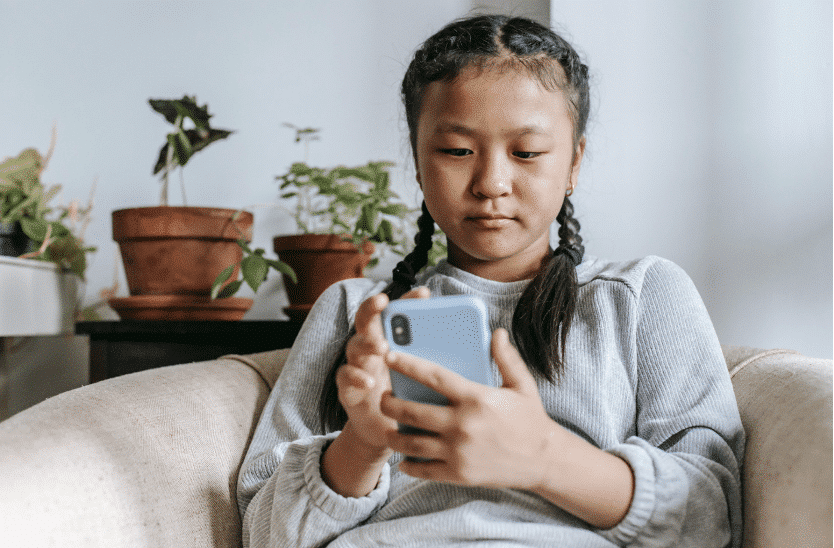
Advancements in artificial intelligence technology have transformed the media we consume. These highly intelligent computer programs can create realistic-looking images from a few words, hold entire conversations, and even write cited essays. While programs like ChatGPT can give us simple answers to our questions, they can also hinder our children’s learning when they outsource their brainwork to an all-knowing robot. If you worry that your child is relying on technology a little too much, our Screen Safety Toolkit offers a resource guide so you can tighten up screen time supervision and management.
What is ChatGPT?
ChatGPT is a language processing tool that is powered by artificial intelligence (AI) technology, allowing you to have human-like conversations.[1] ChatGPT can answer one’s questions and complete various tasks from essays, to editing code, to writing emails. This software is open to the public for free, although there is also a paid subscription version with additional features.[1] Notable celebrities in technology like Elon Musk have commented on the strength of ChatGPT, stating “ChatGPT is scary good. We are not far from dangerously strong AI.”[1]
ChatGPT gets its data from textbooks, websites, and various articles which it simultaneously uses to model its language to seem more human-like.[2] This AI is well-trained on biased and unbiased data and can reproduce data with reliability, something that many other similar AI systems lack.[2]
When asked to write a sentence for this article, ChatGPT responded with, “ChatGPT is an artificial intelligence language model developed by OpenAI, based on the GPT-3 architecture. It is designed to generate natural language responses to a wide variety of prompts and questions. ChatGPT uses advanced machine learning algorithms to understand the nuances of language and generate context-sensitive responses that are often indistinguishable from those written by a human. It has a wide range of potential applications, from customer service and education to creative writing and more.”[3] How’s that for a definition?!
How are kids using ChatGPT to cheat?
While ChatGPT’s design of being able to generate natural responses to various questions and prompts can make it a helpful tool for educational and informational purposes, it also opens it up to exploitation for other purposes. A quick Google search will turn up dozens of articles on how to get ChatGPT to write your essay for you. A student at Cardiff University in Wales shared his experience with turning in two papers, one written by himself and the other written by ChatGPT.[4] The essay from ChatGPT earned him the highest grade he had ever received on an essay in his entire time in undergraduate school.[4]
College professor and TikTok user Lilmaverick3 received an essay from one of her students that had been flagged by TurnItIn.com as being 100% written by AI technology, proving that students have already started taking advantage of the AI’s skills and ability to create human-like speech.[5] The technology is still relatively new but stories just like this will likely continue.
Cheating robs children of the satisfaction of completing their own assignments and the learning experience that comes with research. It also offers a dishonest view of academic ability, which can quickly get out of hand when teachers ratchet up expectations in response.
What Parents and Educators Can Do to Prevent Cheating
Research various forms of AI detectors and run your child’s papers through flagging software, this way you can see if the paper has any elements that have been plagiarized.
Some popular flagging software includes Writer’s AI Content Detector and Content at Scale’s AI Detector. For educators, we recommend having students turn in assignments through TurnItIn.com, this checks for plagiarism as well as how much of the assignment is AI-generated content.
Sit with your child while they work on assignments to offer support as they need it, and be there before they decide to turn to AIs.
Manage smart devices during homework time using resources from our GKIS Screen Safety Toolkit.
Utilize ChatGPT in ways that allow it to be an educational tool, like writing ideas, creating to-do lists, and finding resources.
ChatGPT is a helpful tool for educational purposes when used properly. As a prompt-based language bot, it can be used to spruce up resumes or cover letters based on inputted job description data, help create outlines for papers based on inputted prompt data, and even provide recipes for weekly meals.
Promoting ChatGPT as an educational tool rather than a homework robot can prevent your child from creating an unhealthy dependence on AI software to do their work for them.
Three billion people use social media globally. We use it to stay in touch with friends and family, share memorable moments in our lives, and entertain ourselves during our leisure time. Although social media has its benefits, it also has its negative effects. Much of the outcome depends on the characteristics of the user. One characteristic that impacts social media use is the user’s attachment style. In today’s GKIS article, you will learn what attachment style is, how a child’s attachment style may impact the way they use social media, and strategies to improve your family relationships and create healthier attachments.
Social Media Readiness
In the article “Do Kids Need Driver’s Training … for the Internet?” Dr. Bennett asks, “Does driving city streets have anything in common with browsing the internet?” She argues it does, stating that “ Like driving a car, browsing the internet can cause significant injury. But instead of a concussion, we see kids succumbing to anxiety, depression, and body image problems linked to cyberbullying, radicalization, and compare-and-despair. Also, like driving, kids browsing the internet can wander into any kind of digital neighborhood making friends from faraway places. Most of the places they visit are cool, with fun friends, creativity, and harmless excitement. But there are also digital neighborhoods that would horrify us. Dangerous people like predators and traffickers may be common there and so is intensely violent and explicit sexual content.” With over 25 years of helping kids and families navigate difficult situations resulting from screen use, she created an online course for tweens and teens called the GKIS Social Media Readiness Course.
Dr. B argues that kids need specific knowledge and problem-solving strategies to recognize red flags online, as well as psychological wellness tools to bolster mental health and overall resilience. Not only does our course teach kids what they need to know for online safety, but parents need knowledge too along with an ongoing cooperative dialogue with their kids about online issues. Creating this dialogue has a lot to do with healthy attachment.
Attachment
The father of attachment theory is John Bowlby, a British psychoanalyst who was interested in studying the intense distress that infants demonstrate when they are separated from their parents. Other attachment researchers went on to create theories and testing measurements, like the Strange Situation paradigm created by Mary Ainsworth.
Strange Situation
To test a child’s “attachment style,” researchers created a child separation situation in the psychology lab. For the Strange Situation method, researchers put a mother and toddler child alone in a room. The room was filled with toys and plenty of eye-catching items for the child. After some time of playing, a stranger enters the room and attempts to interact with the child. The mom is instructed to then leave the room. After a few minutes, she returns and comforts her child. A few minutes later the stranger returns and interacts with the child again. Then the mother comes back and greets her child.[2]
The Strange Situation was designed to present children with an uncommon, but not too overwhelming, experience. The child’s response was then coded and classified to fit in one of four attachment styles.
Attachment Styles
Attachment styles are academic descriptors of how an individual relates to other people. An attachment style is formed at an early age, and once established it stays with you.
Children with secure attachment styles have healthier relationships overall. Kids with avoidant, anxious, or disorganized attachment styles tend to form poor quality family and peer interactions. They have trouble maintaining healthy, mutually beneficial friendships because they’re often anxious or dependent.
The Four Types of Attachment Styles
SecureAttachment
Secure attachment is characterized by a stable sense of security and comfort to be out and about knowing that their caregiver will be there when needed. Caregivers of securely attached children are typically available, sensitive, and protective of the child. They use authoritative (warm and consistent) parenting strategies rather than being overly strict (authoritarian) or indulgent (permissive).
Avoidant Attachment
Avoidant attachment is characterized by a child who avoids interaction with the caregiver and shows no distress during separation. Caregivers of an avoidant attached child typically don’t acknowledge a distressed child, instead of shaming the child for showing emotions and having unrealistic expectations. These caregivers often don’t validate the child. Emotional validation is the process of encouraging emotional expression and offering warm acceptance and nurturance. Validating a child’s emotion is a critical element to teaching children socio-emotional intelligence and self-soothing.
Anxious Attachment
Anxious attachment is characterized by a child who fears abandonment and doesn’t interact with strangers. Kids with anxious attachment tend to be clingy and insecure. Caregivers of anxiously attached children are often overly protective or insensitive. They can be available at one moment, then unavailable, which can leave the child confused.
Disorganized Attachment
Disorganized attachment is characterized by a child who, when their caregiver unexpectedly leaves the room, will respond with a confused expression, freezing, and demonstrating unorganized behavior. Caregivers in this situation are inconsistent. More specifically, they may demonstrate kindness and care to their child sometimes and other times ignore their needs or get angry. Parents who send these types of mixed signals are often impaired due to mental illness, addiction, or severe overwhelm.
What does social media have to do with attachment?
Social media has become a new form for people to receive validation and support from others, especially for those who are building identities like tweens and teens. In a study by Stöven and Herzberg, researchers reviewed 17 studies on attachment styles and social media use. They found that people with higher levels of abandonment anxiety tend to overuse social media as a way to feel like they belong.[1] The subjects were more likely to seek support and attention from people online to feel good. Social media was a way for them to seek reassurance and feel like people liked them.
How is an over-reliance on social media for identity a problem?
A constant need for reassurance can cause undesired results, such as
trouble making decisions because the subject is too concerned about what others think.
anxiety or depressive symptoms when the subject does not get the response they hope for.
the subject having an “internal debate” with themselves with questions like, “what if?”
Ways to Improve Your Child’s Attachment and Make Them Healthier Adults
Be sensitive and compassionate. Children need nurturing warmth during their early years to identify the emotion, learn how to express it, and build the confidence to self-soothe on their own.
Respond calmly to your child. Modeling self-soothing is an awesome way to teach socio-emotional skill-building. Plus, it serves to clear the way for logical problem-solving rather than escalating an already stressful situation.
Get involved. Just as you would supervise and monitor your child’s exploration of city neighborhoods, you must do the same with digital neighborhoods. That means setting rules and expectations like those detailed in our Connected Family Courseand setting up parental controls using the resources (and discounts) offered in our Screen Safety Toolkit.
If you’d like all GKIS course materials delivered in an inexpensive, convenient, easy-to-follow drip on your smartphone, check out Dr. Bennett’s weekly parent and family coaching videos in the GetKidsInternetSafe App!
Thanks to CSUCI intern, Maira Soto for researching social media and attachment styles for this article.
I’m the mom psychologist who will help you GetKidsInternetSafe.





 Thanks to CSUCI intern, Katherine Carroll for researching ChatGPT.