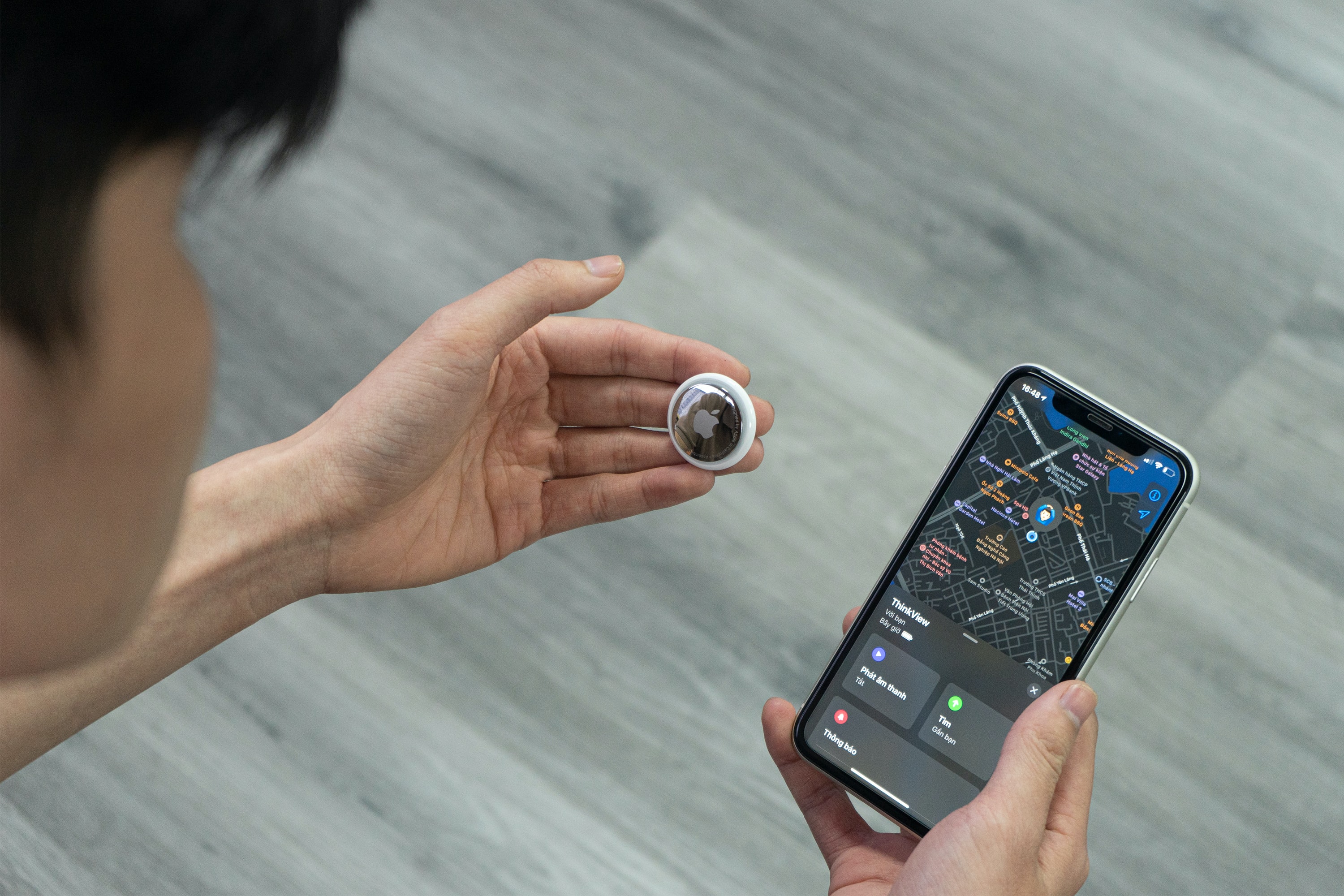
As if there weren’t enough things to worry about, here is a new one. There have been several reports of people finding button-sized Apple devices, called AirTags, in their cars, purses, and pockets before realizing that they are being stalked. In this GKIS article, we will be discussing what AirTags are, how they are being utilized for stalking, what happened to Sports Illustrated swimsuit model, Brooks Nader, when she was being stalked, and how to keep yourself and your kids safe. For more information on technology and useful tips about how to make the internet a safer place for your family, check out our Screen Safety Essentials Course to get parenting and family coaching information, support, and other valuable information.
What is an AirTag?
AirTags are button-sized Apple devices that are supposed to help you locate your keys when they end up in your couch cushions. The idea is that you can use your phone to locate lost or stolen objects. This sounds great unless you are me and you are always losing your phone as well. Due to their small size, AirTags can be placed just about anywhere.
Here’s the Issue
Due to the small size, AirTags can be difficult to spot if some shadowy figure slips one of these into your pocket, purse, or car. There have been multiple reports of these coin-sized buttons being non-consensually used to stalk someone. They can be used to find out where someone lives or to find out where they go in real-time, which is frightening and potentially dangerous. They have also been used for other nefarious purposes like tracking nice cars to steal when they are in a more opportune location.
Strange iPhone Alerts
Recently, there have been multiple reports of people finding out they are being stalked through strange alerts coming from their iPhones. Brooks Nader, who is a Sports Illustrated swimsuit model, recently discovered she was being stalked for several hours.[1]
While going about her day, she received a notification on her iPhone that said, “Unknown Accessory Detected,” with a warning that the item was moving with her for a while and the owner can see its location. She instantly took a screenshot and shared it on her social media asking her followers if they knew what was going on. With their help, she learned it was an AirTag. She eventually found that someone had slipped the AirTag into her pocket and tracked her location and followed her in their car for over 5 hours. They not only learned where she was going, but by stalking her they also discovered her regular routine and where she lived.
Kidnapping
One woman kept hearing a noise coming from her car. She pulled over and began looking for it but couldn’t figure out where it was coming from. After going to the police, they took her car to a garage and located an AirTag wrapped in duct tape and stuck to the inside of the rear bumper. It turned out to be the father of her children whom she had a restraining order against. He later used the technology to locate her, run her off the road, and kidnap her.[2]
Finding Strange Devices
Other women have also found these items through security alerts or by finding the tags themselves. One woman found an AirTag on her car after leaving a bar. Another woman found an AirTag in her handbag, and her and her husband had to go online to find out what it was. Dr. B recently rented a car and discovered the car was being tracked by its owner. She received the notifications on her iPhone, but wrongly assumed it was somehow an alert about her iPad. Apparently, the notifications don’t make intuitive sense without doing extra research.
Car Theft
While the AirTags can be used to find a stolen object, thieves are using them to steal as well. There have been several reports of car thieves placing Bluetooth trackers on cars in parking lots or at dealerships. They then use these devices to wait until the cars end up in a location that is more suitable for auto theft. By doing this, they can reduce their risk of getting caught.
Apple Update
Apple has become aware of this problem and has put out several statements. They recently changed the item description to say it was “designed to discourage unwanted tracking.”[3] The iPhone Airtag alert notifies users when an AirTag is a certain distance away from the owner and has been travelling with the tracked person. In another effort, they try to discourage stalkers by requiring that it be linked to the purchaser’s Apple account.
There are still other issues as well. These alerts only go to iPhones. Therefore, if a user has a Samsung or any other type of phone, they will not be notified. Also, linking these to specific Apple accounts will not discourage criminals who can make a fake account. They can also use VPNs and other software to mask their location and identity.
Staying Safe
Here are some GKIS tips how you and your family can stay safe and avoid AirTag stalking:
Pay attention to iPhone alerts.
Stay vigilant and practice good situational awareness.
Trust your instincts.
Stay informed.
Dr. B is in a unique position to help you to learn more about the potential dangers that your family could face when engaging with technology. She can help you to navigate safely throughout your journey as a practicing psychologist, university professor, and mother. In Dr. B’s book, Screen Time in the Mean Time, she discusses and attacks the issue of raising a family while safely integrating technology rather than fearing it. Also, you can download the free GKIS Connected Family Agreement simply by creating a GKIS account on our website home page. Finally, Dr. Bennett’s Social Media Readiness Online Course for tweens and teens will give you the answers you are looking for and help you to navigate through these ever-changing waters!
Thanks to CSUCI intern, Michael Watson for researching AirTags and the issues surrounding them.
I’m the mom psychologist who will help you GetKidsInternetSafe.
[1] Court, A. (2022). Model stalked in NYC after stranger slips AirTag into her pocket. New York Post. https://nypost.com/2022/01/07/sports-illustrated-model-is-latest-victim-of-airtag-stalker/
[2] Cassi, S. (2022). Kidnapping suspect previously used tracking device on victim’s car, Bethlehem cops say. Lehigh Valley Live. https://www.lehighvalleylive.com/bethlehem/2021/10/kidnapping-suspect-previously-used-tracking-device-on-victims-car-bethlehem-cops-say.html
[3] Apple. (2022). AirTag. Apple. https://www.apple.com/airtag/
Did you know that the FDA has given the go-ahead for companies to turn human test subjects into cyborgs? Advancements in the tech industry are being made at an alarming rate, giving rise to difficult ethical issues, especially in the medical field. Currently, there is a race to develop brain-computer interfaces (BCIs) for a multitude of purposes. In today’s GKIS article, we discuss the possible benefits, risks, and ethical issues associated with developing such devices. If you are unsure of how to protect your tweens and teens growing reliance on technology and obsession with online presence, Dr. Bennett’s Social Media Readiness Online Course will give you the answers you are looking for and help you to navigate through these ever-changing waters!
What is a brain-computer interface?
A brain-computer interface (BCI) is a technological device that directly interacts with the brain with no noticeable lag time. These devices read the electrochemical signals of the brain and translate them to carry out a desired action. This action can be anything from moving a prosthetic limb to telepathic communication. The goal of these devices is to bypass the body’s natural pathways using technology. Up until recently, this was merely the stuff of science fiction fantasy, and comic books. Yet, with advances in processing speed and data storage, it’s become a reality.
Neuralink
Neuralink is a company created by Tesla founder and carnival showman, Elon Musk. The goal of this company is specifically to create BCIs. The current BCI that Neuralink is working on consists of a computer chip the size of a coin connected to extremely thin wires. The chip will be surgically implanted into the skull with the wires being inserted directly into the brain.
The original stated purpose of this company was the altruistic goal of helping disabled individuals regain lost function of limbs and mobility. Yet more recently, Elon Musk stated that the goal is “human enhancement.” In interviews, such as on Joe Rogan’s podcast, he spoke of telepathic communication and thinking capabilities to rival computer artificial intelligence (AI). Neuralink has been given FDA approval to start the human trial phase and is looking to begin drilling holes in test-subjects heads sometime this year.
Synchron
Synchron is a much smaller company based in New York with a similar purpose of developing BCIs. Synchron’s flagship BCI, the Stentrode implant, is inserted through a vein and guided into the brain. Synchron has already successfully conducted clinical trials in Australia, inserting these devices into four human subjects suffering from severe paralysis. They have also been given FDA approval to begin human trials in the United States, which will take place at Mount Sinai Hospital and involve six subjects.
Though Sychron’s current goal is to allow disabled people to control digital devices with their brains and to improve their functional independence, their ultimate stated goal is to achieve whole-brain data transfer. What that means is they want to be able to transfer a human into a digital world.
Possible Benefits of BCIs
Improving the lives of disabled individuals
Faster access to information
Telepathic communication
Virtual immortality
Possible Risks of BCIs
The exploitation of individuals with disabilities
Risky surgery
Disability or death
A wider gap between the abilities of the wealthy and the poor
Literal brain hacking
Forever altering what it means to be human
Possible Ethical Issues of BCIs
Tech to BioTech
The biggest issue with BCIs requires a discussion in ethics. When it comes to ethical questions, we are in a truly unique situation. We have multi-million-dollar for-profit tech companies entering the medical field with end goals that are not medical in nature. Is it ethical for a tech company to perform risky experiments on individuals with disabilities when the end goal is profit and ultimately may not benefit the group initially being tested upon?
It could be argued that the initial experiments will benefit disabled subjects, which is ethically sound. Yet, several ethicists have concerns that the ultimate goal of this research is for commercial means, such as using the technology to be implemented into Tesla automobiles, rather than being purely medical in nature.[1]Others have pointed out that this could be considered exploitative due to the potential for commercial gains in other areas of business.
Pain and Suffering
Recently, news broke that 15 of the 23 monkey test subjects that had the Neuralink chip implanted in their brains at UC Davis died horrible deaths.[2] Since this news broke, UC Davis has been trying to distance itself from Neuralink. The surgical device that Neuralink created to perform the surgery is currently not approved for human trials since it is not okay to put humans through a medical trial where they are more likely to die or suffer from debilitating side effects than to receive any benefits.
The Opportunity Gap
Another ethical issue revolves around the potential societal effects if everything works out according to plan. There is already a huge gap between the haves and the have-nots, those with power and those without. What would happen if one could pay to be smarter, faster, and stronger? The opportunity gap would become insurmountable!
Privacy and Cybercrime
There is also the issue of privacy. All technology that can access the internet can be accessed by others. The most advanced encryption and security safeguards eventually become obsolete as technological advances are made that allow people to bypass them. Imagine if every thought or memory could be hacked and stolen from you. An entire person’s being could be manipulated, altered, or even held for ransom. Cybercrime is already an issue when it comes to ransomware, identity theft, and phishing scams. Think about the new problems that would arise if people’s brains were connected to the internet!
Technology Weaponized
For every technological achievement, there is always someone who will use it for evil. BCIs could eventually be used for military applications. Powerful organizations could utilize this technology to create heavily modified super soldiers. The possibilities become endless when physical and mental enhancement is on the table.
I know this sounds crazy, like something out of a comic book. Yet, flying cars are currently being tested for manufacture by multiple auto companies. Thirty years ago, no one could have imagined where we would be today from a technological standpoint. As computer chips become smaller and more powerful, there is no telling where we will be by 2050. The question is now whether something should be possible rather than if it could be possible.
Staying Informed
Dr. B is in a unique position to help you to learn more about the potential dangers that your family could face when engaging with technology. She can help you to navigate safely throughout your journey as a practicing psychologist, university professor, and mother.
In Dr. B’s book, Screen Time in the Mean Time, she discusses and attacks the issue of raising a family while safely integrating technology rather than fearing it. Also, you can download the free GKIS Connected Family Agreement simply by creating a GKIS account on our website home page. If you are looking for our most comprehensive toolkit to achieve screen safety and family cooperation, our Screen Safety Essentials Course offers useful tips about how to make the internet a safer place for your family with weekly parenting and family coaching videos, important teaching materials and infographics, webinars, articles, and other valuable information.
Thanks to CSUCI intern, Michael Watson for researching brain-computer interfaces and the potential bioethical issues surrounding them.
I’m the mom psychologist who will help you GetKidsInternetSafe.
Video games have come a long way since Pong was first released in the 1970’s. Advances in gaming technology can enhance the experience for adults, but for children more realistic games are harder to distinguish from reality. At GKIS, our Social Media Readiness Course is designed to prepare your tweens and teens for the unexpected dangers of video games and social media sites. Our course is backed by Dr. Bennett’s years of experience helping tweens and teens who have already suffered digital injury from the unforeseen dangers found online. In this GKIS article we will cover the evolution of graphics and the steps gaming companies take to make games seem more real.
Video games Are Evolving
Video games are based in technology, and since players got their hands on Pong there has been a push to
advance that technology. Originally, video games were played using bulky arcade cabinets. The first home consoles were very restricted by their hardware. Games were flat and involved a character moving around the screen like a piece on a board. This all changed with the introduction of 3D graphics in the early 2000s. For the first time, video games had physical depth and the characters on screen moved more like a real person would.
Video games are striving every year to create a more realistic virtual environment. Games now have wind that moves individual leaves on tree branches, light that dances across the surface of the water, and characters that look real from a distance. Modern video games have advanced technology to foster a sense of extreme realism and maximize immersion. With such engaging digital experiences, it is important that children are provided with boundaries so as to prevent screen-time overload and digital injury. Our Screen Safety Essentials Course grants you access to weekly videos with parenting tips and coaching from Dr. Bennett that will help you pull your child out of their digital world and back into ours.
Motion Capture
It can be difficult to program a character to move in a realistic way. The awkward way early 3D characters moved unfortunately hampered immersion. Recently, the gaming industry began to use motion capture technology to solve this issue. Motion capture is a technique whereby a real human being is recorded in a studio as a program captures their motion and applies it to the game character to make the movement look as real as possible.
In a game called LA Noir, you are a 1940’s detective. One of the major objectives of the game is to interrogate suspects and solve crimes. For authenticity, developers created the characters with real facial expressions. The game used an advanced motion capture system to record the real facial expressions of the voice actors portraying the game characters. Players can tell what a character is feeling or if they’re lying based on facial expressions alone. The game uses very real human empathy and natural social cues as a part of the game, offering deeper immersion and better quality overall.
Real Game with Real Fear
Realistic graphics are fascinating when they’re used to make a character blink and breathe like a real person. Immersion is the goal, especially in horror games. Early horror games were limited in what they could create by the consoles of the time. However, as modern technology has evolved, new possibilities have opened for the horror genre.
Games can include motion-captured characters with realistic looks of fear and pain on their face. Horror games originally wanted to compete with the horror movie industry, but horror games now have the ability to do more than movies ever could.
For example, a game called Dead Space takes the classic zombie movie genre and sets it in a futuristic space station. An alien artifact mutates humans into nearly unkillable monsters. The game makes great use of body horror to drive home the alien nature of these dead humans. Body horror is a type of horror derived from twisting the human body into unnatural shapes creating nightmarish monsters. Our mind still sees that the monster is technically human, but is terrified by how wrong it has become. For example, in Dead Space, the zombie you are tasked to fight is a human with an open chest cavity and arms twisted in unnatural positions with sharpened bone where hands used to be. The key feature is that they still have a human face attached to the monstrous form to remind you that they used to be like you.
Immersion in horror games
The main thing horror games have over movies is the personal nature of the narrative and fear within. A zombie movie may be scary to watch as your favorite character fights for their life. However, an immersive game like Dead Space can make you feel like you’re the one fighting for your life. The immersive narrative attempts to draw you into the character’s shoes and, for the time you play, you can believe that you’re really in danger. The narrative takes on a whole new depth as suddenly you’re the one backed into a corner with only a handful of ammo and your wits.
Another dimension is that a game doesn’t guarantee a happy ending. When you run out of ammo, you know that you’re the one who’s going to die. Often when a gamer talks about an experience with a horror game, they speak in the first person. When I first played Dead Space, I remember the adrenaline rush I got when I had no ammo, because I knew I was going to have to fight my way out with my bare hands. The memory of playing a game differs from a movie because it stores itself as if the player had physically been there.
What does immersion mean for kids?
Realistic video games can be frightening and exciting to play. But at the end of the day, a player can still distinguish the game from reality. The same can’t be said for children exposed to the same things. Children have a harder time separating fantasy from reality.
As video games strive to be as close to reality as possible the task only gets harder. An adult who plays a particularly realistic horror game may have trouble sleeping for a night, but a child will suffer far worse than any adult.
Even outside of horror, we have shooter games that strive for realistic blood and death. Sniper Elite is a game that will follow the bullet fired from a sniper rifle through an enemy to show bones break and organs rupture as the bullet penetrates their body. These advances in immersion are great for taking a player into the world of a game, but only as long as that player has developed enough to pull themselves back out.
What can you do for your young gamer?
ESRB Ratings
Most video games come with an ESRB rating on the box to let players and parents know what type of audience the game is suitable for. If a game is rated for an audience older than your child, the game contains content inappropriate for their age group.
Our Connected Family Course is designed to help keep your family connected in a world separated by screens. Backed by years of psychological research our course is designed to keep your family connected and working together to prevent digital injury.
Play games with your kids
Make sure the game your child is playing is appropriate and get some fun bonding time in. You can learn what the game your kids are playing is really like by just spending time with them while they play. If a game is inappropriate, it’ll be hard to hide for long.
Thanks to CSUCI intern, Jason T. Stewart for researching advances in the video game industry and co-authoring this article.
I’m the mom psychologist who will help you GetKidsInternetSafe.
Walker, C. (2010, December 22). Video games and realism. Wake Forest News. Retrieved November 3, 2021, from https://news.wfu.edu/2010/12/22/video-games-and-realism/.
Among Us is an app/video game that has seen a rising fan base since its release. It is popular with gamers of all ages. Its cutesy characters and simple gameplay make it appealing to even the youngest children. To get your home set up for cooperation and screen safety, check out Dr. Bennett’s Screen Safety Essentials Course which features weekly parent and family coaching videos in addition to several other valuable resources for promoting family connectedness and preventing digital injury! In today’s GKIS Sensible Guide, you will be learning all the information you need to make an informed decision on if this game is appropriate for your child.
How long has Among Us been around, and how popular is it?
Among Us was released by a small development company called InnerSloth LLC in June 2018. According to Steam, the number of users began to rise when COVID lockdowns started. This peaked around October 2020 with an average number of 170,000 players.[1] It should be noted that this does not include players on Apple or Android devices. The true player count is likely much higher.
Among Us is available for purchase on Steam for under $5. On mobile devices, Among Us is a free download. However, users on mobile devices will be shown ads between games and will have their data collected. To stop this, the user is allowed to purchase an ad-free version of the app. This prevents any ads from playing and their data from being collected by the app.
Getting Started on Among Us
To play Among Us, the player must confirm their age is over 13. This is done with a simple birthdate selection and can be easily bypassed by children younger than 13. Among Us can be downloaded on Steam, along with the Apple app store and the Google Play store.
Before letting your child play Among Us or games like it, we recommend the Connected Family Course to help inform you and your child about the dangers of screen use. It also provides a large number of tips to help your child stay safe online.
Features of Among Us
Basic Gameplay
During the game, groups of 4 to 10 play together. One to three of those players are selected as the imposters, the rest of the players are crewmates.
Crewmates will have a certain number of tasks to complete as a group around the map. These tasks are usually simply mini-games such as connecting wires or swiping a keycard. This group wins when either all of the imposters have been eliminated through voting, or all of the tasks are completed.
Imposters have a much simpler task. They want to eliminate the crewmembers until the number of imposters is equal to the number of crewmembers. If this happens the imposters win. Imposters have extra abilities such as using vents to teleport around the map. Imposters always know who the other imposters are.
When a dead body is reported or the emergency button is pressed a meeting is called. During this meeting, all players discuss who they think the imposters are. This discussion may be over a text chat or a voice chat. At the end of the meeting, they have the option to vote off a player. They may skip voting if they aren’t confident. Once a player is voted off, it is revealed if they were a crewmember or an imposter.
Cosmetics
A various number of cosmetics are available for direct purchase for Among Us. They can range in price from one dollar to up to five dollars. While not a loot box, some people do worry that microtransactions like this can lead your child to develop a gambling addiction. For more information on this, please visit our article on gambling in gaming.
Benefits of Among Us
There are numerous benefits of playing Among Us. It is a fun way for friends to interact or to meet new friends online. Its simple gameplay allows for everyone to enjoy it, not just dedicated gamers. Plus, the game is easily accessible because it’s extremely inexpensive or even free. Finally, it teaches players to detect deception from other people. This can be considered a good life skill.
Risks of Among Us
There are a few big risks that come with children playing Among Us. The first is that it does expose the child to violence. While it is cartoon-like, there are some graphic deaths including stabbing, snapping necks, and eating heads off. It also teaches children to lie. To be a successful imposter, one has to lie and plant deception in the crewmates’ heads. This might lead the child to lie in other aspects of their life, particularly younger children. Another risk for anyone playing the game is they may be exposed to cyberbullying by others. Other players may be muted to prevent this, but it is still a risk of playing an online game. Another big risk is talking and interacting with strangers. Though it hasn’t been reported, predators could potentially use Among Us to find victims and groom them into talking outside of the game or offline.
Due to the risk potential for child players, GKIS rates Among Us as a yellow-light app due to the cartoon violence and potential exposure to cyberbullying. This means that children under the age of 13 are not recommended to play this game.
If your child wants to play Among Us, GKIS recommends that you:
Add it to your free GKIS Connected Family Agreement (Available if you enter your email on our GKIS home page.)
Discuss the risks of chatting with strangers with your child. For tips and advice on how to do this, check out our Connected Family Course.
Consider joining our Screen Safety Essentials Course to gain access to weekly parenting and family coaching videos that provide information, extra support, and exclusive tips for helping your child stay internet safe.
Thanks to CSUCI intern Dakota Byrne for researching Among Us and co-authoring this article.
I’m the mom psychologist who will help you GetKidsInternetSafe.
Onward to More Awesome Parenting,
Tracy S. Bennett, Ph.D.
Mom, Clinical Psychologist, CSUCI Adjunct Faculty
Ten percent of American children are estimated to have Attention-Deficit/Hyperactivity Disorder (ADHD). Children with ADHD often struggle in school because they get distracted and have difficulty following through. Kids with ADHD also tend to LOVE screen technology. Not only do screens offer them a world of on-demand discovery, but they can also gain expertise over time and earn much-needed social capital that they may have difficulty earning in real life. To help your family make their way through the world with a fun, positive connection and better screen safety, access Dr. Tracy Bennett’s expert parent and family coaching videos through our GKIS Screen Safety Essentials Course. In today’s GKIS article, we will discuss the benefits of technology and app recommendation for children with ADHD.
What is ADHD?
Attention-Deficit/Hyperactivity Disorder (ADHD) is one of the most common neurodevelopmental disorders of childhood. Children with ADHD have trouble paying attention, controlling their behavior, and can be very active as if driven by a motor.[1] ADHD can impact emotions, behaviors, and the ability to learn new things. It is usually diagnosed in childhood and often lasts into adulthood. About 60% to 85% of the children diagnosed with ADHD at a young age continue to have it as teens, although symptoms might change with age.[2]
The Three Types of ADHD
Inattentive Type
ADHD, Predominantly Inattentive Type is characterized by a daydreamer who has difficulty paying attention, listening, and following through with tasks. Children with this type of ADHD are often overlooked until late grade school because they are quiet and not disruptive. However, their ability to function to their true ability is impaired in all contexts of their lives. It has been shown that more girls are diagnosed with inattentive ADHD than boys.[3]
Symptoms of ADHD, Predominantly Inattentive Type
Often has trouble giving close attention to details and makes careless mistakes
Has difficulty sustaining attention to certain tasks or play activities
Frequently distracted and doesn’t seem to pay attention to those speaking directly to them
Often does not follow instructions and fails to complete tasks
Has difficulties organizing tasks and activities
Doesn’t enjoy and avoids activities that require them to use mental effort
Hyperactive-Impulsive Type
ADHD, Predominantly Hyperactive-Impulsive Type is characterized by a child who fidgets, has trouble staying in their seat, and talks a lot. It is hard for them to stay still for long. They tend to be impulsive and interrupt others. It is more common for a child with hyperactivity to have more accidents and sustain frequent injuries. They also tend to be identified at younger ages because of their acting out potential.
Symptoms of ADHD, Predominantly Hyperactive-Impulsive Type
Frequently fidgets with or taps hands or feet
Leaves the seat in situations when remaining seated is expected
Runs or climbs in situations where it is inappropriate
Is “on the go” and doesn’t seem to get tired
Talks excessively
Answers questions before the person has time to finish it
ADHD Combined Type
ADHD, Combined Type is characterized by a child that has trouble paying attention and difficulty sitting still and staying quiet. This is the most common type of ADHD. It is characterized by the symptoms from both the inattentive criteria list and the hyperactive-impulsive criteria list.
How Technology Helps Children With ADHD
Children with ADHD commonly struggle with time management, organization, and failure to focus. Technology and apps can help children with ADHD stay organized, reach their goals, and fight the urge to get distracted.
GKIS-Recommended Apps for Kids With ADHD
Rescue Time
Rescue Time is a web-based time management and analytics tool that helps children be more efficient and productive. One of the symptoms of ADHD is “distraction.” This app aims to prevent distractions and any possibilities of children getting scattered. It allows you to rate each activity from “very distractive” to “very productive” and sets goals for children while tracking progress. With all of that rescued time, be sure to plan fun family activities. For great ideas, check out Dr. B’s GKIS article, #TogetherAtHome Family-Friendly Activity Ideas
Roblox
Roblox is available for iOS and Android. It is a video game that is reported to strengthen planning skills, organization, and working memory as children learn as they go. Roblox is a game where people come together to create and imagine as they play. It is a fun game where the whole family can have fun. To learn more about the risks and benefits of Roblox, check out our The GKIS Sensible Parent’s Guide to Roblox.
News-O-Matic
News-O-Matic is available for iOS. It is a captivating app that delivers news in small chunks which is useful for older children with ADHD. The stories vary from funny to serious and have a read-aloud option for kids who struggle with reading.
Mindnode
Mindnode is available for iOS and it is designed to help children focus and be organized. It is an app that uses mind maps to help children visualize their thoughts. The map can be color-coded and contains images. Children with ADHD tend to be energetic; this app can help make sure that they stay concentrated.
Relaxation and Mindfulness Apps
Headspace
Headspace is a mindfulness app that helps children exercise, meditate, and visualize. This is beneficial because it helps them take a moment to focus and stay calm.
Toonia Colorbook
Toonia Colorbook is an app where children use coloring activities to help them relax. It can help children concentrate, calm down, and keep their minds balanced. Keeping the brain busy with something simple as coloring can have a relaxing effect.
Three billion people use social media globally. We use it to stay in touch with friends and family, share memorable moments in our lives, and entertain ourselves during our leisure time. Although social media has its benefits, it also has its negative effects. Much of the outcome depends on the characteristics of the user. One characteristic that impacts social media use is the user’s attachment style. In today’s GKIS article, you will learn what attachment style is, how a child’s attachment style may impact the way they use social media, and strategies to improve your family relationships and create healthier attachments.
Social Media Readiness
In the article “Do Kids Need Driver’s Training … for the Internet?” Dr. Bennett asks, “Does driving city streets have anything in common with browsing the internet?” She argues it does, stating that “ Like driving a car, browsing the internet can cause significant injury. But instead of a concussion, we see kids succumbing to anxiety, depression, and body image problems linked to cyberbullying, radicalization, and compare-and-despair. Also, like driving, kids browsing the internet can wander into any kind of digital neighborhood making friends from faraway places. Most of the places they visit are cool, with fun friends, creativity, and harmless excitement. But there are also digital neighborhoods that would horrify us. Dangerous people like predators and traffickers may be common there and so is intensely violent and explicit sexual content.” With over 25 years of helping kids and families navigate difficult situations resulting from screen use, she created an online course for tweens and teens called the GKIS Social Media Readiness Course.
Dr. B argues that kids need specific knowledge and problem-solving strategies to recognize red flags online, as well as psychological wellness tools to bolster mental health and overall resilience. Not only does our course teach kids what they need to know for online safety, but parents need knowledge too along with an ongoing cooperative dialogue with their kids about online issues. Creating this dialogue has a lot to do with healthy attachment.
Attachment
The father of attachment theory is John Bowlby, a British psychoanalyst who was interested in studying the intense distress that infants demonstrate when they are separated from their parents. Other attachment researchers went on to create theories and testing measurements, like the Strange Situation paradigm created by Mary Ainsworth.
Strange Situation
To test a child’s “attachment style,” researchers created a child separation situation in the psychology lab. For the Strange Situation method, researchers put a mother and toddler child alone in a room. The room was filled with toys and plenty of eye-catching items for the child. After some time of playing, a stranger enters the room and attempts to interact with the child. The mom is instructed to then leave the room. After a few minutes, she returns and comforts her child. A few minutes later the stranger returns and interacts with the child again. Then the mother comes back and greets her child.[2]
The Strange Situation was designed to present children with an uncommon, but not too overwhelming, experience. The child’s response was then coded and classified to fit in one of four attachment styles.
Attachment Styles
Attachment styles are academic descriptors of how an individual relates to other people. An attachment style is formed at an early age, and once established it stays with you.
Children with secure attachment styles have healthier relationships overall. Kids with avoidant, anxious, or disorganized attachment styles tend to form poor quality family and peer interactions. They have trouble maintaining healthy, mutually beneficial friendships because they’re often anxious or dependent.
The Four Types of Attachment Styles
SecureAttachment
Secure attachment is characterized by a stable sense of security and comfort to be out and about knowing that their caregiver will be there when needed. Caregivers of securely attached children are typically available, sensitive, and protective of the child. They use authoritative (warm and consistent) parenting strategies rather than being overly strict (authoritarian) or indulgent (permissive).
Avoidant Attachment
Avoidant attachment is characterized by a child who avoids interaction with the caregiver and shows no distress during separation. Caregivers of an avoidant attached child typically don’t acknowledge a distressed child, instead of shaming the child for showing emotions and having unrealistic expectations. These caregivers often don’t validate the child. Emotional validation is the process of encouraging emotional expression and offering warm acceptance and nurturance. Validating a child’s emotion is a critical element to teaching children socio-emotional intelligence and self-soothing.
Anxious Attachment
Anxious attachment is characterized by a child who fears abandonment and doesn’t interact with strangers. Kids with anxious attachment tend to be clingy and insecure. Caregivers of anxiously attached children are often overly protective or insensitive. They can be available at one moment, then unavailable, which can leave the child confused.
Disorganized Attachment
Disorganized attachment is characterized by a child who, when their caregiver unexpectedly leaves the room, will respond with a confused expression, freezing, and demonstrating unorganized behavior. Caregivers in this situation are inconsistent. More specifically, they may demonstrate kindness and care to their child sometimes and other times ignore their needs or get angry. Parents who send these types of mixed signals are often impaired due to mental illness, addiction, or severe overwhelm.
What does social media have to do with attachment?
Social media has become a new form for people to receive validation and support from others, especially for those who are building identities like tweens and teens. In a study by Stöven and Herzberg, researchers reviewed 17 studies on attachment styles and social media use. They found that people with higher levels of abandonment anxiety tend to overuse social media as a way to feel like they belong.[1] The subjects were more likely to seek support and attention from people online to feel good. Social media was a way for them to seek reassurance and feel like people liked them.
How is an over-reliance on social media for identity a problem?
A constant need for reassurance can cause undesired results, such as
trouble making decisions because the subject is too concerned about what others think.
anxiety or depressive symptoms when the subject does not get the response they hope for.
the subject having an “internal debate” with themselves with questions like, “what if?”
Ways to Improve Your Child’s Attachment and Make Them Healthier Adults
Be sensitive and compassionate. Children need nurturing warmth during their early years to identify the emotion, learn how to express it, and build the confidence to self-soothe on their own.
Respond calmly to your child. Modeling self-soothing is an awesome way to teach socio-emotional skill-building. Plus, it serves to clear the way for logical problem-solving rather than escalating an already stressful situation.
Get involved. Just as you would supervise and monitor your child’s exploration of city neighborhoods, you must do the same with digital neighborhoods. That means setting rules and expectations like those detailed in our Connected Family Courseand setting up parental controls using the resources (and discounts) offered in our Screen Safety Toolkit.
If you’d like all GKIS course materials delivered in an inexpensive, convenient, easy-to-follow drip on your smartphone, check out Dr. Bennett’s weekly parent and family coaching videos in the GetKidsInternetSafe App!
Thanks to CSUCI intern, Maira Soto for researching social media and attachment styles for this article.
I’m the mom psychologist who will help you GetKidsInternetSafe.