
Need peaceful screen time negotiations?

Get your FREE GKIS Connected Family Screen Agreement

parenting

The Toxicity of Cancel Culture

Smartphones can be a gateway to public humiliation for kids and teens. Not only do they feel constantly scrutinized, but it’s difficult to predict your audience. One slip, and you can become the victim of cancel culture. Today’s article covers what cancel culture is, how influencers have been impacted, and how kids can fall victim to it. Find out how your family can avoid this digital nightmare with our sensible GKIS tips.

What is “Cancel Culture?”

According to Psychology Today, cancel culture is described as “the ending of (or attempt at ending) someone’s career or prominence to hold them accountable for immoral behavior.”[1] This notion of exclusion is masqueraded as a trendy new term yet is synonymous with what we already know as cyberbullying. So, what does it mean to be cancelled? When someone is cancelled, it means that their reputation has taken a severe hit from a mistake that is nearly impossible to come back from, justify, or apologize over.

Found predominantly among social media platforms, cancel culture involves relentless comments, posts, and sharing of the alleged immoral behavior. Intending to remove someone from a place of authority or popularity, these efforts go on indefinitely. Depending on the targeted person, people can be cancelled once, twice, or even more.

The complexity of cancel culture typically lies within the severity of the situation; however, the trend as a whole remains unmatched in the realm of cyberbullying— sometimes going as far as doxing or swatting. Doxing means publicly outing the victim’s private information with malicious intent. By making personal information public, other bad actors online can further stalk and harass the victim. Swatting occurs when a prank call dispatches armed law enforcement to the victim’s location under false pretenses, like saying the victim is holding a hostage and is armed. To learn about other need-to-know cyberbullying techniques, check out Dr. Bennett’s book, Screen Time in the Mean Time: A Parenting Guide to Get Kids and Teens Internet Safe. It’s available in paperback and audible on Amazon.
Cancel Culture is Trending

Anybody can say anything behind a screen. You can create a fake username and present a profile for any virtual self. Without a trace, people will be unable to decipher your true self from your virtual self, rendering you the power to say anything you want to say without real-life consequences. Thousands of fanbases (also known as “stans” or “armies”) have their phones readily available for battle with their eyes on the screen and the intent to voice their opinion with even the slightest invitation from their idols.

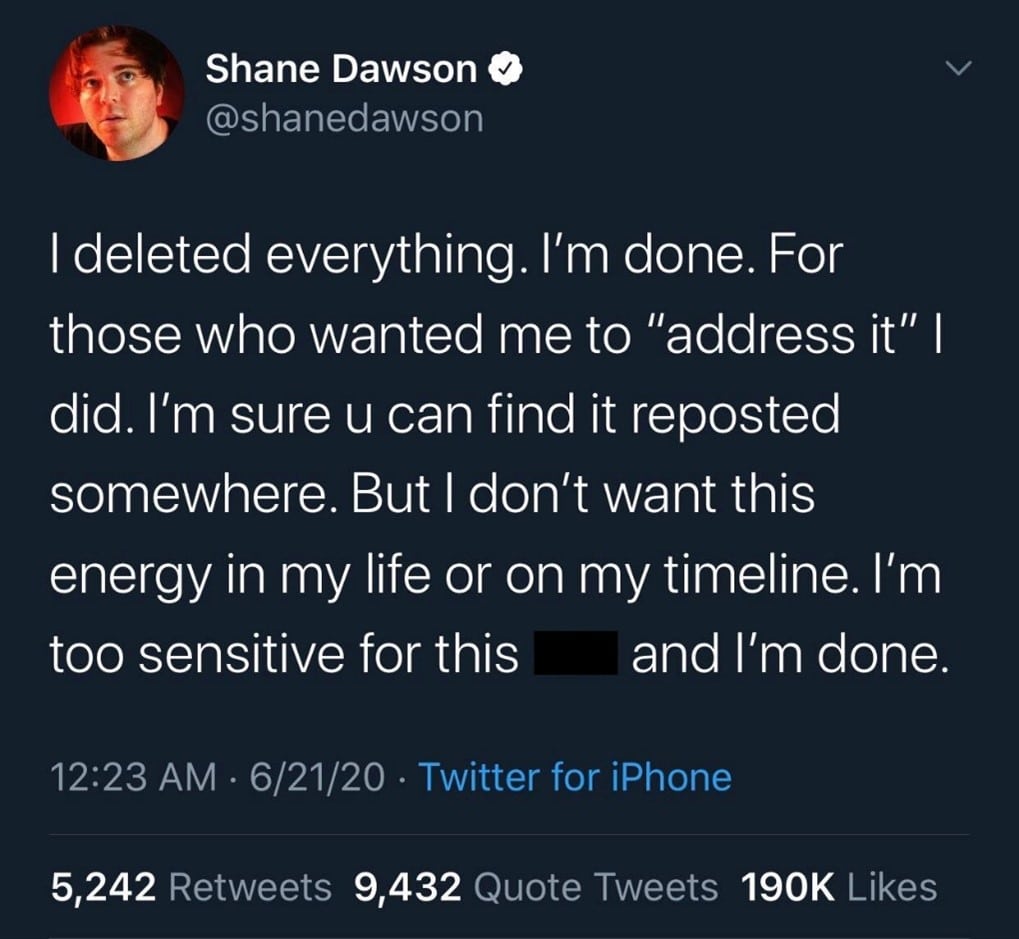
A classic example of cancel culture has been the fall of Shane Dawson in mid-2020, a YouTuber who was once famous for conspiracy theories, docu-series of other YouTubers, and other day-to-day vlogs. At his peak he had a total of 23.3 million subscribers but has since abandoned his channel, leaving video views and subscriber counts to plummet.[2]

Why was Shane Dawson cancelled? Following the 2020 rise of the Black Lives Matter movement, old videos (~10-year-old videos) from Shane Dawson’s channel resurfaced. Such content included racial slurs, inappropriate acts towards children, and even skits involving blackface. These videos spiraled throughout social media, leaving Shane Dawson to become #1 in trending for infamous reasons.

Gossip YouTubers took to these tweets, threads, and videos compiling incriminating evidence against Shane Dawson. Users across all social media platforms chastised him, using words like “pedophile,” “predator,” and “racist.” In a matter of three months, Shane Dawson lost over two million subscribers, was dropped as a brand ambassador of the makeup line Morphe, had all of his videos demonetized (he is no longer able to make any money off of views), and has since been silent since the end of June.

The Psychology Behind Cancel Culture

Research demonstrates that people invest in cancel culture because it offers them:

  • increased social status (one’s popularity in an online community),
  • an opportunity to show their commitment to their virtual community, and
  • instant gratification (enjoying the battle and voicing your opinion in real-time).[3]

This is detrimental on both ends of cancel culture, with one person becoming a victim of cyberbullying and the other succumbing to narcissistic tendencies. Narcissism in today’s online community involves becoming preoccupied with one’s self-image and projecting your flaws or mistakes onto other people to avoid becoming the outcast.[4] Likes, comments, and shares have become the token economy of the internet, driving people to continue their behaviors no matter how toxic they may be.

We are living in a time where saying nothing can be just as incriminating as saying something. Silence online insinuates compliance, leaving kids and teens vulnerable to cyberbullying even if they opt to stay out of it. Cancel culture flourishes at the expense of human error, with online communities waiting for the next person to slip up. Even though it is important for people to be held accountable for their actions, our children must understand that cancel culture is not the solution.
Cyberbullying Exposure and Prevention

Not only influencers fall victim to cyberbullying. Whether your child has succumbed to the giving or receiving end of cyberbullying, it’s never too late to have a conversation about the many issues involving our virtual selves. Social dynamics look different online compared to face-to-face interaction; however, a sense of humanity should not be among those differences.

Social media posts never completely vanish, as someone could easily take a screenshot of your mistake and share it among thousands of eager viewers to be released over and over. It is crucial that children, tweens, and teens understand the challenges of virtual vulnerability and accountability.

Here are our GKIS tools to avoid digital injury:

  • Start informing your kids about online risks by adopting our free Connected Family Agreement. Our agreement not only helps your family negotiate sensible rules, but it also covers online etiquette, empathy, and family values.
  • Follow our GKIS blog for hot topics to stay in-the-know for family discussion around a screen-free dinner table. You’ll receive an article a week in your email if you sign up for your free Connected Family Agreement. If it’s not for you, you can unsubscribe at any time.
  • Let us do the research for you with our Screen Safety Toolkit. Our toolkit is a family-tested, outcome-based resource guide with our best recommendations, how-to information, and links to our favorite easy-to-onboard parental control systems. You’ll be set to create the custom screen safety toolkit for your unique child. Help your kids stay accountable with the rules and regs included in our Connected Family Course. This course not only gives you what you need for safety, but it also offers fun home setup ideas to enrich online activities with offline play.
  • For kids only, our Social Media Readiness Course is particularly powerful in helping tweens & teens get educated about the risks of digital injury and offer Dr. B’s tested psychological wellness techniques. Using modules and mastery quizzes, this online course offers expertise to parents and kids, so they can form a warm and supportive alliance with kids who are vulnerable and relatively inexperienced.

 

Thanks to CSUCI intern Kaylen Sanchez for contributing to this GKIS article.

I’m the mom psychologist who will help you GetKidsInternetSafe.

Onward to More Awesome Parenting,

Tracy S. Bennett, Ph.D.
Mom, Clinical Psychologist, CSUCI Adjunct Faculty
GetKidsInternetSafe.com

Photo Credits

Photo by Prateek Katyal from Pexels

Photo by Kaylen Sanchez

Photo by Kaylen Sanchez

Photo by cottonbro from Pexels

Works Cited

[1] Henderson, R. (2020, March/April) What Propels Cancel Culture? Psychology Today, 53(2) 36-38.

[2] Urgo, J. (n.d.). Shane’s YouTube Stats (Summary Profile) – Social Blade Stats. Retrieved from https://socialblade.com/youtube/user/shane/monthly

[3]  Henderson, R. (2019, December 01). 5 Reasons Why People Love Cancel Culture. Retrieved from https://www.psychologytoday.com/us/blog/after-service/201912/5-reasons-why-people-love-cancel-culture

[4]  MacDonald, P. (2014). Narcissism in the modern world. Psychodynamic Practice: Individuals, Groups and Organisations, 20(2), 144–153. https://doi-org.summit.csuci.edu/10.1080/14753634.2014.894225


Do Kids Need Driver’s Training … for the Internet?

Our Gracie got her first smartphone when she was ten years old. We wanted to wait, terrified of the creeps and porn and the rest of it. But she needed to contact us for pickup from dance, and that’s how her friends connected. Without a phone, she got left out of plans and private jokes. She was feeling more and more alone, and we worried she was depressed. We caved. We couldn’t take the begging and crying. We tried to do it smartly, starting with a phone and no social media. We read articles about risks and checked her phone regularly. We insisted she wait until she was 13-year-old for social media. We allowed only YouTube and TikTok to start. She’s loved it and quickly started feeling better. Two years later, it doesn’t seem unreasonable to allow Instagram. She’s 12 now, so it’s maybe a little early. We’ve talked to her about it a lot. She rolls her eyes, but I think she gets it. She’s smart and funny and social. We are confident she’ll be fine. At least we hope so…

And there it is, the way it happens for most families now. As a screen safety expert, mom, and psychologist, I get it. We all outsource to our phones: for memory, entertainment, navigation, design, communication. When’s the last time you memorized a phone number or planned a trip with a paper map? We are cyborgs and so are our kids. Digital fluency is part of life and a critical element to education, especially now. Screen restriction until high school may be wise, but it isn’t an option for most families. We survived running around town with our friends unsupervised.

Is screen time that big of a deal?

The short answer is . . . that it can be. Preventing screen-loving kids from wandering into a dangerous digital neighborhood isn’t always possible, especially at the beginning. We are too busy, and they are too clever for us to supervise everything they do online. Even the best tech tools have workarounds. But there is one step you cannot miss if you think they are ready for social media, teaching them judgment and accountability like we do before they are allowed to drive a car. Does driving city streets have anything in common with browsing the internets?

As a psychologist who treats digital injury (psychological harm resulting from internet use), I would argue it does. Like driving a car, browsing the internet can cause significant injury. But instead of a concussion, we see kids succumbing to anxiety, depression, and body image problems linked to cyberbullying, radicalization, and compare-and-despair.

Also like driving, kids browsing the internet can wander into any kind of digital neighborhood making friends from faraway places. Most of the places they visit are cool, with fun friends, creativity, and harmless excitement. But there are also digital neighborhoods that would horrify us. Dangerous people like predators and traffickers may be common there and so is intensely violent and explicit sexual content.

Kids who’ve learned the traffic laws from driver’s training and practiced for many hours with invested parents and trained experts are safer. They are so much safer than the government requires these prerequisites before getting a state-issued driver’s license. Doesn’t it make sense to offer the same support for screen use?

Yes, we could keep them off screens and avoid the issue altogether. Yet, also like a car, the internet offers access to learning opportunities that help us thrive. Despite the risk of accidents, we browse because we refuse to miss out on that great job, amazing discovery, and healthy social connections. Our kids feel the same way about their screen devices.

If allowed to browse with little training, more accidents seem certain. That is why my private practice is flourishing. Treatment doesn’t erase trauma; instead, it helps with coping. Once a child experiences danger on the internet, that memory never goes away. Our best options for child screen safety lie in prevention.

What can we do to help tweens and teens browse more safely with sound judgment and accountability?

We can require Internet training! Like driver’s training, our online Social Media Readiness Course offers education about digital risk as well as tools for psychological wellness.

Specifically, our GKIS subscribers get:

  • lots of verifiable facts and science-based information about online risk and screen use (no fake news),
  • expert strategies and techniques to optimize psychological health and judgment,
  • realistic exercises that illustrate typical online scenarios and help coach sensible resolutions,
  • trigger-topics to encourage smart parent-child discussions to further build a healthy alliance,
  • accountability quizzes so you know they are learning as they go, and
  • opportunity for the child to act independently and practice without parent guidance (although course access for parents who want to take it first or along with them is optimal).

I’m the mom psychologist who will help you GetKidsInternetSafe.

Onward to More Awesome Parenting,

Tracy S. Bennett, Ph.D.
Mom, Clinical Psychologist, CSUCI Adjunct Faculty
GetKidsInternetSafe.com

Photo Credits

Photo by Samuele Errico Piccarini on Unsplash

Why Good Sleep is Critical for Child and Teen Health

Ask anybody what they need more of – and they’ll say SLEEP! Surveys report that sleep deprivation among Americans is rampant. As a psychologist who treats kids, teens, and adults, I see that those who suffer the most are teens! Teens are burdened with a ton of schoolwork and the temptations of social media, video gaming, and binge-watching YouTube, TikTok, and Netflix. With crazy busy work weeks, we crave “me-time,” especially during those precious moments when we’ve settled in for bed without interruptions and distractions. Unfortunately, most people don’t know why sleep is so important. Without enough sleep, we are at risk for mental illness and overall performance decline. Today’s GKIS article goes over the reasons why sleep is so important and how to preserve your mental health and learning capacity by protecting much-needed restorative sleep.

Why is sleep so important?

During sleep, our brains conduct general housekeeping and memory-strengthening duties. Housekeeping tasks necessary for brain health include the pruning, repair, and new growth of neurons and the removal of toxins.

Memory strengthening, called memory consolidation, occurs by stabilizing memory traces that were collected while awake. Memory consolidation occurs with both declarative (fact-based) and procedural (how-to) information. Rapid-eye-movement (REM) sleep is particularly important for stabilizing complex or emotionally charged memories.[i]When we don’t get enough sleep, our brain’s housekeeping and memory consolidation tasks remain undone, leaving us unable to efficiently acquire (onboard) or retrieve information.

Sleep deprivation not only stunts learning, but it can also cause:

  • mood swings,
  • negative mood states like depression, irritability, and anxiety,
  • fatigue,
  • confusion,
  • attention problems,
  • motor impairment, and
  • overall impaired cognitive performance.[ii]

If people regularly sleep fewer than six hours a night, research has found that they may have:

  • a higher risk of developing Alzheimer’s Disease,
  • a 200% increased chance of having a heart attack or stroke,
  • a 70% reduction in cancer-fighting T-cells, and
  • disrupted melatonin and cortisol which can lead to weight gain and Type 2 diabetes.

For those who stay awake 16 hours straight, they may lower their overall functioning to resemble somebody who is legally drunk. Furthermore, sleep-deprived individuals often fail to recognize impairment. In other words, they don’t realize the costs and keep burning the candle at both ends.

Vamping

Missing out on much-needed sleep and staying up all night on screens is called vamping.

Teens with chronic sleep deprivation have been found to demonstrate:

  • lower achievement motivation,
  • more teacher-child relationship problems,
  • a poorer academic self-concept, and
  • poorer school performance.[iii]

How might you decrease the risk of vamping and encourage healthy sleep?

Stage the room to be restful.

I know it’s nearly impossible to motivate kids to unclutter their rooms. But a soothing environment contributes to a soothed mind. Offer your support by helping your child create a more restful environment with a fresh bedroom makeover. Light paint colors, soft textures, organized closets and bedside tables, soft lighting, white noise makers, and yummy smells can turn a chaotic hovel into a relaxing paradise.

Recognize that nutrition, exercise, and screen content impact the quality of sleep.

Research has demonstrated that young children who watch violent television content have more sleep problems, particularly delayed onset of sleep, than children who view age-appropriate content.[iv] Furthermore, kids who get adequate nutrition and exercise, especially outdoor exercise because of sunlight setting your circadian rhythm, also get better quality sleep. In practice, I find that teens, in particular, benefit from the mood benefits of regular cardio and cooperative team play.

No screens in the bedroom.

Why? Because screens wake up our brains! The blue LED light from the screen stimulates the photosensors in the retina that signal the brain to suppress melatonin production (our sleep-regulating hormone) and makes us more alert. Less melatonin disrupts our natural circadian rhythms, which can lead to sleep during the day and wakefulness during the night.

Using screens before bedtime has been found to cause people to:

  • go to bed later,
  • prolong the time it takes to fall asleep,
  • delay the timing of REM sleep, reduce the amount of REM sleep and sleep overall,
  • reduce alertness in the morning, and
  • cause more daytime sleepiness.[v]

Screens also condition us to be awake in bed. If we are often awake in bed, our bodies will automatically be conditioned to cue, or believe that the bed is an “awake-only” zone.

Alternatively, if we only rest and sleep in bed, our bodies will be conditioned that the bed is a “sleep-only” zone.

In psychology, we call this type of cued learning classical conditioning. By these principles, we must resist the urge to do anything in bed but sleep to develop good expectations and habits.

Make the No Screens in the Bedroom Rule BEFORE it’s necessary. It’s asking a lot to say no TV, video games, tablets, or smartphones in the bedroom, but vamping leads to sleep deprivation. Sleep deprivation leads to impulsivity and risk-taking.[vi] Impulsivity while in intimate spaces leads to intimate gestures like sexting and viewing inappropriate online content.

Also, use alarm clocks with red-lighted numbers in bedrooms rather than screens for timekeeping.

Encourage a soothing nighttime ritual.

We are creatures of habit. Habitual activity during the thirty-minute bedtime wind-down signals the body to anticipate rest. Components of a soothing ritual may include soft lighting; quiet, repetitive, or white noise sounds; and comforting activities. Sticking to a consistent bedtime schedule is also important.

Screens off thirty minutes before lights out.

As our brains sort through our memory caches, information is prioritized to either forget or remember. Because experiences that trigger emotion are typically important, evolution has shaped our brains to prioritize memories infused with emotion. Based on cognitive science theories, looping on a troubling experience is thought to be the cause of nightmares.

Just like the response to fright when we’re awake, stress hormones like cortisol and adrenaline dump into our bloodstream when we have nightmares. If we are troubled upon falling asleep, agitated dreaming and tossing and turning may result, leaving us tired, irritable, and cognitively scrambled the next day. Over time, this can seriously impair mental health.

Although emotionally triggering and arousing screen activities like gaming, texting, or viewing activating content aren’t as troubling as real-life trauma, they still stimulate the same brain regions activated with chronic stress, often for hours at a time. The hangover from chronic stress has been referred to as mental brownout. Limiting activating screen activities at night and giving your children time to soothe prior to bedtime will result in better quality sleep overall and pave the way for healthy learning during the day. Particularly, avoid eating, triggering discussions, video gaming, and intense exercise before bed.

Teach sophisticated self-soothing strategies.

The opportunity to spend time with a relaxed parent is another factor critical to self-soothing. From birth, a child’s brain synchronizes with a responsive parent. Eye contact, narrative moment-to-moment comments with emotion words, and general conversation teach kids what emotions are and how to deal with them.

We cannot provide this kind of synching and teaching if we are focused on screens instead of each other. Also, if you don’t sleep well one night, don’t stress about it. Getting anxious or angry will wake you up more, and most of us get poor sleep here and there and simply make it up later.

If you are reading this because you are taking our Social Media Readiness Course, you’re about to learn cognitive-behavioral exercises like diaphragmatic breathing, progressive muscle relaxation, mindfulness, imagery, and meditation. These skills can prevent even the most persistent sleep disorders.

Exercising one’s mind to relax is critical to self-soothing. Another option for overcoming some of the negative effects of sleep deprivation is napping.

A full cycle of sleep takes about ninety minutes and provides cognitive rejuvenation that improves procedural memory and creativity with no sleep inertia (grogginess). Sixty to thirty minutes is good for slow-wave sleep, which helps with fact memory and retrieval but may still result in grogginess. Twenty to ten-minute power naps are shown to increase alertness and energy. If you have time to nap, it’s best to spend ninety minutes to complete a sleep cycle or just a power nap for ten.

Onward to More Awesome Parenting, 

Tracy S. Bennett, Ph.D.
Mom, Clinical Psychologist, CSUCI Adjunct Faculty
GetKidsInternetSafe

Works Cited

[i] Xie, L., Kang, H., Xu, Q., Chen, M., Liao, Y., Thiyagarajan, M., O’Donnell, J., Christensen, D., Nicholson, C., Iliff, J., Takano, T., Deane, R., &

Nedergaard, M. (2013). Sleep Drives Metabolite Clearance from the Adult Brain. Science 342.6156: 373-77. Web.

[ii] Goel, N., Rao, H., Durmer, J., & Dinges, D. (2009). Neurocognitive Consequences of Sleep Deprivation. Seminars in Neurology 29.04: 320-39. Web.

[iii] Dewald-Kaufmann, J., Oort, F., Bogels, S., & Meijer, A. (2013). “Why Sleep Matters: Differences in Daytime Functioning Between Adolescents with Low & High Chronic Sleep Reduction & Short & Long Sleep Durations.” Journal of Cognitive & Behavioral Psychotherapies, 13, 171-182.

[iv] Garrison, M. & Christakis, D. (2012). The impact of a healthy media use intervention on sleep in preschool children. Pediatrics, 2011-3153; DOI: 10.1542/peds.2011-3153

[v] Chang, A., Aeschbach, D, Duffy, J., & Czeisler, C. (2014). Evening Use of Light-emitting EReaders Negatively Affects Sleep, Circadian Timing, & Next-morning Alertness. Proceedings of the National Academy of Sciences 112.4: 1232-237. Web.

[vi] Killgore, W., Kamimori, G., & Balkin, T. Caffeine Protects Against Increased Risk-taking Propensity During Severe Sleep Deprivation. Journal of Sleep Research 20.3 (2010): 395-403. Web.

GKIS Guide to Helping Your Child Deal with Grief

Do you remember as a young child when you lost someone you loved? Whether it was your first dog or your grandma, the pain was definitely there. Many children are exposed to death in their early years initially from cartoons, tv shows, and movies. The complex concept of death is often difficult for kids to understand. Today’s GKIS article covers some basics about children, grief, and how to help them through it.

Every child will grieve at some point.

Whether we like it or not our children will have to face a time where they must grieve. One day their fish will die, their friend may pass, maybe even a grandparent will pass away. Parents are the most important touch-point during a time like this. Knowing how to manage it can make a big difference in child outcome.

When I was 10 years old the biggest person in my world would become a memory to me, my dad. On January 22, 2009, my dad lost his battle with stage-4 colon cancer. I remember it like it was yesterday, from my feelings to the headband I was wearing when I found out. The hurt and pain I felt knowing I would never be able to smell his hair pomade, take a Walmart trip with him just so I could sneak a J-14 magazine into the cart, or learn the game of football from him with dreams of playing for his favorite team, the Raiders. My dad was my world and just like that …  he was gone.

For a long time growing up I was angry. I would act out and talk back to my mom, you name it I did it. I did not really understand how to deal with my emotions and felt that I needed to be strong for my mom and older sister. I would brush off his death like I did not care a single bit, but how could I not? My mom tried everything to help me, from taking me to therapy, encouraging me to play sports, and even retail therapy, but nothing made it better. Of course, I had many times where I was happy and laughing because yes, my life did go on, but I always felt a void in my heart.

Looking back now, I wish I could have understood the process more. Maybe with more support, my mom could have reached me better or helped me feel more understood. As I got older one of my goals was to become a children’s therapist, hoping to specialize in children who are grieving the loss of a loved one because I know first-hand how that feels. Every now and then when I think of a new way of grieving, I write it down. Writing today’s GKIS article helped me heal a little bit. I hope you find some of these helpful for you too.

Helping Your Child Overcome Grief

Try to go about your daily life as normal as possible.

Your child is already having to cope with the absence of somebody they loved. So rather than change other things in their life that they may miss as well, like friends or school, try to stick to your daily regimen.[1] The day after my dad passed away my mom encouraged me to go to my softball game. Although it was painful to see the empty seat next to my mom, it actually helped distract me for some much-needed temporary relief.

If past routines are too hard, start new ones!

If you are unable to stick to your daily routine because the pain of the missing loved one is just too great, creating new ideas may offer a fresh start. Anticipating events can be almost as much fun as doing them. When you come up with an idea, like building a sandbox, painting a room, or by making an outside fort, put it on the calendar. Give your child something to look forward to.

Show your child that you love them!

Be there for your child and remind them how much you love them each and every day by doing these small things:[1]

  • Leave them a small note in their sack lunch so they know you are always thinking of them.
  • Greet them with an enthusiastic smile and a hug in the morning.
  • Read them one too many stories and kiss them goodnight.
  • Treat them occasionally with an unexpected surprise from the store, like a cupcake or little toy.
  • Spend extra family time together, like on a hike or a special trip to their favorite ice cream shop
  • Leave love notes for them under their pillow.

It will be tough at times.

Dealing with the death of a loved one is difficult no matter what age you are. There are many complexities that come along with grieving and moving forward when losing someone you love. Although, you are probably just as heartbroken as your child, grief can manifest differently for different people. Although you will have challenging moments sometimes where you won’t know the next step, it’s okay. Breathe…you are not alone.

For extra coaching and support, it’s okay to ask for help from family, clergy, your child’s teacher, and even a psychologist. Sometimes children will speak more openly with someone they don’t have to worry may burst into tears themselves.

Teaching your child the concept of death may be challenging.

This is one thing about my dad’s death I struggled with for a long time. Like many young children who go through a loss of a loved one, I began to fear death and would constantly ask my mom if I was going to die too.

You will be asked a ton of questions

Children are curious and usually speak their minds with no filter. So, when asking about death
and loss be prepared to be asked very vague and challenging questions. Make sure you always give a thought out and complete explanation.

Questions you may get asked:

  • What is death?
  • Why do people die?
  • Where do they go when they die?
  • Will I die, too?
  • Can’t they come back?

It is important, in any which way you answer these questions, to keep it positive while also being straightforward with your child. Dr. Bennett calls it honesty with discretion. Kids get a lot of comfort if you tell them they’ll see their loved one again, but not for a very long time. Follow up that their loved one will always be with them, held close. It just won’t be as easy to see them.

Teach them the concept of death in a positive way. Be honest about your emotions while assuring them of their safety and that they are loved. Letting your children see you grieve sometimes will normalize healthy emotions. You don’t have to suppress emotion completely, all the time. It’s OK to be genuine and even accept soothing from them sometimes.

Still feel a disconnection.

Grief is a very normal and healthy process. However, kids and adults can sometimes sink into what psychologists call complicated bereavement. Complicated bereavement is grief that escalates into impairment and may benefit from professional clinical treatment. If you are wondering if it’s time to seek clinical help, ask yourself simple questions:

  • Are they sad more than half of the time?
  • Are they not eating or failing to gain or lose weight?
  • Are they having trouble sleeping or sleeping too much?
  • Are they complaining about intrusive thoughts or frequent nightmares?
  • Are they refusing to go to school or do homework?
  • Are they moving like they have no energy or agitated often?

Do they act tired, like they have no energy and can’t make decisions? Have they engaged in self-harm or threatened suicide?

Do’s and Don’ts When Helping Your Child Grieve

Do’s

  • Allow your child to grieve in their own way whether it be video games or crying into their pillow.
  • Mix curiosity with caring. This will not only show your child that you too are saddened by the loss, but it will also help your child express their feelings to you.
  • Separate your grief from theirs. It may sound selfish but, in this time, it will be beneficial to your child to see you hold yourself together as much as you can. They are in a foreign state of mind and will need to look up to you in how to move forward.
  • Be careful with your actions. Children are absorbent and pay close attention. Try not to grieve in ways that will not be beneficial to your child, like overindulging with alcohol, checking out, or having huge meltdowns in front of your child.
  • Praise! Oftentimes children develop new skills in this time of grieving. Be sure to mention how good they got at painting, you like their new makeup style, or even how easily they were able to pick up a sport.
  • Consider online support groups if there is a deficit of live support in your area.

Don’ts

  • Do not insist on a certain time or way to mourn. Everyone mourns in their own way.
  • Tell your child the truth, don’t say that their grandma is just sleeping or that their dog went on a walk. Kids can take things too literally and blame themselves or become afraid.[2]
  • Children need to be children. Don’t make them take on adult duties. Taking away their childhood will be seen as another loss for them.
  • Don’t be quick to punish. Your child may act out to elicit your attention. This sounds crazy but normalize their actions. This will help them stop this bad behavior.
  • Don’t knock the idea of support groups. Children being exposed to other children who are also experiencing loss may benefit from a sense of camaraderie.

If you live in California, Hawaii, or Idaho and need some warm, therapeutic support, Dr. Bennett offers teletherapy sessions. Go to DrTracyBennett.com for more information. A grieving child is not the only one to learn something new, you are too. Knowing how to help, nurture, and care for your child during this time is not easy but with simple steps, it can become second nature. Keep going and don’t give up on yourself, you’re doing great! Thanks to Danielle Rivera for contributing this GKIS article.


Photo Credits

Photo by Pixabay on Pexels

Photo by August de Richelieu on Pexels

Photo by Suzy Hazelwood on Pexels

Photo by Edward Jenner on Pexels

Works Cited

[1] Ehmke, Rachel. Helping Children Deal with Grief. Retrieved from https://childmind.org/article/helping-children-deal-grief/

[2] Nathan, Edy (2019). When Children Grieve. Retrieved from https://www.psychologytoday.com/us/blog/tales-grief/201903/when-children-grieve

[3] “Grief Share,” GriefShare.org, accessed May 10, 2020, https://www.griefshare.org

[4] “Corona Virus: Daily Change,” accessed May 19, 2020, https://www.google.com/search?client=safari&rls=en&q=how+many+people+have+died+of+covid+19&ie=UTF-8&oe=UTF-8

Clever Smartphone Emergency Apps


All parents work hard to keep our kids safe. However, sometimes unexpected things happen. Imagine if your child finds themselves alone at school or at the soccer field waiting for their ride and starts to feel unsafe. Or maybe in an emergency a teen takes an Uber and feels uncomfortable with their Uber driver. Or maybe they are at a new friend’s house and you need to pick them up, but they’re not answering your texts or calls. Today’s GKIS article covers several tech remedies that you may not have been aware of.

Fake Phone Calls on TikTok

Although we’d like to think our child would never feel unsafe enough to need a fake phone call, TikTok users think otherwise. Search “fake phone call safe” on TikTok and you’ll see a video that stages the sounds of a real phone call conversation.

Typically in these fake phone call videos, the person recorded in the conversation is saying that they are expecting you and are aware of what you are doing. They are designed to make the listener appear as though they are real-time connected to their parent.

Possible uses for this video are if your child is in an Uber or somebody they don’t feel comfortable with is giving them a ride home or if they feel unsafe while walking home or waiting for a ride alone. Not only does the fake call take the pressure off of them from talking to the stranger=, but it also appears as though they are being tracked for location and situation.

Emergency SOS

Emergency SOS is a free default feature on your iPhone. By clicking your power button five times, you can trigger an automatic 911 call within three seconds.

How to Check if Your Child has this on Their iPhone

Go to Settings > Emergency SOS > Select On to turn on the call with the side button switch, then enable Auto Call.

To test it, click your power button five times and wait for a loud alarm to sound. Of course, be sure to click it off before the 911 call goes through.

Find My Friends

Another great way to know where your child is at all times is the Find My Friends app on the iPhone. With this app, you can check where your child is at all times.

Find My Friends comes as a default feature of an iPhone. To use it, you simply have to make sure you have clicked the Share My Location feature under Settings > Privacy > Location Services > Share My Location.

Life360 “Feel free, together”

Similar to FindMyFriends, Life360 is a tracking device for Apple phones and Android phones that allows you to sync your family into a private, invite-only circle.

Life360 has three membership levels with different features:

Free:

  • Location Sharing
  • Battery Monitoring
  • Location ETA
  • Place Alerts – notifications when family members come and go from your most frequent Places
  • History – a quick view of your family member’s drive a location data for the last 48 hours
  • Help Alert
  • In-App Chat
  • Crash Detection

Plus:

  • All of the above plus Crime Reports

Driver Protec:

  • All of the above plus Emergency Dispatch, Roadside Assistance, and Driver Report

Personally, my mom and I have always shared our locations on the FindMyFriends app because of our almost 3-hour drive from one another. Once I discovered this app, I immediately made her download it because of all the unique features. However, not everybody is a fan of this tracking app. Search “Life360” on TikTok and you’ll see teens insisting that their lack of privacy and spying parents have ruined their lives.

Recently Dr. B says her clients have reported that teens are giving it one-star in the Apple store hoping that Apple will respond by removing the app. GKIS suggests you use discretion and offer older teens their privacy if they ask for it.

Emergency Whistle App

This kind of app can be found in the app store by searching up “Emergency Whistle.” Choose your favorite and download it!

In this app, you can access a digital whistle that activates a loud and alarming sound while also causing your phone flashlight to flash off and on. This acts as a physical whistle nicknamed a “rape whistle.”

Growing up I always carried one of these whistles. But now I’ve found this app which allowed me to feel safe for those late nights on campus as I walk back to my car.

Siren GPS

Cell service is not always the best. This app offers a “panic button” service which when you press it you are instantly connected to 911 services.[1] It will give emergency personnel your exact coordinates with or without a good cell connection.

I remember a time in middle school where my mom was running late after I got out of drill team practice. I sat at school alone for a bit wondering when she would show. Worried, I began to walk home on my own on an unfamiliar path that was deserted. Looking back at that memory, I wish I would’ve had an app like this one just in case something happened. Luckily, I made it home safe and sound!

ICE Medical Standard App

With the ICE app,  “The World’s #1 Emergency Medical App,” your vital statistics like blood type, allergies, medical conditions, and medications will appear on your Lock Screen Display Overlay.[2] That way emergency personnel has potentially life-saving information for appropriate medical care.

Medical ID App

Similar to the ICE Medical Standard App, you can use the Medical ID app on both Android and Apple smart devices. It displays an emergency medical card on the lock screen of the user’s smartphone while also allowing to navigation through this screen to get to a list of emergency contacts.

Another great feature of this app is that you are capable of sending SMSs of your location. There is also a function where you are able to send GPS tracking to designated contacts. Several profiles can be saved on this device for those who have larger families.[3]

Although every parent does their best to ensure their child’s safety, parents can’t be with their kids 24/7. Thankfully with the help of these apps, you can have the reassurance that your child safe when you are not around.

Special thanks to Danielle Rivera for researching and co-writing this article. If you liked the article, you’re interested in learning more tips on how to get yourself and your child prepared with great safety tools check out the Connected Family Course on the GKIS website where you will be able to create a family understanding of why these apps are important for everyone to have on their phones.

Onward to More Awesome Parenting,

Tracy S. Bennett, Ph.D.
Mom, Clinical Psychologist, CSUCI Adjunct Faculty
GetKidsInternetSafe

Photo Credits

Photo by Pixabay on Pexels

Photo by Ready Made on Pexel

Photo by Andrea Piacquadio on  Pexel

Photo by Muhammad Irfan on  Pexel