We were hunters and gatherers for 90% of human existence. That means our brains are still wired to prioritize the things that kept us alive when we were living on the land, before the domestication of animals and the construction of cities. One thing that kept us alive was living in a tribe and cooperating. Attracting a tribe and fitting in was a requirement of life. That is why kids and teens are hyper-focused on doing what their friends do and working to be cool and accepted. Online influencers count on this drive to maintain their income streams. One way to attract kids online is to be a kid doing what kids love to do, playing with toys and video games, opening new packages, and hanging out with friends acting goofy. Netflix’s Bad Influencer offers a glimpse of the kid influencer “scene,” and the lengths that some parents will go to attract and keep a following.
What is Bad Influence about?
The limited documentary series has gone viral for good reason. It’s definitely entertaining, but also deeply unsettling. It is a perfect way to raise awareness about how scary a life all about social media can be. Bad Influencer is a documentary that focuses on a tween who becomes an overnight social media star and brings her friends to stardom with her. What started out as a fun hobby quickly turned into a living nightmare. It may seem glamorous to be famous online, until you learn that the child influencers spent the majority of their childhoods working long hours acting out video ideas, risky stunts, and performing pranks that sometimes went too far—all under the pressure of adult producers/parents hungry for views. Check out Intimacy With Minors Encouraged at the Hype House for a similar story of underage exploitation.
SPOILER ALERT: The show takes a chilling turn when the mother of the main character is accused of, and videotaped, sexually exploiting these kids on set by positioning herself as one of the only adults supervising them to control them. Some survived the battle with only a few scars, while the main character is stuck living this nightmare over and over again. It may be funny, exaggerated, and attention-grabbing, but it also paints a dark picture of a digital world where clout matters more than character and children are left to pay the price.
Psychology Behind the Fame Obsession
From a psychological point of view, being an influencer is cool to children because they have a natural need for validation, attention, and social connection.[1] Although the minimum age on most social media platforms is 13, it is reported that children ranging from 8-17 are found scrolling through online platforms soaking up content too mature for their ages.[2] Sadly, unlike real-world relationships, social media platforms offer fast, unfiltered dopamine hits through likes, shares, and views. Without proper guidance, this can make kids tie their self-worth to online numbers, which can result in low self-esteem, fear of missing out (FOMO), performance anxiety, and digital addiction.[3] As a result of social unlimited social media usage, kids can also experience anxiety, depression, and even poor quality of sleep.[4] Counteract this monster and help your child build emotional resilience, red flag awareness, and digital literacy by taking our GKIS Social Media Readiness Training Course. Geared for teens or tweens, it’s the perfect giftbefore that new device or video game.
What You Can Do to Help
Bad Influencer is not just a show; it’s a cautionary tale that shares the pressures kids face online every day. It is easy to get off topic and want to pull the plug on all electronics just to protect your child from their dangers, but that is not always possible. Technology and online platforms are all around us, and it is better to set your child up for success than to try to keep them out of the loop. Connecting with your child over what they find interesting can help create a trusting relationship where you can notice if things start to become a little off. Our free Connected Family Screen Agreement can help you and your child co-create rules around how to safely navigate online platforms. This way your child can thrive in the digital age without losing themselves in it.
Thanks to CSUCI intern, Elaha Qudratulla for researching and co-writing this article.
I’m the mom psychologist who will help you GetKidsInternetSafe. Onward to More Awesome Parenting,
Advancements in artificial intelligence technology have transformed the media we consume. These highly intelligent computer programs can create realistic-looking images from a few words, hold entire conversations, and even write cited essays. While programs like ChatGPT can give us simple answers to our questions, they can also hinder our children’s learning when they outsource their brainwork to an all-knowing robot. If you worry that your child is relying on technology a little too much, our Screen Safety Toolkit offers a resource guide so you can tighten up screen time supervision and management.
What is ChatGPT?
ChatGPT is a language processing tool that is powered by artificial intelligence (AI) technology, allowing you to have human-like conversations.[1] ChatGPT can answer one’s questions and complete various tasks from essays, to editing code, to writing emails. This software is open to the public for free, although there is also a paid subscription version with additional features.[1] Notable celebrities in technology like Elon Musk have commented on the strength of ChatGPT, stating “ChatGPT is scary good. We are not far from dangerously strong AI.”[1]
ChatGPT gets its data from textbooks, websites, and various articles which it simultaneously uses to model its language to seem more human-like.[2] This AI is well-trained on biased and unbiased data and can reproduce data with reliability, something that many other similar AI systems lack.[2]
When asked to write a sentence for this article, ChatGPT responded with, “ChatGPT is an artificial intelligence language model developed by OpenAI, based on the GPT-3 architecture. It is designed to generate natural language responses to a wide variety of prompts and questions. ChatGPT uses advanced machine learning algorithms to understand the nuances of language and generate context-sensitive responses that are often indistinguishable from those written by a human. It has a wide range of potential applications, from customer service and education to creative writing and more.”[3] How’s that for a definition?!
How are kids using ChatGPT to cheat?
While ChatGPT’s design of being able to generate natural responses to various questions and prompts can make it a helpful tool for educational and informational purposes, it also opens it up to exploitation for other purposes. A quick Google search will turn up dozens of articles on how to get ChatGPT to write your essay for you. A student at Cardiff University in Wales shared his experience with turning in two papers, one written by himself and the other written by ChatGPT.[4] The essay from ChatGPT earned him the highest grade he had ever received on an essay in his entire time in undergraduate school.[4]
College professor and TikTok user Lilmaverick3 received an essay from one of her students that had been flagged by TurnItIn.com as being 100% written by AI technology, proving that students have already started taking advantage of the AI’s skills and ability to create human-like speech.[5] The technology is still relatively new but stories just like this will likely continue.
Cheating robs children of the satisfaction of completing their own assignments and the learning experience that comes with research. It also offers a dishonest view of academic ability, which can quickly get out of hand when teachers ratchet up expectations in response.
What Parents and Educators Can Do to Prevent Cheating
Research various forms of AI detectors and run your child’s papers through flagging software, this way you can see if the paper has any elements that have been plagiarized.
Some popular flagging software includes Writer’s AI Content Detector and Content at Scale’s AI Detector. For educators, we recommend having students turn in assignments through TurnItIn.com, this checks for plagiarism as well as how much of the assignment is AI-generated content.
Sit with your child while they work on assignments to offer support as they need it, and be there before they decide to turn to AIs.
Manage smart devices during homework time using resources from our GKIS Screen Safety Toolkit.
Utilize ChatGPT in ways that allow it to be an educational tool, like writing ideas, creating to-do lists, and finding resources.
ChatGPT is a helpful tool for educational purposes when used properly. As a prompt-based language bot, it can be used to spruce up resumes or cover letters based on inputted job description data, help create outlines for papers based on inputted prompt data, and even provide recipes for weekly meals.
Promoting ChatGPT as an educational tool rather than a homework robot can prevent your child from creating an unhealthy dependence on AI software to do their work for them.
Since the onset of Covid-19, many establishments have become credit card-only and no longer take cash. With this change, getting a cash allowance for doing chores or mowing the lawn is slowly becoming a thing of the past. However, it is still possible for parents to reward their children and teach financial literacy with debit cards specifically made for children. Greenlight advertises itself as a tool to help empower parents to raise financially-smart children, if you are interested in a tool to help empower you to raise digitally-smart children, check out our GKIS Screen Safety Toolkit.
What is Greenlight?
Greenlight is a debit card and money app for families that is managed by parents or legal guardians.[1] Parents are able to load money onto their child’s card and manage where, when, and how much their child spends.[1] Greenlight was first founded in 2014 and is worth 2.3 billion dollars.[2] CEO Tim Sheehan says that through Greenlight, he is teaching children financial literacy worldwide through the tools provided in his application.[2]
According to CNET, Greenlight is one of the most popular debit card apps for kids and the best choice for kids’ debit cards out of five similar cards.[3] Greenlight accumulated 10,000 users within its first five months of operation and has more than four million accounts today.[4] The Greenlight website mentions that three out of four teens do not feel knowledgeable about their personal finance, and that they were created with the mission of changing that.[5]
Features of Greenlight Debit Cards
One of the reasons Greenlight is the most popular choice among competitors is that there are a number of features that their competitors do not have.
Greenlight has three different plans that parents can choose from, each at a different monthly rate. The least expensive plan provides debit cards for up to five children and offers an educational app, core financial tools, parental controls, a one percent savings reward, fun money skill games, credit for parents, and a “lite” version of investing for parents.[6] The next plan has investing for parents, investing for kids, a two percent saving reward, one percent cash back, greenlight black card, priority customer support, and three-times protection (identity theft, purchase, and phone protection).[6] The final plan has all the aforementioned benefits plus a five percent savings reward, family location sharing, SOS alerts, and crash detection.[6]
Greenlight provides an app for both parents and kids. It is one app but allows for two different experiences.[7] Parents are able to turn cards on or off from the app, get real-time spending notifications, instantly transfer money, and control where their kids spend their money.[7] Kids using the app are able to “Level Up”, a game that teaches kids financial literacy and allows them to learn skills from budgeting to investing.[8] The games provided are full of minigames, videos, and questions that allow for learning to occur.[8]
Benefits
Financial literacy is the ability to comprehend and use various financial skills like budgeting and investing.[9] By creating strong financial literacy skills early in life, children can learn valuable life skills that will benefit them in the future. These skills include knowing how to save for retirement, purchase a home, select insurance, create budgets, invest, buy a car, save for big expenses, use credit cards, and reduce unnecessary expenses.[10]
Financial literacy empowers children and equips them with the knowledge needed to navigate unique financial situations they will undoubtedly encounter in the future. According to a national survey, of 1203 college undergraduate participants, 46.1% of respondents have credit card debt with 27% exceeding $2000.[11] More than 79% of respondents also did not know that a credit score measures your risk to banks and can have a negative impact on future financial endeavors.[11] Through financial literacy, your children can avoid these mistakes and understand how to properly manage their funds which will allow them to avoid getting into debt at a young age.
Risks & How to Mitigate Them
As with any online financial transaction, there are always risks to placing your money in the hands of a virtual bank. However, according to the Greenlight website their debit cards are federally insured for up to $250,000 and come with Mastercard’s Zero Liability Protection.[12]
Allowing your child financial freedom can be worrisome for some parents who are unsure where their child may be spending their savings. Luckily, the parental controls in the app also allow parents to know where their child is spending their money and what they are spending it on. Communicating with your child beforehand about where they can use their money helps to avoid being caught off guard if their card gets declined for a certain purchase. We can help facilitate this healthy conversation with your child through our GKIS Connected Family Screen Agreement.
With the Covid-19 pandemic creating an unexpected need for online school, tech has been forever integrated into our children’s everyday curriculum. Teachers recognize that kids benefit from tech tools, and schools now offer individual devices for kids as young as elementary age. We’ve become reliant on screen devices at home too. Smart assistants, like devices that support Alexa, Google Assistant, and Siri, get us fast answers to questions in seconds. But is it helpful to outsource the brainwork we should be doing ourselves? What if you’re a kid who hasn’t yet mastered independent reasoning? Does relying on a screen device impair learning rather than help us develop it? Are teachers aware of how much kids are outsourcing learning to their devices? If you worry that your child is using tech too much, our Screen Safety Toolkit offers a resource guide so you can tighten up screen time supervision and management.
What are smart assistants?
Smart assistants are tech devices, like phones, portable screens, watches, and speakers that use software to perform verbally requested tasks.[1] Among the most popular are Alexa, Google Assistant, and Siri.
As of 2021, about 47% of smartphone users in the United States are Siri-equipped iPhone users.[2] In 2020, close to 70% of smart speaker users in the United States used Alexa-equipped Amazon Echos.[3] The prevalence of these two smart assistants has created an encyclopedia of knowledge accessible just at the sound of our voices. In fact, Amazon promotes using Alexa for that very purpose.
Last year, Amazon ran an ad that showed a father asking Alexa what year Pompeii was destroyed. Once he receives his answer from Alexa, he shares it with his daughter who is clearly doing homework at the dining table. She then turns to ask him for the name of the volcano. He responds by turning back to the Alexa device. Although this ad intends to demonstrate a fun interaction between father and daughter, it also demonstrates how smart devices are being used to cheat on assignments and get easy answers.
Are kids using smart devices to cheat?
The modern generation of students is smart, and they know how to use the technological resources they are given. But they also know how to use them to cheat and get away with it.
A college student I interviewed recalls a run-in with a fellow classmate who had Siri turned on during a test in high school. “We were in the middle of a test in my AP European history class, and suddenly the iPhone of the girl sitting next to me begins speaking. You can hear Siri say, ‘The War of 1812 was…’ before she abruptly turned it off. The teacher immediately turned to her and said, ‘Make sure all phones are turned off please.’ The student turned bright red, so I think she definitely learned her lesson.”
This instance of cheating occurred in 2017. Since then, opportunities for cheating with smart devices are more common than ever. A recent high school graduate recalls taking tests during Covid-19. “The teachers would make us all have our cameras on, but they wouldn’t require us to be unmuted since it would be a distraction. Since they couldn’t hear us, anytime I would get stuck I would just ask the Alexa sitting in my room. Sometimes my friends and I would even Facetime each other and use my Alexa together whenever we felt confused. I honestly would never study for tests because I didn’t see a point when I could just get the information from Google so easily.”
For a student who is struggling, smart devices provide the perfect assistance for quick and easy answers to questions while simultaneously being practically untraceable. Other forms of cheating leave behind indicators or evidence, but smart assistants don’t.
It is a given that cheating is bad, but you may not know of the many downsides to cheating that go beyond academia. A recent study by a Harvard-Duke research team found that cheaters tended to engage in “self-deception,” meaning they would view their high performance as a sign of high intelligence, which may not actually be true. They see a high score, and even though they cheated, they believed that they are smart enough to have earned that score.[4] Another study found that when our kids cheat, they deprive themselves of the happiness that comes from independent accomplishment.[5] Smart devices are helpful tools, but when their assistance turns into dependence, kids begin to create a world where there actually at a disadvantage.
Take away or manage smart devices during class or homework time using resources from our Screen Safety Toolkit.
Advocate for your kids and communicate your preferences about tech integration with teachers and school administrators.
Offer valuable information and support for your learning community by suggesting a screen safety webinar from Dr. Bennett, our Screen Safety Expert, at your school and church.
Set up tech-free learning challenges for the whole family like a family game or trivia night.
Encourage creativity, curiosity, confidence, and a love of learning by offering a variety of fun educational materials and outings.
Optimize health tech integration for the whole family with the parents-only and family coaching videos from our Screen Safety Essentials Course.
Thanks to CSUCI intern, Katherine Carroll for researching kids cheating using smart assistant devices and co-authoring this article.
I’m the mom psychologist who will help you GetKidsInternetSafe.
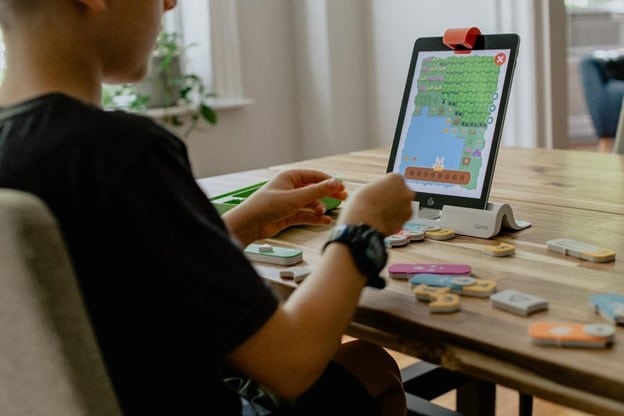
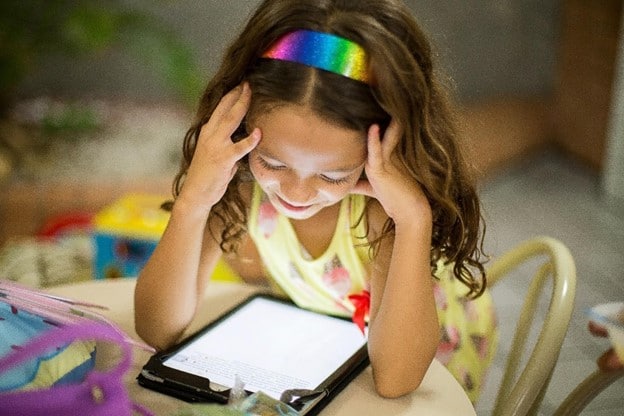
Surveys show that 72% of children under the age of 8 have a tablet or smartphone device.[1] Not only are young kids fluent with screen technology, but many are also learning computer programming and other high-level skills. Imagine if you could get your child started on coding at the age of 5 and set them on their way to a successful future. To avoid your child working around parental controls and outsmarting you, check out our GKIS Screen Safety Toolkit.Our Screen Safety Toolkit is a resource guide for tried-and-true parental control options and monitoring and safety apps plus so much more.
What exactly is coding?
Coding is essentially computer language or using commands to create software that makes images and words online.[2] There are many different coding languages used by programmers and big tech. The language of coding is what makes your computer function, it tells the computer what to do. We need coding to create websites and apps and to run software programs. To put it simply, coding is a list that the computer reads to know what to do.
How can a child learn to code?
With so many children using tablets, the number of apps made for children has skyrocketed. Kids can download and use a variety of art, educational, and STEM games.
Coding games fall under the STEM category. STEM stands for science, technology, engineering, and math. STEM can be hard for some people to grasp and starting early is incredibly beneficial.[3] Schools in Europe and the United States have already added coding to their curriculum. Educators are finding that teaching children coding is setting them up with good life skills and a potential career in technology![4] A key factor to coding apps and games is that coding not only teaches children problem-solving skills but they are also mixed with creativity. The combination has proven to help children to de-stress and relax.[5]
Subscription-Based Children’s Apps for Coding
Kodable
Ages 5 & Up
Kodable is proudly rated 4 out of 4 stars and is parent-and teacher-approved. Some schools use Kodable’s online platform. Kodable has fun and quirky elements that children love. For example, with Kodable the “fuzzFamily” takes children on an adventure through their universe with different games that they can play and create. Some are similar to the old-school Mario games parents used to play.
Parent reviews state that their children are learning sequencing, critical thinking, memorization, and other skills, and the parentsare having just as much fun playing as the children![6] To help get your family tech-friendly, check out our GKIS Connected Family Course. Dr. Bennett created GKIS courses for fun family connections and to help children avoid digital injury.
codeSpark
Ages 5 and Up Free Trial Option Available
codeSpark was rated the number one coding app for kids in 2021. codeSpark does not use words, only colorful creatures so that kids as young as 5 can play. The characters are called “The Foos.” Foos are a mixture of animals, ninjas, and people that take children onto their coding journey. Each character has a backstory and special goal to teach. For example, Gracie is a green character that is part of the “Fooville Police.” Grace’s bio states that her job is to “catch glitches and viruses” and to find the missing pets. Each level has a different “glitch” that needs to be solved. Once players master the games’ coding terms and concepts, they’re ready to make their own games. This helps ensure that they are retaining the necessary information before they move on.[7]
Free Coding Apps for Children
Code Karts
Ages Preschool and Up 10 Levels Free
Code Karts is a coding app for preschoolers. To win the kart race, players must avoid obstacles. Obstacles become harder and more frequent as the child progresses through the levels. The game is self-explanatory with easy-to-understand icons. This helps children develop critical logical thinking techniques without having to be instructed on their every move. This app also supports 24 languages so kids all over the world can play.[8]
Scratch Jr.
Ages 5-7 Free
Scratch Jr. is a free app that has a unique approach allowing for a lot of creativity. Children choose a character (the side panel shows the images/animals they need to select) and a background. Once the animal has been selected, they can decorate them or add their voices. Puzzle pieces are aligned on the bottom that can be connected to animate the animals. The animating is part of the code learning process. Children can make their backgrounds and create their scenes to watch over and over again. The options are endless and can keep children busy and learning for hours.[9]
Try it!
These games are just a few of many options. There is nothing to lose when it comes to furthering your child’s education. Play along with your kids! Learning to code can be beneficial for everyone.
If you’re feeling guilty about your children using their screen devices too much, Dr. Bennett’s book, Screen Time in the Mean Timedetails how to manage screen time so it can be beneficial for learning and a fun way to connect as a family.
Thanks to CSUCI intern Tara Meizel for researching coding apps for children and for co-authoring this article.
I’m the mom psychologist who will help you GetKidsInternetSafe.
[1] Rayman, N. (2013, October 28). More than 33 percent of kids under two use tablets so prepare for an army of robot babies. Time. Retrieved November 18, 2021, from https://newsfeed.time.com/2013/10/28/more-than-33-percent-of-kids-under-two-are-using-tablets-so-prepare-for-an-army-of-robot-babies/.
[2] What is coding? Code Conquest. (2014, December 7). Retrieved November 18, 2021, from https://www.codeconquest.com/what-is-coding/.
[3] Midrack, R. L. (2019, November 17). Is a STEM education right for your child? Lifewire. Retrieved November 18, 2021, from https://www.lifewire.com/what-is-stem-4150175.
[4] Tevfik Kaplancali, U. (2017). Teaching coding to children: A methodology for kids 5+. International Journal of Elementary Education, 6(4), 32. https://doi.org/10.11648/j.ijeedu.20170604.11
[5] Columbia Engineering Boot Camps. (n.d.). Retrieved November 18, 2021, from https://bootcamp.cvn.columbia.edu/.
[6] Programming for Kids. Kodable. (n.d.). Retrieved November 18, 2021, from https://www.kodable.com/.
[7] Coding game for kids – try it free! codeSpark Academy. (n.d.). Retrieved November 18, 2021, from https://codespark.com/how-it-works.
[8] Patel, G. (2017, May 31). Code karts: Precoding for preschoolers. Teachers With Apps. Retrieved November 18, 2021, from https://www.teacherswithapps.com/code-karts/.
[9] Home. ScratchJr. (n.d.). Retrieved November 18, 2021, from https://www.scratchjr.org/.
It is no surprise that homeschooling has been on the rise in the last few years. What is surprising is the new concept – “unschooling.” In this article we are going to delve into the world of traditional homeschooling and the newer model, “unschooling.” Is your kid ready for unschooling? Is the world ready for unschooling? Whether your child is at home or in school they are going to be active participants in social media and the world of screens. Dr. Bennett’s Social Media Readiness Training for Teens and Tweens will reduce your child’s risk of digital injury and take the stress of navigating the social media world off you.
Why homeschool?
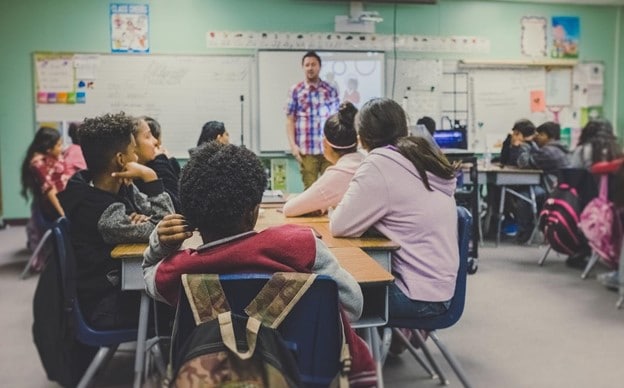
We are an individualistic culture in the United States. We prioritize having the freedom of choice. We promote the idea that we are all unique individuals with our own creatively cultivated paths in life. It has been argued that the public school system does not do enough to support individuality and freedom of choice. Instead, public schools tend to set one curriculum for each grade. For many years, the majority of families accepted that same-age children must follow the same curriculum from grade school to high school.
But within the past half-century, many parents have chosen a more flexible curriculum by choosing to homeschool.[1] The U.S. Census Bureau reported that when schools shut down due to the COVID19 pandemic in 2020, 5% of US families homeschooled their children. Currently, that figure has risen to 11%.[2]
The Original Homeschool Format
While education laws differ by state, the general concept of homeschooling refers to an individualized education program where a teacher comes to the child’s home or the parent teaches their child with materials provided by the local public or private school.[3] This can be particularly beneficial for children that have emotional or physical disabilities or if you’d just prefer to be the one to teach your child. With homeschooling, the child still benefits from a set curriculum and resources.
What is unschooling?
Although there are some overlaps, unschooling is not the same as homeschooling. Unschooling does not follow a set curriculum, instead, it welcomes the child’s freedom of choice. Parents that choose the unschooling route allow their children to choose what they learn and when. Since there is no set curriculum and each child is taught differently.
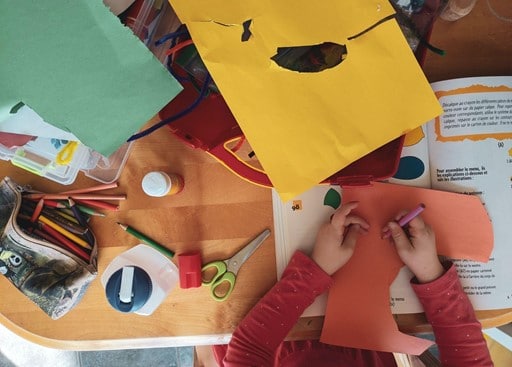
The concept of unschooling started in the 1960s. It is not entirely new but not as common as homeschooling.[4] Unschooling aims to help children desire to learn by allowing them to choose what to learn about. Concepts are not forced onto the children and there are more hands-on opportunities for learning. It is believed that by allowing children to indulge in their own interests, you are allowing them to find their own path in life. A lot of people follow the path of their parents or what they are told to do and ultimately end up unhappy in their chosen career path. Unschooling is a great way to help a child find their special niche.
Why deviate from the public and private school programs?
There are many reasons why a parent may choose to take their child out of school and turn to homeschooling or unschooling. Some parents choose to do this due to political disagreements, religious reasons, wanting to be closer to their children, or to cater to special needs.[5] Others want to integrate their family’s beliefs and values into the curriculum. Each reason is an individual as the participating families.
Pros to Homeschooling Your Child
The family dynamic may grow stronger with more time together.
Children are likely more protected from bullying.
Parents get the liberty to decide aspects of the curriculum.
Hands-on activities, like field trips, occur more frequently.
Unique content may be integrated into the child’s day, ultimately triggering a unique skill or interest set.
Cons To Homeschooling Your Child
There may be a lack of resources compared to larger schools.
Parents and kids may have less personal time.
There are more potential conflicts due to overworked parents in dual roles.
Kids are likely to have fewer peer-to-peer interactions.
There may be fewer opportunities for exposure to student and teacher diversity.
Elements of a traditional curriculum may be bypassed and cause some challenges later for the child.
While there are many aspects of homeschooling and unschooling that are similar, unschooling also has its set of pros and cons that add to the homeschooling lists above.
Pros to Unschooling Your Child
Children get more freedom to choose what they learn about.
Kids have more opportunities for extracurricular activities.
Parents can choose how to teach.
Cons to Unschooling Your Child
Children are less likely to be learning the same things as their peers.
If a child decides to continue with “regular” education when they are older, they may feel behind or fearful of the rules and regulations.
A lack of structure can cause anxiety in parents and children.
Which is the better option?
Parents must consider not only the best program for their child but also what is best for them since they may be taking on the teacher role. Considerations include your skillset and available time for teaching and mentorship as well as your child’s goals, personality, and learning style and how much peer interaction they need.
We at GKIS celebrate freedom of choice, creativity, and the love of learning! To facilitate close family connection and effective communication, check out our weekly parenting/family coaching videos and other valuable resources from the GKIS Screen Safety Essentials Course.
If you liked this article about unschooling, you may also enjoy Family-Friendly Activity Ideas for inspiration on hands-on activities to do with your child.
Thanks to CSUCI intern, Tara Meizel for researching the different types of homeschooling and co-authoring this article.
I’m the mom psychologist who will help you GetKidsInternetSafe.
[1] LINES, P. M. (2000). Homeschooling comes of age. Public Interest, 74. https://link.gale.com/apps/doc/A63856605/AONE?u=csuci&sid=bookmark-AONE&xid=a2cf9ae8
[2] Lambert, D. (2021, July 1). Pandemic drives sharp rise in California families opening their own home schools. EdSource. Retrieved October 27, 2021, from https://edsource.org/2021/pandemic-drives-sharp-rise-in-families-opening-their-own-homeschools/657233.
[3] Schooling at Home. Schooling at Home – Private Schools and Schooling at Home (CA Dept of Education). (2020). Retrieved October 27, 2021, from https://www.cde.ca.gov/sp/ps/homeschool.asp.
[4] School’s out forever. (2012). The Wilson Quarterly, 36(2), 64+. https://link.gale.com/apps/doc/A306514910/AONE?u=csuci&sid=bookmark-AONE&xid=5d9f9b5f
[5] Preethi, V., & Lawrence, A. S. A. (2021). Homeschooling: A paradigm shift during COVID-19 crisis. Researchgate.net. Retrieved October 28, 2021, from https://www.researchgate.net/profile/Arul-Lawrence-A-S/publication/349477381_HOMESCHOOLING_A_PARADIGM_SHIFT_DURING_COVID-19_CRISIS/links/603239ac299bf1cc26de16be/HOMESCHOOLING-A-PARADIGM-SHIFT-DURING-COVID-19-CRISIS.pdf.









 Thanks to CSUCI intern, Katherine Carroll for researching ChatGPT.