In a generation that places social media “likes” at a higher importance than registering to vote, it’s no surprise that screen technology has become critical to friendship and entertainment. As my father would say, “We have the world at our fingertips.” Not only can we research smart investments, how to cook a Thanksgiving dinner, or recent celebrity exploits, we can escape into social media. The virtual lives of teens can be particularly consuming as they constantly craft and brand their virtual selves. Self-presentation and self-disclosure are among the major reasons teens use social media.[1]
Studies have found that unmanaged screen time can deteriorate real-life interpersonal relationships and can lead to social isolation. This is not to suggest that we must go screen-free. Instead, we at GKIS encourage parents to support their kids and teens to best navigate a positive screen-using experience. Signing up for the Free GKIS Connected Family Agreement is a valuable first step towards learning how to properly monitor technology usage while developing a trusting and loving environment for families.
Our Connected Family Agreement isn’t just a digital contract. It’s a flexible blueprint that will lead your family into important discussions about what to look out for and what’s expected. After all, if we don’t have an agreement and learn to talk about screen use, even sensible management rules won’t make sense. Parents will get mad, and kids will get in trouble too often. None of us want that.
Topics our agreement covers include
taking inventory of online activities,
how to “love and protect” online as well as offline,
how to maintain honesty and transparency,
screen smarts and digital permanence,
and digital citizenship, online reputation, and netiquette.
When you sign up on our GetKidsInternetSafe home page, you’ll receive the child and teen versions of the Connected Family Agreement in your email. Today’s GKIS article covers issues to keep an eye out for as teens launch their lifetime relationships with tech.
Media Multitasking
Media multitaskingis the use of different media simultaneously, for example, listening to music while playing a video game or texting while watching a movie. Research shows that media multitasking can lead to performance decline due to an overload of cognitive resources. Too much time spent in mental brownout can lead to mental illnesses like depression or anxiety. To learn more about media multitasking, check out our GKIS article Smartphones During Homework?
Social Media’s Effects on Friendship
Psychology research has also explored how smartphones affect friendship quality and face-to-face interactions. Here are the findings:
People rely heavily on social media to develop and maintain relationships with family and friends.[4]
Teens tend to move towards a group that is highly susceptible to negative psychological and behavioral outcomes from social media use.[5]
Teens who obsessively engage in self-presentation on social media may be more susceptible to psychological stress.[6]
Adolescents who appreciate having greater control over message content may prefer smartphone communication rather than face-to-face because they are allowed more time to edit response when behind a screen.[7]
In 2013, college students reported lower feelings of trust and empathetic understanding when there was a smartphone in the room, especially when intimate topics were being discussed.[8]
In 2014, women reported that mobile devices frequently interrupted quality time with romantic partners, and the more frequent interruptions, the lower their relationship satisfaction.[9]
Some teens seek media to help cope with negative emotional states.[10]
Friends who get distracted by their smartphones are more likely to report poor conversations and decreased access to emotional cues, which could reduce their opportunities to build a long-term mature sense of intimacy.[11]
Internet use has been associated with depression and suicidal ideation between the ages of 13 and 18.[12]
The distractions imposed by smartphones are of great concern considering that intimacy development is a critical skill in emerging adulthood.[13]
Internalizing Behaviors to Look Out For
Depression and anxiety are among the leading internalizing behavior diagnoses for teens.[14]
What type of parental monitoring leads to the best results?
Research has shown that parental media monitoring can be effective at reducing the negative effects of media.[16]
Active monitoringrefers to media-based conversations reviewing what content the teen is allowed to view and post.
Restrictive monitoringrefers to parents imposing restrictions around the amount of screen time teens are allowed.
Supportive restrictive media monitoring refers to a parent placing limits on their child’s media use but also taking the time to explain why the rule is important and engaging in mutual feedback in setting rules and limits.
Active monitoring is the most effective type or parental monitoring for promoting autonomy (the child making good independent decisions) because the parent encourages open conversation. This approach promotes critical thinking about the differences between the on-screen world and the real world. When a teen can take charge of their media usage, they are better equipped to engage in critical thinking and learn to make decisions about technology based on internalized values, rather than being instructed by their parents.
Autonomy-supportive approaches are associated with lower levels of depression and anxiety. Whereas controlling parenting styles can encourage teens to spend more time on their smartphones as an escape to express themselves. Teens may not feel comfortable enough to open up to their parents and are more likely to internalize problems instead of reaching out to parents for support.
Overall, teens of all ages can benefit from screen-use rules and limits if they are conducted constructively. We encourage parents to allow enough space for their kids to develop their sense of identity and the free will to make their own decisions. With the help of Screen Time in the Mean Time: A Parenting Guide to Get Kids Internet Safe, you can learn how to properly monitor and protect your teens while still allowing a sense of autonomy. Our goal at GKIS is to prevent issues that may come up related to screen use before treatment is necessary.
Thanks to Isabel Campos for her research and help with writing this article.
Although parenting in the digital world may seem impossible, taking time to understand and learn will allow parents to better connect and relate to their teens. Interested in sharing this information and additional findings with other parents? Be sure to follow GKIS on Facebook, Instagram, and Twitter for more.
I’m the mom psychologist who will help you GetKidsInternetSafe.
Tik Tok is a social media app that allows users to create and discover short videos made and posted by users. It’s popular because it combines teen users’ love for social media, music, and creative shorts. They love the authenticity of sharing and creating Tik Tok offers. Dangers are that kids may post and view sexualized or stunt videos and explicit songs, post videos of others without their permission, users are commonly ridiculed and cyberbullied, they may read lewd comments, and there is potential for public direct messaging. Be aware that popular Tik Tok influencers produce highly sexualized content and the “For You” autofeed commonly offers up content that most parents find inappropriate for child viewing. Plus, it’s so fun it’s addictive. Kids can spend hours scrolling endless content. As always, make sure you have familiarity with Tik Tok before you allow your child to use it. And, of course, add it to your free GKIS Connected Family Agreement as an “OK” or a “not yet,” so parameters, rules and regs, and etiquette issues are understood. (If you haven’t downloaded it yet, enter your name and email on our GetKidsInternetSafe home page and it will be emailed immediately). For a comprehensive tween/teen course on how to stay safe on social media, know what to watch out for, and how to apply amazing psychology wellness strategies, check out our GKIS Social Media Readiness Training Course. It gets the conversations started about the truths of Internet risk,. Also, y\ou won’t want to miss the parent setup tips at the end of this article. Our GKIS Sensible Guide provides information that parents need to know to make an informed decision.
What is Tik Tok?
Tik Tok is an app that allows users to create 15-second videos. It’s based on a previously popular app called Musical.ly, which is no longer available. Tik Tok users can post videos they saved on their phones and add sounds, parts of songs, special effects, and filters. Recently, Tik Tok added a new feature that allows users to record their reactions to other Tik Tok videos. The app also includes a feature that notifies users when they’ve spent more than two hours on the app. Users seem to value creativity and authenticity over likes.
How long has it been around and how popular is it?
Tik Tok is developed by ByteDance, a Chinese Internet technology company. It was first released in September 2016 for IOS and Android. Tik Tok’s global offices are located in Los Angeles, London, Dubai, and Tokyo, among other places. As of October 2018, Tik Tok was downloaded 80 million times in the US and 800 million times globally. It is free to use. ByteDance makes its money through advertisements integrated into the app.
How old is old enough for adoption?
Tik Tok’s Term of Service states, “If you are under age 13, you may only use the Services with the consent of your parent or legal guardian. Please be sure your parent or legal guardian has reviewed and discussed these Terms with you.” As you know from other GKIS Sensible Guides, 13 years old allows social media apps to be in compliance with the U.S.’s Children’s Online Privacy Protection Act (COPPA). It has nothing to do with child psychology. Nobody assessed that 13 years old is a healthy age for app adoption. That is up to you.
Before you make your decision, keep in mind that before 13 years old, kids still have limited ability to understand potential consequences and lack impulse control. In Dr. Bennett’s book, Screen Time in the Mean Time, she recommends no social media app adoption until at least the second semester of sixth grade, when kids have more social experience for creative problem solving and are no longer transitioning into middle school. (If the seventh grade is a transition year in your community, she recommends waiting until spring semester for the introduction). Most parents will find that, even at 13 years old, they are uncomfortable with their kids viewing the sexually explicit and sometimes cruel content easily available on Tik Tok. Follow a few popular Tik Tok influencers to sample what I’m talking about. Of course, every family circumstance is unique. We at GKIS believe that parents are the ultimate authority on your children’s unique traits and “fit” with Tik Tok.
Tik Tok In the News
In December 2019, the U.S. Army and U.S. Navy banned soldiers from using the Tik Tok app on government-owned phones due to concerns that content shared with ByteDance could be used to influence and surveil Americans. ByteDance reports that it stores U.S. user data in the U.S. with backups in Singapore, so it is not subject to Chinese law. But as a security expert told me, “It doesn’t matter where they store the data, it’s how they access it that counts. China is well known for having an excellent ability to steal private data from foreign countries.”
In February 2019, ByteDance was fined $5.7m by the U.S. Federal Trade Commission for illegally collecting personal information from children, like names, emails, addresses, and locations. in violation of COPPA. The FTC found that Tik Tok failed to delete content from underage children despite receiving thousands of complaints from parents. As a result of the FTC fine, Tik Tok created an experience for underage users which allows them to only access curated, clean videos and not have the ability to comment, search, or post their own videos. Kids can work around this by simply entering a false birthdate.
What are Tik Tok’s popular features?
After opening the app through your smartphone, you have the option of looking at the videos of those who you follow, what’s featured, and videos under hashtags.
You can follow friends and other Tik Tok users. Those you follow will show up under “following” on the home page of the app. With a simple scroll, you’ll be introduced to the thousands of videos Tik Tok users create. Just because you follow someone doesn’t necessarily mean they follow you back.
To make a Tik Tok video, click the square button with the plus sign. Once there, the app will ask you if you want 15 seconds, 60 seconds, or photo templates. You also have the option to add sounds, upload photos or videos, and add effects. Users can also adjust the speed and add filters. Tik Tok provides sound categories like “Trending,” “Country,” “Furry Friends,” “Sweat It Out,” and even “Munchies.”
There’s a search feature that allows users to browse through various hashtags. They can also search through categories like “top,” “videos,” “sounds,” and “hashtags.”
You can personalize your “For You” feed by ♥︎ing videos you like or choosing “not interested” on those you don’t.
Tik Tok nudges its users to go outside of their groups of friends by immediately introducing them to group challenges, theme hashtags, and videos based on a popular song.
What is included in the personal profile?
Tik Tok makes signing up to the app simple. You can sign up with an email, name, and phone number or through your Facebook, Google, Instagram, or Twitter accounts or through your Apple ID. From there, you can choose to sync your phone or Facebook contacts with Tik Tok to see if your friends also have an account.
Along with a personal profile photo of your choosing, your profile page can also contain your bio, the number of people you follow, who follows you, and how many Tik Tok videos you’ve liked. If you have uploaded Tik Tok videoes, they’re displayed on your profile too.
The top left has a button for searching for friends on the app. The top right is a button for the settings. When you click on “edit your profile,” you have the option of adding your Instagram username or your YouTube channel, which will be public to those who can see your profile.
What are the privacy and safety options?
Many Tik Tok users love interacting with a large, global audience to spark creativity and enjoy fun feedback. As a clinical psychologist who sees how some of these collaborations with strangers can turn dangerous, I recommend a private account so you can approve or deny follower requests, and only users you’ve approved as followers can see your content. Of course, we encourage parents to discuss the pros and cons of use with their kids to reach a cooperative agreement.
To do this,
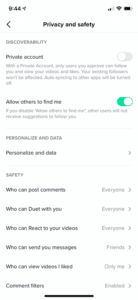
Click on the Settings button at the top right corner on your profile page.
Click on Privacy and Safety.
The first option is “Private Account” or “Allow others to find me.”
If you change an already-existing account to private, current followers will not be affected.
You can also remove or block followers at any time. Removing them disables their ability to direct message your teen. Blocking them stops them from interacting with or viewing your teen’s content at all.
Opting for Restricted Mode limits content that may be considered inappropriate. Users can also restrict comments to friends only or block them altogether. The can also disable messaging and disable duets.
Tik Tok offers a Screen Time Management mode with a passcode as one of their Digital Well Being offerings.
If you see inappropriate content while browsing the app, you have the option of reporting it within the app. We noticed that the report button is somewhat difficult to find in that it is hidden among other buttons.
As with most social media apps, the company collects information, including your name, email address, and phone number. They may also collect any messages you send through the app to friends. This is part of their privacy policy.
Tik Tok is rated a 12+ app store rating. This means you can block underage kids from onboarding the app with Gooogle and Apple parental controls. Tik Tok resources for parents include a Top Ten Tips for Parents primer, “You’re in Control,” safety educational videos, a Safety Center, and an ongoing blog series with helpful tips. The videos can be accessed directly in-app @TikTokTips.
What are the risks for use?
Constant Access
When kids are little, parents decide when playdates happen. Once Tik Tok is on board, keep in mind that your kids will have access to their friends whenever they have their device, and other Tik Tok users will have access to your kids. For many, that means 24/7 access. If you’re not OK with that, you’ll have to dock screens consistently or limit their access.
Inappropriate Content
Although the rules state that users younger than age thirteen shouldn’t be on Tik Tok without parental guidance, anyone can simply lie and accept the terms of conditions without informing their parents. Sometimes the content may not be filtered, and any kind of inappropriate content may pop up. Of particular concern is dangerous stunts, hate speech, and sexualized dancing to explicit music lyrics. Imagine watching your 12-year-old dancing sexy to lyrics that include the n-word, the f-word, p&^sy, and worse.
Cyberbullying
A fun video posted today can feel humiliating when viewed tomorrow. Since moderators can’t oversee all comments on the app, there is cyberbullying. Since being creative requires risk, public ridicule now or later is a real concern. Often the ridicule happens when the Tik Tok video is shared on other social media platforms, like Instagram or Twitter. The best way to prevent this would be to keep the account on private and add only people whom you know or are friends with. However, keep in mind that cyberbullies can always screenshot from a private account and share publicly. Users can turn off comments to prevent or stop cyberbullying on their content. Exclusion from posts about friend groups can also be hurtful. Imagine if your child is the one who was left out.
Trends & Attention-Seeking
Users can produce or view inappropriate Tik Tok’s and often try to attract large numbers of followers with poor posting or comment choices. For example, the trend for “Chop Chop Slide” involves kids filming their parents’ reactions to an unexpected string of very explicit lyrics. Many of these videos of their parents are likely shared without permission. To feed the need for likes, affiliative apps offer the purchase of likes for your posts and to buy more followers.
Stunts & Challenges
Most Tik Tok Challenges are incredibly skillful dance moves. You’ll also see kids singing along with their tongues out and clever facial expressions to vulgar lyrics alone and in groups. Like with the other social media platforms, you’ll also see some winners come up with something like the outlet challenge which involves shoving a penny in a charging cube for sparks. To see what I’m talking about, search YouTube for Best Tik Tok Compilations and prepare to be mesmerized for awhile. The talent Tik Tok inspires is amazing.
Online Predators
If your child’s profile is set to public, anybody signed into the app can view your child’s videos, comment, and message your child. The tech website, Motherboard, reported a large community of adults soliciting young Tik Tok users for nude photos and videos and even sent videos to the children. Lewd and hateful comments have been found on children’s videos. News reports say that, while Tik Tok has attempted to remove those comments after being reported, several inappropriate comments were left on videos. The owners of the accounts that left those comments were not suspended from Tik Tok and were allowed to continue commenting.
It’s Addictive!
Once you test the app, you’ll see how fun it is! It’s hard for users to resist the endless on-demand video content on the Discover page (indexed with hashtags) that is interactive, shocking, funny, creative, musical, and titillating. Be aware that popular Tik Tok influencers produce highly sexualized content and the “For You” autofeed offers up content that is similar to what has been viewed before. Kids spend hours scrolling endless content.
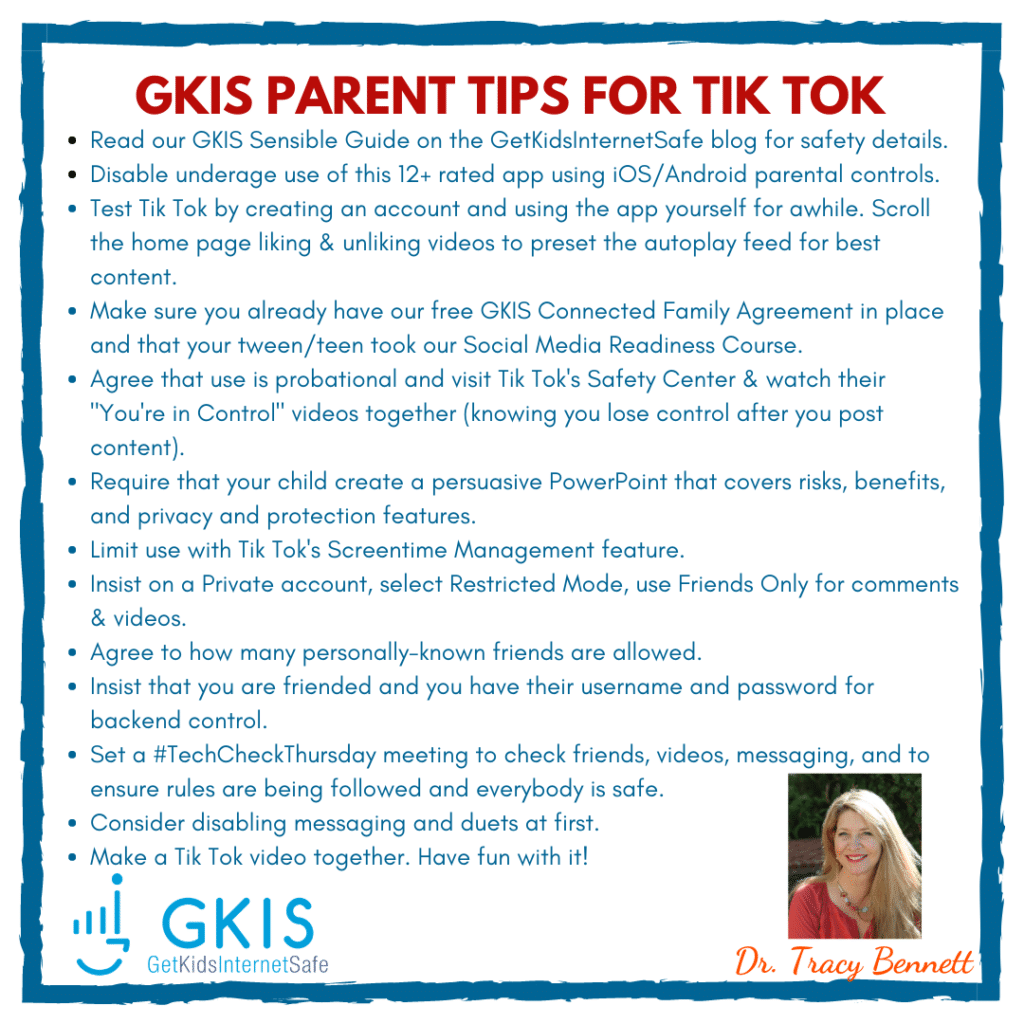
GKIS Parent Checklist for Tik Tok Use:
Disable underage use of this 12+ rated app using IOS & Android parental controls.
Test Tik Tok by creating an account and using the app yourself for awhile. It’s mind-blowing how creative users can be. It’s also helpful to search YouTube for Tik Tok compilations (e.g., “Tik Tok procreate compilations”).
Preset your chid’s account for best content by scrolling the home page liking appropriate videos & selecting “not interested” for inappropriate videos. Although it won’t keep them safe from viewing inappropriate content, it does preset the autoplay to a more positive autoplay pattern.
It’s also helpful to block influencers who commonly produce inappropriate content, while also “hearting” topics and influencers that match your child’s interests (e.g., singing, dancing, drawing, procreate, etc.).
Make sure you already have a digital contract in place (like our free GKIS Connected Family Agreement). Add it to your agreement as an “OK” or a “not yet,” so parameters, rules and regs, and etiquette issues are understood. (If you haven’t downloaded it yet, enter your name and email on our GetKidsInternetSafe home page and it will be emailed immediately.)
Agree that use is probational and visit Tik Tok’s Safety Center and watch their “You’re in Control” videos together (recognizing that once the content is posted, you no longer are in control).
Require your child to create a persuasive PowerPointthat covers risks, benefits, and privacy and protection features so you both know the in’s and out’s of Tik Tok’s features before you agree to it. For more information about how to create and judge a persuasive PowerPoint about a social media app along with other useful screen safety strategies, check out our Connected Family Online Course. The course was created to optimize healthy screen use while protecting kids and teens from digital injury. The best part about the course is it brings parents and kids closer with more cooperative negotiation around family screen rules. Once you agree on a trial, create a digital poster with a bullet list of the rules you agreed upon and tape it up in your home’s homework or computer space.
Limit use with Tik Tok’s Screentime Management feature.
Insist on a PRIVATE account so strangers can’t view your child’s posted videos, Select RESTRICTED MODE. Use FRIENDS ONLY for comments and videos.
Consider DISABLING messaging and duets at first.
Agree to how many personally-known friends are allowed at first to limit exposure while your child is gaining expertise and judgment. Remember, they WILL post, view, and message inappropriately no matter how great you parent. If that’s unacceptable to you, DON’T ALLOW TIK TOK.
Insist that you are friended and you have their username and password for backend control.
Set a #TechCheckThursday meeting to check friends, videos, messaging, and to ensure rules are being followed and everybody is safe. This will also keep the cooperative dialogue going.
Make a Tik Tok video together. Have fun with it!
GetKidsInternetSafe rates Tik Tok as a red-light app due to the easy access to strangers, inappropriate content, bad judgment while posting or live streaming, and potentially harmful comments. Because the app has millions of users, it is difficult for Tik Tok moderators to weed out all of the unacceptable content. But there is also a legitimate argument for creative and fun sharing with a private profile. If you do opt to allow Tik Tok, be sure and get your child’s username and password and monitor posts. Share our GKIS Parent Tips on your social media for friends and family. HERE’S THE LINK TO THE IMAGE
Thank you to CSUCI intern Makenzie Stancliff for co-authoring this article. For more help with social media. judgment and overall psychological health, you won’t want to miss our GKIS Social Media Readiness Training Course for tweens and teens.
I’m the mom psychologist who will help you GetKidsInternetSafe.
Do you worry that you allow too much, or too little, screen time for your kids?
Have you read about digital injuries, like interaction with Internet predators, screen addiction, and neck and spine deformities, and worry you don’t know enough to spot risk in time to intervene?
Do you yell, punish, and lecture too often trying to keep them from doing what they beg to do online?
I did too! That’s why I started GetKidsInternetSafe 7 years ago. Yes, even psychologists find parenting challenging – especially nowadays with teens. When I started this legacy project, I was heartbroken and overwhelmed when my dad died and my mom succumbed to dementia. To get everything done and keep my kids happy, I was relying too much on Minecraft. The parents in my practice were doing the same…at the expense of the kids. I started to get freaked out.
But when I looked for digital safety tools and parenting strategies online for support, the best I could find was Dr. Phil saying to supervise all child screen use – as in, sit with them every time they were on screen. Because we all know that can’t happen, I did a deep-dive in the research, created my own screen safety parenting programs based on my 25+ years of momming and working with families, pooled resources of friends and colleagues, and founded GetKidsInternetSafe. Every day, I hear from families just like ours telling me how much they needed it and how much they appreciate it! A feel-good project, indeed.
If you who have been with me from the beginning, THANK YOU! I’ve appreciated your support more than you know. And for those who are new to GKIS or considering subscribing, you’ll want to know what’s happening with GKIS these days!
As a subscriber,
1. You receive your free Connected Family Screen Agreement, designed to inform and inspire you to cooperatively connect as a family and set reasonable and sensible online safety guidelines for kids and teens. It’s delivered in 4 weekly chunks so you don’t get overloaded. Slow, steady, and fun is the goal.
And of course, I never share your information with anyone. Please let me know if there’s anything you want to learn more about (or just to say hi!) by emailing me at DrTracy@DrTracyBennett.com.
Thanks again for being part of the GKIS community!
I’m the mom psychologist who will help you GetKidsInternetSafe.
Onward to More Awesome Parenting,
Tracy S. Bennett, Ph.D.
Mom, Clinical Psychologist, CSUCI Adjunct Faculty
Move over debutante balls and high school dances, unboxing a brand new smartphone is the new coming-of-age ritual for today’s teens.[6] Teenagers born in 1995 and after are the first generation to live their entire adolescence with a smartphone.[5] In 2017, ten years old was the national average for receiving a smartphone.[6] This profound and sudden cultural shift has fundamentally changed childhood and parenting. Smartphones are a new-found necessity and parents are scrambling to provide one as soon as possible.
“What’s the WiFi password?”
Technology is an important part of our modern culture. In comparison to the rest of the world, the United States provides cell phones to the youngest kids.[8] Everywhere you go there’s a child or teen glued to a screen. There are babies listening to “Baby Shark” in their strollers during morning walks with mom, toddlers playing Candy Crush in their restaurant booster seats, and teenagers scrolling their Instagram feeds while blindly following their parents around Costco. It shouldn’t be surprising that adults and kids alike spend more than half of their days staring at a smartphone screen.[6]
With a smartphone in every hand, parents are peer pressured by their friends and begged by their children to provide one. Parents feel guilty for withholding one for too long because they see their children socially isolated.[11] Yet, giving a smartphone to a ten-year-old today is fundamentally different than when parents gave sixteen-year-olds flip phones in the 90s.[4]
Nokia Flip Phone vs. iPhone
Down to the basics, the main function of a cell phone is to call and send text messages wirelessly with no data. Smartphones such as iPhones, Androids, Google Pixels, and so forth have transformed those basic necessities.[7] They need data and WiFi to power infinite applications and endless Internet access. Basically, it’s a mini-computer that is more powerful than all of NASA’s computing power in 1969…in the palm of your hand!
Innovative or Addictive?
Unlike phones in the 70s, there are thousands of engineers and tech designers updating smartphones every day.[5] Their job is to make sure that smartphones and applications consume all our attention. They dazzle us with colorful visuals, sound effects, and seamless switching between applications. Studies have shown that children exposed at a young age to these stimulating effects become wired to crave easy dopamine release.[12] Instead of going outside and playing with their friends, they turn to their screens for pleasure
Sean Parker confessed to taking advantage of the human psyche when developing Facebook.[1] The former president of Facebook explained their objectives were, “How do we consume as much of your time and conscious attention as possible?”[1] He and Mark Zuckerberg knew that small hits of dopamine from notifications would hook everyone.[1] Parker reflects, “I don’t know if I really understood the consequences…God only knows what it’s doing to our children’s brains.”[1]
It’s true. Silicon Valley’s tech executives have become wary of their own creations. They’ve noticed the negative effects on their own children.[11] For example, Apple’s co-founder Steve Jobs limits his children’s tech time. He even kept the iPad away from them when it was first released.[10]
Smartphone Dependency
With all this power comes responsibility. Former Apple designer Tony Fadell struggles with whether his apple products have helped or hurt society.[2] In his own children he has seen smartphone dependency:
“They literally feel like you’re tearing a piece of their person away from them — They get emotional about it, very emotional…They go through withdrawal for two to three days.”[2]
Dr. Bennett details in her book, Screen Time in the Mean Time: A Parenting Guide to Get Kids and Teens Internet Safe, how smartphone dependency is like that of drug and alcohol addictions. Whenever teens hear a notification or see new content, dopamine is released and pleasure is felt. If too much time is spent apart, the smartphone-dependent gets agitated. There’s even evidence that we get distracted just by having a smartphone near us, even if it’s turned off as if we are in a state of chronic hypervigilance for notification. She chooses to have a screen-free classroom, stating that the research demonstrates that, not only is the screen users distracted from the lecture, but so are those around them.
Notifications on smartphones can be so addicting they cause phantom buzzing or ringxiety. Daniel Kruger researched cell phone dependency at the University of Michigan. His study found that “if your phone is rubbing in your pocket or if you hear a similar tone, you might experience it as your phone vibrating or ringing, especially if your phone messages are highly rewarding to you.”[3] That’s how adept our attention has become to our smartphones.
“Best” Age
Many studies have tried to determine which age would be best for a smartphone. Recently, the World Health Organization (WHO) came out with guidelines recommending no screen use for infants under one year of age and only an hour a day for kids under 5. Dr. Bennett’s GKIS guidelines, which are offered in her must-have Connected Family Online Course, are consistent with this recommendation as well. The American Academy of Pediatrics and the Canadian Pediatric Society also recommend no screen time for toddlers younger than two years old.[12]
Many parents are under the false impression that virtual reality can replace real-life lessons for toddlers. But the psychological research shows that the skills don’t transfer over. For example, toddlers who play building block games don’t know how to build the same blocks when presented the toys in real life.[5] This is because the toddlers didn’t develop the skills before seeing it on the Internet.
Furthermore, Dr. Bennett states in her keynote lectures that some kids are less likely to try a task after seeing performed on YouTube. It’s as if watching “scratches the itch” of wanting to do it themselves. How-to videos often demonstrate an effortless learning curve, as the practice and messy sessions are edited out – leaving a quick and perfectly executed trial to view. When a child tries out the task themselves, they can fall into “compare and despair,” feeling that their very normal imperfect trial was a failure rather than a healthy try.
Dr. Bennett recommends that, from two to twelve years old, children shouldn’t have Internet-enabled smartphones. A normal flip phone that only allows for calling and texting will suffice for any safety concerns. Some starter phones even have GPS tracking.
Those are a general rule of thumb since all children vary in maturity. Age doesn’t qualify a child to use a smartphone well but instead impulse control, social awareness, and true comprehension of what technology does.[5] Bill Gates’ household requires at least one of the following to be met before a smartphone is given[6]:
Must be 14 years old
Demonstrate behavioral restraint
Comprehend the value of face-to-face communication
Dr. Bennett further points out that, even at 14 years old, kids don’t have the brain development to anticipate consequences and engage in high-order thinking. Just telling them what not to do will not keep them from making unwise, impulsive decisions online. In fact, kids are neurologically programmed to copy some of the cruel and vulgar behaviors they will invariably run across online, even with parental controls. Be prepared to calmly coach them through a variety of online mistakes. No child escapes it.
Wait Until 8th Campaign
If you’re looking for a place to start, GKIS recommends Wait Until 8th. As of March 2019, 20,000 families across the entire nation have signed the Wait Until 8th pledge.[9] These families have pledged not to give their children smartphones until at least the 8th grade. They emphasize that it isn’t the only path, but a path that offers a safe space for parents with the same concerns. Professionals in law, psychology, education, healthcare, business, and social work created the non-profit pledge.[10] They’re parents who have seen the negative effects of premature smartphone usage in classrooms, court systems, private practices, communities, and households. By spreading the pledge, the Wait Until 8th Campaign hopes to:
Increase engagement in education
Encourage parents to set screen time boundaries
Change society’s view on technology so children can live authentic childhoods
“Can I have one now?”
Your teens will eventually get a smartphone, like everyone else. We don’t want to restrict them for so long that they go wild once given access. But first, we have to coach them to make good decisions on their own. This way, we can better trust them to be mature when facing issues like cyberbullying and age-inappropriate content. As simple as they seem, smartphones are very powerful. With that power comes great responsibility for parents to make sure that smartphones are a tool we use, not a tool that uses us.
Already given them a smartphone or getting ready to start? It’s never too late to make some adjustments. Dr. Bennett has put together a reliable Screen Safety Toolkit to help you get started. This resource offers links and explanations of parental control options on devices, through your Internet service provider, and through third party products so you can match your child’s use patterns with the right toolkit. She also offers a bonus of great learning apps and websites to help your child build their joy of tech-assisted learning!
Thank you to our GKIS intern Hanna Dangiapo for writing about this topic! (She admits that she still reminisces about her Motorola Razr).
I’m the mom psychologist who will help you GetKidsInternetSafe.
I’m curled up on a weathered leather couch in a beautiful loft barn we rented for the weekend. A last of summer cozy couples’ retreat in the rolling hills of wine country. We are waking up to soft braying of ponies, early morning foggy walks in vineyards ripe for harvest, and a leisurely breakfast of fresh eggs, hot mint tea, fresh squeezed watermelon and orange juice, and buttery warm banana bread left by our generous hosts. Later we are meeting our friends for a delicious farm to table lunch from local farms and orchards. Best of all…a weekend of fun with old and new friends before a busy school year starts. Crazy grateful for the rejuvenation from the sunshine and laze of summer.
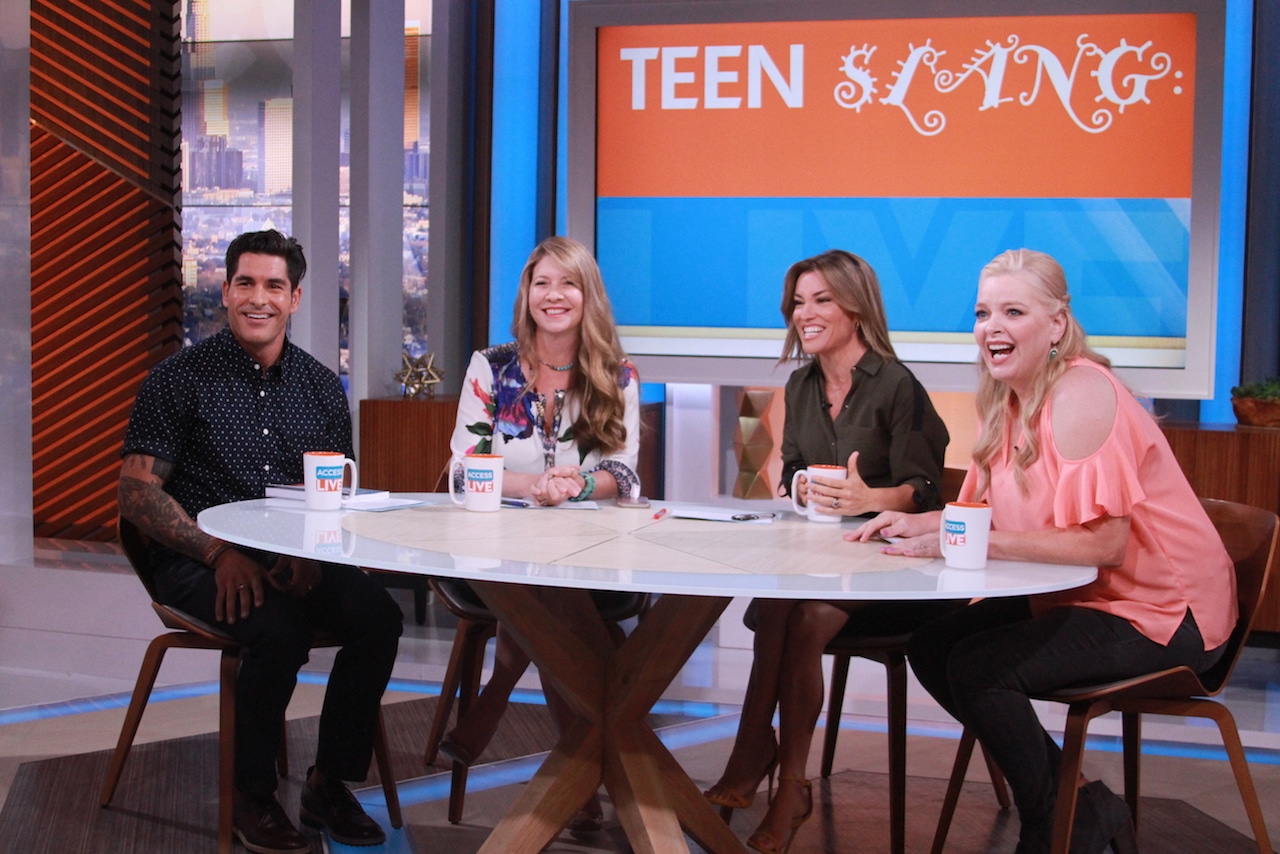
Now that my kids are teens, we are able to sneak away sometimes, guilt-free. If you have little ones and can’t seem to sneak off for weekends yet, don’t despair. It’s coming one day. And when you do, you’ll spend much of it fondly remembering being frazzled and sleep-deprived with your little ones. Each phase of parenting has its challenges and its pleasures. In the spirit of sharing and friendship, I’m taking fifteen minutes out in this sweet little farm kitchen to share the fun content producers of Access Hollywood Live helped me develop for my segment Monday on Online Teen Slang: Should We Worry? I hope you’ve set aside time each week to curl up with steaming hot tea for a moment of solitude to read your GKIS article. They are written to gently pepper you with useful information about tech, parenting, and safety so you can teach during screen-free dinners with you and yours. ❤️ Now on to the basics of teen online slang.
Why is slang always changing? Is it to be ‘cool’ with friends?
Slang is an expression of culture. Youth culture changes rapidly and is based on popular memes, songs, and movies. Part of the excitement is that you have to be an integral part of the culture to keep up. No parents!
Teen Slang: The Bad News
Often reflects and teaches concepts you may not want your child to know.
Can be used to hide from parents and plan secret and even dangerous activities
Can be vulgar, offensive, or cruel.
Teen Slang: The Good News
Young people who use slang are striving to form their own, independent, adult identities.
Sharing slang provides a sense of belonging, and being ‘in-the-know’with friends.
Using slang is a celebration of being young and having fun.
Every generation creates its own slang, but why does it seem so different now? Has it evolved in the age of social media and smartphones?
Slang is not new. But with the web, kids have a bigger, private, more versatile playgroundto live in. They juggle lots of virtual identities, each with its own characteristics, slang, activities, and community on demand with thousands of members of their tribe connected at once. We had our neighborhood buddies and the telephone. Big difference.
Should parents attempt to use their teens’ slang as a way to try to relate to their kids, or is that getting into majorly uncool territory?
If you want them to roll around in agony and openly insult you, you should totally use their slang.
Should parents be worried about the slang their teens are using now, or is it no different than if they think back to when they were younger?
It’s different. It’s more dark and vulgar for sure.But the teens I see in practice and the ones I’m raising are still good people. They’ve just habituated to a more troubling slang culture overall. Parents should be worried if their kids are too “thirsty”to belong, because that would result in being too eager to join in and take risks. They should be worried if they’re too secretive. They should be worried if there’s evidence of sneaking and dangerous defiance. Otherwise, have fun with it. Of course, correct them when they cross over the line, but stay engaged. Allowing them some privacy is also important.
Another topic we want to touch on is the cultural sensitivity issue of using slang — many of the terms originate in African American or LGBTQ communities — how mindful should people of other communities be of this before being quick to just use any term?
In-groups are delicate. If a person intrusively hijacks slang from a group they haven’t earned a place in, it can look aggressive or demeaning. Slang provides information about boundaries and belonging.
How can people make sure it’s appropriate to use a term before they start using it?
Do your research before using slang, like observe and ask others, Google it, err on the side of caution.Teens brutally police each other to follow social morè’s, which may even slip into bullying. Let your teen know you have their back 100%, even when they make stupid mistakes. Even better, teach them that mistakes are part of learning and you expect them often. Rather than shame them when they’re hurting with a lecture, take them for a smoothly, show deep compassion, and share stories about how common and healthy mistakes are. Sometimes providing a fun distraction while it passes is what they need.
How to Spot Red Flags in Teen Slang Use & What to do About it:
Talk to your teen often. Let them DJ in the car and share funny videos to stay connected. Keep up on their friends and interests. Be you but with humor. Encourage their independence but reassure them you are being them 100%.
Keep an eye out for concerning behavioral changes like increased isolation, poor hygiene, reckless behavior, or darkened moods are things that may signal trouble.
Block dangerous websites and monitor screen use.
Bookmark helpful websites, like Urban Dictionary, and set google alerts.
Look out for defensiveness and changing the browser quickly or erasing it.
If you’re worried and they won’t talk to you, consider psychotherapy. It’s shocking the influence I have with teens as they blatantly reject their parents with the same advice. It can really turn the situation around.
Want to know which slang terms to pay attention to and if slang use leads to teens having sex? Check out my earlier article Online Slang That Parents Need to Know.
I’m the mom psychologist who helps you GetKidsInternetSafe.
Do you worry your teen has a Finsta? Based on recent surveys, most parents have a considerable concern that our kids’ digital selves aren’t making kind or safe choices. After all, experimentation, taking social risks, and creative self-expression is healthy for teens. The problem is that social media can blast innocent mistakes to thousands of people at once. Fortunately, teens aren’t stupid. They usually “get” that trust is earned. To protect themselves, they form several virtual social groups from more intimate to the public, much like they do in their nonvirtual lives. Is having a Finstagram dangerous? Or is it simply a smart caution to minimize social fallout from impulsive or questionable judgment? When a parent does uncover concerning content, is it worth the risk to confront the teen? How can a parent spot a Finsta?
Cybersecurity safety starts at home. Feel empowered to talk to your kids about what is appropriate to post online. Dr. Bennett’s Cybersecurity and Red Flags Supplement has easy to implement strategies for how to keep your kid’s information secure without the risk of them oversharing online while keeping your parent-teen relationship intact.
What is a Finstagram?
As of June 2018, Instagram reached over 1 billion active users, the highest number of bloggers in the history of the wildly popular social media app.[1] As Instagram grows and expands, so too does the pressure to create the “perfect profile,” resulting in an unspoken set of rules and expectations dictating what you can post, when you can post, and how you can post. To “keep it real,” young Instagram users often create Finstagramsor Finstas, which are fake private Instagram accounts exempt from the strict posting-rules of real Instagram profiles (Rinstas). Finstagram is a mashing of the words “fake” and “Instagram. Finstas are almost always a secondary account and only close friends are allowed to follow, thus excluding acquaintances, love interests, and the prying eyes of parents.[2]
Posts in a Finsta are usually funny and embarrassing “behind-the-scenes” photos, like awkward candid faces, silly activities, or pictures that are not deemed ‘artsy’ enough for the Rinsta. Teens use their Finsta to express more intimate thoughts and feelings. Posts are often accompanied by long-winded captions explaining daily events or opinionated ranting – like how mean and unfair parents are. In general, Finstas can be considered a form of blogging where people ditch the superficial and fake façade of Rinstagrams and post uncensored photos to only a select few followers.[3]
Because Finstas are “private,” teens can get reckless with their posting choices. Under this false sense of security, kids will post pictures of themselves and friends participating in demeaning, offensive, and sometimes even criminal behavior. Typical posts include party behavior like alcohol, e-cigarettes or vape pen use or revealing or sensual poses. Cruel commentary about fights and cyberbully-like exclusion are also typical Finsta content.
Consequences of Careless Finstagram Posting
One example of the effects of thoughtless Finsta posting is Sophie* and her family. Sophie posted a photo on her Finsta featuring herself and a friend vaping at the beach. The picture was seen by a parent and family friend of Sophie’s family, who spotted it on the Instagram feed of her daughter. The parent shared what she had seen with Sophie’s parents, knowing that if Sophie was familiar with e-cigarettes, it was likely that she was also experimenting with alcohol and other substances. Sophie’s parents were put in the complicated position of debating whether to confront Sophie about her actions or to remain silent to preserve their relationship with their daughter.
A similar story is that of Lindsay*, who posted a revealing photo of herself seductively posing in a bodysuit and holding an unlit cigarette. She posted it on her Finstagram because she knew it was a suggestive photo and did not want her parents or other adults to see it on her primary account. Unfortunately, someone brought the photo to the attention of her swim coach, whose concern for Lindsay’s action prompted her to ask to speak to Lindsay privately. Her coach expressed her disappointment over the photo and told Lindsay that “[she was] better than that.” Lindsay felt an overwhelming sense of shame and humiliation at having let down her coach, a young woman who she respected and whose opinion she valued. Not only was Lindsay devastated by the shame of her swim coach thinking less of her, but she was left wondering who betrayed her. The remainder of her swim season was spent scrutinizing each of her teammates and guessing at who might have ratted her out.
In both of these scenarios, the adults chose to confront the kids out of concern for their safety and potential future consequences, including professional relationships with employers, advisors, and coaches. Also, in each case, the discovery of the Finsta posts compromised the trust between adult and child. The truth is, the consequences could have been far worse.
The Dilemma Parents Face
Parenting teens is tough. It’s too easy to get caught up in emotional swings and crises, resulting in worried and freaked out parents and angry teens. Choosing which hill to die on can be confusing. Here are some issues to think about when deciding whether to confront your teen about unwise Finsta posts.
Humiliating your child. Although teenagers like to act aloof and indifferent, the truth is that they crave the approval of prominent adults in their lives. No parent wants to humiliate their child, but sometimes facing the disappointment of respected mentors is the most effective way to get teens to quit their Finsta-ing ways.
Dealing with punishment.There are times when the hassle of creating a punishment worthy of the crime seems like more work than it is worth. Do you ground them, or let them off with just a warning? Do you take their phone away, or do you also go through it to see what other activities they are keeping secret? And then there’s the fear that you might see something worse than the initial incriminating photo. Consequences are necessary to teach a lesson but don’t compromise your own sanity in the process. A compassionate conversation is probably enough for first-time and understandable slips. Remember, they are supposed to be making mistakes in order to learn.
Inadvertently causing your child to be even more sneaky Kids who have been caught posting risky Finsta photos in the past may take greater measures to make sure they are not caught again. Firm and effective confrontation can help foster a sense of trust between adults and kids, while angry scolding will only push them farther away.
How to Spot a Finsta
Ask your child. In the two stories above, the main cause of the lack of trust after the discovery of a Finsta resulted not from the uncovering of the secret account, but from the seemingly sneaky way the adults came across it. No one likes to feel like they are being spied on, and kids are more likely to try harder to keep secrets if they feel like their parents are constantly sleuthing their social media. By asking your kid face-to-face if they have any other Instagram accounts, you give them the chance to tell the truth, show you trust them, and create the opportunity to better get to know your child.
Check tagged photos. Instagram has a feature where you can look at all the photos someone has been tagged in on their profile. Scroll to see all photos your child was tagged in.
Look for silly Instagram handles. Finstagram account handles are usually nicknames or an inside joke. If you recognize a nickname in the account name as something your child has referred to, it might be their Finsta.
Let’s face it: in a world where we are constantly surrounded and exposed to technology, there is no way to truly prevent kids from being active on social media. All we can do as parents is educate ourselves on the consequences and potential dangers of reckless Finsta posting and steer our kids in the right direction. Thanks to Claire Therriault for teaching us all about Finstagrams. To learn more about safe Instagramming, check out The GKIS Sensible Parent’s Guide to Instagram.
I’m the mom psychologist who will help you GetKidsInternetSafe.