Did you know that our activities change how our brains grow? And the way our brains work determines what activities we like to do. In other words, our brain wiring changes over time, and those changes lead us to prefer some tasks over others. These days, we spend more time on our screens than we do outside or face-to-face with other people. That means our brains are wired to function best in the virtual world. Because screens are a relatively new phenomenon in the scope of human history, we don’t know what the long-term outcome of screen use will be on our brains. Child and teen brains are especially vulnerable to rewiring issues because they are already in a massive state of change. Will this information change the way you use your screens?
Brains!
Neurons & Superhighways
Our brains are made up of millions of brain cells, called neurons. Neurons communicate with each other and help us think, move, and even breathe! Neurons are necessary for us to live. The healthier our brains are, the better our lives are.
As we age, our brains are constantly remodeling. At first, our brains use many neurons to complete one task. But with practice, our neurons form superhighways for the most efficient thinking. As we age, fewer neurons can get the same task done that used to take far more neurons. The more primitive pathways that get replaced prune away while the superhighways develop.
Our brain is its biggest when we are 10 years old! Then our gray matter (the brain tissue packed with neurons) decreases from there. At certain ages, some parts of our brain remodel more than others based on the types of learning that we are doing. For example, babies and toddlers are remodeling the brain areas responsible for attaching to others and learning a language. Teen brains are remodeling the brain areas responsible for creating abstract ideas and connecting with their peers.
Brain Thinning from Excessive Screen Use
To build healthy brains, we must take good care of ourselves and get good sleep, nutrition, and exercise. We also need to do a lot of balanced learning off-screen, not just on-screen. Doing different types of learning will build a more capable, healthier brain.
Doing only one type of learning over and over for many hours a day will build a less capable brain than learning a variety of things. In fact, studies are showing that kids who use screens seven hours a day, versus kids who do not, show thinning in many parts of the brain and lower scores on thinking and language tests.[i][ii][iii][iv] The way their brains process information is also negatively affected.[v]
Is multitasking healthy for our brains?
Many of us spend much of our day multitasking, which means going back and forth between different screen tasks and in-real-life tasks. We are doing many (multiple) tasks at the same time – going back and forth between a primary task and an interrupting task. We love to be connected to our screen devices when we are doing in-real-life things like checking our social media during homework or watching a video while at a restaurant. Most of the time that’s fun and works great. But other times our screen devices can reduce the quality of our work.
Many people think that when they are multitasking, their brains can work on everything at the same time as if the brain has a huge mental pipeline where different things flow in and out at once. But the brain can’t do many things at the same time. Instead, we have a single mental pipeline that is built to do only one thing at a time.
When you are multitasking, you end up quickly going back and forth between those tasks rather than doing them at the same time. We call that toggling back and forth. Those activities must take turns using the same brain area. Competition between the same cognitive resources can decrease our energy, happiness, and learning performance.
But it’s not so simple to say that interrupting one task with another is always a problem. Sometimes there are learning benefits to using screens during real-life activities. The challenge is figuring out what screen activities help get the task done and which are distracting us and wearing us out.
Do younger people outsource to their screens better than older people?
Young people who grew up with screens tend to multitask more often and better than older people who did not grow up with screens. With early life practice, they have learned the mental flexibility of digital learning. Screen natives learn differently than screen immigrants.
For example, younger people are better than older people at multitasking.[vi] Using our screens for things like memory, increased access to information, mapping, performing calculations, and creating is called outsourcing. Outsourcing to screens means less need for memory or spatial skills and less cognitive effort.
Is that a good thing or a bad thing?
Well, the answer is complicated. Some types of limited multitasking are healthy for learning. Other types are not so much. Furthermore, we cannot trust our judgment. Though people insist they get more done, better, and faster when multitasking, they are most often wrong.[vii] Multitaskers don’t recognize that juggling tasks cost us more time and results in worse performance, kind of like a drunk driver saying he drives better while under the influence.
The Costs of Multitasking
Performance Decline
Results are consistent across studies that multitasking results in a small but significant decrease in test scores (4-5% decrease). Larger interruptions cause even larger decreases.[xiii][xiv] Perhaps a 5% decline doesn’t seem like much, but it is half a letter grade.
If two tasks require different cognitive resources, like walking and talking, then the performance decline is smaller. If tasks require similar cognitive resources, like talking and texting, which both require language centers, then the deficits are larger.[xv]
In the long term, multitasking (with social media and instant messaging for example) can lead to lower grades and poorer cognitive performance overall, especially in the areas of working memory and attention.[xvi][xvii] Multitaskers tend to have poorer memories because they are getting less memorizing practice.
Time Cost & the Google Effect
Multitasking also costs us extra time. When people are interrupted, it takes an average of 23 minutes, 15 seconds to return to work, often getting distracted by two or more tasks after the interruption.[xi]
When we use the Internet, we are also less likely to remember something we’ve learned if we know it’s published online, a dynamic now called the Google effect.[xii] It’s as if we quit thinking or taking responsibility for learning because we expect our smartphones to have it handled. Why bother to take the effort to remember the date if a press of a button will get the job done?
Brain Drain & Anxiety
Another cost of multitasking with our screens is brain drain. Research has shown that toggling between mental tasks burns the brain’s fuel, oxygenated glucose, at a rate faster than concentrating on a single task.[xx]We think we are saving time and energy by fracturing our attention, but we are actually draining the very energy necessary to do the work and taking more time to do it!
Our screens drain us in other ways too. A 2015 study found that smartphone notifications hijack attention and distract us by launching distracting thoughts whether we’ve checked notifications or not.[viii] Furthermore, when smartphone users are unable to answer a notification, their pulse and blood pressure increase, they feel anxious, and their problem-solving skills decline.[ix] The more attached we are to our phones and the closer they are to us, the more distracted and stressed we are.[x]
Brain overload from multitasking can take a toll on mental health. Factors that make us most vulnerable to rapidly switching tasks are anxious and impulsive personality traits, stress, and too little sleep.[xxi]Without downtime, mental stress and fatigue can lead to poorer learning, irritability, and mood and anxiety disorders, especially for teens.[xxii]
Homework & Multitasking
Kids argue, and rightfully so, that it is impossible to do homework without multitasking on- and offscreen. As they get older, school tasks require the student to look up information for research, communicate with other group members, and track progress across multiple platforms.
Here are some research findings that can help you make better choices while doing schoolwork.
Watching TV or videos while doing schoolwork interferes with performance.
Watching TV and doing homework are both demanding tasks that compete for the same brain areas. Research studies have demonstrated that watching television, or even just having it on in the background, impairs reading performance, [xxiii] memory of homework facts, [xxiv] and even your memory of what you’ve watched on TV. [xxv
How about music and homework?
It was once widely believed that listening to classical music makes you smarter, known as The Mozart Effect. However, this theory has largely been proven to be untrue.
Studying in a quiet environment results in better homework performance than studying with music.[xxvi] Kids tend to think they do better while listening to the music they like and worse while listening to music they don’t like. But performance is poorer in either condition.[xxvii]
However, music does have a positive role in learning if you listen to music you like before homework or during breaks due to a bump in arousal and mood (called the Stephen King Effect).
Is using a laptop during the lecture OK?
College students who do not use any type of technology during class time tend to outperform those students who do use screen technology during the lecture.[xxviii] Researchers explained the results in terms of a bottleneck in attention. Meaning that more goes into the brain than it can handle, so it must slow down to catch up. Using a smartphone decreases a student’s ability to remember lecture information.[xxix] Moreover, laptop use during lectures not only distracts the user but also distracts the student’s neighbors.[xxx]
Supertaskers & Neuroplasticity
Pumping yourself up to learn before homework and relaxing during breaks is a good thing. But distracting yourself during homework with anything that may compete for the same brain resources is a bad thing. But there are exceptions to this rule.
Approximately 2% of the population, called supertaskers, defy statistics and demonstrate an extraordinary ability to screen out distractors when multitasking. It’s as if they have super-enhanced brain skills called synaptic plasticity.[xxxi]
Supertaskers can maintain these exceptional abilities by practicing excellent brain health habits, like good organization and time management, and refueling with emotional and cognitive control strategies that are screen-free like mindfulness, imagery, and meditation.
The Work-Home Boundary
It’s not just kids and teens that are impacted by screen time. Parents also have problems getting off their screens.
Studies have found that the boundaries between work and home have blurred. Overall, our work and school days span more hours and our jobs have become more demanding. This has led to more stress and dissatisfaction and less connection to the things that are meaningful to us.[xviii] We have trained ourselves to self-interrupt, leading to worsened task prioritization and poorer sustained attention overall.[xix]
How can we overcome the depleting effects of multitasking and screen time?
Taking YouTube breaks is not the answer.
Try these things instead:
Focus on one task at a time.
Do your work first, then enjoy fun content as your reward for a job well done.
Batch notifications (turn off notifications, then save them up and go through them all at once every few hours instead of constantly checking).
Take frequent screen-free brain breaks. Don’t go on the screen because you will lose track of time and stay distracted. Instead, let your mind wander or stare off for fifteen minutes every couple of hours.
Sprinkle in brain-healthy activities throughout your day, like yoga, group hikes, and nutritious snack times.
[ii] Kim, S., Baik, S., Park, C., Kim, S., Choi, S. & Kim, S. (2011). Reduced Striatal Dopamine D2 Receptors in People with Internet Addiction. NeuroReport 22.8: 407-11. Web.
[iii] Koepp, M., Gunn, R., Lawrence, A., Cunningham, V., Dagher, A., Jones, T., Brooks, D., Bench, C., & Grasby, P. (1998). Evidence for striatal dopamine release during a video game. Nature 393: 266-268.
[iv] Kühn, S., Romanowski, A., Schilling, C., Lorenz, R., Mörsen, C., Seiferth, N., & Banaschewski, T. (2011). The Neural Basis of Video Gaming. Translational Psychiatry 1: e53.
[v] Dong, G. Hu, Y., & Lin, X. (2013). Reward/punishment sensitivities among internet addicts: Implications for their addictive behaviors. Progress in Neuro-Psychopharmacology & Biological Psychiatry, 46, 139–145.
[vi] Ie, A., Haller, C., Langer, E., & Courvoisier, D. (2012). “Mindful Multitasking: The Relationship between Mindful Flexibility and Media Multitasking.” Computers in Human Behavior 28.4: 1526-532. Web.
[vii] Finley, J., Benjamin, A., & McCarley, J., (2014). “Metacognition of Multitasking: How Well Do We Predict the Costs of Divided Attention?” Journal of Experimental Psychology: Applied, 20.2: 158-65. Web.
[viii] Ward, A., Duke, K., Gneezy, A., & Bos, M. (2017). “Brain Drain: The Mere Presence of Oneâs Own Smartphone Reduces Available Cognitive Capacity.” Journal of the Association for Consumer Research 2.2: 140-54. Web.
[ix] Clayton, R. (2015). “The Extended ISelf: The Impact of IPhone Separation on Cognition, Emotion, & Physiology.” Journal of Computer-Mediated Communication, vol. 20(2), pp. 119–135., doi:10.1111/jcc4.12109.
[x] Ward, A., Duke, K., Gneezy, A., & Bos, M. (2017). “Brain Drain: The Mere Presence of Oneâs Own Smartphone Reduces Available Cognitive Capacity.” Journal of the Association for Consumer Research 2.2: 140-54. Web.
[xi] Sano, A. (20160. “Neurotics Can’t Focus: An in Situ Study of Online Multitasking in the Workplace – MIT Media Lab.” MIT Media Lab, www.media.mit.edu/publications/neurotics-cant-focus-an-in-situ-study-of-online-multitasking-in-the-workplace/.
[xii] Sparrow, B., et al. (2011). “Google Effects on Memory: Cognitive Consequences of Having Information at Our Fingertips.” Science, vol. 333, no. 6043, pp. 776–778., doi:10.1126/science.1207745.
[xiii] Conard, M., & Marsh, R., (2013). “Interest Level Improves Learning but Does Not Moderate the Effects of Interruptions: An Experiment Using Simultaneous Multitasking.” Learning and Individual Differences: n. pag. Web.
[xiv] Wood, E., Zivcakova, L., Gentile, P., Archer, K., De Pasquale, D., & Nosko, A. (2012). “Examining the Impact of Off-task Multi-tasking with Technology on Real-time Classroom Learning.” Computers & Education 58.1: 365-74. Web.
[xv] Conard, M., & Marsh, R., (2013). “Interest Level Improves Learning but Does Not Moderate the Effects of Interruptions: An Experiment Using Simultaneous Multitasking.” Learning and Individual Differences: n. pag. Web.
[xvi] Fein, S., Jones, S., & Gerow, J. (2013). “When It Comes to Facebook There May Be More to Bad Memory than Just Multitasking.” Computers in Human Behavior 29.6: 2179-182. Web.
[xvii] Fox, A., Rosen, J., & Crawford, M. (2009). “Distractions, Distractions: Does Instant Messaging Affect College Students’ Performance on a Concurrent Reading Comprehension Task?” CyberPsychology & Behavior, 12(1): 51-53.https://doi.org/10.1089/cpb.2008.0107
[xviii] Gregoire, C. (2016). “The American Workplace Is Broken. Here’s How We Can Start Fixing It.” The Huffington Post, TheHuffingtonPost.com, 22 Nov. 2016, www.huffingtonpost.com/entry/american-workplace-broken-stress_us_566b3152e4b011b83a6b42bd.
[xix] Sano, A. (2016). “Email Duration Batching and Self-Interruption: Patterns of Email Use on Productivity and Stress – MIT Media Lab.” MIT Media Lab, 17 May 2016, www.media.mit.edu/publications/email-duration-batching-and-self-interruption-patterns-of-email-use-on-productivity-and-stress/.
[xx] Sridharan, D., et al. (2008). “A Critical Role for the Right Fronto-Insular Cortex in Switching between Central-Executive and Default-Mode Networks.” Proceedings of the National Academy of Sciences, vol. 105, no. 34, pp. 12569–12574., doi:10.1073/pnas.0800005105.
[xxii] Becker, M., Alzahabi, R., & Hopwood, C., (2013). “Media Multitasking Is Associated with Symptoms of Depression and Social Anxiety.” Cyberpsychology, Behavior, and Social Networking 16.2: 132-35. Web.
[xxiii] Lin, L., Robertson, T., & Lee, J. (2009). “Reading Performances Between Novices and Experts in Different Media Multitasking Environments.” Computers in the Schools 26.3: 169-86. Web.
[xxiv] Armstrong, G. Blake, & Chung, L. (2000). “Background Television and Reading Memory in Context: Assessing TV Interference and Facilitative Context Effects on Encoding Versus Retrieval Processes.” Communication Research 27: 327–352.
[xxv] Zhang, W., Jeong, S., & Fishbein, M. (2010). “Situational Factors Competing For Attention: The Interaction Effect of Multitasking and Sexually Explicit Content on TV Recognition.” Journal of Media Psychology 22: 2–13. Web.
[xxvi] Furnham, A., & Bradley, A. (1997). “Music While You Work: The Differential Distraction of Background Music on the Cognitive Test Performance of Introverts and Extraverts.” Applied Cognitive Psychology 11.5: 445-55. Web.
[xxvii] Perham, N., & Vizard, J. (2011), Can preference for background music mediate the irrelevant sound effect? Appl. Cognit. Psychol., 25: 625–631. doi:10.1002/acp.1731
[xxviii] Hembrooke, H., & Gay, G. (2003). “The Laptop and the Lecture: The Effects of Multitasking in Learning Environments.” Journal of Computing in Higher Education 15.1: 46-64. Web.
[xxix] Wood, E., Zivcakova, L, Gentile, P., Archer, K., De Pasquale, D., & Nosko, A. (2012). “Examining the Impact of Off-task Multi-tasking with Technology on Real-time Classroom Learning.” Computers & Education 58.1: 365-74. Web.
[xxx] Sana, F., Weston, T., & Cepeda, N. (2013). “Laptop Multitasking Hinders Classroom Learning for Both Users and Nearby Peers.” Computers & Education 62: 24-31. Web.
[xxxi] Watson, J., & Strayer, D. (2010). “Supertaskers: Profiles in Extraordinary Multitasking Ability.” Psychonomic Bulletin & Review 17.4: 479-85. Web.
Minecraft is a virtual 3D game that allows users to create unlimited worlds using online building blocks while unlocking resources along the way. From cities to rollercoasters, the possibilities are nearly endless. We at GKIS are big fans of Minecraft because it fosters creativity, problem-solving, new skill development, and socialization opportunities. But like any online tool, there are also associated risks. This GKIS Sensible Guide provides information that parents need to optimize Minecraft’s benefits while keeping your children safe.
How long has Minecraft been around and how popular is it?
Minecraft was created in 2011 by Swedish game developer Markus Persson and purchased by Microsoft in 2014. Nearly 176 million copies were sold by late 2019. In 2019, Minecraft has over 112 million players every month and can be played on various platforms including smartphones, tablets, Xbox, and other gaming stations. It has evolved to include more elements and has a series of spin-off g
ames with different themes. Users also post Let’s Play videos YouTube to show how they build their worlds and different ways to create items.
Getting Started on Minecraft
According to Minecraft’s Terms of Service, “If you are young and you are having trouble understanding these terms and conditions, please ask a responsible adult such as your parent or guardian.” Minecraft also insists that children under age 13 have their parents download and register for an account. However, children can easily change their age before signing up to go around that rule.
Minecraft varies in price depending on the type of platform. Signing up for an account is simple. Just create an account with a unique username and email address. Users are given one profile by default but have the option to make multiple profiles.
Features of Minecraft
Minecraft allows users to collect resources and build their own worlds. Users can dig, build, and enchant items to transform their world into whatever they want. Users can also select different game modes, each with unique challenges and features.
Survival Mode
One of the main game modes
Players must collect resources, build structures, battle mobs, find food.
The goal is to survive and thrive.
Creative Mode
Players are able to build with an unlimited number of blocks.
Players are given all the items needed to build.
Mobs still exist, but there is no threat to survival.
Players are able to fly around the world.
Adventure Mode
Players use maps to navigate the world.
Depending on the device played on, blocks can either be destroyed or placed.
Hunger and dying is possible.
Spectator Mode
Users have the ability to fly around and observe the worlds without interacting with it
Players are invisible and can move through blocks and buildings.
Hardcore Mode
Available only on the online version.
The world is locked to hard difficulty and the player cannot respawn after they die.
Only specific worlds enable hardcore mode and not individual players.
Minecraft has two different play modes, single-player and multiplayer. In single-player mode, a user only interacts with their own character and their own world. In multiplayer, users can join any game with any player, friends or strangers. Parents have the ability to sign their child up for a family-friendly multiplayer mode that is supervised and has restrictions on the chats and interactions.
The Benefits of Minecraft
Minecraft allows players to use their imagination and create what they desire. Users develop problem-solving skills while they are creating their world. Minecraft also helps users develop computer literacy skills, teamwork, and collaboration. For example, while in multiplayer mode, players are able to communicate and work together to build their worlds. Mathematics and spacial skills are also developed while playing the game. For example, it takes six planks to build one door. If players have 60 planks, they can calculate how many doors they are able to build.
Parents have the ability to limit their child to only single-player mode or a family-friendly version of multiplayer. There are several Minecraft servers that have been designed for children in mind. They are designed with a code of conduct and have full moderation. Parents are able to sign their children on to a family-friendly server where they will be safe from interacting with strangers in a negative way.
The Risks of Minecraft
There are relatively few risks for children playing Minecraft. With the exception of playing too often, for too long, or getting frustrated with gameplay, single-player mode is relatively safe because kids can be restricted from interacting with players they don’t know. However, violence can be easily found in the game. For example, there are multiple ways to kill users, mobs, or animals, such as:
setting another player on fire using lava or a torch
hanging an animal or another player
using canons and bombs
using sand to trap and suffocate mobs
using a zombie as a weapon to kill a villager
shooting with a gun or stabbing with a sword
There is also a chance for cyberbullying in multiplayer mode. It is not uncommon to come across a user who is intentionally irritating and harassing other users. They often use parts of the game in unintended ways. For example, they may curse, cheat, and kill without reason. Cyberbullying also includes players who deliberately kick players off the server and anger others for their own enjoyment.
Multiplayer mode carries the risk of children chatting with strangers. For example, in 2017 a Minecraft user was jailed for meeting two children on Minecraft and persuading them to carry out sexual acts. [i]
There is a potential for users to track down your IP address from playing Minecraft. An IP address is n unique number for an internet network. The IP address provides the location of where your network is coming from. If users are able to hack into the server, they can find another player’s IP address. This can lead the user to the location of the player within a couple of miles.
If your child wants to play Minecraft, GKIS recommends that you:
Add it to your free GKIS Connected Family Agreement (If you haven’t downloaded it yet, enter your name and email on our GetKidsInternetSafe home page and it will be emailed immediately)
Discuss the risks of chatting with strangers with your child. For ideas about how to do this, check out our GKIS Connected Family Course.
GetKidsInternetSafe rates Minecraft as a green-light app due to the safety of the game and the benefits it can have on children’s development. Dr. Bennett has found that her kids and the kids in her practice love Minecraft when they are young and even return to it as teens! They tell her they appreciate the simplicity of it and especially love the relatively stress-free atmosphere with no in-game purchase requirements.
Thank you to CSUCI intern Makenzie Stancliff for writing this article. If you love to encourage creativity with your kids, you won’t want to miss the Makerspace ideas in our Connected Family Course.
I’m the mom psychologist who will help you GetKidsInternetSafe.
Tik Tok is a social media app that allows users to create and discover short videos made and posted by users. It’s popular because it combines teen users’ love for social media, music, and creative shorts. They love the authenticity of sharing and creating Tik Tok offers. Dangers are that kids may post and view sexualized or stunt videos and explicit songs, post videos of others without their permission, users are commonly ridiculed and cyberbullied, they may read lewd comments, and there is potential for public direct messaging. Be aware that popular Tik Tok influencers produce highly sexualized content and the “For You” autofeed commonly offers up content that most parents find inappropriate for child viewing. Plus, it’s so fun it’s addictive. Kids can spend hours scrolling endless content. As always, make sure you have familiarity with Tik Tok before you allow your child to use it. And, of course, add it to your free GKIS Connected Family Agreement as an “OK” or a “not yet,” so parameters, rules and regs, and etiquette issues are understood. (If you haven’t downloaded it yet, enter your name and email on our GetKidsInternetSafe home page and it will be emailed immediately). For a comprehensive tween/teen course on how to stay safe on social media, know what to watch out for, and how to apply amazing psychology wellness strategies, check out our GKIS Social Media Readiness Training Course. It gets the conversations started about the truths of Internet risk,. Also, y\ou won’t want to miss the parent setup tips at the end of this article. Our GKIS Sensible Guide provides information that parents need to know to make an informed decision.
What is Tik Tok?
Tik Tok is an app that allows users to create 15-second videos. It’s based on a previously popular app called Musical.ly, which is no longer available. Tik Tok users can post videos they saved on their phones and add sounds, parts of songs, special effects, and filters. Recently, Tik Tok added a new feature that allows users to record their reactions to other Tik Tok videos. The app also includes a feature that notifies users when they’ve spent more than two hours on the app. Users seem to value creativity and authenticity over likes.
How long has it been around and how popular is it?
Tik Tok is developed by ByteDance, a Chinese Internet technology company. It was first released in September 2016 for IOS and Android. Tik Tok’s global offices are located in Los Angeles, London, Dubai, and Tokyo, among other places. As of October 2018, Tik Tok was downloaded 80 million times in the US and 800 million times globally. It is free to use. ByteDance makes its money through advertisements integrated into the app.
How old is old enough for adoption?
Tik Tok’s Term of Service states, “If you are under age 13, you may only use the Services with the consent of your parent or legal guardian. Please be sure your parent or legal guardian has reviewed and discussed these Terms with you.” As you know from other GKIS Sensible Guides, 13 years old allows social media apps to be in compliance with the U.S.’s Children’s Online Privacy Protection Act (COPPA). It has nothing to do with child psychology. Nobody assessed that 13 years old is a healthy age for app adoption. That is up to you.
Before you make your decision, keep in mind that before 13 years old, kids still have limited ability to understand potential consequences and lack impulse control. In Dr. Bennett’s book, Screen Time in the Mean Time, she recommends no social media app adoption until at least the second semester of sixth grade, when kids have more social experience for creative problem solving and are no longer transitioning into middle school. (If the seventh grade is a transition year in your community, she recommends waiting until spring semester for the introduction). Most parents will find that, even at 13 years old, they are uncomfortable with their kids viewing the sexually explicit and sometimes cruel content easily available on Tik Tok. Follow a few popular Tik Tok influencers to sample what I’m talking about. Of course, every family circumstance is unique. We at GKIS believe that parents are the ultimate authority on your children’s unique traits and “fit” with Tik Tok.
Tik Tok In the News
In December 2019, the U.S. Army and U.S. Navy banned soldiers from using the Tik Tok app on government-owned phones due to concerns that content shared with ByteDance could be used to influence and surveil Americans. ByteDance reports that it stores U.S. user data in the U.S. with backups in Singapore, so it is not subject to Chinese law. But as a security expert told me, “It doesn’t matter where they store the data, it’s how they access it that counts. China is well known for having an excellent ability to steal private data from foreign countries.”
In February 2019, ByteDance was fined $5.7m by the U.S. Federal Trade Commission for illegally collecting personal information from children, like names, emails, addresses, and locations. in violation of COPPA. The FTC found that Tik Tok failed to delete content from underage children despite receiving thousands of complaints from parents. As a result of the FTC fine, Tik Tok created an experience for underage users which allows them to only access curated, clean videos and not have the ability to comment, search, or post their own videos. Kids can work around this by simply entering a false birthdate.
What are Tik Tok’s popular features?
After opening the app through your smartphone, you have the option of looking at the videos of those who you follow, what’s featured, and videos under hashtags.
You can follow friends and other Tik Tok users. Those you follow will show up under “following” on the home page of the app. With a simple scroll, you’ll be introduced to the thousands of videos Tik Tok users create. Just because you follow someone doesn’t necessarily mean they follow you back.
To make a Tik Tok video, click the square button with the plus sign. Once there, the app will ask you if you want 15 seconds, 60 seconds, or photo templates. You also have the option to add sounds, upload photos or videos, and add effects. Users can also adjust the speed and add filters. Tik Tok provides sound categories like “Trending,” “Country,” “Furry Friends,” “Sweat It Out,” and even “Munchies.”
There’s a search feature that allows users to browse through various hashtags. They can also search through categories like “top,” “videos,” “sounds,” and “hashtags.”
You can personalize your “For You” feed by ♥︎ing videos you like or choosing “not interested” on those you don’t.
Tik Tok nudges its users to go outside of their groups of friends by immediately introducing them to group challenges, theme hashtags, and videos based on a popular song.
What is included in the personal profile?
Tik Tok makes signing up to the app simple. You can sign up with an email, name, and phone number or through your Facebook, Google, Instagram, or Twitter accounts or through your Apple ID. From there, you can choose to sync your phone or Facebook contacts with Tik Tok to see if your friends also have an account.
Along with a personal profile photo of your choosing, your profile page can also contain your bio, the number of people you follow, who follows you, and how many Tik Tok videos you’ve liked. If you have uploaded Tik Tok videoes, they’re displayed on your profile too.
The top left has a button for searching for friends on the app. The top right is a button for the settings. When you click on “edit your profile,” you have the option of adding your Instagram username or your YouTube channel, which will be public to those who can see your profile.
What are the privacy and safety options?
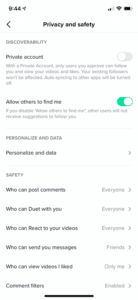
Many Tik Tok users love interacting with a large, global audience to spark creativity and enjoy fun feedback. As a clinical psychologist who sees how some of these collaborations with strangers can turn dangerous, I recommend a private account so you can approve or deny follower requests, and only users you’ve approved as followers can see your content. Of course, we encourage parents to discuss the pros and cons of use with their kids to reach a cooperative agreement.
To do this,
Click on the Settings button at the top right corner on your profile page.
Click on Privacy and Safety.
The first option is “Private Account” or “Allow others to find me.”
If you change an already-existing account to private, current followers will not be affected.
You can also remove or block followers at any time. Removing them disables their ability to direct message your teen. Blocking them stops them from interacting with or viewing your teen’s content at all.
Opting for Restricted Mode limits content that may be considered inappropriate. Users can also restrict comments to friends only or block them altogether. The can also disable messaging and disable duets.
Tik Tok offers a Screen Time Management mode with a passcode as one of their Digital Well Being offerings.
If you see inappropriate content while browsing the app, you have the option of reporting it within the app. We noticed that the report button is somewhat difficult to find in that it is hidden among other buttons.
As with most social media apps, the company collects information, including your name, email address, and phone number. They may also collect any messages you send through the app to friends. This is part of their privacy policy.
Tik Tok is rated a 12+ app store rating. This means you can block underage kids from onboarding the app with Gooogle and Apple parental controls. Tik Tok resources for parents include a Top Ten Tips for Parents primer, “You’re in Control,” safety educational videos, a Safety Center, and an ongoing blog series with helpful tips. The videos can be accessed directly in-app @TikTokTips.
What are the risks for use?
Constant Access
When kids are little, parents decide when playdates happen. Once Tik Tok is on board, keep in mind that your kids will have access to their friends whenever they have their device, and other Tik Tok users will have access to your kids. For many, that means 24/7 access. If you’re not OK with that, you’ll have to dock screens consistently or limit their access.
Inappropriate Content
Although the rules state that users younger than age thirteen shouldn’t be on Tik Tok without parental guidance, anyone can simply lie and accept the terms of conditions without informing their parents. Sometimes the content may not be filtered, and any kind of inappropriate content may pop up. Of particular concern is dangerous stunts, hate speech, and sexualized dancing to explicit music lyrics. Imagine watching your 12-year-old dancing sexy to lyrics that include the n-word, the f-word, p&^sy, and worse.
Cyberbullying
A fun video posted today can feel humiliating when viewed tomorrow. Since moderators can’t oversee all comments on the app, there is cyberbullying. Since being creative requires risk, public ridicule now or later is a real concern. Often the ridicule happens when the Tik Tok video is shared on other social media platforms, like Instagram or Twitter. The best way to prevent this would be to keep the account on private and add only people whom you know or are friends with. However, keep in mind that cyberbullies can always screenshot from a private account and share publicly. Users can turn off comments to prevent or stop cyberbullying on their content. Exclusion from posts about friend groups can also be hurtful. Imagine if your child is the one who was left out.
Trends & Attention-Seeking
Users can produce or view inappropriate Tik Tok’s and often try to attract large numbers of followers with poor posting or comment choices. For example, the trend for “Chop Chop Slide” involves kids filming their parents’ reactions to an unexpected string of very explicit lyrics. Many of these videos of their parents are likely shared without permission. To feed the need for likes, affiliative apps offer the purchase of likes for your posts and to buy more followers.
Stunts & Challenges
Most Tik Tok Challenges are incredibly skillful dance moves. You’ll also see kids singing along with their tongues out and clever facial expressions to vulgar lyrics alone and in groups. Like with the other social media platforms, you’ll also see some winners come up with something like the outlet challenge which involves shoving a penny in a charging cube for sparks. To see what I’m talking about, search YouTube for Best Tik Tok Compilations and prepare to be mesmerized for awhile. The talent Tik Tok inspires is amazing.
Online Predators
If your child’s profile is set to public, anybody signed into the app can view your child’s videos, comment, and message your child. The tech website, Motherboard, reported a large community of adults soliciting young Tik Tok users for nude photos and videos and even sent videos to the children. Lewd and hateful comments have been found on children’s videos. News reports say that, while Tik Tok has attempted to remove those comments after being reported, several inappropriate comments were left on videos. The owners of the accounts that left those comments were not suspended from Tik Tok and were allowed to continue commenting.
It’s Addictive!
Once you test the app, you’ll see how fun it is! It’s hard for users to resist the endless on-demand video content on the Discover page (indexed with hashtags) that is interactive, shocking, funny, creative, musical, and titillating. Be aware that popular Tik Tok influencers produce highly sexualized content and the “For You” autofeed offers up content that is similar to what has been viewed before. Kids spend hours scrolling endless content.
GKIS Parent Checklist for Tik Tok Use:
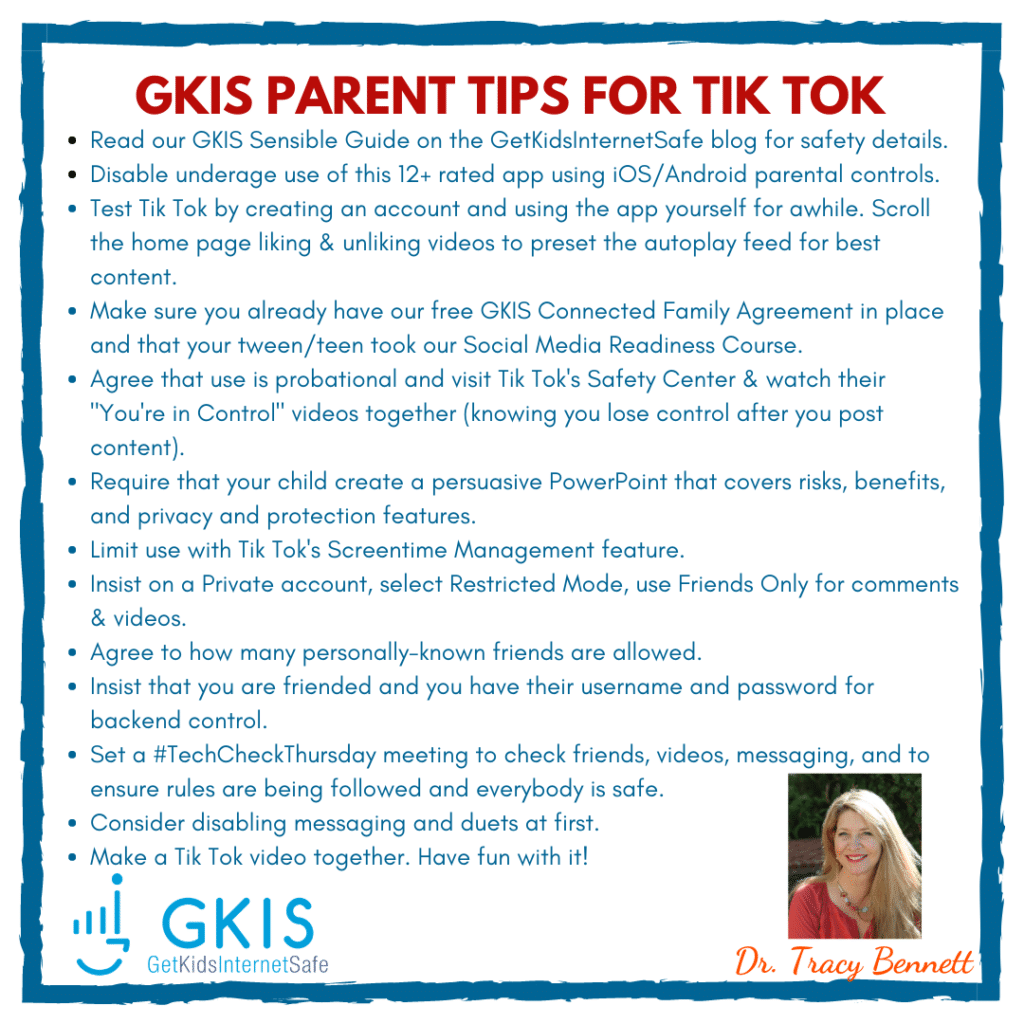
Disable underage use of this 12+ rated app using IOS & Android parental controls.
Test Tik Tok by creating an account and using the app yourself for awhile. It’s mind-blowing how creative users can be. It’s also helpful to search YouTube for Tik Tok compilations (e.g., “Tik Tok procreate compilations”).
Preset your chid’s account for best content by scrolling the home page liking appropriate videos & selecting “not interested” for inappropriate videos. Although it won’t keep them safe from viewing inappropriate content, it does preset the autoplay to a more positive autoplay pattern.
It’s also helpful to block influencers who commonly produce inappropriate content, while also “hearting” topics and influencers that match your child’s interests (e.g., singing, dancing, drawing, procreate, etc.).
Make sure you already have a digital contract in place (like our free GKIS Connected Family Agreement). Add it to your agreement as an “OK” or a “not yet,” so parameters, rules and regs, and etiquette issues are understood. (If you haven’t downloaded it yet, enter your name and email on our GetKidsInternetSafe home page and it will be emailed immediately.)
Agree that use is probational and visit Tik Tok’s Safety Center and watch their “You’re in Control” videos together (recognizing that once the content is posted, you no longer are in control).
Require your child to create a persuasive PowerPointthat covers risks, benefits, and privacy and protection features so you both know the in’s and out’s of Tik Tok’s features before you agree to it. For more information about how to create and judge a persuasive PowerPoint about a social media app along with other useful screen safety strategies, check out our Connected Family Online Course. The course was created to optimize healthy screen use while protecting kids and teens from digital injury. The best part about the course is it brings parents and kids closer with more cooperative negotiation around family screen rules. Once you agree on a trial, create a digital poster with a bullet list of the rules you agreed upon and tape it up in your home’s homework or computer space.
Limit use with Tik Tok’s Screentime Management feature.
Insist on a PRIVATE account so strangers can’t view your child’s posted videos, Select RESTRICTED MODE. Use FRIENDS ONLY for comments and videos.
Consider DISABLING messaging and duets at first.
Agree to how many personally-known friends are allowed at first to limit exposure while your child is gaining expertise and judgment. Remember, they WILL post, view, and message inappropriately no matter how great you parent. If that’s unacceptable to you, DON’T ALLOW TIK TOK.
Insist that you are friended and you have their username and password for backend control.
Set a #TechCheckThursday meeting to check friends, videos, messaging, and to ensure rules are being followed and everybody is safe. This will also keep the cooperative dialogue going.
Make a Tik Tok video together. Have fun with it!
GetKidsInternetSafe rates Tik Tok as a red-light app due to the easy access to strangers, inappropriate content, bad judgment while posting or live streaming, and potentially harmful comments. Because the app has millions of users, it is difficult for Tik Tok moderators to weed out all of the unacceptable content. But there is also a legitimate argument for creative and fun sharing with a private profile. If you do opt to allow Tik Tok, be sure and get your child’s username and password and monitor posts. Share our GKIS Parent Tips on your social media for friends and family. HERE’S THE LINK TO THE IMAGE
Thank you to CSUCI intern Makenzie Stancliff for co-authoring this article. For more help with social media. judgment and overall psychological health, you won’t want to miss our GKIS Social Media Readiness Training Course for tweens and teens.
I’m the mom psychologist who will help you GetKidsInternetSafe.
Click on YouTube and the first video trending is “Million Dollar Home Tour.” The next recommended video is “My Multi-Country Vacation” followed by “Upgrading my Lambo (short for Lamborghini).” You’ve fallen into the rabbit hole of people flashing their wealth and the expensive items they have. Next thing you know, three hours have passed, and you catch yourself thinking about how nice it would be to afford the huge homes, nice cars, and expensive vacations. Could you be falling victim to wealth addiction?
Wealth Addiction
In Dr. Bennett’s CSUCI Addiction Studies course, we learned that addiction is often characterized by three factors, compulsive use, loss of control, and continued use despite the presence of consequences. Typically, these result from drug addiction. However, they are also seen in the behavioral addictions of gambling and video gaming. If you compulsively seek get-rich-quick schemes, can’t stop watching online flex videos, and make rash decisions in your quest for wealth, you might be wealth addicted!
Wealth addictionor money addiction is a fairly old concept that is currently being fueled by new social media trends. Philip Slater’s 1983 book, “Wealth Addiction” illustrated how Americans are addicted to money.[1] Thirty-six years later, more and more people seem wealth addicted than ever.
In his 1999 research, economist Romesh Diwan compared wealth to the general quality of life. He discovered that the overconsumption of materialistic items promotes wealth addiction. Diwan said that people believe that if they buy the material item they’ve been longing for, they’d be happy. However, his research surprisingly demonstrated that purchasing those items did not fulfill the need and want, instead leaving the consumer anxious and dissatisfied.[2]
Key Influencers
Many YouTube stars flaunt their wealth and material possessions in their videos. For example, YouTuber Jake Paul has 19.6 million subscribers on his channel.[3] As of 2018, his net worth was nearly $19 million.[4] Paul shows off how much money he has by posting videos such as, “I Spent $1 Million Dollars On This Vacation” where he documented an expensive vacation with his brother and friends.[3] In another video called, “I Spent $100,000 in 56 Minutes,” Paul created a competition where he and five of his friends had to spend $10,000 cash in less than an hour.[3]
Jeffree Star is another popular YouTuber who shows off how much money he has. With 15.9 million subscribers as of 2018, Star’s net worth is almost $75 million.[4] Star also posts videos that flaunt his wealth such as, “My Pink VAULT Closet Tour,” where he gave a tour of his dream closet in his home that is full of designer clothes.[5] In another video titled, “Surprising my Boyfriend with His Dream Car,” Star bought his boyfriend an Aston Martin Vantage worth roughly $150,000.[5]
The Benefits of Wealth Addiction
Not all aspects of longing for wealth are negative. For instance, if a watcher is encouraged to pursue higher education to get into a higher-paying career, one might argue that the dream is worthwhile.
Another positive aspect of wealth addiction is sparking the desire to give back with philanthropic gestures. Despite his obscene displays of wealth, Jeffree Star donates money to several charities including victims of gun violence and LGBTQ organizations.[6]
The Risks of Wealth Addiction
Teaching kids that wealth is the highest priority may lead them to seek wealth from opportunistic marketers. For instance, several years ago in Camarillo, a get-rich-quick scheme was introduced to popular high school and college students causing a rash of school dropouts. The product called Vemma Nutrition promised riches in exchange for selling their energy drinks and protein shakes. To get in on the action, the seller had to purchase the products themselves.[7]
Another risk is kids seeking wealth in place of healthier activities like academics, sports, and socializing. After binge-watching videos, they may get duped into believing that money will solve all their problems and make them happy. Of course, this may not be true, instead luring them into false hope with pressure to show off wealth instead of saving or investing in their future.
For some, the first goal of earning is never enough. They chase wealth in a quest to find true happiness. That could translate into depression and anxiety. Addiction studies tell us that living to chase a high is a dead-end scenario. If wealth is the goal, will you ever reach it?
Thank you to GKIS intern, Makenzie Stancliff for alerting us about the risks of wealth addiction. If you learned something about this article, please join us on our DrTracyBennett Instagram page so you won’t miss out on other fun GKIS opportunities.
I’m the mom psychologist who will help you GetKidsInternetSafe.
[1] Peele, S. (2015, February 8). Addicted to Wealth – A National Trait? Retrieved from https://www.psychologytoday.com/us/blog/addiction-in-society/201402/addicted-wealth-national-trait
[2] Diwan, Romesh. (2000). Relational wealth and the quality of life. Journal of Socio-Economics, 29(4), 305. https://doi-org.summit.csuci.edu/10.1016/S1053-5357(00)00073-1
[3] JakePaulProductions. (n.d.). Jake Paul. Retrieved from https://www.youtube.com/channel/UCcgVECVN4OKV6DH1jLkqmcA
[4] Chakrabarti, R. (2019, September 15). The Highest-Paid Stars on YouTube. Retrieved from https://moneywise.com/a/the-highest-paid-youtube-stars
[5] jeffreestar. (n.d.). jeffreestar. Retrieved from https://www.youtube.com/channel/UCkvK_5omS-42Ovgah8KRKtg
[6] Diply. (2018, October 24). 15 Facts About Controversial YouTuber Jeffree Star. Retrieved from https://diply.com/11366/15-facts-about-controversial-youtuber-jeffree-star
[7] Press, T. A. (2015, August 26). FTC: Vemma temporarily shut down for running pyramid scheme. Retrieved from https://www.ksl.com/article/36179492/ftc-vemma-temporarily-shut-down-for-running-pyramid-scheme.
Americans LOVE online browsing. YouTube is the second largest search engine, with 1.9 billion registered users watching 5 billion videos daily![1] As online discovery grows, so does child disconnection from real life. Sometimes, just watching a task get accomplished on video feels as good, if not better than doing the task itself. Numbing out online allows us to escape the hard work of trying and failing. It also replaces the opportunity for learning to cope with boredom. Online, one can escape the first twinge of anxiety with a click of the mouse. In real life, you must endure the moment and work it through. It’s no wonder so many of us choose the less threatening online version of reality over offline experiences.
Ways We Live Vicariously Online:
In Dr. Bennett’s book, Screen Time in the Mean Time, she agrees that discovery online and learning from how-to videos is a great benefit of technology. But she also believes that kids need “buckets of face-to-face interaction and three-dimensional play experiences to grow the neurological wiring necessary for skill mastery. Too much screen time takes the place of critical learning experiences.” Although watching a how-to video may spark curiosity and experimentation, it can also offer satisfaction without really working for it.[2]
Social Media & JOMO
Social media is one way people live vicariously online (in their imagination while watching others).[3] Each post is carefully staged. We pause the live moment until we get just the right shot. No messy reveals of the moment before when you were sweating to climb the cliff overlooking the sunset or annoyed with your companion for talking too much about politics. Only our best accomplishments are highlighted.
Even better, look at Tiffany with her handsome new boyfriend on the sailboat. We no longer have to worry about how she’s handling her eating disorder or that the trip maxed out her credit card. She’s happy! End of story. Honest real life is messy…and stressful. Who wants to deal with that?
Our brains can keep track of, at most, 150 friendships while maintaining a sense of a meaningful connection. This is called Dunbar’s number. A maximum number of meaningful connections is true for our offline as well as our online lives. Yes, we are acquainted with our 1,247 Instagram “friends.” But are we truly connected?
A recent GKIS article, The FOMO EFFECT: How Fun Friend Posts Can Lead to Clinical Anxiety, described how social media sparks fears of missing out (FOMO). However, Jason Fried, co-founder and president of 37signals, has coined the phrase joy of missing out (JOMO). JOMO is a trend in response to FOMO.[3] Challenging your kids to exercise JOMO may help them avoid the lure of too much vicarious living on social media platforms.
Television & Movies
We also use TV and movies to allow us to live vicariously through the characters on screen. Viewers can get so consumed that they associate the character’s achievements and growth with their own. With on-demand content, we can binge-watch a series, immersing ourselves in ways that can feel profound. It’s as if we are personally experiencing the characters, settings, and plots.
Studies have found that:
79% of viewers reported enjoying television more when they watched multiple episodes at a time.
Approximately 61% of Netflix users watch from 2-6 episodes in one sitting.
56% of binge-watchers prefer to binge alone.
On average, people watch at least 7 hours of television daily. That’s one hour short of a full-time day at work![4]
Negative Effects of Binge-Watching
You are 23% more likely to become obese and 14% more likely to develop diabetes from watching only 2 hours of TV every day.
Those who watch more TV are more likely to experience anxiety or depression.[4]
After the age of 25, you lose 22 minutes of life for every hour of television watched.[5]
Like a television-video game hybrid, programmers have picked up on these immersive phenomena, creating tv and movie series where you can impact the direction of the plot by choosing the decision you want the character to make next. This is called interactive TV.
Netflix recently experimented with it by allowing users to vote for one of five pre-recorded endings. Big tech and entertainment are betting that this will be the next mass medium with huge appeal.[6]
Gaming
Everyone knows someone who stays up all night gaming instead of getting the sleep their body desperately craves. In her book, Dr. Bennett cites peer-reviewed studies that demonstrate how immersive gaming floods dopamine into the pleasure center of the brain.
One doesn’t have to risk peril in real life; just strap on your weapons and save the world with your virtual character. Complete with novel landscapes, skilled partners, and novel rewards, the gaming life provides mastery and socialization that is almost effortless to achieve. Again, real-life struggles are so much more work. Gaming is so compelling, it leads to clinical addiction among some players, requiring professional detox and rehabilitation in inpatient hospitals.
YouTube
YouTube is the most popular social media platform used today. We have access to experts on everything … and nothing. By watching endless streams of videos, we can live vicariously through different genders, ages, and ethnicities.[7] Replacing real-life mastery of tasks, we watch the edited version that leaves out the messy failures endured before the perfection is captured and downloaded for our consumption.
It has been suggested that many people who view how-to videos gain such satisfaction, they choose not to attempt it in real life after all. That means that watching a how-to video squelches real-life practice of the skill. Rather than aiding you to complete the project, it replaces your desire to start.
Celebrity Worship Syndrome
Celebrities have managed to become the idols of many little girls and boys around the world. With society watching and reporting their every move our children come to believe this extravagant behavior is normal. In this way, we are raising a generation of vicarious livers. Children that would prefer to be cast for a reality television show than grow up to be the president.[8] Celebrity Worship Syndromeis when the individual becomes obsessed with the life of a celebrity.[9]
Travel
Why spend the money and endure the stress when you can enjoy the experience of traveling all over the world on Snapchat? WeTravel, a company that allows users to travel the world virtually, claims that it will temporarily satisfy your craving to travel by showcasing people’s travels around the world.[10]
Pornography
Watching online pornography can be a cheap replacement for intimacy acquired through romantic human relations. Too much use can decrease dating confidence.[11] Porn is a source of pleasure that will not turn them down, break their heart, make them feel incompetent, or worse, embarrassed.
From Competition to Inspiration
Mastery can only be achieved through anxious anticipation, mustering the courage to try, and multiple failures along the way. Each step in the journey strengthens emotional resilience, character, confidence, and competence. Missing out on real-life learning opportunities can lead to real emotional impairment. None of us want that for ourselves or for those we love.
One technique for altering one’s mindset when viewing photos of others’ accomplishments is replacing the competitive lens with one of inspiration.[12] Teaching your children to be inspired by others’ successes will help them steer clear of vicarious living. Ultimately, engaging and successfully mastering a skill provides you with much more satisfaction and self-efficacy than observing the successes of others.
How to Encourage Real-Life Mastery
Decide if what you wish you could do, is something you can do. By encouraging your child to dream with enthusiasm and encouragement, they’ll build the scaffolding of confidence that will lead to real effort.[13]
Commit to a specific end goal. Help your kids bridge the gap between dreaming and reality by encouraging them to identify a goal and start to research it!
Tackle it. By reminding your child that failure and poor results along the way are part of the learning, they can start to chunk the task into several benchmark goals. Remind them that mastery is only meaningful if you overcame the struggle to get there.
Encourage them to recognize their worth and importance. Ensuring your child that they don’t have to earn their worth is an important part of helping them build a healthy sense of self.[14]
Remind them to celebrate their achievements (and those of others) along the way. Celebrating benchmark goals will give them the joy of learning that drives follow-thru. Keeping a gratitude journal is a great way to spark celebration.
Demand an occasional disconnect. By following the guidelines and suggestions from our GKIS courses, you can create a lifestyle that carves creative space and time for real-life experiences. Dr. B’s weekly parenting and family coaching are quick lessons on how to tweak family living to increase screen safety and closer family relationships.
JOMO. Most important of all, teach your kids the many joys of missing out! Show them how to break free of the activities that social media says they should do. Instead, spend time doing truly satisfying tasks in real-time, in the real world.
Thank you to Sara Doyle, GKIS intern, for researching and writing this article. In the end, those who never give up on their goals will succeed as much as the talented.
I’m the mom psychologist who will help you GetKidsInternetSafe.
[1] http://www.businessofapps.com/data/youtube-statistics/
[2] NPR. “Hidden Brain. Close Enough: The Lure Of Living Through Others.” Shankar Vedantam, Laura Kwerel, Tara Boyle, and Jennifer Schmidt, 2019.
[3] SoundCloud. “Living Vicariously Through Social Media…” Phil Svitek.
[4] CogniFit. “Binge watching: Complete guide to its effects on the brain and body.” Anna Bohren, 2018.
[5] Personal Excellence. “Are You Living Vicariously Through Movie, Drama, or Game Characters?” Celestine Chua.
[6] https://www.latimes.com/business/hollywood/la-fi-ct-netflix-black-mirror-20181228-story.html
[7] “I’m Living Vicariously Through YouTubers” Lily Brundin, 2016.
[8] HuffPost. “Americans Have An Unhealthy Obsession With Celebrities.” Jo Plazza, 2012.
[9] Psychology Today. “Celebrity Worship Syndrome.” Mark D. Griffiths Ph.D., 2013.
[10] “Traveling Vicariously Through Snapchat.” Azzura Ricci.
[11] “Is Living Vicariously Through Others Dangerous?” Nicola Kirkpatrick, 2018.
[12] Riskology. “Are You Living, or Living Vicariously?” Tyler Tervooren, 2019.
[13] Nerd Fitness. “How to Live Vicariously Through Yourself.” n.
[14] Lifehack. “3 Ways to Stop Living Vicariously Through Technology.” Derek Ralsto
It’s hard to ignore the huge influence social media has on our society. There’s reasonable concern with how much our kids are engaged on their screens, that use of social media is ego-inflating and of little value. But this concern may be overgeneralizing. Younger generations have found ways to use social media for good, some gathering followers by the thousands. One of these beneficial ways is gathering support for social change.
Twitter is shaping up to be a platform worth something beyond memes and humorous one-liners. It’s proving capable of being a reliable source that many young people look to for news about current events. “74% of Twitter users say they use the network to get their news.”[1] Twitter offers the unique ability for protestors to organize together with a speed, efficiency, and reach that has previously been unheard of. Localized protest becomes national overnight; global protest is accessible to all.
Parkland Florida Students Viralize Their Cause
The students who survived the Parkland, Florida school shooting were left grieving, confused, and angry. Their hearts were broken, wanting justice for their friends and other kids like them. As a result, they organized the “March for our Lives” protest in Washington that attracted 108,000 protesters to their cause.[2] Not only did a genius use of social media attract live protestors, but by March 2018, two of the Parkland survivors had a total of over 1.5 million social media followers.[3]
They made their opinions known to a vast like-minded audience who wanted to see gun laws reformed. Not only did they draw thousands to their cause, they also had impact on legislation. A bill was passed in Florida which limits the sale or ownership of guns for a year to anyone determined to be a threat.[4]
Twitter Becomes a Platform for Social Movements
Traditionally, people have assumed that social media platforms like Twitter only talk of trivial topics. Current and critical social issues are taking form, turning Twitter into a powerful platform for social justice. And it’s not a mistake that this is happening. A 2015 study published in the InternationalJournal of Consumer Studies looked at the link between social media and its ability to make people feel connected. This study compared desire to be involved in a particular social movement formed through social media with how often the desire resulted in social movement participation. They concluded that social media users are more inclined to follow through with social movement aspirations if they are both avid users and feel socially involved within a group.[5]
Climate as the Next Frontier
An annual survey by the World Economic Forum shows millennials ranked climate change as the number one world issue for the third year in a row.[6] Gen Z kids are equally as likely to see climate change as the most pressing global issue currently.[7] Like the gun reform protests of this last year, students are again staging mass protests to fight against leaders of government –this time on a global scale. For instance, the rapidly-building March 15 2019 “School Strike 4 Climate” movement resulted in a massive protest, with 1.4 million young young people from twelve countries banding together to skip school.[8] These kids were seeking global government attention to reduce carbon emissions.
There is an urgency to climate change protests inspiring kids all over the world to act. Hitting headlines globally is a young girl from Sweden, Greta Thunberg. She has a Twitter account with 540,600 followers, which she uses to mobilize her cause.[9] Greta reported that she became impassioned with the global threat of climate change at only 8 years old. On April 23, 2019, she spoke in front of parliament in the UK at only 16 years old.[10] Greta is the face of generation Z’s climate change protest representing an entire generation demanding change, and they’re using social media to do it.
Interested in how to get your kids mobilized to do good? Check out these organizations:
[1] https://www.omnicoreagency.com/twitter-statistics/
[2] Shear, M.D. (2018, March 24). Students lead huge rallies for gun control across the U.S. The New York Times. Retrieved from https://www.nytimes.com/2018/03/24/us/politics/students-lead-huge-rallies-for-gun-control-across-the-us.html?module=inline
[3] Bromwich, J.E. (2018, March 7). How the Parkland students got so good at social media. The New York Times. Retrieved from https://www.nytimes.com/2018/03/07/us/parkland-students-social-media.html?module=inline
[4] Kramer, M. & Harlan, J. (2019, February 13). Parkland shooting: where gun control and school safety stand today. The New York Times. Retrieved from https://www.nytimes.com/2019/02/13/us/parkland-shooting.html
[5] Hwang, H., & Kim, K. (2015). Social media as a tool for social movements: The effect of social media use and social capital on intention to participate in social movements. International Journal of Consumer Studies, 39(5), 478-488. doi: 10.1111/ijcs.12221
[6] Loudenback, T. & Jackson, A. (2018, February 26). The 10 most critical problems in the world, according to millennials. Business Insider. Retrieved from https://www.businessinsider.com/world-economic-forum-world-biggest-problems-concerning-millennials-2016-8
[7] Parker, K., Graf, N., & Igielnik, R. (2019, January 17). Generation Z looks a lot like millennials on key social and political issues. Pew Research Center. Retrieved from https://www.pewsocialtrends.org/2019/01/17/generation-z-looks-a-lot-like-millennials-on-key-social-and-political-issues/
[8] Kaplan, S. (2019, February 16). How a 7thgrader’s strike against climate change exploded into a movement. The Washington Post. Retrieved from https://www.washingtonpost.com/national/how-a-7th-graders-strike-against-climate-change-exploded-into-a-movement/2019/02/15/e20868e2-2fb4-11e9-86ab-5d02109aeb01_story.html?utm_term=.a97cad4efa4d
[9] https://mobile.twitter.com/GretaThunberg
[10] (2019, April 23). Greta Thunberg: Teen activist says UK is ‘irresponsible’ on climate. BBC News. Retrieved from https://www.bbc.com/news/uk-48017083