So many of us follow our favorite celebrities on social media hoping to get small glimpses of their private lives. But have you ever wondered, where’s the line between fandom and obsession? Tweens and teens are especially vulnerable to developing parasocial relationships with celebrities they love online. Because of their fame, celebs can influence followers in some of the worst ways. To prevent your child from being negatively influenced by others online and to create a strong digital foundation, check out our Screen Safety Essentials Course. Today’s GKIS article covers what online parasocial relationships are and how to prevent their negative influence on kids and teens.
What is a ‘Parasocial’ Relationship?
A parasocial relationship is a one-way relationship with a person of higher status who you know intimately but who hardly knows you at all.[1] Social media is the perfect vehicle to develop parasocial relationships. Younger tweens and teens are especially susceptible due to a powerful social drive fed by adolescent identity formation. Not only are teens looking for mentorship, but they also easily form an attachment to idealized versions of their favorite celebs.[2]
Social media features that readily fuel parasocial relationships include the attraction of stylized and beautifully edited posts, branding relationships between celebrities, produced dramas between celebrities designed to bring in more followers, fan comments and forums, and even the ability to send private messages. Studies show that adolescents that have a weaker sense of self-identity often participate in celebrity worship as they are more easily influenced by others.[2]
‘Stan Culture’
Fans aim to achieve closer relations with their favorite celebs through various consumption activities.[1] Twitter is the social media site with the largest number of users who participate in celebrity worship, which is also known as a stan. A Stan is an overzealous or obsessive fan of a particular celebrity. Primarily a term used to define a fan of a particular musical artist, there are Stans for just about any popular current artist you can think of. Stan culture on Twitter consists of individuals sharing fanmade videos and pictures and consuming as much of the artist’s content as possible.
There is also a dark side to Twitter’s Stan culture. Arguments between Stans of different celebrities frequently appear in comment sections, which eventually turn into cases of cyberbullying. Studies have found that intense celebrity worship can be linked to tendencies toward addiction and stalking behaviors.[3] What seems like innocent fan engagement could potentially lead to something more negative and even illegal.
Defending Harmful Messages
Well-known celebs have the freedom to post whatever they want on the Internet, just like the rest of us. Although they aren’t obligated to maintain a certain image, sometimes they promote harmful ideologies that influence fans who’ve developed parasocial relationships with them.
The most recent example is rapper Kanye West, who has been at the forefront of recent celeb controversy. In October 2022, Kanye made some anti-Semitic remarks based on conspiracy theories and harmful stereotypes in interviews and Instagram posts. This resulted in groups of people in Los Angeles standing with signs over freeways saying harmful anti-Semitic things shortly after the comments circulated on the Internet. One of the signs said that Kanye was “right” about what he said about Jewish individuals. Amongst the backlash that he received, there were die-hard fans that stood their ground and continued to defend his actions. This led some fans to adopt his conspiracy theories and ideals at worst and turn a blind eye to such ignorance at best.
Impressionable Teens and Tweens
Other celebrities have also promoted problematic ideas with the support of fans who adore them. This is a problem primarily for young tweens and teens due to their lack of real-world experiences and their evolving views of the world around them. Being negatively influenced by celebrities online can have serious risks.
How to Discourage Parasocial Relationships
There is a difference between being a fan of someone’s work and developing an obsessive parasocial relationship with them online. Having conversations with your kids about the importance of navigating the Internet safely is a good place to start. Our Connected Family Course can help with that. It includes the tools necessary to monitor and promote healthy screen engagement while still maintaining a positive environment at home.
Young teens and tweens who are still learning about the world could be exposed to ignorant comments from their favorite celebrities and could potentially become influenced by them. In the worst case, teens become radicalized in their thinking without their parents even knowing. To prevent your tweens and teens from engaging in ignorant and harmful content online, check out our Social Media Readiness Course. Our course provides you and your child with the knowledge necessary to safely browse the Internet and avoid ignorant and harmful content, as well as how to make healthy digital decisions.
Learning the ways of the Internet doesn’t have to be a daunting task. Dr. Bennett’s book Screen Time in the Mean Timeis another great tool for parents to use to become more knowledgeable about the unpredictable online realm. This book can further prepare you for establishing a safe environment for your tweens and teens to express their love for their favorite celebrities/artists online.
Thanks to CSUCI intern Tracy Pizano for researching the risks of forming parasocial relationships and for co-authoring this article.
I’m the mom psychologist who will help you GetKidsInternetSafe.
[1] Derbaix, M., & Korchia, M. (2019). Individual celebration of pop music icons: A study of music fans’ relationships with their object of fandom and associated practices. Journal of Consumer Behaviour, 18(2), 109–119. https://doi-org.ezproxy.csuci.edu/10.1002/cb.1751
[2] Ang, C.-S., & Chan, N.-N. (2018). Adolescents’ views on celebrity worship: A qualitative study. Current Psychology: A Journal for Diverse Perspectives on Diverse Psychological Issues, 37(1), 139–148. https://doi-org.ezproxy.csuci.edu/10.1007/s12144-016-9497-0
[3] Sansone, R. A., & Sansone, L. A. (2014). ‘I’m your number one fan’—A clinical look at celebrity worship. Innovations in Clinical Neuroscience, 11(1–2), 39–43.
We love the constant, on-demand access to the Internet. Almost nothing can compete. But we all have those times when we wonder, is it too much? How does frequent access to tech impact our brains? Is there a detrimental effect when our brains are still maturing? Might it be negatively affecting our children’s mental health? Does what we view make a difference? Where is the line drawn between staying up to date on current events versus compulsively consuming distressing news? Ensure that your family is protected from excessive negativity online with our Screen Safety Essentials Course. This mega course offers all GKIS course content for parents and families to provide the tools necessary to navigate the internet safely and grow closer as a family. Today’s GKIS article covers the dangers of doom-scrolling and what can be done to prevent it.
What is ‘doom-scrolling’?
Doom-scrolling refers to the excessive consumption of distressing online news coverage. This phenomenon increased exponentially as people became more active on the internet in conjunction with the rise of concerning national and international news. On the one hand, staying informed may be a coping mechanism. Browsing opportunities allow people to “reassert control over the situation” by actively seeking knowledge about a novel context or threat.[1]
For example, during the height of the Covid-19 pandemic, many people became obsessed with news about variants, vaccines, and the number of cases around the world and within one’s local county.
Another example of doom-scrolling is the high viewer rate of news about the Black Lives Matter protests during the summer of 2020. It was too easy to become glued to our screens watching videos documenting police brutality and protester violence unfiltered and in real time on TV, Facebook, Twitter, YouTube, and TikTok. The desire to stay up to date on this hot topic social movement grew so intense that people commonly spent several hours a day watching violent videos.
Our Attention Has Been Commodified
In recent years, scary news items permeate the airwaves, with reports of mass shootings and alarming weather events due to climate change. The public’s trust in the government has reached an all-time low, with divisively high levels of partisanship and serious concerns about U.S. democracy. Sensationalistic and divisive programming that sparks outrage is intelligently designed to capture our attention and keep us watching. Media and social media companies recognize that more eyes on the story result in more profit.
Internalizing Negativity
Negative media and news coverage can affect our mood and hopes for the future. Anxiety, depression, and the adoption of a nihilistic outlook may result from doom-scrolling. Constant exposure to negative news content can lead to a low expectation for positive future outcomes which can lead to feelings of hopelessness – a primary precursor to suicidality.[3] For example, a doom-scrolling teenager may be led to wonder if applying for college is worth it if global warming is going to end the world by 2030, or even consider if it’s worth staying alive to witness the decline. Staying informed can come with a serious mental cost.[2]
Compulsive Use and Desensitization
Twitter, YouTube, Facebook, and TikTok are popular social media sites that offer real-time footage of violence. From intense protests and desperate attempts to escape a mass shooting to families trying to escape the horrors of war. There’s no end to the horrific content you can consume.
Gen Z social media users (born between the years 1997-2013) particularly possess a collective passion for activism and justice paired with a prominent collective online presence. However, this drive seems to also come with an obsession with sharing, retweeting, and reblogging violent content to encourage others to stay up to date. While this may have the good intention of bringing attention to serious issues, the constant access to intense videos, photos, and articles desensitizes consumers. To read more about how Gen Z online users differ from Millenials, check out my GKIS article Millennials, Gen Z, and the Internet: Generational Divides.
Compare and Despair
A demanding social media presence may also lead to a more negative self-appraisal. Children, tweens, and teens are especially susceptible to compare and despair due to an immature personal identity and impoverished life experience. The more the individual relates to the influencer, the more impact the content may have. Our GKIS article, Is My Selfie Good Enough? How Screen Media Drives Beauty Pressures That Distress Kids and Teens, dives deeper into how social media can heighten comparison and feelings of inadequacy. Check it out to learn more.
PTSD
Post-traumatic stress disorder (PTSD) is a mental disorder in which a person struggles to recover from experiencing or witnessing a traumatic event. Our article, Live Streaming Can Cause PTSD in Adults and Children, discussed the different ways online violence can lead to PTSD. In Kids Watched a Facebook Live Suicide That Turned Into a Trending Meme, desensitization and the impact of watching shocking and violent content on the mind and body are discussed. And in Graphic Livestream Horrors, the dangers of watching violent events unfold in real-time and the tolerance of violence are discussed. This series provides additional information on what can happen to those who excessively consume violent content online, as well as how to protect your children from such possible outcomes.
Children with social media accounts unintentionally come across negative news coverage because social media algorithms suggest videos and posts after even the slightest interaction, which can expose them to increasingly inappropriate content. To help your tweens and teens avoid inappropriate content and avoid doom-scrolling and desensitization, check out our Social Media Readiness Course. This course can help prepare your kids for safer screen use and prevent psychological illness with emotional wellness tools.
How To Protect Your Children While Staying Informed
Parental Supervision
Children, tweens, and teens are particularly susceptible to distressing online content. Our Screen Safety Toolkit offers an outcome-based resource guide with recommendations and links to our favorite parental control systems necessary for effective parental supervision.
Stay Informed
Our free GKIS blog articles offer a great way to stay in the know on all topics surrounding internet culture and safety, which can help parents keep their children safe from digital injury.
Have Important Family Conversations
Our free Connected Family Screen Agreement provides tools to educate and empower families to set digital boundaries and expectations while building stronger family relationships. Having group discussions about tech, mental health, and current events offer an important way to educate kids and answer your child with openness and honesty at a developmental level they can understand.
Dr. Bennett believes that providing children and teens the skills necessary to navigate the internet responsibly is important for not only individual development but for family development, which is why the Connected Family Course can help families connect and avoid potential digital injury. Finding a middle ground between education and overexposure exists and it can be implemented safely.
Thanks to CSUCI intern Tracy Pizano for researching doom-scrolling online and its effects on the mental health of those who participate in the habit and for co-authoring this article.
I’m the mom psychologist who will help you GetKidsInternetSafe.
[1] Buchanan, K., Aknin, L. B., Lotun, S., & Sandstrom, G. M. (2021). Brief exposure to social media during the COVID-19 pandemic: Doom-scrolling has negative emotional consequences, but kindness-scrolling does not. PLoS ONE, 16(10). https://doi-org.ezproxy.csuci.edu/10.1371/journal.pone.0257728
[2] Price, M., Legrand, A. C., Brier, Z. M. F., van Stolk-Cooke, K., Peck, K., Dodds, P. S., Danforth, C. M., & Adams, Z. W. (2022). Doomscrolling during COVID-19: The negative association between daily social and traditional media consumption and mental health symptoms during the COVID-19 pandemic. Psychological Trauma: Theory, Research, Practice, and Policy. https://doi-org.ezproxy.csuci.edu/10.1037/tra0001202
[3] Hepburn, S. R., Barnhofer, T., & Williams, J. M. G. (2009). The future is bright? Effects of mood on perception of the future. Journal of Happiness Studies: An Interdisciplinary Forum on Subjective Well-Being, 10(4), 483–496. https://doi-org.ezproxy.csuci.edu/10.1007/s10902-008-9102-9
Feeling unproductive, unmotivated, and notice that you are wasting countless hours scrolling through social media? A social media cleanse may be a great decision to improve your well-being. In this week’s GKIS article, we will provide a step-by-step guide to putting down your phone and getting that much-needed break your mental health deserves. To help your tween or teen demonstrate they have the knowledge, problem solving ability, and judgment for social media, check out our Social Media Readiness Course. It’s an online course for tweens and teens that offers information about the risks of digital injury due to social media and psychological wellness tools. With a quiz for each module, they work their way through independently so their graduation certification demonstrates mastery of content. Of course, you can take it too if you’d like. It’s like driver’s training but for the internet!
According to pewresearch.org, 70% of Americans use social media.[1] For adults, the most popular social media platforms include YouTube (73%) and Facebook (68%). In contrast, 63% of teens use Instagram, making it the most popular social media platform amongst young users ages 15-25.[2]
According to the American Academy of Child & Adolescent Psychiatry, 90% of teens have used social media and teens spend an average of nine hours a day on social media.[3] Participants of a research study conducted by the Pew Research Center found that 74% of Facebook users visit Facebook daily. People of varying ages spend a lot of time on social media.
We use social media to view funny memes, stay connected to friends and family, meet new people, share opinions and information, show off passions and creative pursuits, advertise businesses, and even get news. Most of us find it extremely rewarding and feel we’ve got it under control. But for others, social media can negatively impact mental health.
Risks of Social Media Use
I’m a millennial who’s been using social media for 10 years. I’ve experienced a wide range of negative effects due to my social media use, including feelings of insecurity and not being good enough, anxiety, and the big one, fear of missing out (FOMO).
For years, I followed my friends’ and Instagram influencers’ profiles and wondered why I wasn’t as happy as them or why I couldn’t travel the world and have a life of fun and excitement. I often compared myself to others on social media and it hurt my mental health. In her book, Screen Time in the Mean Time, Dr. Bennett calls that “compare and despair” and believes it is a common contributor to teen anxiety and depression.
Social media can be a toxic place, especially during these unprecedented times. It’s too easy to spend hours on Google trying to figure out if you have COVID-19 and spend another 45 minutes scrolling through Facebook comments of people arguing over politics. Feelings are high and extreme opinions are rampant. According to helpguide.org, social risks include increased feelings of isolation, depression, anxiety, and insecurity.[4]
The Benefits of a Social Media Cleanse
To get away from negativity, a social media cleanse may be the answer. The benefits of a social media detox include:
More free time for other things, like research about a favorite topic
To research this article, I deleted all of my social media apps including my all-time favorite, Instagram, about a month ago. I was concerned that I was averaging too much screen time (6 hours a day), and I wanted to be more productive and connect more with my boyfriend and family.
My first week of being social media free was by far the hardest. But it became much easier after that. I often felt the urge to redownload my Instagram app, but for the most part I have been able to stay away.
The benefits of staying offline have really paid off for me. Almost immediately, I felt it was easier to fall asleep at night (since I was not on Instagram or TikTok late). I’ve also felt a reduction in stress, anxiety, and anger. Now I don’t feel the need to check my friend’s social media just to see what they’re doing all the time. Instead, I reach out directly to friends to reconnect.
I worried that if I deleted my social media accounts, I would feel more disconnected from my friends. But instead, I’ve kept in touch with them more than before my social media cleanse. Relationships and connections are important to me, and I’m glad that I’ve been able to connect in a more meaningful and sincere way. Overall, I’m happy with the results. I feel more mindful and present in my everyday life, my sleep has improved, I’ve experienced less stress and anxiety, and I have more free time to get work done and spend time reconnecting with the people I love.
Do You Need a Social Media Break?
Here are some red flags that may signal that you are ready for a social media cleanse:
You spend most of your free time on social media.
You feel like you need to share or post often.
You find it hard to focus on schoolwork or other life responsibilities.
You feel an increase in anxiety and stress after spending time on social media.
You feel more lonely, unmotivated, and less creative.
You are experiencing feelings of low self-esteem or low self-confidence.
You feel anxious without your phone.
You feel guilty or ashamed about the amount of time spent on social media.
How to Get Started
There are many ways to jump-start your social media cleanse. You can stop your phone use cold turkey, or you can delete one or two apps at a time. You can also cut down your friend list to only those you have a close, personal relationship with to cut out the less meaningful posts. Find whatever works best for you.
Here are some tips for getting started:
Deactivate or delete your social media accounts.
Delete social media apps from your phone.
Connect with family and friends in alternative ways.
Set a time limit on your phone to cut back on overall phone use.
Check your daily Screen Use and make adjustments if needed.
Set a specific “phone bedtime” before your actual bedtime (At least 3o minutes before you go to bed is recommended).
Make your bedroom a phone-free zone.
Turn your phone on “Night Mode” to decrease blue light emissions.[6]
Most importantly, remind yourself why you decided to go on a cleanse in the first place. And remember, your cleanse doesn’t have to be a permanent decision, you can always go back.
Enriching Activities to Reconnect Offline
There are endless possibilities for new enriching activities. You can practice meditation, pick up a new skill, or do that thing you’ve been meaning to do. Here are some fun ideas to reconnect with your loved ones:
Family game night
Family movie night
Cook a family dinner. Make it exciting by trying a new recipe or cooking an old family favorite.
Have a family yoga or workout session.
Practice meditation and deep breathing (alone or with family).
Using this extra time to reconnect and spend valuable time with your family is great, but it’s also important to spend time hanging out with yourself. Start by catching up on your sleep, creating a playlist, or reading a favorite book. Don’t feel pressured to constantly look for something to keep you busy unless that’s what you want to do. This is a well-deserved break. Do whatever you want with it and enjoy!
If you’re interested in learning more helpful tips about parenting in the digital age, check out the GKIS Connected Family Course. The GKIS Connected Family Course is family-tested and outcome-based and helps you close screen risk gaps and improve family cooperation and closeness.
Thanks to CSUCI intern, Remi Ali Khan for researching social media cleanses for this article.
I’m the mom psychologist who will help you GetKidsInternetSafe.
Parler is a social network platform that has recently become popular due to public outrage over big tech censorship. Controversy swirls as to whether a powerful private entity, like Facebook or Twitter, should have the power to alter public access to information. Should it be up to the reader to determine the accuracy of information or is the proliferation of fake news into our news cycle a danger to us as individuals and to our democracy – thus making censorship necessary? In this article, we will be showing you why Parler appeals to certain users, the perceived benefits and potential dangers of the app, and why GKIS recommends that children not be allowed access.
Nearly the whole world relies on social media to market their business, get the news, network, or stay connected with friends and family. But recently it has been brought to light that social media platforms shadowban content that violates their terms of service. Shadowbanning is when a social media platform blocks a user’s content without notifying the user. So, instead of understanding their content has been blocked, the user believes that nobody is engaging with their content when in reality it cannot be seen or has been obscured to other users.
Some users who have experienced their content being taken down or shadowbanned by social media apps like Facebook and Twitter believe that it is a violation of their constitutional first amendment right to free speech and accuse big tech of politically-motivated censoring. In response, many have decided to jump ship and go to other apps known to be against censorship like Parler. Parler has become one of the most downloaded apps after Twitter flagged some of former President Donald Trump’s tweets.
What is Parler?
Parler is a social network platform that is similar to Twitter. It was founded by John Matze and Jared Thompson based out of Henderson, Nevada. The social media platform describes itself as a “free-speech platform” focused on protecting users’ rights. The content is focused on real user experiences and engagement without censorship, except for obscenity and pornographic material.
The guidelines on the platform state that the company aims to “uphold the rights of free speech according to the U.S. Constitution.” But many are criticizing it for being a far-right social media platform and calling Parler names such as Meinspace, Hicktock, and Fashbook.
Who is joining Parler?
The majority of Parler users have a more conservative ideology who joined during the 2020 presidential election when Twitter’s algorithms censored a New York Post story involving files and emails reportedly taken from Hunter Biden’s laptop. When Republican Senators questioned Jack Dorsey, the CEO of Twitter, about the censorship, he replied that it was a “mistake” and that Twitter policies would be amended. In response, conservatives claimed that the algorithms favored liberal news and unfairly targeted conservative content.
Many Saudi’s have also have left Twitter and joined Parler in response to news stating that several Twitter employees were charged by the U.S. Department of Justice for spying for Saudi Arabia. According to court papers, one of the people implicated in this scheme is an associate of the Saudi Crown Prince Mohammed Bin Salman who the CIA has concluded made the order of assassinating the journalist Jamal Khashoggi. Saudis feel that Twitter is protecting the Saudi government by spying on users that do not agree with the government.
Many non-political people also use the platform such as athletes, business owners, and people that just want fewer rules and a platform that welcomes all political views.
How do you sign up for Parler?
To sign up, go to the Parler website or download the app and submit your email address and phone number to confirm your identity. Agree to their terms of service and privacy rights and community guidelines. If you want to comment on user posts, verify your identity by taking a picture of a valid identification document such as a driver’s license or passport and a selfie and send it in.
How Parler Works
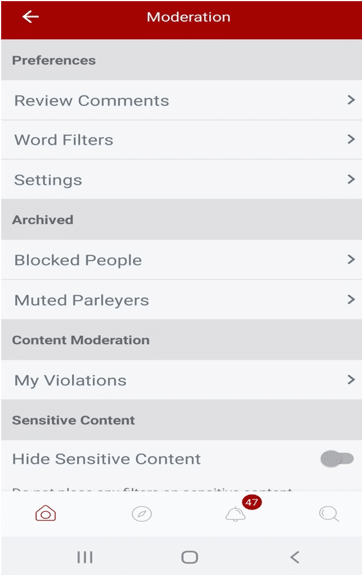
Users can moderate what kind of content they’d like to see as well as block or mute users. Additional features include entering word filters associated with content that you’d not like to see and the option to view your comments before anyone else can see them. Parler also has Community Guidelines violation points which allow a warning (20 points) prior to losing your Parler account.
In the main feed, there are different terms for certain content. For example, a parley is a post and an echo is a re-post similar to a retweet. Votes are similar to likes or dislikes. Parleys can only be upvoted and comments can either be upvoted or downvoted.
Despite Parler being credited as a free speech platform, users cannot post:
Terrorist threats or threats
Trolling
Spam
Pornography
Slander
Blackmail
Plagiarism
Bribery
Copyright infringement
Doxing
Impersonation
Libel
Obscenity
Privacy
Users can make an account public or private. You can also select an option where the only email you’ll receive from Parler is to inform you of critical updates.
How Hashtags Work on Parler
Parler is hashtag heavy. To search for content or post content, a user needs to be precise with hashtags and usernames more so than other social media platforms. This means that exact hashtags or usernames must be typed in with no spaces. Parler’s algorithms only search for usernames and hashtags. Twitter, on the other hand, uses all kinds of algorithms that search for more vague keywords. Their algorithms also curate a person’s feed to suit their interests in order to keep a user scrolling. Parler does not do this. Users that do not like an algorithm to decide what should be on the top of their newsfeed may prefer an app like Parler.
Is Parler appropriate for minors?
GKIS rates Parler as a red light app for kids and teens due to the commonality of extreme views and lack of censorship. For example, far-right groups like the Proud Boys post about destroying Antifa and promoting civil war. We at GKIS recognize that young people are particularly vulnerable to believing conspiracy theories and may become radicalized by extreme content. Kids on Parler may also be at risk for exploitation and abuse.
For more information on how to keep you and your tweens and teens safer on social media, check out our Social Media Readiness Course. It’s like driver’s training except for the internet!
Thank you to CSUCI intern Andres Thunstrom for co-authoring this article.
I’m the mom psychologist who will help you GetKidsInternetSafe.
Onward to More Awesome Parenting,
We all want easy money, especially teenagers. The website OnlyFans.com promises huge profit just by selling their uncovered bodies to men and women prowlers of the internet. This has become a phenomenon to young people all across every social media platform with advertisements to their personal accounts.
What is “OnlyFans.com?”
Onlyfans.com is a social media platform built for sharing nudes, displaying sexual actions live on a webcam, and share private calls with a person who is willing to pay extra[i]. Launched in 2016, it has sky rocketed within the last year, exceeded over 20 million registered users. This website states in terms and agreement that it is marketed for 18+ users, although users of all ages have been seen to be on this website. This website is gloried across twitter where people, young to old, gather and share tweets. It has become a popular topic amongst twitter often being marketed by users leaving their links on their profiles to get directly to their OnlyFans page.
Why create an OnlyFans account?
Money
Social media culture caters to the wealth addicted. We want to show off our nice shoes and fancy cars to prove we are somebody important. Everyone wants to get the next best thing as easy and fast as possible. The way OnlyFans has been marketed makes aspiring users believe they will become wealthy over night.
Fame
Social media influencers have become bigger than many movie stars to the younger generation. Young people crave the idea of becoming an influencer, trying to gain fame any way possible. OnlyFans offers this opportunity to users for their chance to go viral.
Sense of Empowerment
On OnlyFans, account owners charge consumers for services such as sexual actions performed, speaking sexual, and even taking nude photos of themselves to later sell all while being broadcasted live on the webcam. He/she will have to pay a fee according to the account owner’s expense. People who also own an OnlyFans account can gain a false sense of reassurance from other people by getting sucked into this idea that they are better undressed which can be harmful to a young teen who is barely developing their idea of what makes them feel confident.
Is OnlyFans.com safe?
Leaked Information
Many young girls have gotten their what was said to be confidential content leaked to the outside world by hackers who were able to get into their profiles and leak their videos [ii].
This can also help the viewers find out more information about OnlyFans webstars.
Stalking
OnlyFans.com is marketed as a safe pornographic website that has a lot of unsafe precautions when using it. There has been many cases where consumers have obsessively stalked OnlyFans account owners by directly messaging them abusive sexual content, as well as finding out where they live by stalking the specific user, searching their Twitter and Instagram to pin point exactly where they live.
Dangerous
Not only could this be a dangerous website for the user to use it could also be dangerous for the users family. There is a possibility your whole family could be put at risk if a viewer were to reveal where you lived,
Job at Risk
By using OnlyFans you could also be putting your job at risk. If your employer finds out about your use of this website they may not want their company to be represented in such way.
Family Separation
Your family may not be fond of the actions you take when using this website. This can cause there to be tension within the family which can lead to family separation.
While conducting my research on the web, I attempted to start a profile and it did not ask me for much verification regarding my age just a simple email, name, and password to create your account. I navigated through the website to get an insight on what the website looks like.
Why should parents be afraid of this website if typically its an 18+ user website?
Teens are especially prone to the appeal of looking sexy, sophisticated, and in control. OnlyFans preys on this vulnerability by glorifying this type of sex appeal which later down the line this can have a negative affect on a young teens well being by having these videos be linked to them for the rest of their time.
An eighteen year-old OnlyFan member, @xgabyv on twitter whose account is now suspended, reportedly earned $3,000 after having a profile live for only two days. Comments praising her photos included how “sexy she looked with her clothes off.”
While browsing around some more I came across a young girl, Alyssa Scott, age 18 charging for “1 on 1 screen time.” This 1 on 1 screen time meant that Alyssa Scott would be giving her services to one singular customer. She priced this at a much higher rate than her monthly subscription services doubling what she would gain from one monthly subscription.
How do I block sites like OnlyFans.com?
Our GKIS Screen Safety Toolkit [iii] offers easy navigation to parental control settings. It explains how to set up screen time management, filtering and blocking so that way your teen won’t have the ability to come across these when navigating through the web. You’ll be able to learn how to block certain social media platforms and set up alerts just in case your child does venture off into these unwanted websites. You can gain this knowledge and more all for the low cost of $37.
I would like young teens and parents to be more aware of this website and its purpose. I do not in any way have any judgement towards users who are on OnlyFans, but I do want to bring it to the attention of parents and their teenagers that this is not the only way to make money, feel confident, and have stardom. There are more teen friendly ways of doing so and I would hope that this article was able to help guide you into that direction.
A special thank you to Danielle Rivera for researching and co-writing this article. If you liked the article and you’re interested in learning more tips on how to be more aware of new websites developing that your child may be tapping into, check out our Screen Safety Toolkit on GKIS where you can learn what to look out for.
[ii] Harris, Margot (2020) Terabytes of Stolen Porn from ‘OnlyFans’ Was Leaked Online, and Creators Say It Represents a Larger Problem That Could Put Them in Danger
Twitter is a popular social media app that allows users to communicate with their peers through short “tweets” or posts. Many users post whatever is on their mind, what happened to them during the day or to reach out to their friends. Twitter has the potential for cyberbullying, communicating with strangers, sharing fake news, and viewing inappropriate content. This GKIS Sensible Guide provides the information parents need to know to be familiar with Twitter and make informed decisions on when and how to allow their children to use Twitter.
What is Twitter?
Twitter is a social media platform that allows users to communicate with others using short messages. Twitter messages are called “tweets” and may include text, photos, and videos. Many people use Twitter to follow and reach out to others and to post tweets that aim at becoming “viral.”
Many companies like Target, Starbucks, and fast-food restaurants have Twitter accounts and use them to advertise their products and reach customers. Twitter is also useful for customer service and reporting issues to companies. During highly political times, it is not uncommon to see politicians and their followers using Twitter to garner support and attack opposing opinions.
Twitter has produced many popular influencers. Katy Perry and Justin Bieber are the popular influencers for entertainment/celebrity. Elon Musk, inventor of Tesla, and Jack Dorsey, founder of Twitter, are the top influencers in the technology area. There are several other areas with influencers including The Frugal Traveler as a travel influencer, Jamie Oliver as a health influencer, and Atelier Dore as a fashion influencer.[1]
How long has Twitter been around and how popular is it?
Twitter was founded by Jack Dorsey and officially launched in July of 2006. It is based in San Francisco and has over 25 offices around the world. In a statistic published in February 2020, 56.2% of United States Twitter users were male.[2] There is a wide age range of users with the most common ages 25 to 34 and 55 to 64.[3] In 2019, 330 million monthly active users were reported.[4]
How old is old enough for adoption?
According to Twitter’s Terms of Service, a user “must be at least 13 years old to use the Services.” [5] This age is selected for compliance with the U.S.’s Children’s Online Privacy Protection Act (COPPA). However, in Dr. Bennett’s book Screen Time in the Mean Time, she recommends no social media app adoption until at least the second semester of sixth grade, when kids have more social experience for creative problem solving and are no longer transitioning into middle school. (If the seventh grade is a transition year in your community, she recommends waiting until spring semester for the introduction). Because every child has unique strengths and vulnerabilities, parents are well suited to make the best-informed decision for their family.
What is included in the personal profile?
To create a Twitter account, you will need to enter your name, phone number or email, and create a password. The name you enter does not have to be your real name. It can also be a nickname. You will be directed to set a profile photo that will be used as a thumbnail for all your tweets. A cover photo may also be uploaded and will appear at the top of your profile.
A profile also includes your birthday, including the year, and the month and year that you joined Twitter. It also displays the number of people who follow you and the number of people that you follow. The profile also has four tabs that include Tweets, Tweets & replies, Media, and Likes.
Tweets: Shows all tweets the user has posted or retweeted.
Tweets, retweets, & replies: Shows all tweets the user has posted or retweeted and any replies to tweets.
Media: Shows any photos, videos, or gifs the user has tweeted.
Likes: Shows all tweets the user has liked.
When clicking on a stranger’s profile, it will display if they are following you. It will also list everyone that follows them and that you follow. It also gives you an option to follow the user, turn on their notifications, send them a direct message, and mute, block, or report.
What are the privacy options?
When clicking on “Privacy and Safety” in your settings, Twitter gives you several options which include information on protecting your tweets, direct messages, discoverability and contacts, safety, and personalization and data.
Tweets
The Protect your Tweets option allows users to only show their tweets to those that follow them. This also requires users to approve their followers.
The location information option allows users to add their location to each of their tweets. Users also have the ability to delete all location information.
The photo tagging option allows users to block others from tagging them in photos.
Direct Messages
Users are able to block others from messaging them
Users are able to turn on or off their read receipts which notify the sender with the time they read their message.
Discoverability and Contacts
Users are able to allow people to find their accounts using their phone number or email address.
Safety
Users have the option of blocking media that may contain sensitive content
User can also mark the media they tweet as containing sensitive content
Users have the option of muting works or account
Users can block accounts which means they will no longer see the account and the account will no longer see their account
Users can change their notification settings or turn off notifications
Personalization and Data
Through these settings, users can control how Twitter personalizes content and collects and shares certain data
Users can block Twitter from sharing their data with business partners.
What are the risks for use?
Inappropriate Content
It is easy for users to stumble upon potentially inappropriate content for their age and/or fake news. If one user retweets or shares something potentially inappropriate, all their followers will see that post. The best way to prevent your child from viewing inappropriate content on their Twitter feed is to go through their privacy settings and make sure to block inappropriate accounts. Requiring your child to get approval before the following accounts is another way to prevent inappropriate content. Please note, however, that once on Twitter it is impossible to filter out all inappropriate content.
Cyberbullying
Twitter carries a major risk for cyberbullying due to the anonymous nature of the platform. Twitter users may use a fake name and photo in order to remain anonymous and then send harmful messages or leave harmful comments on others’ tweets. The best way to prevent cyberbullying is to have the Twitter profile set on private and only approve people who are known by the user.
Sub tweeting is another common form of cyberbullying that is found on the platform. Sub tweeting means posting a tweet about someone without specifically naming that person. Most subtweets are harmful and are used as a way to attack a person without having an explicit connection to that person. Once again, even with best efforts, it’s impossible to block all cyberbully behaviors once on the Twitter platform.
Communicating with Strangers
Users who have a public profile are able to be contacted by any Twitter user. This means that strangers of any age can message a user and send them text or photos. Predators have the ability to send messages to young users. A private Twitter account is the best way to prevent contact with strangers.
Distractibility & Constant Access
Twitter produces a wide variety of content which makes it easy to keep scrolling for hours. Users often start looking at one tweet which leads to others of similar content. The cycle can go on for hours. Also, consider how comfortable you are having your child’s friends have constant screen access with your child. Social media fills one’s digital inbox constantly, all-the-time.
GetKidsInternetSafe rates Twitter as a yellow-light app due to the easy access to strangers, inappropriate content, and the potential for cyberbullying. Twitter tries to block inappropriate content from being posted, but there are millions of users who post multiple times a day. If you do opt to allow Twitter, be sure and get your child’s username and password and monitor posts.
Thank you to CSUCI intern Makenzie Stancliff for co-authoring this article. For more information on keeping your child safe on social media, check out the Get Kids Internet Safe Screen Safety Toolkit. Be sure to add Twitter on to the free GKIS Connected Family Agreement as a “not yet.”
I’m the mom psychologist who will help you GetKidsInternetSafe.
[1] Meet The Top Twitter Influencers by Topic. (2018, February 20). Retrieved from https://izea.com/2018/02/20/influencers-on-twitter/
[2] Clement, J. (2020, February 18). U.S. Twitter user distribution by gender 2020. Retrieved from https://www.statista.com/statistics/678794/united-states-twitter-gender-distribution/
[3] Clement, J. (2019, August 9). Twitter: U.S. user age distribution 2018. Retrieved from https://www.statista.com/statistics/192703/age-distribution-of-users-on-twitter-in-the-united-states/
[4] Clement, J. (2019, August 14). Twitter: number of active users 2010-2019. Retrieved from https://www.statista.com/statistics/282087/number-of-monthly-active-twitter-users/
[5] Twitter Terms of Service. (n.d.). Retrieved from https://twitter.com/en/tos