Does Lil Tay sound like a nine-year-old your child knows? The “youngest flexer of the century” was an internet sensation before her materialistic persona dragged her and her family down. With two million followers, Lil Tay didn’t shy away from using profanity to call other people broke or kick a Rolls-Royce. Accessories in her posts included wads of cash and million-dollar homes.[7] She isn’t the first or only young one showing off money and what it can buy. What is this social media trend?
Flexing on the Gram
Flexing (showing off wealth) on the Gram(Instagram) is a popular social media trend.[3] Upcoming celebrities like “Gucci Gang” rapper Lil Pump flex on the gram to prove they’ve made it to the top.[4] His image is particularly known for flashing Gucci threads head to toe. When critics say he’s inadequate, Lil Pump argues his expensive clothing makes him worthy.
Other social media celebrities flex to build their brand in the same way. Rubber bands of cash and expensive goods bring millions of followers. Riches reflect success and outrageous posts attract engagement.
Internet personality RiceGum is a perfect example. His YouTube diss tracks are notorious for bragging about his money, cars, and a million-dollar home. His lyrics talk about how all those things make him better than other YouTube stars.[3]
Instagram Envy Leads to Compare and Despair
With a continuous stream of real-time, unfiltered, unedited, and freshly published posts, fans have an on-demand, front-row seat to the rich and famous.[1] The compare and despair of watching friends, celebrities, and idols live lavish lifestyles makes them believe they too need cars, houses, and clothes to succeed in life.[3] Ariana Grande promotes the idea in her hit single “7 Rings,” “Whoever said money can’t solve your problems must not have had enough money to solve ’em.” [6]
Social psychologists call this new phenomenon Instagram Envy.[1] Child psychologist, Allen Kanner, states that children believe, “If I could have this product that’s associated with all of this success, then I’m going to be able to join this world. I’ll feel better about myself.”[4]
Provoking envy and anxiety make fans want to spend, leading a generation too willing to go into impulsive buying and higher levels of debt.[8] A 2017 analysis discovered a rise in credit card debt for young adults 18 – 20 years old where the average amount owed was $611.[1]
Studies have found that materialism (holding material things as too important) among children may cause them to become overly focused on what they can gain from friends and family and contribute to more self-centeredness and aggression.[8]
In extreme cases, children blame their parents for not providing the wealth they desire. When their parents can’t help them, children buy high fashion knockoffs. For example, replicas of Kanye West’s designer sneakers called “Yeezys” are highly sought after.[5]
Profits made from these fake designer goods fund illegal organizations. These organizations take part in “terrorism and the trafficking of drugs, people, sex, and wildlife.”[5]
It’s difficult to explain to children that not everything that glitters is gold. Studies have shown that being rich and famous are top priorities for today’s generation.[1]
Social media has given a false idea that such a lifestyle is easily achieved overnight. However, most of the money shown off on social media doesn’t really belong to the person who’s posting about it.[7] Children forget that social media is a staged reality.[8] For instance, the cars and mansions Lil Tay posed in actually belonged to the homes that her mother represented as a realtor.[7]
Why do people show off on social media?
Some show off on social media to make a statement to the world.[3] They feeling driven to prove they’ve made it to the top.[3] But instead of feeling happy once they buy the thing they’ve longed for, research demonstrates that they end ups feeling anxious and dissatisfied.[9]
Others show off “to arouse jealousy, envy, or other negative emotions” in others.[2] They create Instagram Envy to prove that they can’t be overshadowed.[2]
Some people believe that showing off their money will bring them more friends.[3] Teens are particularly vulnerable to the need for attention and validation.
Ideas About How to Start a Fun Conversation with Your Kids
Here at GetKidsInternetSafe, we want your children to dream big and accomplish their aspirations. Social media takes down walls to show that all-star athletes and pop artists were once normal kids too. They did their homework and helped their mother with the groceries. Be wary of the messages that Instagram Envy and Flexing tell our children. Counter the social media culture by having in-depth conversations on concepts your kids have yet to think about. For example:
Showing off material wealth on social media brings fans, not friends.
Teaching your kids that, rather than bringing more friends, studies have shown that people prefer to be friends with someone with a simpler lifestyle.[3] These fake friends often have ulterior motives.[2]
How does wealth affect relationships with friends? Genuine friends will always be by your side whether you’re rich or poor.
Can you have quality relationships if you’re breaking others down to build yourself up?
Wealth comes from a good work ethic.
Children are brainwashed into thinking that being disrespectful and obscene on the internet can easily roll in cash. Doing dangerous pranks, making hurtful comments, and participating in age-inappropriate activities are just a few examples. Start a discussion about how wealth actually comes about.
What is a good work ethic?
What is perseverance, and what do people learn from it? Making a sustainable income doesn’t happen overnight. Most successful people put in hours of hard work before making it to the top. Some fail a few times before catching their big break. Enduring the journey toward success will teach you more about yourself than the shortcut.
Follow uplifting social media sites created to inspire with positivity and stories of hope.
Some posts give advice or insight to encourage others.[2] That’s why impoverished children idolize the Instagram profiles of famous rappers who came from the same projects.[4] They see someone from the same struggling upbringing break the barriers for a better life.[4]
Your values define your definition of “wealth.”
People value different things, and what we value forms our idea of what wealth is. These values change throughout our lives as we learn through our experiences. As children grow through their personal journeys, help them become the best versions of themselves.
What are your dreams?
What kind of image do you want for yourself?
Do you want to help make the world a better place?
Is passion for your career worth more than money in your pocket?
Is working countless hours of overtime worth it for a fancy car?
In what ways does it benefit family life or take away from it?
These examples will help you start a mutual, complex conversation with your children so they can think further than celebrating a Rolls Royce. You’ll be able to pass on your wisdom, navigate their confusion, and give them the confidence to aim higher.
Thanks to Hanna Dangiapo for covering this modern topic! Want to learn more ways to protect your child from RiceGum-like content? Check out Dr. Bennett’s GKIS Connected Family Online Course
I’m the mom psychologist who will help you GetKidsInternetSafe.
You’re having dinner with friends and realize you forgot your wallet. No longer do your friends have to cover wondering if you’re good for the money. With the free money-sharing app, Venmo (send money make purchases), you can send a digital transaction more simple than sending an email. Viola! Your friend has your money in their bank with a digital receipt of payment. Crisis averted. You feel safe, because Venmo promises your personal and financial information is kept private with encryption. But is Venmo safe enough for teens to use? Today’s GKIS Sensible Guide answers parent questions.
What is Venmo?
Venmo is a free money-sharing application. Users can immediately transfer money from either their Venmo account, bank account, or debit card. Users can connect with other Venmo users by using the search function. With Venmo, you can pay for items automatically or transfer money between friends without an additional charge. Instead of cash, teenagers can be found saying, “I’ll Venmo you.”
Venmo was created by two college students in 2009, in the hopes to create a better way of paying each other back. It started as a text message transferring system; which, has revolutionized to a new type of social network. According to Fast Company, it is estimated that there are about 7 million active users every month. The also reported that last year the app transferred almost a total of $18 Million dollars between users.
What are Venmo’s popular features?
Venmo is super popular as a convenient, quick and easy way to wire somebody money. You can request for somebody else to send you money or you can easily pay somebody back. Your account will use the money you have received in Venmo or link to your bank account or debit card quickly. Venmo does have the option to connect to Facebook but it will only take your contact list.
How to use Venmo?
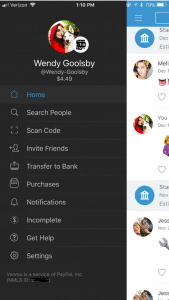
You’re on the Venmo app and you press the three lines on the left hand side. You’re brought to your account options but what do all of these tabs mean?
Home: This is where you can see your friend’s interactions with the app. When on the home tab there is three buttons at the top.
One is an emoji of a world, which will bring you to a list of anyone in the world’s latest interaction with Venmo.
The second option shows two heads, this is where you can see the money you’re friends have been transferring between each other. On this section, it used to show how much people were sending but for security reasons it now just shows that you transferred but with no money total.
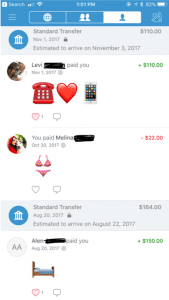
The last button is a picture of single–headed emoji. This shows all of your past transactions and also when you took out money from your bank and when you deposited money back into your bank.
Search People: This is where you can search through your friends for the appropriate person you want to send or receive money from. You have the option to connect to your Facebook so it can inherit your contact list.
Scan Code: Your coworker brings you coffee and asks you to pay them back. You don’t have cash and you’re not friends on Venmo. Instead of searching their name, this tool gives you the option to scan the user’s unique barcode. Both of you have to have the application open at the same time for this to work.
Invite Friends: Your friend isn’t on Venmo? You can input their name, phone number, or email to invite them to join the app.
Transfer Balance: This is where you go when someone has sent you the money but now you need to get it into your bank. It has the option to transfer the money to your previously entered account or to enter a new bank account.
This is also where you will see Venmo’s new interaction to instantly transfer money to your Bank in seconds. This new feature does cost $.25. The standard option (free) is still available but this option takes one to three business days to transfer to your bank account.
Purchases: You can now use Venmo to pay in other apps and on the mobile web with select PayPal merchants.
Venmo does put in their FAQ webpage that if a person purchases a good or service on the internet using Venmo, they will not offer protection. The transactions are potentially high risk and you may lose funds.
Notifications: This is where it will show if you have any pending requests for money or if anyone is requesting money from you.
Incomplete: This will show outstanding requests or payments. There will not disappear until the other user pays your or you pay them.
Get Hep: This brings you to three options and those being “Browse Ours FAQs”, “Contact Us”, or “My Support Tickets” (for any IT help).
How to make a payment or request a payment?
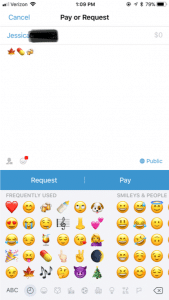
Click on the button in the top right hand corner to pull up your contact page.
Select the friend you want to send money to or request money from. You can also type in the name.
Type the amount for payment.
Add a comment about what the payment is for using words, emojis, or a combination of both (Venmo will not let you skip this step).
Select pay or request money. If you pay, the money is transferred to their account. If you request, your friend receives an email or text and an app notification saying that you requested money.
What are the privacy options?
When you make a payment or receive money from someone it automatically gets added to a live feed. This feed is where you can see your friends and families latest transactions. It will not show the amount transferred but it will show the reason (you can leave the reason blank). It’s common for people to not use words in their description but instead emoji’s.
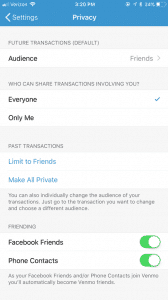
In the Settings menu you can change your audience options to include public (everyone on the Internet), friends (sender, recipient, and their friends), and participants only (sender and recipient only). There is the option to change past transactions viewers as well and make everything completely private.
It also asks where you want your contacts to come from. You can get contacts imported from your Facebook contacts or your phone contacts or both. You have the option to turn both options off and only have friends you add by hand.
What are the risks for use?
A new trend is for sites like Craigslist, Instagram, or Facebook to ask people to buy goods and services and to pay with their Venmo accounts. The company highly discourages this type of transaction but it happens daily. Buying a pair of leggings off an Instagram promoter seems innocent enough, but the real problem is now it’s even easier to buy illegal substances.
Rachael Ferguson did a research project in which she used an application called Whisper, a messaging app that allows users to send and receive messages anonymously, and she had two drug dealers agree to talk to her about their social media influence on the drug market. They explained how easy it is to find drugs on apps like Instagram or Twitter, just buy searching up relevant hashtags. An example of those would be #Kush4Sale or #OGKUSH. If you comment on these posts it’s more likely you’ll caught, so there in underground etiquette of messaging the hastagger privately (Ferguson.)
Besides using social media to buy drugs, there are plenty of other goods and services that can be bought through these apps and that are requesting a payment using Venmo. One man was selling a car on Craigslist, the purchaser claimed he could only pay if he used Venmo. The car dealer watched the other person transfer money and he saw the money come into his bank account. Happily, he signed the car over to the purchaser. 12 hours later, the dealer of the car received an email from Venmo saying the payment had been stopped (Chatman.)
What to watch out for on Venmo.
Users can remain secretive about the actual reason for money transfer. Unless you set your page to private, the public can see your transactions and reason for sending. In the privacy section of a Venmo account, there is the option to set all past transactions to private.
When I asked my friends why they or their other friends are using Venmo, they majority reported that they used it for paying rent, bills, dinner, coffee, drugs and when they were underage they can transfer money to someone 21+ to buy alcohol. This is where the emoji’s come in handy when putting in a description for your money transfer.
Emoji’s and what they mean on Venmo:
Wine/Beer/Cocktail: Alcohol/ booze
Dancing/Celebrate: Party/bar
House: Rent or bills
Car: Uber
Leaf: Marijuana
Needle: Drugs
And there numerous food emoji’s used to indicate that they are paying the person back for food. Fun fact: the pizza emoji is the most popular emoji in Venmo transaction messages (Wener-Fligner.)
What are the protection features?
Venmo’s security page outlines how it will protect you financial information, your account, storage and how it will keep you safe in the long run.
Venmo is an easy app to use, but when the user is a child or a teen, parents should consider discussing with them the risks and how to stay safe. Some things to think about:
Decide if it is the right time for your child to have their own personal bank account or if they are responsible enough to have a Venmo account connected to your bank account.
Discuss with the child when it’s appropriate to send money and when it is not. Set limits and don’t let them send or receive money from strangers.
Consider monitoring their transactions. One way to do this is by making a contract demonstrating their Venmo rules and regulations. Establish an agreement that you can have access to their account anytime.
Create a list of the people they are allowed to transfer money to. If they want to add a new person, they must let you know first. You have the right to remove any person at anytime.
When using a money sharing app, the child should be prepared to be honest and responsible. As parents, instead of banning certain apps all together, make sure your children know what your rules are! Keep a copy of their username and password so you can easily monitor their account. Also, remember this application is not only for your kids! Venmo is super helpful in limiting your cash interactions and providing a safe way to share money with your friends and family.
Thanks GKIS Intern, Wendy Goolsby for keeping us up to date on the latest virtual wallet. Make sure to keep an eye out if your child is attaching credit cards to any sorts of applications. In other teen news, check out the article, Is Your Teen Hooking Up? for ideas about how to support your kids in today’s casual sex environment.
After the Charlottesville violence, Silicon Valley giants, like Facebook, Google, Twitter, Paypal, and GoDaddy, are choking off tech avenues that hate groups use for crowdsourcing, organizing, and funding. This is a reversal of tech companies’ overall “hands off” approach to censorship and raises free speech concerns. In response to the censorship, alt-right organizations are revolting by creating parallel digital services, essentially birthing an alt-right Internet resembling the dark net. Some believe it is the tech companies’ right to cancel accounts that violate their values and membership agreements. Others think a private company using unregulated editorial judgment, with a profound impact on the ability for American citizens to communicate, is overstepping. What do you think?
What does this censorship look like?
Facebook and Twitter have actively suspended the accounts of white supremacists attached to the violence in Charlottesville, like white nationalist Christopher Cantwell and @Millenial_Matt, a social media personality who showcases the Neo-Nazi agenda. Considering that a third of the world’s population has a Facebook account and Twitter boasts 1.6 billion users per month, the power these social media giants wield is substantial.
The 71 million-website host, GoDaddy, has also chosen to censor users who demonstrate hate speech. For example, on Monday GoDaddy delisted the popular Neo-Nazi website The Daily Stormer, after its founder celebrated the murder of Charlottesville counter-protester Heather Heyer. When the Daily Stormer transferred its website registration to Google, Google also cut off the site.
In regard to funding, Paypal stated intent to remove 34 organizations from its customer base who espouse white nationalism. Apple also dropped funding sources for hate groups. GoFundMe, one of the largest crowdsource sites, deleted campaigns for the driver who murdered protesters in Charlottesville (Jan, 2017).
Promoting violent genocide is flat wrong, why are we even having this discussion?
I’m writing this article partly to impart news in case you didn’t hear it, but mostly to challenge you to think through the implications of Silicon Valley giants making decisions about the sharing of information. In this instance, I happen to agree with the policy that threatening violence should not be tolerated by any of us, government, private companies, or American citizens. The Internet spreads ideas like a virus, with hate groups recruiting people with untrue, manipulative, and inflammatory rhetoric. Vulnerable individuals, particularly the mentally ill and children, are at risk for being duped by sophisticated online grooming techniques. Perhaps Silicon Valley CEO’s have a moral obligation to limit their products’ availability as a tool to spread evil. But then there’s this concern…
What if the information they shut down is a cause you believe in? What if some of the censored activists were promoting unpopular ideas rather than threats or violence? What if the man behind the curtain decides to censor the democratic principles key to American freedom? Where does the slope start to get slippery? Should private corporations be making decisions about blocking pedophiles, terrorists, hate groups, and cults or should that be left to the government? Do we still trust a government that secretly surveilles its citizens, like what was revealed by Edward Snowden? Do we still have confidence in elected government leaders who use Twitter to cyberbully those who disagree with them?
“I’m happy to forfeit informational freedom for security”
Have you heard of the Total Information Awareness (TIA) policy? This program was developed in 2003 by the Pentagon under the direction of retired Adm. John Poindexter as a counter-terrorism measure. Under this policy, later renamed to Terrorism Information Awareness, the United States government aimed to integrate private and government intelligence and surveillance programs to be used as a powerful tool for the use of intelligence, counter-intelligence, and law enforcement. Simply put, that means secretly surveilling American citizens to better “detect, classify, and identify potential foreign terrorists” (The Associated Press, 2003).
On its surface, one may think, “Go ahead and track my online activities. It’s worth giving up some freedom for security. I’m not up to anything anyway.” But consider the fact that your personal online information is vast. The scope of the data collected by TIA included, but was not limited to, your browsing history (what you subscribe to, what your read, who you’re friends with, what you “like,” what you don’t like), financial data like purchases, transfers, and deposits, phone, email, and texting content, geolocation data, travel itineraries and passport data, licenses, judicial (driving and divorce) records, medical records, and biological data like fingerprints, DNA, and gait, face, and iris data. With your private information gathered and stored by the US government, your very identity is available to be hacked by any other entity as well. In the wrong hands, your private information could be used toward your personal devastation, whether you’re up to “no good” or not.
Fortunately in the case of TIA, Congress defunded the program after media reports recognized the alarming potential of “the biggest surveillance program in the history of the United States.” Elements of the program were then absorbed by three-letter governmental agencies and are said to be “quietly thriving” at the National Security Agency (NSA) operating with “little accountability or restraint” (Harris, 2012).
Current law requires that suveilling an American citizen or permanent resident is illegal without a court order. The loophole though, is that surveillance is legal if that citizen is communicating with somebody outside of the United States. Don’t worry though, if you were accidentally caught up in the NSA’s surveillance web, your private data is locked securely in a one million square foot facility in the Utah desert. What could possibly go wrong with that?
From Snopes: The film is authentic. “Don’t Be a Sucker” was produced by the U.S. Signal Corps and distributed by Paramount Pictures for viewing in civilian movie theaters in 1943 and again in 1947. This two-minute clip making the Twitter rounds captures the essence of its anti-fascist message:Where do you stand?
Most of us are frogs in the pot, slowly getting used to giving up our digital freedoms to entities like Facebook in order to gluttonously dine on delicious free Internet content. At what point is enough, enough? Will we get concerned when the government oversteps or when private corporations overstep? Or is privacy something that we are willing to give up for safety and security? Maybe we are OK with adult privacy being violated, but what about our kids? If this stirred you up, please comment in the comments below. Or better yet, “like” the GetKidsInternetSafe Facebook page and start up a conversation.
For specific information to discuss with your kids to protect them from hate group and cult recruitment, read this GKIS article.
I’m the mom psychologist who helps you GetKidsInternetSafe.
Are you fighting the homework wars? Wondering if screens during homework are helping or hurting grades? We can’t take screens away during homework time anymore. So much of it is online! Kids insist that tech helps them learn better. But does it? Today’s GKIS article covers who tech can help with learning and how it can interfere.
How We Learn
We have to have a good memory to earn good grades. To learn, we must encode, or anchor, that information into brain memory storage. This type of learning happens as we engage with the material over and over. Memories also encode while we sleep. Changing short-term memories into long-term memories happens through biochemical and electrical processes called consolidation.
Different types of memories store in different parts of the brain. Memorizing factual information (required to perform well on tests) primarily involves the part of the brain called the temporal cortex. Intentionally learning facts is called explicit memory.
Memorizing how to do something, like tie your shoes, is called procedural learning. It is stored in the areas of the brain that involve motor control. This kind of learning is called implicit memory.
Emotional memories (like those that occur in traumatic situations) are stored in multiple brain areas including our emotional center, the amygdala.
Research suggests that kids studying while watching TV may encode that information as procedural rather than factual data. Encoding in the wrong brain region makes fact retrieval at test time more difficult. How and where you study also makes a difference.
How to Facilitate Learning
To learn well, we must start with great brain health, get motivated, set up a good workstation, and follow best learning practices. Are you practicing these learning techniques?
Good self-care, brain health, and cognitive fitness are the foundations of learning engagement (like sleep, nutrition, exercise, and a positive mood)
A distraction-free study environment
Efforts toward mental engagement: attention and motivation
Putting the learning content in a variety of different formats (listening to a lecture, reading notes, writing notes, re-writing notes, watching videos, engaging in discussion, etc.)
Memorizing material in a variety of study environments
Making unique meaning of the material, such as generalizing and applying the concepts, especially with emotional connections
Repetition and practice
Avoid doing two tasks at once that require the same cognitive resources (don’t multitask)
Uninterrupted brain rest after each study session (mindfulness, meditation, time out in nature)
The Benefits of Screen Time for Learning
Screen devices can be amazing learning aids. Not only do they help us put the material in different formats, but they are fun and convenient to use! Here are some of the ways screen time benefits our learning.
With our screen devices, we have immediate, easy access to massive stores of information.
The biohacks built into our devices make learning fun. We are captured and motivated.
Online quizzes and testing help us immediately assess where we are with our learning.
Learning programs dish out progressively challenging content at a pace that matches our performance.
Screens give us access to others for group discussions and crowdsourcing problems.
Screens offer cool and create learning formats, like project management and brain mapping systems.
Gamifying content helps us learn and have fun!
Best Learning Strategies
1. Learn from the get-go.
Don’t waste a moment of studying. Be an active learner the minute you come into contact with the material. Actively engage with the content while you read the textbook, take notes in class, and watch the videos. Participating in class also helps deep processing of the material!
2. Learn while you format study materials.
Outline the text and rewrite and highlight your notes. Attend to and connect the main concepts. Leave out illustrative details so you have only essential material (fewer pages) to memorize.
3. Set the stage to study.
Block out sufficient study time over several days using a block-scheduling download from the Internet. Prepare yourself and your study space to optimize learning. Make sure you are comfortable and fit (fed, hydrated, rested) with a positive attitude about studying. Find a comfortable, non-distracting study location. Turn off your phone and other notifications and commit to studying only, no social media or Internet surfing.
4. Engage with content, don’t kill and drill.
For a student to learn effectively, they must engage with the content and integrate it into a meaningful framework. Students often make the mistake of mindlessly rehearsing isolated facts, thinking time spent is evidence of learning. Kill and drill is a waste of time and mind-numbingly punishing. Deeply processing information is the best way to learn.
5. Create learning pathways.
Each time we encode a fact into the hippocampal area (memory center) of our brain, we create a learning pathway to that content that can later be traveled for retrieval at test time. Increasing the number of pathways to that encoded fact is the process of effective learning.
In items 2 and 3 of this list, you already paved the initial pathways! The first pathways include when you listened to the lecture, wrote notes, read the textbook, answered the teacher’s questions, and formatted study materials.
To pave additional pathways to test content, find creative ways to further engage with and elaborate on the material while you study. The more emotionally and cognitively meaningful the material is for you, the easier it will be to learn. For example, use the Internet to view the study material in a variety of vivid formats, such as illustrative maps, diagrams, pictures, speeches, or videos. Link the information to emotionally meaningful memories or associated topics. Study from a variety of locations. Form a study group and talk with others about the content.
6. Rehearse the information and practice retrieving it and applying it just like you would at test time.
If the test is multiple-choice, make up questions that would lead to memorized facts. If the test is an essay, practice outlining and writing essays on that material.
7. Study small chunks of material at a time over several days, eventually linking the chunks together.
Don’t cram at the last minute. Your brain needs time to deeply process newly learned material. It will even process when you’re not actively studying, even in your sleep! That means it’s best to learn and rehearse chunks of material over several days. By test time, the chunks will come together for easy, A+ retrieval.
Fostering the love of learning is the best thing we can do with our kids, that means helping them learn better and achieve a healthy balance on- and off-screen. For more learning tips, view my free video, “How to Study Effectively: Metacognition in Action.”
I’m the mom psychologist who will help you GetYourKidsInternetSafe.
PLEASE SHARE OUR GKIS VIDEO by clicking on the share buttons on the left 🙂
Did you know that the prefrontal region of the brain, the part that involves impulsivity, complex reasoning, and problem solving, doesn’t fully mature until we are 23 years old? This is why kids don’t recognize future consequence and make unwise decisions.
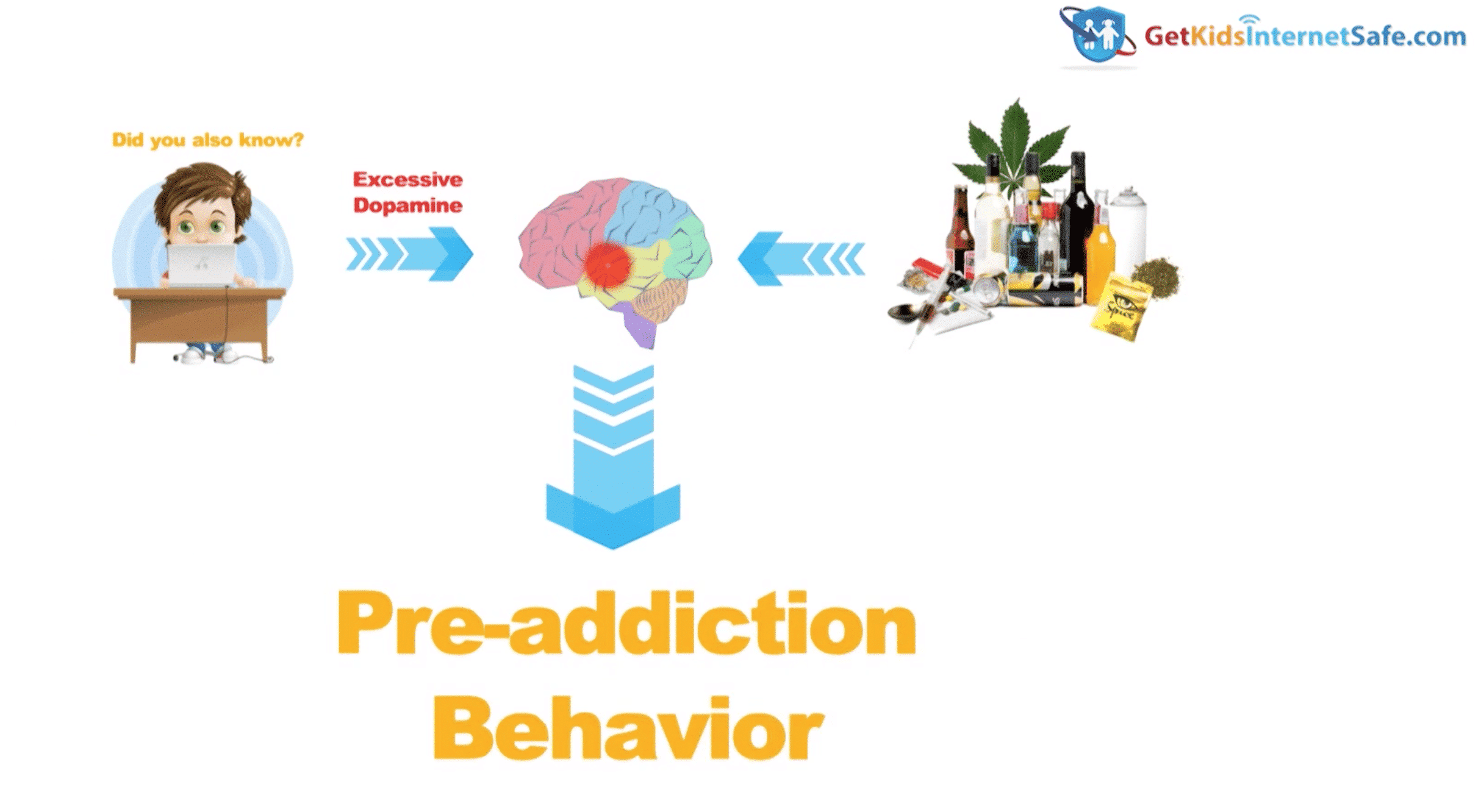
Did you also know that screen media may lead to excessive dopamine in the pleasure center of the brain in a similar way that all drugs of addiction do? That means some kids drift into pre-addiction behavior patterns, like “flow,” when video gaming or using social media.
Although every child’s different, boys tend to prefer gaming and girls tend to prefer social media.
Surging dopamine in the pleasure center quickly overpowers an immature frontal lobe. That means our kids need us to guide them well into what we consider “adulthood.”