Need peaceful screen time negotiations?

Get your FREE GKIS Connected Family Screen Agreement

algorithms

The Psychology and Marketing Behind Online Tarot Reading

If your child has inquired about buying a deck of cards, candles, or pendulums, they might be showing interest in tarot! Tarot reading is a New Age practice that has acted as a spiritual guide and coping mechanism for many people. In the previous article on online astrology, we shed light on what astrology is, the marketing tactics behind it, and the psychological perspectives that relate to it. In today’s part two, this article covers tarot reading, testimony, common misconceptions, and red flags to be wary of.

What is tarot reading?

Tarot reading involves the process of picking cards, finding a common ground between the cards, and relating it to everyday life. Today’s tarot deck consists of 78 cards and are divided into two groups— the major arcana (22) and the minor arcana (56).[1] Similar to standard playing cards, tarot cards contain different suits and are used for different purposes (e.g., questions about spirituality, love, and finances).

I am not savvy in the world of tarot reading, so I interviewed someone who has used tarot in their life for over 20 years. For privacy purposes, I will refer to this person as “Hope.” Hope is not a professional tarot reader, but it is clear that her connection to tarot has merit. Hope deepened my understanding of tarot reading, as well as offered insight on misconceptions and red flags.

Tarot and Testimony

When asked about tarot reading and its massive trend across social media platforms, Hope stressed the importance of using caution and common sense, as fast information isn’t the best way to learn or receive information. During a time of chaos, people are looking for ways to cope and can easily be exploited. As discussed in the previous article on online astrology, horoscopes and tarot readings can work for you (positive effect) or work against you (negative effect).

Depending on the reading, children may succumb to high expectations or disappointment. Even when cautioned, kids simply don’t have the brain wiring or experience to anticipate all possible outcomes. They tend to lead with innocence and trust rather than cynicism and caution.

Hope recommends seeking tarot readers that have lineage through family members or those who have been taught by a reputable leader. Training, experience, and compassion should come together in a trustworthy tarot reader (as interpretations are also different among readers).

Common Misconceptions

Hope emphasized, “Tarot reading is not fortune-telling, rather, it’s about the reader interpreting the cards, breaking down its psychological symbols of the tarot, and applying it to everyday life.” It is meant to act as a guide, providing more open-ended questions than answers. Tarot also provides a different perspective, just as any other New Age practice such as meditation or yoga.

At face value, a tarot reading can come off very woo-woo, meaning unconventional beliefs concerning spirituality that typically do not have scientific proof. Hope explained that rituals can be meaningful by creating structure, providing creative, enriching support, and helping people move through the cycles of their life. Despite the crystal ball portrayals and witch-like stereotypes, tarot has evidently become more mainstream in the new age.

Red Flags

Hope advises beginners to “take what resonates and leave the rest.” Tarot is a tool that one can include in their toolkit of life, but it should not negate the power that someone has over their own life. Tarot is meant to be insightful, not harmful; she emphasized this by using a paywall as an example. “If someone tells you you’re going to have bad things happen to you unless you pay them $200, exit the door immediately.” A safe online experience with tarot reading should include keeping a sense of humor, as well as an open mind and sensible assessment.

Tarot Reading is Trending   

Tarot Reading is trending on platforms, most notably TikTok. With a total of 913.4 million views, the hashtag #tarotreading has become a daily affirmation among TikTok users. Your child may seemingly come across this content by chance, but that is not always true. TikTok offers content to users using computer-generated algorithms (formulas) to lead their users to content in their “For You” feature. As a supportive parent, it may be helpful to acquaint yourself with accounts that are age-appropriate for your child to ensure a healthy online experience.

Elementually is a well-known mother-daughter duo with a following of 1.2 million users. Elementually offers multiple daily affirmations through tarot cards, pendulums, crystals, and dice. I investigated this account and found their page to be appropriate for users of all ages. Not only do they offer daily card affirmations, but they are interactive with their following. Comments are selected from posts, and answers are given based on pendulum and dice outcomes. This duo also offers free tarot card readings, while other influencers charge anywhere between $10-30.

Tarot and Algorithms

The biggest concern over any online experience includes algorithms. Algorithms take your personal data and utilize it for marketing purposes. An important term to become acquainted with is bait engagement. Bait engagement involves a call to action to the user (usually to provoke likes, comments, or shares), but in reality, it boosts the posts in favor of the algorithms. With regards to tarot reading (or any other subject), bait engagement may sound like “like/comment/share this post to claim your reading.” While it may give the user some peace of mind that they are acknowledging and accepting their daily affirmation/refutation, children must also recognize when they are being manipulated to act and perhaps even exploited for profit.

Online tarot reading may not be completely exclusive, as the algorithms within the “For You” feature expose the user to content they predict is favorable. Children must acknowledge hashtags and understand that it may not be a coincidence. As Hope said earlier in her interview, the user is ultimately the one in control. While it may be comforting to connect with a public reading, online tarot readers on TikTok typically post multiple times a day. Depending on the post your child comes across, they must consider algorithms when receiving their daily card or reading.

GKIS Tips for Online Safety

If your child chooses to incorporate tarot reading as a tool on their spiritual journey, GKIS is here to offer our Screen Safety Toolkit to ensure a safe online experience. Features of our toolkit include links and information about parental controls, filtering and blocking for safe browsing, and social media monitoring to help keep your children internet safe. To further expand your tween’s or teen’s knowledge of digital injuries, GKIS also offers a Social Media Readiness Course. Encouraging autonomy and accountability, this course equips youth with 10 social media lessons, mastery quizzes, and Dr. B’s psychological wellness techniques to help prevent digital injury.


Thanks to CSUCI intern Kaylen Sanchez for researching online tarot reading for this GKIS article.

I’m the mom psychologist who will help you GetKidsInternetSafe.

Onward to More Awesome Parenting,

Tracy S. Bennett, Ph.D.
Mom, Clinical Psychologist, CSUCI Adjunct Faculty
GetKidsInternetSafe.com

Photo Credits

Photo by Lucas Pezeta from Pexels

Photo by Viva Luna Studios on Unsplash

Photo by Alina Vilchenko from Pexels

Photo by J. Kelly Brito on Unsplash


Works Cited

[1] https://www.britannica.com/topic/tarot

Parler the Free Speech App

Parler is a social network platform that has recently become popular due to public outrage over big tech censorship. Controversy swirls as to whether a powerful private entity, like Facebook or Twitter, should have the power to alter public access to information. Should it be up to the reader to determine the accuracy of information or is the proliferation of fake news into our news cycle a danger to us as individuals and to our democracy – thus making censorship necessary? In this article, we will be showing you why Parler appeals to certain users, the perceived benefits and potential dangers of the app, and why GKIS recommends that children not be allowed access.

Nearly the whole world relies on social media to market their business, get the news, network, or stay connected with friends and family. But recently it has been brought to light that social media platforms shadowban content that violates their terms of service. Shadowbanning is when a social media platform blocks a user’s content without notifying the user. So, instead of understanding their content has been blocked, the user believes that nobody is engaging with their content when in reality it cannot be seen or has been obscured to other users.

Some users who have experienced their content being taken down or shadowbanned by social media apps like Facebook and Twitter believe that it is a violation of their constitutional first amendment right to free speech and accuse big tech of politically-motivated censoring. In response, many have decided to jump ship and go to other apps known to be against censorship like Parler. Parler has become one of the most downloaded apps after Twitter flagged some of former President Donald Trump’s tweets.

What is Parler?

Parler is a social network platform that is similar to Twitter. It was founded by John Matze and Jared Thompson based out of Henderson, Nevada. The social media platform describes itself as a “free-speech platform” focused on protecting users’ rights. The content is focused on real user experiences and engagement without censorship, except for obscenity and pornographic material.

The guidelines on the platform state that the company aims to “uphold the rights of free speech according to the U.S. Constitution.” But many are criticizing it for being a far-right social media platform and calling Parler names such as Meinspace, Hicktock, and Fashbook.

Who is joining Parler?

The majority of Parler users have a more conservative ideology who joined during the 2020 presidential election when Twitter’s algorithms censored a New York Post story involving files and emails reportedly taken from Hunter Biden’s laptop. When Republican Senators questioned Jack Dorsey, the CEO of Twitter, about the censorship, he replied that it was a “mistake” and that Twitter policies would be amended. In response, conservatives claimed that the algorithms favored liberal news and unfairly targeted conservative content.

Many Saudi’s have also have left Twitter and joined Parler in response to news stating that several Twitter employees were charged by the U.S. Department of Justice for spying for Saudi Arabia. According to court papers, one of the people implicated in this scheme is an associate of the Saudi Crown Prince Mohammed Bin Salman who the CIA has concluded made the order of assassinating the journalist Jamal Khashoggi. Saudis feel that Twitter is protecting the Saudi government by spying on users that do not agree with the government.

Many non-political people also use the platform such as athletes, business owners, and people that just want fewer rules and a platform that welcomes all political views.

How do you sign up for Parler?

To sign up, go to the Parler website or download the app and submit your email address and phone number to confirm your identity. Agree to their terms of service and privacy rights and community guidelines. If you want to comment on user posts, verify your identity by taking a picture of a valid identification document such as a driver’s license or passport and a selfie and send it in.

 How Parler Works

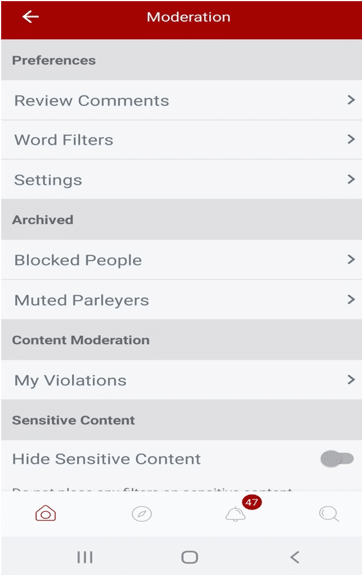
Users can moderate what kind of content they’d like to see as well as block or mute users. Additional features include entering word filters associated with content that you’d not like to see and the option to view your comments before anyone else can see them. Parler also has Community Guidelines violation points which allow a warning (20 points) prior to losing your Parler account.

In the main feed, there are different terms for certain content. For example, a parley is a post and an echo is a re-post similar to a retweet. Votes are similar to likes or dislikes. Parleys can only be upvoted and comments can either be upvoted or downvoted.

Despite Parler being credited as a free speech platform, users cannot post:

  • Terrorist threats or threats
  • Trolling
  • Spam
  • Pornography
  • Slander
  • Blackmail
  • Plagiarism
  • Bribery
  • Copyright infringement
  • Doxing
  • Impersonation
  • Libel
  • Obscenity

Privacy

Users can make an account public or private. You can also select an option where the only email you’ll receive from Parler is to inform you of critical updates.

How Hashtags Work on Parler

Parler is hashtag heavy. To search for content or post content, a user needs to be precise with hashtags and usernames more so than other social media platforms. This means that exact hashtags or usernames must be typed in with no spaces.  Parler’s algorithms only search for usernames and hashtags. Twitter, on the other hand, uses all kinds of algorithms that search for more vague keywords. Their algorithms also curate a person’s feed to suit their interests in order to keep a user scrolling. Parler does not do this. Users that do not like an algorithm to decide what should be on the top of their newsfeed may prefer an app like Parler.

Is Parler appropriate for minors?

 GKIS rates Parler as a red light app for kids and teens due to the commonality of extreme views and lack of censorship. For example, far-right groups like the Proud Boys post about destroying Antifa and promoting civil war. We at GKIS recognize that young people are particularly vulnerable to believing conspiracy theories and may become radicalized by extreme content. Kids on Parler may also be at risk for exploitation and abuse.

For more information on how to keep you and your tweens and teens safer on social media, check out our Social Media Readiness Course. It’s like driver’s training except for the internet!

Thank you to CSUCI intern Andres Thunstrom for co-authoring this article.
I’m the mom psychologist who will help you GetKidsInternetSafe.
Onward to More Awesome Parenting,

Tracy S. Bennett, Ph.D.
Mom, Clinical Psychologist, CSUCI Adjunct Faculty
GetKidsInternetSafe.com

Photo Credits

Photo by Pixabay
Photo by Andres Thunstrom

Works Cited

 Conger, K (2019, November 6) Former Twitter Employees Charged with Spying for Saudi Arabia https://www.nytimes.com/2019/11/06/technology/twitter-saudi-arabia-spies.html

Cullford, E (2019, June 13) Unhappy with Twitter, thousands of Saudis join pro-Trump network Parler https://www.reuters.com/article/us-twitter-saudi-politics-idUSKCN1TE32S

Molina, B. (2018, July 27). Shadow Banning: What Is It, and Why Is Trump Talking about in on Twitter. www.usatoday.com/story/tech/nation-now/2018/07/26/shadow-banning-what-and-why-trump-talking-twitter/842368002/.

Weiss, S (2020, November 23) Ivanka Trump’s New Favorite Social Platform is Dangerous for Kids https://www.sheknows.com/parenting/articles/2374446/parler-dangerous-kids-social-media/