“I can’t breathe, and my chest is killing me. My heart is racing. Am I having a heart attack? I am sweating, trembling, and dizzy. I think I’m going to vomit. My thoughts are racing. Have I gone crazy? What is wrong with me?” If this sounds familiar, you are probably one of three adults in the U.S. who has had an anxiety attack. Screens can have a significant effect on our levels of anxiety, but how?
What is anxiety?
In my 25+ years of clinical practice, I have treated many kids, teens, and adults with anxiety disorders. Since the advent of mobile screen technology, we have seen prevalence numbers increase dramatically. Twenty-five percent of 13- to 18-year-olds have mild to moderate anxiety with the median age of onset at 11 years old.[1]
There are five major types of anxiety disorder.
Generalized Anxiety Disorder(GAD) is characterized by chronic worry about things that don’t warrant that level of concern.
Obsessive-Compulsive Disorder (OCD) is characterized by recurrent, intrusive thoughts and repetitive ritualistic behaviors, like counting, tapping, washing, or checking.
Panic Disorder (PD) is a chronic dread of having a panic attack, which feels like intense fear and trouble breathing, heart racing, and dizziness.
Post-Traumatic Stress Disorder(PTSD) is typically triggered by a terrifying ordeal.
Social Phobia (SP) causes people to withdraw due to extreme self-consciousness or embarrassment around others and a fear of being scrutinized or judged.
How Screens Can Trigger Clinical Anxiety Symptoms
Generalized Anxiety Disorder
Screens can be distracting and lead to wasted time and poor work performance. Not only do kids worry about those missed assignments, but too many hours of online learning can put them in a state of irritable exhaustion. In Dr. Bennett’s book, Screen Time in the Mean Time, she details how multitasking, which refers to interrupting one task to attend to another (like social media notifications during homework), burns brain fuel at a rapid rate – leading to mental brownout.[2] Mental brownout can lead one to feel hopeless and helpless, which can lead to chronic worry about … just about everything.
Obsessive-Compulsive Disorder
Keeping up with the Jones’s (or Kardashian’s) on social media can lead to obsessive scrolling and compulsive checking. We’ve all seen the notorious #GymSelfie or #FoodPorn that pops up on our news feed. Then there’s the #OutfitOfTheDay, #MCM (man crush Monday), #WCW (woman crush Wednesday), or your #TBT (throwback Thursday). Keeping up can feel overwhelming.
As Dr. B says in her article “Teaching Kids the Brain Traps of Video Games May Break the Spell,” “likes” are designed to tap into our evolutionarily-reinforced need to please our tribe – also called social capital. She elaborates, “When that notification pops up on our smartphone that somebody liked our post, we get a slight euphoria.”
Getting the likes makes us want more (compulsive use patterns), and not getting the likes can send us into compare and despair. Big tech is aware of this and plays on our psychology to keep our eyes on the screen. Our attention has been commodified (meaning that data about our online behaviors is for sale because it has value to marketers). The more we stay on screen, the more we fall victim to ads and the compulsion to buy.
Panic Disorder
Panic attacks happen when the autonomic nervous system, our survival center, gets triggered too easily. Poor self-care (like not sleeping, eating well, exercising, or socializing) can make us vulnerable having panic attacks. Dr. B says video games are also programmed to jack up your autonomic nervous system, which can lead to panic attacks.
Post-Traumatic Stress Disorder
In our GKIS article, “Live Streaming Can Cause PTSD in Adults and Children,” we detailed how watching live-streamed videos on social media and Youtube can lead to debilitating trauma symptoms. It’s critical to consider that screen content matters as much as, if not more than, screen time.
Social Phobia
It doesn’t take much imagination to consider that social media can lead to fear of excessive social scrutiny. Dr. B writes about the normal adolescent defense called the imaginary audience. She writes, “Teens can become extremely focused on their looks and very self-conscious, convinced that EVERYBODY is looking at them. As a result, they pay meticulous attention to clothing, makeup, hairstyle, body shape, and mannerisms. It’s as if they are carefully cultivating their brand to fit in and stand out among admired peers. Although imaginary audience has been observed among adolescents throughout history, social media may exacerbate anxiety. I believe compulsive urges to take perfect selfies are a healthy expression of the imaginary audience rather than the pathology of narcissism.”
It didn’t happen if you didn’t post it.
There is a popular saying that if you didn’t post about it, it didn’t really happen. Many teens are more invested in their virtual lives than they are in their non-virtual lives. This makes sense considering they spend more waking time on screen than they do off-screen!
Teen life often happens in a snapshot and not much else. Our kids are spending time at events, the beach, and vacation looking for that split moment to capture a picture guaranteeing them likes from their followers. Conversations are “Uh-huh” and “Mm, sure” without eye contact. Screen time is the master, and we’ve grown to accept that that is “just what teens do these days.”
Social media can become a shrine of a person’s life, and if it is subpar, that person’s life seems subpar. Sound extreme? It is, and it is real. The pressure to be perceived in a certain way can consume our minds and impact self-esteem. A Canadian study found that the more time spent on screens, the higher the risk of developing anxiety in children.[3] Screen addiction is proving to be a real concern rather than a minor annoyance.
Driven to Distraction
Anxiety has the potential to impact not only the quality of time spent with family and friends but may also sever the most important relationship of all, the one with ourselves. Self-worth goes down, anxiety shifts to depression, and all because we judge others and ourselves through the safety of a screen, hidden in anonymity, and supported by strangers.
It can happen to anybody.
A child therapist friend of mine shared with me that she recently deleted all social media apps off her phone. She said she felt social media was consuming her and ultimately the cause of a lot of anxieties. Between clients, she browsed Facebook and Instagram instead of doing her mandatory briefings. Her briefings would get stacked up for weeks. Ultimately, this would contribute to her unease. This is a professional in mental health, one whom we would like to think could find a good balance. Now imagine your teenager…
What can we do about it?
Identify the triggers and recognize that you may be powerless against them without cutting down on screen time.
Set reasonable parameters.
Use time management and blocking apps.
Learn cognitive behavioral coping skills like breathing, mindfulness, cognitive restructuring, and meditation
Make your nonvirtual life more enriching
Thank you to Chad Flores for helping us recognize how screens may contribute to anxiety.
[3] Maras, D., Flament, M. F., Murray, M., Buchholz, A., Henderson, K. A., Obeid, N., & Goldfield, G. S. (2015). Screen time is associated with depression and anxiety in Canadian youth. Preventive Medicine: An International Journal Devoted To Practice And Theory, 73133-138. doi:10.1016/j.ypmed.2015.01.029
If your child has inquired about buying a deck of cards, candles, or pendulums, they might be showing interest in tarot! Tarot reading is a New Age practice that has acted as a spiritual guide and coping mechanism for many people. In the previous article on online astrology, we shed light on what astrology is, the marketing tactics behind it, and the psychological perspectives that relate to it. In today’s part two, this article covers tarot reading, testimony, common misconceptions, and red flags to be wary of.
What is tarot reading?
Tarot reading involves the process of picking cards, finding a common ground between the cards, and relating it to everyday life. Today’s tarot deck consists of 78 cards and are divided into two groups— the major arcana (22) and the minor arcana (56).[1] Similar to standard playing cards, tarot cards contain different suits and are used for different purposes (e.g., questions about spirituality, love, and finances).
I am not savvy in the world of tarot reading, so I interviewed someone who has used tarot in their life for over 20 years. For privacy purposes, I will refer to this person as “Hope.” Hope is not a professional tarot reader, but it is clear that her connection to tarot has merit. Hope deepened my understanding of tarot reading, as well as offered insight on misconceptions and red flags.
Tarot and Testimony
When asked about tarot reading and its massive trend across social media platforms, Hope stressed the importance of using caution and common sense, as fast information isn’t the best way to learn or receive information. During a time of chaos, people are looking for ways to cope and can easily be exploited. As discussed in the previous article on online astrology, horoscopes and tarot readings can work for you (positive effect) or work against you (negative effect).
Depending on the reading, children may succumb to high expectations or disappointment. Even when cautioned, kids simply don’t have the brain wiring or experience to anticipate all possible outcomes. They tend to lead with innocence and trust rather than cynicism and caution.
Hope recommends seeking tarot readers that have lineage through family members or those who have been taught by a reputable leader. Training, experience, and compassion should come together in a trustworthy tarot reader (as interpretations are also different among readers).
Common Misconceptions
Hope emphasized, “Tarot reading is not fortune-telling, rather, it’s about the reader interpreting the cards, breaking down its psychological symbols of the tarot, and applying it to everyday life.” It is meant to act as a guide, providing more open-ended questions than answers. Tarot also provides a different perspective, just as any other New Age practice such as meditation or yoga.
At face value, a tarot reading can come off very woo-woo, meaning unconventional beliefs concerning spirituality that typically do not have scientific proof. Hope explained that rituals can be meaningful by creating structure, providing creative, enriching support, and helping people move through the cycles of their life. Despite the crystal ball portrayals and witch-like stereotypes, tarot has evidently become more mainstream in the new age.
Red Flags
Hope advises beginners to “take what resonates and leave the rest.” Tarot is a tool that one can include in their toolkit of life, but it should not negate the power that someone has over their own life. Tarot is meant to be insightful, not harmful; she emphasized this by using a paywall as an example. “If someone tells you you’re going to have bad things happen to you unless you pay them $200, exit the door immediately.” A safe online experience with tarot reading should include keeping a sense of humor, as well as an open mind and sensible assessment.
Tarot Reading is Trending
Tarot Reading is trending on platforms, most notably TikTok. With a total of 913.4 million views, the hashtag #tarotreading has become a daily affirmation among TikTok users. Your child may seemingly come across this content by chance, but that is not always true. TikTok offers content to users using computer-generated algorithms (formulas) to lead their users to content in their “For You” feature. As a supportive parent, it may be helpful to acquaint yourself with accounts that are age-appropriate for your child to ensure a healthy online experience.
Elementually is a well-known mother-daughter duo with a following of 1.2 million users. Elementually offers multiple daily affirmations through tarot cards, pendulums, crystals, and dice. I investigated this account and found their page to be appropriate for users of all ages. Not only do they offer daily card affirmations, but they are interactive with their following. Comments are selected from posts, and answers are given based on pendulum and dice outcomes. This duo also offers free tarot card readings, while other influencers charge anywhere between $10-30.
Tarot and Algorithms
The biggest concern over any online experience includes algorithms. Algorithms take your personal data and utilize it for marketing purposes. An important term to become acquainted with is bait engagement. Bait engagement involves a call to action to the user (usually to provoke likes, comments, or shares), but in reality, it boosts the posts in favor of the algorithms. With regards to tarot reading (or any other subject), bait engagement may sound like “like/comment/share this post to claim your reading.” While it may give the user some peace of mind that they are acknowledging and accepting their daily affirmation/refutation, children must also recognize when they are being manipulated to act and perhaps even exploited for profit.
Online tarot reading may not be completely exclusive, as the algorithms within the “For You” feature expose the user to content they predict is favorable. Children must acknowledge hashtags and understand that it may not be a coincidence. As Hope said earlier in her interview, the user is ultimately the one in control. While it may be comforting to connect with a public reading, online tarot readers on TikTok typically post multiple times a day. Depending on the post your child comes across, they must consider algorithms when receiving their daily card or reading.
GKIS Tips for Online Safety
If your child chooses to incorporate tarot reading as a tool on their spiritual journey, GKIS is here to offer our Screen Safety Toolkit to ensure a safe online experience. Features of our toolkit include links and information about parental controls, filtering and blocking for safe browsing, and social media monitoring to help keep your children internet safe. To further expand your tween’s or teen’s knowledge of digital injuries, GKIS also offers a Social Media Readiness Course. Encouraging autonomy and accountability, this course equips youth with 10 social media lessons, mastery quizzes, and Dr. B’s psychological wellness techniques to help prevent digital injury.
Thanks to CSUCI intern Kaylen Sanchez for researching online tarot reading for this GKIS article.
I’m the mom psychologist who will help you GetKidsInternetSafe.
In 2014, the Founder of GetKidsInternetSafe Dr. Tracy Bennett wrote an article on artificial intelligence (AI) facial recognition and the potential dangers associated with such technology. Fast-forward 6 years to 2020 and many of her predictions have proven true plus more than could have been anticipated. AI facial recognition has boomed to an extent that many companies are using our social media data to increase profits. Big tech is willing to do to capitalize on us, even if it is not in our best interest. For a glimpse into the scary future possibilities of privacy invasion and trampling on our civil rights, check out what’s happening in China in today’s GKIS article.
Artificial intelligence (AI) facial recognition has come a long way in the past few years especially since engineers have been using artificial neural networks. These neural networks are similar to an actual human brain. They consist of a connection of nodes called artificial neurons and can transmit a signal to other nodes. Once a node receives a signal, it can process the signal and relay the information to the other nodes connected to it. When it comes to neural networks, a person can input any type of information. In face recognition technology, an image of the face is entered. AI marks each feature as a nodal point, collecting more data with each image.
Facebook uses neural networks and processes over 350 million new pictures daily. Amazon also has a service called recognition where customers can pay to acquire Clearview AI is a controversial service that many in Silicon Valley have opposed due to implications on privacy. Clearview AI searches social media platforms and has acquired over 3 billion pictures in their inventory. When someone searching Clearview gets a match, they get data AND a link to the social media accounts where the facial data was acquired. Many have concerns that this takes the privacy breach a step further.
Beneficial Ways Facial Intelligence is Being Used
AI has led to the recovery of many missing children that have been sex trafficked or sexually exploited.
Taylor Swift’s security team used facial recognition at her concerts to see if any of her stalkers were in the audience.
Law enforcement uses AI to identify people that cannot identify themselves, like people with severe mental illnesses, people high on drugs, or people that are refusing to identify themselves. With a three-minute turnaround time, law enforcement is saving a ton of money and time so they can focus on other crimes.
Controversial Ways Facial Intelligence is Being Used
A man seen stealing beer at a CVS in New York City looked a lot like Woody Harrelson. The police entered a picture of Woody Harrelson into facial recognition technology and found a match. Although police were able to locate and apprehend the suspect, this technology could implicate the wrong person with similar facial geometry.
People of color are more likely to be misidentified due to AI facial recognition not being as good at differentiating people with darker skin.
The government could enable continued surveillance of certain individuals like they are doing in China. China uses facial recognition to follow Uighurs, a largely Muslim minority, as well as monitor all Chinese citizens using a social credit score.
Dystopian Surveillance
AI advancements worry people due to fear of one day living in a dystopian surveillance taped society. Having this type of society would mean that all citizens would be tracked, and privacy would cease to exist. One might think that with the civil rights protections in the United States we are not at risk. I wonder if Chinese citizens have concerns…
China has more AI facial recognition CCTV cameras than any other country in the world and is a prime example of dystopian surveillance. The Chinese government claims to use AI to lower crime and increase prosocial behavior using a social credit system by a company called Sesame Credit. They contend that this system encourages citizens to behave in a socially appropriate manner and if someone is a good citizen, then they have nothing to hide and the cameras should not be a concern.
Specifically, using Sesame Credit in China, if a Chinese citizen is caught on camera doing anything that is not considered “socially appropriate” like jaywalking, littering, smoking, or buying too much alcohol or too many video games, their social credit score will decrease. A low social credit score may result in the inability to purchase airline or train tickets or book at certain hotels, or they may be barred from certain schools and jobs. Citizens can also have their dog taken away if it isn’t walked on a leash or is a public disturbance. It is also mandatory for blacklisted citizens to register to a public blacklist which typically results in social stigmatization. Parent scores can affect other family members, like preventing kids from being accepted to private schools. Public shaming is a big part of the social credit system. Pictures of blacklisted and low scoring citizens are shown on TikTok, pictures and videos with names play on public LED screens, and addresses are shown on a map on WeChat.
People with good social credit scores appreciate the system since they get rewarded. Perks consist of discounts on hotels, entertainment, and energy bills and one can rent bikes without a deposit. High scorers also get into better schools and get access to better jobs. Users on dating apps are required to put in their social credit score; good scores get more dates.
Ways Citizens Can Raise Their Scores
Donating to college funds for poor students
Caring for elderly or disabled people
Repaying a loan even if the bank canceled it
How the United States is Implementing Social Credit
The U.S. has not implemented AI as comprehensively as China. However, it is used in some industries. For example, life insurance companies in New York are allowed to look at a person’s public social media account to see if they are engaging in risky behavior. They base a person’s premium on what they find. In fact, a 2020 survey found that 98% of professionals do a background check on new hires and 79% disqualified a job candidate due to unfavorable social media content.
There is also a company called PatronScan which was designed to help restaurants and bars manage customers. It can help spot fake IDs and troublemakers by scanning an ID upon entry. A public list is shown for all PatronScan customers. The problem is that judgment about what constitutes a “troublemaker” is subjected and may result in an unfair listing without the owner’s consent.
Rideshares like Uber and Lyft have reviews for both drivers and riders that may result in a customer being refused a ride. Airbnb also works by reviewing both hosts and renters. Many hosts refuse to rent to certain people based on their past reviews, and many hosts may not be booked based on renter reviews.
China is a prime example of the dangers of AI facial recognition and how it can affect our privacy and freedoms. There is not yet much legislation preventing AI from being used in the United States and there’s a need to push for it. Like the frog in the pot, people adapt so willingly to advancing technology that it’s difficult to recognize possible consequences.
For information and safety tips about how to keep you and your family safe, we highly recommend Dr. B’s Cybersecurity and Red Flags supplement. In an age where technology is advancing at such a fast rate, it is important to keep you and your family informed on current technological risks and how to prevent them.
Thank you to CSUCI intern Andres Thunstrom for co-authoring this article.
I’m the mom psychologist who will help you GetKidsInternetSafe.
Meeting people online can be fun and exciting, especially for teens. However, there are risks. If you want to prepare your child for these risks, check out the GKIS Social Media Readiness Course. You may have heard of popular adult dating apps likeTinder or Bumble. In this GKIS article, we cover 5 dating apps that are popularly used by teens that you probably have never heard of.
Yubo
Yubo is a location-based social networking app advertised for making new friends, but many people describe it as a dating app for teens.
This app contains many features such as:
Stream: share live stream videos with friends.
Chat: chat with friends and other app users.
Swipe: discover new friends nearby or around the world.
Find a community: connect with people who have the same interests by finding a community. The online communities range from art and sports to LGBTQ+.
Play: play games with friends like Q&A, Would You Rather and Let Them Guess.
Yubo’s age rating is 17+, but there is no age verification for this app, meaning any teen can use it and lie about their birthday.
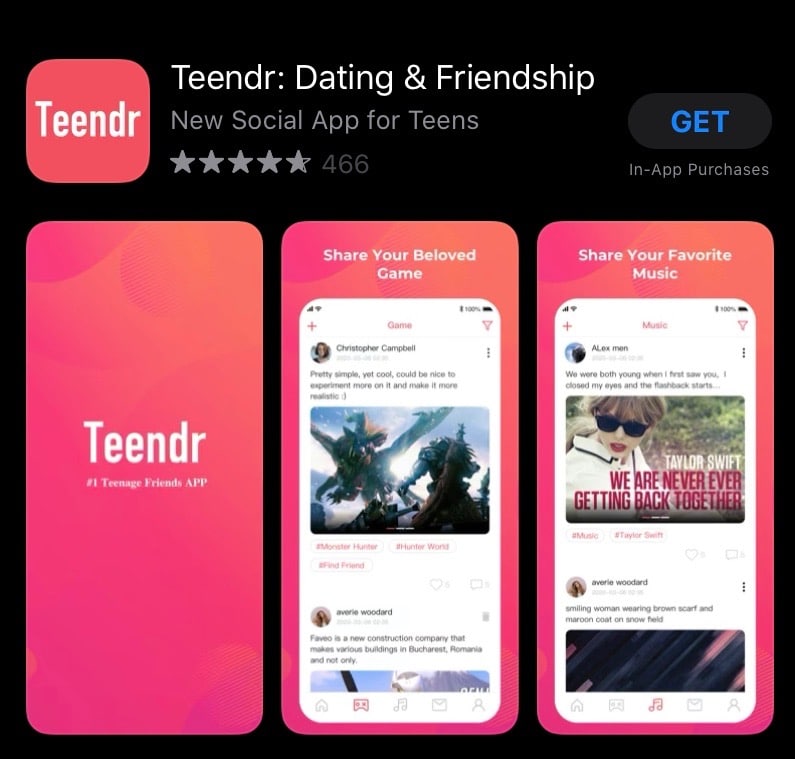
Teendr
Teendr is marketed as a dating app for teens. On this app, users can meet and chat with new friends nearby based on their common interests like music, games, and more.
This app contains:
Unlimited swipe: swipe right to meet new people or left to ignore.
Search nearby: discover matches based on location.
Game & music sharing: meet people based on their gaming and music preferences, which they can share on the app.
Teendr is also rated 17+, with no age verification.
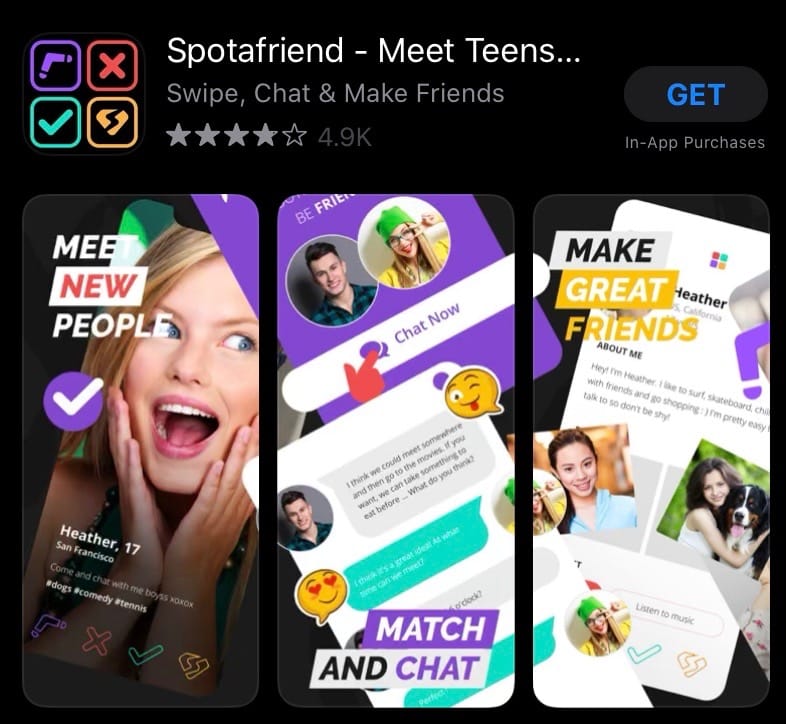
Spotafriend
Spotafriend is an app designed for teens to meet new people in their proximity. On the app store, it is described as “not a teen dating app,” but that’s what many teens are using it for.
Spotafriend includes:
Swipe: swipe right to become friends with someone.
Chat: chat privately when you get a match.
Spotafriend is rated 17+, but it is designed for ages 13-19.
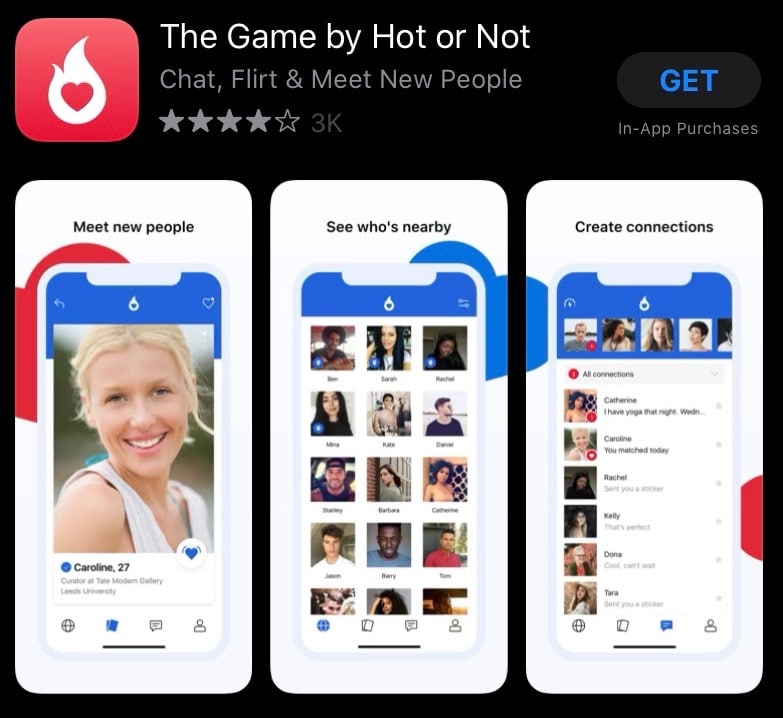
The Game by Hot or Not
The Game by Hot or Not is another app that allows teens to meet people in their area. It is marketed as an app to find the ‘hottest’ people nearby.
This app includes:
Ratings: rate each other’s attractiveness by tapping a heart on your profiles.
Direct messages: Users who match (by liking each other’s profiles) can exchange messages.
Location services: find people in your proximity.
Age: Hot or Not was originally rated 17+, but is now 18+ with no age verification.
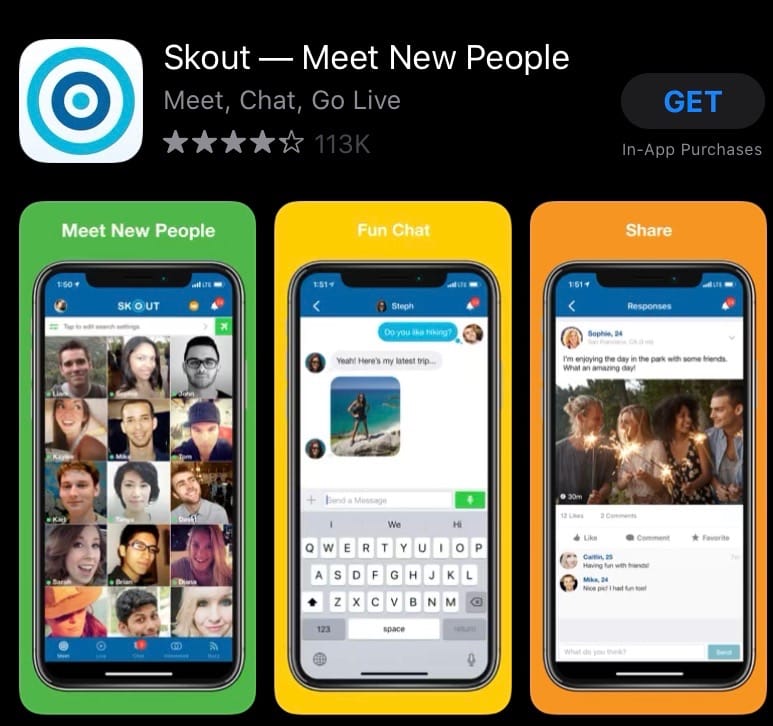
Skout
Skout is a social networking app that allows its users to meet people nearby or around the world.
The app features:
Preference and location: connect with people based on preferences and proximity.
Live broadcasting: broadcast live videos on the app and watch other’s videos.
Chat and upload photos: send direct messages, share photos, and like/comment on other users’ photos.
Promote: Skout claims to have in-app features that increase your chances of finding new people and chatting.
Skout is rated 17+, but only people 18+ are allowed to join. Again, there is no age verification.
Meeting and flirting with people online can be exciting and fun, but it can also come with risks.
Catfishing and Online Grooming
Not everyone on the internet is who they say they are. Some people make fake profiles to deceive other users, which is called catfishing. On dating apps and social media, your teen can get exposed to sexual predators who use catfishing and grooming techniques to gain their trust.
Sexting
Oftentimes, teens exchange their phone numbers and Snapchat usernames when they connect with others online. This can easily lead to sending sexual messages and photos. According to Guardchild:
20% of teens have sent or posted semi-nude photos or videos of themselves
39% of teens have sent sexually suggestive messages online
Sexting is common among teens which can be scary if their photos end up in the wrong hands and are shared publicly. This can lead to bullying, blackmailing, and emotional distress for the victim. For more information about sexting, check out the GKIS article, How Texting Can Turn To Sexting in the Blink of an Eye.
Cyberbullying and Harassment
Using dating apps and social media increases the likelihood of your teen experiencing cyberbullying and online harassment. Your teen might experience hateful comments, stalkers, and receive unwanted sexual messages.
Click here to read a GKIS survivor’s story about teen bullying and sexual abuse.
If you see your teen using dating apps…
Don’t panic. Most likely, many of your teen’s peers are also using the same apps.
Have an open discussion about the risks of dating or social networking apps.
Teach them to turn off location services for apps to disable people from seeing where they are.
Encourage them to approach you if anything makes them feel uncomfortable online.
Remember that it’s okay to say no, especially if they are too young to have an account.
Betts, J. (n.d.). Teen Dating Apps. Retrieved December 03, 2020, from https://teens.lovetoknow.com/relationships/teen-dating-apps
Online Dating – The Risks For Teens. (n.d.). Retrieved December 03, 2020, from https://www.internetmatters.org/resources/teens-and-online-dating-advice-hub-for-parents/online-dating-the-risks-for-teens/
Online Dating Is Especially Risky For Teens. (2020, September 17). Retrieved December 03, 2020, from https://yourteenmag.com/social-life/tips-teen-dating/online-teen-dating
Team, F. (n.d.). Swipe right for trouble: Six teen dating apps parents need to know about. Retrieved December 03, 2020, from https://www.familyzone.com/anz/families/blog/six-teen-dating-apps-parents-need-to-know
Teenage Sexting Statistics. (n.d.). Retrieved December 03, 2020, from https://www.guardchild.com/teenage-sexting-statistics/
Updated: November 8, 2., Kelli Dugan, C., Bob D’Angelo, C., Natalie Dreier, C., & Jared Leone, C. (2019, November 08). Teen dating apps: 5 popular dating apps that parents need to know. Retrieved December 03, 2020, from https://www.whio.com/news/local/teen-dating-apps-popular-dating-apps-that-parents-need-know/KQGkhTpFCxeyrmLejeODpN/
Parler is a social network platform that has recently become popular due to public outrage over big tech censorship. Controversy swirls as to whether a powerful private entity, like Facebook or Twitter, should have the power to alter public access to information. Should it be up to the reader to determine the accuracy of information or is the proliferation of fake news into our news cycle a danger to us as individuals and to our democracy – thus making censorship necessary? In this article, we will be showing you why Parler appeals to certain users, the perceived benefits and potential dangers of the app, and why GKIS recommends that children not be allowed access.
Nearly the whole world relies on social media to market their business, get the news, network, or stay connected with friends and family. But recently it has been brought to light that social media platforms shadowban content that violates their terms of service. Shadowbanning is when a social media platform blocks a user’s content without notifying the user. So, instead of understanding their content has been blocked, the user believes that nobody is engaging with their content when in reality it cannot be seen or has been obscured to other users.
Some users who have experienced their content being taken down or shadowbanned by social media apps like Facebook and Twitter believe that it is a violation of their constitutional first amendment right to free speech and accuse big tech of politically-motivated censoring. In response, many have decided to jump ship and go to other apps known to be against censorship like Parler. Parler has become one of the most downloaded apps after Twitter flagged some of former President Donald Trump’s tweets.
What is Parler?
Parler is a social network platform that is similar to Twitter. It was founded by John Matze and Jared Thompson based out of Henderson, Nevada. The social media platform describes itself as a “free-speech platform” focused on protecting users’ rights. The content is focused on real user experiences and engagement without censorship, except for obscenity and pornographic material.
The guidelines on the platform state that the company aims to “uphold the rights of free speech according to the U.S. Constitution.” But many are criticizing it for being a far-right social media platform and calling Parler names such as Meinspace, Hicktock, and Fashbook.
Who is joining Parler?
The majority of Parler users have a more conservative ideology who joined during the 2020 presidential election when Twitter’s algorithms censored a New York Post story involving files and emails reportedly taken from Hunter Biden’s laptop. When Republican Senators questioned Jack Dorsey, the CEO of Twitter, about the censorship, he replied that it was a “mistake” and that Twitter policies would be amended. In response, conservatives claimed that the algorithms favored liberal news and unfairly targeted conservative content.
Many Saudi’s have also have left Twitter and joined Parler in response to news stating that several Twitter employees were charged by the U.S. Department of Justice for spying for Saudi Arabia. According to court papers, one of the people implicated in this scheme is an associate of the Saudi Crown Prince Mohammed Bin Salman who the CIA has concluded made the order of assassinating the journalist Jamal Khashoggi. Saudis feel that Twitter is protecting the Saudi government by spying on users that do not agree with the government.
Many non-political people also use the platform such as athletes, business owners, and people that just want fewer rules and a platform that welcomes all political views.
How do you sign up for Parler?
To sign up, go to the Parler website or download the app and submit your email address and phone number to confirm your identity. Agree to their terms of service and privacy rights and community guidelines. If you want to comment on user posts, verify your identity by taking a picture of a valid identification document such as a driver’s license or passport and a selfie and send it in.
How Parler Works
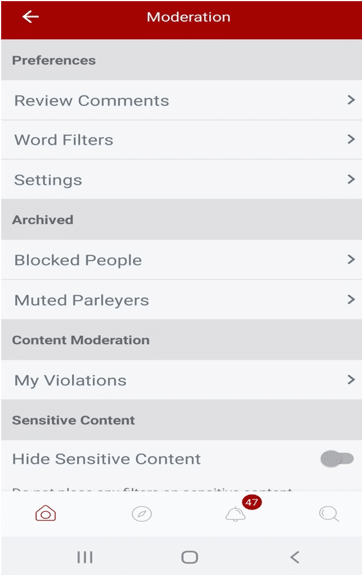
Users can moderate what kind of content they’d like to see as well as block or mute users. Additional features include entering word filters associated with content that you’d not like to see and the option to view your comments before anyone else can see them. Parler also has Community Guidelines violation points which allow a warning (20 points) prior to losing your Parler account.
In the main feed, there are different terms for certain content. For example, a parley is a post and an echo is a re-post similar to a retweet. Votes are similar to likes or dislikes. Parleys can only be upvoted and comments can either be upvoted or downvoted.
Despite Parler being credited as a free speech platform, users cannot post:
Terrorist threats or threats
Trolling
Spam
Pornography
Slander
Blackmail
Plagiarism
Bribery
Copyright infringement
Doxing
Impersonation
Libel
Obscenity
Privacy
Users can make an account public or private. You can also select an option where the only email you’ll receive from Parler is to inform you of critical updates.
How Hashtags Work on Parler
Parler is hashtag heavy. To search for content or post content, a user needs to be precise with hashtags and usernames more so than other social media platforms. This means that exact hashtags or usernames must be typed in with no spaces. Parler’s algorithms only search for usernames and hashtags. Twitter, on the other hand, uses all kinds of algorithms that search for more vague keywords. Their algorithms also curate a person’s feed to suit their interests in order to keep a user scrolling. Parler does not do this. Users that do not like an algorithm to decide what should be on the top of their newsfeed may prefer an app like Parler.
Is Parler appropriate for minors?
GKIS rates Parler as a red light app for kids and teens due to the commonality of extreme views and lack of censorship. For example, far-right groups like the Proud Boys post about destroying Antifa and promoting civil war. We at GKIS recognize that young people are particularly vulnerable to believing conspiracy theories and may become radicalized by extreme content. Kids on Parler may also be at risk for exploitation and abuse.
For more information on how to keep you and your tweens and teens safer on social media, check out our Social Media Readiness Course. It’s like driver’s training except for the internet!
Thank you to CSUCI intern Andres Thunstrom for co-authoring this article.
I’m the mom psychologist who will help you GetKidsInternetSafe.
Onward to More Awesome Parenting,
In last week’s GKIS article, “How Teens Overshare,” we covered the ways kids intentionally and unintentionally share location information on social media and how to prevent this safety risk. In today’s article, we detail how cybercriminals victimize teens and offer more helpful information on how to get your kids internet safe.
Cyberstalkers
Cyberstalkers are predators who track online information to extort or harass, create cybercrimes like hacking or identity theft, or intercept a victim offline. Cyberstalkers can be complete strangers or people your teen may already be acquainted with.
Hackers
Hackers are predators who steal usernames, passwords, and personal information to gain access to a victim’s screen device. Once they can access, they can still further data, change or destroy information, install malware, and even take over the device’s camera.[1] Data can then be sold to other criminals on the dark web or be used for identity theft to take out loans and credit cards in your name.
Phishing
Phishing is a cybercrime in which a victim is contacted by email, telephone, or text message by someone posing as a legitimate institution to lure individuals into providing sensitive data. Phishing can also occur through websites and social media.[2] Dr. Bennett notes in her book, Screen Time in the Mean Time that the sensitive information obtained by phishing is often used for online login information such as usernames and passwords, bank account and credit card information, and even identity theft.
The most common example of phishing is email phishing. To email phish, the cybercriminal creates a fake domain that looks trustworthy and legitimate, then sends emails to potential victims asking them to click a link, download an attachment, or “update” their passwords.
To prevent your child from falling victim to online phishing, encourage them to only open emails, online messages, and text messages from trusted individuals and advise them to never click on any links or download attachments from an unusual or suspicious-looking email or message.
Identity Theft
According to The United States Department of Justice, “Identity theft and identity fraud are terms used to refer to all types of crime in which someone wrongfully obtains and uses another person’s personal data in some way that involves fraud or deception, typically for economic gain.”[5]
Cybercriminals often target younger individuals because children do not have bad credit (which is great for cybercriminals) and it is easy to keep it from being noticed until the child is older. In Dr. Bennett’s book, Screen Time in the Mean Time, she writes about a couple of children who were victims of identity theft.
Here are a few ways to protect your child from identity theft:
Install cybersecurity safeguards on phones, laptops, iPads, and any other device that need protection
Have family conversations about being wary of posting or sharing personal information online
Set up a virtual private network (VPN) to ensure the safety of your device(s)
Update passwords at least once a year and be sure that the new password does not include any information that may already be public such as, your teen’s name, age, pet’s name, or anything that could be easily guessed
Social Media Quizzes
Cybercriminals can also phish for information through social media by reviewing posts, asking questions, or offering an online quiz with targeted questions. Quiz questions to avoid include any that ask for your (or your mother’s) maiden name, your favorite color, the street you grew up on, your pets’ names, the first car you owned, or your best friend’s name.
The answers to these questions are often security answers on websites. With security information, personal accounts can be accessed for malicious intent. To prevent cybercrimes, ask your teen to refrain from taking online quizzes or you can encourage them to only take online quizzes from a legitimate source. Teaching your teen to withhold sharing personal information that could pose a security risk is vital to ensure their online safety.
Cyber Blackmail
Once a cybercriminal obtains sensitive information, they may use it to coerce a victim further. According to the BBC, “Cyber-blackmail is the act of threatening to share information about a person to the public, their friends or family unless a demand is met or money is paid.”[3] Cyber blackmail can take many forms and the cybercriminals who commit this crime use different tactics to take advantage of their victims.
Cybercriminals may even say that they have explicit photographs, access to their victim’s phone and computer’s webcam, or even recordings of them from their personal devices. Some of those claims may be true or false, but either way, the cybercriminal uses fear and shame to get what they want.[4]
To help prevent your teen from becoming a victim of cyber-blackmail;
advise them to never share sexual images of themselves (the images can end up anywhere)
advise them to not accept friend requests from strangers
advise them to be wary of things they post, share, or message others online (what they say can very well be used against them in the future)
require your teen to have private social media accounts
For more information and safety tips, we highly recommend parents to purchase our Cybersecurity & Red Flags Supplement. Dr. B created this tool because parents in her clinical and coaching practices frequently asked her to teach their kids the red flags that may alert them to the tricks of online predators, hate groups, and cyberbullies. In this Supplement, she offers her clinical teaching list so you can educate your kids. Knowledge and assertiveness coaching are key elements of child resilience and good judgment online.
Also included in the supplement is Dr. B’s Online Safety Red Flags for Parents. This tool teaches parents what child behaviors to look for that may signal they are at risk – a tool she created from 25+ years of clinical practice. Being able to recognize behavioral red flags in your child may be the difference between stopping risk after one exposure versus not recognizing dangerous relationships and exposures until it’s too late.
Thanks to CSUCI intern, Remi Ali Khan for researching cybercrimes and cybersecurity for this article.
I’m the mom psychologist who will help you GetKidsInternetSafe.
Onward to More Awesome Parenting,
Tracy S. Bennett, Ph.D.
Mom, Clinical Psychologist, CSUCI Adjunct Faculty
Photo Credits
Photo by Gerd Altmann from Pixabay
Photo by B_A from Pixabay
Photo by Pixabay from Pexles
Photo by Tracy Leblanc
Works Cited
Bennett, T. (2017). Screen Time in the Mean Time: How to Get Kids and Teens Internet Safe.
Brant, E., & Butterly, A. (2013, September 20). Cyber-blackmail: How to keep safe and deal with it. BBC Newsbeat. http://www.bbc.co.uk/newsbeat/article/23724703/cyber-blackmail-how-to-keep-safe-and-deal-with-it.
Cyber Extortion: Ransomware vs Extortionware. Alpine Security. (2020, August 2). https://alpinesecurity.com/blog/cyber-extortion-ransomware-vs-extortionware/.
The Dangers of Hacking and What a Hacker. https://www.webroot.com/us/en/resources/tips-articles/computer-security-threats-hackers.
Identity Theft. The United States Department of Justice. (2017, February 7). https://www.justice.gov/criminal-fraud/identity-theft/identity-theft-and-identity-fraud.
KnowBe4. What Is Phishing? Phishing. https://www.phishing.org/what-is-phishing.