
Need peaceful screen time negotiations?

Get your FREE GKIS Connected Family Screen Agreement

social media

Why Your Smartphone Is a Nuclear Football

BLOG45NUCLEARFOOTBALL I’m a child of the ‘80’s. This essentially means six things shaped my understanding of the world: The Love Boat, Atari (Frogger!), Fast Times at Ridgemont High, being a latchkey kid, the birth of MTV, and the fear of nuclear holocaust. (And yes, as an Internet safety expert, it has not escaped me that four of those six things involved screen media).

Now back to nuclear bombing . . . It sucked being a kid and learning that I had an omnipotent and invisible enemy powerful enough to eradicate Earth. Thanks Cold War for ruining my childhood security.

And OMG, remember the television show The Day After? This lovely little drama depicted a full-scale nuclear war between the United States and the Soviet Union. Nearly 100 million Americans watched the first broadcast, the content of which reportedly inspired then President Reagan to note in his diary that the show was “very effective and left me greatly depressed.” This from the guy in charge of THE BUTTON, also known as THE NUCLEAR FOOTBALL*. Nuclear war made the 1980s super scary.

Flash forward. For research, and to get an idea of the current blood curdling fear tantamount to 1980s nuclear war, I just walked into the playroom and asked my 11 and 13 year olds, “What is your biggest fear?” Now keep in mind, my 13 year-old got second in her school on the super quiz test on ecology without even studying. In other words, I was all giddy for them to say global warming or Internet predators or some such so I could hop back to my computer and develop today’s nuclear football argument…

But true to form, messing up all of my pie-in-the-sky expectations, my children could only come up with was, and I quote, 1) “You” and 2) “Your dancing.” Seriously, that’s what they said.

So besides the fact that my kids are hilarious and wrong about many things (my reverse trailer dance move is unrivaled), I posit our smartphones have personal nuclear football capability. Not for blowing up the planet or whatever, but definitely for blowing up your life.

You’d be shocked, or maybe not, to hear all the ways my patients have ignited their lives with a push of the send button. I know that sounds hyperbolic, but it isn’t. And I’m not just talking about teenagers. I’m talking about sound-minded, responsible adults.

What kind of screen media bombs have I seen detonated?

I’ve seen every type of pathological relationship birthed and every type of secure attachment detonated. I’ve seen wives lose their husbands, husbands lose their wives, best friends betrayed, kids groomed, daters deceived, reputations ruined, jobs lost, car accidents triggered, parents infuriated, and drug deals executed. I even heard of a woman who fell on the escalator while she was texting, resulting in her hair getting tangled in the landing mechanism. I know, arrrggg! I’ve seen an epidemic of powerful destruction facilitated by an impulsive text, a compulsive iChat exchange, or a traumatic video.

Take a second and run a slide show in your imagination of the horrors you have witnessed online. I, for example, still cringe at the memory of videos I’ve seen of people jumping to their deaths from tall buildings, innocent people getting knocked unconscious by malicious pranksters, and spider babies crawling out of its unfortunate victim’s flesh. Shiver. Now imagine a six year-old enduring these images. Nightmare material, indeed!

As a clinical psychologist, we are taught how to nurture our emotional health despite being a daily witness to the ravage of our patient’s emotional safety. Like you, we strive to maintain a healthy lifestyle with solid supportive relationships. And in order to help us work through the pain that we carry as a result, we set up regular consults with our colleagues. During these lunch meetings we speak of our sadness, disgust, anger, fear, and other leftover ashes from the hardest psychotherapy sessions. In order to not burn out or become deeply cynical, we work to deliberately preserve our emotional fitness.

My challenge to you today is to consider what type of emotional fitness strategies do you engage in? Do you take steps to protect yourself from destructive messages, images, and videos? Do you enrich your inner world with healthy relationships and self-care strategies like imagery, mindfulness, and a heart full of compassion? And more specific to GetKidsInternetSafe, have you taught your kids just what they need to do in order to protect themselves and then heal if they take a misstep?

In addition to blocking, filtering, and setting screen media limits, I challenge you to take that extra step and teach them powerful health strategies like good nutrition, sleep hygiene, and exercise. And certainly don’t leave out psychological strategies like mindfulness, imagery, diaphragmatic breathing, and positive thinking. But most importantly, we all must be willing to filter out content that drains our hope, while feeding in content that inspires us like enriching passions and loving friendships.

I’m the mom psychologist who will help you GetYourKidsInternetSafe.

Onward to More Awesome Parenting,

Tracy S. Bennett, Ph.D.
Mom, Clinical Psychologist, CSUCI Adjunct Faculty
GetKidsInternetSafe.com

*What is the nuclear football? It is reported to be black briefcase carried by the president’s aid that contains everything necessary to launch a nuclear attack in minutes. According to Bill Gulley, former director of the White House Military Office, the briefcase contains two black books (one with retaliatory nuclear strike options and another classified shelter sites), a manila folder with instructions on how to operate the emergency broadcast system, and an index card with authentication codes. The nuclear football is always within reach of the acting president. Is your smartphone really much different?

Hey Dad, Your Twelve Year-Old Daughter Has a “Nude Out”


blogbc11-sadteen Originally published by The Good Men Project

You’re reading with the hopes that this is one of those bait-and-switch sensational articles, right? Oh how I wish that was true. Unfortunately, I have run across a phenomenon that few parents know about, and those that do are too ashamed to tell anybody. The ugly truth is that middle school girls, with their immature frontal lobes and tender insecurities, are trying to attract high school boys by texting them sexy images of their blossoming private parts. It’s like they’ve invented an unregulated child porn matchmaking profile that doesn’t even have privacy settings, terms of agreement, or the option to delete the profile. Just a CLICK and SEND and your daughter’s catastrophically nude profile image is available to everybody everywhere forever, no take-backs. Thirty seconds of bad judgment at twelve years old launches a nightmare digital footprint and sullied online reputation. Ouch!

And what about the boys? They enthusiastically log in to this mess too. Some become expert at grooming the girls to send the sexy photos which they then share with their “boyz” on the wrestling team for quickly growing “<city name> nudes exposed!” collections. And to make things more horrifying, the boldest of the boys proudly share their name lists of the virginity prizes personally collected from girls they intentionally targeted who were too young to know any better. Fifteen minutes and these young women have exposed their vulnerabilities, their reputations, and the essence of their true potential. It’s like these teens lost their minds and logged in for an on- and off-line pimp-prostitute internship program. All that was needed was a mobile phone with texting ability and a misguided sense of adventure.

How do I know this? Because I’m a psychologist and the teens I see tell me the shameful truth, all of it; the truths that trigger pride, shame, sadness, and desperation. They tell me all about how they “released their nude” when they turned 12 years old in order to attract attention from the older boys. Or how they were duped into it by the soothing promises from entrepreneurial Romeos, only to find out later that they were lied to and it had been shared over text to the high school football team. There’s also the confessions from the boys that get their “ah-ha! I was being a dirt bag” moment when their frontal lobes come online later in high school. And believe it or not, both genders are capable of being predatory on the other. I hear what most parents don’t know.

I remember the first session when I realized this was a thing. I was seeing a beautiful eighth grade girl who was starting to get it and was lamenting about her best friend who purposely “put a nude out” when she was 11 year old. At 15 years old, the friend was bizarrely proud of it being re-released via text to “everyone in the county” four years later. My client guessed it was the fourth mass texting of the image. I sat there, horrified and dumbfounded, assessing my ethical requirements to the teens involved and my community in general. As a mother, I began visualizing the creation of a blueprint for Rapunzel’s tower in our backyard for my kids, screen-media-free.

So much of my young client’s disclosure made me deeply upset for everybody involved. I was saddened that children this young had already learned how to use and exploit sexuality as a cheap commodity. I was saddened that these kids broker power through contemptuous attention catamount to social media “likes.” I was saddened that there was an army of teenagers willing to receive these tragic misperceptions of self worth. And I was furious that some actively groomed their victims to build a sick collection of lost innocence with no more thought than they gave to their Pokémon collections six months earlier. Keep in mind that in many cases these releases are consensual, while in others coerced.

I imagine you’re thinking, “What kind of amoral community does this writer live in anyway? My kids would NEVER do that!” Right? I’m sorry to tell you that I live in the same community you do. This is not an isolated phenomenon. Participants come from all types of families, families of all income levels and religions with great parents and slack parents. Short of raising your child in a stone tower, there is no family situation where your parenting supervision cannot be breached.

Of course there are situations where children tend to be the most vulnerable. But the temptation is there for even the most well adjusted kids. And to make things even more concerning, this pimp-prostitute culture does not always end by college age. The media is rampant with stories of fraternity houses that have private Facebook pages littered with nude photos of non-consenting women and blatant drug deals, not to mention social media and hookup dating sites flooded with sexual trolling. Like it or not, the young have their own culture of sexuality that is different from their parents.

What has led us here? Is it the unregulated Wild West atmosphere of the Internet? Perhaps it is the moral decay of the Western culture? Perhaps it is the accumulation of sexualization and objectification of women splashed throughout popular culture over decades? Are permissive parents to blame or the rapid technological developments we simply cannot keep up with? And more importantly, what is going to lead us out?

My university students and I discuss this often, and I think you would be surprised how many advocate for mass regulation and filtering while I wonder about the sincerity of their self-righteousness. Because like them, I am conflicted about what makes up our “rights” for online liberties balanced with personal vulgarity and decency standards. Until our legislators are able to fully secure online child pornography portals, some which apparently begin in our own unsuspecting homes, parents must get serious about becoming informed and taking real action. And believe it or not, waiting until your child reaches the teen years to do this is simply too late.

I created GetKidsInternetSafe (GKIS) to provide sensible support and easy-to-implement guides for parents at all stages of the game. After all, the fantasy of locking your child out of technology is simply not realistic. Whether you have a toddler just starting to clamor for her tablet, an elementary schooler playing his first video game, a middle schooler begging for social media, or a high schooler who’s already technologically fluent, it is imperative that you become fluent in screen media activities.

With the help of GKIS, you can become informed, educate your children and set expectations about digital citizenship and online reputation, create a family dialogue about GKIS screen smarts, stage your home, filter and block online portals, set up sensible GKIS family rules and regulations, and most important of all, become your child’s trusted ally and guide should they stumble into an on or offline tangle. Too busy or overwhelmed by the task? Let GKIS be your guide.

I’m the mom psychologist who will help you GetYourKidsInternetSafe.

Onward to More Awesome Parenting,

Tracy S. Bennett, Ph.D.
Mom, Clinical Psychologist, CSUCI Adjunct Faculty
GetKidsInternetSafe.com

YouTube Shaming Doesn’t Rehab the Cyberbully, But Kindness and Education Just Might


BLOGBC9cyberbullydad

Did you see the YouTube video of the Minnesota dad defending his 14-year-old Black-American daughter from racist Snapchat cyberbullies? It went viral and gained over 7 million views! Instead of standing by, he took matters into his own hands. Read today’s GKIS article and see if you agree with the way he handled it. Also, find out what we at GKIS think the internet hates.

How a Dad Defended his Daughter Against Cyberbullies

Bradley K’s daughter and her friend were sending Snapchat selfies to friends when freshman twin boys viewed them at a party and responded with racist, sexist giggling comments. She showed her parents who were horrified and recorded the snaps. They then tried to contact the boys’ parents on several occasions, even knocking on their door.

When the boys’ parents didn’t respond, Mr. K went to the police. The police investigated and shared Deron P’s (the dad of the boys) cell number with Bradley K. Mr. K left a message for the boys’ parents, only to receive a series of verbally abusive responses. Mr. K was furious and threatened to post the voicemails on YouTube. Mr. P reportedly replied, “I don’t care.”

So, Mr. K posted them.

The Fallout

After the publication of the YouTube naming Mr. P and the high school his boys attend, news reports stated that Mr. P lost his job and was admitted for detox from prescription pills and alcohol. The P family also released the following statement:

“The P family is not racist, nor do we use the “N” word lightly in our household. What happened was very unfortunate for both families, and we hope each family can heal and move on from this. There is no excuse for how Deron P acted, and nothing can take back the words he said to Brad K.”

Isn’t this dad bullying back?

Due to my experiences as a mother, clinical psychologist, and professor at CSUCI, I created GetKidsInternetSafe to support kids and parents in exactly this kind of situation, which are increasingly epidemic in our unregulated online culture. As a result of my expertise, people come to me for my specialized GKIS parenting programs and informational support. In this capacity, I received an email from a good friend with this news report asking what I thought of Bradley K’s posting. She said, “Isn’t this dad bullying back?”

Upon watching the video my heart goes out to Bradley and his daughter. He is clearly hurt and angry and has every reason to be. I’m a mother and I know the almost-crippling rage that burns when somebody hurts my child. I TOTALLY GET IT.

And the racist and sexist verbal abuse that this beautiful teenage girl had to endure…my thoughts play like a slide show of the hundreds of cyberbully stories I have helped young people process in my clinical office. I ache with empathy for the pain kids experience at the hands of their impulsive peers; pain that becomes woven into the tapestry of how they view themselves, their bodies, and their very identities. Like Mr. K, I am angry at the permanent damage that is being inflicted on our kids over screen media.

But here’s the kicker; I also treat the cyberbullies. In fact, more times than not, the victims have retaliated or acted badly on social media themselves. Victims often respond by perpetrating back or passing the abuse to another peer. And so on, and so on, and so on. Each child becomes a desensitized and sometimes monstrous participant, usually under parents’ noses.

What do you think of Mr. K’s choice to publicly air this incident?

He stated his intent for the Ps to “own” their racism. Considering the content of the statement released by the P family, that ownership simply did not happen. The children involved are now held up for public scrutiny for the public to debate this very real, very painful, and very common issue. The victims and cyberbullies will be forever paired with this shameful, brutal, and highly publicized incident.

I don’t vilify Mr. K for making the decision he did. He tried civilized means of resolution only to be verbally assaulted himself. Furthermore, he had no way of knowing he would get 7 MILLION views.

And my opinions about Mr. P? Clearly the man has serious substance abuse issues and wrestles with hate. My father taught me it is never OK to kick those who are already wounded. Assert myself, yes, but brutalize back, no. I’d like to think I wouldn’t make Mr. K’s choice myself. But having addiction in my family has taught me the hard way that addicts can provoke the worst from us.

My passionate feelings about this incident have little to do with the parents actually and more to do with the children. These boys are 15 years old! They were at a party showing off for friends harassing girls they didn’t know. They were clearly raised with ignorance and hate and verbal abuse. They were likely taught that this behavior is what men do. And any 10-minute Internet surf session shows us that this revolting behavior is modeled to our kids hundreds of times a day online. These goofball boys’ split-second decision has resulted in the financial ruin and public humiliation of their entire family; a piercing punishment indeed for 30 seconds of poor judgment.

Here is what you and your kids need to know about the Internet:

THE INTERNET HATES

The Internet hates privilege. It hates poverty. It hates women. It hates men. It hates puppies. It hates children. It hates race. It hates culture. It hates anybody and everybody, everywhere and all of the time. The Internet spews all that is inside of us – all that is vile, ugly, and hurtful – all that is loving, beautiful, and nurturing.

And kids get mixed up. They can be TERRIBLE at determining what is funny and what is brutal. Kids need to be taught humanity, generosity, and assertiveness. They need to be taught by those who most love and understand them, their family. They need to fail and succeed, only to fail again before they get it right.

And sadly, some parents are TERRIBLE at parenting. These parents need to be taught humanity, generosity, and assertiveness themselves. So many of us get lost in our jobs, our relationships, our finances, and our addictions. We all sometimes lose our way to some degree or another. We all need support and love and understanding to find our way back. Like our children, we need to fail and succeed, only to fail again before we get it right.

Mr. K is clearly an intelligent and loving man. Was it his responsibility to teach Mr. P? Was it the police officer’s job? Perhaps the school staff should have intervened more effectively.

I don’t know an easy answer to this. But I do know that our kids saw us buy an 86-year-old stranger and his wife their dinner this week for his birthday. We didn’t know him, and we asked that the server not point us out. But what a gift to us to see the old man light up when he was told about the gift. And to our delight, we watched the 20-year-old server love all on him (“He’s a regular!”) and then witness no fewer than six other people from the restaurant come and shake his hand.

Our kids watch us love on our pets, talk kindly to our neighbors, hug and kiss each other, and validate them when they feel hurt, angry, or confused about the actions of others. When they act terribly toward each other or others, we patiently reprimand them, encourage better problem-solving, and reassure them that it’s ok to make mistakes if you learn from them. Anger, frustration, and remorse are normal and must be validated rather than shamed. We make sure they know our values and challenge them to develop opinions of their own. We are not perfect parents, but our kids absolutely know we are there to listen and support them through success and failure.

Please, in the wake of tragic news events like this one, do the world a favor and take the opportunity today to pay a little kindness forward to somebody in your life, stranger or kin. Love and education are how we spread kindness, not public shaming and humiliation. And please, most of all, protect and guide the children, cyberbullies and victims alike. Their prefrontal lobes are not done developing until they are 23 years old! We have to lovingly guide them knowing that perfection is not a reasonable expectation of anybody, especially of impulsive teens.

I’m the mom psychologist who will help you GetKidsInternetSafe.

Onward to More Awesome Parenting,

Tracy S. Bennett, Ph.D.
Mom, Clinical Psychologist, CSUCI Adjunct Faculty
GetKidsInternetSafe.com

Photo credit:
Copy of old pictures 232, by Mighty mighty bigmac, CC by-ND 2.0

Did Your Baby Take His First Digital Footprint Before He Started Crawling? 9 GKIS Social Media Tips For Young Parents

blog39instagramprofile

I just shared a post about face recognition technology that might have freaked you out a little. Maybe it got you wondering about your child’s digital footprint and if you want to be the one to start it?

Although some parents are concerned enough to not post ANY child pictures online, it is an unrealistic expectation for most families. The benefits of sharing your little one’s firsts with friends and family is just too awesome to pass up. Perhaps some thoughtful consideration prior to making social media decisions is a good starting point. Ultimately each family must determine online privacy rules of their own, and then communicate it to friends and family.

Here are some sensible GKIS tips on how to protect your child’s privacy online:

  1. Set your privacy settings to friends-only or tighter on any social media site where you’re posting child images.


  2. Don’t use your child’s image for social media profile pictures or cover photos. These are public regardless of your privacy settings.


  3. Only post your child’s online pictures with a nickname (e.g., “the boy” or “Teeny Tiny”).


  4. Never post nude shots or embarrassing activities. Consider how your child will feel about the image if it were shown at a middle school assembly when she is twelve years old.


  5. Be aware that face recognition technology can be used with even side profile pictures.


  6. Always ask permission from other parents before posting pictures of their children, like from parties or play-dates.


  7. Don’t use your child’s pictures for professional marketing purposes.


  8. Don’t give permission for schools and camps to use your child’s images for marketing purposes.


  9. Create a Google Alert with your child’s name so you’ll be alerted of an online mention.


For a vast majority of parents this ship has already sailed. However, online decisions should not be flip and uniformed. Finally don’t forget that friends and family can also tag or forward your posted images, so once posted the image will no longer be under your control. Please comment below and let me know what you think about the risk of digital footprints.

I’m the mom psychologist who will help you GetYourKidsInternetSafe.

Onward to More Awesome Parenting,

Tracy S. Bennett, Ph.D.
Mom, Clinical Psychologist, CSUCI Adjunct Faculty
GetKidsInternetSafe.com

Here Little Girl Have Some Candy…Facial Recognition Technology and the Threat to Your Family


blog38faces

Article originally published by The Good Men Project

I adore my kids, and I heart Facebook. As a result, these two passions met long ago and often! Posting images of my kids and their happenings was ancient history and still a current reality when I launched GetKidsInternetSafe. Do I feel uneasy after learning about rampant online victimizations and BigData capture? Well imagine this:

<Old Witch Voice> “Here little girl, would you like some candy?”

Scene change:

<Voice modulated to resemble her own grandmother (who’s on Facebook)>“Here Jenny, would you like a Butterfinger (your fav)/wrapped in sparkles (in your preferred colors)/handed to you by this Maltipoo puppy (the one from your last birthday party)/held by your favorite cartoon character (whom you watched just this morning)/to your favorite song (that’s been on repeat all week)?”

I mean OMG and shiver right? How can we possibly protect them enough? And it’s not just pedophiles that may creep on them, it’s big business! And governments too! Yes I meant that to be plural. Whether you believe identity tracking is a terrifying intrusion on your privacy or you are reassured to have these tools in place for your security, please turn off your social media notifications and read this article so you can be even more informed about important decisions about your family.

What do you think about face recognition technology? Are you concerned, comforted, or somewhere in between? Rate your opinion really quick:

(No concern) 0 to 10 (Extremely concerned)

blog39facebookcover

WHAT IS FACE RECOGNITION TECHNOLOGY?

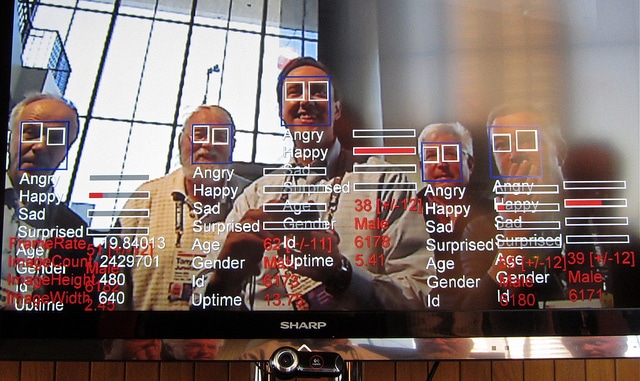
Face recognition technology is a computer application that collects data from an image of a face and compares it to a larger database, ultimately identifying the person. Older algorithms used data about distinctive facial features to make matches. The newer three-dimensional technology is modeled after the neural networking of the human brain and adds data about face shape and surface contours. As a result of these recent advances, accuracy has greatly increased with identification possible from even side-profiled pictures and even with different lighting. Some 3-D systems boast identification ability as good as a human’s at 97% accuracy!

WHO HAS IT?

Most big technology companies and law enforcement currently use face recognition. Examples include Apple’s iPhoto, Adobe System’s Photoshop, Google’s Picasa, and Microsoft’s Windows Live Photo Gallery.

The FBI database has been estimated to have private data on 4.3 million Americans who have not even been accused of a crime; data that can be pulled up immediately on handheld scanners, paired with other private information, and potentially shared with third parties.

What are you thinking now? Has your 0-10 rating changed at all? Rate again and then read on…

HOW IS FACE RECOGNITION TECHNOLOGY BEING USED?

We can’t be totally sure, as much of its use is confidential. Right Homeland Security? But we do know it’s commonly used in many applications, including photo apps for better focusing and photo organizing and on social media (e.g., tagging), mobile apps that require a selfie for login (e.g., computer access, ATMs, online test taking), or employer systems to track a worker’s computer face-time. Private companies also use it for security purposes, such as casinos in order to identify blacklisted customers.

Governments currently use this data to identify suspects (e.g., at public events or to monitor voter fraud), streamline border crossings (the US will roll it out this summer), and for visa processing and airport surveillance.

An important element to keep in mind is that, unlike with fingerprints and iris scans, this technology does not require the cooperation of the user. Therefore subjects may be unaware they are being identified.


HOW WILL IT BE USED IN THE FUTURE?

So far Facebook and Google are reticent to blatantly apply sophisticated 3-D face recognition software due to a fearful and vocal public. However, recent news reports suggest that Facebook will be utilizing their version of 3-D face recognition technology (DeepFace) on newly posted images in order to notify users their image was just posted. This allows that user the option of blurring their face on the image to preserve privacy. Some European governments have already forced Facebook to delete its face recognition data.

Google (with their social media platform Google +) is not far behind. However, they currently have refused to use facial recognition software for Google Glass or approve third party apps that use it. It has been speculated that Facebook and Google are waiting to apply the advanced technology until the public gets used to computers using face recognition for login. Wait for it…

The courts already obtain warrants to seize Facebook data about specific users, including images, posts, messages, locations, and activities. Facebook has argued that broad use of databases by the government is a violation of the Fourth Amendment freedom from unreasonable searches by the government. That battle continues.

OTHER RELATED DEVELOPMENTS

Big Data is also invested in analyzing text and posts to decipher mood and context as well as facial expression analysis technology. After all, logging viewer engagement and emotional response real-time allows the marketer to lead the potential buyer into a split-second purchase click, without the buyer even knowing he was neuro-marketed. Quick and profitable indeed!

Just this week news reports that Samsung’s SmartTV instructions read, “Please be aware that if your spoken words include personal or other sensitive information, that information will be among the data captured and transmitted to a third party through your use of Voice Recognition.” Yes, your SmartTV listens in to adapt to the spoken content of your private living room. You know this because a little microphone icon appears in the right hand corner. Right? And you can always turn it off, of course, but it will disable the voice command feature. I wonder what third parties think about the fight my husband and I had last night…

Perhaps you’ve noticed that it’s no coincidence that the very lamp you were shopping online yesterday shows up on your social media feed today. Your buying and browsing habits are already being collected and analyzed so advertisers can market directly to your interests. So generous of them and convenient! To thicken the plot further, consider that it’s not only you that marketers are targeting and tracking. Go to any popular children’s website and you’ll see that products are being blatantly and sophisticatedly pitched to your children. With this technology, that pitch will morph to be designed specifically for your individual child, her likes, her dislikes, all of it.

How is your rating faring now? 0 to 10

blog3buy

 WHAT SHOULD WE BE DOING TO ENSURE OUR PRIVACY?

This is where the controversy comes in. It seems people have settled into two camps, like the partygoers I mentioned earlier. One camp feels that people should not post anything; stay off social media and keep it old school. Others feel the ship has sailed. They’ve already got a digital footprint, the disappearance of privacy is the wave of the future. Accept it and don’t bother to swim against the current.

I don’t have a crystal ball that gives me enough information to offer you a concrete call-to-action. Maybe its no big deal that Google knows so much about us, starting at our image. And maybe it’s the beginning of something truly frightening for us. Because I use my image online for branding, my goose is surely cooked as far as face recognition technology goes. But I still have decisions to make about what to allow my kids to post online. There is data protection software out there, but I assure you it isn’t getting many buyers as most of us eat up the opportunity to exchange our private information for fun, free online content (thanks Facebook! Num-num-num). The Japanese recently developed privacy visors with infrared lights to protect facial recognition in public spaces…so there’s that.

I suppose if pressed I would encourage people to stay aware, educated, screen smart, and cautious. And teach your kids to do the same. Hold to strict age guidelines and monitor to prevent oversharing. My GetKidsInternetSafe 30 Days to Internet Safety online parenting course provides detailed suggestions of just how to do that in the most efficient ways possible, along with other ideas that fill Internet risk gaps. Ultimately, we must ask ourselves at many points along the way if the costs outweigh the benefits.

Does the risk of inaccurate face identification put us at high risk? What if other countries that don’t have our human rights protections get ahold of our data? Under what conditions is it acceptable and legal for private and governmental agencies to collect information about us without our knowledge? Furthermore, how is it that they are able to offer opportunities to some but not others based on that knowledge? Has there ever been a time in history where a government secretly collected private information about its citizens? And then treated those citizens differently because of that private information? Anybody? Ever?

Have you heard the allegory that if you put a frog in a pot of boiling water he’ll jump out, but if you put him in while the water’s still cold he’s certainly dinner?

Well I don’t know about you, but it’s feeling a little tepid in here…“Ribbit!”

blog38frog

Admittedly, it’s a bit of a leap from face recognition technology to covert data collection to hacking, behavioral manipulation, and discrimination or coercion. But being a frog myself (and a mom who worries about what kind of world we are handing to our kids), the evidence holds together tight enough for me to be worried.

What’s your 0-10 rating now?


I’m the mom psychologist who will help you GetYourKidsInternetSafe.

Onward to More Awesome Parenting,

Tracy S. Bennett, Ph.D.
Mom, Clinical Psychologist, CSUCI Adjunct Faculty
GetKidsInternetSafe.com


Photo Credits:

Fraunhofer Face Finder by Steve Jurvetson, CC by 2.0
Frog in a Pot 5 by James Lee, CC by 2.0


What will a future without secrets look like?

What Parents Need to Cover About Kim Kardashian’s Un-covering

BLOGBCkkcover1rgbwatermark-221x300

There’s nothing like Kim Kardashian’s greased assets to make a mother get honest about female empowerment. I mean, I think the female form is beautiful. In general, I’m all for nudity!

Until…

I am intrusively confronted with it greasily slinking out of sequins and “breaking the Internet.”

I reflect that the photograph was brilliantly strategized to promote the Kardashian’s multimillion-dollar celebrity profile.

I am struck that our children and teenagers are soaking in this slick marketing technique as the way to get self worth (and millions more Twitter followers). And in many instances, are emulating her…down to the detailed cosmetic application, hairstyle, and nude selfies. And more seriously, mimicking the polished and languid avoidance of topics deeper than “favorite looks.”

 ****

Are you freaked out now? Well you should be if you’re a parent and have functioning grey matter. I mean honestly, did you read the article that accompanied the photos in Paper Magazine? Amanda Fortini did a great job addressing Kim Kardashian’s brilliant execution of celebrity fortune, including a mocking observation that Kim’s “perceived lack of accomplishment is also, perhaps, an accomplishment in itself.” Fortini did such a great job, that after reading the article I was left dumbfounded and disturbed.

Between celebrity trash culture turned on our TV channels and our obscene pursuits of impossible beauty standards, we have nearly annihilated the intelligent female image our mother’s fought for in the ‘60’s. I’m dismayed to hear stories from my college students that they must have to have a male escort at parties or feel at risk for being publicly grabbed or otherwise sexually assaulted! I can assure you, as a teenager in the ‘80’s, I was never worried about my shoulder padded, neon outfitted parts being groped during a party simply because I had parts.

What has happened to female empowerment? Kim’s nudie-shootie screams as a call to action for parents everywhere to start teaching their kids about self worth, sexuality, and the true meaning of social media likes.

Tips to help ensure our kids blossom into proud, intelligent, self-honoring adults:

  • Don’t take nude or provocative selfies. Although your body is beautiful, exciting, and fun, a digital blast of it is not something you can control. You may think the message is your ownership of sexy, but the cutting criticism and mocking of others is not the messaging you want to have or that you can control. If Kim Kardashian’s style team can’t stop people from annihilating her with despicable criticisms, neither can you. As a thinking human being you have a responsibility to protect yourself from others being emotionally abusive just for the fun of it. Honor yourself by loving and protecting your body and the heart that it harbors.
  • The true seed of self worth comes from your soul, not your private parts. Who you are comes from intelligent reflection and acts of true kindness, not from social media exposure. Social media is fun, but means nothing beyond that. Keep it in perspective.
  • Your body, with all of its uniqueness, is powerfully worthy of love. We don’t have to have Kim’s skin which is the “golden color of whiskey, is free of wrinkles, crow’s feet, laugh lines, blemishes, freckles, moles, under-eye circles, scars, errant eyebrow hairs or human flaws of any kind” to radiate true beauty. We are beautiful in the way we were born, not in the way we are digitally altered.
  • Wasting two hours executing a torturous beauty regimen is a waste of precious moments. Spend 15 minutes accentuating your “cute,” and the remaining 105 soaking in the true pleasures in your life, like your family, friends, pets, and the sunny blue sky. Those moments have true meaning, not eyeliner and mascara applications.
  • Kim’s last marriage lasted 72 days. She simply doesn’t have it right. But as a human being, she’s welcome to her journey without us hating on her…or emulating her. Our time is best spent becoming the best we can be. If Kim’s best is “her perceived lack of accomplishment,” then I challenge you to leave her to it. As the loving protectors of our children, our energies are best spent making sure our children aim far higher. Let’s love and support them in that journey by giving them our time, our validation, and our wisdom from lives lived passionately.

I’m the mom psychologist who will help you GetKidsInternetSafe.

Onward to More Awesome Parenting,

Tracy S. Bennett, Ph.D.
Mom, Clinical Psychologist, CSUCI Adjunct Faculty
www.GetKidsInternetSafe.com