People seeking companionship or romantic connections online are falling victim to internet predators. There has been a dramatic increase in recent reports claiming that LGBTQ+ individuals are being purposely targeted for malicious online sextortion crimes. These crimes have led to devastating and long-lasting repercussions for victims and their families. As a result, the Federal Trade Commission (FTC) issued a warning in response to complaints about dating sites geared towards LGBTQ+ community members being infiltrated by sextortion perpetrators.[1] To help ensure your family has the tools to safely navigate the online world, check out our Screen Safety Essentials Course.
What is Sextortion?
The term sextortion (sexual-extortion) falls under the broader category of sexual exploitation. In many cases, sextortion is a form of blackmail that involves the act of extorting things like money and sexual favors through means of manipulation and coercion. For example, a perpetrator may threaten to reveal or expose personal and sensitive information about the victim to others unless they agree to the perpetrator’s demands.
How are people being victimized?
Despite advancements in societal attitudes towards LGBTQ+ community rights, the world can sadly still be a hostile place. That’s why dating apps geared toward members of the LGBTQ+ community, like Grindr, Feeld, and Her, have become popular.
These sites were designed to provide a safe space for both openly queer and closeted people to meet and make connections with each other without fear of harassment or exposure. Unfortunately, recent reports have indicated that an increasing number of apps and websites marketed toward members of the LGBTQ+ community are being infiltrated by sextortion predators.
Blackmail
A typical sextortion scam begins with a perpetrator creating a fictitious account on a dating app or social media networking site using a fake identity and photos. The perpetrator poses as a potential partner or someone looking to make a connection online and attempts to establish contact with another person under the guise of starting a romantic relationship. This is a process referred to as catfishing.
The perpetrator cultivates the relationship with their target to gain their victim’s trust and make them feel comfortable. The process can last for days, weeks, or even months. After establishing rapport, the perp will send explicit messages, photos, and videos and ask for some in return. Once the target shares their personal images and information, the scammer threatens to release it to the victim’s friends, family, or co-workers, or post it online unless the victim does what they say.
The primary motivations behind these types of romance scams can be financial and sexual. Sextortion predators use various manipulation tactics to not only extort money from victims but also to access sexually explicit photographs and messages, for their own sexual gratification. Recent reports have revealed that minors using the app, despite there being minimum age of use requirements, were targeted specifically by pedophiles hoping to elicit child pornography. In both cases, similar methods of exploitation are used.[2]
The FBI has stated that most victims report that initial interactions with perpetrators are mutual and unsuspicious. However, after a brief period, the extortionist will attempt to transition the interaction away from the app and onto private messaging forums. Without exposing their true identities, these online predators will go to great lengths to convince targets that they are legitimate users of the app.
Scammers often use stolen or fake photographs and may even hire a video model to convince their victims that they are interacting with an authentic person. It is very common for perpetrators to befriend victims on social media to access a list of the victim’s followers which typically include family members, friends, and co-workers.[2]
Why are LGBTQ+ apps being targeted?
Experts suggest that individuals using these dating apps are being specifically targeted by predators for a few different reasons. Given the nature of the apps, which are primarily used to foster romantic connections, online predators have a much greater opportunity to collect private and sexually explicit information from their targets. Additionally, since these apps have been designed for LGBTQ+ community members, predators assume that their targets have an even greater incentive to keep quiet about their victimization and comply with demands.
Because these apps are marketed as a safe space, people who are not openly queer rely on them to make connections with others without fear of exposure. As the thought of public shaming and the potential outing of their sexual orientation or gender identity is so profound, these individuals are more easily subject to victimization.
The Fallout
According to the FBI, the number of these cases has been steadily increasing. Experts speculate that the onset of the COVID-19 pandemic and the emergence of hookup-culture has escalated this trend. As the dating world transitioned largely onto virtual platforms, sextortion predators took advantage of this change.
Last year, the federal agency reportedly received over 16,000 sextortion complaints with financial losses totaling over $8 million.[2] In reality, the repercussions of these crimes extend beyond financial ruin. Sadly, the effects of being targeted and exposed by sextortion predators were overwhelmingly devastating for some victims who felt driven to take their own lives.[1] As a result of the seriousness of these crimes, law enforcement officials have significantly increased their efforts to capture and charge perpetrators.
How to Protect Yourself
It is important to be aware of the potential dangers inherent online in order to prevent yourself and your loved ones from becoming victimized. Dr. Bennett believes that providing our kids and teens with the necessary knowledge and skills to navigate these pitfalls before they arise, is the key to avoiding digital injury. That is why we created the Social Media Readiness Course which is designed to empower families to promote safe and responsible practices while avoiding harmful outcomes online. The internet can be an exciting and helpful tool when we are equipped with the proper skills to use it.
Thanks to CSUCI interns, Mackenzie Morrow and Michael Watson for researching the targeting of LGBTQ+ community members in sextortion scams on popular dating apps and co-authoring this article.
I’m the mom psychologist who will help you GetKidsInternetSafe.
Meeting people online can be fun and exciting, especially for teens. However, there are risks. If you want to prepare your child for these risks, check out the GKIS Social Media Readiness Course. You may have heard of popular adult dating apps likeTinder or Bumble. In this GKIS article, we cover 5 dating apps that are popularly used by teens that you probably have never heard of.
Yubo
Yubo is a location-based social networking app advertised for making new friends, but many people describe it as a dating app for teens.
This app contains many features such as:
Stream: share live stream videos with friends.
Chat: chat with friends and other app users.
Swipe: discover new friends nearby or around the world.
Find a community: connect with people who have the same interests by finding a community. The online communities range from art and sports to LGBTQ+.
Play: play games with friends like Q&A, Would You Rather and Let Them Guess.
Yubo’s age rating is 17+, but there is no age verification for this app, meaning any teen can use it and lie about their birthday.
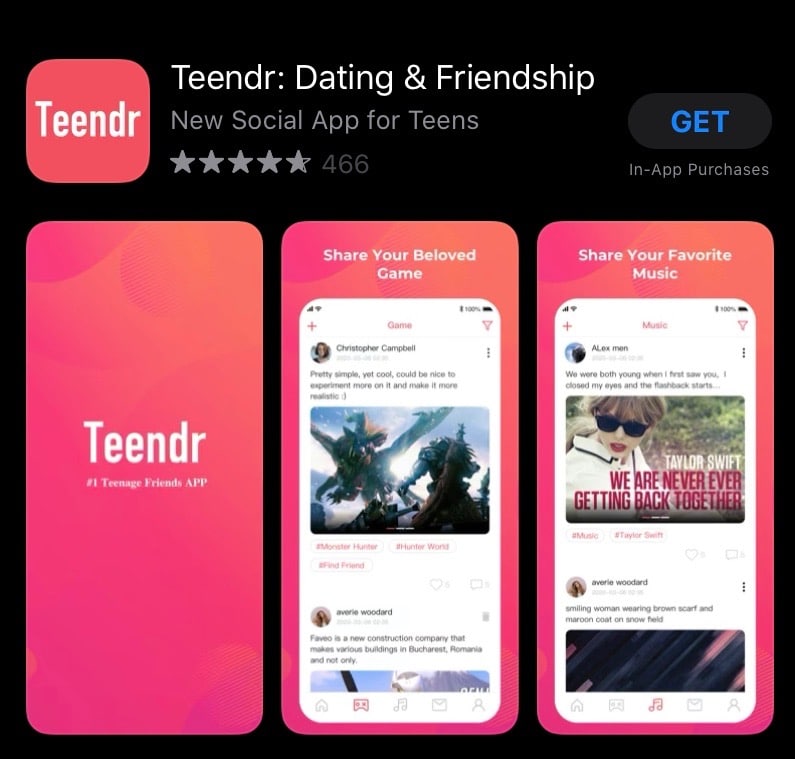
Teendr
Teendr is marketed as a dating app for teens. On this app, users can meet and chat with new friends nearby based on their common interests like music, games, and more.
This app contains:
Unlimited swipe: swipe right to meet new people or left to ignore.
Search nearby: discover matches based on location.
Game & music sharing: meet people based on their gaming and music preferences, which they can share on the app.
Teendr is also rated 17+, with no age verification.
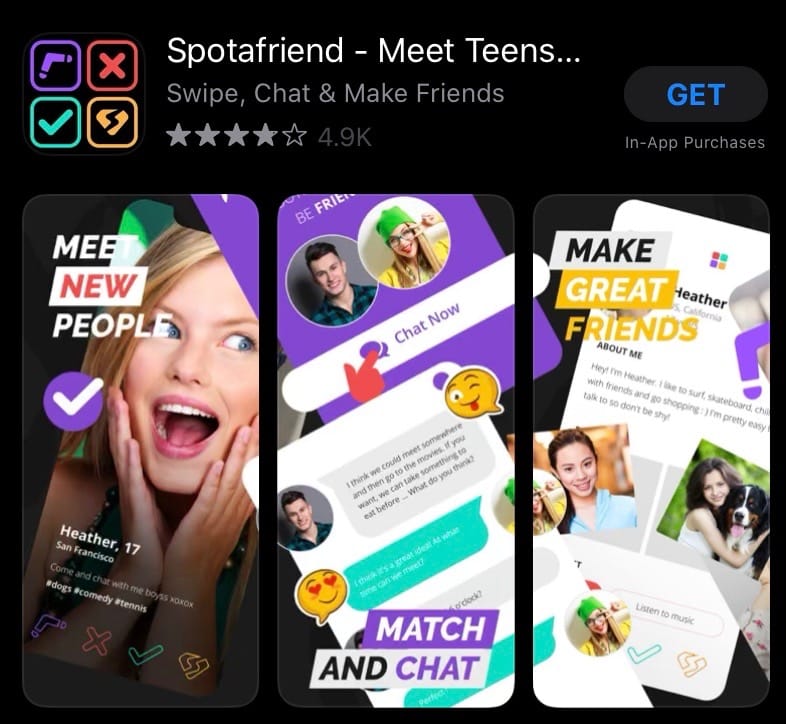
Spotafriend
Spotafriend is an app designed for teens to meet new people in their proximity. On the app store, it is described as “not a teen dating app,” but that’s what many teens are using it for.
Spotafriend includes:
Swipe: swipe right to become friends with someone.
Chat: chat privately when you get a match.
Spotafriend is rated 17+, but it is designed for ages 13-19.
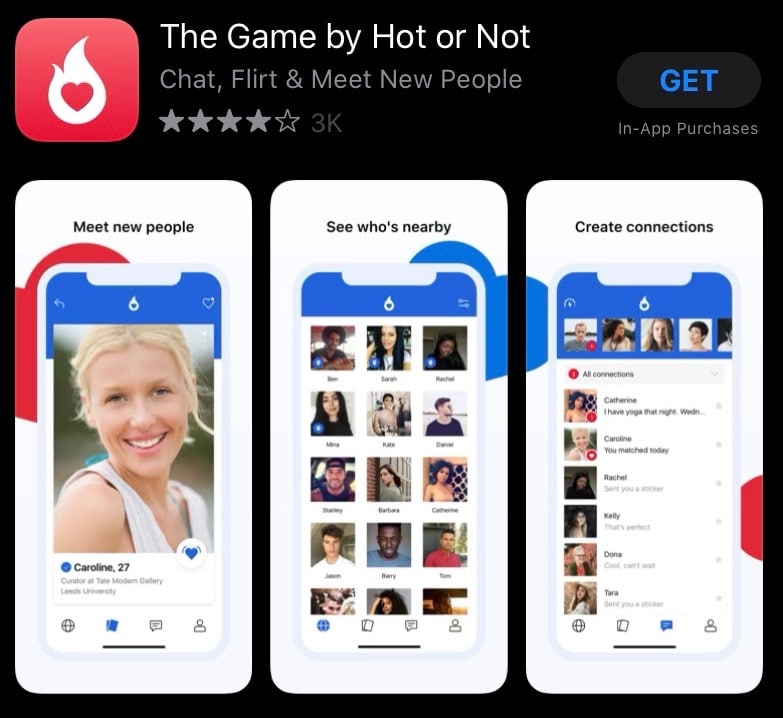
The Game by Hot or Not
The Game by Hot or Not is another app that allows teens to meet people in their area. It is marketed as an app to find the ‘hottest’ people nearby.
This app includes:
Ratings: rate each other’s attractiveness by tapping a heart on your profiles.
Direct messages: Users who match (by liking each other’s profiles) can exchange messages.
Location services: find people in your proximity.
Age: Hot or Not was originally rated 17+, but is now 18+ with no age verification.
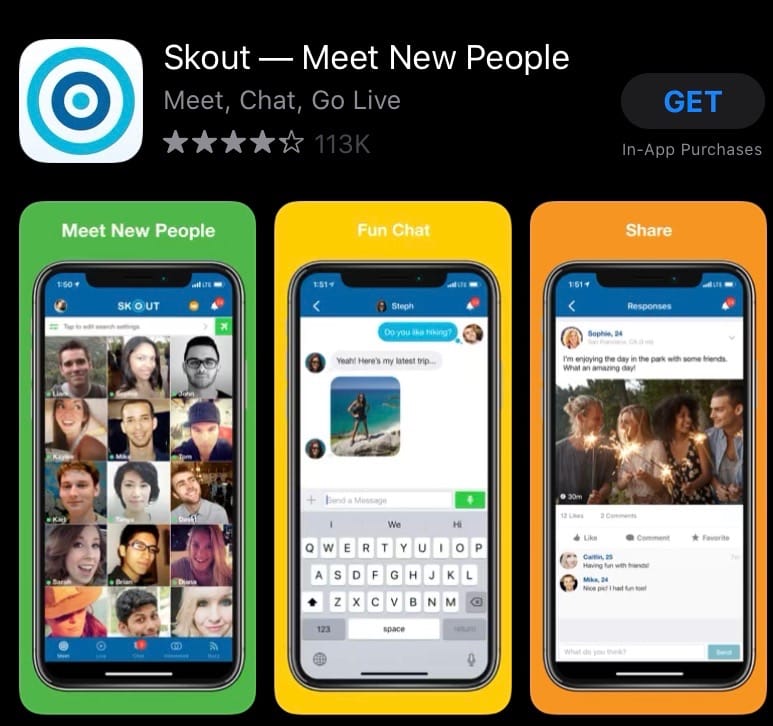
Skout
Skout is a social networking app that allows its users to meet people nearby or around the world.
The app features:
Preference and location: connect with people based on preferences and proximity.
Live broadcasting: broadcast live videos on the app and watch other’s videos.
Chat and upload photos: send direct messages, share photos, and like/comment on other users’ photos.
Promote: Skout claims to have in-app features that increase your chances of finding new people and chatting.
Skout is rated 17+, but only people 18+ are allowed to join. Again, there is no age verification.
Meeting and flirting with people online can be exciting and fun, but it can also come with risks.
Catfishing and Online Grooming
Not everyone on the internet is who they say they are. Some people make fake profiles to deceive other users, which is called catfishing. On dating apps and social media, your teen can get exposed to sexual predators who use catfishing and grooming techniques to gain their trust.
Sexting
Oftentimes, teens exchange their phone numbers and Snapchat usernames when they connect with others online. This can easily lead to sending sexual messages and photos. According to Guardchild:
20% of teens have sent or posted semi-nude photos or videos of themselves
39% of teens have sent sexually suggestive messages online
Sexting is common among teens which can be scary if their photos end up in the wrong hands and are shared publicly. This can lead to bullying, blackmailing, and emotional distress for the victim. For more information about sexting, check out the GKIS article, How Texting Can Turn To Sexting in the Blink of an Eye.
Cyberbullying and Harassment
Using dating apps and social media increases the likelihood of your teen experiencing cyberbullying and online harassment. Your teen might experience hateful comments, stalkers, and receive unwanted sexual messages.
Click here to read a GKIS survivor’s story about teen bullying and sexual abuse.
If you see your teen using dating apps…
Don’t panic. Most likely, many of your teen’s peers are also using the same apps.
Have an open discussion about the risks of dating or social networking apps.
Teach them to turn off location services for apps to disable people from seeing where they are.
Encourage them to approach you if anything makes them feel uncomfortable online.
Remember that it’s okay to say no, especially if they are too young to have an account.
Betts, J. (n.d.). Teen Dating Apps. Retrieved December 03, 2020, from https://teens.lovetoknow.com/relationships/teen-dating-apps
Online Dating – The Risks For Teens. (n.d.). Retrieved December 03, 2020, from https://www.internetmatters.org/resources/teens-and-online-dating-advice-hub-for-parents/online-dating-the-risks-for-teens/
Online Dating Is Especially Risky For Teens. (2020, September 17). Retrieved December 03, 2020, from https://yourteenmag.com/social-life/tips-teen-dating/online-teen-dating
Team, F. (n.d.). Swipe right for trouble: Six teen dating apps parents need to know about. Retrieved December 03, 2020, from https://www.familyzone.com/anz/families/blog/six-teen-dating-apps-parents-need-to-know
Teenage Sexting Statistics. (n.d.). Retrieved December 03, 2020, from https://www.guardchild.com/teenage-sexting-statistics/
Updated: November 8, 2., Kelli Dugan, C., Bob D’Angelo, C., Natalie Dreier, C., & Jared Leone, C. (2019, November 08). Teen dating apps: 5 popular dating apps that parents need to know. Retrieved December 03, 2020, from https://www.whio.com/news/local/teen-dating-apps-popular-dating-apps-that-parents-need-know/KQGkhTpFCxeyrmLejeODpN/
With social media and public servers for games, your child is likely to come across many different types of people. Just like in real life (IRL), they may come to be great friends. There is concern—and for good reason—if this is safe. A “catfish” is a term commonly used in popular culture to refer to someone who presents themself online to be someone or something that they are not. In our GKIS article “What You Need to Know About Online Catfishing,” we covered information about the rise of the term catfish, the psychology behind it, and certain red flags. In this article, we will cover how to best recognize catfishing and how your child can more safely meet an online friend once you, as the parent or guardian, have determined it is safe.
The Benefits of Making Friends Online
The internet displays a diverse range of people from many different cultures, ethnicities, identities, and lifestyles. Exposure to people different than themselves can be a great learning opportunity and help your child develop empathy and a greater perspective of the world. Dr. Tracy Bennett, Screen Safety Expert and Founder of GetKidsInternetSafe offers weekly parent and family coaching to help parents optimize the benefits of screen tech while minimizing risk. To learn more about her coaching videos, check out the GetKidsInternetSafe App. Sign up now and the first 30 days are free!
For kids who may be of a marginalized community themselves, like those who identify as LGBTQ+ for example, online contacts can be a lifesaver. Not only can kids have fun with their online friends who share similar interests and values, these friendships may also provide a sense of understanding, bonding, and representation.
In a 2014 study by Van Zalk and colleagues, shy adolescent participants who had online friends reported fewer depressive symptoms than those who were friendless.[1] Also, they found that having online friends didn’t distract the subjects from making IRL friends. Instead, online friends improved real-life friendships. This suggests that online friendships may boost self-esteem and social skills, so kids gain the confidence to seek friends offline too.
Making friends online may also be easier and more realistic for some kids, especially if they have trouble approaching new peers in real life. Further, if your child feels outcasted, they might search for an online community with or without your permission. So, preparing your child for safer online exploration may be your best option.
My Catfish Story
I’m a 23-year-old CSUCI intern for Dr. Bennett. In 2013, I joined an online friend group from a public Minecraft server. We would regularly participate in Skype group calls to play. All of us except one person—who I will call Sam—would regularly show our faces on video camera. Because we often saw each other, we felt we knew each other. But Sam refused to show himself on camera. Instead, he led us to believe that he was who he said he was by occasionally updating his profile picture.
Sam was really handsome and he eventually started dating one of the girls in our friend group. They tried meeting a few times, but something always came up where Sam had to cancel. We were in awe of his skills in the game and he gave us some assurance by going on camera although it was in a dark room.
Over a year into our friendship, Sam accidentally let the camera slip to reveal his face. Although it was a relief to see that we were, in fact, talking to someone our age, we were unsettled that the photos he was using were not him. Imagine the ways Sam could have been dangerous for us in slightly different circumstances.
How to Prevent Being a Victim of Catfishing
Verify Identity Through Social Media History
It is rare for a person to not have a digital footprint these days. However, with kids – they are often new users. If your child’s new friend does have social media, be suspicious if all their profiles are new.
Red flags for catfishing on Instagram might be if the person’s photos were all posted recently, if they are not tagged in any photos, or if the photos they are tagged in are from new accounts or accounts with under 30 followers.
To determine if a Snapchat account is new, look at the person’s Snap Score. A Snap Score is a feature shown on a Snapchat friend’s profile that displays the amount of live Snapchats the friend has received and sent. A Snap Score lower than 100 could indicate that the online friend recently created their account.
Other Snapchat Tricks
Snapchat offers a few features in addition to video calling. For example, you can send pictures and videos that have just been taken. One way to game this exchange is for the catfish to use their phone to take live pictures of preexisting pictures from another device.
A good way to challenge this deceptive catfish trick is to insist that the online friend send a personalized video that mentions your child’s name or a specific activity of your choosing. A few years ago, sending a selfie holding a sign with a name would have been satisfactory. But now with easily accessible editing software, written messages on paper or signs can be altered.
Opt for Video Chatting
Live video chatting can take place in many different forms through platforms like FaceTime, Skype, Facebook, or Zoom. We at GKIS especially like Facebook’s Messenger Kids. Dr. B is on Facebook’s Youth Advisory Team and has enjoyed having a part in its development from the beginning! She says she loves Messenger Kids because it doesn’t expose kids to ads and is the walled garden with parent transparency we’ve all been hoping for. Live interaction between two people makes it difficult to catfish. Even if the person tries to recycle prerecorded media in an attempt to appear live, it won’t look authentic because live chat conversation typically requires personal response.
Meet in Public
Unfortunately, there is no way to be 100% certain until you meet the friend in person. With deep fake technology, even personalized messages can be created.
If you’ve vetted your child’s friends online and you feel it is time for them to meet, meeting in public with your supervision is a good first option.
Meet their Parent(s)
Meeting the friend’s family can also help develop confidence in supporting your child’s new friendship. That way future plans can be run through the parents first.
Have Fun
Most importantly, have fun! Your child may have been waiting for months to meet their friend and now they finally can. You can also take comfort in the fact that you helped your child bring their newfound virtual friendship into real life.
Social Media Readiness Course
As kids get older, they must demonstrate knowledge, capability, and resilience to gain independence. We recommend our GKIS Social Media Readiness Course to help improve your tween’s or teen’s online experience by teaching the potential risks on social media and providing them with emotional wellness tools. As your teen works through the course, there are mastery quizzes at the end of each module so you can take track their knowledge-build course.
Thanks to CSUCI intern, Avery Flower for researching the pros and cons of creating friends online and co-authoring this article.
I’m the mom psychologist who will help you GetKidsInternetSafe.
Onward to More Awesome Parenting,
Tracy S. Bennett, Ph.D.
Mom, Clinical Psychologist, CSUCI Adjunct Faculty
[2]Van Zalk, M. H. W., Van Zalk, N., Kerr, M., & Stattin, H. (2014). Influences between online‐exclusive, conjoint and offline‐exclusive friendship networks: The moderating role of shyness. European Journal of Personality, 28(2), 134–146. https://doi-org.summit.csuci.edu/10.1002/per.1895
Not everything you read online is real, nor is everyone you meet. You have been catfished when you meet someone online who created a fake profile to deceive you. Catfishing varies in severity, from posting younger pictures of oneself to stealing another’s identity. Most commonly experienced in dating websites or social media, catfishing provokes more skepticism and fear when it comes to meeting people online.
It started on Tinder…
Being a victim of catfishing can happen to anyone. With more teens joining social media, they are exposed to not only same-age peers but also adults with bad intentions.
For example, my friend Sam had been online dating since her sophomore year of high school. She recently met a guy on Tinder and fell head over heels for him. Soon after meeting each other online, they texted every day. At first, she suggested they FaceTime, but he always came up with some excuse to text only. Sam didn’t think much of it and continued to text with him. When she suggested they meet in person, he ghosted her and then messaged her randomly, ignoring her suggestion. She ignored the red flags.
While talking to a friend about her concerns, her friend shared that she was having a similar experience with her online boyfriend. When they compared notes and photos, they realized it was the same guy using different names and accounts. Since then, Sam has had difficulty trusting anybody online.
Adults and kids can be victims.
The popular MTV show “Catfish: The TV Show,” gives the audience a deeper look into the world of catfishing. During each episode, the host helps a victim uncover the truth behind a catfishing incident. Each episode illustrates the complex reasons people create deceptive online identities to make up for deficits in their non-virtual lives, such as:
insecurity about their looks, so they steal someone else’s identity who is better looking – like wearing a virtual mask.
pretending to be a different gender, perhaps experimenting before coming out of the closet.
cyberstalking or seeking revenge.
It’s not just adults that are deceived by catfishing. In the Lifetime TV show, “I Catfished My Kid,” parents try to teach their teens a lesson about the dangers of talking to strangers online. In the pilot, two Ventura County teens were duped by an adult producer into thinking they were interacting with a peer. When he asked each victim to meet him in the park to watch his band practice, one of the teens complied. On the show, we see her walk to the park and then be confronted by her parents and the host of the show.
Dr. Bennett received production credit on this pilot and helped with the emotional support on set. She describes feeling uncomfortable with the plot of deceiving a teen. However, to the benefit of millions of viewers, the show is an opportunity to teach kids how easy it is to be catfished.
Why do we fall for it?
Dr. Bennett believes that texting and online dating are some of the worst things to ever happen to singles. Although they offer immediate access to possible friends and dates, she says it also exposes our psychological vulnerabilities to exploitive others.
For instance, Dr. B describes a phenomenon she’s seen in practice where the screen between us and our new partner allows us to confabulate a false truth, that our new dating partner is better than they actually are. Confabulation is the act of unconsciously creating imaginary facts to fill in for a loss of memory.
In other words, with their dream dating profile in mind, online daters sometimes start by identifying a partner that loosely fits their criteria. Because they are so hopeful, they unconsciously convince themselves that their date is their dream partner. A simple “I look forward to meeting you” text becomes a sign of affection, romance, and fidelity. They create a dream person in their heads before the date has even revealed their true selves.
Dr. Bennett also believes that online dating can trigger our hunting and gathering instincts. Too often, she sees people “keep an eye out” for a better partner, even when they are committed to their current one. By always looking for the next best thing, singles sabotage the relationship they’re in. The thrill of the chase and the novelty of a new person can overshadow real partnership.
She also notes that healthy daters find partners and quickly move off dating sites, whereas predators stay. Dr. B theorizes that is the reason there are more creeps on dating sites than in the general population. Online dating can help you find love, but it can also open one up to exploitation, financial coercion, or online dating fraud. Although some dating sites verify users through other social media profiles and have safety tips, daters must beware.
If you visit websites, play video games, or are on social media, it may be helpful to you to know the red flags that. you may be being catfished.
Red flags that you are being catfished if the person:
is too good to be true
demands too much contact or acts possessive
is overly elaborative
attempts to pull you in with dramatic stories of victimhood or emotional distress
makes too many promises
is only available to talk during certain days and times
-gets too affectionate too fast
Thank you to GKIS intern, Nubia Bandek, for telling us all about catfishing. The hookup culture, which makes teens vulnerable to catfishing, is more prominent among teens than parents realize. Check out the GKIS article, Is Your Teen Hooking Up? for tips on how to have important conversations with your tweens and teens.
I’m the mom psychologist who will help you GetKidsInternetSafe.
[1.] Couch, D., Liamputtong, P., & Pitts, M. (2012). What are the real and perceived risks and dangers of online dating? Perspectives from online daters. Health, Risk & Society,14(7–8), 697–714.https://doi-org.summit.csuci.edu/10.1080/13698575.2012.720964
[2.] Menkin, J. A., Robles, T. F., Wiley, J. F., & Gonzaga, G. C. (2015). Online dating across the life span: Users’relationship goals. Psychology and Aging, 30(4), 987–993. https://doi-org.summit.csuci.edu/10.1037/a0039722.supp (Supplemental)