Feeling unproductive, unmotivated, and notice that you are wasting countless hours scrolling through social media? A social media cleanse may be a great decision to improve your well-being. In this week’s GKIS article, we will provide a step-by-step guide to putting down your phone and getting that much-needed break your mental health deserves. To help your tween or teen demonstrate they have the knowledge, problem solving ability, and judgment for social media, check out our Social Media Readiness Course. It’s an online course for tweens and teens that offers information about the risks of digital injury due to social media and psychological wellness tools. With a quiz for each module, they work their way through independently so their graduation certification demonstrates mastery of content. Of course, you can take it too if you’d like. It’s like driver’s training but for the internet!
According to pewresearch.org, 70% of Americans use social media.[1] For adults, the most popular social media platforms include YouTube (73%) and Facebook (68%). In contrast, 63% of teens use Instagram, making it the most popular social media platform amongst young users ages 15-25.[2]
According to the American Academy of Child & Adolescent Psychiatry, 90% of teens have used social media and teens spend an average of nine hours a day on social media.[3] Participants of a research study conducted by the Pew Research Center found that 74% of Facebook users visit Facebook daily. People of varying ages spend a lot of time on social media.
We use social media to view funny memes, stay connected to friends and family, meet new people, share opinions and information, show off passions and creative pursuits, advertise businesses, and even get news. Most of us find it extremely rewarding and feel we’ve got it under control. But for others, social media can negatively impact mental health.
Risks of Social Media Use
I’m a millennial who’s been using social media for 10 years. I’ve experienced a wide range of negative effects due to my social media use, including feelings of insecurity and not being good enough, anxiety, and the big one, fear of missing out (FOMO).
For years, I followed my friends’ and Instagram influencers’ profiles and wondered why I wasn’t as happy as them or why I couldn’t travel the world and have a life of fun and excitement. I often compared myself to others on social media and it hurt my mental health. In her book, Screen Time in the Mean Time, Dr. Bennett calls that “compare and despair” and believes it is a common contributor to teen anxiety and depression.
Social media can be a toxic place, especially during these unprecedented times. It’s too easy to spend hours on Google trying to figure out if you have COVID-19 and spend another 45 minutes scrolling through Facebook comments of people arguing over politics. Feelings are high and extreme opinions are rampant. According to helpguide.org, social risks include increased feelings of isolation, depression, anxiety, and insecurity.[4]
The Benefits of a Social Media Cleanse
To get away from negativity, a social media cleanse may be the answer. The benefits of a social media detox include:
More free time for other things, like research about a favorite topic
To research this article, I deleted all of my social media apps including my all-time favorite, Instagram, about a month ago. I was concerned that I was averaging too much screen time (6 hours a day), and I wanted to be more productive and connect more with my boyfriend and family.
My first week of being social media free was by far the hardest. But it became much easier after that. I often felt the urge to redownload my Instagram app, but for the most part I have been able to stay away.
The benefits of staying offline have really paid off for me. Almost immediately, I felt it was easier to fall asleep at night (since I was not on Instagram or TikTok late). I’ve also felt a reduction in stress, anxiety, and anger. Now I don’t feel the need to check my friend’s social media just to see what they’re doing all the time. Instead, I reach out directly to friends to reconnect.
I worried that if I deleted my social media accounts, I would feel more disconnected from my friends. But instead, I’ve kept in touch with them more than before my social media cleanse. Relationships and connections are important to me, and I’m glad that I’ve been able to connect in a more meaningful and sincere way. Overall, I’m happy with the results. I feel more mindful and present in my everyday life, my sleep has improved, I’ve experienced less stress and anxiety, and I have more free time to get work done and spend time reconnecting with the people I love.
Do You Need a Social Media Break?
Here are some red flags that may signal that you are ready for a social media cleanse:
You spend most of your free time on social media.
You feel like you need to share or post often.
You find it hard to focus on schoolwork or other life responsibilities.
You feel an increase in anxiety and stress after spending time on social media.
You feel more lonely, unmotivated, and less creative.
You are experiencing feelings of low self-esteem or low self-confidence.
You feel anxious without your phone.
You feel guilty or ashamed about the amount of time spent on social media.
How to Get Started
There are many ways to jump-start your social media cleanse. You can stop your phone use cold turkey, or you can delete one or two apps at a time. You can also cut down your friend list to only those you have a close, personal relationship with to cut out the less meaningful posts. Find whatever works best for you.
Here are some tips for getting started:
Deactivate or delete your social media accounts.
Delete social media apps from your phone.
Connect with family and friends in alternative ways.
Set a time limit on your phone to cut back on overall phone use.
Check your daily Screen Use and make adjustments if needed.
Set a specific “phone bedtime” before your actual bedtime (At least 3o minutes before you go to bed is recommended).
Make your bedroom a phone-free zone.
Turn your phone on “Night Mode” to decrease blue light emissions.[6]
Most importantly, remind yourself why you decided to go on a cleanse in the first place. And remember, your cleanse doesn’t have to be a permanent decision, you can always go back.
Enriching Activities to Reconnect Offline
There are endless possibilities for new enriching activities. You can practice meditation, pick up a new skill, or do that thing you’ve been meaning to do. Here are some fun ideas to reconnect with your loved ones:
Family game night
Family movie night
Cook a family dinner. Make it exciting by trying a new recipe or cooking an old family favorite.
Have a family yoga or workout session.
Practice meditation and deep breathing (alone or with family).
Using this extra time to reconnect and spend valuable time with your family is great, but it’s also important to spend time hanging out with yourself. Start by catching up on your sleep, creating a playlist, or reading a favorite book. Don’t feel pressured to constantly look for something to keep you busy unless that’s what you want to do. This is a well-deserved break. Do whatever you want with it and enjoy!
If you’re interested in learning more helpful tips about parenting in the digital age, check out the GKIS Connected Family Course. The GKIS Connected Family Course is family-tested and outcome-based and helps you close screen risk gaps and improve family cooperation and closeness.
Thanks to CSUCI intern, Remi Ali Khan for researching social media cleanses for this article.
I’m the mom psychologist who will help you GetKidsInternetSafe.
Is your child sharing their location with hundreds of “friends” online? Are they unwillingly giving away personal information that can put their privacy in danger? Our GKIS tools can help with that. In this article, we cover the ways kids overshare online and provide insightful tips and strategies to keep your child safe.
The GKIS Mission
GKIS helps families achieve screen sanity, prevent digital injury, and form deeper, more meaningful relationships. We don’t have to give up screens to be safe. GKIS offers tools and strategies that keep the joys of childhood discovery alive for all of us in today’s overtasked world.
Oversharing
Teenagers love to share what they are doing online, whether it’s posting what they’re eating, uploading selfies, or posting pictures of their pet. Sharing daily life online is fairly common; we adults are guilty of it too. But sharing location data can be particularly dangerous for teens because it offers a bridge from online contacts meeting them online to meeting them offline.
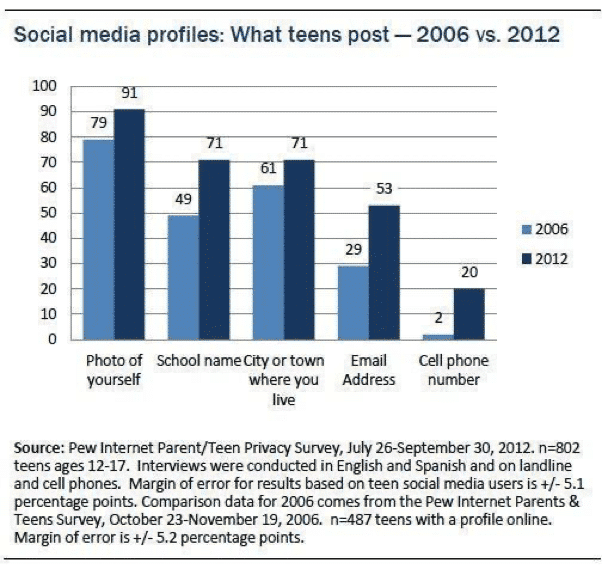
According to Pew Research Center, 71% of teens post their school name, 71% post the name of the city or town they live in, and 20% post their phone number.[1] Further, 36% of older teen’s Facebook friends are people they have never met in person.[2]
Although teens understand that oversharing can be dangerous, few have the life experience to understand exactly how it can be dangerous. When I was a teenager, the more “likes” I got on a photo or the more “friends” or “followers” I had on social media, the better I felt about myself and my online presence. I accepted friend requests from mutual friends who I had never met before, along with accepting requests from strangers. In my teenage mind, there wasn’t any harm in letting strangers see my online profiles. I felt that I would be okay as long as I wasn’t sending them my address. It didn’t occur to me that this data could be used to predict my location or even that anyone could have that kind of predatory intent.
Dr. Bennett shared a story with us where she worked on the production of the Lifetime TV show, I Catfished My Kid. In the show, producers created a poster board map (like detectives do) with yarn connecting the teens’ movements throughout the day for a week. With this data, they were able to predict daily habits like location, activities, and even who they hang out with.
How is Location Data Shared?
Instagram
One way location is shared on social media is through geotagged photos. A geotag is an electronic tag that assigns a geographical location to a photo or video posted on social media or other websites.[3] Geotags are commonly used to share what restaurant or city someone is in and are very popular on Instagram.
If your teen has a public profile and decides to post a photo on Instagram with a geotag, not only will their friends be able to see where they are, but users around the world can too. By simply clicking on that location’s tag, your teen’s photo will pop up as a current or recent visitor.
Another way location is shared on Instagram is by the use of hashtags. If your teen has a public profile and adds hashtags to their posts, their photos will show up as recent users of whatever hashtag they use, similar to the geotag feature. Hashtags are commonly used to have other users find their posts quicker and potentially gain more followers and traffic on their profile. However, that could be a privacy concern for younger users.
Facebook
The check-in feature on Facebook is similar to geotags. Facebook users “check-in” as an announcement to friends that they are visiting a particular location. Once checked-in, it appears on the user’s Facebook profile.
Snapchat
The SnapMap feature on Snapchat can also be a location risk. SnapMap allows your teen to share their location with their Snapchat friends every time they open the app. The SnapMap feature is a default, meaning it is automatically on so your teen might not even know that they are sharing their location. This is another privacy issue and may be a safety concern if your child accepts friend requests from strangers.[4]
Helpful Tips and Tools to Protect Your Child on Social Media
Set up a digital contact like our free Connected Family Screen Agreement and have ongoing, informative conversations with your kids about online safety. Our GKIS blog offers credible, interesting topics that will feed an ongoing agenda. Register for our Connected Family Screen Agreement to get on our weekly email list!
Set up your home to optimize best-use screen practices using our Connected Family Course for school-age kids.
Limit location sharing in Settings. On an iPhone, go to Settings and remove the location by clicking on the social media name > Location > select Never, Ask Next Time, While Using the App, or Always. You also have the option to turn off “Precise Location” meaning apps can only determine your approximate location
Don’t allow your child to have social media accounts until they are ready (we recommend after 13 years old or late middle school).
Require that your child set social media to private and only accept friend requests from family and friends they know in real life
Have your child change to the “Ghost Mode” on Snapchat (their location will no longer be viewable on SnapMap)
Thanks to CSUCI intern, Remi Ali Khan for researching common ways teens overshare on social media for this article.
I’m the mom psychologist who will help you GetKidsInternetSafe.
Onward to More Awesome Parenting,
Tracy S. Bennett, Ph.D.
Mom, Clinical Psychologist, CSUCI Adjunct Faculty
Photo Credits
Photo by Cottonbro from Pexels
Photo by Pixabay from Pexles
Photo by Pew Research Center
Works Cited
Deahl, D. (2017, June 23). Snapchat’s newest feature is also its biggest privacy threat. Retrieved November 04, 2020, from https://www.theverge.com/2017/6/23/15864552/snapchat-snap-map-privacy-threat
Dove, J. (2020, October 07). How to Remove Location Data From Your iPhone Photos in iOS 13. Retrieved November 04, 2020, from https://www.digitaltrends.com/mobile/how-to-remove-location-data-from-iphone-photos-in-ios-13/
Madden, M., Lenhart, A., Cortesi, S., Gasser, U., Duggan, M., Smith, A., & Beaton, M. (2020, August 17). Teens, Social Media, and Privacy. Retrieved November 04, 2020, from https://www.pewresearch.org/internet/2013/05/21/teens-social-media-and-privacy/
Oxford Languages and Google – English. (n.d.). Retrieved November 04, 2020, from https://languages.oup.com/google-dictionary-en/
Is your teen on Snapchat and Instagram? If so, they may be using what is popularly called, ‘plastic surgery’ filters. These filters may be altering your teen’s image of themselves and could be harmful to their mental health. I have been using filters on Instagram, Snapchat, and other social media platforms since I was a teen. Over the years these filters have become more face-altering than ever before. For more tips and guidance on social media, check out Dr. Bennett’s Social Media Readiness Course.
What Are ‘Plastic Surgery’ Filters?
Plastic surgery filters are filters that make users look like they have different types of cosmetic surgery. These filters give the users bigger lips, smoother skin, smaller noses, sharper cheekbones, and even different colored eyes. They are popularly used by celebrities, influencers, teens, and young adults.
Unrealistic Beauty Standards
‘Plastic surgery’ filters can be harmful because they promote unrealistic beauty standards by erasing imperfections and enhancing certain features. Teenagers view thousands of ‘perfect’ images daily on social media shared by peers, idols, and even themselves. This can cause self-esteem problems because beauty standards become less and less realistic.
Attention from Followers
Many celebrities and people I know refuse to post an unedited or unfiltered image of themselves, which is sad and scary. Attention from followers contributes to this problem. If a teenager posts filtered selfies and they get positive comments from their followers, they may depend on using those filters because they feel that they will not get the same attention without one. This can cause people to become obsessed with the filtered images of themselves and unhappy with their appearance without a filter.
Snapchat Dysmorphia
Along with lowering self-esteem, filters like these are inspiring more young people to get cosmetic surgeries because they prefer the edited version of themselves. Cosmetic doctors are noticing that filters might be leading to a new type of body dysmorphia. Body dysmorphia is a mental disorder where a person obsesses over a minor flaw in their appearance.
Dr. Esho, a cosmetic doctor, claims that an increasing number of individuals are bringing pictures of themselves with filters to plastic surgeons and asking to look like that. Doctors are calling this new type of body dysmorphia, ‘Snapchat Dysmorphia.’
My Personal Experience Using Filters
I have used filters that make my lips fuller, skin smoother, and face slimmer. When I was using them, I did not fully realize how often I was using them until my boyfriend once told me, “Why do you always use filters? You are beautiful without them.” He wasn’t telling me to stop using them, he simply asked me why.
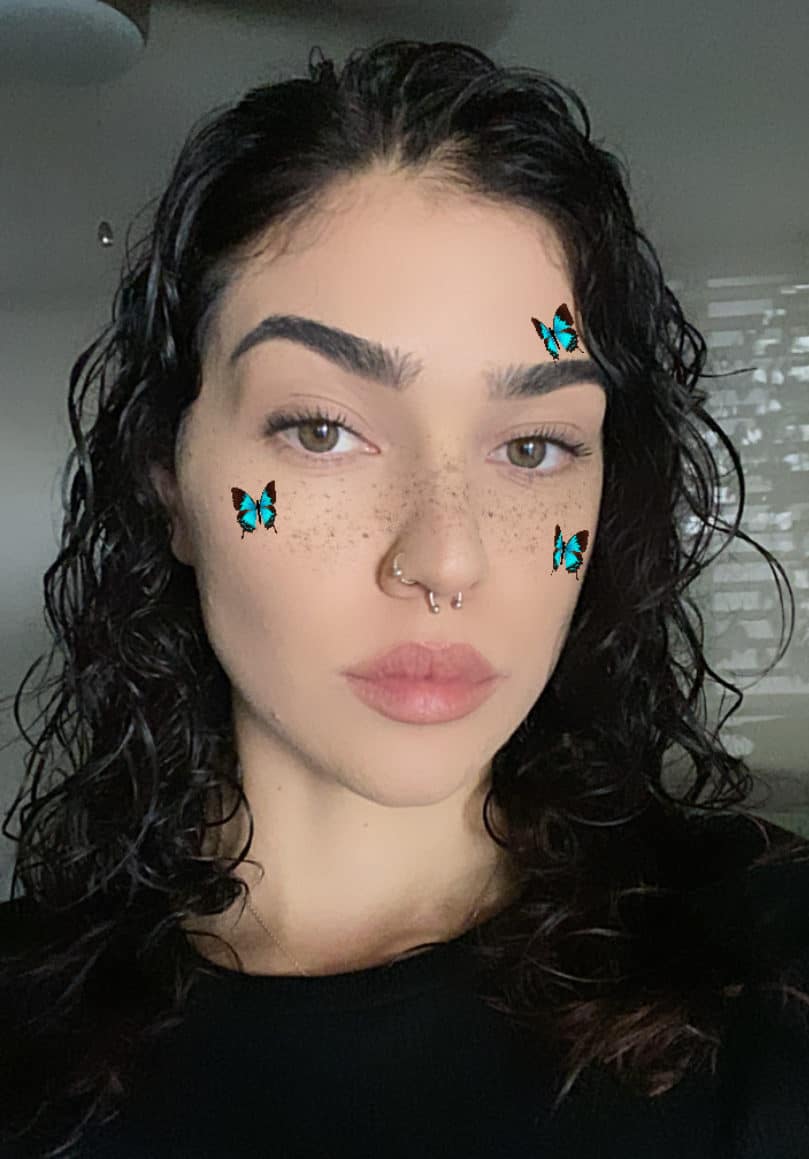
I realized that he was right, that I was relying on filters to feel beautiful. Since then, I limit my use of filters and embrace my imperfections. I want to share an authentic version of me. For this article, I decided to do a before and after using a few Instagram filters, so you can see how different they make me look.
(No Filter) Filter 1 Filter 2 Filter 3
What can you do if your teen is using filters on social media?
Just because your teen uses filters does not mean that they will develop a disorder or develop self-esteem problems. Everyone is different. But it is important to be aware of the potential risks of this social trend.
If you notice that your teenager is on social media and using filters here are some things you can do:
Have a conversation with your teen.
Talk to your teenager about what they see on social media. Remind them that most of the photos that they see on Instagram or any other platform are not 100% real because of filters or photo editing. This is something that they most likely are aware of, but I oftentimes have to remind myself of this when I am scrolling through Instagram.
In this generation where many teenagers and adults rely on likes and comments for self-worth, it is important to remind your teenager that there are more qualities in life that matter than their looks. Point out their other qualities and strengths like work ethic, intelligence, and kindness.
Don’t forget to remind them that they are beautiful without a filter!
Practice positive affirmations.
Teach your teenager positive affirmations and practice them together. Affirmations are positive statements that you say out loud to yourself. 7 Mindsets provide helpful affirmations for teens, here are a few:
“I embrace my flaws because I know that nobody is perfect”
Best, S. (2020, January 28). Instagram still has several ‘plastic surgery’ filters despite ban last year. mirror. https://www.mirror.co.uk/tech/instagram-still-several-plastic-surgery-21369194.
Cavanagh, E. (2020, January 11). ‘Snapchat dysmorphia’ is leading teens to get plastic surgery based on unrealistic filters. Here’s how parents can help. Insider. https://www.insider.com/snapchat-dysmorphia-low-self-esteem-teenagers-2020-1.
Hosie, R. (2018, February 6). People want to look like versions of themselves with filters rather than celebrities, cosmetic doctor says. The Independent. https://www.independent.co.uk/life-style/cosmetic-surgery-snapchat-instagram-filters-demand-celebrities-doctor-dr-esho-london-a8197001.html.
Kelly, S. M. (2020, February 10). Plastic surgery inspired by filters and photo editing apps isn’t going away. https://www.cnn.com/2020/02/08/tech/snapchat-dysmorphia-plastic-surgery/index.html.
Rodulfo, K. (2020, August 13). It’s Easier Than Ever To Make A New Face On Social Media. But Is It Killing Your Confidence? Women’s Health. https://www.womenshealthmag.com/beauty/a33264141/face-filters-mental-health-effect/.
Manavis, S. (2019, October 29). How Instagram’s plastic surgery filters are warping the way we see our faces. https://www.newstatesman.com/science-tech/social-media/2019/10/how-instagram-plastic-surgery-filter-ban-are-destroying-how-we-see-our-faces.
Yang, L. (2018, August 10). People are seeking plastic surgery to look like their edited selfies in real life – here’s why doctors think the trend is ‘alarming’. Insider. https://www.insider.com/plastic-surgery-selfie-filters-2018-8.
Our Gracie got her first smartphone when she was ten years old. We wanted to wait, terrified of the creeps and porn and the rest of it. But she needed to contact us for pickup from dance, and that’s how her friends connected. Without a phone, she got left out of plans and private jokes. She was feeling more and more alone, and we worried she was depressed. We caved. We couldn’t take the begging and crying. We tried to do it smartly, starting with a phone and no social media. We read articles about risks and checked her phone regularly. We insisted she wait until she was 13-year-old for social media. We allowed only YouTube and TikTok to start. She’s loved it and quickly started feeling better. Two years later, it doesn’t seem unreasonable to allow Instagram. She’s 12 now, so it’s maybe a little early. We’ve talked to her about it a lot. She rolls her eyes, but I think she gets it. She’s smart and funny and social. We are confident she’ll be fine. At least we hope so…
And there it is, the way it happens for most families now. As a screen safety expert, mom, and psychologist, I get it. We all outsource to our phones: for memory, entertainment, navigation, design, communication. When’s the last time you memorized a phone number or planned a trip with a paper map? We are cyborgs and so are our kids. Digital fluency is part of life and a critical element to education, especially now. Screen restriction until high school may be wise, but it isn’t an option for most families. We survived running around town with our friends unsupervised.
Is screen time that big of a deal?
The short answer is . . . that it can be. Preventing screen-loving kids from wandering into a dangerous digital neighborhood isn’t always possible, especially at the beginning. We are too busy, and they are too clever for us to supervise everything they do online. Even the best tech tools have workarounds. But there is one step you cannot miss if you think they are ready for social media, teaching them judgment and accountability like we do before they are allowed to drive a car. Does driving city streets have anything in common with browsing the internets?
As a psychologist who treats digital injury (psychological harm resulting from internet use), I would argue it does. Like driving a car, browsing the internet can cause significant injury. But instead of a concussion, we see kids succumbing to anxiety, depression, and body image problems linked to cyberbullying, radicalization, and compare-and-despair.
Also like driving, kids browsing the internet can wander into any kind of digital neighborhood making friends from faraway places. Most of the places they visit are cool, with fun friends, creativity, and harmless excitement. But there are also digital neighborhoods that would horrify us. Dangerous people like predators and traffickers may be common there and so is intensely violent and explicit sexual content.
Kids who’ve learned the traffic laws from driver’s training and practiced for many hours with invested parents and trained experts are safer. They are so much safer than the government requires these prerequisites before getting a state-issued driver’s license. Doesn’t it make sense to offer the same support for screen use?
Yes, we could keep them off screens and avoid the issue altogether. Yet, also like a car, the internet offers access to learning opportunities that help us thrive. Despite the risk of accidents, we browse because we refuse to miss out on that great job, amazing discovery, and healthy social connections. Our kids feel the same way about their screen devices.
If allowed to browse with little training, more accidents seem certain. That is why my private practice is flourishing. Treatment doesn’t erase trauma; instead, it helps with coping. Once a child experiences danger on the internet, that memory never goes away. Our best options for child screen safety lie in prevention.
What can we do to help tweens and teens browse more safely with sound judgment and accountability?
We can require Internet training! Like driver’s training, our online Social Media Readiness Course offers education about digital risk as well as tools for psychological wellness.
Specifically, our GKIS subscribers get:
lots of verifiable facts and science-based information about online risk and screen use (no fake news),
expert strategies and techniques to optimize psychological health and judgment,
realistic exercises that illustrate typical online scenarios and help coach sensible resolutions,
trigger-topics to encourage smart parent-child discussions to further build a healthy alliance,
accountability quizzes so you know they are learning as they go, and
opportunity for the child to act independently and practice without parent guidance (although course access for parents who want to take it first or along with them is optimal).
I’m the mom psychologist who will help you GetKidsInternetSafe.
“First impressions are everything.” This once referred to tone, dress, and personality. Now, it also refers to your social media page. Teens rack up an average of 6 hours per day of social mediag.[1] They not only browse endlessly, but many also post impulsively. With immature prefrontal brain development, kids and teens are unable to anticipate consequences. Plus, the internet culture is vulgar, shocking, and celebrates pushing moral limits. Using profanity, sub-tweeting and cyberbullying are common. Using principles from Dr. Bennett’s book, Screen Time in the Mean Time: A Parenting Guide to Get Kids and Teens Internet Safe, this article covers how to best guide your teen through the social media dilemmas of cyberspace.
Social media is the perfect place to “out” your enemies.
My friend “Catherine” used to expose her ex-boyfriends on Facebook. Once she posted, “He says he’s over me, but he just came to my house and cried.” Often, she’d think twice and delete her post. Other times, her ex-boyfriends posted angry responses outing her bad behavior back.
My friend “Robert” also shared a personal story. This is one about Myspace going wrong. When he was in the eighth grade, his high school sophomore girlfriend sent him sexy selfies. Robert showed his friends the photos. Although he refused to text them directly, a friend hacked his phone and sent himself the photos. Within a few days, the girl’s family and the police were at Robert’s door. Her photos had been posted on Myspace. Although Robert did not directly post her photos, he was held responsible because they were initially on his phone.
Online Behavior Matters
We love our podcasts at GKIS. In one of our favorites called Hidden Brain. The “You Can’t Hit Unsend” episode tells the story of William, whose social media posts destroyed a golden opportunity with Harvard.[2]
William was a brilliant high school senior from Pennsylvania. He was a great student who played competitive golf and performed for the local symphony. Although he didn’t believe he was “Harvard material,” he applied anyway. He was accepted through the early admission process and was overcome with joy. In the excitement of his acceptance, Will quickly joined an online group chat to meet other incoming freshmen.
One chatroom that focused on sharing memes was particularly funny. As the chatroom friends grew closer, they exchanged increasingly “edgier” memes, riding the fence between funny and offensive. To be added to the subgroup chat, at least one edgy meme had to be shared in the main group chat. As time passed, the memes increased in explicitness, oftentimes referring to outrageous, violent, and sexual topics. Will states that members of the chat knew that their meme was good based on how many likes and fire emojis members commented afterward.
The admissions department at Harvard University learned of the private chatroom and investigated. Harvard withdrew admission offers from ten prospective students because of their participation.
Will shared that he will always remember the last sentence of the email, “Harvard can withdraw admission under various conditions, including if you engage or have engaged in behavior that brings into question your honesty, maturity, or moral character.” Now he recognizes how adults would be offended and regrets his posts. He apologized, “It is far too easy to act out of character behind a screen in a fast-paced setting and to say things I would never say or even think of in my everyday life.”
The Harvard student newspaper later published the story. Soon after, the story was everywhere, including CNN and Fox News. Will and his family were devastated.
He waited a year and applied to other schools, only to be rejected by all ivy league universities. Will’s voice broke with emotion as he spoke of the experience. Fortunately, his emotional honesty appealed to a physics department chair at a school he was waitlisted at, and he was ultimately granted admission.
College Recruiters and Managers Search Applicants Online
Social media posts can make or break a teen’s future. The relationship between your digital footprint and personality is about as constant as the relationship between personality and behavior, also known as “the personality coefficient.“[3] That means that your behavior on your social media profile is a reliable source of information about your personality.[4]
Many college admission officers and employers use online data to investigate prospective students or employees. While the internet is fun and creates a space for creativity and connection, adolescents can make dire mistakes online just as they do offline. Instead of those mistakes happening in front of a few close friends and family, they can be blasted out to millions. Social media profiles produce large amounts of user-generated data that may be used and sold in ways we cannot anticipate.[5]
As social media evolves, parenting tactics must evolve as well. That means educating yourself about the risks of posting and challenging your kids to explore online risk with ongoing empowering dialogue.
Here are a few ways you can prep them today:
Use our free GKIS Connected Family Screen Agreement to set parameters and create a screen-friendly, cooperative dialogue.
Engage in fun co-viewing, both with passive screen use (TV) and interactive screen use (browsing the internet). Fun projects may include researching a particular topic using various learning formats (articles, videos, images).
Find food recipes and cook a meal together.
Co-create a movie – complete with music, still-image slides, videos, and graphics.[6]
Work together to purposely stylize your family’s cyber footprint. Ensure that that footprint will work for you rather than against you.
Act as a role model on social media and encourage responsible posting.
Internet sites can collect and analyze large quantities of data from everyday devices.[7] This information provides more opportunities to use data in deceitful ways. With helpful GKIS tools, you can best prepare yourself and your teens.
Thanks to Isabel Campos for her research and help with writing this article. Interested in learning more about current cyberspace news? Signup for weekly GKIS articles by entering your name and email address at GetKidsInternetSafe.com!
I’m the mom psychologist who will help you GetKidsInternetSafe.
I taught my kids all about online safety, and now they use it against me. I’m a screen safety expert and a psychologist, and I admit I’ve had a screwed up relationship with Facebook. It started out that it was such a new and cool forum to check out the lives of people you like and had genuinely lost touch with. It was so fun to see that college roommate who actually became a journalist…or that high school boyfriend who kicked his weed habit and seems to have a great marriage with happy, healthy kids. And how exciting to show everyone how great your kitchen remodel turned out and how your kids were rockin’ those new backpacks the first day of school. Early on, Facebook was a beautiful landscape of fresh faces and fun stories…kind of like the first 30 minutes of your ten-year high school reunion. But then, just like that high school reunion, people started revealing the other annoying sides of themselves.
You know what I mean by that. Your cousin who constantly brags about her relationship when you know she kicks her husband out every other month. Or that friend who sensationalizes other people’s tragedies by pretending she is totally distraught and constantly praying – and you know she’s only talked to them three times. Your bigoted Uncle Bob spews racist rhetoric, and you get drawn into ugly political debates and later have to delete your overzealous comments after the bloodshed. At some point in accumulated online trauma, Facebook wasn’t as fun anymore.
Our kids witnessed it. They posed for us and encouraged us to share at first. But after a while, they caught on that some of the humor parents shared about the challenges of parenting weren’t very nice. They realized that their beaming grin with braces and green, shiny pool hair after their fourth-grade summer wasn’t very flattering. They started to fear that their parents were using them to promote the family’s community image…and it felt kind of fake. They were feeling used to prop up a virtual ego that was kind of pathetic.
Besides, kids love to kill their parent’s joy. I’m the mother of three, ages 25, 17, and 15 years old. Nobody calls me out more brutally than my teenagers. They don’t even try to be nice about it. They started to tell me, in no uncertain terms, that I wasn’t to post photos of them anymore without their permission. And me begging them to post was humiliating, so I quit doing it.
Look, I’m not ashamed of being a crazy mom. I love my kids. I want to show others how awesome I think they are. I also know I’m not alone. I hear about these issues every day in my clinical office. Some parents do it anyway…but it damages the trust in the family. Others, like me, post about our adult lives outside of our kids. We know that our Facebook friends are a different tribe than our nonvirtual one. There’s overlap, sure, but we only have the opportunity to interact with some of them on Facebook, and we don’t want to give those relationships up.
Go ahead and troll me and tell me what a loser I am that I still post. But let’s be honest here. Most of us still use Facebook to at least check in with others. Some have gone Facebook free, and, like recovered smokers, they love to tell us how it’s made their lives more precious. It probably has, but for now, I’m still posting about travels and puppies and the occasional funny meme. I’ve hidden the Uncle Bobs and fake prayers while celebrating those I’m truly fond of and rooting for.
And as for the kids who are revolting due to sharenting…have at it you guys! Yes, many of you are hypocritical as you constantly post on Snapchat. You may even assert yourselves more to boss your parents around than because you have an actual concern. But the fact that you have a passionate opinion and the assertiveness to state it is the kind of resilience I believe in as a parenting expert. You are the best advocates for GetKidsInternetSafe. Because typically, the kids who speak up to their parents are not blindly obedient pleasers. They have informed opinions and well-honed voices of confident digital natives. That practiced voice of calm and intelligence may save them from a bad actor they run across online or in their three-dimensional lives. I think that, even though we want to share the parenting part of our lives with our friends, posting should require shared consent. Kids do have rights.
As for our family, with the exception of a few side profiles here and there, I have opted not to put my kids’ faces on my promotional materials for GetKidsInternetSafe. I also don’t share them on my Facebook profile or cover photos, because they are public and not private.
Occasionally, my kids throw me a bone and allow me to post pics of them here and there. But once they’re up for a bit, I typically delete them – kind of like a manually-disappearing-profile ala Snapchat for old people. The truth is, it creeps me out to have a running photo commentary of my life that weird acquaintances could excavate if they were lurking.
For parents of young kids, get ready. One day you’ll hear a protest about it. If you listen and respect their great reasons for not consenting, it’ll be a learning opportunity that will build up your relationship. If you blow them off and play the authority card, you’ll be squelching their voices. Either way, it’s annoying to be told what to do by a tween or teen. But honestly, I’d much rather watch my kid be an outspoken advocate for themselves than a compliant pleaser. Wouldn’t you?
Thanks to Thriveglobal.com for publishing this article.
I’m the mom psychologist who will help you GetKidsInternetSafe.