With social media and public servers for games, your child is likely to come across many different types of people. Just like in real life (IRL), they may come to be great friends. There is concern—and for good reason—if this is safe. A “catfish” is a term commonly used in popular culture to refer to someone who presents themself online to be someone or something that they are not. In our GKIS article “What You Need to Know About Online Catfishing,” we covered information about the rise of the term catfish, the psychology behind it, and certain red flags. In this article, we will cover how to best recognize catfishing and how your child can more safely meet an online friend once you, as the parent or guardian, have determined it is safe.
The Benefits of Making Friends Online
The internet displays a diverse range of people from many different cultures, ethnicities, identities, and lifestyles. Exposure to people different than themselves can be a great learning opportunity and help your child develop empathy and a greater perspective of the world. Dr. Tracy Bennett, Screen Safety Expert and Founder of GetKidsInternetSafe offers weekly parent and family coaching to help parents optimize the benefits of screen tech while minimizing risk. To learn more about her coaching videos, check out the GetKidsInternetSafe App. Sign up now and the first 30 days are free!
For kids who may be of a marginalized community themselves, like those who identify as LGBTQ+ for example, online contacts can be a lifesaver. Not only can kids have fun with their online friends who share similar interests and values, these friendships may also provide a sense of understanding, bonding, and representation.
In a 2014 study by Van Zalk and colleagues, shy adolescent participants who had online friends reported fewer depressive symptoms than those who were friendless.[1] Also, they found that having online friends didn’t distract the subjects from making IRL friends. Instead, online friends improved real-life friendships. This suggests that online friendships may boost self-esteem and social skills, so kids gain the confidence to seek friends offline too.
Making friends online may also be easier and more realistic for some kids, especially if they have trouble approaching new peers in real life. Further, if your child feels outcasted, they might search for an online community with or without your permission. So, preparing your child for safer online exploration may be your best option.
My Catfish Story
I’m a 23-year-old CSUCI intern for Dr. Bennett. In 2013, I joined an online friend group from a public Minecraft server. We would regularly participate in Skype group calls to play. All of us except one person—who I will call Sam—would regularly show our faces on video camera. Because we often saw each other, we felt we knew each other. But Sam refused to show himself on camera. Instead, he led us to believe that he was who he said he was by occasionally updating his profile picture.
Sam was really handsome and he eventually started dating one of the girls in our friend group. They tried meeting a few times, but something always came up where Sam had to cancel. We were in awe of his skills in the game and he gave us some assurance by going on camera although it was in a dark room.
Over a year into our friendship, Sam accidentally let the camera slip to reveal his face. Although it was a relief to see that we were, in fact, talking to someone our age, we were unsettled that the photos he was using were not him. Imagine the ways Sam could have been dangerous for us in slightly different circumstances.
How to Prevent Being a Victim of Catfishing
Verify Identity Through Social Media History
It is rare for a person to not have a digital footprint these days. However, with kids – they are often new users. If your child’s new friend does have social media, be suspicious if all their profiles are new.
Red flags for catfishing on Instagram might be if the person’s photos were all posted recently, if they are not tagged in any photos, or if the photos they are tagged in are from new accounts or accounts with under 30 followers.
To determine if a Snapchat account is new, look at the person’s Snap Score. A Snap Score is a feature shown on a Snapchat friend’s profile that displays the amount of live Snapchats the friend has received and sent. A Snap Score lower than 100 could indicate that the online friend recently created their account.
Other Snapchat Tricks
Snapchat offers a few features in addition to video calling. For example, you can send pictures and videos that have just been taken. One way to game this exchange is for the catfish to use their phone to take live pictures of preexisting pictures from another device.
A good way to challenge this deceptive catfish trick is to insist that the online friend send a personalized video that mentions your child’s name or a specific activity of your choosing. A few years ago, sending a selfie holding a sign with a name would have been satisfactory. But now with easily accessible editing software, written messages on paper or signs can be altered.
Opt for Video Chatting
Live video chatting can take place in many different forms through platforms like FaceTime, Skype, Facebook, or Zoom. We at GKIS especially like Facebook’s Messenger Kids. Dr. B is on Facebook’s Youth Advisory Team and has enjoyed having a part in its development from the beginning! She says she loves Messenger Kids because it doesn’t expose kids to ads and is the walled garden with parent transparency we’ve all been hoping for. Live interaction between two people makes it difficult to catfish. Even if the person tries to recycle prerecorded media in an attempt to appear live, it won’t look authentic because live chat conversation typically requires personal response.
Meet in Public
Unfortunately, there is no way to be 100% certain until you meet the friend in person. With deep fake technology, even personalized messages can be created.
If you’ve vetted your child’s friends online and you feel it is time for them to meet, meeting in public with your supervision is a good first option.
Meet their Parent(s)
Meeting the friend’s family can also help develop confidence in supporting your child’s new friendship. That way future plans can be run through the parents first.
Have Fun
Most importantly, have fun! Your child may have been waiting for months to meet their friend and now they finally can. You can also take comfort in the fact that you helped your child bring their newfound virtual friendship into real life.
Social Media Readiness Course
As kids get older, they must demonstrate knowledge, capability, and resilience to gain independence. We recommend our GKIS Social Media Readiness Course to help improve your tween’s or teen’s online experience by teaching the potential risks on social media and providing them with emotional wellness tools. As your teen works through the course, there are mastery quizzes at the end of each module so you can take track their knowledge-build course.
Thanks to CSUCI intern, Avery Flower for researching the pros and cons of creating friends online and co-authoring this article.
I’m the mom psychologist who will help you GetKidsInternetSafe.
Onward to More Awesome Parenting,
Tracy S. Bennett, Ph.D.
Mom, Clinical Psychologist, CSUCI Adjunct Faculty
[2]Van Zalk, M. H. W., Van Zalk, N., Kerr, M., & Stattin, H. (2014). Influences between online‐exclusive, conjoint and offline‐exclusive friendship networks: The moderating role of shyness. European Journal of Personality, 28(2), 134–146. https://doi-org.summit.csuci.edu/10.1002/per.1895
I wrote this article for my awesome GKIS Social Media Readiness Course for tweens and teens. I have to admit, I have never worked so hard on an article. Explaining complex psychological principles that big tech bakes into video games in easy-to-understand language for teens is difficult. But this information needs to be understood by everyone who uses screen technology – like a how-to manual.
Why This is Important
Too many of us are addicted to our screens, and it’s not an accident. Programmers intentionally bake hidden brain traps into our devices and onscreen activities to capture our attention. Technology has moved us into a new wildly profitable market where our attention is the commodity. The more attention they can get us to surrender, away from healthy offscreen activities like hanging out in real life, sleeping, being in nature, and anything else that offers us three-dimensional brain enrichment, the more money they make.
Big tech has cracked the code on brain reward. With psychology research and protective laws lagging behind rapidly developing technology, it’s up to us to understand what we’re up against. Learning how to recognize manipulatively designed brain traps can break the spell, interrupting our screen dependence and our spending.
I’ve tested it on gamers in my practice. By teaching them how special features trigger our feel-good chemical (dopamine) in the pleasure center of the brain, gamers can be taught to recognize it as it’s happening. With this new awareness, many of them popped out of autopilot responses and found the games less enticing.
How To Teach Your Kids
If you teach your kids about the hidden brain traps of video games, maybe they too will change their addictive online habits! For younger kids, just cover a few items at a time. Older players may be willing to cover all of these hacks at once. Make the discussion interesting and fun. If your child is getting bored with these fun facts, take a break and return to the discussion later.
Don’t forget to ask them what they think along the way and be willing to listen and learn as well as teach. You’ll find that these ideas pop up again over and over if you keep the cooperative dialogue going.
The application of this learning has endless benefits. Get familiar with the ideas on your own first, then teach these concepts along with your free GKIS Connected Family Agreement. Congrats on being the parent who goes the extra mile for the health and happiness of your family.
What We’re Up Against
There are lots of screen activities that can addict users, but video games are among the strongest. They’re so fun and compelling that some gamers lose control and can’t pull away. Gambling and gaming are the only addictive behaviors officially recognized by the World Health Organization and the mental health community.
Behind gaming is a huge profit. In 2019, 2.5 billion gamers contributed to a gaming market that made 152 billion dollars![1] The most successful game in video game history is Fortnite. First released in July 2017, gamers can download it for free on nearly every gaming platform. In just two months of being on the market, Fortnite was played 2.7 billion hours, the equivalent of 300,000 years.[2] Currently, it boasts 78.3 million players a month.[3]
Under Fortnight’s spell of perfectly programmed brain traps, I’ve had clients drop out of school and isolate themselves from friends and family to play 12+ hours a day. The most addicted can barely sleep, fail school, and become socially isolated and burned out. Some are admitted to pricey screen addiction rehab programs that are often outside of their home states and away from their families!
What makes video games like Fortnite so addictive?
Each brain is unique with over 100 trillion synapses(the spaces between our brain cells where cell communication takes place). Not only does our DNA impact our brain wiring, but so does experience. That makes learning a nature-via-nurture phenomenon. In other words, we seek out certain experiences because of our brain wiring, and our brain wiring changes in response to our experiences.
No two people experience video games alike. Some people may be barely amused by the most addictive video game on the market, while others will forgo eating and sleeping to rack up points.
On the other hand, we are all human. We come from a common ancestry that developed with similar evolutionary triggers in play. As a species, we’ve been hunting and gathering for 200,000 years; that’s 90% of human existence.[4] Atari first introduced Pong in 1971. That means video games have only weighed in for the last .024% of our evolution. Find the triggers that captured the attention of our Neanderthal ancestors, and you’ll find triggers that capture us today. Technology has evolved much faster than our human brains. We simply can’t keep up.
Rewards and Punishments Are Folded into Gameplay
One of the first things college professors teach is the processes behind how we learn. Operant conditioning is a psychological learning method that involves rewards (pleasant) and aversives (unpleasant).
When a behavior increases, it has been reinforced. When a behavior decreases, it has been punished. Programmers use reinforcers and punishers to manipulate player behavior.
Rewards
The most obvious reinforcers in video games include points, prizes, and social likes that are delivered with attaboys in the form of yummy sights and sounds. Cool graphics, pleasing colors, attractive shapes, and amazing sounds stimulate the pleasure centers of our brains. When I asked my son what sounds he finds most appealing, he said the “kill” sounds are particularly attractive in Fortnite, especially the higher-pitched headshot sound and the sound of ammo reloading. My army of client gamers enthusiastically agreed.
Punishments
If we are doing badly in a game, it makes us anxious. Not only are we disappointing ourselves, but others may see we are failing too. Of course, game creators don’t let us feel crappy for long. They offer up relief from that unpleasant stress at mixed intervals (just like slot machines do), and we get double hooked!
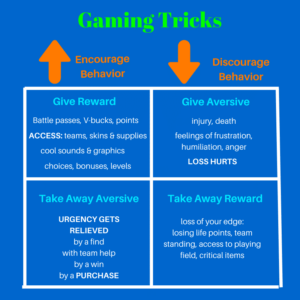
Brilliant game builders exploit all four of the operant conditioning boxes on the blue image. Game features that interact with our primitive brains are so sophisticated and so well executed that we don’t even know it’s happening to us.
Remember nature via nurture? Our brain wiring sets us to seek gaming rewards and gaming rewards change our brains. Psychology research has demonstrated that addictive gameplay specifically permanently changes our brain’s interpretation of rewards and losses.[5] The addict’s rewired pleasure center makes recovery very challenging.
Learn these game traps that hack our pleasure centers, and you may be better equipped to make choices about gameplay instead of blindly getting tricked into them.
Expert Video Game Traps Designed to Snare Your Attention & Emotions
Finding Your Tribe & Being a Leader
One of the cornerstones of our survival as humans is our ability to form tribes and have babies. Through attachment and cooperative communication, humans dominate over other Earthly species.
Gaming programmers know what makes us tick. They build games by testing them on themselves and millions of teen players they pay to play for study. By isolating and testing addictive game features, programmers combine the motherload of behavioral reinforcers.
Social feedback is one of those ultimate rewards. The likes and verbal and written comments from other players are like crack cocaine to the human brain. This is why the most popular games allow you to make new friends and invite others. The more influence we have, the more social capital we’ve earned.
Social capital, the good feelings we collect from our interactions with friends, is particularly valuable to teens. It’s during this phase of development that one prepares to leave their family and hone in on attracting your tribe. By finding friends, testing skills, and “versing” each other, kids thrive on the team aspects of play.
But what if you are too shy to fail in front of your friends? No worries, the gaming engineers thought of that too. They allow you to start by playing anonymously or playing against yourself or strangers. That way you slowly gain confidence until you’re ready to show off your new skills with your team.
The emotional stimulation of wins and losses with your friends is extraordinarily captivating. As a young player told me, “Dying sucks and the team gets mad at you because they die too. If your friends are beating you, it makes you mad. So, you work to get more dubs (w for wins) to get bragging rights.”
Standing Out in the Crowd
But what if you become like everybody else in the game? You won’t stand out at all. That’s not fun.
Voila! Game makers thought of that too. They help you stand out with badges, points, and skins that discriminate who’s a newbie and who’s a pro. Sexy curves and muscled skins are valuable game commodities. By crafting the perfect look, players can attract other teammates. How you look, the levels you’ve achieved, and your arsenal of skills and weapons offer the optimal distinctiveness you need to stand out in a crowd. In Fortnite, you can even earn the opportunity to be paired with other high-ranking and even celebrity players.
Brain Candy Learning & Expert Mentorship
Humans love to set, pursue, and reach goals. Learning through trial and error and tracking progress is deeply satisfying to our most primitive selves. We especially love to learn from people we look up to and want to be someday, like celebrities and influencers. Celebrity endorsement as a branding (selling) strategy is illustrated by the popularity of Let’s Play videos (videos of other gamers playing and commenting on gameplay) on streaming sites like Youtube, Twitch, and Mixer.
You don’t want to put in the hours it takes to learn everything? No worries, game creators will let you pay your way to the top by buying up for levels. Even players who haven’t reached celebrity status can make money from expert play. I’ve had clients play an account until they’ve leveled up, then sell these accounts for thousands of dollars to buyers who want expert-level access to features without having to put in the time commitment.
Backchannel deals can also lead to big-earning e-sport tournament play. Some players even win college scholarships in tournaments that boast prize pools as big as 34 million dollars![6]
Hunting & Gathering > Building & Defending Community
Just as our ancestors did, our brains delight in building and defending the community. Being a good seeker, builder, and warrior gave us an evolutionary advantage.
Fortnite taps into these traits by having players forage for and gather useful, rare, and collectible items randomly placed around the map. Excited anticipation paired with finding items triggers our hunting and gathering instincts.
Fortnite also offers community competition and violence to scratch that primitive itch. Although parents are pleased there aren’t blood spatter and guts in Fortnite, developers know that tapping into our human need to protect and survive through violent in-group, out-group protectionism is a sure win.
How They Make Losing Fun
Getting a victory royale in Fortnite is difficult. Players must have the skill and luck to defeat other competitors in battle. Most gamers play multiple, consecutive rounds without getting a victory royale because, in their minds, they are not failing, they are “almost succeeding.”
In psychology, this is known as the near-miss effect. A gambler experiences a near-miss when almost winning a hand in poker. They take it as a sign to continue playing. During a near-miss, the brain’s reward system activates the same way it would during a win.[7] Earlier generation Candy Crush game developers learned that the near-miss effect kept players hooked for hours and willing to spend, and Fortnite adopted this strategy.
Attracting New Players & Keeping Old Players Playing
To stay successful, games need to bring in new players while keeping the attention of seasoned players (must cater to different player populations). Building anticipation for something new and exciting with a free gift is a sure way to hook and keep customers.
Upon signing up for Fortnite (which is free and convenient), players are offered a starter bundle. Once you get tired of that, more anticipation is generated with the promise of another free gift with repeated seasonal battle passes which contain prizes like free skins, a pickaxe, a glider, a rare item, and some XP multiplier to level up in the game. Each season offers a new map and fresh features to avoid burnout.
To reinforce habit and daily use, Fortnite even offers a fee asking for unlocking a majority of weekly challenges (55 of the 70) and cash if you log in on consecutive days! With immediate and long-term rewards, the game traps the immediate-reward players and the work-for-it-reward players.
Making Money From the Game & Within the Game
In 2018, Fortnite made 2.4 billion dollars in revenue.[8] Most of this revenue came from players purchasing skins and emotes. As of January 2020, Fortnite was in its first season of Chapter 2. Chapter 1 had ten seasons.
With each season comes the release of new skins and emotes, as well as the removal of ones from past seasons. Removing products from the marketing creates an impression of scarcity – meaning if you don’t buy now you’ll lose out. This makes collecting and purchasing skins and emotes a high priority to players, as it signifies status within the gaming community. The more fancy tools we collect in our cave, the more leadership we build within our community.
Triggering a sense of urgency in players is highly motivating, anxiety-producing, and builds intensity. Finding that sweet spot of flow between boredom and anxiety is the quest of every gamer. Once again, Fortnite doesn’t disappoint. The sense of urgency while searching and release upon finding creates a feedback loop of needing more, more, more! Being online puts us in a perpetual state of want.
Anxiety When We Leave the Game and Intense Craving to Get Back to Playing
Intensely craving game rewards feels pretty exciting in the short term, but in the long term, it can be stressful and take a toll on our mental health. That is why so many young gamers throw tantrums when they have to get off the game and older gamers feel irritated, frustrated, and depressed. Needing more skills to keep earning points builds what we call tolerance in addiction medicine, and the terrible feeling when we get off is called withdrawal. Just like drugs of addiction, tolerance keeps us using more and more and withdrawal makes us crave more gaming.
It’s Contagious!
Speaking of craving and withdrawal, Fortnite knows that watching friends have fun triggers FOMO (fear of missing out). By jacking up player anticipation with live online events, Fortnite gets players advertising to their friends for free.
To attract big numbers, Fortnite offers exclusive information and items. In other words, gamers must attend to get a chance to see what’s coming and get access to cool stuff. Players prioritize these events to get a leg up on team members.
Earning Your Trust & Upping the Ante
Since we covered the standards in marketing in business like scarcity and urgency, you might as well learn about the upsell. Marketers know that we buy out of habit. If they can get us to use our credit card once, we will be far more willing to use it a second and third time.
To get us into this buying habit, games offer an in-game purchase for cheap. Once we buy that, they then approach us with the pricier items. Since we trust them after liking the first item, we are more likely to purchase from them again.
An example of an upsell in Fortnite is the offer for a common emote or skin costs only $8. Once you buy that, Fortnite entices you with a more expensive and rare emote or skin for a higher $20 price. Fortnite in-game purchases can be very expensive. A father from England found out when his son spent $918 on the game in three days![9] Fortnite is a virtual marketplace that is very enticing to immature brains.
If You Like Them, You’ll Also Like Us!
Fun products that tie into popular brands, like The Avengers, are often integrated with video games. This is called affiliative marketing (meaning if you affiliate with or like another brand, they can entice that brand’s users over to them). By paying an already-popular brand to partner, both brands benefit by sharing each other’s user base. Celebrity skins, affiliation, and team competitions sweeten the offer even more.
Issues Specific to Neurodivergent Players
Neurodivergence simply means players who think differently than the average player. Most commonly, it refers to people who have traits of autistic spectrum disorder (ASD) or attention-deficit hyperactivity disorder (AD/HD). All players have gameplay strengths and weaknesses. But for neurodivergent players, these strengths and weaknesses can be more extreme.
For instance, many neurodivergent players have a tough time making and keeping friends in real life. For them, the opportunity for online mastery and social capital is particularly valuable. And the cool thing is, some strengths typical of neurodivergent players, like pattern recognition, make them awesome gamers. One of my ASD clients describes loving the problem-solving elements of gaming and the thrill of earning accolades from her teammates for her exceptional Jedi skills.
Should we just forbid video games?
Going screen-free is not an option for most because of the extraordinary learning, communication, and socialization benefits that screens bring. Also, the genie is out of the bottle already. If everybody else is doing it, it may be a real loss to your child to not have access to their friends.
Fortnite, which some say is on its way out, is not the only culprit. As long as the video game market continues to pull in a huge profit, developers will continue to build games with increasingly sophisticated brain traps.
By reviewing this article with your gamer tonight, covering the points where you agree or disagree, and asking them for their thoughts and observations, you will empower your child through the parent-child connection. Protecting your kids is less about depriving them of screen time, and more about giving them the tools they need to have informed agency. By equipping our children to be smart problem solvers on- and offline with loving support, we open the bridge to really connect as a family. It’s the connection that our children are looking for, and we are a part of that.
The Next Step
Although this article offers a ton of free information, there’s so much more to learn for long-term mental health and brain enrichment. Also, you want your kids to become increasingly more independent and start to solve problems on their own when you aren’t there for help. For even better coping and psychological resilience, you don’t want to miss our GKIS Social Media Readiness Course. Complete with lessons about digital injury risks and psychological wellness tools and individual lesson mastery quizzes, it’s the perfect prep!
I’m the mom psychologist who will help you GetKidsInternetSafe.
[5] Dong, G. Hu, Y., & Lin, X. (2013). Reward/punishment sensitivities among internet addicts: Implications for their addictive behaviors. Progress in Neuro-Psychopharmacology & Biological Psychiatry, 46, 139–145.
Do you remember as a young child when you lost someone you loved? Whether it was your first dog or your grandma, the pain was definitely there. Many children are exposed to death in their early years initially from cartoons, tv shows, and movies. The complex concept of death is often difficult for kids to understand. Today’s GKIS article covers some basics about children, grief, and how to help them through it.
Every child will grieve at some point.
Whether we like it or not our children will have to face a time where they must grieve. One day their fish will die, their friend may pass, maybe even a grandparent will pass away. Parents are the most important touch-point during a time like this. Knowing how to manage it can make a big difference in child outcome.
When I was 10 years old the biggest person in my world would become a memory to me, my dad. On January 22, 2009, my dad lost his battle with stage-4 colon cancer. I remember it like it was yesterday, from my feelings to the headband I was wearing when I found out. The hurt and pain I felt knowing I would never be able to smell his hair pomade, take a Walmart trip with him just so I could sneak a J-14 magazine into the cart, or learn the game of football from him with dreams of playing for his favorite team, the Raiders. My dad was my world and just like that … he was gone.
For a long time growing up I was angry. I would act out and talk back to my mom, you name it I did it. I did not really understand how to deal with my emotions and felt that I needed to be strong for my mom and older sister. I would brush off his death like I did not care a single bit, but how could I not? My mom tried everything to help me, from taking me to therapy, encouraging me to play sports, and even retail therapy, but nothing made it better. Of course, I had many times where I was happy and laughing because yes, my life did go on, but I always felt a void in my heart.
Looking back now, I wish I could have understood the process more. Maybe with more support, my mom could have reached me better or helped me feel more understood. As I got older one of my goals was to become a children’s therapist, hoping to specialize in children who are grieving the loss of a loved one because I know first-hand how that feels. Every now and then when I think of a new way of grieving, I write it down. Writing today’s GKIS article helped me heal a little bit. I hope you find some of these helpful for you too.
Helping Your Child Overcome Grief
Try to go about your daily life as normal as possible.
Your child is already having to cope with the absence of somebody they loved. So rather than change other things in their life that they may miss as well, like friends or school, try to stick to your daily regimen.[1] The day after my dad passed away my mom encouraged me to go to my softball game. Although it was painful to see the empty seat next to my mom, it actually helped distract me for some much-needed temporary relief.
If past routines are too hard, start new ones!
If you are unable to stick to your daily routine because the pain of the missing loved one is just too great, creating new ideas may offer a fresh start. Anticipating events can be almost as much fun as doing them. When you come up with an idea, like building a sandbox, painting a room, or by making an outside fort, put it on the calendar. Give your child something to look forward to.
Show your child that you love them!
Be there for your child and remind them how much you love them each and every day by doing these small things:[1]
Leave them a small note in their sack lunch so they know you are always thinking of them.
Greet them with an enthusiastic smile and a hug in the morning.
Read them one too many stories and kiss them goodnight.
Treat them occasionally with an unexpected surprise from the store, like a cupcake or little toy.
Spend extra family time together, like on a hike or a special trip to their favorite ice cream shop
Leave love notes for them under their pillow.
It will be tough at times.
Dealing with the death of a loved one is difficult no matter what age you are. There are many complexities that come along with grieving and moving forward when losing someone you love. Although, you are probably just as heartbroken as your child, grief can manifest differently for different people. Although you will have challenging moments sometimes where you won’t know the next step, it’s okay. Breathe…you are not alone.
For extra coaching and support, it’s okay to ask for help from family, clergy, your child’s teacher, and even a psychologist. Sometimes children will speak more openly with someone they don’t have to worry may burst into tears themselves.
Teaching your child the concept of death may be challenging.
This is one thing about my dad’s death I struggled with for a long time. Like many young children who go through a loss of a loved one, I began to fear death and would constantly ask my mom if I was going to die too.
You will be asked a ton of questions
Children are curious and usually speak their minds with no filter. So, when asking about death
and loss be prepared to be asked very vague and challenging questions. Make sure you always give a thought out and complete explanation.
Questions you may get asked:
What is death?
Why do people die?
Where do they go when they die?
Will I die, too?
Can’t they come back?
It is important, in any which way you answer these questions, to keep it positive while also being straightforward with your child. Dr. Bennett calls it honesty with discretion. Kids get a lot of comfort if you tell them they’ll see their loved one again, but not for a very long time. Follow up that their loved one will always be with them, held close. It just won’t be as easy to see them.
Teach them the concept of death in a positive way. Be honest about your emotions while assuring them of their safety and that they are loved. Letting your children see you grieve sometimes will normalize healthy emotions. You don’t have to suppress emotion completely, all the time. It’s OK to be genuine and even accept soothing from them sometimes.
Still feel a disconnection.
Grief is a very normal and healthy process. However, kids and adults can sometimes sink into what psychologists call complicated bereavement. Complicated bereavement is grief that escalates into impairment and may benefit from professional clinical treatment. If you are wondering if it’s time to seek clinical help, ask yourself simple questions:
Are they sad more than half of the time?
Are they not eating or failing to gain or lose weight?
Are they having trouble sleeping or sleeping too much?
Are they complaining about intrusive thoughts or frequent nightmares?
Are they refusing to go to school or do homework?
Are they moving like they have no energy or agitated often?
Do they act tired, like they have no energy and can’t make decisions? Have they engaged in self-harm or threatened suicide?
Do’s and Don’ts When Helping Your Child Grieve
Do’s
Allow your child to grieve in their own way whether it be video games or crying into their pillow.
Mix curiosity with caring. This will not only show your child that you too are saddened by the loss, but it will also help your child express their feelings to you.
Separate your grief from theirs. It may sound selfish but, in this time, it will be beneficial to your child to see you hold yourself together as much as you can. They are in a foreign state of mind and will need to look up to you in how to move forward.
Be careful with your actions. Children are absorbent and pay close attention. Try not to grieve in ways that will not be beneficial to your child, like overindulging with alcohol, checking out, or having huge meltdowns in front of your child.
Praise! Oftentimes children develop new skills in this time of grieving. Be sure to mention how good they got at painting, you like their new makeup style, or even how easily they were able to pick up a sport.
Consider online support groups if there is a deficit of live support in your area.
Don’ts
Do not insist on a certain time or way to mourn. Everyone mourns in their own way.
Tell your child the truth, don’t say that their grandma is just sleeping or that their dog went on a walk. Kids can take things too literally and blame themselves or become afraid.[2]
Children need to be children. Don’t make them take on adult duties. Taking away their childhood will be seen as another loss for them.
Don’t be quick to punish. Your child may act out to elicit your attention. This sounds crazy but normalize their actions. This will help them stop this bad behavior.
Don’t knock the idea of support groups. Children being exposed to other children who are also experiencing loss may benefit from a sense of camaraderie.
If you live in California, Hawaii, or Idaho and need some warm, therapeutic support, Dr. Bennett offers teletherapy sessions. Go to DrTracyBennett.com for more information. A grieving child is not the only one to learn something new, you are too. Knowing how to help, nurture, and care for your child during this time is not easy but with simple steps, it can become second nature. Keep going and don’t give up on yourself, you’re doing great! Thanks to Danielle Rivera for contributing this GKIS article.
Psychologists have successfully treated phobias for decades. Starting with education about what anxiety is, they then offer calming tools in preparation for exposure therapy. Exposure therapy is a form of therapy where the client and therapist focus on a specific fear and attempts to relax and gain control of the situation.[1] Initially, psychologists recommend imagining the thing their client is most afraid of. Then, over time, they work toward exposures of the event in real life. This can be difficult in situations where the real-life object can’t be found (like airplanes, spiders, and injection needles). Technology now has a solution for us. It’s called Virtual Reality Exposure.
Imagine being terrified of riding in an elevator. You sit in your therapist’s office with a headset and you are virtually walking into and riding an elevator. After several sessions with your therapist and the headset, you can walk into an elevator and ride it up several stories. Virtual reality is giving people the opportunity to overcome their phobias in the comfort and safety of their therapist’s office.
What is virtual reality?
Virtual reality projects an environment that feels real, but is not. Users wear a headset that resembles large goggles that have screens instead of lenses. Once the headset is on, users can only see what is being shown on the screens. They can no longer see anything around them. There are sensors in the headset that can tell when users move their heads. The screen view moves along with users heads to make it feel real.[2]
Top 10 Phobias
Phobias are extreme reactions to certain situations. Below are the 10 most common phobias among people
Arachnophobia: Fear of spiders
Ophidiophobia: Fear of snakes
Acrophobia: Fear of heights
Aerophobia: Fear of flying
Cynophobia: Fear of dogs
Astraphobia: Fear of thunder and lightening
Trypanophobia: Fear of injections
Social Phobia: Fear of social situations
Agoraphobia: Fear of being alone in a situation or place where escape is difficult
Virtual reality (VR) exposure therapy allows the client to face the object of their phobia through the headset while being in the safety of their therapist’s office. The therapist then coaches the client to manage anxiety during virtual reality exposure.
Benefits of VR Exposure Therapy
Gradual Exposure is More Tolerable
VR exposure is less triggering than real-life exposure. It’s an awesome second step, after imaginal exposure, to get them where they need to be before direct exposures.
Saves Time and Money
Real-life exposure therapy typically requires time and money to travel to different locations to treat the phobia. With virtual reality exposure therapy, travel is not needed since the therapy takes place in the therapist’s office – convenient, inexpensive, quick, and effective.
More Confidential
Any emotion elicited from the exposures will not occur in front of anyone besides their therapist.
Therapist Has More Control
The therapist can stop the simulation if necessary for the client. The therapist could also repeat the same simulation multiple times if the client needs it.
Less Risk
The simulation can end whenever the client needs to. For example, the client can easily get off the airplane in VR but in real life, the client would have to stay on the airplane once it has started taking off.[4]
I’m the mom psychologist who will help you GetKidsInternetSafe.
Onward to more awesome parenting,
Tracy S. Bennett, Ph.D.
Mom, Clinical Psychologist, CSUCI Adjunct Faculty
GetKidsInternetSafe.com
Works Cited
[1] exposure therapy. (n.d.). Retrieved from https://medical-dictionary.thefreedictionary.com/exposure therapy
[2] Emspak, J. (2016, March 22). What Is Virtual Reality? Retrieved from https://www.livescience.com/54116-virtual-reality.html
[3] Cherry, K. (2020, January 20). How Are the Most Common Phobias or Fears Treated? Retrieved from https://www.verywellmind.com/most-common-phobias-4136563
[4] Posted by Dr. Andrew Rosen, Rosen, D. A., & Anderson, J. (2017, April 7). Virtual Reality Therapy for Phobias. Retrieved from https://centerforanxietydisorders.com/virtual-reality-therapy-for-phobias/
We are all under one of a variety of different directives due to COVID-19. The news is full of videos of people wearing masks and gloves and others panic buying at grocery stores. At a time when we need our wits about us, we feel overwhelmed and anxious. Our fight, flight, freeze, or fold responses are on hair-trigger standby. We are all freaked out and definitely all in this together.
That’s where psychology comes in. Our anxiety is guiding the ship and clogging the pipes when it comes to concentration and problem-solving. How we respond to this threat will make all the difference for how we feel for the next coming weeks.
For today’s GKIS article, I’m going to focus on YOU, helping you recognize where you’re at in regard to mental health and how to bring yourself down a notch. After all, the people around you are syncing with your heart rate and mood. If you are calm, they too will settle in better for the long stay-at-home haul. So let’s start with how you’re feeling right now . . .
If you’re like me and trying hard to keep busy, you may notice that intrusive, unwanted anxieties pierce your veil of concentration more often than you’re comfortable with. Maybe you are panic browsing the Internet or watching television for the most accurate and up-to-date news. Or you’re hitting the overstressed grocery stores to make sure you have two weeks’ worth of food just in case. Maybe you’re feeling irritable and angry and tempted to blame the politicians for underreacting or overreacting or annoyed with panic shoppers who once again bought up the last roll of toilet paper. Or maybe you’re pulling fighting kids apart and trying to figure out how to keep them busy so they’re not climbing the walls. However you’re coping, please know that a variety of stress responses are expected right now. Although uncomfortable, anxiety about COVID-19 is “normal” and “healthy.” Those feelings alert us that something new is underfoot, and it’s the right time to peek your head up from normal daily activities to make sure you’re equipped for whatever is coming your way.
Of course, not all responses are staying in the healthy coping category. Red flags that your moods or anxiety may be tipping into the “impaired” category include reduced or increased appetite, trouble sleeping, panic attacks, or excessive use of addictive substances to numb out like carbs, sugar, tobacco, alcohol, and marijuana.
Whether you’re a little bit anxious or a lotta bit anxious, here are some wellness and coping tips to help you through the COVID-19 crisis:
Wake up with an intention for independent psychological health.
That means facing the problems of the day with your thinking brain rather than your crisis-driven nervous system. My favorite tool for keeping my psychological stability is the 6-second exhale. Simply said, that means filling your belly with a deep cleansing breath and breathing out for 6 seconds. Repeat several more times with an easy breath and always a 6-second exhale. For extra calmness, imagine gathering up your stress with each breath and releasing it into the sky with each exhale.
Create best-coping language.
I’ve been speaking to a lot of clients this week about stress and fear. Rather than focusing on how scary and difficult things are right now, I focus on the language of empowerment. That means reminding people about how their safety measures are putting some control into their hands. Focusing on choice, smarts, strength, and love gets us into a far better place than focusing on vulnerability or fear.
Protect yourself from information overload.
Limit news to once in the morning and once in the evening and avoid constant COVID chatter amongst colleagues, friends, and family. A check-in is important but then change the subject. Endless conjecture about the what-ifs moves you too far away from empowerment.
Balance on-screen activities with off-screen activities.
Our brains need a variety of activities to stay healthy. To do this, stage your home for success. GKIS offers two great tools to help with this. First, use our GKIS Screen Safety Toolkit Course to implement tech tools that filter and manage technology. Second, implement out free digital contract (Connected Family Agreement) to avoid an exhausting and damaging habit of asking > pleading > yelling > threatening > fighting with your kids. A negotiated agreement saves you from all of that. Third, create a block schedule with balanced activities in the work and play categories. Following a routine helps. And finally, if you need help getting your kids to get creative with healthy activities on- and off-screen without the fight, implement our Connected Family Course.
Schedule opportunities for connection.
Schedule a morning digital coffee hour with a chosen group of friends and family. Ask people to join you for a walk or a hike. Reach out to friends, family, and neighbors who may need help with grocery delivery or animal care. Schedule an evening digital happy hour with a chosen group of friends and family. Game night!
Remember, this is temporary, and we will get through it.
Stay in the moment and recognize this is a temporary time, not a permanent one. That will help you distance from the current fear and shelf your anxieties while you focus on other things throughout the day.
Exercise your mind with productive, creative activities.
Touch the earth. Dig into projects you’ve been putting off, whether it’s digitizing your photos, making sense of the DNA genealogy test you got for Christmas, or mending fences (literally and figuratively). Journal your feelings once a day with words or art. Feed your brain something delicious, like that novel you’ve been dying to get to or that craft or building project that sounded so fun (jewelry making, an owl box, trivets out of corks – whatever, Pintrest is your friend).
Exercise your body with nurturing, health-promoting activities.
Take a run. Incorporate meditative and yoga practice (we love the free NIKE Training app for all things fitness).
Sleep well.
Practice good sleep hygiene practices like setting your room up to be cozy for all the senses, avoiding caffeine and alcohol, and practicing imagery to set yourself up for good dreams. (We love the apps Headspace or Calm for meditative and mindfulness practice).
Most of all, lower your expectations of yourself and others. Perfection is not the goal right now. Instead, set an intention to be good to yourself. Intentions allow you the slips without guilt and approximations for perfection without shame. It simply means that you commit to going in the direction of self-compassion right now and a lot of love and togetherness.
I’m the mom psychologist who will help you GetKidsInternetSafe.
More information and resources for managing anxiety and stress:
If you need some TLC and some real coping skills from an experienced clinical psychologist, schedule a telepsychology session with me at DrTracyBennett.com
If you’d like some great ideas about how to positively parent during this overwhelming time, schedule a coaching session with me at GetKidsInternetSafe.com.
NAMI (National Alliance for the mentally ill) is offering a “warmline,” a confidential, noncrisis emotional support telephone hotline staffed by peer volunteers who are in recovery at 800-950-NAMI (6264) and has a great list of COVID-19 (CORONAVIRUS) INFORMATION AND RESOURCES
For more information about stress and coping check out these articles:
It’s a battle keeping students engaged in education in our screen-soaked world. Kids love learning. But they seem less in love with school and more in love with screen time. How do we reengage our students in school and the love of learning? Have we reached the tipping point where tech in the classroom is necessary for engagement? Or since COVID-19 Stay at Home Orders, have screens isolated kids and made them too fatigued to learn? Screens are great at teaching kids to self-interrupt, leading often report that real-life classrooms turn them off instead of turning them on. Today’s GKIS article highlights the benefit of tech and how gamification is being tested in education.
Traditional Teaching Methods Versus Screen Tech
Traditionally, schools use teacher-led workbook activities, in-class discussions, and textbook-based homework that rely heavily on structured lessons and memorization. Lessons often span longer than 10 minutes. This can be problematic considering the typical adult’s attention span is only 15 minutes.[1]
Screen technology, on the other hand, is fast-moving and interactive and offers the student on-demand selection at the click of a button. The opportunity to self-select content is empowering and gratifying. Teachers can also track the student’s learning process in real time and gradually feed relevant and increasingly challenging content.
The rewarding versatility of technology has led children to immerse themselves in their virtual worlds an average of ten hours a day. With this number of hours on-screen, many kids are creating brain pathways best matched with on-demand screen delivery rather than teacher-facilitated instruction.
Evidence of Disengagement
Even before COVID, a 2014 poll of 825,000 5th-12th grade students found that nearly half of the students surveyed felt disengaged in the learning process. Only 40% of their teachers believed their students were engaged. Reported numbers were even lower (26%) in high-poverty schools.[2] This finding is particularly concerning, considering that a student’s engagement in grade school is correlated with how well they will do in college.[3]
When schoolteacher and gamification enthusiast Scott Hebert asked his students why they didn’t seem to care about the lessons taught in school, they replied, “I don’t get why we need to do this stuff, give us a reason to care.”[4] Without intrinsic interest, meaning the task isn’t naturally motivating, they felt like they had to jump through meaningless hoops to learn.
To be successful, education must speak their language and meet them where they’re at. For most kids, that means reaching them in their virtual worlds. Studies have reported that 90% of students agree using a tablet will change the way they learn in the future, and 56% of high school students would like to use mobile devices in the classroom.[5]
Gamification
Gamification was coined by computer programmer Nick Pelling in 2002. The concept of gamification is to take the natural enjoyments that attract people to technology and inject those into education. In other words, create a more fun humanisticapproach to education, rather than our traditional instruction-led, function-focused approach.[6]
Dr. See is a professor at the University of Hong Kong who teaches human anatomy and medicine. He noticed that video games and education have features that overlap. For example, they both:
require solving mental puzzles,
recalling information,
looking for patterns,
working under pressure,
communicating ideas, and
working within a time limit.
Because his students loved video games, he decided to use gamification within his classroom. He applied puzzles and games to the curriculum, like for the memorization of the names of medications. As a result, his students reported that they were more motivated and learned better.[7] His gamification worked!
Learning through gamification does not mean it is easy. Gamification is engaging because it requires the student to generate the material instead of being instructed to do so. It is not about making school easier. Instead, it allows the student to actively engage in the learning process.[8]
Intrinsic & Extrinsic Motivators
We are psychologically motivated by intrinsic and extrinsic factors.
Intrinsic motivators (things that you enjoy doing that compel you forward) are important for well-being.
The psychological needs that must be met to feel motivated are:
autonomy (working on your own),
competence (being good at it), and
relatedness (feeling connected to what you learn).
Extrinsic motivators are rewards that come from outside. Examples include grades, points, and praise. External rewards may become harmful to our psychological well-being when they’re the only reason for engagement.[9]
For great learning, then, we must avoid rewarding students with points and grades. Instead, we must allow students to have a choice in what they’re learning and a chance to try it on their own and celebrate their efforts. These goals within a classroom can be challenging.
Gamifying Tests
Video games are set up for lots of autonomy, competence, and relatedness. The player gets to pick the game they relate to. then they get to play it on their own, simply restarting after they fail. They may lose points. But so what. They can just start over. Nobody is judging them.
Traditional school testing methods do the opposite. Typically, a failing grade on the test is the student’s final act of the lesson. They don’t get a do-over. That means failure has huge consequences and may leave the learner feeling hopeless and demoralized.
Gamifying testing could reverse that process by offering smaller quizzes that the student can retake over and over as they learn the material. Instead of feeling terrible about their first attempt, they can see their points going up and up – just like in a video game.
Starting a student at 100% with nowhere to go but down can lead the student to feel hopeless. According to prospect theory, people have a difficult time choosing activities when they anticipate a loss.
Alternatively, starting at zero and gaining points from there encourages a growth mindset. That means looking forward to learning instead of feeling defeated by it. The student would begin the semester with zero points and as the year progresses, they could earn points as they complete assignments. This would give students a growth mindset for their education!
AltSchool
Educators have tested technology-assisted education models, especially since the 2020 COVID-19 pandemic. For example, millions of dollars have been invested in AltSchool, a school that promotes a personalized learning platform using technology. In Altschool, students are provided with iPads or laptops and given individualized learning activities. The school encourages students to learn at their own pace, developing the mastery skills needed to learn the subject. The goal is engagement and learning potential.
Outcome studies revealed that students who learned at their own pace felt more competent and autonomous.[10] However, a teacher noticed his students were less connected with each other than before. They were more engaged with the technology than they were with one another. Also, we all remember the Zoom burnout students felt after the COVID epidemic. Losing motivation and connectedness over time may be risks of technologically assisted education.
The need for relatedness and connection is particularly important in learning because others provide feedback and perspective.[11]Authoritative instruction may trigger the reactance theory, which explains how people value autonomy so much they will “react” or do the opposite of what they are told to feel they made their own decision.
Quest to Learn
Another applied experiment for new and creative education is Quest to Learn. This is a gamified high school in Manhattan that was founded in 2009. Many of the classes at the school are not internet-based but instead teach through role-playing. Students act out the responsibilities of a chosen profession, like learning about politics by impersonating a politician.[12] By narrating the character, a student generates the answers needed for complex subjects.[13]
Because screen technology is still new, innovative (new and creative) teaching models and outcome studies are still being developed. Hybrid models (part in-classroom and part on-screen) are also being tested. As tech optimists, we at GKIS look forward to seeing all the cool things coming up in education.
Thanks to Andrew Weissmann for his research for this article. For a glimpse into some of the benefits of video games, check out our GKIS article Is Your Child a “Professional Gamer”?
Works Cited
[1] Usnews.com Kids asked to learn in ways that exceed attention spans by the Hechinger Report
[7] School of Biomedical Sciences sbms.hku.hk Dr. See, Christopher
[8] Christopher See Gamification in Higher Education
[9] Kasser and Ryan (1993) A dark side of the American dream: Correlates of financial success as a central life aspiration. (1996). Further examining the American dream: Differential correlates of intrinsic and extrinsic goals.
[10] Black & Deci, (2000) selfdeterminationtheory.org
[11] The Backlash Against Screen Time at School by Rob Waters
[12] Worldgovernmentsummit.org Gamification and the future of education