Surveys reveal that depression and anxiety have increased for adults, teens, and kids. It’s unclear what is causing these increases, but longer workdays and overtasked lives may be strong contributors. Increased screen time on video games, social media, video and movie streaming, texts, and emails can be super fun and even improve productivity. But too much screen time can also lead to a mental brownout, a type of anxious fatigue that we may not even recognize until it leads to mental illness. Giving up screens to avoid it simply isn’t possible for most of us. But the good news is we don’t have to! Learn how smartphone health and wellness apps can benefit you without having to give up screen time!
Mental Health
Did you know that anxiety, depression, self-harm, and suicide is up 78% among teens?[1] In fact, by some estimates 1 in 6 children between the ages of 2 and 8 have a mental, behavioral, or developmental disorder. Left untreated, child symptoms may lead to more issues in adulthood.
Among children ages 3 to 17:
4% or 6.1 million have been diagnosed with ADHD
4% or 4.5 million have been diagnosed with a behavior problem
1% or 4.4 million have been diagnosed with anxiety and
2% or 1.9 million have diagnosed with depression.
Boys are more likely than girls to experience a mental, behavioral, or developmental disorder.[2]
Social Media Impacts on Children’s Mental Health
Sleep Deprivation
Social media has various effects on mental health, especially in children. Dr. Bennett writes in her book, Screen Time in the Mean Time, says that she feels sleep deprivation is the most common contributor to mental health problems today. The blue light on devices interrupts the sleep pattern and makes it more difficult to fall asleep. Many people also develop a compulsive impulse to check notifications which can also delay sleep.[3] Teens with sleep deprivation demonstrate lower achievement motivation, more teacher-child relationship problems, a poorer academic self-concept, and poorer school performance.
Self-Comparison
Too often, we see the best sides of our friends on social media. After all, nobody wants to read about the doom and gloom of a breakup or the fight someone just had with their mother-in-law. Positive posting can lead to friends feeling left out and generally bad about how their lives don’t compare. The GKIS article The FOMO EFFECT: How Fun Friend Posts Can Lead to Clinical Anxiety provides more information on self-comparison.
Distraction
Social media poses a major risk of distractibility. We tend to go on an endless cycle of content on one social media app or we cycle between multiple social media apps. This causes us to spend a longer amount of time on social media and forget about what we are supposed to do in the “real world”.
Mental Health Apps
Dr. Bennett recommends mental health apps to her clients all of the time. Free and convenient, they can be a great addition to psychotherapy. Even for people who aren’t in treatment, mental health apps can help us get to where we want to be by offering mood-enhancing toolkits, mood monitoring, and breathing and meditation ideas.
Mental health apps are awesome in that they are convenient, inexpensive, and even free, and available. They can be a comfortable first-step to wellness prior to (or even while) seeking out help from a mental health professional.
CAUTION: Keep in mind possible privacy issues due to the risk of data breaching and the release of private information to third parties. Many psychologists also agree that the apps are not as effective as seeing a mental health professional.[4]
Here are some mental health apps that GKIS is happy to share with you:
Sanvello
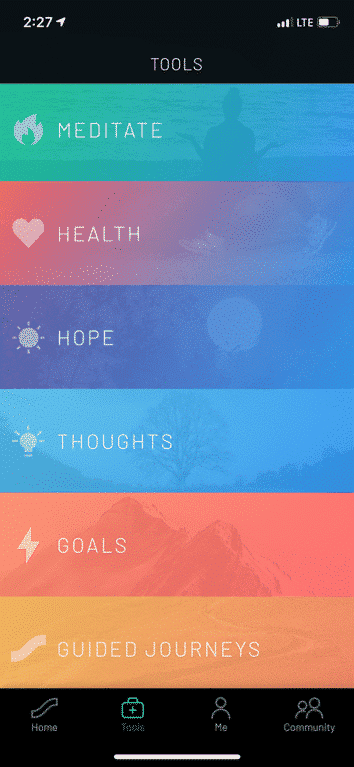
Sanvello is an app that aims to help you relieve symptoms of depression or anxiety by providing a complex toolkit of strategies and resources. It allows you to record your mood and health activities in order to track patterns.
There is also a Sanvello peer community that allows users to share stories, encouragement, and personal insights on any topic. The Terms of Service state “You must be over 13 years of age to use the Services, and children under the age of 13 cannot use or register for the Services.”[5]
The toolkit provided by Sanvello includes:
Meditation: Lessons focus on specific topics like relaxing, mindfulness, stressful situations, and calm down.
Health: Helps you track health habits that may be affecting your moods such as exercise, drug use, and water or caffeine consumption.
Hope: This tool provides the user with a space to save photos, quotes, activities, and community content.
Thoughts: Provides a place for journaling, analyzing events that have occurred, or discovering characteristics that have contributed to a feeling.
Goals: Allows users to select a challenge such as reconnecting with a friend or saying hello to a stranger.
Guided Journeys: A series of journeys that encourage a user to accomplish something they have never done before.
Porchlight: Being There
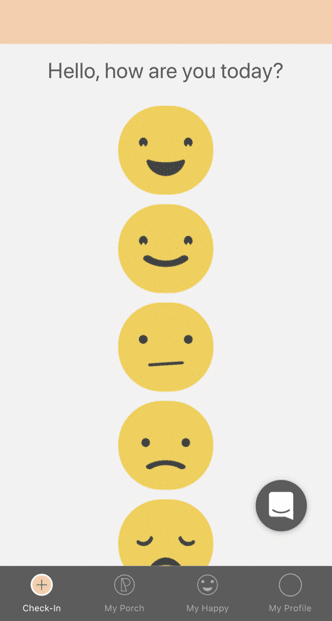
Porchlight is an app that is designed to allow loved ones to easily check in on each other’s mental health. The app prompts you to “check-in” once you enter the app where you can share your emotions using emoji. Users can connect with others which will send daily check-in notifications to the connected users. Porchlight provides prompts to check in with the connected users depending on what emotion they check in as.
Porchlight’s Terms of Service states “you must be 13 or older to register as a user or to use the app. If you are a minor, you must have your parents’ permission to donate through the App.”[6]
Headspace
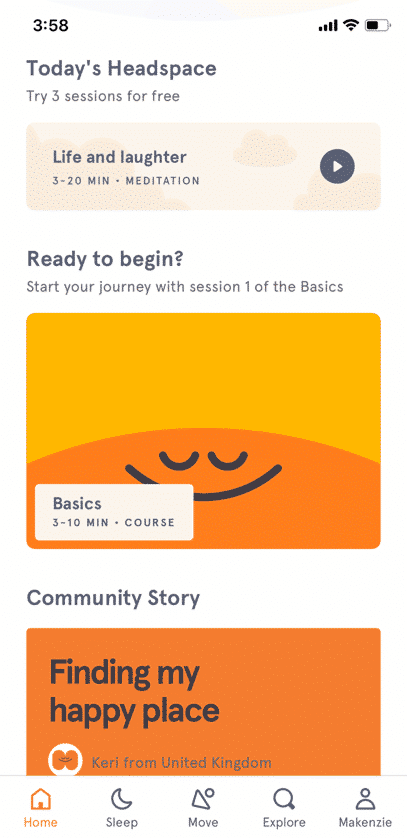
Headspace is an app that provides guided meditation exercises to help the user become healthier and happier. Headspace claims that it can increase happiness by 16% with just 10 days of use. It is also a popular app with over 60 million active users.
There are 4 main guides to mindfulness within the app:
The Wake Up: Daily short stories and small meditations to help you start your morning on a good start
Move Mode: Exercises to help strengthen mental and physical well-being
Sleep: Sleepcasts, music, and audio experiences to aid a restful night of sleep
Meditation: Teaches everyday mindfulness to help at any time of the day[7]
According to the Terms of Service for Headspace, “You must be 18 years of age, or the age of majority in your province, territory or country, to sign up as a registered user of the Products. Individuals under the age of 18, or the applicable age of majority, may utilize the Products only with the involvement and consent of a parent or legal guardian, under such person’s account and otherwise subject to these Terms.”[8]
Calm
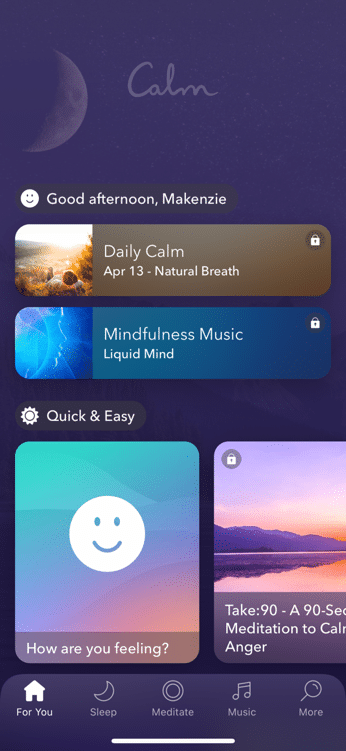
Calm is an app designed to assist users to develop healthy mental fitness, relax, and good sleep habits. The goal of the app is to introduce people to the benefits of mindfulness through meditation.
There are 6 different items of focus in the app:
Meditate: Teaches the skills of meditation
Sleep: Tools to have a restful sleep
Music: To help you relax, focus, or sleep
Body: Demonstrates mindful movement and stretching
Masterclass: Audio programs taught by experts
Scenes: Nature scenes and sounds to help relax and focus[9]
Calm’s Terms of Service state “you may only use the Services only if you are 13 years or older. To make a purchase via the Services, you must be 18 years or older and capable of forming a binding contract.”[10]
Thank you to CSUCI Intern, Makenzie Stancliff for providing insight on mental health apps. For more information about how electronics can impact our health, check out Dr. Bennett’s GKIS article, Is Wi-Fi Dangerous to Our Health?
I’m the mom psychologist who will help you GetKidsInternetSafe.
[1](n.d.). Retrieved from https://www.ajmc.com/focus-of-the-week/mental-health-issues-on-the-rise-among-adolescents-young-adults
[2]Data and Statistics on Children’s Mental Health. (2019, April 19). Retrieved from https://www.cdc.gov/childrensmentalhealth/data.html
[3] How does social media impact the mental health of young people? (2019, October 28). Retrieved from https://www.internetmatters.org/blog/2017/04/12/social-media-impact-mental-health-young-people/
[4]Technology and the Future of Mental Health Treatment. (n.d.). Retrieved from https://www.nimh.nih.gov/health/topics/technology-and-the-future-of-mental-health-treatment/index.shtml
[5]Home. (n.d.). Retrieved from https://www.sanvello.com/
[6]Being There. (n.d.). Retrieved from https://www.porchlightapp.io/
Instagram is the second most popular social media app among teens, with 78% using the social media platform in 2018. Instagram has become a necessary tool to manage relationships and participate in public culture.[1] Teens love to develop their virtual identities, follow friends and popular celebrities, and keep track of popular culture. Relative to other platforms, Instagram is easy to use, encourages creative content with photo filters, and has privacy and protective report features that are easy to access. But there are danger potentials and parenting strategies you should be aware of before you give permission for this social media staple.
What is Instagram?
Instagram is a free mobile social media app that offers photo or video sharing to followers or a select group of friends. Videos range from 3 to 15 seconds. All you need to sign up is an email address and a username (a phone number is optional).
How long has it been around and how popular is it?
Instagram was created by Stanford graduates Kevin Systrom and Mike Krieger and launched in October 2010. Within two months, Instagram gained over a million users. In 2011, Apple named Instagram iPhone app of the year. In April 2012, Instagram was acquired by Facebook for a billion dollars. As of April 2019, Instagram has 500 million daily active users.[2] It is the gateway app for most young social media users.
How old is old enough for adoption?
Instagram Terms of Use state, “You must be at least 13 years old to use the Service.” I recommend sixth grade as the youngest adoption age for Instagram and only under the following conditions:
Require your child to create a persuasive PowerPointthat covers risks, benefits, and privacy and protection features so you both know the ins and outs of Instagram’s features. For more information about how to create and judge a persuasive PowerPoint about a social media app along with other useful screen safety strategies, check out our Connected Family Online Course.
Add it to your free GKIS Connected Family Agreement as an “OK” or a “not yet,” so parameters, rules and regulations, and etiquette issues are understood. (If you haven’t downloaded it yet, enter your name and email on our GetKidsInternetSafe home page and it will be emailed immediately.)
Require the account to be set to private and you agree on the number and nature of followers and frequency of posting.
Ensure you are friended and you have their username and password for backside control.
Instagram Basics
Instagram’s big appeal is its image-based simplicity. Here are its regularly used features:
Stories (like Snapchat) that allow the user to post a collection of photos or videos to their profile. The story lasts 24 hours then disappears.
Your personal photo & video collection profile with captions that others can love, comment, and share.
Photo filters that offer limited editings, like color and hue.
Option to tag and @mention others or your post.
Links to other social media platforms including Facebook, Twitter, and Tumblr.
The ability to search and explore public profiles and follow favorites, like celebrity profiles.
Instagram offers suggestions of videos and posts you might like as well as potential FB contacts to follow.
What are Instagram’s popular features?
Direct Messenger allows users to start a conversation with friends.
Send messages, photos, videos, and posts. You can even video chat with up to 6 friends.
Watch long-form videos where users can create and watch videos that are not limited to one minute.
Similar to Stories or photos and videos you see in your Feed, you can like, comment, or share IGTV videos with friends.
Shop as You Scroll allows users to find products in your Feed and Stories that you’re curious about.
Tap the Product Tag to see the price, item name, and even have the ability to buy it directly from Instagram. There is also a save ion that will automatically add the item to your private Shopping Collection.
Search & Explore offers fresh content based on people you follow and posts you like.
Refresh the Explore page to see a new set of photos and videos, all created based on your interests.
Close Friendsallows for private messaging and posting to occur on Instagram, similar to private stories on Snapchat.
Start at the main page of Instagram, press the top-right icon of three bars, choose which followers you’d like to add to your list, and press Done.
What is included in the personal profile?
Number of posts, followers, and following
Username (can be a nickname)
Bio (like a website and other social media contact info here like Kik messenger, Skype, Facebook)
Your collection of photos and videos with the date posted, likes, and comments
Tagged photos and videos of you
Photos and videos you save
What are the privacy options?
Profiles are set to public by default. To change this, follow these steps:
Go to the settings icon, select the Privacy icon, and under Account Privacy turn the Private Account toggle on to require the approval of follow requests. If your profile is private, posts will not appear on the EXPLORE tab and only followers can see your posts.
Teens typically create more than one account for improved privacy options. Instagram allows you to simply toggle between the two. I require my teens to keep even their main profile on “private.” But they also generate a second account, offered referred to as a “Finsta” (a spam Instagram account) where they only friend their closest friends. Be aware that the posts on the finsta accounts are where the most questionable content is posted. Don’t forget to spot-check those from your child’s phone directly. You can’t just assume you’ll see everything they are up to on your feed.
Be aware that if your child posts other contact information on their profile (like Skype or Kik usernames), the public can view that and reach out to them even if their post is set to “private.” Another tricky workaround that people aren’t usually aware of is that if you SHARE your Instagram post on another social media platform like Twitter, your Twitter followers can click on the link and see your private post.
What Instagram trends and slang should I know about?
Clickbait: The practice of using a provocative title with the sole purpose of driving clicks.
Finsta: “Fake Instagram account.” Followed by a close circle of friends where teens post their casual, authentic side, where they can let their guard down a bit, act silly and not edit out every blemish.
#influencer: Instagram is becoming a huge platform for brands to publicize their company. 48.8% of brands use Instagram for promotional purposes. They pay people who are “Instagram famous” to show these brands on their profiles.
Rinsta: “Real Instagram account.” Usually accessible by a wider audience for teens polished and idealized selves.
Slide into someone’s DMs: The practice of randomly sending a DM to someone.
Throwing shade: The act of publicly denouncing or disrespecting someone. Often used in reference to sarcastic remarks against someone or something.
VSCO: The term originally referred to an app used for simple photo edits. It is now commonly used to make fun of girls who use the app.[3]
What are the risks for use?
Cyberbully potential:
Bullies posting unflattering or humiliating tagged or @mentioned photos and videos (@drtracybennett is a loser).
Cruel comments or hashtags (#annoying).
Fake accounts and impersonation.
Influencers making certain activities or expensive clothes/makeup seem normal.
Tracking potential:
Users can include contact information on comments or in their bio. Although posts are set to private, anyone can see your profile photo, username, and bio.
Photos and videos may be geotagged so the location can be tracked. For safety, turn off this feature on your device by turning off the “location” option for “camera.” To prevent Instagram from capturing your location on the iPhone, go to the phone’s settings, tap Instagram, select Location, and choose the “Never” option.
Attention-seeking potential:
Users often try to attract large numbers of followers with poor posting or comment choices.
There are numerous other apps that are affiliated with Instagram and they give the option to buy likes for your posts and even buy more followers.
Inappropriate content potential:
Sexualized, cutting, violent, politicized, and eating disorder images and inappropriate memes are commonplace and easily found when viewing photos and videos from the Explore tab.
Ability to send and receive instant messages, photos, or videos directly:
If your child’s profile is public anyone, including Instagram users your child does not follow, can send them messages, photos, or videos directly. If your child’s account is private, then the messages will be sent to their “message requests” instead of directly to their inbox. From there, you or your child can proceed to decline or accept the message. If one ignores the request folder, the sent item will disappear after two weeks.
What are the protection features?
By setting your profile to private, only followers can see your posts and stories. (There is an option to let anyone see your Stories, followers or not, make sure this setting is turned off). However, keep in mind that ANYONE can see your profile information (profile image, username, and bio), even non-followers.
If you come across an inappropriate photo (or you are tagged inappropriately), go to your profile page, select the three-line icon located at the top right corner above “Edit Profile”, select “Settings”, and “Report a Problem” in the Help area. From there Instagram offers many categories for the report with specific instructions.
Spam or Abuse
Something Isn’t Working
General Feedback
Image or Video Quality Issue
After the Block or Report is completed, that person cannot search for you or view your photos. However, mutual followers can still see your likes and comments on other people’s pictures. Blocked users can also still @mention you. You will receive a notification that they mentioned you but it will not show you the comment they made unless you unblock them. You must change your username to avoid mentions.
If an unwanted comment on your page appears, simply swipe on it and select the “!” icon to report Spam or Scam or Abusive Content or simply trash it.
Review your profile often and delete old or questionable photos.
Finesse your posts to favorably reflect positive activities, experiences, and character traits (like a digital resume).
Track your time.
Parents – check for extra accounts and other social media follow requests.
Social media can be really fun, but it has its risks. If you think your child is ready for an Instagram account or if they are on it and you want to optimize safety and resilience, YOU WILL LOVE OUR GKIS Social Media Readiness Training Course. It covers social media risks to digital injury and teaches tweens and teens the psychological wellness tools they need to thrive!
Thanks to Isabel Campos for her research and help with writing this article.
I’m the mom psychologist who will help you GetKidsInternetSafe.
Onward to More Awesome Parenting,
Tracy S. Bennett, Ph.D.
Mom, Clinical Psychologist, CSUCI Adjunct Faculty
GetKidsInternetSafe.com
Your heart is racing, your chest is constricting, and it feels as if you may vomit. The logical part of your brain tries to soothe the panic that’s building in your chest by informing you it’s due to the three cups of coffee you’ve consumed in the last hour. But instead of listening to your better instincts, you turn to Google. Article after article feeds your worst fears with information about heart attacks. And just when you think your “diagnosis” can’t get any worse, a dreaded link takes you to a site for cardiac tumors. Before you know it, you are texting your mom to tell her how much you love her and escaping into social media rather than paying your bills. All you can think about is how painful it’s going to be to die from this fatal medical condition. While you are preoccupied with your heart, a muscle spasm occurs in your lower back which drives you into more panic. Now you’re convinced your kidneys are shutting down…
What is Illness Anxiety Disorder?
Illness Anxiety Disorder is a relatively new concept that has replaced the diagnosis of hypochondriasis. Individuals who suffer from this disorder are frequently preoccupied with worry over becoming extremely ill or developing a rare life-threatening condition. They may fixate on a specific part of the body or a certain medical condition like cancer or tumors.
Although illness anxiety or health anxiety will not kill you, it is extremely distressing and can be debilitating. According to Mayo Clinic (2018), illness anxiety disorder typically develops in early to middle adulthood and can get progressively worse over time.
Symptoms of Illness Anxiety Disorder
Repeatedly checking your body for signs of illness or disease, like checking your breasts for lumps or checking moles constantly
Frequently making medical appointments for reassurance
Frequently searching the internet for causes of symptoms or possible illness
Worrying excessively about a specific medical condition or your risk of developing a medical condition because it runs in the family
Having so much distress about a possible illness that it’s hard for you to function.[1]
Cyberchondria
With information just a click away, it is very easy to become a victim of cyberchondria. Cyberchondria is a subtype of illness anxiety disorder. It occurs when an individual seeks Dr. Google to research their ache or pain. Cyberchondria refers to preoccupation with a feared illness paired with compulsive Internet browsing.
What the Research Says About Illness Anxiety Disorder
A research team from Microsoft found that, although people reported low levels of health anxiety when Googling their symptoms, the searching provoked anxiety, leading to more compulsive searches. From there, many went on to schedule exploratory doctor or specialist appointments.
Although occasionally triggering unnecessary anxiety, White and Horvitz (2009) pointed out that a benefit of Googling a pre-existing medical diagnosis is an opportunity to become acquainted with accurate medical terminology. With this knowledge, a patient can give a more informative history and be a better advocate for appropriate treatment with their doctor.
Illness Anxiety Disorder Often Occurs with Another Psychiatric Disorder
Research has shown that illness anxiety disorder is more commonly comorbid with other anxiety disorders, such as generalized anxiety disorder (worrying excessively), panic disorder (impairment due to fear of panic attacks), agoraphobia (avoidance of everyday life experiences due to fear of panic attacks), and even phobias (excessive fears).[3] It can also be seen in those who suffer from depressive symptoms but is most commonly seen in those with anxiety disorders.
Not much information is known on illness anxiety disorder because individuals who suffer from this will seek medical help first over psychiatric help. That means the client undergoes expensive medical diagnostic procedures rather than cognitive-behavioral therapy (the psychological treatment that is the most effective treatment).
What Causes Illness Anxiety Disorder?
While the exact cause of illness anxiety disorder is still unknown, researchers believe certain events contribute to the early onset of an illness anxiety diagnosis.[2]
Possible contributors:
History of abuse as a child
Excessive screen use overall
A serious medical diagnosis as a child or a parent had a serious medical diagnosis
Experiencing a major stressful life event
Excessive worrying related to health
Difficulty asserting oneself or impoverished social skills
How to Help Individuals Suffering from Illness Anxiety
If your child or teen is demonstrating tendencies, use the tools offered in our GKIS Screen Safety Toolkit. They will allow you to identify risk by monitoring browser searches, emails, and inquiring text messages.
Limit screen time and Internet access to WebMD and Mayo Clinic
Develop a positive, healthy relationship with your doctor by informing them about your tendencies
Find a psychologist for cognitive-behavioral therapy
Develop ways to ease stress, like exercise or meditation
Thank you to CSUCI intern, Kassidy Simpson for providing parents with the knowledge they need to help recognize and become aware of the signs of illness anxiety disorder. If you learned something new from this article, please talk to your friends about us and “like” our GetKidsInternetSafe Facebook page so other parents can find us!
I’m the mom psychologist who will help you GetKidsInternetSafe.
Onward to More Awesome Parenting,
Tracy S. Bennett, Ph.D.
Mom, Clinical Psychologist, CSUCI Adjunct Faculty
White, R. W., & Horvitz, E. (2009). Experiences with web search on medical concerns and self-diagnosis. AMIA … Annual Symposium proceedings. AMIA Symposium, 2009, 696–700.
Scarella, T. M., Laferton, J. A., Ahern, D. K., Fallon, B. A., & Barsky, A. (2016). The Relationship of Hypochondriasis to Anxiety, Depressive, and Somatoform Disorders. Psychosomatics,57(2), 200–207. doi:10.1016/j.psym.2015.10.006
Screen addiction is officially a thing. As a mom and clinical psychologist for over 25 years, I recognized and identified it in 2014 when I founded GetKidsInternetSafe from treating hundreds of families in my private practice. Teaching addiction studies at CSUCI also highlighted the similarities between drugs and screen behaviors for me. Like everybody else, I too was having a hard time chasing my kids off our screens. Honestly, even I was getting lost in my research and on Facebook, losing the ability to chill and read a novel. I started to worry about my family. From there, I wrote my book Screen Time in the Mean Time, offered keynotes and presentations, consulted with tech companies, coached families, built and tested my online courses, and created a weekly blog. And, after all that, the World Health Organization finally confirmed what I’ve been screaming from the rooftops. Big tech creates screen products that are manipulatively designed to trigger the pleasure centers of our brains, and we are, in fact, clinically addicted.
Gaming Addiction
Nearly 60% of parents think their teens are addicted to their mobile devices. In 2018, the World Health Organization (WHO) classified gaming addiction (IGD)as a mental health disorder. In the last twenty years, the tech revolution has affected every aspect of our lives. Studies have shown that, for some subjects, compulsive screen use impacts the reward and pleasure areas of the brain in the same ways that alcohol, drugs, and other behavioral addictions do. Screen addiction treatment centers have been popping up in Asia for the last decade and are starting to be in the United States as well. Do you worry your child may be showing signs of screen addiction?
——————-
“Remember, when Betty Ford first admitted she was an alcoholic, we didn’t have people believing it was actually a problem until she came around and talked about her own problems with it. This is a place for people to go for help, and that we hope will help everyone around them stop taking Internet addiction so lightly.”
Kimberly Young (founder of The Center for Internet Addiction in 1995)
————————
Who is to blame?
Parents
Of course, we have some accountability for what happens under our roofs. Pester power breaks us down, and we allow too much screen use even though we know better. We need a break in our overtasked, screen-saturated lives. We can’t entertain our rug rats 24-7.
Kids
They are so persistent! They CRAVE screen use and are master manipulators. Children are vulnerable to screen addiction because their brains are not fully developed, particularly in the prefrontal cortex, which is responsible for impulse control and decision-making. Children who suffer from trauma like bullying, divorce, and abuse, as well as from psychological vulnerabilities like ADHD, anxiety and mood disorders, and autism are particularly vulnerable.
Schools
Schools are increasingly adopting curriculums that require screen use and Internet access during classroom and homework time. Without digital literacy, our kids academically falter. If you are reading this as part of your Social Media Readiness Course, then either your parents or your school are doing an awesome job prepping you to avoid addiction issues down the line.
Big Tech
Screens are programmed to addict us. Big tech, like Google, Amazon, and Facebook, are experts in how to keep us coming back for more. Using secret computer algorithms, our online behavior is studied, collected, and aggregated. This data is used to create and deliver content in the ways our brains will effortlessly absorb it. That translates to targeted ads for clicks and money leaving our bank accounts. Big profit indeed.
The Gaming Industry
The gaming industry made 183 billion dollars last year. Multi-level, high-sensory games, like Fortnite, are intentionally programmed for addictive use. Players are rewarded for staying on and punished for getting off. This keeps kids on-screen, vulnerable to hours of autonomic overarousal. That means they burn too much brain fuel and are left fatigued and in mental brown-out.
The Government
Where is the regulation to protect kids? Are civil liberties really that strong that legislators can’t step in to help parents protect their kids against known harm like online pornography? Or is it that research and treatment organizations can’t compete with rich lobbyists who get direct access to our legislators? Did you know that the advertising budget for Budweiser alone exceeds the entire budget for research on alcoholism and all drugs of addiction?
How common is Internet Gaming Addiction?
Recent studies claim that around 1 – 5% of the US population could be classified as Internet game addicts. It is most common among single young males. Male Internet addiction most typically involves video gaming, cyber-pornography, and online gambling. Women are more likely to show addictive use patterns with social media, texting, and online shopping. IGD commonly cooccurs with depression, anxiety, AD/HD, self-harm, obsessive-compulsive disorder, oppositionality, suicidality, and personality disorders.
Other risk factors include living in the city, not living with a biological parent, low parent involvement, parent unemployment, and not having a reliable friend.
Consequences of IGD include skipping school, lower grades, family conflicts, lack of offline sociality, sleep problems, and unresolved developmental problems. These factors, along with emotional problems, often result in the addict lacking the very resources necessary to break out of the addictive cycle.
What do brain studies say?
Brain imaging studies have found brain changes like those seen in subjects with drug addictions. In other words, the more we play video games, the more our brains change and adapt.
Activation pattern changes that result in brain tissue changes are called adaptive neuroplasticity.
More specifically, subjects with video game addiction show a reduction in gray and white brain matter and reduced cortical thickness in various areas of the brain. The more the gamer plays, the more brain changes. Studies have also found evidence of dopamine release and higher activity in the brain’s pleasure center when playing video games. Heavy gamers have significantly more difficulty calming their emotions and making sound decisions than nongamers.
Thank you to CSUCI Intern, Katherine Bryan for contributing to this article. Screen addiction is real and now universally recognized. If you worry you are seeing red flags in your home, remember that screen addiction is preventable!
I’m the mom psychologist who will help you GetKidsInternetSafe.
With more pressures at school and with friends, middle school can be awkward, scary, and lonely. Middle school is also when many tweens and teens onboard social media. Although social media is a fun way to keep up with friends and follow special interests, it has also been proven to increase insecurities and make kids feel left out and excluded. Cyberbullying is not uncommon and can lead to depression and anxiety. Insecure about their looks, teenagers are the perfect target for online beauty gurus and product marketing. Are beauty videos innocent instructional fun or high-tech marketing? Today’s GKIS article covers the beauty guru craze on YouTube, Instagram, and TikTok and how they trick us into buying expensive and unnecessary beauty products.
What is a beauty guru?
Beauty gurus are social media celebrities who create images and videos that offer makeup and hairstyling tutorials, skincare reviews, and fashion advice. They are popular on YouTube, TikTok, Instagram, Snapchat, and Facebook.
Millennials (those born between 1980 and 1995) and Generation Z (those born between 1996 and 2015) are the targeted populations for beauty gurus.
Tweens, teens, and young adults spend an average of 11.3 hours on YouTube each week.
60% of them follow YouTube celebrities on social media.
Nearly a third of teens ages 13 to 17 prefer YouTube celebrities over movie or TV celebrities.
As of 2015, there were approximately 45.3 billion views on YouTube for beauty videos alone. [1]
Each month, 50 million people watch over 1.6 billion minutes of beauty guru content. [2]
Why are beauty gurus so popular?
Developmental changes during adolescence make teens perfect targets for beauty marketing. As kids develop and mature, they are getting used to maturing bodies and also switch attachment focus from parents to peers.
To attract their tribe, teens focus on their looks and often believe that others frequently watch and judge them. Child psychologist David Elkind coined this developmental phenomenon imaginary audience.
Is a judging audience imaginary? After all, the hundreds of social media selfies and YouTube videos teens view each day fuel the idea that everybody is watching, scrutinizing, and judging.
Teens are also attracted to the fame and influence of YouTube celebrities. Fifty-six percent of teen subscribers aspire to be a YouTube star. [3] Beauty gurus are particularly admired because they are often more relatable than polished celebrities like Kylie Jenner or Angeline Jolie. They’re “normal girls” just like everyone else, right?
Videos Shot for Profit
High subscriber numbers mean high profits. Although beauty videos appear to be spontaneously self-produced, informal chats into the camera, they aren’t. Most teens would be surprised to learn that these videos are expertly produced with scripting, expensive cameras and sound equipment, professional lighting, digital filtering and enhancements, and extensive editing. Newly created video editing software offers filters that enhance the skin and hide imperfections.
Beauty Box Video is an example of a digital enhancement software product. “This early-generation video plugin automatically identifies skin tones and creates a mask that limits the smoothing effect to just the skin areas…[It’s] Powerful, Easy, Real-time skin retouching for video” (website product description). With retouching software and filters, beauty gurus lead their audience to believe that their flawless skin is the result of a skincare item or a makeup product available for purchase rather than photography, video, and editing tricks. [4]
Some beauty Youtubers are not even amateurs. They are professional makeup artists or stylists. Some Youtuber celebrities may have started innocently making videos, but when subscriber numbers rise, advertisers offer attractive incentives to better sell. For example, Youtuber Michelle Phan was initially endorsed by Lancôme and now has her own makeup line called EM Cosmetics. Her brand makes millions of dollars a year.
Fake Friends and Confidants
YouTube beauty gurus intentionally create a false sense of intimacy in their videos that appeal to a lonely generation of young people who are captive audiences to their screens. Intimate video titles such as “Get ready with me” or “Storytime” offer the viewer a false sense of friendship with the Youtuber. [5]
Although teens may feel entertained and satisfied with learning, hours of watching may also contribute to their dissatisfaction and loneliness. Despite the teen’s best efforts, they will never be able to attain the professionally produced look of the beautiful Youtuber. The most popular beauty gurus are very attractive to begin with. Youtubers with average looks rarely get views and endorsement deals. The prettier the Youtuber, the more brand deals they get, and the more discouraged teens get sold on expectations they can’t achieve.
Compare and Despair
Many teens look to beauty gurus as role models. Unfortunately, beauty gurus rarely encourage their audience to explore interests outside of beauty and fashion.
Instructional beauty videos reinforce gender stereotypes that our worth is based on beauty, which requires time, skill, and money to achieve and maintain. These stereotypes are reflected in filter features that reflect Western beauty biases. We covered an example of this in our GKIS article, Beauty Filters Don’t Embrace Brown Beauty: The Rise of Colorism.
Also disturbing is how many beauty gurus discuss their plastic surgery and cosmetic procedures on camera. Browse “I got injections,” and you will see dozens of videos produced by surgically enhanced influencers with millions of views each.
In Xiaxue’s video titled, “Plastic surgery questions answered!” she discusses her nose job and double eyelid surgery as if it’s an everyday, simple get. Surgical transformation is a dangerous proposal to a lonely, self-conscious teen who has spent hours mesmerized by enhanced marketers slowly grooming her desperation to be reinvented. Anxieties inspired by this type of content can lead to mental illnesses like body dysmorphic disorder and eating disorders. [6]
Popular YouTube celebrities boast large followings, high influence, and big profits off of vulnerable teens. A top beauty influencer, Wayne Goss, blew the whistle on this misleading phenomenon in his video, “WARNING. YOU’RE BEING LIED TO.” In his illustration, Wayne shows his audience what his face looks like before and after using skin retouching software. But knowledge doesn’t always cut through compulsive video viewing habits. [7]
What you can do:
Recognize that worth is more than skin deep and emphasize this among friends and family. Provide opportunities for intellectual, spiritual, and character growth. Value substance.
Be a good role model. Makeup-free days and clean, natural living balance special, glitzy occasions.
Parents can filter streaming video content with screen safety management tools like those offered in our Screen Safety Toolkit. The more developed your child’s personality and self-concept, the more resilient they’ll be in the face of relentless marketing.
Educate kids about the risks and benefits of watching beauty guru videos. Make sure they understand that beauty videos are meticulously edited to make a profit from unsuspecting targets.
Help each other know that we don’t need to alter our appearance to be genuinely loved and accepted.
Monitor and limit how often you or the people you care about view beauty guru content. Take notice if you or those you care about are showing compulsive viewing habits or are negatively affected by the content they are consuming.
Teach balanced, healthy, and fun beauty activities like giving to others, gratefulness, kindness, a clean diet, and satisfying fitness. Beauty radiates from within, not from ten-minute ombré lips and $50 shimmer. Sometimes it’s important to dare to go bare.
Thank you to CSUCI Intern, Mara Pober for providing parents with information about the beauty gurus of Youtube. For more parenting support to dull the influence of high-earning, big-influence celebrities like Kim Kardashian, check out the GKIS article What Parents Need to Cover About Kim Kardashian’s Un-covering.
I’m the mom psychologist who helps you GetKidsInternetSafe.
My brother has been living in Singapore, Malaysia, for his freelance job. He recently told me he feels like he is constantly on screen and thinks his virtual life is overtaking his nonvirtual life. He also noticed that it’s impossible engage his friend’s kids away from their screens. He shared with their dad that he was concerned the kids were screen-addicted. The Dad brushed it off, saying all kids are screen addicted. He said they’d grow out of it. No big deal.
Online Overdose in Singapore
Except in India, Singapore citizens spent more time online than people from any other country in the world. More than half of Singaporeans admit that they are online for as many as 12 hours a day.[1]
Screen addiction has been defined as 38 hours or more of screen use per week or screen use that causes impairment in work and relationships, a loss of control (inability to stop despite unpleasant consequences), and evidence of tolerance (increasing use to get the same sense of satisfaction) and withdrawal (irritability and anxiety when prevented from screen time).
It’s not just adults that are screen addicted. Many kids are as connected as their parents, growing up with the newest technologies always online and up with the latest trends.
For some families, too much turns into way too much. Due to high screen addiction numbers, Asian countries like China, South Korea, and Singapore have more inpatient (hospital) treatment facilities for screen addictions than any others.
We may not want to face it, but based on alarming statistics American kids may be catching up. 28% of American adults now report that they go online “almost constantly,” up from 21% in 2015.[2] Over 50% of teens feel they are addicted to their smartphones.[3] Perhaps Americans have things to learn from Asians in terms of clinical treatment and government regulation.
Rules & Regulations
The Cinderella/Shut Down Law
At the last stroke of midnight, the spell will be broken ~ Fairy Godmother
Too many parents are naïve about the risks of screen addiction. In response to rising child addiction rates, the South Korean government implemented the Cinderella or Shut Down Law.[4] This law blocks access to gaming websites from midnight until 6 AM for those under the age of 16. South Korean parents are only allowed access after midnight if they enter their social security number. The idea behind this law is to force teenagers to sleep instead of game, ultimately improving school performance.[5]
The Cooling-Off System
Another approach from the South Korean Government to regulate screen use is the Cooling-Off System. It aims to regulate screen time by programming the gaming system to shut down automatically every 2 hours for 10 minutes, with gamers only able to log back on once every 24 hours.[6] Because screen addiction is connected to adolescent bullying and suicide, the idea behind this law is to get these issues under control.
Screen Addiction Treatment
If you worry that someone you know needs help with screen addiction, learning about the different types of treatment will be helpful.
Outpatient Treatment
Outpatient treatment includes day programs that clients attend while maintaining a normal school schedule and home life. Schedules typically vary from one to six hours/day. Addiction treatment programs offer services like:
individual and group psychotherapy,
psychoeducation,
medical evaluation and management,
art and music therapy,
life skills and mindfulness training, exercise and yoga,
academic tutoring,
job training, and
general skill-building programs, like goal setting, relaxation, and assertiveness and social skills.
Well-rounded treatment is based on the biopsychosocial team treatment model. This means that all aspects of the individual are cared for from the brain, self, and environment by a team of experts.
Outpatient care is usually preferable for mild to moderate screen addiction.
Inpatient Treatment
Inpatient treatment means that clients sleep on-site and are offered round-the-clock medical and therapeutic services like those listed above, either voluntarily or involuntarily. Involuntary treatment may be indicated only in cases of danger to self or others, like suicide or homicide, or the inability to get food, shelter, or medical care due to severe mental illness.
Inpatient treatments are the first choices in treating kids with serious screen addiction. Examples of impairment related to screen use include eating disorders, reduction of brain capacity, and repetitive use injuries like eye strain, hearing loss, and back and neck pain.[7]
China is at the forefront when it comes to inpatient treatment. There are over 250 inpatient treatment boot camps in Asia. Screen addiction boot campscombine military discipline with traditional clinical techniques to overcome addiction. These programs incorporate excessive workouts, group punishments, music, art, and psychological counseling to get clients free of their screens.
According to Tao, who began specializing in addiction treatment in 1991, these are necessary and inevitable methods to teach discipline in the treatment of addicted kids.[7] In his screen addiction boot camp, the children stay from three to six months dependent on their progress. Tao boasts a success rate of 75% since 2008, which is far higher than recovery statistics from traditional inpatient addiction treatment. Tao admits that long-term success is difficult to maintain. While most kids will soon fall back to old patterns after leaving the camp, Tao designed an after-care schedule while also educating parents on how to supervise their child’s gradual reintegration to the web.
What you can do to GetKidsInternetSafe and avoid screen addiction
Be perceptive and get to know your child, offline and online.
Set limits.
Create opportunities for fun offline activities and encourage a healthy lifestyle.
Read together.
No screens in the bedroom, bathroom, or behind closed doors.
No screens at mealtime.
A 2014 study found that old-school family dinners decrease the risk of adolescent mental health issues and cyberbully victimization.[8] Screens at mealtime are also associated with poorer family communication and poorer nutrition choices.[9] Mealtime and car rides are awesome opportunities to inquire about your child’s daily highs and lows, share screen-relevant stories, and teach important skills that will get your kids Internet safe.
Thank you to CSUCI Intern, Lisa Sommer for her work on this article. What do you think? Are we headed for high addiction rates like what’s happening in Asia? What is the key to addiction prevention? Would you agree to country-wide regulations like the Shut Down Law? How about inpatient treatment with military tactics?
I’m the mom psychologist who will help you GetKidsInternetSafe.
Bogart, N. (2014). Top apps that give parents control over kids screen time. For: Global News, retrieved April 30th, 2017 from: http://globalnews.ca/news/1441624/top-apps-that-give-parents-control-over-kids-screen-time/
[3] Common Sense Media. (2016). Dealing with devices: The parent-teen dynamic; Are we addicted? Retrieved from https://www.commonsensemedia.org/technology-addiction-concern-controversy-and-finding-balance-infographic
[8] Elgar, F. J., Napoletano, A., Saul, G., et al. (2014). Cyberbullying Victimization and Mental Health in Adolescents and the Moderating Role of Family Dinners. JAMA Pediatr. 2014;168(11):1015-1022. doi:10.1001/jamapediatrics.2014.1223
Flisher, C. (2010). Getting plugged in: An overview of Screen addiction. Journal of Paediatrics and Child Health 46, p. 557–559
[9] Fulkerson, J. A., K. Loth, M. Bruening, J. Berge, M. E. Eisenberg, and D. Neumark-Sztainer. “Time 2 Tlk 2nite: Use of Electronic Media by Adolescents during Family Meals and Associations with Demographic Characteristics, Family Characteristics, and Foods Served.” Journal of the Academy of Nutrition and Dietetics. U.S. National Library of Medicine, July 2014. Web. 21 Apr. 2017.
[6] Hawkins, M. (2012). South Korea introduces yet another law to curb gaming’s ills. For: NBC News. Retrieved April 4th, 2017 from: http://www.nbcnews.com/tech/video-games/south-korea-introduces-yet-another-law-curb-gamings-ills-f158168
[4] Lee, J. (2011). South Korea pulls plug on late-night adolescent online gamers. For CNN. Retrieved March 17th, 2017 from http://www.cnn.com/2011/11/22/world/asia/south-korea-gaming/
[5] McLellan, H.(2011). South Korea’s “Shutdown Law” Takes Effect. For: The Escapist Magazine. Retrieved April 4th, 2017 from
http://www.escapistmagazine.com/news/view/114369-South-Koreas-Shutdown-Law-Takes-Effect
[2] Pew Research here
Rowan, C. (2010). Unplug-don’t drug: A critical look at the influence of technology on child behavior with an alternative way of responding other than evaluation and drugging. Ethical Human Psychology and Psychiatry, 12, 60–68.
Wieland et al. (2005). Computer Addiction: Implications for Nursing Psychotherapy Practice. Perspectives in Psychiatric Care Vol. 41, No. 4
[1] Williams, A. (2014). Singaporeans are second most Internet-addicted people in the world: Survey. For the straitstimes.com. Retrieved March 6th, 2017 from http://www.straitstimes.com/business/singaporeans-are-second-most-Internet-addicted-people-in-the-world-survey
[7] Zigor, A. (2015). Inside the Chinese boot camp treating Screen addiction. For: The Telegraph. Retrieved March 17th, 2017 from http://www.telegraph.co.uk/news/health/11345412/Inside-the-Chinese-boot-camp-treating-Internet-addiction.html
Photo Credits
Baby Wearing Pink Crew Neck Cap Sleeve Shirt Between 2 Person Standing during Daytime, 2016, CC0 1.0