Surveys reveal that depression and anxiety have increased for adults, teens, and kids. It’s unclear what is causing these increases, but longer workdays and overtasked lives may be strong contributors. Increased screen time on video games, social media, video and movie streaming, texts, and emails can be super fun and even improve productivity. But too much screen time can also lead to a mental brownout, a type of anxious fatigue that we may not even recognize until it leads to mental illness. Giving up screens to avoid it simply isn’t possible for most of us. But the good news is we don’t have to! Learn how smartphone health and wellness apps can benefit you without having to give up screen time!
Mental Health
Did you know that anxiety, depression, self-harm, and suicide is up 78% among teens?[1] In fact, by some estimates 1 in 6 children between the ages of 2 and 8 have a mental, behavioral, or developmental disorder. Left untreated, child symptoms may lead to more issues in adulthood.
Among children ages 3 to 17:
4% or 6.1 million have been diagnosed with ADHD
4% or 4.5 million have been diagnosed with a behavior problem
1% or 4.4 million have been diagnosed with anxiety and
2% or 1.9 million have diagnosed with depression.
Boys are more likely than girls to experience a mental, behavioral, or developmental disorder.[2]
Social Media Impacts on Children’s Mental Health
Sleep Deprivation
Social media has various effects on mental health, especially in children. Dr. Bennett writes in her book, Screen Time in the Mean Time, says that she feels sleep deprivation is the most common contributor to mental health problems today. The blue light on devices interrupts the sleep pattern and makes it more difficult to fall asleep. Many people also develop a compulsive impulse to check notifications which can also delay sleep.[3] Teens with sleep deprivation demonstrate lower achievement motivation, more teacher-child relationship problems, a poorer academic self-concept, and poorer school performance.
Self-Comparison
Too often, we see the best sides of our friends on social media. After all, nobody wants to read about the doom and gloom of a breakup or the fight someone just had with their mother-in-law. Positive posting can lead to friends feeling left out and generally bad about how their lives don’t compare. The GKIS article The FOMO EFFECT: How Fun Friend Posts Can Lead to Clinical Anxiety provides more information on self-comparison.
Distraction
Social media poses a major risk of distractibility. We tend to go on an endless cycle of content on one social media app or we cycle between multiple social media apps. This causes us to spend a longer amount of time on social media and forget about what we are supposed to do in the “real world”.
Mental Health Apps
Dr. Bennett recommends mental health apps to her clients all of the time. Free and convenient, they can be a great addition to psychotherapy. Even for people who aren’t in treatment, mental health apps can help us get to where we want to be by offering mood-enhancing toolkits, mood monitoring, and breathing and meditation ideas.
Mental health apps are awesome in that they are convenient, inexpensive, and even free, and available. They can be a comfortable first-step to wellness prior to (or even while) seeking out help from a mental health professional.
CAUTION: Keep in mind possible privacy issues due to the risk of data breaching and the release of private information to third parties. Many psychologists also agree that the apps are not as effective as seeing a mental health professional.[4]
Here are some mental health apps that GKIS is happy to share with you:
Sanvello
Sanvello is an app that aims to help you relieve symptoms of depression or anxiety by providing a complex toolkit of strategies and resources. It allows you to record your mood and health activities in order to track patterns.
There is also a Sanvello peer community that allows users to share stories, encouragement, and personal insights on any topic. The Terms of Service state “You must be over 13 years of age to use the Services, and children under the age of 13 cannot use or register for the Services.”[5]
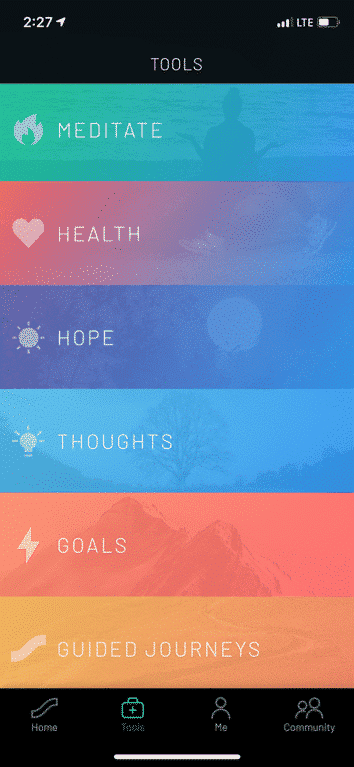
The toolkit provided by Sanvello includes:
Meditation: Lessons focus on specific topics like relaxing, mindfulness, stressful situations, and calm down.
Health: Helps you track health habits that may be affecting your moods such as exercise, drug use, and water or caffeine consumption.
Hope: This tool provides the user with a space to save photos, quotes, activities, and community content.
Thoughts: Provides a place for journaling, analyzing events that have occurred, or discovering characteristics that have contributed to a feeling.
Goals: Allows users to select a challenge such as reconnecting with a friend or saying hello to a stranger.
Guided Journeys: A series of journeys that encourage a user to accomplish something they have never done before.
Porchlight: Being There
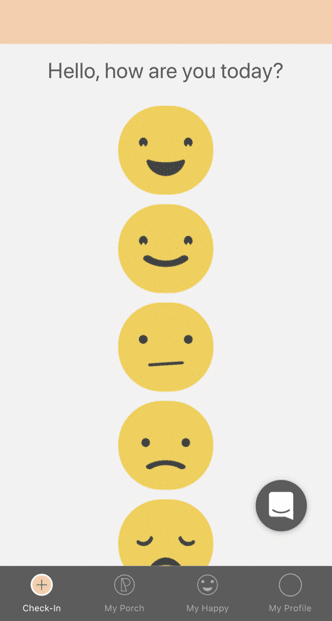
Porchlight is an app that is designed to allow loved ones to easily check in on each other’s mental health. The app prompts you to “check-in” once you enter the app where you can share your emotions using emoji. Users can connect with others which will send daily check-in notifications to the connected users. Porchlight provides prompts to check in with the connected users depending on what emotion they check in as.
Porchlight’s Terms of Service states “you must be 13 or older to register as a user or to use the app. If you are a minor, you must have your parents’ permission to donate through the App.”[6]
Headspace
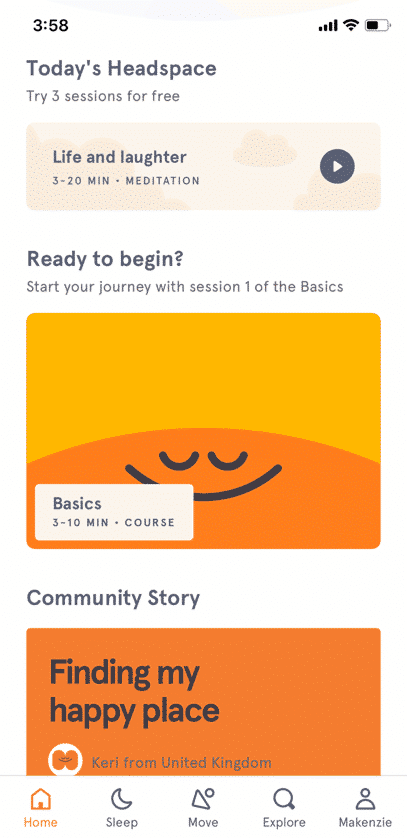
Headspace is an app that provides guided meditation exercises to help the user become healthier and happier. Headspace claims that it can increase happiness by 16% with just 10 days of use. It is also a popular app with over 60 million active users.
There are 4 main guides to mindfulness within the app:
The Wake Up: Daily short stories and small meditations to help you start your morning on a good start
Move Mode: Exercises to help strengthen mental and physical well-being
Sleep: Sleepcasts, music, and audio experiences to aid a restful night of sleep
Meditation: Teaches everyday mindfulness to help at any time of the day[7]
According to the Terms of Service for Headspace, “You must be 18 years of age, or the age of majority in your province, territory or country, to sign up as a registered user of the Products. Individuals under the age of 18, or the applicable age of majority, may utilize the Products only with the involvement and consent of a parent or legal guardian, under such person’s account and otherwise subject to these Terms.”[8]
Calm
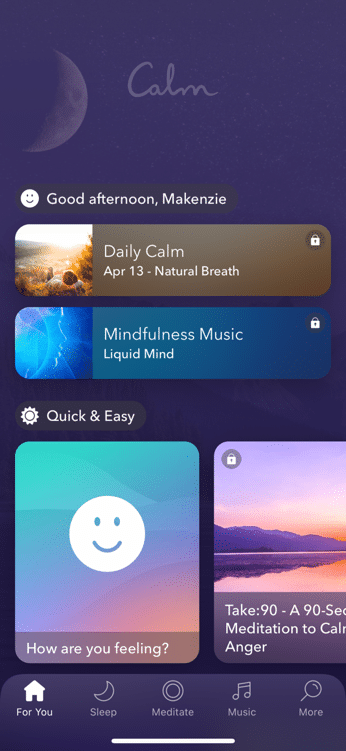
Calm is an app designed to assist users to develop healthy mental fitness, relax, and good sleep habits. The goal of the app is to introduce people to the benefits of mindfulness through meditation.
There are 6 different items of focus in the app:
Meditate: Teaches the skills of meditation
Sleep: Tools to have a restful sleep
Music: To help you relax, focus, or sleep
Body: Demonstrates mindful movement and stretching
Masterclass: Audio programs taught by experts
Scenes: Nature scenes and sounds to help relax and focus[9]
Calm’s Terms of Service state “you may only use the Services only if you are 13 years or older. To make a purchase via the Services, you must be 18 years or older and capable of forming a binding contract.”[10]
Thank you to CSUCI Intern, Makenzie Stancliff for providing insight on mental health apps. For more information about how electronics can impact our health, check out Dr. Bennett’s GKIS article, Is Wi-Fi Dangerous to Our Health?
I’m the mom psychologist who will help you GetKidsInternetSafe.
[1](n.d.). Retrieved from https://www.ajmc.com/focus-of-the-week/mental-health-issues-on-the-rise-among-adolescents-young-adults
[2]Data and Statistics on Children’s Mental Health. (2019, April 19). Retrieved from https://www.cdc.gov/childrensmentalhealth/data.html
[3] How does social media impact the mental health of young people? (2019, October 28). Retrieved from https://www.internetmatters.org/blog/2017/04/12/social-media-impact-mental-health-young-people/
[4]Technology and the Future of Mental Health Treatment. (n.d.). Retrieved from https://www.nimh.nih.gov/health/topics/technology-and-the-future-of-mental-health-treatment/index.shtml
[5]Home. (n.d.). Retrieved from https://www.sanvello.com/
[6]Being There. (n.d.). Retrieved from https://www.porchlightapp.io/
Shallow and manipulative influencers, the toxic culture of materialism and vanity, vulgarity, pranks, and violence have earned YouTube a mixed reputation when it comes to acting in the best interest of young users. Parents talk of wanting to ban it, but they also recognize the benefits it can have on their kids. Plus, kids LOVE it! Beyond the questionable content, the platform offers opportunities for creativity, education, socialization, and entertainment that is safe for young audiences. Many popular influencers create content with their younger audience in mind, censoring their language and actively selecting appropriate topics. Join us in this exploration of some child-and-teen-friendly YouTube creators and their potential to inspire children to explore the world beyond their screens.
YouTube as a Source of Educational Inspiration
With channels featuring art, technology, beauty, music, or the environment, YouTube offers millions of opportunities to explore. Many online communities have gained popularity over the last few years, including those centered around makeup, comedy, cooking, DIY projects, dance, and video games. Shows like Bill Nye the Science Guy and Sesame Street produce videos to educate children about the wonders of the world. Many even inspire kids to explore their interests and experience the potential in the offscreen world around them.
If you haven’t yet allowed your kids access to a browser or haven’t yet put solid safe screen parameters in place, Dr. B is here to help. For help with home setup and sensible rules, you’ll love our GKIS Connected Family Course. For tech tool tips and referrals, our GKIS Screen Safety Toolkit is the course you need. If online courses are still new to you or you just can’t find the time to take one, Dr. B also offers one-to-one coaching for effortless implementation. At the click of a button, she can set up a video or phone call to help you get started. You’re not in this alone anymore. GKIS and Dr B are here to help.
Child-Friendly YouTube Influencers Your Whole Family Can Enjoy
Baking on YouTube
Like the Food Network, a large food-focused community on YouTube has become popular. One popular creator in this community is YouTuber Rosanna Pansino, a creator known for her baking videos. With over 11 million subscribers, Rosanna has the largest baking channel on YouTube and rose to fame with her recipes for making baked goods with various themes based on pop culture. Rosanna has a charming, energetic, and bubbly personality, and provides detailed instructions for her videos. Her content is classified as safe for children and teens. She does not use inappropriate language and is transparent about advertised products that sponsor her content.
Beauty on YouTube
In the beauty community, makeup artist Tati Westbrook is well known for her makeup looks and makeup reviews. Westbrook’s channel, with over 9 million subscribers, publishes videos mainly reviewing various makeup brands and products. Tati has a calm, soft personality and gives detailed and honest reviews and recommendations on the products she discusses. Tati makes sure to put disclaimers in her videos if a personal bias is present in reviews to be as transparent as she can to her viewers. Her content is suggested for older viewers, as there may occasionally be language and topics not suited for young children. Westbrook does promote her personal brand of beauty and wellness products on her channel.
Education through YouTube
In the educational community, the YouTube channel Crash Course, with over 10 million subscribers, has been used by students and teachers as an educational aid to learning different academic subjects. This channel, created by brothers John and Hank Green, produces videos covering various topics in subjects such as math, science, history, psychology, chemistry, and more. Videos are designed to be entertaining and educational and to help new learners better understand the subjects covered. Due to the topics they cover, some of the videos could discuss sexual or violent information not suitable for all ages.
Sports and Humor
YouTube team Dude Perfect, with almost 50 million subscribers, are best known for trick shot videos, or videos where they attempt challenging sports moves that require significant skill and luck to achieve. We at GKIS love how they inspire children to go play outside to reproduce incredible sports tricks of their own. We didn’t see evidence of inappropriate language, and they appear to disclose which of their videos are sponsored.
Gaming and Education
The Game Theorists YouTube channel is unique for creating content discussing different video game theories using research and reasoning. The creator of this channel, who goes by MatPat, has gained over 12 million subscribers by discussing his video game theories using humorous narrations, quality graphics, and his energetic and animated personality. Many of the games covered are popular among kids, such as Minecraft, Five Nights at Freddy’s, Pokémon, and Super Mario Brothers. This creator does occasionally use offensive language. Also, some of the games covered by this channel may have violent and frightening plots not suitable for children. This channel appears to disclose which content is sponsored.
Wilderness Survival on YouTube
YouTube channel Primitive Technology produces videos on how to build in nature for survival without utilizing modern technology. This channel, with over 10 million subscribers, is unique in the sense that it does not provide verbal narration. All instructions and commentary are provided in the closed captions of the video. The videos on this channel are characterized by still frames showing the environment around the creator, with audio of calm nature sounds. The closed captions give detailed descriptions of the materials used, such as the different plant species shown in videos, and give easy instructions for how to build the materials shown. Given that there is no narration in these videos, there is no explicit language or content on this channel. There are currently no identified sponsors, only advertisements for the creator’s book shown after videos.
Dr. Bennett’s Current Fav YouTube Channel
When I presented my idea for this article to our GKIS intern team, Dr. Bennett raved about her current favorite YouTube channel Liziqi. With over 8.96 million subscribers, this 29-year-old Chinese YouTube celebrity is known for creating fascinating food and handicraft preparation videos. Beautifully shot to soothing music, incredibly hardworking and talented Liziqi can be viewed wandering gracefully through the forests and countryside of Pingwu, Mianyang, Sichuan planting and harvesting corn, rice, and cotton (among other things), making handicrafts like colorful weaved clothing and baskets, and creating expertly staged traditional Chinese food. Once you get started watching, it’s easy to be mesmerized.
Although we are excited to share our awesome child-friendly YouTube finds, many of these creators have hours of videos that we did not sample. Please watch and decide for yourself the appropriateness of the creators on this list for your unique child.
How Can You Select and Curate Content for Your Child?
To further protect your child against harmful videos, especially for young children, consider downloading the YouTube Kids app. This version of YouTube was created to show the most family-friendly content offered on YouTube [i]. The app allows parents to have more control over what kind of videos they want to be suggested to their child and gives more options to block certain videos, creators, turn off the search options, and more to protect your child from inappropriate content [1].
If you decide to continue using the regular YouTube app, there are certain settings that can help protect your child from harmful content. In YouTube’s settings, there is a “Restricted Mode” option, which helps hide inappropriate content flagged by users [2]. You can also turn off the “Search” option for YouTube so your child cannot search for inappropriate videos, and can only view content suggested to them or posted by creators they have subscribed to.
With a little time, cooperation, and creativity, you too can explore and discover family-friendly YouTube channels to share. While there are good reasons to be vigilant of the dangers of YouTube, it’s important to remember the positive aspects too.
Thanks to Alexandra Rosas-Ruiz for her research and help with writing this article. Along with the creators listed above, there are many new creators and communities rising to fame on YouTube. Want to know what makes them so popular? Check out GKIS article, “Why Are YouTube Celebrities So Popular?”
I’m the mom psychologist who will help you GetKidsInternetSafe.
It seems everybody is on their screens all of the time. Whether you’re working on your computer or your kids are texting and walking back from school, screen use can take an unexpected toll on your body. Find out about “text neck” and what you can do to avoid damaging and even dangerous distractions and repetitive use injuries.
What is a repetitive strain injury?
According to the CDC, device use has contributed to a 10% increase in unintentional child injuries.[1] Overuse or repetitive strain injuries (RTI) refers to bodily injuries that result from reduced blood flow to the muscles, bones, and ligaments as a result of poor posture or repeated movement.[2]For kids, repetitive strain injuries can occur from repeated movements typical in sports play, video controller use, or from repeatedly swiping or texting on smartphones and from excessive screen use.
Preventable Repetitive Strain and Misuse Injuries
Tendonitis
Repetitive strain injuries from excessive screen use include tendonitis in the shoulder, elbow, forearm, wrist, and hand and back or neck strain.
Ocular Migraines
Migraine headaches, particularly ocular migraines, are also becoming increasingly common due to excessive screen use. Symptoms of ocular migraines include visual disturbances like temporary vision loss, blind spots, auras, flashing lights or seeing stars, and zigzag lines.
Tinnitus
Tinnitus refers to a hissing, buzzing, whistling, roaring, or ringing in the ears that result from exposure to excessive and loud noises. Not only can the tiny hairs in the inner ear be damaged by loud and excessive noises, but they can also occur due to aging, sudden impact noises, middle ear infections, stress, negative side effects from medications, neck or head injuries, and other untreated medical conditions. Currently, tinnitus is incurable, but symptoms can be relieved with techniques like sound therapy (listening to specially selected distracting sounds).
Postural Injuries
A postural injury refers to injuries that result from accumulated pressure due to poor posture while sitting, using your computer, driving, wearing high heels, or standing. If you’re not using good posture your bones don’t properly align and your muscles, joints, and ligaments can’t work as they are designed to.
The most common postural injuries include
lower back pain
neck pain
shoulder impingement
knee pain
carpal tunnel syndrome (numbness, tingling, and weakness in your hand and arm due to nerve impingement in your wrist)
piriformis syndrome(pain that radiates down the back of the legs when the piriformis muscle compresses the sciatic nerve when sitting or crossing your legs)[3]
Text Neck
Another common type of postural injury among kids and teens is text neck. Text neckrefers to premature degeneration and malformation of the neck and spine caused by looking down at the screen for texting.
In the past, these types of injuries were only seen among aging dentists and welders. Now physicians are seeing these injuries in teens.
Hanging your head at a sixty-degree angle while texting places sixty pounds of force on the neck. This is far beyond the ten pounds of force your neck is designed to support when your head is in the neutral position.
Kyphosis
Poor texting posture can be particularly problematic for young users whose spines are still developing and could lead to arthritic changes in the spine, bone spurs, or muscle deformities. Research findings indicated that kyphosis, which refers to an S-curve of the spine or rounded back, can be caused by the loosening of ligaments in the spine aggravated by screen use.
Prevention
Instead of taking away the screen device or video controller altogether, simply implement healthy screen practices in your family.
Here are some great injury prevention ideas
Balance off-screen and on-screen activities.
Download an app, use parental controls like those we offer in our Screen Safety Toolkit, or provide a simple kitchen timer for time limit compliance and body-healthy rest and stretch breaks. Suggested break times are fifteen-minute for every forty-five minutes of play.
Encourage your kids to refocus their eyes for twenty seconds after every twenty minutes of screen time
Set up kids’ yoga, which helps with strength, stabilization, balance, and range of motion. Plus, kids learn more about their physiology and how to optimize healthy posture and avoid painful injuries. We recommend watching Youtuber AloYoga’s video “Yoga for Kids with Alissa Kepas.”
Implement ergonomics, the study of people, and their efficiency when interacting in different environments. The primary goal of ergonomics is to arrange a workplace so that it fits the individual working there.
Ergonomic computer setups include:
Eyes leveled with the top of the screen
Head and neck balanced and in line with the torso
Shoulders relaxed
Elbows supported and close to the body
Wrists and hands in-line with forearms
Feet flat on the floor
Overhead lighting dim to prevent glare
Curious to learn more helpful tips on RTI prevention? More information can be found in Dr. Bennett’s book, Screen Time in the Mean Time.
Distraction Injuries
We’ve all seen this form of injury in headlines about car accidents due to texting while driving. We’ve even had a laugh at trips and falls while texting in programs such as America’s Homes Funniest Videos where a person may trip and fall while texting. A distraction injury is an injury resulting from one’s attention being taken by screen use (texting, viewing, talking, or video conferencing).
While Walking
On CBS News you can find an article where a woman was texting and so distracted, she fell into a mall fountain.4 Or maybe you saw the viral video of a guy who literally ran into a bear while walking and staring into his phone. The Internet is alive with videos of injuries that have resulted from distracted walking or bicycle riding. The possibility of bringing harm to yourself has become such an issue that New Jersey has proposed a ban on walking and texting.5 Remind your child that there is a time and place to be sure you are being extra cautious towards your surroundings, such as walking in the streets.
While Driving
Distracted driving accounts for 60% of all teen accidents.6 Teens are more reliant on their phones and lack experience behind the wheel. According to CNN Health, texting is the most distracting form of device use and has been proven to limit the number of times an individual will look up and look both ways before crossing.7
TheCDC Youth Behavior Surveillance System (YRBSS) reports that 39.2% of teens will use devices while driving.8 While you may assume that your teen knows better, it’s always a smart choice to play it safe. This can be as easy as putting devices out of sight while driving or adopting helpful tech.
Tech Tools That Can Help
Use the “Do Not Disturb” mode on their smartphone to ensure safety practices when you’re not around.
On iPhones:
Go to settings
At the very top, there will be a search bar, type “driving”
Press “Do Not Disturb While Driving”
Activate the Feature at the bottom
If your phone doesn’t already have the Do Not Disturb feature, the following are GKIS-approved apps that can assist in distracting free driving!9
The AT&T Drive Mode App silences incoming alerts and calls. The application automatically activates once you’ve reached a speed of 15 mph or higher. If you’re concerned about not calling your kid and being left on voicemail with no notice, the app has customizable automatic responses that will let the parent know they are driving and will answer them afterward.
The OMW (On My Way) app works similarly to the AT&T app, but rather than activating at 15 mph it starts at 10 and higher. Aside from this you could earn points and win discounts for being a safe driver.
The Safe 2 Save app also allows you to earn points for being a safe driver by giving discounts to local businesses. The app also encourages users to include pictures of loved ones as a reminder of who they’re driving safely for.
Think you’ll need a helping hand in implementing all these tips? Contact ourscreen safety expert and founder of GKIS Dr. Tracy Bennett for a telehealth coaching session to discuss specific outside-the-box screen safety tips! In a quick, fun, and customized family workshop, you’ll feel more at ease knowing you have the tools to continue to have important safety conversations with your kids.
Special thanks to Aroni Garcia for researching and co-writing this article. If you liked the article, you’re interested in learning more tips on how to manage device time to avoid distracted driving and repetitive tech use, look at What Age Should We Allow Smartphones?
We at GetKidsInternetSafe love fun, educational, and safe screen time. But even better than that? We love creative offscreen play activities that help family members get to know and bond with each other, teach initiative and problem solving, and make forever memories. Sometimes great ideas are hard to dream up on-the-run with busy families. Enjoy these fun at-home indoors or outdoors activities that we at GKIS are sure your kids will love!
Indoor Fun
Let Your Kid be the Media Star
Record your kid as their favorite video star doing fun activities
Create an old movie recorder from cardboard boxes and black paint, don’t forget the director’s board so you or your kids get to yell “cut!”
If your kids like do it yourself videos, set up a station and let them surprise you with the results
If your child wants to be a movie star, let their imagination run wild and have them do small skits of their favorite scenes
Share videos with friends and family and have them comment and let them “like” the videos as fans
Don’t forget to follow up on their roles and nominate them in their own awards show for a later idea.
A thank you speech from your kid is highly encouraged
Up-Cycle Old Games
Give your old board games new meaning by breaking them apart and making a new game
Create cards with inside jokes that only friends and family will know
Use a Jenga game and tape truth or dares to pull out for twice the amount of fun
Create fun Loteria cards! Customize cards to make up members of your family such as the overprotective father or the daughter who says “like” in every sentence
Update trivia games and have your kids teach you a thing or two about new pop culture words and celebrities
Need Inspiration? A blogpost by Claire Harmeyer demonstrates how games are currently being reused with an old Guess Who game!
At Home Art Gallery
Let your child show their artistic creativity in a variety of ways by hosting an art gallery!
Remember that there are various forms of creating art, encourage them to complete at least three different “sections” to their gallery which may include the following:
The painting room
Play-dough or moon sand sculptures room
Origami room
The Barbie fashion showcase room
Photography room
The popsicle architecture room
Live art with temporary tattoos or a henna kit
Food art room
As the art critique, give reassuring feedback to encourage their creativity
Home Lab
Have your kids play mad scientist with some of these fun science creations
Follow scientist Joe and create a storm in a glass.
You’ll need: shaving cream, large glass, water food coloring, and a spoon
Help your kids create a baking soda volcano by following Science Bob’s easy steps
Something to put the liquids in, baking soda, liquid dish soap, food coloring, water, vinegar
Createa tornado in a bottle by looking at the young Youtuber Ryan lay out the steps with his dad
You’ll need: 2-liter soda bottles (same shape), duct tape or connector, water, lamp oil (any color)
You’ll need: Stones, a pencil, and a piece of clay
Outdoor Fun
Backyard Scavenger Hunt
Set up an imaginary scenario that will fit your child’s interests whether that be finding a treasure chest to a vial that will cure the zombie apocalypse
Entice your child: add something of interest to their treasure
Set up a list of instructions that may include:
Riddles
Math problems
Guessing an image outline
Word association games
DIY puzzles
Connect the dots images
Phone a Friend! (have them call a loved one for their next clue)
Create steps such as stacking stones or doing cartwheels to unlock the next set of instructions
If you’d like to play along, act as a helping hand and create a character that will help them
Balcony Garden
For those in apartments, set up a small garden for your child if you have a balcony available.
Be sure everything is easily accessible so that there is no need for leaning or climbing on the railing
Consider easy to maintain plants such as succulents
Customize pots with markers/paint or give them name tags to personalize
Make paper insects like butterflies and prop them into the plants for decoration
Use stick skewers for food or popsicle sticks to glue to your paper insects and stick them into the edge of the pots
Color skewers green to act as plant stems
Set up Christmas lights around the balcony so your child can admire their plant friends at night
Home Triathlon
Set up a backyard triathlon using whatever sports equipment you have or can make.
The idea is to do each obstacle non-stop until they reach the finish line
Get creative and work with what you have!
Ideas for challenges include:
Pitch up a tarp/sheet and have your kid’s army crawl under
Draw a challenging hopscotch segment
Set a designated amount of hula hoops swirls
Have two volunteers be ready with a double dutch jump rope obstacle
How low can you limbo station
Basketball into a hoop
Making a soccer ball into a goal that’s
guarded
Jumping jacks
Backward walking
Set up a finish line using items such as ribbon or even tied up rags
Outside Movie Nights
Pull up some chairs, snacks, and whatever else you’ll need to be comfortable
If you have a projector get a flat white surface to hang to a wall
If you’re trying this on a balcony, prop the backdrop on the sliding door
No projector? No worries, this idea will work fine with a device that’s big enough for you and your kids to see
Watch your favorite films under the night sky
Or make your own movie story
Grab a flashlight and have the family show their storytelling skills.
Give the group a movie genre they can work with
In a bowl you can add random folded words they will need to incorporate into their story
Set a timer that works for everyone
Deem the new storytelling king or queen of the night
The newest king or queen will get to be the judge for the next game
Added bonus! Stargazing till your kids are pooped and ready for bed
Wrap-up: These stars have a story, share a one constellation story and have them excited for the next one
Special thanks to Aroni Garcia for researching and co-writing this article. If you liked these fun tips and want to stay updated on new fun ways to keep your kids entertained follow GKIS on social media! Follow our @GetKidsInternetSafe Instagram and Facebook pages and @drtracybennett Twitter for our latest posts! And, as always, thanks for sharing us with friends and family. Cheers to happy memory making!
I just finished a webinar I offered for moms to support them during our stay-at-home order. In the audience, we had a mom who was seven-months pregnant with a three-year-old as well as moms with school-age kids and teens. During these challenging times, all have unique situations. Some of us are working full-time and struggling to find a free moment, while others are bored and working to find fun and purpose. Some of our kids are best friends, while others can’t seem to get along ever. Some kids are jetting through easy schoolwork while others can’t seem to get anything done. How are you doing? Are you making amazing memories with your time together or struggling to make things happen? Today’s article is about recognizing that the love is in the daily details, but it may take some special effort to notice.
“Seeing” by Annie Dillard from Pilgrim at Tinker Creek (Harper Perennial 1974)
When I was six or seven years old, growing up in Pittsburgh, I used to take a precious penny of my own and hide it for someone else to find. It was a curious compulsion; sadly, I’ve never been seized by it since. For some reason, I always “hid” the penny along the same stretch of sidewalk up the street. I would cradle it at the roots of a sycamore, say, or in a hole left by a chipped-off piece of sidewalk. Then I would take a piece of chalk, and, starting at either end of the block, draw huge arrows leading up to the penny from both directions. After I learned to write I labeled the arrows: SURPRISE AHEAD or MONEY THIS WAY. I was greatly excited, during all this arrow-drawing, at the thought of the first lucky passer-by who would receive in this way, regardless of merit, a free gift from the universe. But I never lurked about. I would go straight home and not give the matter another thought, until, some months later, I would be gripped again by the impulse to hide another penny.
It is still the first week in January, and I’ve got great plans. I’ve been thinking about seeing. There are lots of things to see, unwrapped gifts and free surprises. The world is fairly studded and
strewn with pennies cast broadside from a generous hand. But—and this is the point—who gets excited by a mere penny? If you follow one arrow if you crouch motionless on a bank to watch a tremulous ripple thrill on the water and are rewarded by the sight of a muskrat kid paddling from its den, will you count that sight a chip of copper only, and go your rueful way? It is dire poverty indeed when a man is so malnourished and fatigued that he won’t stoop to pick up a penny. But if you cultivate a healthy poverty and simplicity so that finding a penny will literally make your day, then, since the world is in fact planted in pennies, you have with your poverty bought a lifetime of days. It is that simple. What you see is what you get.
I love this passage because it captures so much about childhood joy. Like the puppy-dog-tails and sugar-and-spice nursery rhyme, childhood joy is a magic blending of anticipation, preparation, and imagination. Children build their magic worlds by keeping their eyes open for real-world discovery. And when they find something new and delightful, they turn to those around them to share in their excitement. For young children, this is a ladybug on a blade of grass; and for older kids, this is a giggling walk with friends to get ice cream. Parents can be a part of this magical discovery, or they can be washing dishes. It’s really up to us to be present.
But here’s the thing, we don’t have to entertain our kids 24/7. Contrary to popular parenting lore, our job is not to make our prodigy happy all of the time. Our job is to offer a safe and enriching place in love and guidance, helping them build resiliency skills so they can feel their worth and practice their capabilities. Sometimes that means we are by their sides, and sometimes that means we offer a crafted setting of endless possibilities.
To teach them how to recognize those endless possibilities, we first have to create the framework for meaningful magic and create the lens for them to see through. And I’m telling you now, memory-making family events don’t have to take place in a faraway destination or during a $5000 planned vacation. Magical, meaningful moments worthy of memories don’t cost dollars….they cost pennies. They’re like shiny pennies cradled in the roots of a Sycamore or left by a chipped-off piece of sidewalk. They are gathered in tiny moments of discovery and shared joy. To find them, we just have to have our eyes, and our hearts, open.
VIRTUAL SUPPORTIVE ACTIVITY IDEAS
Take a virtual travel vacation.
Create a passport for the virtual trips you will take.
Research the things to do once you get there.
Visit those places on Google Earth.
After the trip your child can draw a picture of something from the trip as a passport stamp.
Create a collage of the virtual places you visit.
Create family businesses and then end with a trade show.
Decide on your idea and write a mission statement.
Design your logo (fun ideas are to look on https://www.fiverr.com/ or https://99designs.com where people hire logo designers online). Pick your brand colors (https://coolors.co is a fun site for that)
Pick free stock images for your site or take them on your own (we love https://unsplash.com)
Create a budget
Source and buy materials for your product
Manufacture your product
Create flyers and business cards
Design and film a TV commercial (don’t forget to hire your celebrities and learn your marketing)
Create a sales convention where you each have a sales table where you hawk your wares (you can take turns as founders and customers or recruit family members and friends as customers)
Find brand partners
Create your store
Have a trade show where you buy each other’s wares and services with a budget and fake money you set up ahead of time.
Set up a restaurant in your home.
Plan the menu
Prepare the food
Dress up like chefs and waiters
Serve your family guests just as they’d be served in a restaurant (menu, orders, bill payment).
For more ideas to create fun family fun, follow our daily #TogetherAtHome idea posts on the GetKidsIternetSafe Instagram page! To help you out during challenging times, here is a list of linked resources to help you make magic family memory moments while you’re #TogetherAtHome.
ARTS AND CRAFTS
Easy Peasy and Fun
From their website: “Ready for a fantastic crafting session with your kids or students? We have a ton of engaging art and craft for kids to make and you’ll find ideas for all ages and for all occasions.”
From their website: “If you’re looking for easy and fun craft ideas for kids – you’ve definitely come to the right place! We’ve included our best and most popular crafts for kids on this page for you. Kids will love making these simple crafts – and the best part is the preparation for you will always be easy too!”
From their website: “Kidspace may be temporarily closed, but curiosity never ceases. Keep the learning going at home with Kidspace curated programming and resources developed to spark connection, creativity, laughter, and inspiration. Join the Kidspace-At-Home journey bringing hands-on joyful learning experiences to families every day. Scroll to the bottom to learn how you can help support our efforts and keep Kidspace strong!”
From their website: “An award-winning audio show for kids and families. Each week, a different kid co-host joins Molly Bloom to find answers to fascinating questions about the world. Our mission is to encourage kids’ natural curiosity and wonder using science and history…but there’s no age limit on curiosity, and episodes of Brains On can be enjoyed by anyone.”
From their website: “But Why is a show led by you, kids! You ask the questions and we find the answers. It’s a big interesting world out there. On But Why, we tackle topics large and small, about nature, words, even the end of the world. Have a question? Send it to us!”
From their website: “Goodnight With Dolly” will feature Dolly Parton reading a series of Imagination Library books all carefully chosen for their appropriate content at this moment in time.”
From their website: “Looking eBooks for your kids? We have the best collection of free animated eBooks will undoubtedly stimulate your child’s mind, studies and learning pattern. Find these very interesting carefully made free eBooks for kids. These online eBooks touch various subjects and promise to make your child’s learning experience richer. Read and download your favorite eBooks for free.”
From their website: “Full online curriculum ages 2-8. 10 levels. More than 850 Lessons Across 10 Levels. The Step-by-Step Learning Path presents the full ABCmouse.com curriculum in a carefully designed program of more than 850 lessons in ten levels. As your child completes each lesson, he or she is guided to the next one and is motivated to continue learning by ABCmouse.com‘s Tickets and Rewards System.”
From their web site: “The Aquarium of the Pacific is currently closed. During this time, we will be offering a variety of live and on-demand programming for our community..”
From their website: “The Exploratorium isn’t just a museum; it’s an ongoing exploration of science, art, and human perception. Explore our vast collection of online experiences to feed your curiosity and education resources supporting online teaching and learning.”
From their website: “Bring the Zoo to You. During our closure, we’ll continue to share cool views of the Zoo, our animal residents, and our dedicated keepers to keep you informed, engaged, and connected while social distancing.”
From their website: “MOCA Education makes education more collaborative, inclusive, and learner-centered, and nurtures intellectual growth through transformative experiences with contemporary art. Join our team of MOCA educators as they lead different family-friendly activities through interactive workshops, virtual Talking Tours, and classroom curriculum discussions. It is fun for all and particularly helpful for homeschooling!”
Live storytime events aimed at providing children with emotional support tools to help them cope with anxiety and stress in an entertaining, engaging way. In the first installment, Leah Bowen reads A Feel Better Book for Little Worriers, co-authored with Holly Brochmann, to help children identify a worry and where it might come from, as well as provide them with helpful tools to reduce and cope with worries.
Full disclosure, when Facebook’s Messenger Kids (MK) first came out in 2017, I was skeptical. As a GKIS screen safety expert, I published an article accusing Facebook of branding our kids and introducing them to the world of social media too young. Soon after, Facebook’s Head of Global Safety contacted me to let me in on some things I hadn’t thought about. She said that they’d done the research and found that kids were already using their parents’ messaging apps whether we liked it or not. To increase safety and offer parent management and kid-friendly features, they decided to trial Messenger Kids. They also offered me a volunteer spot on their Youth Advisory Committee for ongoing input. Since I joined in 2017, I’ve enjoyed a monthly collaborative call with about 25 other child development experts from over the world. Messenger Kids has benefitted from some of the most respected experts in the business, including Sesame Street, The Fred Rogers Institute, and the Yale Center for Emotional Intelligence, among many others. Do you want a safe way for your child to message and video chat with friends and family? This GKIS Sensible Guide offers you the information you need to make a competent decision about whether Messenger Kids makes sense for your family.
What is Messenger Kids?
Messenger Kids is a video conferencing app for kids that was released by Facebook in 2017. It was created as a safe alternative to Facebook’s Instant Message.
How old is old enough for adoption?
Messenger Kids is designed for kids ages 6 to 12 as a safe, parent-managed way for children to video chat and message with friends and family.
After downloading the app, you will be prompted to complete the following:
Log into your Facebook account
Once logged in, you will be prompted to enter your child’s name and their birth date.
After the account is created, you will be shown a list of other Messenger Kids accounts, as well as Facebook accounts to add to your child’s friend list.
Add a second parent or guardian who would be able to manage the account as well.
Set a code that your child can give out to their friends which would request your permission to be a contact.
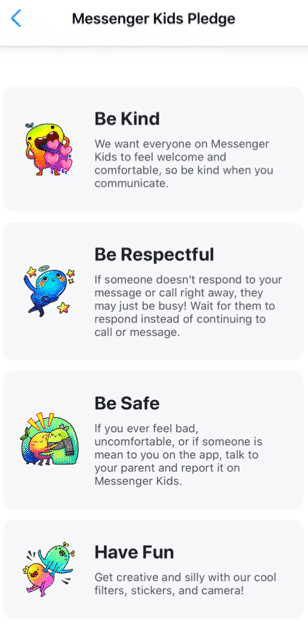
After you have completed all the above steps, your child will be prompted to add a photo of themselves, set a color to decorate the app, and complete “missions” to get to know the functions of the app. Your child will be prompted to read the Messenger Kids Pledge to be kind, be respectful, be safe, and have fun.[i]
What are the main features?
A parent dashboard that displays your child’s activities, contacts, and controls
Provide education to the child about new control features
Blocking a user allows the user to remain in the contact list, but the child will not be able to have individual conversations with that user
The child can use photo filters to send images to their contacts and to video chat
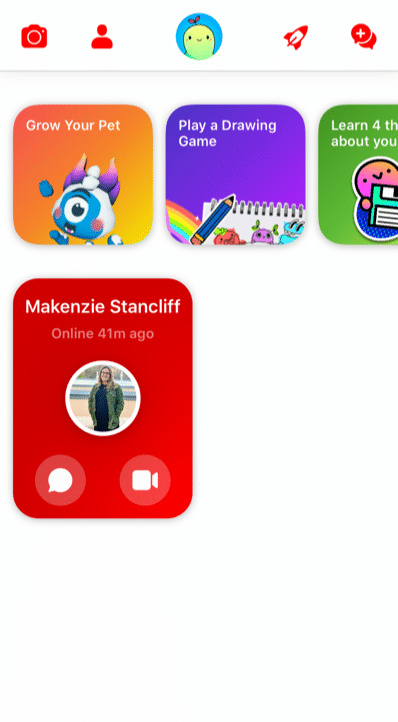
There are several “missions” the child can complete
Grow a pet
Play a drawing game
Learn 4 things about your information
Add a friend
Take a funny photo
Create a group
The Parent Dashboard
Because Facebook gets feedback from kids, parents, and child development experts, Messenger Kids is always changing for the better. For example, the updated parent dashboard is where you can see all of your child’s latest activities, contacts, and controls at a glance in one place. It also shows you
who and what content your child has reported or blocked and why,
a list of recent chats and calls (including how frequently your child is chatting/calling and with whom),
an image gallery of all the images and videos exchanged by your child and their contacts (including whether exchanged in a group).
User Education for Kids
Facebook has also thought through Kids’ digital literacy and privacy needs by notifying child users of the new parental control features in a Data Transparency Flow. Kids are prompted to go through this education with a push notification. It’s also available in the “mission” section of the app for kids. New users engage with this education during the registration process. They’ll get important basic information about how their personal data is used and shared when they use Messenger Kids – a great first step to cyber awareness and privacy issues in general.
Because child friendships need a healthy pause here and there, Facebook has also made blocking easier to use and less permanent. Before, if a child blocked someone, they were automatically removed as a contact. Now when a kid blocks someone, they won’t be able to communicate in a 1:1 chat, but they’ll remain contacts and still be able to be in group chats together. This allows kids to leave or stop individual interactions they no longer want while not having to leave group environments they may share with that contact. The child is always warned when they return to or start a group chat that contains a blocked contact that they have the option to continue to the chat, leave the group, or cancel joining the chat.
What are the privacy and safety options?
There is no minimum age of use outlined in the apps privacy policy. Facebook has a detailed list of what features they collect while using the app on their privacy policy. Here are a few of the features collected while using the app:
Facebook has recently added more controls. In the controls tab, you can see which device your child is logged into on MK, when your child last used MK on those devices and enables you to log your child out of selected devices. Parents also have the ability to remove and report any of these images and videos from the same Dashboard (doing so will remove that content from the child’s thread and notify them that you removed it).
As long as parents stay on top of who’s being friended and the information that is being exchanged, there are few risks associated with using Messenger Kids. The parent has the ability to control what the child can and cannot do as well as who they contact. Parents can also see what has been shared (and deleted).
However, any messaging app has its risks, especially when kids are involved. Here are a few we at GKIS thought you may want to consider
Your child and their friends may post inappropriately or impulsively
Cyberbullying between known contacts, like exclusion.
Too much access to friends and screens (of course, parents can schedule the use and use the sleep feature).
Your child is exposed to the Facebook brand, just as they are other popular American brands like Coca-Cola, Harley Davidson, and Budweiser.
Because parents have so much management opportunity and kids love the socializing, GetKidsInternetSafe rates Messenger Kids as a green-light app. We also love that Messenger Kids offers educational information that helps kids make better decisions with friends onscreen.
Thank you to CSUCI intern Makenzie Stancliff for co-authoring this article. For more information on keeping your child safe on social media, check out the Get Kids Internet Safe Screen Safety Toolkit. Be sure to add Messenger Kids on to the free GKIS Connected Family Agreement as “appropriate.”
I’m the mom psychologist who will help you GetKidsInternetSafe.
[i] Introducing Messenger Kids, a New App For Families to Connect. (2019, November 7). Retrieved from https://about.fb.com/news/2017/12/introducing-messenger-kids-a-new-app-for-families-to-connect/
[ii] (n.d.). Retrieved from https://www.facebook.com/legal/messengerkids/privacypolicy?version=2020