During the age of lockdowns and quarantines, many children have discovered a new way of finding someone new to talk to. A website known as Omegle, and other websites like it, have filled this social gap in many people’s lives. Omegle is considered a ‘roulette’ style website, where users may set interests and get matched with people with the same interest. This can be only a text chat, or it can be a video chat. If you find screen safety issues overwhelming in your family, you’ll benefit from Dr. Bennett’s weekly parenting and coaching videos on our Screen Safety Essentials Course. The most important thing that parents can do is be aware of the potential risks and promote an environment of open communication with your children. In this program, Dr. B offers a comprehensive family program for fostering this kind of communication in her Screen Safety Essentials Course. With this course, your family will learn tons of information about how to create a safer screen home environment while also connecting and having fun as a family. Armed with the right tools, you and your family can learn how to better thrive in today’s digital era. In this GKIS Sensible Guide, we will explain what you should know before letting your child chat away with complete strangers.
How long has Omegle been around, and how popular is it?
Omegle was created in March 2009. Omegle has recently seen over 54 million daily visits.[2] According to Google, searches for the site began to increase during March 2020, with the number of searches quadrupling the week before Christmas.[1] This surge in users isn’t much of a surprise. People were stuck inside their homes for almost a year due to the COVID-19 pandemic. Much of that time was spent on the computer, so why wouldn’t a website that allows someone to meet a new person be appealing? Teenagers have also created a ritual of hanging out together in person and going on Omegle as a group.
Omegle does state that to use the website, one must be over the age of 13. This is done with a simple pop-up box that can be clicked away. No date verification is required, so this is easy for children to bypass. As explained in the book Screen Time in the Mean Time, parents should use their best judgment to determine whether or not their child is ready to use a website like this. This GKIS Sensible Guide aims to help inform the parents so they are able to make the best decision possible.
Features of Omegle
Text-Chat
Individuals are prompted to enter optional interests to help match them. There are two options for the text chat: Text or Spy Mode
Text: Users are randomly matched in pairs, either based on their interests or completely at random if no interests were entered. Users are completely anonymous so there is no way to get someone’s information unless they offer it. Even if they offer it, they can (and likely will) lie. Either user may end the chat at any time.
Spy: Three users are matched together, two regular chatters and a spy. The spy prompts the other two with a previously entered question. The spy is unable to contribute to the conversation at all, they may only watch. The chatters focus on answering the question presented. Any user can end the conversation at any time.
There is no option for a ‘filtered’ text option. The website warns against profanity, sexual harassment, or violent threats, but there is no way to filter those statements out. If the user gets matched with someone who does any of these, the website simply says to ‘end the chat’.
The website itself warns that predators have been known to use text/video chat to groom or lure victims. It claims that it cannot control human behavior, and only the person committing these actions should be held accountable.
Video-Chat
Similar to text chat, users are randomly matched based on interests if possible. This can be in pairs or in groups. All user’s webcams will turn on while searching for a match.
This section has an option to report nudity, violent threats, and sexual content in addition to numerous other things one might encounter during chatting. This section does not allow any of these.
This section is aimed at users under the age of 18.
These filters to protect users don’t always work. Even the website itself warns that some things of inappropriate nature might be encountered.
“Unmonitored” Video-Chat
This is a carbon copy of the video-chat section with one crucial difference. No filter is used to prevent users from showing nudity or sexual imagery on their webcam chat.
This section is aimed at users who want a more ‘mature’ chatting experience, as long as they are over the age of 18.
Benefits of Omegle
When used correctly, and age-appropriately, it allows for individuals to talk with someone who has similar interests.
It can help an individual feel less alone and more connected in a quarantined world.
Risks of Omegle
The filters in place for the monitored section have inconsistent results. Some users still report encountering things that they shouldn’t several times in a row.
Children are more susceptible to believing an individual who may be lying. This may result in them giving information they shouldn’t to a complete stranger.
This website has the potential to expose children to sexual imagery, violent threats, phishing scams, and numerous other dangers.
None of the age checks are secure. Your child can easily access a section of the website that they shouldn’t with one simple click, no verification needed. This poses both a giant risk for the child and a giant temptation for them.
Throughout its lifetime Omegle has proven to be a constant source of controversy. This led GKIS to consider Omegle to be a red-light app, meaning that it is not recommended for anyone under the age of 18. The possible exposure to explicit material is too hard to control, and the fact that the website itself warns that predators do use this website to target victims were two of many factors that led us to this decision. If you think that your child may be using Omegle or other social media apps, consider our Social Media Readiness Course to help them stay safe.
Thanks to CSUCI intern, Dakota Byrne for researching Omegle and co-authoring this article.
I’m the mom psychologist who will help you GetKidsInternetSafe.
Three billion people use social media globally. We use it to stay in touch with friends and family, share memorable moments in our lives, and entertain ourselves during our leisure time. Although social media has its benefits, it also has its negative effects. Much of the outcome depends on the characteristics of the user. One characteristic that impacts social media use is the user’s attachment style. In today’s GKIS article, you will learn what attachment style is, how a child’s attachment style may impact the way they use social media, and strategies to improve your family relationships and create healthier attachments.
Social Media Readiness
In the article “Do Kids Need Driver’s Training … for the Internet?” Dr. Bennett asks, “Does driving city streets have anything in common with browsing the internet?” She argues it does, stating that “ Like driving a car, browsing the internet can cause significant injury. But instead of a concussion, we see kids succumbing to anxiety, depression, and body image problems linked to cyberbullying, radicalization, and compare-and-despair. Also, like driving, kids browsing the internet can wander into any kind of digital neighborhood making friends from faraway places. Most of the places they visit are cool, with fun friends, creativity, and harmless excitement. But there are also digital neighborhoods that would horrify us. Dangerous people like predators and traffickers may be common there and so is intensely violent and explicit sexual content.” With over 25 years of helping kids and families navigate difficult situations resulting from screen use, she created an online course for tweens and teens called the GKIS Social Media Readiness Course.
Dr. B argues that kids need specific knowledge and problem-solving strategies to recognize red flags online, as well as psychological wellness tools to bolster mental health and overall resilience. Not only does our course teach kids what they need to know for online safety, but parents need knowledge too along with an ongoing cooperative dialogue with their kids about online issues. Creating this dialogue has a lot to do with healthy attachment.
Attachment
The father of attachment theory is John Bowlby, a British psychoanalyst who was interested in studying the intense distress that infants demonstrate when they are separated from their parents. Other attachment researchers went on to create theories and testing measurements, like the Strange Situation paradigm created by Mary Ainsworth.
Strange Situation
To test a child’s “attachment style,” researchers created a child separation situation in the psychology lab. For the Strange Situation method, researchers put a mother and toddler child alone in a room. The room was filled with toys and plenty of eye-catching items for the child. After some time of playing, a stranger enters the room and attempts to interact with the child. The mom is instructed to then leave the room. After a few minutes, she returns and comforts her child. A few minutes later the stranger returns and interacts with the child again. Then the mother comes back and greets her child.[2]
The Strange Situation was designed to present children with an uncommon, but not too overwhelming, experience. The child’s response was then coded and classified to fit in one of four attachment styles.
Attachment Styles
Attachment styles are academic descriptors of how an individual relates to other people. An attachment style is formed at an early age, and once established it stays with you.
Children with secure attachment styles have healthier relationships overall. Kids with avoidant, anxious, or disorganized attachment styles tend to form poor quality family and peer interactions. They have trouble maintaining healthy, mutually beneficial friendships because they’re often anxious or dependent.
The Four Types of Attachment Styles
SecureAttachment
Secure attachment is characterized by a stable sense of security and comfort to be out and about knowing that their caregiver will be there when needed. Caregivers of securely attached children are typically available, sensitive, and protective of the child. They use authoritative (warm and consistent) parenting strategies rather than being overly strict (authoritarian) or indulgent (permissive).
Avoidant Attachment
Avoidant attachment is characterized by a child who avoids interaction with the caregiver and shows no distress during separation. Caregivers of an avoidant attached child typically don’t acknowledge a distressed child, instead of shaming the child for showing emotions and having unrealistic expectations. These caregivers often don’t validate the child. Emotional validation is the process of encouraging emotional expression and offering warm acceptance and nurturance. Validating a child’s emotion is a critical element to teaching children socio-emotional intelligence and self-soothing.
Anxious Attachment
Anxious attachment is characterized by a child who fears abandonment and doesn’t interact with strangers. Kids with anxious attachment tend to be clingy and insecure. Caregivers of anxiously attached children are often overly protective or insensitive. They can be available at one moment, then unavailable, which can leave the child confused.
Disorganized Attachment
Disorganized attachment is characterized by a child who, when their caregiver unexpectedly leaves the room, will respond with a confused expression, freezing, and demonstrating unorganized behavior. Caregivers in this situation are inconsistent. More specifically, they may demonstrate kindness and care to their child sometimes and other times ignore their needs or get angry. Parents who send these types of mixed signals are often impaired due to mental illness, addiction, or severe overwhelm.
What does social media have to do with attachment?
Social media has become a new form for people to receive validation and support from others, especially for those who are building identities like tweens and teens. In a study by Stöven and Herzberg, researchers reviewed 17 studies on attachment styles and social media use. They found that people with higher levels of abandonment anxiety tend to overuse social media as a way to feel like they belong.[1] The subjects were more likely to seek support and attention from people online to feel good. Social media was a way for them to seek reassurance and feel like people liked them.
How is an over-reliance on social media for identity a problem?
A constant need for reassurance can cause undesired results, such as
trouble making decisions because the subject is too concerned about what others think.
anxiety or depressive symptoms when the subject does not get the response they hope for.
the subject having an “internal debate” with themselves with questions like, “what if?”
Ways to Improve Your Child’s Attachment and Make Them Healthier Adults
Be sensitive and compassionate. Children need nurturing warmth during their early years to identify the emotion, learn how to express it, and build the confidence to self-soothe on their own.
Respond calmly to your child. Modeling self-soothing is an awesome way to teach socio-emotional skill-building. Plus, it serves to clear the way for logical problem-solving rather than escalating an already stressful situation.
Get involved. Just as you would supervise and monitor your child’s exploration of city neighborhoods, you must do the same with digital neighborhoods. That means setting rules and expectations like those detailed in our Connected Family Courseand setting up parental controls using the resources (and discounts) offered in our Screen Safety Toolkit.
If you’d like all GKIS course materials delivered in an inexpensive, convenient, easy-to-follow drip on your smartphone, check out Dr. Bennett’s weekly parent and family coaching videos in the GetKidsInternetSafe App!
Thanks to CSUCI intern, Maira Soto for researching social media and attachment styles for this article.
I’m the mom psychologist who will help you GetKidsInternetSafe.
“I can’t breathe, and my chest is killing me. My heart is racing. Am I having a heart attack? I am sweating, trembling, and dizzy. I think I’m going to vomit. My thoughts are racing. Have I gone crazy? What is wrong with me?” If this sounds familiar, you are probably one of three adults in the U.S. who has had an anxiety attack. Screens can have a significant effect on our levels of anxiety, but how?
What is anxiety?
In my 25+ years of clinical practice, I have treated many kids, teens, and adults with anxiety disorders. Since the advent of mobile screen technology, we have seen prevalence numbers increase dramatically. Twenty-five percent of 13- to 18-year-olds have mild to moderate anxiety with the median age of onset at 11 years old.[1]
There are five major types of anxiety disorder.
Generalized Anxiety Disorder(GAD) is characterized by chronic worry about things that don’t warrant that level of concern.
Obsessive-Compulsive Disorder (OCD) is characterized by recurrent, intrusive thoughts and repetitive ritualistic behaviors, like counting, tapping, washing, or checking.
Panic Disorder (PD) is a chronic dread of having a panic attack, which feels like intense fear and trouble breathing, heart racing, and dizziness.
Post-Traumatic Stress Disorder(PTSD) is typically triggered by a terrifying ordeal.
Social Phobia (SP) causes people to withdraw due to extreme self-consciousness or embarrassment around others and a fear of being scrutinized or judged.
How Screens Can Trigger Clinical Anxiety Symptoms
Generalized Anxiety Disorder
Screens can be distracting and lead to wasted time and poor work performance. Not only do kids worry about those missed assignments, but too many hours of online learning can put them in a state of irritable exhaustion. In Dr. Bennett’s book, Screen Time in the Mean Time, she details how multitasking, which refers to interrupting one task to attend to another (like social media notifications during homework), burns brain fuel at a rapid rate – leading to mental brownout.[2] Mental brownout can lead one to feel hopeless and helpless, which can lead to chronic worry about … just about everything.
Obsessive-Compulsive Disorder
Keeping up with the Jones’s (or Kardashian’s) on social media can lead to obsessive scrolling and compulsive checking. We’ve all seen the notorious #GymSelfie or #FoodPorn that pops up on our news feed. Then there’s the #OutfitOfTheDay, #MCM (man crush Monday), #WCW (woman crush Wednesday), or your #TBT (throwback Thursday). Keeping up can feel overwhelming.
As Dr. B says in her article “Teaching Kids the Brain Traps of Video Games May Break the Spell,” “likes” are designed to tap into our evolutionarily-reinforced need to please our tribe – also called social capital. She elaborates, “When that notification pops up on our smartphone that somebody liked our post, we get a slight euphoria.”
Getting the likes makes us want more (compulsive use patterns), and not getting the likes can send us into compare and despair. Big tech is aware of this and plays on our psychology to keep our eyes on the screen. Our attention has been commodified (meaning that data about our online behaviors is for sale because it has value to marketers). The more we stay on screen, the more we fall victim to ads and the compulsion to buy.
Panic Disorder
Panic attacks happen when the autonomic nervous system, our survival center, gets triggered too easily. Poor self-care (like not sleeping, eating well, exercising, or socializing) can make us vulnerable having panic attacks. Dr. B says video games are also programmed to jack up your autonomic nervous system, which can lead to panic attacks.
Post-Traumatic Stress Disorder
In our GKIS article, “Live Streaming Can Cause PTSD in Adults and Children,” we detailed how watching live-streamed videos on social media and Youtube can lead to debilitating trauma symptoms. It’s critical to consider that screen content matters as much as, if not more than, screen time.
Social Phobia
It doesn’t take much imagination to consider that social media can lead to fear of excessive social scrutiny. Dr. B writes about the normal adolescent defense called the imaginary audience. She writes, “Teens can become extremely focused on their looks and very self-conscious, convinced that EVERYBODY is looking at them. As a result, they pay meticulous attention to clothing, makeup, hairstyle, body shape, and mannerisms. It’s as if they are carefully cultivating their brand to fit in and stand out among admired peers. Although imaginary audience has been observed among adolescents throughout history, social media may exacerbate anxiety. I believe compulsive urges to take perfect selfies are a healthy expression of the imaginary audience rather than the pathology of narcissism.”
It didn’t happen if you didn’t post it.
There is a popular saying that if you didn’t post about it, it didn’t really happen. Many teens are more invested in their virtual lives than they are in their non-virtual lives. This makes sense considering they spend more waking time on screen than they do off-screen!
Teen life often happens in a snapshot and not much else. Our kids are spending time at events, the beach, and vacation looking for that split moment to capture a picture guaranteeing them likes from their followers. Conversations are “Uh-huh” and “Mm, sure” without eye contact. Screen time is the master, and we’ve grown to accept that that is “just what teens do these days.”
Social media can become a shrine of a person’s life, and if it is subpar, that person’s life seems subpar. Sound extreme? It is, and it is real. The pressure to be perceived in a certain way can consume our minds and impact self-esteem. A Canadian study found that the more time spent on screens, the higher the risk of developing anxiety in children.[3] Screen addiction is proving to be a real concern rather than a minor annoyance.
Driven to Distraction
Anxiety has the potential to impact not only the quality of time spent with family and friends but may also sever the most important relationship of all, the one with ourselves. Self-worth goes down, anxiety shifts to depression, and all because we judge others and ourselves through the safety of a screen, hidden in anonymity, and supported by strangers.
It can happen to anybody.
A child therapist friend of mine shared with me that she recently deleted all social media apps off her phone. She said she felt social media was consuming her and ultimately the cause of a lot of anxieties. Between clients, she browsed Facebook and Instagram instead of doing her mandatory briefings. Her briefings would get stacked up for weeks. Ultimately, this would contribute to her unease. This is a professional in mental health, one whom we would like to think could find a good balance. Now imagine your teenager…
What can we do about it?
Identify the triggers and recognize that you may be powerless against them without cutting down on screen time.
Set reasonable parameters.
Use time management and blocking apps.
Learn cognitive behavioral coping skills like breathing, mindfulness, cognitive restructuring, and meditation
Make your nonvirtual life more enriching
Thank you to Chad Flores for helping us recognize how screens may contribute to anxiety.
[3] Maras, D., Flament, M. F., Murray, M., Buchholz, A., Henderson, K. A., Obeid, N., & Goldfield, G. S. (2015). Screen time is associated with depression and anxiety in Canadian youth. Preventive Medicine: An International Journal Devoted To Practice And Theory, 73133-138. doi:10.1016/j.ypmed.2015.01.029
Meeting people online can be fun and exciting, especially for teens. However, there are risks. If you want to prepare your child for these risks, check out the GKIS Social Media Readiness Course. You may have heard of popular adult dating apps likeTinder or Bumble. In this GKIS article, we cover 5 dating apps that are popularly used by teens that you probably have never heard of.
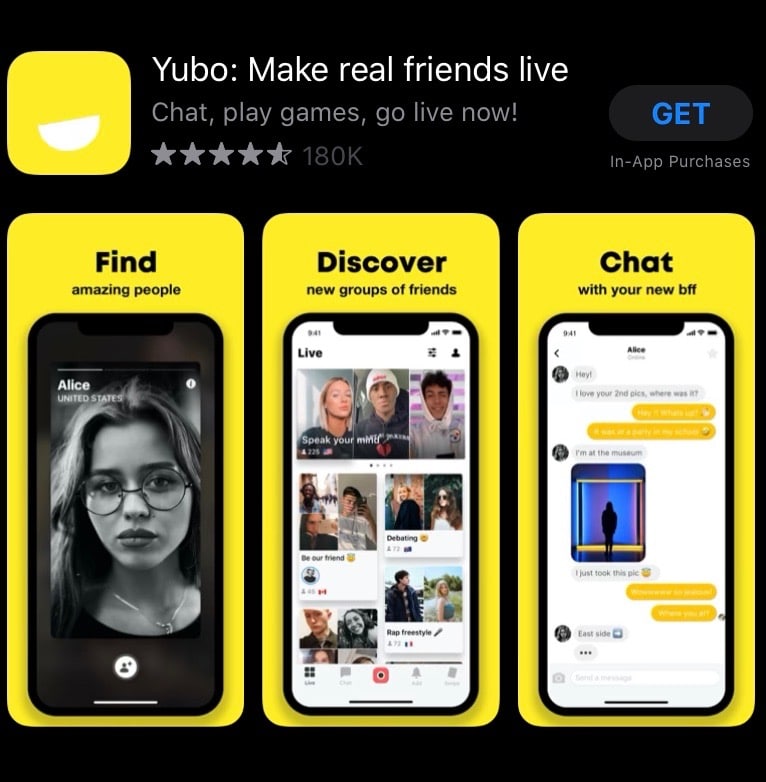
Yubo
Yubo is a location-based social networking app advertised for making new friends, but many people describe it as a dating app for teens.
This app contains many features such as:
Stream: share live stream videos with friends.
Chat: chat with friends and other app users.
Swipe: discover new friends nearby or around the world.
Find a community: connect with people who have the same interests by finding a community. The online communities range from art and sports to LGBTQ+.
Play: play games with friends like Q&A, Would You Rather and Let Them Guess.
Yubo’s age rating is 17+, but there is no age verification for this app, meaning any teen can use it and lie about their birthday.
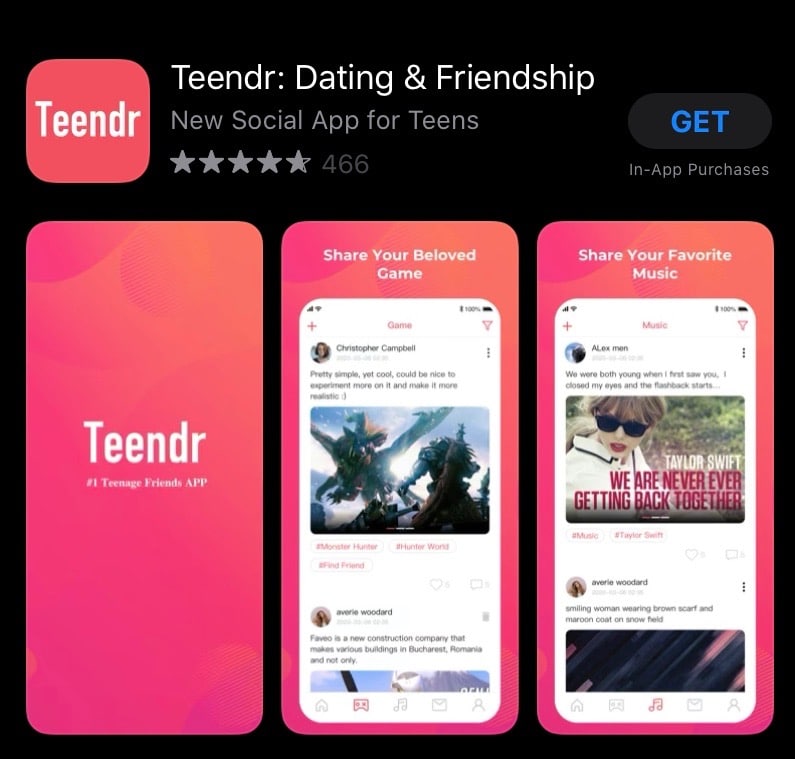
Teendr
Teendr is marketed as a dating app for teens. On this app, users can meet and chat with new friends nearby based on their common interests like music, games, and more.
This app contains:
Unlimited swipe: swipe right to meet new people or left to ignore.
Search nearby: discover matches based on location.
Game & music sharing: meet people based on their gaming and music preferences, which they can share on the app.
Teendr is also rated 17+, with no age verification.
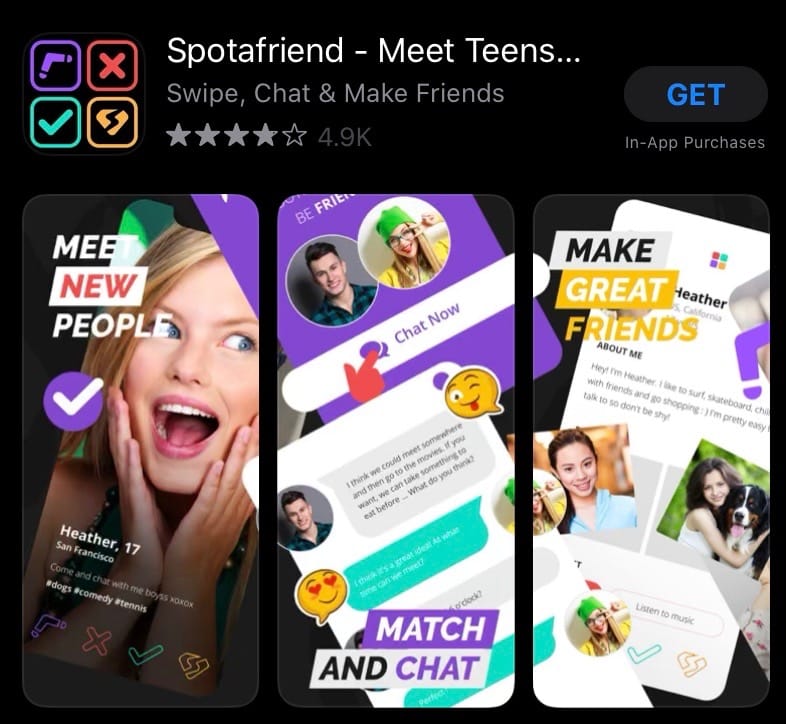
Spotafriend
Spotafriend is an app designed for teens to meet new people in their proximity. On the app store, it is described as “not a teen dating app,” but that’s what many teens are using it for.
Spotafriend includes:
Swipe: swipe right to become friends with someone.
Chat: chat privately when you get a match.
Spotafriend is rated 17+, but it is designed for ages 13-19.
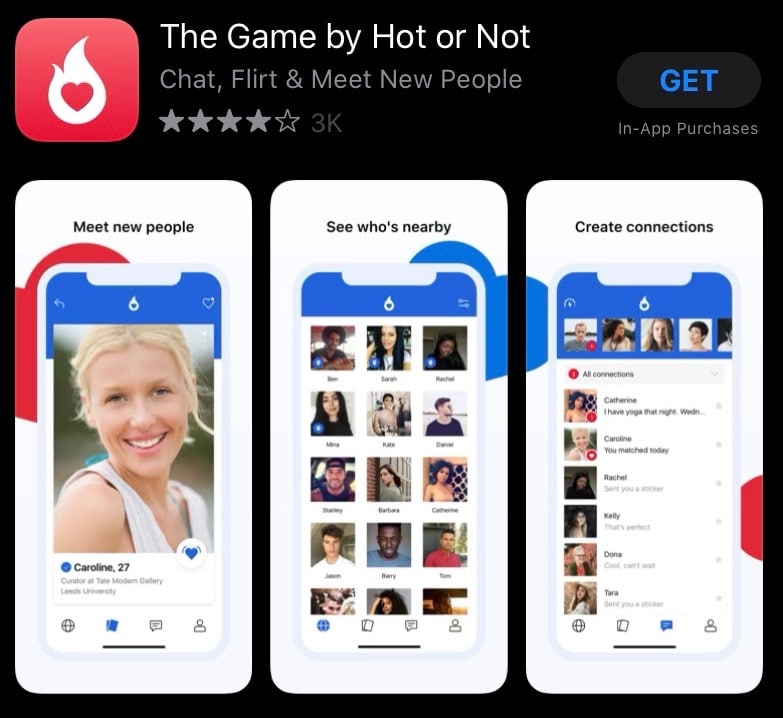
The Game by Hot or Not
The Game by Hot or Not is another app that allows teens to meet people in their area. It is marketed as an app to find the ‘hottest’ people nearby.
This app includes:
Ratings: rate each other’s attractiveness by tapping a heart on your profiles.
Direct messages: Users who match (by liking each other’s profiles) can exchange messages.
Location services: find people in your proximity.
Age: Hot or Not was originally rated 17+, but is now 18+ with no age verification.
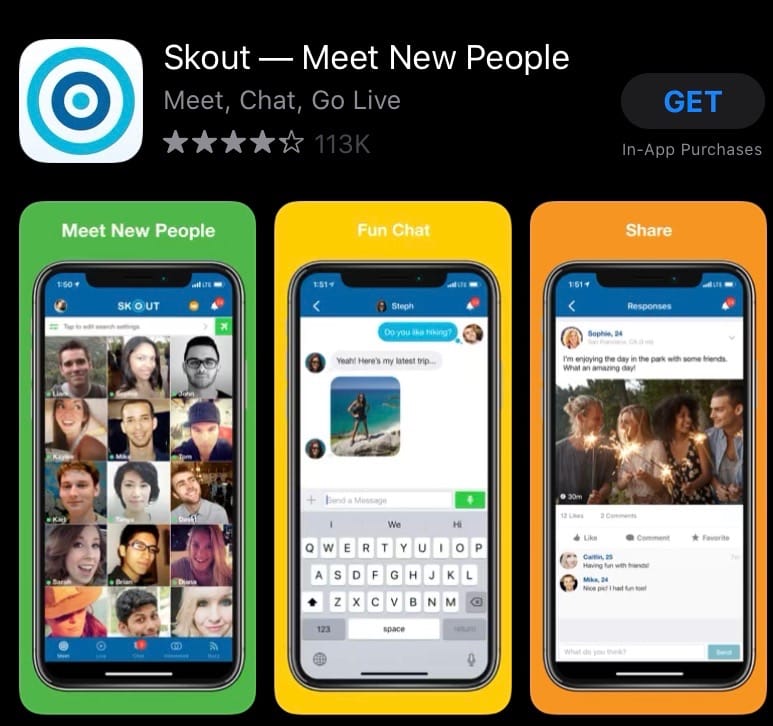
Skout
Skout is a social networking app that allows its users to meet people nearby or around the world.
The app features:
Preference and location: connect with people based on preferences and proximity.
Live broadcasting: broadcast live videos on the app and watch other’s videos.
Chat and upload photos: send direct messages, share photos, and like/comment on other users’ photos.
Promote: Skout claims to have in-app features that increase your chances of finding new people and chatting.
Skout is rated 17+, but only people 18+ are allowed to join. Again, there is no age verification.
Meeting and flirting with people online can be exciting and fun, but it can also come with risks.
Catfishing and Online Grooming
Not everyone on the internet is who they say they are. Some people make fake profiles to deceive other users, which is called catfishing. On dating apps and social media, your teen can get exposed to sexual predators who use catfishing and grooming techniques to gain their trust.
Sexting
Oftentimes, teens exchange their phone numbers and Snapchat usernames when they connect with others online. This can easily lead to sending sexual messages and photos. According to Guardchild:
20% of teens have sent or posted semi-nude photos or videos of themselves
39% of teens have sent sexually suggestive messages online
Sexting is common among teens which can be scary if their photos end up in the wrong hands and are shared publicly. This can lead to bullying, blackmailing, and emotional distress for the victim. For more information about sexting, check out the GKIS article, How Texting Can Turn To Sexting in the Blink of an Eye.
Cyberbullying and Harassment
Using dating apps and social media increases the likelihood of your teen experiencing cyberbullying and online harassment. Your teen might experience hateful comments, stalkers, and receive unwanted sexual messages.
Click here to read a GKIS survivor’s story about teen bullying and sexual abuse.
If you see your teen using dating apps…
Don’t panic. Most likely, many of your teen’s peers are also using the same apps.
Have an open discussion about the risks of dating or social networking apps.
Teach them to turn off location services for apps to disable people from seeing where they are.
Encourage them to approach you if anything makes them feel uncomfortable online.
Remember that it’s okay to say no, especially if they are too young to have an account.
Betts, J. (n.d.). Teen Dating Apps. Retrieved December 03, 2020, from https://teens.lovetoknow.com/relationships/teen-dating-apps
Online Dating – The Risks For Teens. (n.d.). Retrieved December 03, 2020, from https://www.internetmatters.org/resources/teens-and-online-dating-advice-hub-for-parents/online-dating-the-risks-for-teens/
Online Dating Is Especially Risky For Teens. (2020, September 17). Retrieved December 03, 2020, from https://yourteenmag.com/social-life/tips-teen-dating/online-teen-dating
Team, F. (n.d.). Swipe right for trouble: Six teen dating apps parents need to know about. Retrieved December 03, 2020, from https://www.familyzone.com/anz/families/blog/six-teen-dating-apps-parents-need-to-know
Teenage Sexting Statistics. (n.d.). Retrieved December 03, 2020, from https://www.guardchild.com/teenage-sexting-statistics/
Updated: November 8, 2., Kelli Dugan, C., Bob D’Angelo, C., Natalie Dreier, C., & Jared Leone, C. (2019, November 08). Teen dating apps: 5 popular dating apps that parents need to know. Retrieved December 03, 2020, from https://www.whio.com/news/local/teen-dating-apps-popular-dating-apps-that-parents-need-know/KQGkhTpFCxeyrmLejeODpN/
Is your child sharing their location with hundreds of “friends” online? Are they unwillingly giving away personal information that can put their privacy in danger? Our GKIS tools can help with that. In this article, we cover the ways kids overshare online and provide insightful tips and strategies to keep your child safe.
The GKIS Mission
GKIS helps families achieve screen sanity, prevent digital injury, and form deeper, more meaningful relationships. We don’t have to give up screens to be safe. GKIS offers tools and strategies that keep the joys of childhood discovery alive for all of us in today’s overtasked world.
Oversharing
Teenagers love to share what they are doing online, whether it’s posting what they’re eating, uploading selfies, or posting pictures of their pet. Sharing daily life online is fairly common; we adults are guilty of it too. But sharing location data can be particularly dangerous for teens because it offers a bridge from online contacts meeting them online to meeting them offline.
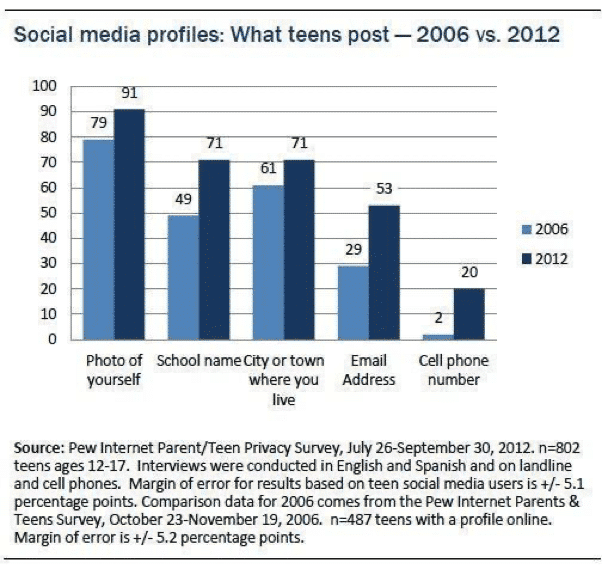
According to Pew Research Center, 71% of teens post their school name, 71% post the name of the city or town they live in, and 20% post their phone number.[1] Further, 36% of older teen’s Facebook friends are people they have never met in person.[2]
Although teens understand that oversharing can be dangerous, few have the life experience to understand exactly how it can be dangerous. When I was a teenager, the more “likes” I got on a photo or the more “friends” or “followers” I had on social media, the better I felt about myself and my online presence. I accepted friend requests from mutual friends who I had never met before, along with accepting requests from strangers. In my teenage mind, there wasn’t any harm in letting strangers see my online profiles. I felt that I would be okay as long as I wasn’t sending them my address. It didn’t occur to me that this data could be used to predict my location or even that anyone could have that kind of predatory intent.
Dr. Bennett shared a story with us where she worked on the production of the Lifetime TV show, I Catfished My Kid. In the show, producers created a poster board map (like detectives do) with yarn connecting the teens’ movements throughout the day for a week. With this data, they were able to predict daily habits like location, activities, and even who they hang out with.
How is Location Data Shared?
Instagram
One way location is shared on social media is through geotagged photos. A geotag is an electronic tag that assigns a geographical location to a photo or video posted on social media or other websites.[3] Geotags are commonly used to share what restaurant or city someone is in and are very popular on Instagram.
If your teen has a public profile and decides to post a photo on Instagram with a geotag, not only will their friends be able to see where they are, but users around the world can too. By simply clicking on that location’s tag, your teen’s photo will pop up as a current or recent visitor.
Another way location is shared on Instagram is by the use of hashtags. If your teen has a public profile and adds hashtags to their posts, their photos will show up as recent users of whatever hashtag they use, similar to the geotag feature. Hashtags are commonly used to have other users find their posts quicker and potentially gain more followers and traffic on their profile. However, that could be a privacy concern for younger users.
Facebook
The check-in feature on Facebook is similar to geotags. Facebook users “check-in” as an announcement to friends that they are visiting a particular location. Once checked-in, it appears on the user’s Facebook profile.
Snapchat
The SnapMap feature on Snapchat can also be a location risk. SnapMap allows your teen to share their location with their Snapchat friends every time they open the app. The SnapMap feature is a default, meaning it is automatically on so your teen might not even know that they are sharing their location. This is another privacy issue and may be a safety concern if your child accepts friend requests from strangers.[4]
Helpful Tips and Tools to Protect Your Child on Social Media
Set up a digital contact like our free Connected Family Screen Agreement and have ongoing, informative conversations with your kids about online safety. Our GKIS blog offers credible, interesting topics that will feed an ongoing agenda. Register for our Connected Family Screen Agreement to get on our weekly email list!
Set up your home to optimize best-use screen practices using our Connected Family Course for school-age kids.
Limit location sharing in Settings. On an iPhone, go to Settings and remove the location by clicking on the social media name > Location > select Never, Ask Next Time, While Using the App, or Always. You also have the option to turn off “Precise Location” meaning apps can only determine your approximate location
Don’t allow your child to have social media accounts until they are ready (we recommend after 13 years old or late middle school).
Require that your child set social media to private and only accept friend requests from family and friends they know in real life
Have your child change to the “Ghost Mode” on Snapchat (their location will no longer be viewable on SnapMap)
Thanks to CSUCI intern, Remi Ali Khan for researching common ways teens overshare on social media for this article.
I’m the mom psychologist who will help you GetKidsInternetSafe.
Onward to More Awesome Parenting,
Tracy S. Bennett, Ph.D.
Mom, Clinical Psychologist, CSUCI Adjunct Faculty
Photo Credits
Photo by Cottonbro from Pexels
Photo by Pixabay from Pexles
Photo by Pew Research Center
Works Cited
Deahl, D. (2017, June 23). Snapchat’s newest feature is also its biggest privacy threat. Retrieved November 04, 2020, from https://www.theverge.com/2017/6/23/15864552/snapchat-snap-map-privacy-threat
Dove, J. (2020, October 07). How to Remove Location Data From Your iPhone Photos in iOS 13. Retrieved November 04, 2020, from https://www.digitaltrends.com/mobile/how-to-remove-location-data-from-iphone-photos-in-ios-13/
Madden, M., Lenhart, A., Cortesi, S., Gasser, U., Duggan, M., Smith, A., & Beaton, M. (2020, August 17). Teens, Social Media, and Privacy. Retrieved November 04, 2020, from https://www.pewresearch.org/internet/2013/05/21/teens-social-media-and-privacy/
Oxford Languages and Google – English. (n.d.). Retrieved November 04, 2020, from https://languages.oup.com/google-dictionary-en/
Is your teen on Snapchat and Instagram? If so, they may be using what is popularly called, ‘plastic surgery’ filters. These filters may be altering your teen’s image of themselves and could be harmful to their mental health. I have been using filters on Instagram, Snapchat, and other social media platforms since I was a teen. Over the years these filters have become more face-altering than ever before. For more tips and guidance on social media, check out Dr. Bennett’s Social Media Readiness Course.
What Are ‘Plastic Surgery’ Filters?
Plastic surgery filters are filters that make users look like they have different types of cosmetic surgery. These filters give the users bigger lips, smoother skin, smaller noses, sharper cheekbones, and even different colored eyes. They are popularly used by celebrities, influencers, teens, and young adults.
Unrealistic Beauty Standards
‘Plastic surgery’ filters can be harmful because they promote unrealistic beauty standards by erasing imperfections and enhancing certain features. Teenagers view thousands of ‘perfect’ images daily on social media shared by peers, idols, and even themselves. This can cause self-esteem problems because beauty standards become less and less realistic.
Attention from Followers
Many celebrities and people I know refuse to post an unedited or unfiltered image of themselves, which is sad and scary. Attention from followers contributes to this problem. If a teenager posts filtered selfies and they get positive comments from their followers, they may depend on using those filters because they feel that they will not get the same attention without one. This can cause people to become obsessed with the filtered images of themselves and unhappy with their appearance without a filter.
Snapchat Dysmorphia
Along with lowering self-esteem, filters like these are inspiring more young people to get cosmetic surgeries because they prefer the edited version of themselves. Cosmetic doctors are noticing that filters might be leading to a new type of body dysmorphia. Body dysmorphia is a mental disorder where a person obsesses over a minor flaw in their appearance.
Dr. Esho, a cosmetic doctor, claims that an increasing number of individuals are bringing pictures of themselves with filters to plastic surgeons and asking to look like that. Doctors are calling this new type of body dysmorphia, ‘Snapchat Dysmorphia.’
My Personal Experience Using Filters
I have used filters that make my lips fuller, skin smoother, and face slimmer. When I was using them, I did not fully realize how often I was using them until my boyfriend once told me, “Why do you always use filters? You are beautiful without them.” He wasn’t telling me to stop using them, he simply asked me why.
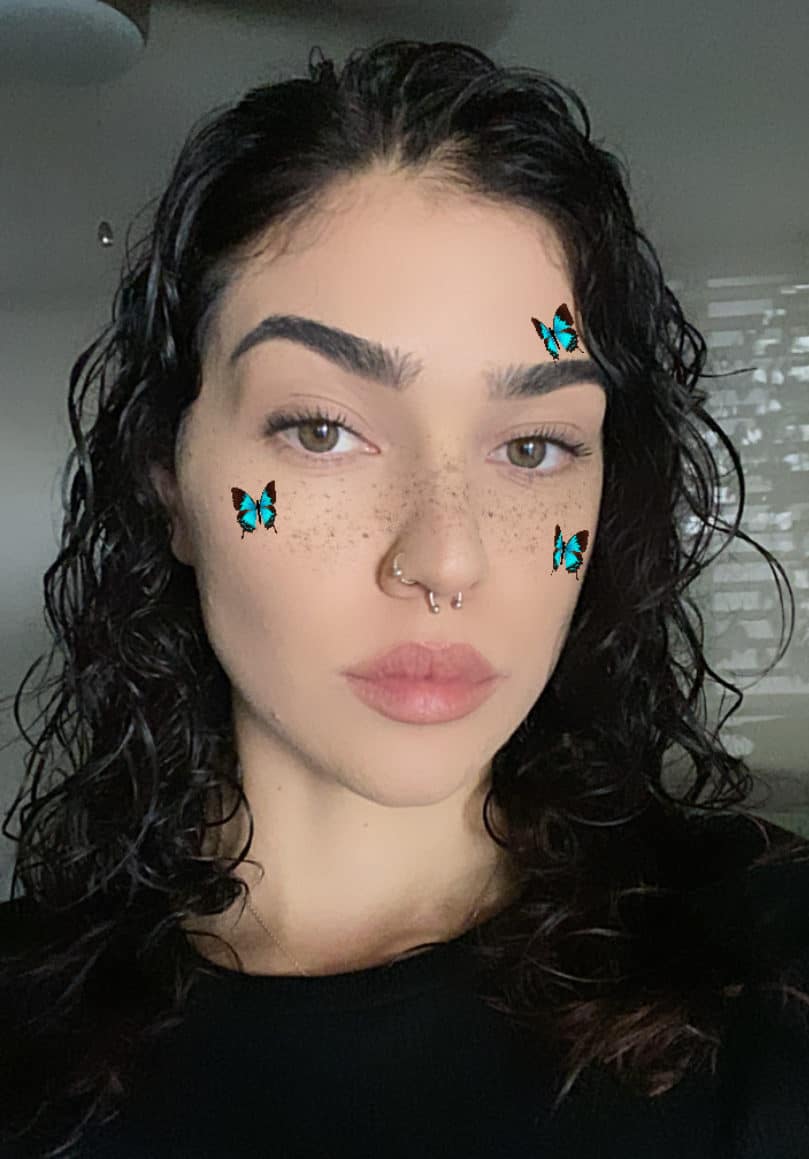
I realized that he was right, that I was relying on filters to feel beautiful. Since then, I limit my use of filters and embrace my imperfections. I want to share an authentic version of me. For this article, I decided to do a before and after using a few Instagram filters, so you can see how different they make me look.
(No Filter) Filter 1 Filter 2 Filter 3
What can you do if your teen is using filters on social media?
Just because your teen uses filters does not mean that they will develop a disorder or develop self-esteem problems. Everyone is different. But it is important to be aware of the potential risks of this social trend.
If you notice that your teenager is on social media and using filters here are some things you can do:
Have a conversation with your teen.
Talk to your teenager about what they see on social media. Remind them that most of the photos that they see on Instagram or any other platform are not 100% real because of filters or photo editing. This is something that they most likely are aware of, but I oftentimes have to remind myself of this when I am scrolling through Instagram.
In this generation where many teenagers and adults rely on likes and comments for self-worth, it is important to remind your teenager that there are more qualities in life that matter than their looks. Point out their other qualities and strengths like work ethic, intelligence, and kindness.
Don’t forget to remind them that they are beautiful without a filter!
Practice positive affirmations.
Teach your teenager positive affirmations and practice them together. Affirmations are positive statements that you say out loud to yourself. 7 Mindsets provide helpful affirmations for teens, here are a few:
“I embrace my flaws because I know that nobody is perfect”
Best, S. (2020, January 28). Instagram still has several ‘plastic surgery’ filters despite ban last year. mirror. https://www.mirror.co.uk/tech/instagram-still-several-plastic-surgery-21369194.
Cavanagh, E. (2020, January 11). ‘Snapchat dysmorphia’ is leading teens to get plastic surgery based on unrealistic filters. Here’s how parents can help. Insider. https://www.insider.com/snapchat-dysmorphia-low-self-esteem-teenagers-2020-1.
Hosie, R. (2018, February 6). People want to look like versions of themselves with filters rather than celebrities, cosmetic doctor says. The Independent. https://www.independent.co.uk/life-style/cosmetic-surgery-snapchat-instagram-filters-demand-celebrities-doctor-dr-esho-london-a8197001.html.
Kelly, S. M. (2020, February 10). Plastic surgery inspired by filters and photo editing apps isn’t going away. https://www.cnn.com/2020/02/08/tech/snapchat-dysmorphia-plastic-surgery/index.html.
Rodulfo, K. (2020, August 13). It’s Easier Than Ever To Make A New Face On Social Media. But Is It Killing Your Confidence? Women’s Health. https://www.womenshealthmag.com/beauty/a33264141/face-filters-mental-health-effect/.
Manavis, S. (2019, October 29). How Instagram’s plastic surgery filters are warping the way we see our faces. https://www.newstatesman.com/science-tech/social-media/2019/10/how-instagram-plastic-surgery-filter-ban-are-destroying-how-we-see-our-faces.
Yang, L. (2018, August 10). People are seeking plastic surgery to look like their edited selfies in real life – here’s why doctors think the trend is ‘alarming’. Insider. https://www.insider.com/plastic-surgery-selfie-filters-2018-8.