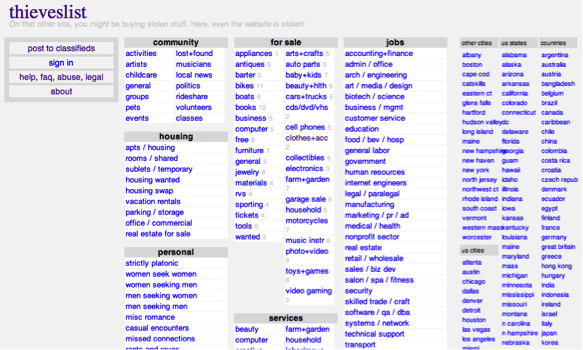
Craigslist is the website where Internet users can buy and sell anything. In just a few clicks of the mouse, one can browse advertisements for housing, items for sale, jobs, information forums, help for services, gigs, community events, and even people. Craigslist can be a highly useful tool, but it also has a dark side. I pulled together accounts from reputable publications to inform GKIS readers about Craigslist benefits and its risks. Then I offered some quick tips for staying safe when using Craigslist.
From Hobby to Fortune
In 1995, Craig Newmark started an email program as a hobby. This program allowed him to easily communicate social events to other San Francisco Internet developers. Word of the program grew quickly, and users began posting emails for other purposes like job searching. Due to popular demand, Craig quickly expanded the features of the program, and in only a year, the website, Craigslist, was created.
The website continued to rapidly expand, and in 1999 Craig’s hobby became a full-time job. In 2010, Craig’s net worth was estimated at a staggering 400 million dollars! His website is now available in over seventy countries and is visited over 20 billion times a month (Terynn, 2013).
So Easy, Your Child Can Do It
Craigslist is famously known as “the public online marketplace.” The website’s user-friendly system and free cost to advertise, draws in 55 million users every month, in the US alone (Usman, 2014). It’s now commonly used by the average American and is a staple for amateur buying and selling.
To access Craigslist, you do not need a user name, personal information, or a credit card. You are free to browse all the content on the website anonymously. If you see an advertisement you like, simply click on the ad, and you will be taken to a page with more detail of the item and a link to the owner.
Creating an ad on craigslist is also easy. Select a category you wish to make an ad for (items for sale, personals, jobs etc.). Then add a title for your ad, a description of what you are selling, and any personal information for those to reach you (email, phone number, social media, or a home address). Once you have posted the advertisement it is viewable to everybody on the site.
My Experience with Craigslist
I love using Craigslist. I have bought and sold many items using the site, and each transaction has gone smoothly. I have had many welcoming encounters, and I have even become friends with a few people I have met. The website is intuitive and easy to manage, and the free advertisement it provides is amazing. However, like with so many Internet sites, people have found ways to use Craigslist for unanticipated, illegal purposes.
The Dark Side: Scammers, Stalkers, and Setups
Scammers use Craigslist to steal money from unsuspecting victims by placing fraudulent advertisements with incredible deals. Buyers are asked to send money orders or checks online, and after making payment, never receive their item. Scammers also take advantage of those selling items. They do this by sending bad money orders or checks that bounce (Paul, 2013).
In Ohio a man tried to use Craigslist to sell his car. He was thrilled when a man responded to his advertisement wanting to purchase his vehicle. The man claimed to be from South Carolina but was unable to come and pick up the car in person. He asked if the car could be shipped to him, and he would send a check to cover the cost of shipping and the vehicle. The Ohio man agreed, and his customer sent $5,450. After receiving the money, he paid for the car to be shipped and told the man from South Carolina it was on its way. The next day he checked his bank account, and the funds he had received were no longer good. He tried to contact the man but was unable to and lost $2500 dollars due to the shipping charges (John, 2016).
Stalkers are also using Craigslist to set-up and harass victims. They do this by posting advertisements that may include the victim’s phone number, address, and even photos. The stalker can even pose as the victim through email and send messages to those who respond to the ad. Victims are then targeted by the harassment of unknown strangers.
A woman from Maryland, was horrified when she founds ads posted on craigslist that read, “Rape me and my daughters.” The ad included her address and photos of her and her daughters. She contacted police, and police found that her ex-husband was responsible for the ads (Justin, 2013).
A bizarre Craigslist story involved a soon-to-be-married couple and an ex-girlfriend (Kelley, 2017). The soon-to-be wife claimed that the ex-girlfriend created a Craigslist advertisement posing as her. In the ad people were asked to come to her house and forcibly rape her. The soon-to-be wife also called the police, claiming that a man had forcibly entered her garage and attempted to rape her. When police arrived, the woman had red marks around her neck and a ripped shirt. Police never found a suspect. However, investigators examined the Internet history of both women. They discovered that the soon-to-be wife had created the advertisement to frame the ex-girlfriend!
Robbery and Sexual Assault
Robberies and assaults are unfortunately quite common on Craigslist. Criminals know that victims are bringing valuable items to meetings and use this knowledge to plan locations where they can easily rob their targets. They also take advantage of trusting and unaccompanied victims.
In Seattle, a woman used the services section of Craigslist. She posted an advertisement asking for someone to fix her broken microwave. A man responded to her ad. When he arrived at her house, she was home alone. He sexually assaulted her and fled the premises (Levi, 2008).
Another story comes from a man who used the personals section of Craigslist. This is a highly controversial section of Craigslist due to its use for soliciting sexual acts. It is illegal to post advertisements soliciting sex on the website, and many are taken down. However, the use of code words has allowed many ads to go undetected (Ed, 2017). In this story the man arrived at an address he had received from the female he had been talking to online. He entered the house and was assaulted and robbed by two men (Levi, 2008).
Child Trafficking and Slavery
Criminals are using Craigslist to make victims sex slaves. One way they do this is by placing advertisements in the “rooms for rent” category. The ads have incredible deals which lure in unsuspecting victims. A woman from Wisconsin responded to an ad that offered free rent for cooking and cleaning. The apartment was in Brooklyn, and when the woman arrived, the man picked her up at the airport. Once at the apartment, the man handcuffed the woman to his radiator and forced her to be his sex slave. After eight days of enslavement she was released. Authorities were contacted and the man was arrested (Irin, 2011).
Children has also been victimized using Craigslist. A father from Texas was arrested and convicted for committing child prostitution and child trafficking. This creep placed ads on Craigslist offering to “come play with daddy’s little girl”. He also tried selling his daughter for one-thousand-dollars (Jeff, 2015).
How to be Craigslist Safe
If the buyer or seller won’t give you their name or phone number or the offer is too good to be true. Abort mission.
Deal with only local people and vet their authenticity by asking for their name and social media handles. Google them to investigate their digital footprint.Talk to the seller on the phone. Ask questions about the item to get a feel for the situation. How long have you had it? Are you the original buyer? Why are you selling it? If their information about the item is sketchy, so are they.
Never give personal information about yourself beyond your name and phone number. If they say they need information for a credit check, make sure the situation is legitimate before you agree to anything.
Only meet during daylight and have a buddy with you whether you’re buying or selling. A public meeting place is best.
Make sure your photos don’t contain meta data, like geotagged location of the photo (where predators can track your advertised merchandise to your home).
Cash only. Do not wire money or accept a check, cashier’s check, or money order. It is a common scam to ask you to cash a check that’s made out for more money than you are asking for.
Trust your gut. If the situation doesn’t feel right, end the transaction.
Thank you to CSUCI Intern, Dylan Smithson for informing parents of the potential dangers on Craigslist. The next time you visit the website, use the Craigslist safe tips. Don’t become a craigslist horror story. If you enjoyed reading this article, feel free to share with friends and family, and give us a like on our GetKidsInternetSafe Facebook page.
I’m the mom psychologist who will help you GetKidsInternetSafe.
Onward to More Awesome Parenting,
Tracy S. Bennett, Ph.D.
Mom, Clinical Psychologist, CSUCI Adjunct Faculty
GetKidsInternetSafe.com
Work Cited
Ed S. (2017) Craigslist Code Words: Do you Know What They Really Mean?
https://www.instantcheckmate.com/crimewire/post/code-words/
Irin C. (2011) The Disturbing Story of the Craigslist “Sex Slave”
http://jezebel.com/5762020/the-disturbing-story-of-the-craigslist-sex-slave
Jeff E. (2015) Shocking Details of Alleged Child Prostitution Case Make Court Onlookers Gasp
http://abc13.com/news/shocking-details-of-alleged-child-prostitution-case/1086504/
John M. (2016) Hamilton man loses $2,500 to Craigslist Scam
http://www.wcpo.com/money/consumer/dont-waste-your-money/hamilton-man-loses-2500-to-craigslist-scam
Justin J. (2013) Stalkers use online ads as weapons against victims
https://www.washingtonpost.com/local/i-live-in-fear-of-anyone-coming-to-my-door/2013/07/14/26c11442-e359-11e2-aef3-339619eab080_story.html?utm_term=.95a80f9fad30
Kelley P. (2017) Wife thought to be victim in “rape fantasy” Craigslist case now charged with framing husbands ex-girlfriend
http://www.ocregister.com/articles/diaz-740628-hadley-rape.html
Levi P. (2008) Free and Friendly Craigslist has its dark side
http://www.seattlepi.com/local/article/Free-and-friendly-Craigslist-has-its-dark-side-1271623.php
Paul M. (2013) 8 Vile Craigslist Scams to Watch Out For
http://www.wisebread.com/8-vile-Craigslist-scams-to-watch-out-for
Usman A. (2014) Top 10 Countries using Craigslist 2014
http://www.toptrendythings.com/2014/07/top-10-countries-using-Craigslist-2014/
I love playing video games! My first article discussed the benefits of gaming. But the truth is, most popular games aren’t designed for kids. They’re designed to attract us and keep us playing. The more we play, the more money the gaming industry makes. Violence and sex attract gamers. But research has demonstrated that exposure to this content can negatively affect a child’s brain. However, child development experts have not been able to pull violent games off the shelves. The best they’ve done so far is accept the game industry’s offer to develop their own rating system. Today’s GKIS article covers why experts are concerned about child exposure to video game violence and why the research hasn’t been enough to make a dent in the global game industry’s annual $183billion revenue.[1]
Most kids start playing video games before adolescence. Content, time spent playing, ability to be interactive, and player vulnerabilities must be considered when determining effect.[3] This makes for messy factors to control for quality research and controversial opinions about the risks of violent video games.
mental rotation, tracking, and toggling between tasks[5]
problem-solving
strategy building
goal setting
and increased confidence, social connection and networking, cooperation, and self-esteem.
Social benefits are particularly valuable for players who may be isolated in tiny towns or who have disabilities. Gaming can also teach important job skills and offer profitable e-sport tournament competition.
The Risks of Gaming
Research has demonstrated that gamers who play violent video games show more aggression toward others. It has also found that gamers show a decrease in friendliness, positivity, and helpfulness.[6] It’s also been demonstrated that gamers are less likely to emotionally react to violence over time. We call that sensitization to violence.
For example, a 2014 experiment also found that gamers were less likely to help and injured person, rated violent acts as less serious, and were less likely to respond to fights.[7]
Another study found that exposure to violence created the idea in children’s heads that violence is an acceptable form of problem-solving. It can also lead to a mean world syndrome, defined as a belief that the world is dark and dangerous.[8]
Video games are not designed for young kids.
Video game companies develop games for kids, but they amount to a small percentage revenue. The average age of gamers is 32-years-old.[14] Since 2009, the top-selling video games are rated mature.[15] Because of good marketing and pester power, a significant portion of those sales come from parents of young kids.
Young players are so common on video streaming sites and MMORPGs (massively multiplayer online role-playing games), they’re referred to as squeakers due to their child voices. Child predators hunt for victims on gaming platforms.
For example, in PokémonGo, predators have been reported to place lures, which are in-game items that spawn rare catches. Children close by will notice the new location and travel to catch the Pokémon unaware of the trap being set.[16]
Regulating Video Games
Attempts to block violent video game content from kids have been unsuccessful. Since the 1972 release of the first popular video arcade game, Pong, parents have worried about the impact of video gaming on their children. Just like our kids, we have largely become desensitized to its impact. From 1976, when parents succeeded in getting the video game Death Race pulled from the shelf due to the little gravestone that appeared when a character was killed, to now, we’ve come a long way. Or have we?
In response to video game players committing violence, several lawsuits have claimed that game manufacturers were negligent by selling violent content that is harmful to children. Few have succeeded due to first amendment (free speech) rights claims and insufficient evidence.
City ordinances attempting to limit gameplay by unaccompanied minors in public places have also failed. Law professors and psychologists argue that the evidence is too flimsy to make solid claims that video games cause violence. For instance, if video games cause aggression why is the rate of juvenile violent crime is at a thirty-year low?
A particularly impactful blow against state regulation was the United States Supreme Court ruling in Brown v. Entertainment Merchants Association (2011). This ruling concluded that the California law restricting the sale and distribution of violent video games to minors was unconstitutional. The ruling stated that “speech about violence is not obscene” and is “as much entitled to the protection of free speech as the best in literature.”
Video Gaming Rating System
To counteract consumer complaints and stop legislation, the video game industry created the Entertainment Software Rating Board (ESRB) in 1994. This voluntary and self-regulating board rates content and classifies video games based on the appropriate user age.
Most stores refuse to sell video games that don’t have an ESRB rating. Similar rating systems exist in other countries. Overall, ESRB ratings have been somewhat successful in limiting child access.
RP (Rating Pending) – this is placed on games that have not yet received a final ESRB rating
EC (Early Childhood) – suitable for ages 3+, these games tend to be educational and do not contain any inappropriate material
E (Everyone) – suitable for all ages, may contain mild fantasy or cartoon violence
E10+ (Everyone 10+) – suitable for ages 10+, may contain mild language, fantasy, or cartoon violence
T (Teen) – suitable for ages 13+, may contain violence, suggestive themes, crude humor, blood, infrequent use of strong language
M (Mature) – suitable for ages 17+, may contain intense violence, blood and gore, sexual content, strong language
A (Adults) – suitable for ages 18+, may contain prolonged scenes of intense violence, graphic sexual content, gambling with real currency
Tips for Parents
Check the ESRB ratings before purchasing.
Engage in video game play with your child to learn about the game’s content, and to model appropriate play.
Set clear rules as to how long play can be at home and away with your free GKIS Connected Family Agreement.
Monitor your child’s online gaming conversations to make sure there are not taken advantage of or threatened.
Set up gaming stations in a family community area (never the bedroom) to optimize supervision.
Encourage your child to engage in alternative activities for a healthy balance, learning, and enriched learning.
Thank you to CSUCI Intern, Dylan Smithson for providing us with an experienced and balanced perspective about gaming. If you missed his first article, Is Your Child a “Professional Gamer”?, it is well worth the read!
I’m the mom psychologist who will help you GetKidsInternetSafe.
[5] Holfeld, B., Cicha, J. & Ferraro, F. (2014). “Executive Function & Action Gaming among College Students.” Current Psychology Curr Psychol 34.2: 376-88. Web.
[8] Justin C. (2015) The Problem with Exposing Kids to Sexual and Violent Content. https://ifstudies.org/blog/the-problem-with-exposing-kids-to-sexual-and-violent-content/
[9] Laura S. (2013) 8 Ways Violent Games Are Bad for Your Kids http://www.huffingtonpost.com/laura-st-john/8-ways-violent-games_b_3875846.html
[10] Petry, N., & O’Brien, C. (2013). Internet Gaming Disorder & the DSM-5. Addiction 108.7: 1186-187. Web.
[11] Petry, N., Rehbein, F., Gentile, D., et al. (2014). An International Consensus for Assessing Internet Gaming Disorder Using the New DSM-5 Approach. Addiction 109.9: 1399-406. Web.
[12] Kuss, D., Griffiths, M., Karila, L., & Billieux, J. (2014). Internet addiction: A systematic review of epidemiological research for the last decade. Current Pharmaceutical Design, 20, 4026–4052. 10.2174/13816128113199990617
[13] Strittmatter, E., Parzer, P., & Brunner, R. (2016). “A 2-year longitudinal study of prospective predictors of pathological Internet use in adolescents.” Eur Child Adolesc Psychiatry 25(7): 725.
My niece is five years old and lives in a tiny village in Switzerland. You would think that in a cute Alpine village the world is still safe, that kids are playing outside until it gets dark, craft themselves little walkie-talkies from strings and cans, and don’t have any interest in online media. But you would be wrong. Smartphones and tablets and the vast possibilities of online entertainment are all the rage everywhere. With her little eyes fixed on the screen, my niece stays online for hours.
Generation X, Y, Z…and now: Alpha!
Futurist, demographer and TEDx speaker Mark McCrindle distinguished a new cohort of anyone born after 2010. He calls it Generation Alpha. The main characteristic of Generation Alpha is the constant use of screen technology. In his opinion, Alpha kids grow up with screens in hand, able to transfer a thought online in seconds (Sterbenz, 2014). Shocking numbers provide evidence of McCrindle’s observations, with kids from five to 16 years spending an average of 6 1/2 hours a day in front of a screen (Wakefield, 2015). Teenage boys have an even higher average of 8 hours a day (Wakefield, 2015).
Why do children spend so much time online?
Every time I visit my sister, I’m fascinated by how her daughter is able to use a smartphone or tablet at such a fast pace. It’s almost impossible for me to get her attention and convince her that drawing with her aunt can be more fun than styling dolls on her tablet. A reward for her for doing a chore could either be chocolate or smartphone-time. Guess what her choice usually is? And it’s not just my niece that prefers YouTube over Oreos, Disney, and Crayola. In Smarty Pants’ eighth annual Brands Love study with 8,125 kids, YouTube was chosen as the most loved brand for kids aged 6-12 (2016). Number one over 2,285 consumer brands!
Why do kids love screentime? Because browsing for quick, yummy screen content really fun. Interacting with friends, playing games, watching videos or movies, and sharing information and experiences are just a few examples of amusing online activities.
Another major contributor to screen addiction is FOMO (fear of missing out) and peer pressure. It’s hard to pass up online engagement when friends are sharing funny snapshots and their latest filtered selfies. You MUST join in or get left behind. Peer acceptance and forming an identity independent of your parents is just too tempting to turn away from.
Jim and Sandra
Jim is 11 years old and has always been a very shy child. He has an immense fear of meeting new people and feels uncomfortable around others. He is always worried about judgement from others, and when someone is rejecting him, he thinks it’s because he made a mistake and that he is unlikable.
Sandra is 10 years old and is a great soccer player. When she wins, she attributes it to factors outside herself, like the poor skills of the other team or luck. She doesn’t believe that she could be a contributor to her team’s success. Her psychologist recognizes that Sandra attributes success to an external locus of control, which means that she looks at everything around her as part of success or failure rather than herself.
Do you think that Jim and Sandra are at high risk for screen addiction?
Predisposing traits for screen addiction
Researchers have found that several personality traits serve as a predisposition for a child becoming an Internet addict. The more shy and the less faith a child has in his or her control over life, the higher the tendency of being addicted to the Internet (Chak & Leung, 2004).
For shy children online communication and interaction with others is less directly linked to judgments and possible disapproval than it would be in the offline world. That means Jim may be more comfortable and suffer less anxiety from online interactions. Although, that doesn’t mean all shy children will become addicted. But it does mean that parents may benefit from knowing shyness is a risk factor.
This study also suggests that kids like Sandra may be less successful at controlling Internet use and tend to offer external explanations why they stayed online for so long rather than take direct accountability (Chak & Leung, 2004).
When Internet use goes from innocent fun to addiction
Internet Addiction was first defined in 1995 by Young as a use of the Internet for more than 38 hours per week which will lead to clinically significant impairment or distress (Flisher, 2010). However, by these criteria most of America would be considered addicted. Today, experts detail several criteria that must be met in order for a person to be considered “addicted.”
Criteria for clinical addiction include four main features:
Loss of control
Your child can’t disengage from the Internet even with the understanding that he or she is spending too much time.
Tolerance
Your child needs more and more time to get the same “fix” from their screen use. Once 15 minutes would do, but now your child feels vaguely dissatisfied and chases more and more screen time.
Withdrawal
When your child has to turn her screen off, she demonstrates classical withdrawal symptoms such as restlessness, nervousness, dissatisfaction, irritation, aggressiveness and psychological craving. Dr. Bennett further theorizes that screen-off meltdowns are the result of too much autonomic arousal. This means your child’s brain is overstimulated and tantrums are like coming down off crack rather than trying to express distress or manipulate parent behavior.
Negative social consequences/impairment
Screen time becomes the sole focus of your child’s life. It’s all he/she wants to do, it’s all he/she wants to talk about. It has replaced nonvirtual relationships and activities needed for healthy balance.
Thank you to CSUCI intern Lisa Sommer for this GKIS article. Are you worried that your kids may be demonstrating symptoms of screen addiction? Wondering when and how to seek help? Check out Lisa’s next article, “Child Screen Addiction From Asia to America: Do We Need a Shut-Down Law?” for answers!
I’m the mom psychologist who will help you GetKidsInternetSafe.
Chak, K. & Leung, L. (2004). Shyness and Locus of Control as Predictors of Internet Addiction and Internet Use. Cyber Psychology & Behavior, Volume 7, Number 5
Flisher, C. (2010). Getting plugged in: An overview of Internet addiction. Journal of Paediatrics and Child Health 46, p. 557–559
The first time I experienced the hookup culture was my first week of college. I was living in the dorms and everybody felt liberated, taking advantage of having no parents around, partying, drinking, smoking, and having sex. I remember watching freshman in their evening outfits make their walks of shame back to the dorms early in the morning. A friend told me how she woke up in an apartment she didn’t recognize. She was scared and left the apartment frantically. I felt sorry for her. I was shocked and confused about how my friends were treating sex so casually.
Hookup Culture
Hooking up is a term used by college students that has a wide variety of meanings. Some people use it to mean kissing, whereas others say it means sex. It turns out that college students themselves don’t really know what it means exactly (Currier, 2013). A survey by McHugh and colleagues (2012) found that 48% of male and 33% of female college students reported that hooking up means having sex.
Sociologist Lisa Wade wrote a book called American Hookup: The New Culture of Sex on Campus. Wade spent five years investigating hookup culture in universities. She explains that a hookup is “a meaningless, spontaneous act of either kissing or having sex with someone to win the approval of friends, bragging rights, and/or improve a college student’s status quo” (Vedantam, 2017).
Hooking up seems to be taking over traditional dating. In a recent survey, 58% of students surveyed from 19 universities reported that they had hooked up with someone by their senior year of college (Monto et al., 2014). Hooking up is particular popular at universities, because students are exploring their identities and having fun outside of their parents’ rules with no rush to get married; no shame, no consequences. Hookup culture fits like a puzzle piece for the college lifestyle. It may sound harmless, but I believe that hooking up can be detrimental.
Your Tween’s Love Life
Dr. Bennett’s article “Hey Dad, Your Twelve Year Old Daughter Has a Nude Out” revealed that the hookup culture often starts as early as middle school. She found that high school boys were grooming middle school girls on social media instant messaging and text to send the nude images of themselves. These nude images were then shared and posted without consent among unknown others locally and on the web. For the local teens, they were valued, collected, traded, and redistributed multiple times over years like Pokemon cards.
Although many young people argue that hooking up is a fun and a harmless way to learn about intimacy and relationships, there are downsides to casual sex. For instance, some teens find causal sex distressing and may feel embarrassed or weak for wanting a more meaningful connection with their partner (Vedantam, 2017).
It has been argued that men generally have an easier time with hooking up than women (McHugh, 2012). As a result, girls will work hard to “fit in” and please the cultural ideal of emotionless hookups, even though they secretly feel ashamed, unfulfilled, conflicted, and embarrassed. After all, sex is often an exercise in bonding and attachment, triggering the release of the neurotransmitter oxytocin, which is responsible for feelings of love, attachment, and even symptoms of obsessive-compulsive disorder. Trying to not bond while having sex with somebody can be very difficult for some people. Whether to hookup or not is a very personal and meaningful decision for college students. But for our tweens and teens, it can be physically and emotionally dangerous.
How can parents help?
Be a good listener and teach your teen your family’s values and beliefs about sex. Start early.
Bring up the topic often. Provide accurate sex education. Listen to your child. Get an idea about what they think. Don’t assume they have absorbed family values from thin air. Family values and sex education is best provided by the people whom love them the most, their parents.
Teach how intimacy differs from sex.
Unfortunately, many kids learn about sex from viewing Internet porn. Don’t let this artificial portrayal of sex go uncorrected. Having sex in order to carve a reputation or live up to demeaning portrayal of a meaningless physical act can be emotionally destructive, especially to a teenager. Teach your child that sex is a profoundly intimate act between mature, caring partners. That means it is best to wait and experience it with somebody you love and trust when you are mature enough to handle the complexities in the relationships that will follow. Intimacy requires a lot of maturity and communication.
Explain how social media differs from reality.
Social media is everywhere whether you like it or not. We love it, because it helps us connect with others during our overtasked lives. Connecting with peers is critical for healthy adolescent development. Explain how social media glamorizes and misrepresents a person’s actual life. Collaborate on how to avoid typical pitfalls. GKIS articles help with that!
Build your teen up by letting them know they are far more than a sexy image.
Self-esteem starts with how we treat ourselves. Keep a lookout for self-deprecating comments in your household (like “I’m so fat”). Kids learn these bad habits, which can be psychologically detrimental over the long term. Be generous with authentic compliments and encouragement. Remind them that every relationship has impact on one’s quality of life. That means taking the time to choose peers who treat us well and help us strive to be the best we can be. Include your teen’s friends in family activities so they feel supported in their friendships and so you maintain influence.
I’m the mom psychologist who will help you GetKidsInternetSafe.
Onward to More Awesome Parenting,
Tracy S. Bennett, Ph.D.
Mom, Clinical Psychologist, CSUCI Adjunct Faculty GetKidsInternetSafe.com
Works Cited
Currier, D. M. (2013). Strategic ambiguity: Protecting emphasized femininity and hegemonic masculinity in the hookup culture. Gender & Society, 27(5), 704-727. doi:10.1177/0891243213493960
McHugh, M. C., Pearlson, B., & Poet, A. (2012). Who needs to understand hook up culture?: Understanding hookup culture: What’s really happening on college campuses. Sex Roles, 67(5-6), 363-365. doi:10.1007/s11199-012- 0172-0
Monto, M. A., & Carey, A. G. (2014). A new standard of sexual behavior? Are claims associated with the ‘hookup culture’ supported by general social survey data?. Journal Of Sex Research, 51(6), 605-615. doi:10.1080/00224499.2014.906031
Vedantam, Shankar. (Host). (2017, February 14). Hookup Culture: The Unspoken Rules Of Sex On College Campuses [Radio broadcast episode]. http://www.npr.org/2017/02/14/514578429/hookup-culture-the- unspoken-rules-of-sex-on-college-campuses.
Photo Credits
Young Couple Undressing Each Other by PhotoMediaGroup, BY Shutterstock, Inc.
“These games are a waste of time!” Does this parent-rant sound familiar? We are all hooked on our screen activities, but gaming has a particularly addictive quality. We already covered that there are many benefits. One big benefit that we haven’t covered yet is that gaming is a great launch for professional ventures that connect players to other people all over the world. Why is gaming so popular, and what can be accomplished or gained by playing them?
Why Kids Are Hooked
A common belief about video games make us mindless. Many studies have found links to aggression and gamers. However, these studies primarily tested a small subset of games with violent shooters. In contrast, studies from role-playing games have shown benefits for the player.
Specifically, gamers have been shown to demonstrate and build emotional skills like feeling guilt and shame when a character acts immorally.[1] Games also provide a fertile resource for building team play and social skills. For instance, in one study online gamers reported feelings of community and belonging while playing online. They claimed that the social relationships gained while playing provided them with social support and helped them develop a healthy social identity.[2]
Action games, which do include shooters, have also been shown to increase our ability to hold visual information[3], increase the ability to multi-task and manage attention[4], and calm and de-stress.[5]
Games are not simply a means of passing the time. The time spent playing is meaningful. Other exciting benefits include entertainment, identity exploration, and higher-order thinking and problem-solving. Gaming can even launch life-changing educational, entrepreneurial, networking, and earning opportunities!
What game do I want to play?
Each gamer is unique and expresses themselves through the genre or style of gameplay they choose. Each genre requires certain skills and characteristics for the player to succeed. There are five main genres in gaming: Action, Role-Playing, Simulation, Strategy, and Sports.
Action
The player is given challenges that can include climbing obstacles, solving puzzles, defeating enemies, or collecting certain key items.
The player must have fast hand-eye coordination and quick reflexes to succeed.
Popular games include Minecraft, Overwatch, Fortnite, Grand Theft Auto.
Role-Playing
Based on the tabletop game Dungeons and Dragons
The player is tasked with completing missions to progress and strengthen their character(s).
Contains immersive worlds and engaging stories
Popular games include World of Warcraft, Final Fantasy, Pokémon.
Simulation
Utilizes the use of virtual worlds to simulate aspects of reality and fantasy for training purposes
There are no goals the player has to follow.
Popular Games include The Sims, Farming Simulator, Flight Simulator.
Strategy
Gives the player control of multiple characters
Players must use these characters to explore, engage in combat, and gather and utilize economic resources.
To succeed the player must use strategy and great tactics.
Popular Games include StarCraft, Civilization, Age of Empires.
Sports
Allows the player to take control and play as their favorite sports team or player
Some games in the genre try to recreate current sports as realistically as possible, while others create new sports with over-the-top effects and fast gameplay.
Popular Games include Madden, FIFA, Rocket League.
What do I want to do in the game?
Through gaming, children are provided with unique freedoms and communicative abilities. In most games, the first goal is to decide what mission to pursue. Completion of the mission rewards the gamer by furthering the story, giving the gamer new items, or providing the gamer with experience points used to increase the skill of their character.
When deciding how to approach the mission, the gamer is given multiple options. In single-player games, the gamer can choose the look of their character, which missions to pursue, and how they wish to approach each mission. The gamer must decide if they want to take on the mission alone, team up with a friend, or tackle missions online with millions of other players worldwide. Cooperative games offer an intimate, fun experience that can be shared with friends and family on a single TV or in private online sessions. They also have to decide about strategy. For example, they can:
charge straight in taking on all challenges at once,
take a stealthy approach,
scout the area and gather resources along the way, or
create a tactic all their own.
Game Streaming & eSports
Social media sites have become an integral part of a gamer’s identity. They give players the ability to choose their online friends, the style of their home page, and what is posted and commented on their profile. Kids can communicate through private sessions with friends and live streams to a worldwide audience.
Dozens of video streaming sites and their users have taken advantage of this gaming movement. On YouTube and TikTok, popular personalities showcase themselves playing video games to garner more views and make revenue from advertisers.
Twitch TV is a video game streaming site that allow users to live-stream themselves playing games to global online audiences. Streamers are paid through viewer subscriptions, donations, and sponsorships. Sponsorships are given to gamers for unique and appealing personalities and highly acclaimed skills. Many gamers who are sponsored for their skills are also part of a rapidly growing eSports league.
The eSports leagueinvolves teams and tournaments similar to those seen in other professional sports leagues. Funding for tournaments and players comes through sponsorships, endorsements, advertisements, and online donations. Gamers are paid well for winning. For instance, a popular game, Dota 2, had a prize pool of over twenty million in 2016. Each player of the winning team took home $1.8 million.[6]
eSports can also bring fame. The eSports league has become a huge phenomenon spanning the globe, rivaling and even surpassing long-standing professional sports. In 2014, a popular PC game, League of Legends had a tournament that garnered more viewers than game seven of the MLB finals and game seven of the NBA finals combined![7]
Universities have begun to pick up on the eSports trend as well. Robert Morris University recently launched the first sponsored eSports Team. Players of the team are students who receive scholarships for their play just as another student would receive a scholarship to play football or basketball. They train just as another collegiate team would. They are instructed by a coach, study the competition, and practice running drills.[7]
In the past, the word gamer was associated with words like lazy and non-social. Fortunately, these stigmas are changing. Gamers today are seen as entrepreneurial (creating your own business), professional, and globally connected.
Thank you to CSUCI Intern, Dylan Smithson for teaching us about the skill-rich, lucrative world of gaming. If you enjoyed reading this article, feel free to share with friends and family, and give us a like on our GetKidsInternetSafe Facebook page.
I’m the mom psychologist who will help you GetKidsInternetSafe.
[6] Bednarski, S (2016) Top 5 Largest eSports Prize Pools of 2016. http://www.xygaming.com/content/top-5-largest-esports-prize-pools-of-2016/
[3] Blacker, K. J., Curby, K. M., Klobusicky, E., & Chein, J. M. (2014). Effects of action video game training on visual working memory. Journal Of Experimental Psychology: Human Perception And Performance, 40(5), 1992-2004. doi:10.1037/a0037556
[4] Maclin, E. L., Mathewson, K. E., Low, K. A., Boot, W. R., Kramer, A. F., Fabiani, M., & Gratton, G. (2011). Learning to multitask: Effects of video game practice on electrophysiological indices of attention and resource allocation. Psychophysiology, 48(9), 1173-1183. doi:10.1111/j.1469-8986.2011.01189.x
[1] Mahood, C., & Hanus, M. (2017). Role-playing video games and emotion: How transportation into the narrative mediates the relationship between immoral actions and feelings of guilt. Psychology Of Popular Media Culture, 6(1), 61-73. doi:10.1037/ppm0000084
[2] O’Connor, E. L., Longman, H., White, K. M., & Obst, P. L. (2015). Sense of community, social identity and social support among players of massively multiplayer online games (MMOGs): A qualitative analysis. Journal Of Community & Applied Social Psychology, 25(6), 459-473. doi:10.1002/casp.2224
[7] Ravitz, J (2016) Varsity Gamers Making History and Dumbfounding Parents http://www.cnn.com/interactive/2015/07/us/varsity-gamers-american-story/
[5] Reinecke, L. (2009). Games and recovery: The use of video and computer games to recuperate from stress and strain. Journal Of Media Psychology: Theories, Methods, And Applications, 21(3), 126-142. doi:10.1027/1864-1105.21.3.126
A selfie is a self-portrait shared on texts or social media for attention-seeking, communication, documenting one’s day, and entertainment.[1] The term was first seen in 2002, but didn’t become popular until 2012. By 2013 The Oxford English Dictionary named it “The Word of the Year.”[2] We’ve all been guilty of taking selfies. But it takes education and practice to use good judgment. Today’s GKIS article asks, “Are selfies bad for our mental health?”
Celebrity Selfies
With ads on social and print media, billboards, and television, kids and teens are exposed to thousands of images and videos every day. And, it isn’t obvious how filtered, lighted, contoured, surgically and cosmetically altered, and digitally enhanced the photos are. They aren’t a quick, natural snapshot. They are highly produced and stylized. Kim Kardashian proudly shared that she once took 6,000 selfies during a four-day vacation. Her celebrity sister, Kylie Jenner, also admitted that it sometimes takes up to 500 photos before she gets the right shot.
With such exposure, kids are encouraged to scrutinize their appearance, striving to develop and refine the “perfect” face and body.3 Hyper-sexualized selfies further serve as a negative influence. One can easily get roped into hyper focusing on looks and attracting “likes” and comments as a reflection of worth and popularity.
Selfie Editing Apps
Makeup and selfie editor apps are very commonly used and include features to:
Change eye color
“Slim and trim to selfie perfection”
Enlarge features
Shrink the nose
Plump the lips
Enhance facial contours
And even offer hundreds of pupil templates “to make your eyes look beautiful.”
Apps also offer combo features that turn your image into cartoon perfection. For example, the “fairy filter” on Snapchat can change your selfie in multiple ways at once, making your eyes larger and gleaming bright while also smoothing out the skin and whitening teeth.
The Beauty, Fashion, and Health and Fitness Industries
Selfie alteration isn’t motivated simply by entertainment. A far more sinister reason often lurks behind the manipulation of young minds, namely profit.
Each year the beauty industry boasts a profit of 42 billion dollars.[10] Add that to the 30 billion dollars brought in by fashion, health, and fitness and the big business of advertising on social media, and one can imagine the lengths corporations will go to manipulate buyers into buying.[4] The worse we feel about ourselves, the more we buy products to “fix” us.
Do we adopt unrealistic attractiveness standards?
In the past twenty years, anxiety and depression have been rising at an alarming rate. The rates of mental health issues among women have particularly jumped.[5] Social media and the pursuit of perfection are likely contributors.
Not only can media exposure lead to mood issues, but body distortion and eating disorder issues are also on the rise.[7] Forty to 60% of elementary school girls report having concerns about weight.[8]
Body shaming among peers starts young and peaks during adolescence. Both males and females engage in shaming, but they do it differently. Males tend to be more directly aggressive, while females shame through passive-aggressive means like gossip and cyberbullying.[9]
Body image issues can lead to excessive use of diet and exercise products and potentially lead to clinical eating disorders. In the United States alone, 20 million women and 10 million men suffer from a clinically significant eating disorder at some time in their life.[6] Even with awareness and education, prevalence numbers continue to rise.
How can we protect our kids from unhealthy self-perception and distorted body image?
Love and compliment your kids loudly and unapologetically for all they are! This includes their worthiness of love just for being the “perfect,” nondigitally enhanced them.
Reinforce that the self is made up of far more facets than a beautiful face. Likes, interests, skills, and traits make up what’s important about a person, not eye size and hair color.
Discuss the fact that we will be hanging out with our bodies for the long haul, which means we must treat our bodies as our best friends rather than our enemies.
Lead by example. Do you voice your disapproval about your face or body aloud to your kids? If you do, they too will follow suit about themselves. Instead, be loud and proud of the woman or man you are today. Value yourself just as you would like your daughter or son to value themselves.
Implement healthy eating, sleeping, and exercise habits and explain why that is so important for strength and health. I prefer to focus on words like “delicious” and “nourishing” for healthy food to highlight lifestyle factors and frame nutritious food options as a treat, rather than words like “diet,” “cleanse,” or “cheat” that focus on junk food as treats and healthy foods as punishment while aggrandizing shaming fads.
Remind your teen that what they see on social media and in ads isn’t always the real deal. Take an Internet browsing journey with them researching this topic by searching “photoshop hacks” or looking up Jean Kilbourne’s ground-breaking work in this area with her “Killing Us Softly” video series. A must-see!
Thank you to CSUCI Intern, Brooke Vandenbosch for her contributions to this important article! Wonder if only girls are susceptible to body image risk to mental health? Check out, “Body Shame and the Average American Male” for a discussion about how boys are increasingly affected as well.
I’m the mom psychologist who will help you GetKidsInternetSafe.
1 – Sung, Y. , Lee, J. , Kim, E. , & Choi, S. (2016). Why we post selfies: Understanding motivations for posting pictures of oneself. Personality and Individual Differences, 97, 260-265.
5 -Press Association Newswire (2014). ‘Very High Rates of Anxiety and Depression for Young Women. Newsquest Media Group.
6 – Wade, T., Keski -Rahkonen A., & Hudson J. (2011). Epidemiology of eating disorders. In M. Tsuang and M. Tohen (Eds.), Textbook in Psychiatric Epidemiology (3rd ed.) (pp. 343 – 360). New York: Wiley.
7 – Leit, R. (2002). “The Media’s Representation of the Ideal Male Body: A Cause for Muscle Dysmorphia?” International Journal of Eating Disorders, vol. 31, no. 3, pp. 334–338., doi:10.1002/eat.10019.
8 – Smolak, L. (2011). Body image development in childhood. In T. Cash & L. Smolak (Ed s.),Body Image: A Handbook of Science, Practice, and Prevention (2nd ed.). New York: Guilford.
9 – Aslund, C., Starrin, B., Leppert, J., & Nilsson, K. (2009). “Social Status and Shaming Experiences Related to Adolescent Overt Aggression at School.” Aggressive Behavior 35.1: 1-13. Web.