We love the constant, on-demand access to the Internet. Almost nothing can compete. But we all have those times when we wonder, is it too much? How does frequent access to tech impact our brains? Is there a detrimental effect when our brains are still maturing? Might it be negatively affecting our children’s mental health? Does what we view make a difference? Where is the line drawn between staying up to date on current events versus compulsively consuming distressing news? Ensure that your family is protected from excessive negativity online with our Screen Safety Essentials Course. This mega course offers all GKIS course content for parents and families to provide the tools necessary to navigate the internet safely and grow closer as a family. Today’s GKIS article covers the dangers of doom-scrolling and what can be done to prevent it.
What is ‘doom-scrolling’?
Doom-scrolling refers to the excessive consumption of distressing online news coverage. This phenomenon increased exponentially as people became more active on the internet in conjunction with the rise of concerning national and international news. On the one hand, staying informed may be a coping mechanism. Browsing opportunities allow people to “reassert control over the situation” by actively seeking knowledge about a novel context or threat.[1]
For example, during the height of the Covid-19 pandemic, many people became obsessed with news about variants, vaccines, and the number of cases around the world and within one’s local county.
Another example of doom-scrolling is the high viewer rate of news about the Black Lives Matter protests during the summer of 2020. It was too easy to become glued to our screens watching videos documenting police brutality and protester violence unfiltered and in real time on TV, Facebook, Twitter, YouTube, and TikTok. The desire to stay up to date on this hot topic social movement grew so intense that people commonly spent several hours a day watching violent videos.
Our Attention Has Been Commodified
In recent years, scary news items permeate the airwaves, with reports of mass shootings and alarming weather events due to climate change. The public’s trust in the government has reached an all-time low, with divisively high levels of partisanship and serious concerns about U.S. democracy. Sensationalistic and divisive programming that sparks outrage is intelligently designed to capture our attention and keep us watching. Media and social media companies recognize that more eyes on the story result in more profit.
Internalizing Negativity
Negative media and news coverage can affect our mood and hopes for the future. Anxiety, depression, and the adoption of a nihilistic outlook may result from doom-scrolling. Constant exposure to negative news content can lead to a low expectation for positive future outcomes which can lead to feelings of hopelessness – a primary precursor to suicidality.[3] For example, a doom-scrolling teenager may be led to wonder if applying for college is worth it if global warming is going to end the world by 2030, or even consider if it’s worth staying alive to witness the decline. Staying informed can come with a serious mental cost.[2]
Compulsive Use and Desensitization
Twitter, YouTube, Facebook, and TikTok are popular social media sites that offer real-time footage of violence. From intense protests and desperate attempts to escape a mass shooting to families trying to escape the horrors of war. There’s no end to the horrific content you can consume.
Gen Z social media users (born between the years 1997-2013) particularly possess a collective passion for activism and justice paired with a prominent collective online presence. However, this drive seems to also come with an obsession with sharing, retweeting, and reblogging violent content to encourage others to stay up to date. While this may have the good intention of bringing attention to serious issues, the constant access to intense videos, photos, and articles desensitizes consumers. To read more about how Gen Z online users differ from Millenials, check out my GKIS article Millennials, Gen Z, and the Internet: Generational Divides.
Compare and Despair
A demanding social media presence may also lead to a more negative self-appraisal. Children, tweens, and teens are especially susceptible to compare and despair due to an immature personal identity and impoverished life experience. The more the individual relates to the influencer, the more impact the content may have. Our GKIS article, Is My Selfie Good Enough? How Screen Media Drives Beauty Pressures That Distress Kids and Teens, dives deeper into how social media can heighten comparison and feelings of inadequacy. Check it out to learn more.
PTSD
Post-traumatic stress disorder (PTSD) is a mental disorder in which a person struggles to recover from experiencing or witnessing a traumatic event. Our article, Live Streaming Can Cause PTSD in Adults and Children, discussed the different ways online violence can lead to PTSD. In Kids Watched a Facebook Live Suicide That Turned Into a Trending Meme, desensitization and the impact of watching shocking and violent content on the mind and body are discussed. And in Graphic Livestream Horrors, the dangers of watching violent events unfold in real-time and the tolerance of violence are discussed. This series provides additional information on what can happen to those who excessively consume violent content online, as well as how to protect your children from such possible outcomes.
Children with social media accounts unintentionally come across negative news coverage because social media algorithms suggest videos and posts after even the slightest interaction, which can expose them to increasingly inappropriate content. To help your tweens and teens avoid inappropriate content and avoid doom-scrolling and desensitization, check out our Social Media Readiness Course. This course can help prepare your kids for safer screen use and prevent psychological illness with emotional wellness tools.
How To Protect Your Children While Staying Informed
Parental Supervision
Children, tweens, and teens are particularly susceptible to distressing online content. Our Screen Safety Toolkit offers an outcome-based resource guide with recommendations and links to our favorite parental control systems necessary for effective parental supervision.
Stay Informed
Our free GKIS blog articles offer a great way to stay in the know on all topics surrounding internet culture and safety, which can help parents keep their children safe from digital injury.
Have Important Family Conversations
Our free Connected Family Screen Agreement provides tools to educate and empower families to set digital boundaries and expectations while building stronger family relationships. Having group discussions about tech, mental health, and current events offer an important way to educate kids and answer your child with openness and honesty at a developmental level they can understand.
Dr. Bennett believes that providing children and teens the skills necessary to navigate the internet responsibly is important for not only individual development but for family development, which is why the Connected Family Course can help families connect and avoid potential digital injury. Finding a middle ground between education and overexposure exists and it can be implemented safely.
Thanks to CSUCI intern Tracy Pizano for researching doom-scrolling online and its effects on the mental health of those who participate in the habit and for co-authoring this article.
I’m the mom psychologist who will help you GetKidsInternetSafe.
[1] Buchanan, K., Aknin, L. B., Lotun, S., & Sandstrom, G. M. (2021). Brief exposure to social media during the COVID-19 pandemic: Doom-scrolling has negative emotional consequences, but kindness-scrolling does not. PLoS ONE, 16(10). https://doi-org.ezproxy.csuci.edu/10.1371/journal.pone.0257728
[2] Price, M., Legrand, A. C., Brier, Z. M. F., van Stolk-Cooke, K., Peck, K., Dodds, P. S., Danforth, C. M., & Adams, Z. W. (2022). Doomscrolling during COVID-19: The negative association between daily social and traditional media consumption and mental health symptoms during the COVID-19 pandemic. Psychological Trauma: Theory, Research, Practice, and Policy. https://doi-org.ezproxy.csuci.edu/10.1037/tra0001202
[3] Hepburn, S. R., Barnhofer, T., & Williams, J. M. G. (2009). The future is bright? Effects of mood on perception of the future. Journal of Happiness Studies: An Interdisciplinary Forum on Subjective Well-Being, 10(4), 483–496. https://doi-org.ezproxy.csuci.edu/10.1007/s10902-008-9102-9
Tiktok is a massively popular app that has been downloaded over three billion times with 60% of those users between the ages of 16-24.[1] Because teens make up the majority of users, they are susceptible to exposure to harmful trends on the platform. Reality shifting is one of these trends. The hashtag #shifting on TikTok has received 9.1 billion views. This trend may seem harmless at first glance. But if you take a second look, it turns out to be a double-edged sword. Today’s GKIS article explains reality shifting and breaks down how popular internet trends can affect your child’s mental health. You can help educate your teen on how to use social media in a safe and positive way with our Social Media Readiness Course. With a steeply discounted price, it’s worth every penny.
What is reality shifting?
Reality shifting, or shifting, is a process of allowing your consciousness to move from one reality to another. Many allege that the realities they are shifting to are real. But the majority of people in the shifting community admit that it’s similar to lucid dreaming but more vivid and realistic.
There are several ways people claim to shift, but they all essentially include meditation and the need for the individual to be in a peaceful environment where they can focus.
One well-known technique is called the raven method. This method has you lie down in a starfish position and count to 100 while picturing your desired reality. A second common way to shift is named the Alice in Wonderland method where you imagine yourself chasing after someone from your desired reality and jumping down a rabbit hole with them.
The authoring or scripting of a dream or desired reality, often referred to as DRs on TikTok, is a crucial component of shifting. Shifters write their lives within DRs. Hogwarts is an example of a very common DR in the shifting community. Scripting includes how the individual looks, who they interact with, and how they behave.
From Coping Strategy to Unhealthy Obsession
Many shifters say they are seeking a way to escape a world that is getting more hectic, suggesting that building the perfect world and living there helps one avoid real-life and mental health problems.
In an interview with Insider Mallory Grimste, an adolescent therapist, stated, “The idea of imagining or visualizing yourself in a different reality can be a very healthy coping strategy for many.” and that “many therapists will often help their clients create their own ‘calm, safe space’ to visualize when they need to re-regulate difficult emotional responses and experiences.”
However, some teens have made numerous Tiktok videos detailing how they shift for 15 hours at a time and wish they could exist only in their desired reality. They have also admitted that shifting had a negative impact on their mental health. One teen stated that she stopped shifting because it became an obsession. She claimed that, because she was continually focused on her dream reality, she “stopped liking things” in day-to-day existence.
In an interview with Insider, Professor of psychology Phillip Reid of Cardiff University in Wales claims that reality shifting can cause people to become disconnected from reality. He said that this could be a “predictor of psychosis.” He also explains how younger people without a strong sense of self may be in danger of adopting numerous new identities because they can become estranged from reality.
How You Can Help
As long as teens are on the internet, they will be subject to popular online trends that may be harmful to their health and well-being. But with Dr. B’s Screen Safety Essentials Course, you can strengthen family bonds and create healthy screen time. This course offers beneficial parenting information in the form of short videos and colorful downloads. Learn how to connect closer as a family so you can be well-prepared to prevent and handle the risks that come with being online!
Thanks to CSUCI intern, Liliana Esquivel, for explaining the popular Tiktok trend, “reality shifting” and discussing how viral internet trends can affect your teen’s mental health.
I’m the mom psychologist who will help you GetKidsInternetSafe.
Kids and teens love their online influencers. Seventy percent of teens say they trust influencers more than celebrities, and 49% depend on influencer recommendations.[1] Influencers count on their followers to help build their numbers and market their products with testimonials and shares. If your child loves to follow online celebrities or influencers, teach them what they need to know for safety and earn online accountability with our GKIS Social Media Readiness Training. Our course covers the red flags of digital injury and tools for psychological wellness with 10 self-paced lessons and mastery quizzes. Help your kids avoid screen risks like viewing pornography, interacting with online predators and cyberbullies, distraction, social media drama, and compare and despair with our GKIS Social Media Readiness Course for tweens and teens.
A Good and Bad Influence(er)
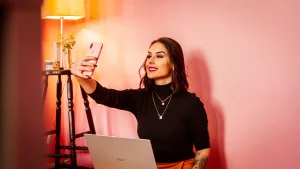
Online influencers promote their personalities, content, areas of interest, and expertise on online platforms to gain recognition and build their brand. Gaining followers requires confidence and showmanship. To best compete, some influencers use editing tricks to appear more attractive, healthier, more competent, and extra qualified. Because editing tricks are hard to spot, kids often emulate influencers with the impression that they really are that perfect.
Positive Impacts of Social Media Influencers
The most popular categories that social media influencers focus on are lifestyle, health, fitness, travel, art, work, fashion, luxury, photography, beauty, pets and animals, and parenting.[2]
The positive impacts influencers offer include:
information for education and awareness,
an engaging and supportive community of like-minded people, and
creativity and entertainment.
Negative Impacts of Social Media Influencers
Some influencers are less interested in quality content and more focused on entertainment that will boost their numbers. To that end, they will use more filters and online trickery and promote harmful content like unrealistic body types, lifestyles, diets, fashion, gossip, rumors, and drama. Harmful content can cause problems with kids and teens, including decreased appearance satisfaction, low self-evaluations, higher negative mood, and insecurity.[3] Over time, these problems can escalate to mental health issues like anxiety, depression, body dysmorphia, and eating disorders.
Body Positive Movement
According to a social media report from a Norwegian influencer marketing platform, 47% of surveyed influencers revealed that they felt their job harmed their mental health, and 32% believed the platform hurt body image.[4] One way to express and promote unconditional self-love is by supporting the body positivity movement. This worldwide movement focuses on acceptance and equality for all body types and sizes.
One of the movement’s goals is to challenge how our society, particularly all forms of media, presents and views the human body.[5]With body positivity modeled by influencers (without the use of filters and digital manipulation), fans feel more confident and comfortable in their bodies.
Instagram vs. Reality
Another popular movement in the media that spreads awareness about the harmful nature of social media is called Instagram vs. Reality. This movement offers a side-by-side comparison of two of the same photos; one photo edited and the other not.
The purpose of this trend is to bring attention to the differences between natural and filtered images. This trend inspires people to embrace themselves naturally without enhancements. Instagram vs. Reality reminds us that online content is not always accurate. Our Screen Safety Essentials Coursefor parents and families offers helpful strategies for social media behavior while reinforcing mindful habits to prevent feelings of self-consciousness and anxiety.
Seeking Self-Acceptance and Fleeing from Filters
Before friending or following someone in real life or online, consider if they reinforce positive, authentic, and empowering morals. Social media influencers that we like appear to serve from the depths of their experienced and passionate hearts.
Positive and Qualified Influencers to Follow
Huda Kattan- Beauty Blogger and Makeup Artist
Zach King- Digital influencer, Writer, Comedian
Michelle Lewin- Fitness Influencer
Jamie Oliver- Chef
Joanna Gaines- Lifestyle Blogger and Writer
Jack Morris- Travel Influencer
Savannah LaBrant- Parenting Influencer
Beth Evans- Mental Health Influencer
PewdiePie- Gaming Influencer
Amanda Gorman- Activist, Poet, Influencer
What Parents Can Do to Protect Their Kids
Parental oversight of child exposure to online content is critical for safety and developing a positive self-image. One way to do this is by monitoring your child’s online activity, such as the sites they visit, the content they watch, who they follow, and how much time they spend online.
GKIS has a variety of valuable courses designed to help families navigate the various pitfalls of internet exposure and prevent digital injury.
The GKIS Social Media Readiness Training is a valuable tool that teaches teens about the inherent risks of social media and ways to make healthy decisions when encountering them.
The Screen Safety Toolkit is a family-tested, outcome-based resource guide with our best recommendations, how-to information, and links to our favorite easy-to-onboard parental control systems.
The GKIS Connected Family Course will provide parents of school-age families with tips for creating a safe screen home environment through fun parenting techniques that are designed to guide sensible screen management.
Finally, our most comprehensive program is our Screen Safety Essentials Course. Our comprehensive Essentials Course provides parenting and family coaching information, support, and other valuable information and activities to get you dialed in for screen safety and healthier family relationships.
Thanks to CSUCI intern Haley Begun for researching and co-authoring this article!
I’m the mom psychologist who will help you GetKidsInternetSafe.
Among Us is an app/video game that has seen a rising fan base since its release. It is popular with gamers of all ages. Its cutesy characters and simple gameplay make it appealing to even the youngest children. To get your home set up for cooperation and screen safety, check out Dr. Bennett’s Screen Safety Essentials Course which features weekly parent and family coaching videos in addition to several other valuable resources for promoting family connectedness and preventing digital injury! In today’s GKIS Sensible Guide, you will be learning all the information you need to make an informed decision on if this game is appropriate for your child.
How long has Among Us been around, and how popular is it?
Among Us was released by a small development company called InnerSloth LLC in June 2018. According to Steam, the number of users began to rise when COVID lockdowns started. This peaked around October 2020 with an average number of 170,000 players.[1] It should be noted that this does not include players on Apple or Android devices. The true player count is likely much higher.
Among Us is available for purchase on Steam for under $5. On mobile devices, Among Us is a free download. However, users on mobile devices will be shown ads between games and will have their data collected. To stop this, the user is allowed to purchase an ad-free version of the app. This prevents any ads from playing and their data from being collected by the app.
Getting Started on Among Us
To play Among Us, the player must confirm their age is over 13. This is done with a simple birthdate selection and can be easily bypassed by children younger than 13. Among Us can be downloaded on Steam, along with the Apple app store and the Google Play store.
Before letting your child play Among Us or games like it, we recommend the Connected Family Course to help inform you and your child about the dangers of screen use. It also provides a large number of tips to help your child stay safe online.
Features of Among Us
Basic Gameplay
During the game, groups of 4 to 10 play together. One to three of those players are selected as the imposters, the rest of the players are crewmates.
Crewmates will have a certain number of tasks to complete as a group around the map. These tasks are usually simply mini-games such as connecting wires or swiping a keycard. This group wins when either all of the imposters have been eliminated through voting, or all of the tasks are completed.
Imposters have a much simpler task. They want to eliminate the crewmembers until the number of imposters is equal to the number of crewmembers. If this happens the imposters win. Imposters have extra abilities such as using vents to teleport around the map. Imposters always know who the other imposters are.
When a dead body is reported or the emergency button is pressed a meeting is called. During this meeting, all players discuss who they think the imposters are. This discussion may be over a text chat or a voice chat. At the end of the meeting, they have the option to vote off a player. They may skip voting if they aren’t confident. Once a player is voted off, it is revealed if they were a crewmember or an imposter.
Cosmetics
A various number of cosmetics are available for direct purchase for Among Us. They can range in price from one dollar to up to five dollars. While not a loot box, some people do worry that microtransactions like this can lead your child to develop a gambling addiction. For more information on this, please visit our article on gambling in gaming.
Benefits of Among Us
There are numerous benefits of playing Among Us. It is a fun way for friends to interact or to meet new friends online. Its simple gameplay allows for everyone to enjoy it, not just dedicated gamers. Plus, the game is easily accessible because it’s extremely inexpensive or even free. Finally, it teaches players to detect deception from other people. This can be considered a good life skill.
Risks of Among Us
There are a few big risks that come with children playing Among Us. The first is that it does expose the child to violence. While it is cartoon-like, there are some graphic deaths including stabbing, snapping necks, and eating heads off. It also teaches children to lie. To be a successful imposter, one has to lie and plant deception in the crewmates’ heads. This might lead the child to lie in other aspects of their life, particularly younger children. Another risk for anyone playing the game is they may be exposed to cyberbullying by others. Other players may be muted to prevent this, but it is still a risk of playing an online game. Another big risk is talking and interacting with strangers. Though it hasn’t been reported, predators could potentially use Among Us to find victims and groom them into talking outside of the game or offline.
Due to the risk potential for child players, GKIS rates Among Us as a yellow-light app due to the cartoon violence and potential exposure to cyberbullying. This means that children under the age of 13 are not recommended to play this game.
If your child wants to play Among Us, GKIS recommends that you:
Add it to your free GKIS Connected Family Agreement (Available if you enter your email on our GKIS home page.)
Discuss the risks of chatting with strangers with your child. For tips and advice on how to do this, check out our Connected Family Course.
Consider joining our Screen Safety Essentials Course to gain access to weekly parenting and family coaching videos that provide information, extra support, and exclusive tips for helping your child stay internet safe.
Thanks to CSUCI intern Dakota Byrne for researching Among Us and co-authoring this article.
I’m the mom psychologist who will help you GetKidsInternetSafe.
Onward to More Awesome Parenting,
Tracy S. Bennett, Ph.D.
Mom, Clinical Psychologist, CSUCI Adjunct Faculty
Our kids are able to find websites that are not recommended for minors. All parents must be aware of these listed websites so that their child will not be a victim of digital injury. Unlike apps, websites make it much easier for underage children to gain quick access to explicit content. GKIS will provide a brief description of the websites, dangers attached to the websites, and methods to prevent digital injury.
Websites to Look Out For
Parler
In our previous blog article, Parler the Free Speech App was covered as a social network platform focusing on the freedom of speech protected under the first Amendment and user’s rights privileges. An increase of conservative users arrived on the platform in the wake of feeling censored on Twitter. In a battle between liberal and conservative views, big tech censorship has become a public outrage sending users to Parler.
As for children, GKIS stands by our previous decided outcome of Parler not being appropriate for minors due to extreme views and lack of censorship. According to Google Trends, the analysis of popularity for search with interest over time (IOT) ranges from 0 to 100. From January 10th to 16th 2021, Parler had a 78 IOT.[8] With a high population usage and the ability to not fact-check user’s posts, children using the app would likely be exposed to false and conspiracy-laden content.
Onlyfans
One of our most-read articles of 2020, Is Your Teen Selling Nudes on Onlyfans?, explained the risks that on Onlyfans kids and teens may easily access pornographic content. Onlyfans is a social media platform meant for users to access a creator’s content that may provide sexual content to subscribers for a monthly payment. From February 21st to 27th 2021, Google Trends reports that Onlyfans had a 99 IOT.[8] According to Onlyfans terms of service, the user must be 18+. Still, there are reports of minors bypassing the age verification without parent knowledge.[1]
GKIS cautions that minors should not have access to Onlyfans due to leaked information, stalking, life-threats, unemployment risks, and family separation. If you worry that your child could become a victim of sexual exploitation, you will get huge benefits from Dr. Bennett’s weekly parent and family coaching videos on the GetKidsInternetSafe App! Your first 30 days are free!
Toomics
In this comic book subscription service, users can receive Japanese and South Korean comics on horror, romance, and action genres. The service does provide a family mode to exclude inappropriate content. However, children can enable or disable the mode without password requirement.
GKIS recommends monitoring this service or, even better, blocking it from your children entirely. There is a vast amount of sexual content and nudity on this service, including comic book sex scenes, incest, and rape. According to the Google Trends report, from February 7th to 13th 2021, Toomics reports an 85 IOT based on search popularity.[8]
Reddit
In 2005, Reddit grew to be the most popular forum website on the internet. But how safe is it for children? The service provides subreddits of vast topics into smaller ones (e.g., from r/books into r/horror stories or r/Stephen King). Subreddits are organized by moderators who are individuals who manage the forum. As of February 27th 2021, Google Trend reports Reddit as an 87 IOT.[8]
Reddit may not look dangerous, but it does have a high volume of not safe for work (NSFW) material that may be easily accessible to children who lie about their age upon entry into the site. Reddit can be used for searching, browsing, and messaging anyone or anything which obviously holds a high risk of digital injury. For more information on the signs and risks of digital injury, be sure to check out Screen Time in the Mean Time A Parenting Guide to Get Kids and Teens Internet Safe.
The Chive
The Chive’s mission statement is “an outlet for attractive ladies from around the world to strut their stuff.” Although intended to be funny, much of the content on this site demonstrates misogynistic views and a strong prejudice against women.
Google trends reports, The Chive has a 95 IOT from February 21st to 27th 2021.[8] GKIS considers this a red light service due to its raunchy and sexist humor. A study by Brown and L’Engle (2009) reported a significant finding that adolescents exposed to sexual content in media are more likely to engage in sexual harassment two years after watching the activity.[3]
DeviantArt
DeviantArt is an online social community where members share their artwork for critique and to build a fanbase. According to their website, DeviantArt has 55 million users and has a score of 92 IOT from February 21st to 27th 2021.[8] DeviantArt earned a red light GKIS rating because reviews report extremely violent and bloody works of art. Parents also report content involving cursing, insulting, stealing art, fetishes, and nudity on community posts.[4]
4Chan
This highly controversial (and GKIS-rated red light) forum had made headlines because of anonymous users posting nude photographs of dozens of celebrities, including Emma Watson. 4Chan users often endorse sexist ideologies against female gamers like the cyberbullying of Jessi Slaughter and discuss neo-Nazi radicalism.[5] Unlike Reddit, users are not required to form an account. Due to its anonymity, kids can easily participate in R-rated posts undetected and unmonitored.[5]
If you haven’t selected a child-safe browser or set parental controls on devices, through your internet service provider, or through third-party apps and services, you’ll want to check out our Screen Safety Toolkit. We did the research for you with this comprehensive how-to safety resource guide.
Tumblr
In our GKIS article “The GKIS Sensible Parent’s Guide to Tumblr,” we rated this social media platform as a yellow-light app due to sexual images and inappropriate content often displayed on member accounts. With over 30 million users and a score of 83 IOT as of February 14th to 20th 2021, this microblogging social platform is still quite popular.[8]
High-risk content includes self-harm, sexual content, eating disorders, and drugs. There are also reports of sex offenders using the website to incite sexual conversations with children. We stand by our previous decision to recommend parents closely monitor their teen’s activities within the website.
Pornographic Websites (NSFW)
A popular website used for viewing pornographic content like photos, videos, and live streams is PornHub. To learn more about how porn impacts our kids and teens, read our GKIS article “Online Pornography’s Impact on Kids and Teens.” We previously reported that 13% of internet searches are found to access pornography. Due to increased access, that percentage has increased to 20% on the computer and mobile internet browsers.[6]
Fight The New Drug is a non-profit organization trying to reduce porn addiction and set regulations for the porn industry. In 2020, they reported that PornHub’s popular searches were “lesbian,” “teen,” “stepmom,” “mom,” “step-sister,” “hardcore,” “gangbang,” and “rough sex.”[7] Further, the average age for first exposure to hardcore pornography has been estimated to be 11 years old.[7]
GKIS highly recommends that parents add pornography websites onto their restricted website list in parental controls. The website Top Porn Sites can help you block them in child-safe browsers.
Hide it Pro
We would all love to believe that we can trust our kids not to search out, post, and collect inappropriate content online. But sadly, we just can’t. Kids and teens often delight in discovering and sharing titillating and forbidden content and hide it from parents. We cover how to check for apps that hide content in our Screen Safety Toolkit and Dr. B covers it in her coaching sessions on the GetKidsInternetSafe App. To get you started with safety, check all devices for Hide it Pro, a particularly popular hiding app.
Set up content restrictions on tablet and phone devices.
On iOS products, Apple has designated a method for parents to limit adult websites for their safety. Follow these steps:
Go to Settings > Screen Time
Tap Content & Privacy Restrictions and enter your Screen Time passcode
Tap Content Restrictions, then tap Web Content
Choose Limit Adult Websites, and Tap Never Allow: Add Website[9]
In this section, you can add each of the listed above websites to protect your child.
Google has designated parents’ methods to limit adult websites for their child’s safety on Android products. Follow these steps:
Open Settings
Tap Digital Wellbeing
Tap Parental controls > tap Get started
Select Parent
Tap Get Family Link and install Google Family Link for parents
Tap Open (review the information) > tap Get started
Use the on-screen instructions on both phones to finish connecting the two devices. Once it’s all set up, you can use the Family Link app to keep an eye on everything[10]
Thanks to CSUCI intern, Christian Sandoval for locating harmful websites that parents should restrict minors from interacting.
I’m the mom psychologist who will help you GetKidsInternetSafe.
Onward to More Awesome Parenting,
Tracy S. Bennett, Ph. D.
Mom, Clinical Psychologist, CSUCI Adjunct Faculty
GetKidsInternetSafe
[3] Brown, J. D., & L’Engle, K. L. (2009). X-rated: Sexual attitudes and behaviors associated with U.s. early adolescents’ exposure to sexually explicit media. Communication Research, 36(1), 129–151.
Feeling unproductive, unmotivated, and notice that you are wasting countless hours scrolling through social media? A social media cleanse may be a great decision to improve your well-being. In this week’s GKIS article, we will provide a step-by-step guide to putting down your phone and getting that much-needed break your mental health deserves. To help your tween or teen demonstrate they have the knowledge, problem solving ability, and judgment for social media, check out our Social Media Readiness Course. It’s an online course for tweens and teens that offers information about the risks of digital injury due to social media and psychological wellness tools. With a quiz for each module, they work their way through independently so their graduation certification demonstrates mastery of content. Of course, you can take it too if you’d like. It’s like driver’s training but for the internet!
According to pewresearch.org, 70% of Americans use social media.[1] For adults, the most popular social media platforms include YouTube (73%) and Facebook (68%). In contrast, 63% of teens use Instagram, making it the most popular social media platform amongst young users ages 15-25.[2]
According to the American Academy of Child & Adolescent Psychiatry, 90% of teens have used social media and teens spend an average of nine hours a day on social media.[3] Participants of a research study conducted by the Pew Research Center found that 74% of Facebook users visit Facebook daily. People of varying ages spend a lot of time on social media.
We use social media to view funny memes, stay connected to friends and family, meet new people, share opinions and information, show off passions and creative pursuits, advertise businesses, and even get news. Most of us find it extremely rewarding and feel we’ve got it under control. But for others, social media can negatively impact mental health.
Risks of Social Media Use
I’m a millennial who’s been using social media for 10 years. I’ve experienced a wide range of negative effects due to my social media use, including feelings of insecurity and not being good enough, anxiety, and the big one, fear of missing out (FOMO).
For years, I followed my friends’ and Instagram influencers’ profiles and wondered why I wasn’t as happy as them or why I couldn’t travel the world and have a life of fun and excitement. I often compared myself to others on social media and it hurt my mental health. In her book, Screen Time in the Mean Time, Dr. Bennett calls that “compare and despair” and believes it is a common contributor to teen anxiety and depression.
Social media can be a toxic place, especially during these unprecedented times. It’s too easy to spend hours on Google trying to figure out if you have COVID-19 and spend another 45 minutes scrolling through Facebook comments of people arguing over politics. Feelings are high and extreme opinions are rampant. According to helpguide.org, social risks include increased feelings of isolation, depression, anxiety, and insecurity.[4]
The Benefits of a Social Media Cleanse
To get away from negativity, a social media cleanse may be the answer. The benefits of a social media detox include:
More free time for other things, like research about a favorite topic
To research this article, I deleted all of my social media apps including my all-time favorite, Instagram, about a month ago. I was concerned that I was averaging too much screen time (6 hours a day), and I wanted to be more productive and connect more with my boyfriend and family.
My first week of being social media free was by far the hardest. But it became much easier after that. I often felt the urge to redownload my Instagram app, but for the most part I have been able to stay away.
The benefits of staying offline have really paid off for me. Almost immediately, I felt it was easier to fall asleep at night (since I was not on Instagram or TikTok late). I’ve also felt a reduction in stress, anxiety, and anger. Now I don’t feel the need to check my friend’s social media just to see what they’re doing all the time. Instead, I reach out directly to friends to reconnect.
I worried that if I deleted my social media accounts, I would feel more disconnected from my friends. But instead, I’ve kept in touch with them more than before my social media cleanse. Relationships and connections are important to me, and I’m glad that I’ve been able to connect in a more meaningful and sincere way. Overall, I’m happy with the results. I feel more mindful and present in my everyday life, my sleep has improved, I’ve experienced less stress and anxiety, and I have more free time to get work done and spend time reconnecting with the people I love.
Do You Need a Social Media Break?
Here are some red flags that may signal that you are ready for a social media cleanse:
You spend most of your free time on social media.
You feel like you need to share or post often.
You find it hard to focus on schoolwork or other life responsibilities.
You feel an increase in anxiety and stress after spending time on social media.
You feel more lonely, unmotivated, and less creative.
You are experiencing feelings of low self-esteem or low self-confidence.
You feel anxious without your phone.
You feel guilty or ashamed about the amount of time spent on social media.
How to Get Started
There are many ways to jump-start your social media cleanse. You can stop your phone use cold turkey, or you can delete one or two apps at a time. You can also cut down your friend list to only those you have a close, personal relationship with to cut out the less meaningful posts. Find whatever works best for you.
Here are some tips for getting started:
Deactivate or delete your social media accounts.
Delete social media apps from your phone.
Connect with family and friends in alternative ways.
Set a time limit on your phone to cut back on overall phone use.
Check your daily Screen Use and make adjustments if needed.
Set a specific “phone bedtime” before your actual bedtime (At least 3o minutes before you go to bed is recommended).
Make your bedroom a phone-free zone.
Turn your phone on “Night Mode” to decrease blue light emissions.[6]
Most importantly, remind yourself why you decided to go on a cleanse in the first place. And remember, your cleanse doesn’t have to be a permanent decision, you can always go back.
Enriching Activities to Reconnect Offline
There are endless possibilities for new enriching activities. You can practice meditation, pick up a new skill, or do that thing you’ve been meaning to do. Here are some fun ideas to reconnect with your loved ones:
Family game night
Family movie night
Cook a family dinner. Make it exciting by trying a new recipe or cooking an old family favorite.
Have a family yoga or workout session.
Practice meditation and deep breathing (alone or with family).
Using this extra time to reconnect and spend valuable time with your family is great, but it’s also important to spend time hanging out with yourself. Start by catching up on your sleep, creating a playlist, or reading a favorite book. Don’t feel pressured to constantly look for something to keep you busy unless that’s what you want to do. This is a well-deserved break. Do whatever you want with it and enjoy!
If you’re interested in learning more helpful tips about parenting in the digital age, check out the GKIS Connected Family Course. The GKIS Connected Family Course is family-tested and outcome-based and helps you close screen risk gaps and improve family cooperation and closeness.
Thanks to CSUCI intern, Remi Ali Khan for researching social media cleanses for this article.
I’m the mom psychologist who will help you GetKidsInternetSafe.










 A Good and Bad Influence(er)
 Negative Impacts of Social Media Influencers