April is Sexual Assault Awareness and Prevention Month (SAAPM). According to the Rape, Abuse, and Incest National Network every nine minutes a child is sexually abused, 93% of survivors know the perpetrator, and 1 in 5 kids have been solicited sexually online before the age of 18.[1] The National Sexual Assault Hotline (1-800-656-4673) provides confidential support to victims. This GKIS article covers sexual violence, technology misuse, support groups, and ways to help. The following information may be triggering to some readers, discretion is advised.
Sexual Violence
Ending sexual violence and assault has become a national outcry. The National Sexual Violence Resource Center conducted a survey in the United States, reporting 734,630 people were raped in 2018.[2] GKIS has partnered with various organizations to raise awareness and end sexual assault.
Survivors endure the trauma of the assault and suffer chronic mental disorders (post-traumatic stress disorder, substance abuse, depression) and physical issues (HIV, sexually transmitted infections (STI), unplanned pregnancy).
The Sexual Assault Nurse Examiners (SANE) is a 24-hour service of first responders aiding sexual assault victims. SANE supports victims with emotional recovery, offers STI testing, and provides investigational leads to law enforcement which speeds and increases the chance for prosecution.[2]
Sexual assault is legally defined as “any type of sexual contact or behavior that occurs without the explicit consent of a recipient.”[3] By legal definition, the following are types of sexual assaults according to California law:
In 2015, the People of the State of California v. Brock Allen Turner made national headlines for convicting a Stanford student for sexually assaulting an unconscious victim. He received a sentence of six months for his crimes. Based on the previous CA law, prison time was only sentenced if the victim could defend themselves. The presiding judge, Aaron Persky, was disbarred after his ruling stating that a prison sentence would “have a severe effect” on the student’s future.[3] In an effort to decrease victim-blaming, former Governor Jerry Brown signed AB 2888 which requires a mandatory minimum sentence and requires that sex crime convictions must result in state prison.[3]
Victimization of Children
Sexual violence is common in youth, with reports of 42.2% of females having experienced their first completed rape before 18 according to the 2010 summary report by the National Intimate Partner and Sexual Violence Survey.[15] Sexual abuse of minors is often unreported because victims are often secretly coerced and confused about the feelings that result from the abuse. Legally, a child cannot consent to sexual activity with an adult due to immature brain development.[4] Pettis and Hughes report that male adult victims are particularly unlikely to seek treatment for childhood abuse.[4]
Violence in Intimate Relationships
Sexual abuse involving an intimate relationship refers to an unwanted or coercive sexual behavior toward one’s partner. In a Burke and colleagues’ study, males and females with high feminine gender identity were more likely to sustain abuse if they refused to perform sexual acts.[5]
Warning signs of an abusive relationship include if your partner
isolates you from friends or family
manipulates you into performing sexual acts
gets frustrated and jealous if you have unaccounted-for time
Sexual harassment is defined as an unwelcome verbal or physical advance for sexual gratification.[7] A study by Adams-Roy and Barling reported that 35-45% of women face severe sexual harassment at the workplace, resulting in an increase in stress, anxiety, and depression. Assertiveness training often helps victims of sexual harassment confront the assaulter.[7]
Online Sexual Abuse
Online sexual abuse is defined by the United Nations Children’s Funds as coercing victims to use live streams, virtual communities, and social media platforms for illegal sexual acts.[13] Social media influencers have been accused of having sexual relationships with minors. For example, YouTube and Tik Tok influencers James Charles and Tony Lopez have been accused of inappropriate intimate involvement with young fans using fame, power, sexual manipulation, and abusive behaviors. Uplift is a non-profit organization that was founded in 2015 that works to combat sexual abuse in the online community. John Green, author of “The Fault in our Stars,” pledged to support the Uplift movement on YouTube, helping Uplift attract additional supporters.
Our 2015 article, How Texting Can Turn To Sexting in the Blink of an Eye, explains how predators groom children in order to pressure them to send nude photos. Revenge porn is another form of digital abuse, defined as the act of posting someone else’s nude image without consent. Perpetrators illegally use the photos to control and exploit their victims. Revenge porn laws vary by state. If you want to know your state’s revenge porn laws, visit Cyberbully.
Sex Trafficking
Sex trafficking is the use of force, fraud, and coercion against someone for prostitution, pornography, and sexual performance fueled by the buyer’s money.[14] Sex trafficking is increasingly aiding the internet. It has been estimated that 3.8 million adults and 1 million children are used for forced and commercial sexual exploitation each year.[11] In 2020, a conspiracy erupted on Reddit accusing Wayfair of trafficking children by disguising codes located behind furniture sales. The public demanded the U.S. government to investigate allegations, which were later proven false.
People who are vulnerable to sex trafficking include:
Frequently child sexual abuse (commonly called child pornography) is captured and shared on smartphones and Go-Pro. According to California law, sending or receiving semi-nude or nude images of minors is child sexual abuse. This act qualifies as transmitting obscene material by distributing generated image(s) containing sexual conduct, punishable up to six years in state prison.[11]
Another form of camera misconduct is capturing or recording a subject in a bedroom or restroom without their consent. In 2019, a vacation rental guest rented an Airbnb for the weekend. He discovered that the chargers in the bedroom were video recorders.[12] Now, the placement of indoor cameras inside vacation rentals is illegal.
Security cameras placed in a particular area to capture a neighbor’s pool, bedroom, or restroom are forms of electronic surveillance that may be illegal depending on intent. Voyeurism is defined as gaining sexual pleasure by watching or recording someone undress.[5] A perpetrator may be imprisoned for 60 days and registered as a sex offender. From our recent article, Red-Light Websites and Online Services that Can Be Dangerous to Kids, GKIS described the Hide It Pro application that can store images and videos from security cameras.
Support Groups for SAAPM
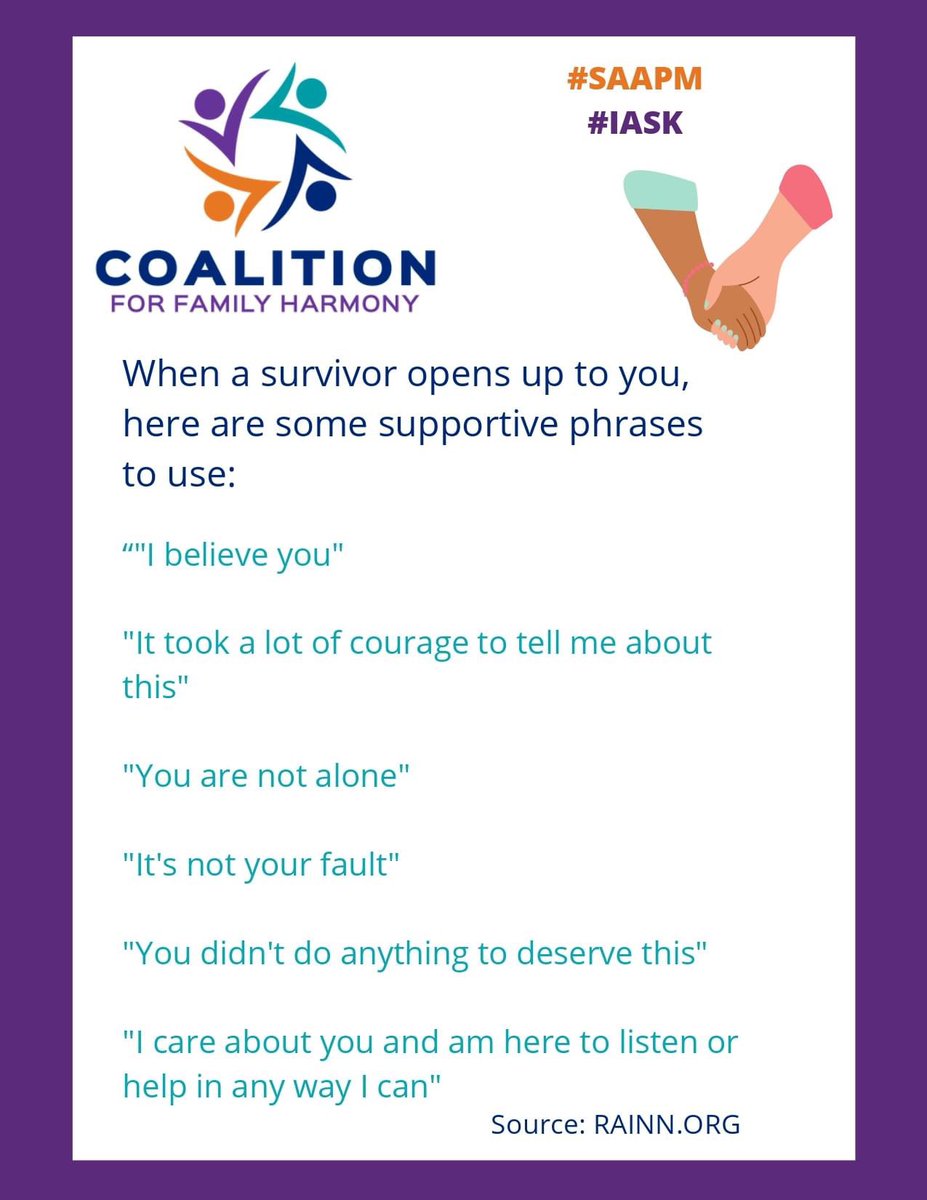
Coalition for Family Harmony
This organization offers mental support, including counseling for sexual assault survivors, support groups for adults and teens, forensic exams, and a 24/7 service with the Rape Crisis Advocates. Dr. Sandy Gomez oversees the Rape Crisis Center in Ventura County at Coalition for Family Harmony and LGBTQ Program. She states that “a person’s access to mental health services should not be limited by their socioeconomic status.” Ten free psychotherapy sessions using a survivor-centered approach are available for sexual assault survivors. There are extended services for survivors who are of color and LGBTQ+.
In April, the Coalition for Family Harmony offers presentations to educate the community and mitigate online romance fraud, which is defined as the act of deceiving another person for financial gains through an online romantic relationship using a fake identity.
A special message from Dr. Sandy Gomez; “If you have experienced sexual violence, you are not alone and what happened to you is not your fault. You are the expert of your situation and we are here to help you review your options so that you can make an informed decision that works for your needs.” Contact their office at (805) 983-6014 or 1-800-300-2181 for a 24-hour Bilingual Crisis Hotline.
The Clothesline Project at Ventura College
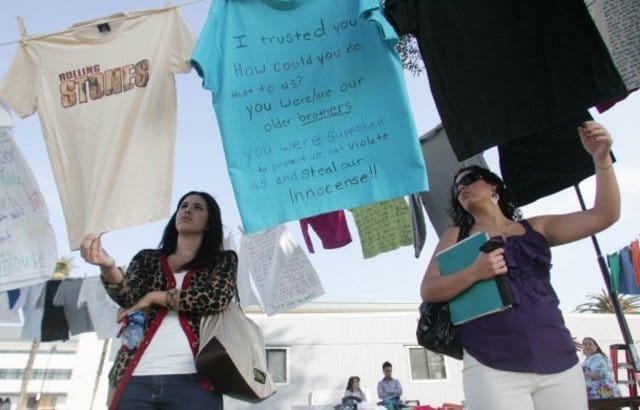
According to Professor Capuano, the Ventura Psychology Club advisor and Coordinator of the Clothesline Project for 18 years, the purpose of the Clothesline Project “is to educate students and the community that violence is a problem everywhere, and that help is available.” Students and the community can visit Ventura College to listen to survivors, attend presentations, receive on-site counseling, and speak with 15+ local organizations. Visitors put their personal message on a shirt for display on campus. Topics covered include incest, cyber exploitation, domestic violence, and sexual violence.
Bikers Against Child Abuse
B.A.C.A. is a non-profit organization free of charge which assists abused children. They work together in conjunction with the local and state officials. B.A.C.A. uses their physical appearance to lend physical and emotional support. These bikers are the shield that protects children from future physical, sexual, and emotional abuse.
Ogie, a current member of B.A.C.A., uses the phrase, “no child should live in fear,” giving children hope for a safer world. In the eyes of children and the community, they are heroes. There are monthly meetings for members and the general public to attend. For more information on Who Is B.A.C.A. and local chapters in your area, visit their website.
American Foundation for Suicide Prevention
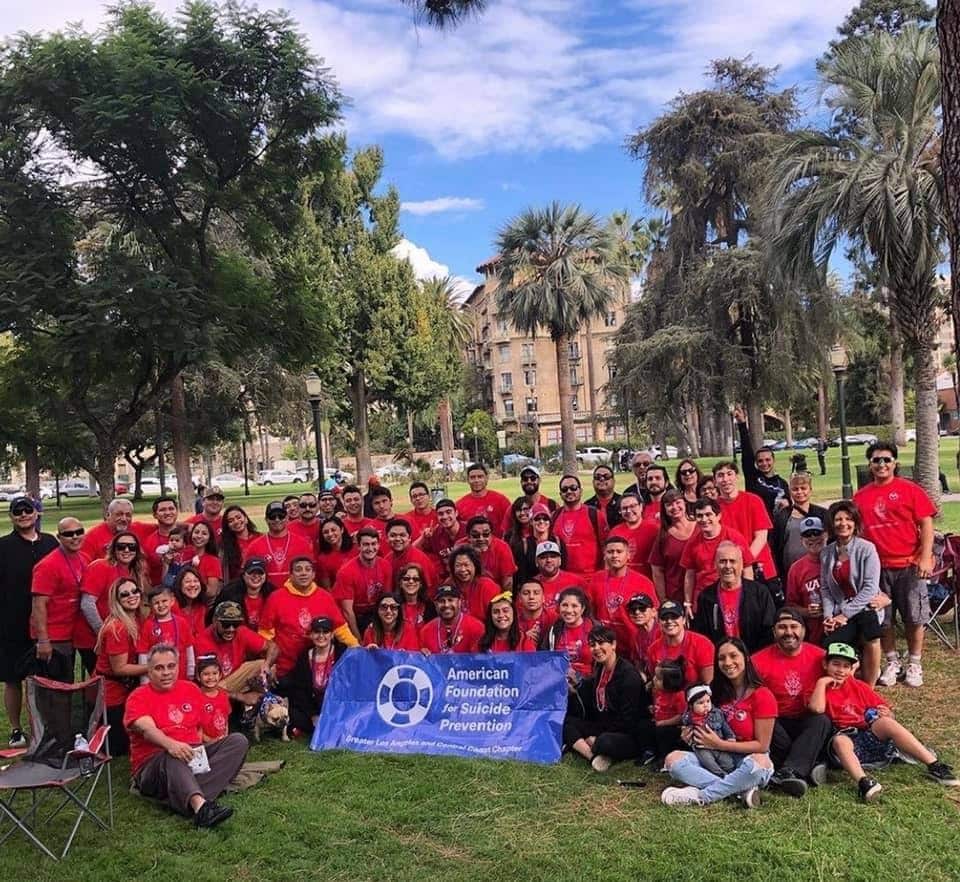
Thirty-three percent of female sexual assault victims contemplate suicide.[1] The American Foundation for Suicide Prevention (AFSP) offers advocacy, research, education, and support to survivors with suicidal ideation. They recognize the importance of diversity, equity, and inclusion. AFSP is offering spring actives, such as Marathon in a Month and Campus Walks Day of Action. To learn more about the events, visit AFSP Greater Los Angeles and Central Coats. Let us be the voice AFSP is missioning for “Save Lives and Bring Hope to Those Affected by Suicide.”
Denim Day
In 1992, a 45-year-old driving instructor raped an 18-year-old woman on her first driving lesson in Italy. The survivor reported the rape, and the perpetrator was arrested and jailed for 6 years. Years later, the man appealed his conviction stating it was consensual sex evidenced by her tight jeans that would be too difficult to be pulled off involuntarily. The conviction was overturned, allowing the rapist to be released. This was to be known as the “jean alibi.”[9]
A Denim Day campaign was established in 1999 to support sexual assault victims. Denim Day is considered the most prolonged prevention and education movement for sexual assault.[9] Feel free to tag GKIS social media accounts to see you be a part of the movement.
The importance of consent shows respect for others and yourself. If you are struggling to explain or understand consent, visit Blue Seat Studio’s published video on YouTube: Tea Consent.
Call to Action Against Sexual Assault
LISTEN to victims when they report assault and assist them to achieve emotional and physical safety (e.g., walking, shopping, or eating in public settings).
PARTICIPATE in April to show your support. Wear or post a teal ribbon on your social media page to give awareness of sexual assault.
ACT to stop victim-blaming, known as the belief that the victim is responsible for the assault because of how they dressed, spoke, or behaved. Fear of being blamed is a significant contributor to the low rates of unreported cases.
Adults must show respectful modeling behaviors to all genders to reduce sexual assault. At National Sexual Violence Resource Center, Jenny Coleman explains the importance of speaking out if someone uses inappropriate phrases and terminology in front of minors. If you order our highly reviewed online course, The GKIS Connected Family Course, GKIS will invite you to our private parenting Facebook group in the service of child safety.
GKIS recommends taking self-defense classes to protect yourself from sexual assault. Visit Ando Mierzwa on YouTube or Threat Management on Tik Tok for free self-defense tactics used in martial arts. Furthermore, BSafe, My Safetipin, and Life360 are GPS tracking apps to provide personal safety in dangerous situations.
SPEAK out against sexual violence outside of April. The importance of sharing one’s story brings hope and awareness. For sexual assault survivors who are willing to share their stories, Boston University created an Instagram page for survivors to be heard: visit Campus Survivors. At the end of the day, the story being said is yours, and the story has the power to change the world.
Thanks to CSUCI intern, Christian Sandoval, for giving awareness and prevention of sexual assault in April. The importance of hearing someone’s story is critical, and we hope you will support the movement.
I’m the mom psychologist who will help you GetKidsInternetSafe.
[1] Children and teens: Statistics. (n.d.). Retrieved March 18, 2021, from Rainn.org website: https://www.rainn.org/statistics/children-and-teens
[2] Morgan, E. R., & Oudekerk, A. B. (2019). Criminal Victimization, 2018. Bureau of Justice Statistics. Retrieved from https://www.bjs.gov/content/pub/pdf/cv18.pdf
[3] Sevenslegal. (2016, September 8). An update to California’s sexual assault laws. Retrieved March 18, 2021, from Sevenslegal.com website: https://www.sevenslegal.com/assault/update-californias-sexual-assault-laws/538/
[4] Pettis, K., & Hughes, R. (1985). Sexual Victimization of Children: A Current Perspective. Behavioral Disorders,10(2), 136-144. Retrieved March 16, 2021, from http://www.jstor.org/stable/23882265
[5] Burke, P., Stets, J., & Pirog-Good, M. (1988). Gender Identity, Self-Esteem, and Physical and Sexual Abuse in Dating Relationships. Social Psychology Quarterly,51(3), 272-285. Retrieved March 16, 2021, from http://www.jstor.org/stable/2786925
[6] Intimate Partner Sexual Violence. (n.d.). Retrieved March 18, 2021, from Rainn.org website: https://www.rainn.org/articles/intimate-partner-sexual-violence
[7] Adams-Roy, J., & Barling, J. (1998). Predicting the Decision to Confront or Report Sexual Harassment. Journal of Organizational Behavior,19(4), 329-336. Retrieved March 16, 2021, from http://www.jstor.org/stable/3100150
[8] National Sexual Violence Resource Center. (2020, April 3). Start at home: Modeling healthy behaviors keeps kids safe. Retrieved March 18, 2021, from Sexual Assault Awareness Month 2020 website: https://medium.com/sexual-assault-awareness-month-2020/start-at-home-modeling-healthy-behaviors-keeps-kids-safe-f454b929a2a0
[9] Why denim? — denim Day. (n.d.). Retrieved March 18, 2021, from Denimdayinfo.org website: https://www.denimdayinfo.org/why-denim
[10] Myths, facts, and statistics. (2018, November 7). Retrieved April 8, 2021, from Polarisproject.org website: https://polarisproject.org/myths-facts-and-statistics/
[14] Chin, K.-L., & Finckenauer, J. O. (2012). What is sex trafficking? In Selling Sex Overseas (pp. 1–33). NYU Press.
[15] Black C. M., Basile C. K., Breiding J. M., Smith G. S., Walters L. M., Merrick T. M., Chen J., & Stevens R. M. (2011). National Intimate Partner and Sexual Violence Survey 2010 Summary Report. Retrieved from https://www.cdc.gov/violenceprevention/pdf/NISVS_Report2010-a.pdf
If you’re on social media, you’ve come across internet trolls. They’re on every social media platform, including Facebook, Twitter, Instagram, and TikTok. It’s almost impossible to avoid them. Read today’s GKIS article to find out why people troll and how you can minimize your child’s risk of being targeted.
What are internet trolls?
An internet troll is someone who makes intentionally inflammatory, rude, or upsetting statements online to elicit strong emotional responses in viewers or to steer the conversation off-topic. I Popular influencers, like Perez Hilton, have become famous for their trolling. Unfortunately, even your friends and family can act like trolls when they’re fired up about a certain topic. But if a “friend” online regularly shows troll-like behavior, it’s best to steer clear of them or, even better, block them altogether.
Why do people troll?
To feel empowered
There are few consequences
They are immature and think it’s funny
They feel so passionate about their topic they get emotionally triggered
They’re envious and want to take the poster down
They’re in a bad mood ii
They are feeling incited by other trolls ii
They are in a spiral of negativity ii
How to Spot an Internet Troll
Internet trolls are easy to spot once you are aware of certain online behavior patterns.
They don’t show their own face in their profile image. Instead, they typically use a seemingly “funny” photo of a cartoon character, a celebrity photo, or a random image.
Their username is a nickname rather than their real name.
Their education is listed “The School of Hard Knocks” or some other cliché.
They are typically following several accounts but have few to no followers themselves.
They usually have a lot of memes on their profile.
There often have several offensive and controversial posts or interactions with controversial comments.
They usually take extreme political or opinion positions on certain issues and repeatedly focus on them.
They are likely attacking more than one account.
Troll Tactics
Trolls get creative when it comes to targeting their victim. They have come up with several tactics to use when trolling their victims such as refusing to back down on known fallacies, troll telephone, aggressively poor reading comprehension, threats and doxxing, and it wasn’t me. All these tactics have their own ways in which trolling takes place. iv
Demeaning Nicknames
Used to insult and provoke their victim, like “libtard,” “heartbreaker,” and even more personalized attacks like “DanielleSucks.”
Incredulous Questions
Used to insinuate that a person’s post can’t possibly be what they meant and to provoke shame and humiliation (e.g., “Did you really just say you agree with him?”)
Isolating the Victim
Making the victim feel small for pretending to have or creating an “army” of allies.
Theoretical laughter
Used to belittle the victim, for example responding “HAHAHA” or “Wow” or “You’re so dumb I can’t even understand you.” iii
Refusing to Back Down with a Known Fallacy
Also known as “lying about lying”, this strategy is common when trolls are trying to hurt you professionally
Troll Telephone
This means that the troll passes rumors from one troll to the next, so it becomes a repeating cycle.
Aggressively Poor Reading Comprehension
This refers to web the troll claims you wrote/said something you did not and then using “your own words” against you.
Doxxing
Doxxing refers to posting peoples personal information online for the public to see and making their victim feel unsafe. Doxing frequently escalates to direct threatening and cyberstalking.
It Wasn’t Me
If a victim dares to publicize that they are getting trolled, the troll acts shocked and blames the victim for not being able to take a joke or that you asked for it by responding. This is a form of gas lighting.
deleting their browser history or switching windows when you walk in like they’re ashamed
frequently asking for reassurance
thoughts of self-harm
Steps to Defeating Internet Trolls
Understand who is harassing you.
According to write Ragen Chastain, there are three types of troll attackers: The Thinker who often fabricates stories, The Zombie Army whose main goal is to hurt the person they are attacking where it hurts, and the The Zealot who is obsessive about ruining your life by making fake profiles and websites about you just to express their hate for you. Iv
Find outwhy they are harassing you.
Often times this is not evident. It may be as simple as a teenager who has too much time. Trolls are made, not born into being a troll ii.
Question yourself if the engagement is adding anything positive to your life.
Try these tactics to remove yourself from the fight.
Bore them into disengagement by ignoring them.
Simply type, “I don’t feed trolls.”
Mute/Block/or Blacklist them.
Put your account on private. V
Why is trolling potentially harmful to kids?
Kids are especially vulnerable to trolling due to lack of experience and immature social skills. One unexpected or shocking negative comment online can have a damaging impact and has been demonstrated to contribute to clinically impairments like depression, anxiety, and insomnia. Once when I was younger, peers posted cruel comments on my Facebook profile body shaming me and calling me fat and gross. That post changed the way I viewed myself in ways I still struggle with today at the age of 22.
What to do if Your Child is Being Trolled
Suggest a cooling-off period from the forum where the trolling is occurring.
Adopt our free Connected Family Screen Agreement to start important safety discussions where your kids learn from you and you learn from them. A strong parent-child alliance is your best defense against bad actors online.
Set parental controls and adopt smart tech tools, like those offered in our Screen Safety Tool Kit. With this tool kit you will gain the knowledge to set up screen monitoring so that way if your child is experiencing trolls and not telling you, you will be able to be notify yourself. Also setting up parental controls with the help of this tool kit will also be valuable because it will allow you to give your child a safer internet experience. You can get this valuable tool kit for $37 off the GKIS website.
Set up your home and adopt rules for smart and safe screen use using our family tested blueprint in our Connected Family Course. This 10-step course offers new and creative ways to get your household screen safe. It takes less than 2 hours!
We have all seen how trolls harm confidence and stop cooperative dialogue online. It’s tough enough for adults to cope with, but for kids it can be really painful. Check out our Screen Safety Toolkit to improve your family’s online safety. A special thank you to Danielle Rivera for researching and co-writing this article.
“First impressions are everything.” This once referred to tone, dress, and personality. Now, it also refers to your social media page. Teens rack up an average of 6 hours per day of social mediag.[1] They not only browse endlessly, but many also post impulsively. With immature prefrontal brain development, kids and teens are unable to anticipate consequences. Plus, the internet culture is vulgar, shocking, and celebrates pushing moral limits. Using profanity, sub-tweeting and cyberbullying are common. Using principles from Dr. Bennett’s book, Screen Time in the Mean Time: A Parenting Guide to Get Kids and Teens Internet Safe, this article covers how to best guide your teen through the social media dilemmas of cyberspace.
Social media is the perfect place to “out” your enemies.
My friend “Catherine” used to expose her ex-boyfriends on Facebook. Once she posted, “He says he’s over me, but he just came to my house and cried.” Often, she’d think twice and delete her post. Other times, her ex-boyfriends posted angry responses outing her bad behavior back.
My friend “Robert” also shared a personal story. This is one about Myspace going wrong. When he was in the eighth grade, his high school sophomore girlfriend sent him sexy selfies. Robert showed his friends the photos. Although he refused to text them directly, a friend hacked his phone and sent himself the photos. Within a few days, the girl’s family and the police were at Robert’s door. Her photos had been posted on Myspace. Although Robert did not directly post her photos, he was held responsible because they were initially on his phone.
Online Behavior Matters
We love our podcasts at GKIS. In one of our favorites called Hidden Brain. The “You Can’t Hit Unsend” episode tells the story of William, whose social media posts destroyed a golden opportunity with Harvard.[2]
William was a brilliant high school senior from Pennsylvania. He was a great student who played competitive golf and performed for the local symphony. Although he didn’t believe he was “Harvard material,” he applied anyway. He was accepted through the early admission process and was overcome with joy. In the excitement of his acceptance, Will quickly joined an online group chat to meet other incoming freshmen.
One chatroom that focused on sharing memes was particularly funny. As the chatroom friends grew closer, they exchanged increasingly “edgier” memes, riding the fence between funny and offensive. To be added to the subgroup chat, at least one edgy meme had to be shared in the main group chat. As time passed, the memes increased in explicitness, oftentimes referring to outrageous, violent, and sexual topics. Will states that members of the chat knew that their meme was good based on how many likes and fire emojis members commented afterward.
The admissions department at Harvard University learned of the private chatroom and investigated. Harvard withdrew admission offers from ten prospective students because of their participation.
Will shared that he will always remember the last sentence of the email, “Harvard can withdraw admission under various conditions, including if you engage or have engaged in behavior that brings into question your honesty, maturity, or moral character.” Now he recognizes how adults would be offended and regrets his posts. He apologized, “It is far too easy to act out of character behind a screen in a fast-paced setting and to say things I would never say or even think of in my everyday life.”
The Harvard student newspaper later published the story. Soon after, the story was everywhere, including CNN and Fox News. Will and his family were devastated.
He waited a year and applied to other schools, only to be rejected by all ivy league universities. Will’s voice broke with emotion as he spoke of the experience. Fortunately, his emotional honesty appealed to a physics department chair at a school he was waitlisted at, and he was ultimately granted admission.
College Recruiters and Managers Search Applicants Online
Social media posts can make or break a teen’s future. The relationship between your digital footprint and personality is about as constant as the relationship between personality and behavior, also known as “the personality coefficient.“[3] That means that your behavior on your social media profile is a reliable source of information about your personality.[4]
Many college admission officers and employers use online data to investigate prospective students or employees. While the internet is fun and creates a space for creativity and connection, adolescents can make dire mistakes online just as they do offline. Instead of those mistakes happening in front of a few close friends and family, they can be blasted out to millions. Social media profiles produce large amounts of user-generated data that may be used and sold in ways we cannot anticipate.[5]
As social media evolves, parenting tactics must evolve as well. That means educating yourself about the risks of posting and challenging your kids to explore online risk with ongoing empowering dialogue.
Here are a few ways you can prep them today:
Use our free GKIS Connected Family Screen Agreement to set parameters and create a screen-friendly, cooperative dialogue.
Engage in fun co-viewing, both with passive screen use (TV) and interactive screen use (browsing the internet). Fun projects may include researching a particular topic using various learning formats (articles, videos, images).
Find food recipes and cook a meal together.
Co-create a movie – complete with music, still-image slides, videos, and graphics.[6]
Work together to purposely stylize your family’s cyber footprint. Ensure that that footprint will work for you rather than against you.
Act as a role model on social media and encourage responsible posting.
Internet sites can collect and analyze large quantities of data from everyday devices.[7] This information provides more opportunities to use data in deceitful ways. With helpful GKIS tools, you can best prepare yourself and your teens.
Thanks to Isabel Campos for her research and help with writing this article. Interested in learning more about current cyberspace news? Signup for weekly GKIS articles by entering your name and email address at GetKidsInternetSafe.com!
I’m the mom psychologist who will help you GetKidsInternetSafe.
I’m a psychologist, a university lecturer, and a mom. Guess which job is the hardest? I’m not going to say that establishing screen safety in your home is easy. But I will say that, with support like GetKidsInternetSafe and plans like those in my Screen Safety Toolkit it’s totally doable and mega important. The fallout I see in my clinical office from poor safety planning is truly tragic. If you’re telling yourself one of these 5 myths, I encourage you to take some time and flush out an effective screen safety plan. You will rest so much easier once you do. On to the 5 myths I too often hear about Internet safety.
I SURVIVED IT, SO WILL THEY
When I think back about my childhood I grimace about the seven shades of peril I was often in. As latch key kids roaming the neighborhood in hoards, we were mostly in danger of falling out of trees and talking to strangers. Yes abduction was a concern, but neighbors were ever watchful and quick to reprimand us and tell our parents when we stepped out of line. (Sorry about the ding-dong ditching and prank calls Mr. and Mrs. Wong).
As an Internet safety expert and clinical psychologist, the online peril kids face today is far more insidious than that of yesteryear. Online predators don’t drive up and grab kids off the street. Instead they stalk them virtually on social media and chat rooms. With slow, steady contact they can gather a shocking amount of personal information that they utilize to form a relationship. They don’t need to grab them, the kids are coerced to come to them. Sprinkle in other risks like cybersecurity, exposure to inappropriate violent and sexual content, and cyberbullying and one can easily see online risks are real. This isn’t falling out of trees and reading your cousin’s Playboy magazine anymore.
WE TALKED ABOUT IT, SO NOW THEY KNOW BETTER
Education is an awesome first step to good online problem solving and resilience. But it isn’t enough. Kids may seem wise with their bravado and impressive technology expertise, but they’re not great at recognizing future consequence.
There’s a good reason for that. In the first 25 years of life the brain is undergoing massive remodeling. Brain cells that aren’t being used are dying off while others grow in synchronized and preplanned patterns among various brain regions. As a result, specialized skills emerge with each developmental phase.
The prefrontal region of the brain, the seat of judgment and problem solving, is among the last to mature. That means that kids don’t have the brain wiring to reason through complex online social situations, even if they’ve been told of the risks. Parents need to be present and alert every day to make up for those deficits and help them build resiliency skills throughout childhood. It’s a process rather than a one-time intervention.
IF I DON’T ALLOW IT, THEY’LL SNEAK IT ANYWAY
Let’s be honest, that’s a cop out. Yes it’s intimidating to program parental controls on screen devices and set up screen safety rules and structure, but the risk of letting this go is simply too high. I treat middle schoolers addicted to porn and high schoolers flunking out due to sleep deprivation from gaming and social media, among other serious problems. GetKidsInternetSafeis my way of supporting families preventively rather than treating issues after the fact. If done right, sneaking and hacking won’t undo the benefits. Parents need to do their jobs well to protect kids effectively. With support, screen safety is not as hard as most parents think.
EVERYBODY’S DOING IT, IT’S JUST THE TIMES
It does seem like everybody’s doing it, but that doesn’t mean your kids should. Overly restricting technology will interfere with your children’s academic and social well being, and so will being too permissive with screen media. It’s worth being that parentwho commits to a strategy and negotiates it actively as your children grow. That kind of active, warm, fun engagement also strengthens the parent-child relationship. When they see how awesome your kids are doing, other parents will follow your lead. That means your children’s friends will also be less likely to browse into trouble.
PARENTAL CONTROLS FILTER ADEQUATELY, PLUS I CHECK THEIR BROWSER HISTORY. I’M GOOD ON SCREEN SAFETY.
Of man . . . if only. Tech is getting more sophisticated and user friendly for sure, but nothing beats old-fashioned human ingenuity to come up with work arounds. The truth is, inappropriate content will show up on your children’s screens. It just will. Recently a teacher friend told me a story that she was looking up “big mouth bass” with a bunch of first graders, and by some horrifying stroke of the key an explicit body part filled the screen. She mimed what it was like to slap at the keyboard while launching her body in front of the screen, all while trying not to scream hysterically. This followed by several uncomfortable telephone conversations with, thankfully, understanding parents.
So what can we do? Build a powerful parent-child relationship, set up filtering and monitoring tech, and develop innovative parenting strategies to keep screen use moderate and safe. No need to be overly restrictive or overly permissive. And as a mom and psychologist, I urge honesty and transparency. Don’t risk losing your credibility by spying and ambushing your kids with online discoveries. Let them know from the beginning that you love them enough to be engaged with their nonvirtual AND virtual selves.
I have mixed feelings about red-lighting the popular self-destructing messaging app, Snapchat, and I’ll tell you why. I Snapchat with my daughter and the other twenty-somethings and its fun! Like all social media apps, Snapchat can be used for good or evil. They say it’s not guns that kill people, it’s people that kill people. The same applies for social media. So here’s the deal; if the individual using Snapchat has a mature frontal lobe and life experience, this app is way cool. But if the user is young and impulsive, Snapchat provides an effective forum for bad behavior in the form of pictures, videos, and texts. Unfortunately, there are no monitoring apps that I know of that work with Snapchat. However, there are many apps that that let recipients sneakily save chats from unsuspecting senders. Keep in mind, social media apps post risks for viewing, posting, and private messaging. Here is your GetKidsInternetSafe Sensible Parent’s Guide to Snapchat so you can make your most informed parenting decision. To help your tween or teen demonstrate they have the knowledge, problem solving ability, and judgment for social media, check out our Social Media Readiness Course. It’s an online course for tweens and teens that offers information about the risks of digital injury due to social media and psychological wellness tools. With a quiz for each module, they work their way through independently so their graduation certification demonstrates mastery of content. Of course, you can take it too if you’d like. It’s like driver’s training but for the internet!
What is Snapchat?
Snapchat is a free mobile messaging app for sharing moments with family or friends. Photos or videos are taken on the application and the user may draw and add a “caption” to their picture and send it to anyone on their “friends” list. Snapchat also contains a “story” (a saved video on static page for 24 hours) where friends can view your photo and/or video series. The photos or videos last up to ten seconds or it can last up to infinite amount of time and then it disappears after the user clicks their screen. The photos can be saved if the other person viewing it takes a screen shot; however it will notify the sender. Also, the sender may save their photos anytime if they are on their “story.” You can also instant message with Snapchat. Snapchat’s Terms of Use states, “Snapchat is intended for people who are at least 13 years old. Persons under the age of 13 are prohibited from creating Snapchat accounts.”
What are Snapchat’s popular features?
Snapchat is highly intriguing to users because the messaging is photo/video based. This is a step-by-step description of how to use it:
Take a photo
Tap screen to add caption; tap the “T” in the right hand corner to change font size and color. Tap the pencil under the “T” to draw on the picture with color or draw with emoji’s, tap the square under the pencil to add emoji’s or bitmojis.
Under the square is a pair of scissors that allows you to clear a blemish, erase a part of the photo, put an entire background, or put hues of color in designated spots.
After the scissors, there is a paper click symbol. This allows for the user to attach a URL to any post they make.
Apply a filter by swiping right on the photo; includes four different tints for pictures, a “mph” to show friends how “fast” you’re going if in a moving vehicle, the time photo or video was taken, the altitude, and the temperature of where you are. You can only choose one of these filters at a time or you can hold the screen and apply numerous filters to the post.
At the bottom of the list of symbols on the left top corner is the clock where, you can choose how long you want your picture to appear when sent to friends from 1-10 seconds or for infinite. You can also click the arrow pointing down (on the bottom of the screen) if you want to download the picture you just took onto your device. Lastly next to the arrow there is the square with a plus sign to “add to your story,” the picture will remain on your story for 24 hours.
At the bottom right corner of the screen, you click the arrow pointing to the right to send the photo to your friends. When clicking here you can choose what friends you want to send it to.
Check the box of the friends you want it sent to; on the bottom the friends you chose will show up in a blue link with an arrow pointing to the right. You click the arrow once your friends are chosen.
The list of friends include, “Your Story,” “Best Friends,” “Recents,” “Groups,” and “Needs Love.” Your story was previously mentioned before; you just have another option to add the photo to your story a different way. Your best friends consist of those you send Snapchats to the most. Recents are those who recently sent you a Snapchat or those you recently sent a Snapchat to. Groups are people who you have grouped together and if you send a snap to them all of the recipients will receive the same snapchat and can respond to the group (like group messaging but with pictures). Lastly those on the needs love list are those who are on your Snapchat list of friends but you don’t Snapchat them often nor sent them a Snapchat recently.
Recently added on Snapchat is group chatting. Now, once you are on your main screen (swipe to the right), you’ll see at the top for the option of “Groups”, “Stories”, or “Chats”. Pressing each of these tabs looks fairly similar but it is a new way of organizing your feed. The New Group Video Chat allows groups of up to sixteen people to instantly start video chatting. To create a video call, you simply create a new group of friends (or use a group already created) and tap the video icon to send an automatic notification to those users, as an invitation to join the call. During your video chat you can use the famous Snapchat filters. You read that right, you can video call your friends and family while you have a dog filter on your face.
What is included in the personal profile?
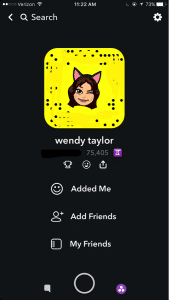
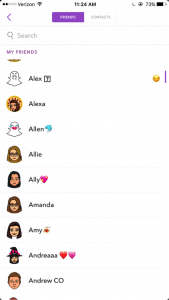
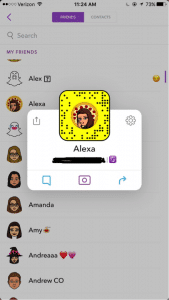
There is not a “personal profile” per se, but there are ways to find your friends who are on Snapchat. From the main snapchat screen, the middle section, you can press the top left corner, which is either a picture of a ghost of your bitmoji you created. From there you can view your name, user name, your astrological sign, and your “score.” There’s a link with a smiley face that says “Added Me” to see those that have recently added you on Snapchat. Then there’s a link that says “Add Friends” and you can search by username, address book, snapcode, or nearby or add from your contacts list. The last link is My Friends, which shows who you have already added.
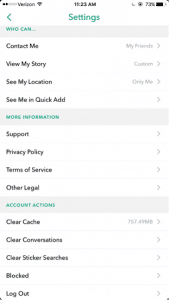
Those who are not your friends can see the pictures you post on your story, unless you go to settings – view my stor y- and make sure its pressed on “My Friends.” There is an option for Everyone or Custom, which you can block certain people from seeing your story. People can find you using any of the things stated above, but most commonly people will add through “contact” list, snapcode or user name. Your personal snapcode is the unique pattern of dots around your bitmoji. It can be scanned by other users to easily and quickly add you as a friend.
What are the privacy options?
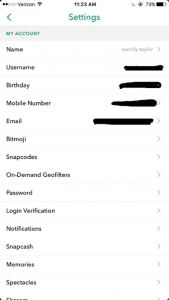
From the screen with your bimoji, click the settings gear icon on the top right hand corner. When you click it you can see the information you entered when signing up for Snapchat.
When you scroll down there is a Manage section with “Who Can…” Contact Me, View My Story, See My Location, and See Me in Quick Add. (Quick add is so you won’t come up on random people’s snapchats saying they might know you and to easily add you as a friend). From there you can select Everyone, My Friends, Only Me, or Custom settings.
How long has it been around and how popular is it?
Snapchat was created by Stanford University students, Evan Spiegel, Bobby Murphy, and Reggie Brow. It was first launched in July, 2011, under the name “Picaboo.” Later it was renamed and relaunched September, 2011.
What are the risks for use?
Cyberbully potential:
Friends sending threatening/cruel messages or offensive pictures
Fake accounts and impersonation.
Mostly used with friends or people the individual knows; so if there is an argument they may say or do hurtful things through the app.
Inappropriate content potential:
Sexualized images
Instant messaging inappropriately
Some consider it the “sexting app;” may receive inappropriate pictures or messages; may send them to others as well.
Often times, people feel as if they are safe to use this as a “sexting app” due to the fact that the app will notify you if someone has taken a screenshot. They may think that no one will screenshot their inappropriate photo because it notifies the sender. Or if they get notified that someone took a screenshot they may feel that they can take action.
However, it’s important to note that there are apps that a user can download that allow them to screenshot the sender’s photos without it sending a notification. Some of these apps are called, “SnapKeep,” “SnapBox,” “SnapSpy,” and “KeepSnap.” This is important to know, because people get too comfortable with pictures when they believe that after 10 seconds it’s magically gone; this may not be case.
Making poor decisions:
Bragging about substance use to friends by taking photos of alcohol use, drug use, or pictures at a party
Using device while driving to use the “mph” filter to brag about the speed of the vehicle you are in. This also can lead to driving over speed limit.
What are the protection features?
You can change your privacy settings to where only friends can send you Snapchats or see your story (view privacy settings).
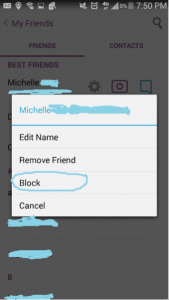
If a user is sending inappropriate images you can block them by going to your friend’s list, tap the name of the friend, click the settings link, and click “block.” Or if they recently snapped you, you can just hold their name and press settings and then block. You will no longer be able to receive or send Snapchats to that user; they also will no longer be allowed to see your story.
Because of the capacity to post images and video unmonitored and instant message, GKIS considers Snapchat a red light app, generally meaning no use prior to age 17. But realistically speaking, most high schoolers actively use and text on Snapchat, so use your best parenting judgment for your child. Also be cautious of similar apps like BurnNote,Slingshot, andYik Yak. These days, popular social media apps tend to add each other’s most popular features (like Snapchat stories now on Instagram and Facebook). No longer is there a “safer” social media app for middle schoolers.
Thank you to CSUCI student Adrienne Roy-Gasper for co-authoring this article. Check out my blog article about how this dad responded to Snapchatters who were cyberbullying his daughter, and how it caused the bully’s dad to lose his job. What are your experiences with Snapchat? Have you run across problems, or do you consider this a reasonable app for your kids? Please let me know what you think in the comments below.
I’m the mom psychologist who will help you GetKidsInternetSafe.

 April is Sexual Assault Awareness and Prevention Month (SAAPM). According to the Rape, Abuse, and Incest National Network every nine minutes a child is sexually abused, 93% of survivors know the perpetrator, and 1 in 5 kids have been solicited sexually online before the age of 18.[1] The National Sexual Assault Hotline (1-800-656-4673) provides confidential support to victims. This GKIS article covers sexual violence, technology misuse, support groups, and ways to help. The following information may be triggering to some readers, discretion is advised.