Need peaceful screen time negotiations?

Get your FREE GKIS Connected Family Screen Agreement

sensible Parent's

The GKIS Sensible Parent’s Guide to Kik

FullSizeRender

It’s every teen’s dream to have unmonitored texting through WiFi, without having to ask parent permission or use expensive data. With instant messaging apps like Kik, all you need is an Internet-connected screen device and, voila, there’s your private Internet portal. Kik is most commonly used among middle schoolers, which translates to online teen hijinks, some innocent and some not-so-innocent. Apps like these are why screen safety agreements among parents and their teens are so vital. My Screen Safety Toolkit is a great instrument for navigating how to monitor your child without hurting your relationship.

What is Kik?

Kik is a free mobile application that is used for instant messaging (IM). It is most commonly used on handheld screen media that connect to WiFi (like smartphones, iPods, and tablets). A Kik account allows the user to send and receive messages with other Kik users. It’s similar to texting, but instead of using “minutes” or a data plan, it sends messages through WiFi. Kik’s Terms of Service state that users must be 13 years or older.

What are Kik’s popular features?

  • Kik looks and acts like a basic SMS text messaging function.
  • You can invite friends or family to use Kik through text, social media, or email.
  • Just like regular text messaging, you will receive notifications when your messages were sent and delivered. Not only can you tell when someone has received your message, but you can also see when they have read it and are typing back.
  • You can send pictures, videos, and texts to peers or even strangers.
  • The main page when you open the app is a list of your Kik conversations.

blog74circletext

What are the privacy options?

  • Kik has limited privacy settings.
  • I recommend that you only tell people you know your personal username. To keep it private, do NOT post it on any other social media sites where strangers may see it.
  • You have the ability to block users (searched by username or name) if you are being cyberbullied. Simply go to “Chat Settings,” then select “Block List.”

blog74kiksecond blog74kikthird How long has it been around and how popular is it?

  • Kik became available to the public in October 2010. In just two weeks it had about one million users.
  • Popular among teenagers, most young adults don’t use this application, due to the fact that most of them already use texting that’s provided with data plans.

What are the risks for use?

Cyberbully potential:

  • Due to the fact that Kik messages do not show up on wireless plans like text messaging, it makes it easier for the kids to send hurtful messages.
  • Cyberbullying commonly occurs with Kik.
    • If an enemy from school gets your username they may message you on Kik and send you insults or threats. For example, there are many reports about Kik users receiving messages telling them they should just die because no one cares about them.
    • Rebecca Sedwick was a twelve year-old girl who was bullied on Kik. Her mother was unaware of the Kik app even though she would sometimes go through her phone. Rebecca had posted photos of herself cutting her arms. Peers responded asking her why she was even alive, calling her names. Before committing suicide she changed her Kik name to, “That Dead Girl.”

blog74fifth

Making poor decisions:

  • It’s possible to have conversations with strangers on Kik, making connection with an online predator dangerously easy.
  • Sexting is a risk with this Kik.

blog74kiksixth

Inappropriate content potential:

  • Due to sexting, Kik users may receive graphic photos from peers or strangers.
  • Drug deals and sex hookups are common on Kik.
  • Parental monitoring is difficult because chats can easily be deleted.

Due to the potential for unmonitorable interaction with peers and strangers and difficulty with monitoring, GetKidsInternetSafe classifies Kik as a red light app. The anonymity and easy delete potential can lead to dangerous conversations. To learn more about the social media applications your child may be using, check out a The GetKidsInternetSafe Sensible Parent’s Guide to Tumblr.

11755355_1062290680448181_4814698546326661932_nThank you to CSUCI intern Adrienne Roy-Gasper for co-authoring this article.

I’m the mom psychologist who will help you GetKidsInternetSafe.

Onward to More Awesome Parenting,

Tracy S. Bennett, Ph.D.
Mom, Clinical Psychologist, CSUCI Adjunct Faculty
GetKidsInternetSafe.com

Photo Credit:

Informal Gluttony by Kat Northern Lights Man, CC BY-NC 2.0

Cyberbullying, would you do it? by kid-josh, CC BY-NC-SA 2.0

Pro Juventute Aufklärungskampagne ‚Sexting’ Themenbild_04, CC BY 2.0

The GKIS Sensible Parent’s Guide to Tumblr

tumblr advertisement

Tumblr is a multimedia microblogging social networking site that many tweens and teens use for streaming a scrapbook of short blogs, images, links, text, and videos and audio clips. Many of my clients love the creative versatility of Tumblr and most choose to have a public profile. Tumblr users commonly form close-knit, highly-involved communities that share common passions. Celebrities like Taylor Swift have benefitted from her 46 million following and reposting fans (#swifties) resulting in consistently viral coverage. Recently a friend of a client detailed her suicide plan on her Tumblr blog, triggering a welfare check from the police. Although this app resulted in a teen getting the help she needed in this instance, often times intimate information is used to get to an unintended victim. Trigger warning with this article due to the graphic and sexual image examples easily found on Tumblr. Sorry folks, but you NEED TO KNOW.

What is Tumblr?

Tumblr is a microblogging, social networking site that you can now use on your phone as an application. It was founded by David Karp and is owned by Yahoo! People use it to post, reblog, or comment on blogs.

What are Tumblr’s popular features?

  • The home screen will contain blogs posted by those you are following.

blog66image1

  • The home screen is where you can see posts made by other people; they can be blogs or reblogs. (Reblogs are when people take a blog and repost it onto their page for more people to see it).
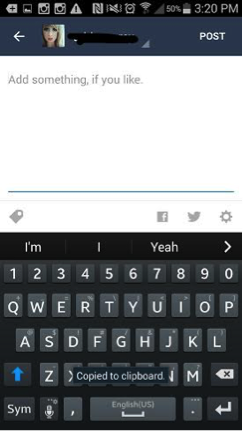
  • To reblog a post you select the two arrows going in a circle; it will take you to a page where you can add something yourself to the post.

blog66image2blog66image3

  • If you want to just like a post you can tap on the heart to the right of the arrows; if you want to leave a comment you can tap the bubble to the left of the arrows. Or you can share a post by tapping the three dots and you can share it via facebook, pintrest, email, etc.
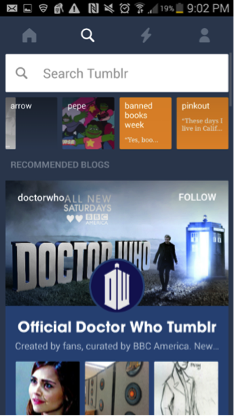
  • The search icon next to the home is where you can look up other users; you can search for friends or you can just search for anyone that may blog about things you enjoy. You can type just about anything into the search bar and find people to follow.

blog66image4.png

  • It will also give you recommendations of what to follow; if you want to follow that page you can just click the follow button.
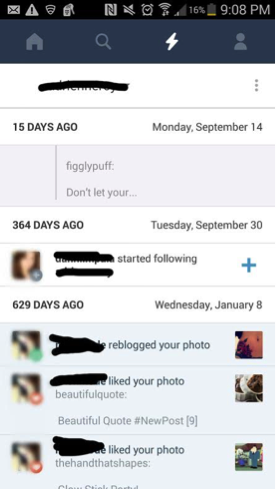
  • The lightning bolt icon is where you can see your notifications. People can tag you, reblog your post, or even comment on something.

blog66image5

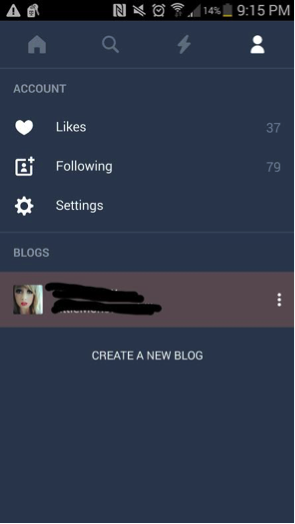
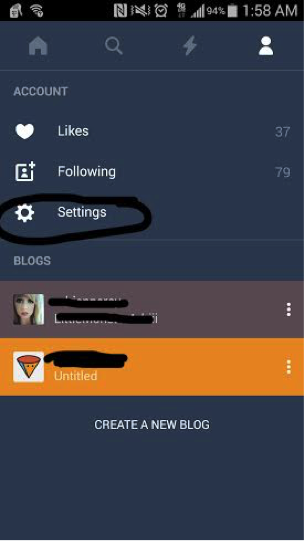
  • The person icon next to the lightning bolt is your account information; here you can see your likes, who you’re following, your settings, and your blog information. There is also a place where you can start a new blog which is like a subaccount.

blog66image7

  • To post a blog you can select the big blue circle with a pencil on the main page.

What is included in the personal profile?

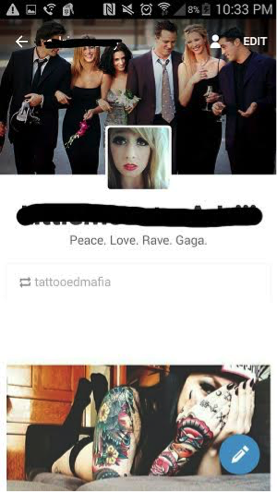
  • To look at your own personal profile you can go to the person icon, click your picture and username. It will bring you to your profile and you can see what everyone else can see.
  • You can edit your user name, background, profile picture, etc. It will also show things that you have posted or shared.

blog66image8

  • The big blue circle with the pencil is where you can post your own personal blog.
  • Top right hand corner is where you can edit your profile.
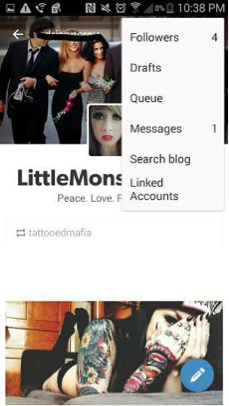
  • The person icon to the left of it is where you can see your followers, messages, search for other blogs, view linked accounts if you have any, etc.

blog66image9

What are the privacy options?

  • There are not many privacy options on Tumblr.
  • You are unable to make your main blog private.
  • In order to post a blog that only you can read; you must make a secondary blog account.
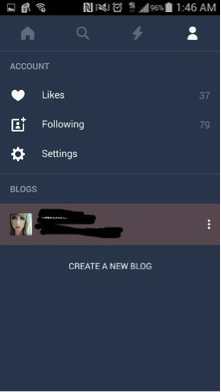
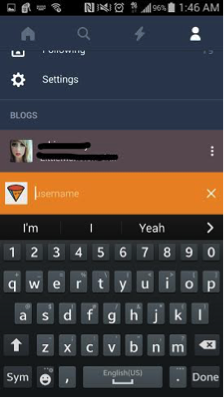
    • To make a secondary blog, you go to the person icon at the top right.
    • Tap the “create new blog link.”

blog66image11blog66image12

  • These secondary blogs are unable to follow other blogs, talk to other users, like or post other blogs.
  • Other privacy information Tumblr offers are under the person icon. Select “Settings,” then select privacy policy.
  • In this section Tumblr just explains why they use your email, username, password, and age (such as using your email to send you updates about the app or site). They note that this information is kept confidential from third parties,

blog66image13

How long has it been around and how popular is it?

  • Tumblr has been around since November, 2007.
  • It is estimated that there are about 30 million users and possibly more.
  • Popular amongst teens and young adults.

What are the risks for use?

Cyberbully potential:

  • Due to the confessional-type nature of many entries, Tumblr users are extremely vulnerable to trollish and cyberbullying comments.

Inappropriate content potential:

  • Social media sometimes provides groups to make teenagers feel like they “belong.” However these groups can be dangerous.
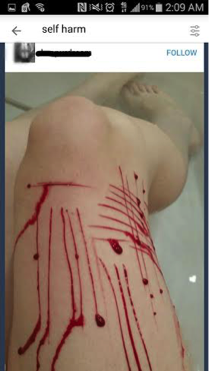
    • Cutting: Those who may have depression and depend on self harm can reach out to others who also cut and share stories/pictures of their experiences, which can lead to more cutting and other “ways” of doing it.blog66image16
      blog66image14
    • Sexualized Content: Due to all ages being on the internet, parents should be aware of the sexualized images that are available through Tumblr.blog66image17 blog66image18
    • Eating Disorders: People tend to use their blogs on social media sites to share their stories and/or pictures of their struggles with eating disorders. This content may give others advice or help on how to become anorexic or bulimic.blog66image20 blog66image19
    • Drug Use: Blogs may be used to “brag” or talk about drug use, making it seem like a cool thing to do.


blog66image22 blog66image21

Making poor decisions:

  • Teens long to form private, creative communities and Tumblr is the perfect place to do that. As with all social media apps, Tumblr can be prosocial or destructive. Therefore if you teen wants Tumblr, I suggest that you continue to nurture a warm, collaborative relationship so they can come to you if they run across anything uncomfortable. And for young teens, definitely monitor content.

Due to the intimate and dangerous content often shared on Tumblr, I recommend this is a GKIS yellow-light app (with monitoring only). Kids are being introduced to topics that they may not be mature enough to handle (is anybody?) and are also vulnerable to cyberbullying. More scary to me is the opportunity that online sex offenders have for learning intimate details about children, such as special interests and personal identifying information. Tumblr is tantamount to confessional YouTube channels and social networking sites like Twitter. Do you have any stories to share about Tumblr? Please share them below!

11755355_1062290680448181_4814698546326661932_nThank you to CSUCI student Adrienne Roy-Gasper for co-authoring this article.


I’m the mom psychologist who will help you GetKidsInternetSafe.

Onward to More Awesome Parenting,

Tracy S. Bennett, Ph.D.
Mom, Clinical Psychologist, CSUCI Adjunct Faculty
GetKidsInternetSafe.com

Photo credit:

Tumblr by Scott Beale, CC BY-NC-ND 2.0
The GKIS Sensible Parent’s Guide to Snapchat

Snapchat Icon

I have mixed feelings about red-lighting the popular self-destructing messaging app, Snapchat, and I’ll tell you why. I Snapchat with my daughter and the other twenty-somethings and its fun! Like all social media apps, Snapchat can be used for good or evil. They say it’s not guns that kill people, it’s people that kill people. The same applies for social media. So here’s the deal; if the individual using Snapchat has a mature frontal lobe and life experience, this app is way cool. But if the user is young and impulsive, Snapchat provides an effective forum for bad behavior in the form of pictures, videos, and texts. Unfortunately, there are no monitoring apps that I know of that work with Snapchat. However, there are many apps that that let recipients sneakily save chats from unsuspecting senders. Keep in mind, social media apps post risks for viewing, posting, and private messaging. Here is your GetKidsInternetSafe Sensible Parent’s Guide to Snapchat so you can make your most informed parenting decision. To help your tween or teen demonstrate they have the knowledge, problem solving ability, and judgment for social media, check out our Social Media Readiness Course. It’s an online course for tweens and teens that offers information about the risks of digital injury due to social media and psychological wellness tools. With a quiz for each module, they work their way through independently so their graduation certification demonstrates mastery of content. Of course, you can take it too if you’d like. It’s like driver’s training but for the internet!

What is Snapchat?

Snapchat is a free mobile messaging app for sharing moments with family or friends. Photos or videos are taken on the application and the user may draw and add a “caption” to their picture and send it to anyone on their “friends” list. Snapchat also contains a “story” (a saved video on static page for 24 hours) where friends can view your photo and/or video series. The photos or videos last up to ten seconds or it can last up to infinite amount of time and then it disappears after the user clicks their screen. The photos can be saved if the other person viewing it takes a screen shot; however it will notify the sender. Also, the sender may save their photos anytime if they are on their “story.” You can also instant message with Snapchat. Snapchat’s Terms of Use states, “Snapchat is intended for people who are at least 13 years old. Persons under the age of 13 are prohibited from creating Snapchat accounts.”

What are Snapchat’s popular features?

Snapchat is highly intriguing to users because the messaging is photo/video based. This is a step-by-step description of how to use it:

  • Take a photo
  • Tap screen to add caption; tap the “T” in the right hand corner to change font size and color. Tap the pencil under the “T” to draw on the picture with color or draw with emoji’s, tap the square under the pencil to add emoji’s or bitmojis.
  • Under the square is a pair of scissors that allows you to clear a blemish, erase a part of the photo, put an entire background, or put hues of color in designated spots.
  • After the scissors, there is a paper click symbol. This allows for the user to attach a URL to any post they make.
  • Apply a filter by swiping right on the photo; includes four different tints for pictures, a “mph” to show friends how “fast” you’re going if in a moving vehicle, the time photo or video was taken, the altitude, and the temperature of where you are. You can only choose one of these filters at a time or you can hold the screen and apply numerous filters to the post.
  • At the bottom of the list of symbols on the left top corner is the clock where, you can choose how long you want your picture to appear when sent to friends from 1-10 seconds or for infinite. You can also click the arrow pointing down (on the bottom of the screen) if you want to download the picture you just took onto your device. Lastly next to the arrow there is the square with a plus sign to “add to your story,” the picture will remain on your story for 24 hours.
  • At the bottom right corner of the screen, you click the arrow pointing to the right to send the photo to your friends. When clicking here you can choose what friends you want to send it to.
  • Check the box of the friends you want it sent to; on the bottom the friends you chose will show up in a blue link with an arrow pointing to the right. You click the arrow once your friends are chosen.
  • The list of friends include, “Your Story,” “Best Friends,” “Recents,” “Groups,” and “Needs Love.” Your story was previously mentioned before; you just have another option to add the photo to your story a different way. Your best friends consist of those you send Snapchats to the most. Recents are those who recently sent you a Snapchat or those you recently sent a Snapchat to. Groups are people who you have grouped together and if you send a snap to them all of the recipients will receive the same snapchat and can respond to the group (like group messaging but with pictures). Lastly those on the needs love list are those who are on your Snapchat list of friends but you don’t Snapchat them often nor sent them a Snapchat recently.
  • Recently added on Snapchat is group chatting. Now, once you are on your main screen (swipe to the right), you’ll see at the top for the option of “Groups”, “Stories”, or “Chats”. Pressing each of these tabs looks fairly similar but it is a new way of organizing your feed. The New Group Video Chat allows groups of up to sixteen people to instantly start video chatting. To create a video call, you simply create a new group of friends (or use a group already created) and tap the video icon to send an automatic notification to those users, as an invitation to join the call.  During your video chat you can use the famous Snapchat filters. You read that right, you can video call your friends and family while you have a dog filter on your face.

personal profile on Snapchat What is included in the personal profile?

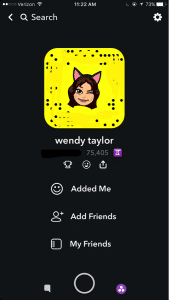
There is not a “personal profile” per se, but there are ways to find your friends who are on Snapchat. From the main snapchat screen, the middle section, you can press the top left corner, which is either a picture of a ghost of your bitmoji you created. From there you can view your name, user name, your astrological sign, and your “score.” There’s a link with a smiley face that says “Added Me” to see those that have recently added you on Snapchat. Then there’s a link that says “Add Friends” and you can search by username, address book, snapcode, or nearby or add from your contacts list. The last link is My Friends, which shows who you have already added.

Those who are not your friends can see the pictures you post on your story, unless you go to settings – view my stor y- and make sure its pressed on “My Friends.” There is an option for Everyone or Custom, which you can block certain people from seeing your story. People can find you using any of the things stated above, but most commonly people will add through “contact” list, snapcode or user name. Your personal snapcode is the unique pattern of dots around your bitmoji. It can be scanned by other users to easily and quickly add you as a friend.

Snapchat settings What are the privacy options?

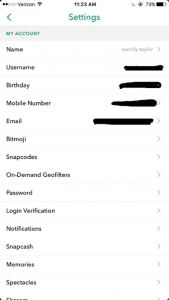
From the screen with your bimoji, click the settings gear icon on the top right hand corner. When you click it you can see the information you entered when signing up for Snapchat.

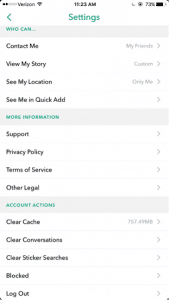
privacy options in Snapchat

When you scroll down there is a Manage section with “Who Can…” Contact Me, View My Story, See My Location, and See Me in Quick Add. (Quick add is so you won’t come up on random people’s snapchats saying they might know you and to easily add you as a friend). From there you can select Everyone, My Friends, Only Me, or Custom settings.

How long has it been around and how popular is it?

Snapchat was created by Stanford University students, Evan Spiegel, Bobby Murphy, and Reggie Brow. It was first launched in July, 2011, under the name “Picaboo.” Later it was renamed and relaunched September, 2011.

What are the risks for use?

Cyberbully potential:

  • Friends sending threatening/cruel messages or offensive pictures
  • Fake accounts and impersonation.
  • Mostly used with friends or people the individual knows; so if there is an argument they may say or do hurtful things through the app.

Inappropriate content potential:

  • Sexualized images
  • Instant messaging inappropriately
  • Some consider it the “sexting app;” may receive inappropriate pictures or messages; may send them to others as well.
  • Often times, people feel as if they are safe to use this as a “sexting app” due to the fact that the app will notify you if someone has taken a screenshot. They may think that no one will screenshot their inappropriate photo because it notifies the sender. Or if they get notified that someone took a screenshot they may feel that they can take action.

However, it’s important to note that there are apps that a user can download that allow them to screenshot the sender’s photos without it sending a notification. Some of these apps are called, “SnapKeep,” “SnapBox,” “SnapSpy,” and “KeepSnap.” This is important to know, because people get too comfortable with pictures when they believe that after 10 seconds it’s magically gone; this may not be case.

Making poor decisions:

  • Bragging about substance use to friends by taking photos of alcohol use, drug use, or pictures at a party
  • Using device while driving to use the “mph” filter to brag about the speed of the vehicle you are in. This also can lead to driving over speed limit.

What are the protection features?

  • You can change your privacy settings to where only friends can send you Snapchats or see your story (view privacy settings).
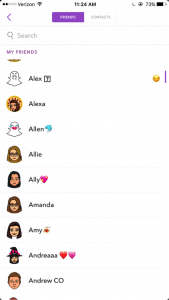
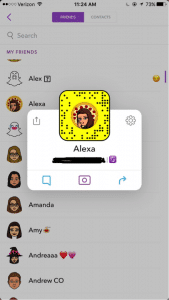
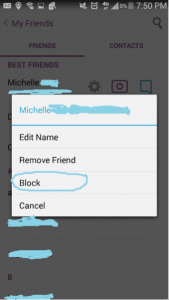
  • If a user is sending inappropriate images you can block them by going to your friend’s list, tap the name of the friend, click the settings link, and click “block.” Or if they recently snapped you, you can just hold their name and press settings and then block. You will no longer be able to receive or send Snapchats to that user; they also will no longer be allowed to see your story.

1st screenshot showing protection features in Snapchat

2nd screenshot showing protection features in Snapchat

3rd screenshot showing the SnapChat block feature


Because of the capacity to post images and video unmonitored and instant message, GKIS considers Snapchat a red light app, generally meaning no use prior to age 17. But realistically speaking, most high schoolers actively use and text on Snapchat, so use your best parenting judgment for your child. Also be cautious of similar apps like BurnNote, Slingshot, and Yik Yak. These days, popular social media apps tend to add each other’s most popular features (like Snapchat stories now on Instagram and Facebook). No longer is there a “safer” social media app for middle schoolers.

CSUCI student Adrienne Roy-Gasper

Thank you to CSUCI student Adrienne Roy-Gasper for co-authoring this article. Check out my blog article about how this dad responded to Snapchatters who were cyberbullying his daughter, and how it caused the bully’s dad to lose his job. What are your experiences with Snapchat? Have you run across problems, or do you consider this a reasonable app for your kids? Please let me know what you think in the comments below.

I’m the mom psychologist who will help you GetKidsInternetSafe.

Onward to More Awesome Parenting,

Tracy S. Bennett, Ph.D.
Mom, Clinical Psychologist, CSUCI Adjunct Faculty
GetKidsInternetSafe.com

The GKIS Sensible Parent’s Guide to ask.fm

blog64askfmleadimage

It was a no-brainer for me to include the confessional question-and-answer app, ask.fm, on the GKIS social media red light list. But then … I was contacted by Catherine Teitelbaum, Chief Trust and Safety Officer for ask.fm. Her generous efforts to inform us about their recent investment of “millions of dollars” and impressive safety updates to bring ask.fm up to industry best practice standards gave me pause. I’ll explain more about recent developments at the end of my article. But despite updated safety implementations, I still have real safety concerns because, in my community, ask.fm remains very popular among middle schoolers and few seem to get out of this cyberbully battleground without long-lasting emotional scars. It’s the perceived anonymity and seductive invitation to ask and answer personal questions on a public forum that make this app risky for impulsive teens. Check out this week’s article so you know what to look out for on your child’s smartphone.

Recently a client shared with me how an ask.fm cyberbully incident triggered her first major depressive episode. She said that she initially really liked answering people’s questions on the app, sharing her opinions and private information. Until one day she woke up to a string of insults about her on the public bulletin board, leaving her hurt and demoralized, questioning constantly who was her friend and who was her enemy. Like other teens, instead of closing her account to escape the misery, she started to compulsively check comments in a futile attempt to feel in control of the situation.

As if that wasn’t difficult enough, shortly after the cyberbully posts a peer posed as her on the app and asked scandalous questions. Again she retreated into confused and frightened silence, too ashamed to tell anybody. She didn’t realize that she was placing herself in harms way by adding the ask.fm app to her Instagram. She eventually deleted it, but the damage was already done. She’s such a beautiful and kind girl it’s mindboggling how somebody would attack her this way and that it would hit her so hard. But then again, the sweet kids who have it all are often targeted and social acceptance is very important to young adolescents. It doesn’t take long to move from optimistic naiveté to defensive fear once cyberbullied. Here is GKIS Sensible Parent’s Guide to ask.fm.

What is ask.fm?

Ask.fm started as a social website and app where people can post questions anonymously (or with their screen name). Responses come in the form of text, images, or video. A user can opt not to receive anonymous questions. It’s commonly used by young people and is open for anyone to post comments and ask questions to the public profile. Users often cyberbully and post sexualized content on the site, and it is a convenient forum to start rumors and be cruel to others. Ask.fm’s Terms of Use states that the individual using the app or website must be thirteen years or older. However that does not stop younger children from using it.

What are ask.fm’s popular features?

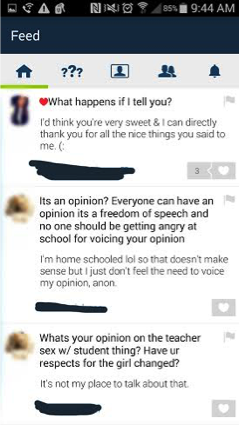
  • The “home” icon is where you can view those you are following on ask.fm. You can see the questions and comments that they received and answers and responses to the comments and questions.

blog64image2

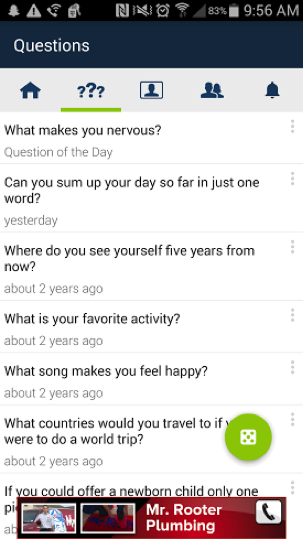
  • Next to the home icon are question marks. Under this icon you can view the questions people have asked you. Some of these questions are also random from ask.fm. These are questions that are generated through the site and you can answer them and post them to your page. So if you are not getting questions from your friends then this can help build your profile. To get these questions you can tap the green circle and more randomized questions from the app itself will pop up.

blog64image3

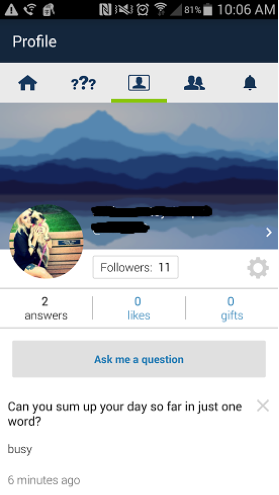
  • Next to the question mark icon is the profile icon where you can see your personal profile. Here you can view your own profile which contains your name, user name, photo, amount of followers, how many questions you’ve answered, amount of likes, and gifts you’ve received.

blog64image4

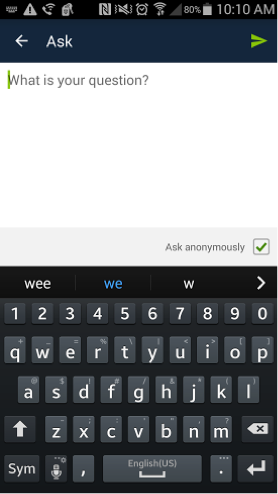
  • There is also the “Ask me a question,” button on every profile. If you click it, it will take you to a page where you can type your comment or question. At the bottom right hand corner there is a check box that when checked allows you post anonymously. Uncheck the box and it will show who asked or commented.

blog64image5


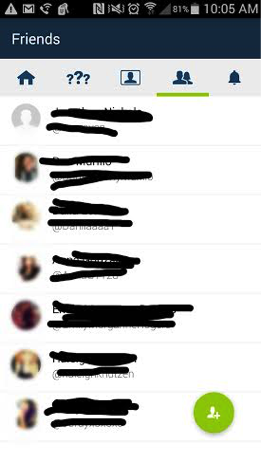
  • Next to the profile link, there is a link with shadowed heads. This is where you can see whom you are following.


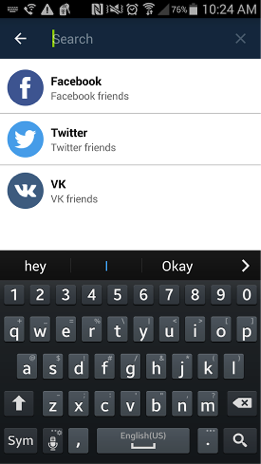
  • blog64image6The big green circle on this page is to help you add friends by either searching, adding them through other social media apps like Facebook, Twitter, or VK Friends.

blog64image7

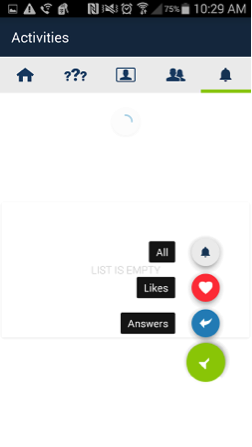
  • The bell next to the friend’s link is where you can see your notifications, such as answers to questions you asked and likes on your page. The green circle on this page lets you choose what notifications you want to receive whether it is just answers, likes, or all.

blog64image9

What are the privacy options?

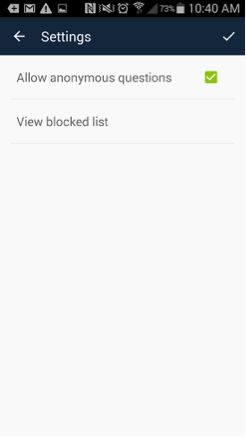
  • You can set your ask.fm account to not allow any anonymous questions and only receive comments or questions from people you know are asking. To do this you go to settings (this is on your public profile, there’s a settings button that looks like a tool), then you click on privacy, and uncheck the box that says “anonymous questions.”

blog64image10blog64image12

What are the risks for use?

  • Cyberbully potential:

The fact that people can post anonymously makes it easy for people to post mean comments and/or threats to a person’s page people cannot post anonymously.

  • Inappropriate content potential:

Just like any other application or social networking site, posts about sex are highly common on ask.fm. People have the tendency to ask other people sex questions- like what they like, who they have been with, etc. Often times, the person being asked questions may end up sharing information that then may be used for cyberbullying. Teens may also inadvertently share personal information about themselves and friends and family members without recognizing long-term consequence.

How long has it been around and how popular is it?

  • Ask.fm was developed by two brothers from Latvia in 2010. It grew in popularity starting in Eastern Europe with a policy that seemed to value free speech over safety concerns. As with so many other social media apps, it became popular quickly and the creators may have been caught off guard and slow to understand the dangerous issues presenting and the important safety changes that needed to be made. Fortunately, the it was acquired by Ask.com (a public company that also owns Match.com, About.com, and numerous other online brands) and they have recently implemented significant safety changes. It is especially popular among teens (40% of users are reported to be under 18 years old). Eighteen billion questions and answers were posted in just one year! That, GKISsers, is A LOT of content. Fortunately, most interactions are inane or neutral to positive and sweet. Catherine Teitelbaum elaborated that users love the opportunity to ask questions and express themselves among peers.

What are the protection features?

  • Users are safest if they block anonymous answers and avoid the public stream. Using WiFi may save you on data charges.
  • Users are now required to be registered with ask.fm before they can log in and ask a question. That means they may be anonymous to other ask.fm users, but they are not anonymous on the backend from ask.fm security. If users violate terms of use, they can be held accountable by receiving a warning and even being banned from the site.
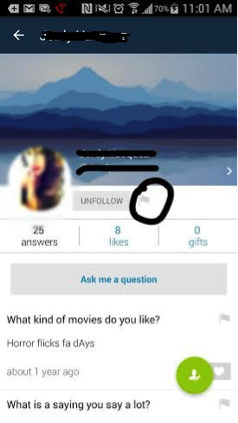
  • Responders can also report content or block another user if they feel threatened or bothered. All you have to do is go to their profile, click the flag button next to the follow button, and then click “block.” Ms. Teitelbaum told me that all reports will be responded to within 24 hours. However, flags are prioritized due to severity and action may be taken within 15 minutes.
    blog64image13
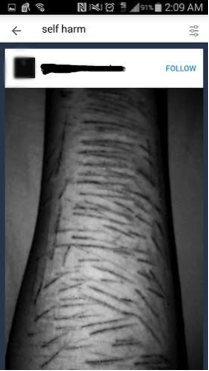
  • Ask.fm has computer algorithms that search for inappropriate content on all questions (like self harm). If content is flagged, ask.fm staff will review the content and determine action. Answers can be in the form text, photo, or video. As of August, 2015, ask.fm policies have resulted in them taking 40% more action on content than before. Of course, as with all social media apps, teens become increasingly sophisticated working around controls using slang and nuance.
  • A gap I’ve identified continues to be that you can be anonymous or not when asking a question. This leaves a lot of opportunity for teens with poor judgement to post unflattering content about themselves and others. Posts are public and not exclusive to a buddy list. In theory, if a predator new a child’s profile name he/she could get into your child’s inbox. That portal to potentially gaining intimate information and/or interacting with you teen pushes ask.fm from yellow to red light in my opinion.
  • The GetKidsInternetSafe overwhelming message is that parents must monitor teen social media posts. This is easy with ask.fm in that EVERYTHING a user answers becomes automatically public and searchable.
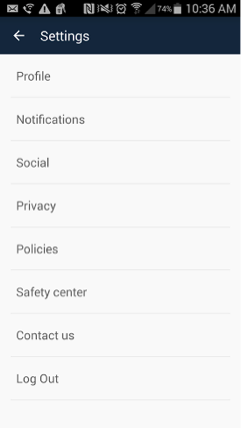
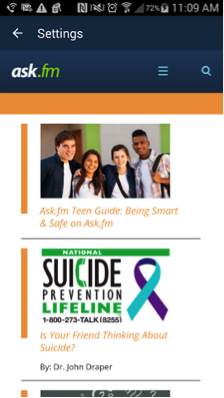
  • Due to their high risk for cyberbullying, if you go to the settings again and click on safety center, it takes you to a page where you can get information on how to be safe on the site. There is also information on a suicide prevention lifeline. I also encourage your to check out the Terms of Use, which includes an impressive list of Rules of Conduct. For more information check out A Parent’s Guide to ask.fm. (Yay ask.fm! We are seeing significant progress in safety here. Cheers to concerned and noisy parents like us!)

blog64image14

Even with the recently instituted safety features, public and anonymous posting makes this a GKIS red light app, meaning no use prior to age 18 years. For good reasons, ask.fm has been compared to a virtual bathroom stall, demoralizing and vulgar. Because teens tend to be open and idealistic, parents are encouraged to use GKIS recommendations about monitoring, ongoing dialogue, and teaching important skills to kids about netiquette and judgement. Keep in mind that their immature problem solving region in their brain will often lead them to make mistakes. It’s critical that we make ourselves available for compassionate and informed consult. I totally “get” how compelling this app is to teens as a way to share with others. But from my perspective as a clinical psychologist, I worry a public format is simply too risky for young teens. Of course, it is important for families to make their own decisions based on their opinions and values and the individual traits of their kids. Similar apps to avoid include Whisper and  Snapchat. What are your experiences with ask.fm? Have you run across problems, or do you consider this a reasonable app for your kids? Please scroll down and let me know what you think! And if you haven’t yet implemented the GKIS staging tools in your home that immediately result in improved safety, check out the GKIS Screen Safety Toolkit today!

11755355_1062290680448181_4814698546326661932_nThank you to CSUCI student Adrienne Roy-Gasper for co-authoring this article.


I’m the mom psychologist who will help you GetKidsInternetSafe.

Onward to More Awesome Parenting,

Tracy S. Bennett, Ph.D.
Mom, Clinical Psychologist, CSUCI Adjunct Faculty
GetKidsInternetSafe.com