

Need peaceful screen time negotiations?

Get your FREE GKIS Connected Family Screen Agreement

teens

The GKIS Sensible Parent’s Guide to ask.fm

blog64askfmleadimage

It was a no-brainer for me to include the confessional question-and-answer app, ask.fm, on the GKIS social media red light list. But then … I was contacted by Catherine Teitelbaum, Chief Trust and Safety Officer for ask.fm. Her generous efforts to inform us about their recent investment of “millions of dollars” and impressive safety updates to bring ask.fm up to industry best practice standards gave me pause. I’ll explain more about recent developments at the end of my article. But despite updated safety implementations, I still have real safety concerns because, in my community, ask.fm remains very popular among middle schoolers and few seem to get out of this cyberbully battleground without long-lasting emotional scars. It’s the perceived anonymity and seductive invitation to ask and answer personal questions on a public forum that make this app risky for impulsive teens. Check out this week’s article so you know what to look out for on your child’s smartphone.

Recently a client shared with me how an ask.fm cyberbully incident triggered her first major depressive episode. She said that she initially really liked answering people’s questions on the app, sharing her opinions and private information. Until one day she woke up to a string of insults about her on the public bulletin board, leaving her hurt and demoralized, questioning constantly who was her friend and who was her enemy. Like other teens, instead of closing her account to escape the misery, she started to compulsively check comments in a futile attempt to feel in control of the situation.

As if that wasn’t difficult enough, shortly after the cyberbully posts a peer posed as her on the app and asked scandalous questions. Again she retreated into confused and frightened silence, too ashamed to tell anybody. She didn’t realize that she was placing herself in harms way by adding the ask.fm app to her Instagram. She eventually deleted it, but the damage was already done. She’s such a beautiful and kind girl it’s mindboggling how somebody would attack her this way and that it would hit her so hard. But then again, the sweet kids who have it all are often targeted and social acceptance is very important to young adolescents. It doesn’t take long to move from optimistic naiveté to defensive fear once cyberbullied. Here is GKIS Sensible Parent’s Guide to ask.fm.

What is ask.fm?

Ask.fm started as a social website and app where people can post questions anonymously (or with their screen name). Responses come in the form of text, images, or video. A user can opt not to receive anonymous questions. It’s commonly used by young people and is open for anyone to post comments and ask questions to the public profile. Users often cyberbully and post sexualized content on the site, and it is a convenient forum to start rumors and be cruel to others. Ask.fm’s Terms of Use states that the individual using the app or website must be thirteen years or older. However that does not stop younger children from using it.

What are ask.fm’s popular features?

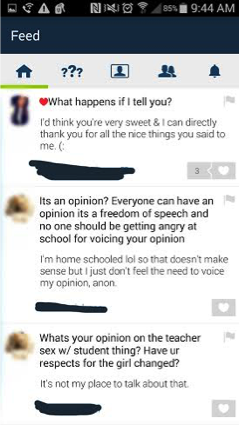
  • The “home” icon is where you can view those you are following on ask.fm. You can see the questions and comments that they received and answers and responses to the comments and questions.
blog64image2

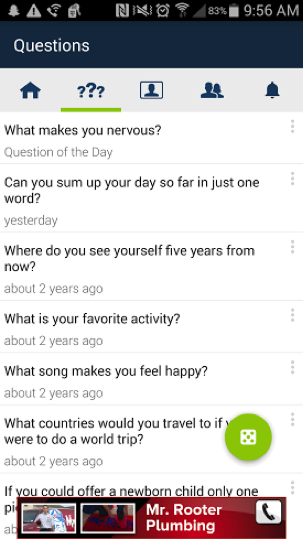
  • Next to the home icon are question marks. Under this icon you can view the questions people have asked you. Some of these questions are also random from ask.fm. These are questions that are generated through the site and you can answer them and post them to your page. So if you are not getting questions from your friends then this can help build your profile. To get these questions you can tap the green circle and more randomized questions from the app itself will pop up.
blog64image3

  • Next to the question mark icon is the profile icon where you can see your personal profile. Here you can view your own profile which contains your name, user name, photo, amount of followers, how many questions you’ve answered, amount of likes, and gifts you’ve received.

blog64image4

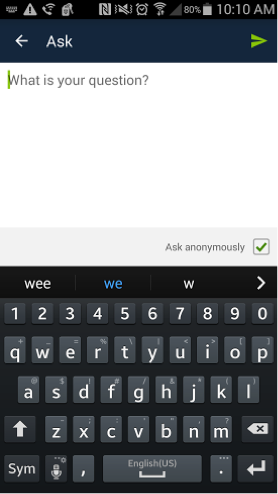
  • There is also the “Ask me a question,” button on every profile. If you click it, it will take you to a page where you can type your comment or question. At the bottom right hand corner there is a check box that when checked allows you post anonymously. Uncheck the box and it will show who asked or commented.
blog64image5


  • Next to the profile link, there is a link with shadowed heads. This is where you can see whom you are following.


  • blog64image6The big green circle on this page is to help you add friends by either searching, adding them through other social media apps like Facebook, Twitter, or VK Friends.


blog64image7

  • The bell next to the friend’s link is where you can see your notifications, such as answers to questions you asked and likes on your page. The green circle on this page lets you choose what notifications you want to receive whether it is just answers, likes, or all.

blog64image9

What are the privacy options?

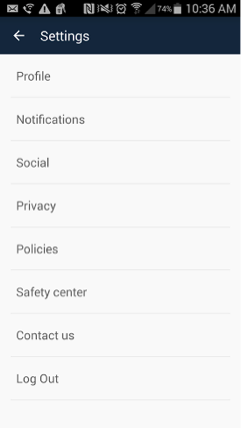
  • You can set your ask.fm account to not allow any anonymous questions and only receive comments or questions from people you know are asking. To do this you go to settings (this is on your public profile, there’s a settings button that looks like a tool), then you click on privacy, and uncheck the box that says “anonymous questions.”

blog64image10blog64image12

What are the risks for use?

  • Cyberbully potential:

The fact that people can post anonymously makes it easy for people to post mean comments and/or threats to a person’s page people cannot post anonymously.

  • Inappropriate content potential:

Just like any other application or social networking site, posts about sex are highly common on ask.fm. People have the tendency to ask other people sex questions- like what they like, who they have been with, etc. Often times, the person being asked questions may end up sharing information that then may be used for cyberbullying. Teens may also inadvertently share personal information about themselves and friends and family members without recognizing long-term consequence.

How long has it been around and how popular is it?

  • Ask.fm was developed by two brothers from Latvia in 2010. It grew in popularity starting in Eastern Europe with a policy that seemed to value free speech over safety concerns. As with so many other social media apps, it became popular quickly and the creators may have been caught off guard and slow to understand the dangerous issues presenting and the important safety changes that needed to be made. Fortunately, the it was acquired by Ask.com (a public company that also owns Match.com, About.com, and numerous other online brands) and they have recently implemented significant safety changes. It is especially popular among teens (40% of users are reported to be under 18 years old). Eighteen billion questions and answers were posted in just one year! That, GKISsers, is A LOT of content. Fortunately, most interactions are inane or neutral to positive and sweet. Catherine Teitelbaum elaborated that users love the opportunity to ask questions and express themselves among peers.

What are the protection features?

  • Users are safest if they block anonymous answers and avoid the public stream. Using WiFi may save you on data charges.
  • Users are now required to be registered with ask.fm before they can log in and ask a question. That means they may be anonymous to other ask.fm users, but they are not anonymous on the backend from ask.fm security. If users violate terms of use, they can be held accountable by receiving a warning and even being banned from the site.
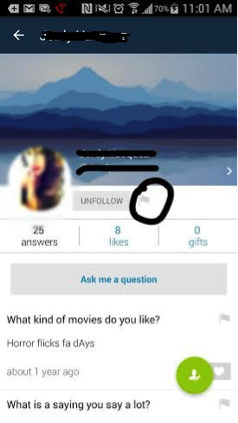
  • Responders can also report content or block another user if they feel threatened or bothered. All you have to do is go to their profile, click the flag button next to the follow button, and then click “block.” Ms. Teitelbaum told me that all reports will be responded to within 24 hours. However, flags are prioritized due to severity and action may be taken within 15 minutes.
    blog64image13
  • Ask.fm has computer algorithms that search for inappropriate content on all questions (like self harm). If content is flagged, ask.fm staff will review the content and determine action. Answers can be in the form text, photo, or video. As of August, 2015, ask.fm policies have resulted in them taking 40% more action on content than before. Of course, as with all social media apps, teens become increasingly sophisticated working around controls using slang and nuance.
  • A gap I’ve identified continues to be that you can be anonymous or not when asking a question. This leaves a lot of opportunity for teens with poor judgement to post unflattering content about themselves and others. Posts are public and not exclusive to a buddy list. In theory, if a predator new a child’s profile name he/she could get into your child’s inbox. That portal to potentially gaining intimate information and/or interacting with you teen pushes ask.fm from yellow to red light in my opinion.
  • The GetKidsInternetSafe overwhelming message is that parents must monitor teen social media posts. This is easy with ask.fm in that EVERYTHING a user answers becomes automatically public and searchable.
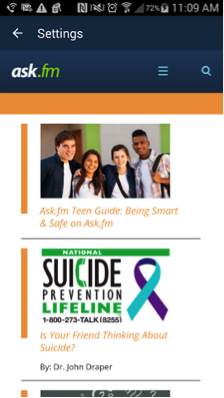
  • Due to their high risk for cyberbullying, if you go to the settings again and click on safety center, it takes you to a page where you can get information on how to be safe on the site. There is also information on a suicide prevention lifeline. I also encourage your to check out the Terms of Use, which includes an impressive list of Rules of Conduct. For more information check out A Parent’s Guide to ask.fm. (Yay ask.fm! We are seeing significant progress in safety here. Cheers to concerned and noisy parents like us!)
blog64image14

Even with the recently instituted safety features, public and anonymous posting makes this a GKIS red light app, meaning no use prior to age 18 years. For good reasons, ask.fm has been compared to a virtual bathroom stall, demoralizing and vulgar. Because teens tend to be open and idealistic, parents are encouraged to use GKIS recommendations about monitoring, ongoing dialogue, and teaching important skills to kids about netiquette and judgement. Keep in mind that their immature problem solving region in their brain will often lead them to make mistakes. It’s critical that we make ourselves available for compassionate and informed consult. I totally “get” how compelling this app is to teens as a way to share with others. But from my perspective as a clinical psychologist, I worry a public format is simply too risky for young teens. Of course, it is important for families to make their own decisions based on their opinions and values and the individual traits of their kids. Similar apps to avoid include Whisper and  Snapchat. What are your experiences with ask.fm? Have you run across problems, or do you consider this a reasonable app for your kids? Please scroll down and let me know what you think! And if you haven’t yet implemented the GKIS staging tools in your home that immediately result in improved safety, check out the GKIS Screen Safety Toolkit today!

11755355_1062290680448181_4814698546326661932_nThank you to CSUCI student Adrienne Roy-Gasper for co-authoring this article.


I’m the mom psychologist who will help you GetKidsInternetSafe.

Onward to More Awesome Parenting,

Tracy S. Bennett, Ph.D.
Mom, Clinical Psychologist, CSUCI Adjunct Faculty
GetKidsInternetSafe.com

Coby Persin’s Viral Child Predator Social Experiment Begs Us to GetKidsInternetSafe

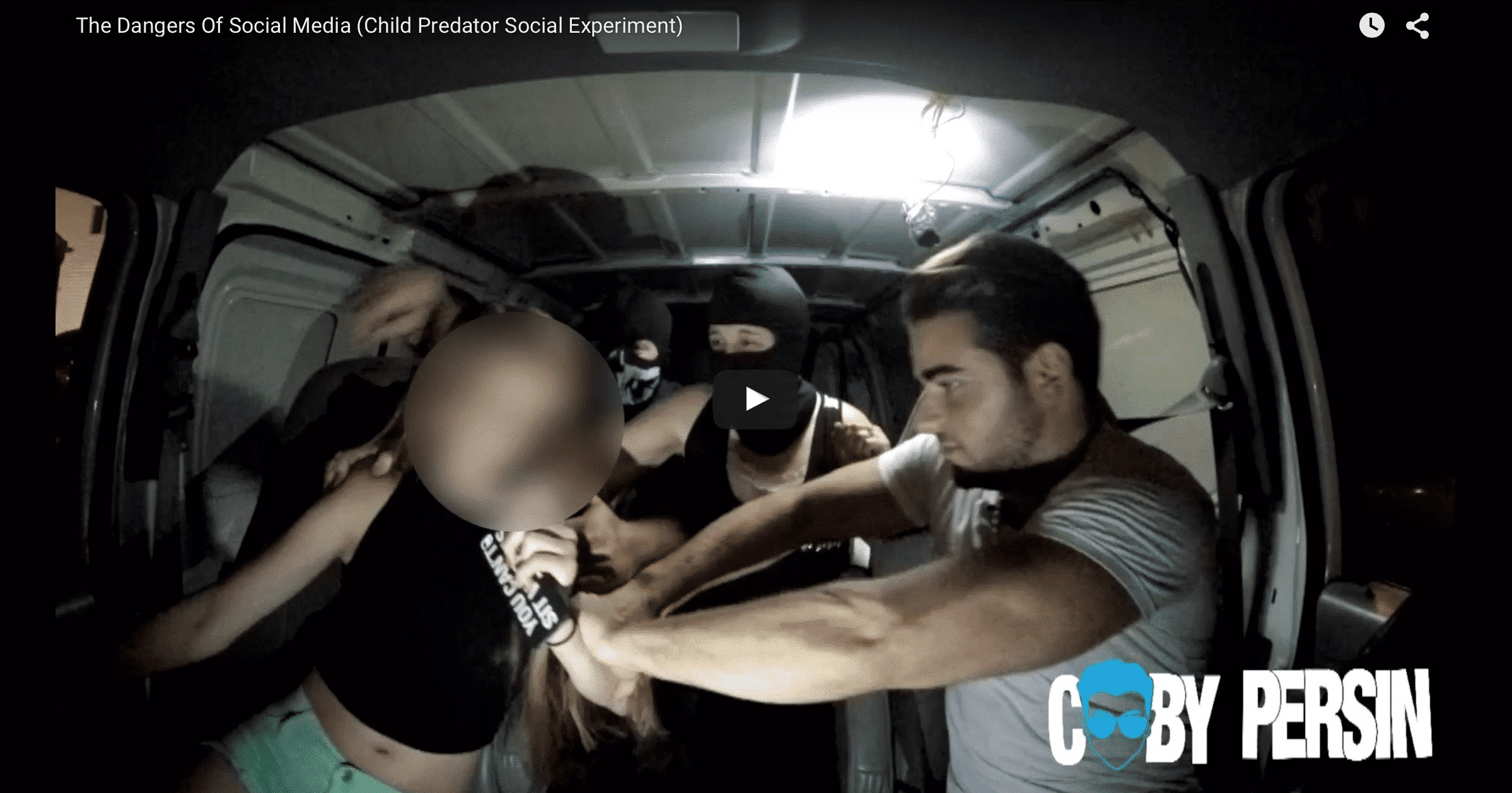
Screenshot-2015-08-14-22.28.25 Coby Persin, kudos to you for releasing The Dangers of Social Media (Child Predator Social Experiment) video that has gone viral this week. As a clinical psychologist, I have treated victims who were lured by online predators, some who carried on intimate online relationships under their parents’ noses and others who were raped by the predator. It happens more often than parents are willing to believe. It’s not that parents don’t recognize risk. They just think it’s other people’s children at risk. They overestimate their children’s judgment and fall short of the effective filtering, monitoring, and sophisticated parenting it takes to prevent online risk.

Consider these statistics:

Permissive Internet use is rampant among kids and teens. Children have access to screen media with Internet capacity at younger and younger ages. Parents tell me they simply can’t keep up with technology fast enough to implement effective protection. They say they talk to their kids, but feel incompetent to teach important issues and skills like assertiveness, safety, and sex education. And the discussions that parents do have with their kids about online risk? Telling them about scary outcomes isn’t enough. Kids need regularly coaching and skill-based learning to have any hope of avoiding the sophisticated grooming techniques of a cunning adult.

The most common mistake parents in my practice make with their kids regarding screen media use is overestimating their children’s ability to recognize risk, anticipate consequence, and control impulse.

Yes our kids are brilliant, but they don’t have the soft skills necessary to avoid online trouble. There’s an excellent neurological reason for this. The prefrontal region of the brain, the part responsible for these abilities, does not mature fully until we are 23 years old. That means that teens, even when taught about online risk, simply don’t have the wiring necessary to make sound decisions when maneuvering online. Place that against the dopamine surge in the brain’s pleasure center that sexy online interactions trigger, and you’ve got a curious teen flooded with fantasies of romance that take far higher priority over anxious caution; a losing battle indeed.

Furthermore, the developmental tendencies that are normal for the adolescent stage actually encourage risky behaviors. For example, consider the important impulse to launch. In order to gain the independence they need to become healthy adults, teens progressively venture away from parents (because that attachment is already firmly in place) and work to form stronger attachments with peers. This means they accept peer influence more readily than parental influence. Listen to Mom and Dad or text Billy? Billy is by far the sexier target. Mix this with the omnipotence, idealism, and egocentrism of youth, and you’ve got more ingredients for the recipe for genuine online risk.

Now let’s consider cultural influence. When our daughters tell us, “everyone’s doing it,” she’s telling the truth. Kids are using social media in massive numbers, often unsupervised and unrestricted by parents. That means teens feel falsely confident in their perceived anonymity among other risk-taking peers. Even though everybody’s doing it, many of these young women will go on to fall under the influence of an online predator. And nobody will find out when things go awry. Sad and scary outcomes quickly become buried in silent shame. Nobody needs to be bothered with that ugly reality other than the victim and those who work to help her heal.

So we’ve established that teen wiring, developmental tendencies, and cultural influences lead teens into dangerous online activities. What about family influence? Where are the parents?

Parents are up against lots of obstacles these days. It’s easy to judge. But let’s be honest, parenting is hard! Finding the time, the energy, and the expertise to lock down effective safety on a daily basis is a legitimate challenge. So often parents have real difficulty maintaining a quality connection with their teens. Keeping their attention and spending the time necessary to build skills and really connect is a tough go. We all hope that our kids know they can come to us anytime about anything. But walking the gauntlet between supervising enough while still allowing trust and independence is a tightrope walk.

In Coby’s viral video, he shows three families with daughters that are willingly lured to meet up with a Facebook contact who says he is fifteen years old. The parents are so mortified at their daughters’ dangerous naiveté that they panic, angrily shouting and in one instance trying to shake the sense into his daughter. I, like many viewers, were initially horrified at the fear these young girls were forced to endure. Social experiment, yes, but not one that would ever be allowed past the ethical hurdles a university study would require.

I’ll admit that initially I was angry with those parents for scaring those girls so much. My impulse was to rant that fear and shame is not an effective learning tool, but instead destructive to the trusting, warm parent-child connection necessary to protect. But then I watched it a second time, and then a third, and I realized I’d probably be freaking out just like that if it was my daughter scrambling into the van in a belly shirt. Instead of being destructively reactive like the parents in Coby’s video, we must be proactive and check out expert strategies like those offered in the GKIS Cybersecurity and Red Flags Supplement. Do it now, because we never know if tomorrow will be too late.

I’m the mom psychologist who will help you GetYourKidsInternetSafe.

Onward to More Awesome Parenting,

Tracy S. Bennett, Ph.D.
Mom, Clinical Psychologist, CSUCI Adjunct Faculty
GetKidsInternetSafe.com

The Good Die Young and the Bad Try to Make Money Off It

BLOGBC14Stop

Originally published by The Good Men Project

“Monsters aren’t born. They are created”…  Are you buying that?

I’m so furious right now! I just got off the phone with my UCSB-student daughter, who informed me about a slasher film titled, Del Playa, being promoted for release. A petition with 20,000 signatures so far is being circulated by Santa Barbara college students calling for its halt, rightfully upset at the audacity of this writer/director capitalizing on the death of innocent victims from last summer’s Isla Vista shooting. The movie was filmed in Isla Vista, written and directed by a UCSB alumni, and has a protagonist stalker/murderer portrayed in a sympathetic light (“Monsters aren’t born. They are created”). The writer/director was quoted to say,

Our intentions were not to make light of such a serious issue, but to engage our audience in an active discussion about bullying and violence.
”

Are you buying that Good Men?

I’m more than skeptical. After all, the superficial, narcissistic online celebrity culture has taught us that profit and shameless self-promotion at the expense of others is acceptable. Everybody’s doing it!

Somebody’s feeling helpless and losing their composure? Film it and FaceBook it! Celebrate their downfall. Hilarious!

Sex on a yacht? Film it and arrange for it to be “stolen.” Publicly denounce the thief while signing your reality series contract.

Kids get gunned down in cold blood by a deranged murderer? Go to the same neighborhood and film a slasher film. Make the protagonist a bullied loner turned down by a beautiful cheerleader like the real-life murderer. Publicly apologize to the still-traumatized community while actively promoting the release of the film.

What the hell is happening to us? Have social media likes and potential for profit rented out the moral judgment center of our brains? Are we so jaded by disappointment that we no longer bother to speak out for the right? Are trolls now setting the tone of discussion just because they have no limits and limitless time? Please tell me my judgment is skewed from the perspective of a protective mother lion. Because I don’t like to think that we have, in fact, slid to such lows as a society.

I’m aware that I risk promoting this heartless film capitalizing on still-fresh pain and trauma. I’m honestly conflicted about it. But I also hope it sparks outrage that shames the film creators into pulling it from the shelves. Or maybe my article will remind us that six innocent kids were stabbed and gunned down in cold blood May 23, 2014, by a remorseless homicidal maniac; a young adult who wrote a detailed manifesto evidencing his evil plot to punish those who wronged him; a young adult who left a chilling YouTube video stating his indignation upon being rejected by beautiful women. It’s important that we don’t forget the victims and work harder for gun violence prevention.

I’m still sad for the murder victims’ families, as well as the Santa Barbara students stripped of their safety and sense of innocent celebration. I was a student at UCSB in the 1980s. My memories of Isla Vista are of partying hoards of sunburned college kids, laughing and playing Smash Ball at sunset at Dog Shit Park. In those days we feared midterms, finals, and that we might oversleep and miss one of the three parties we hoped to attend that night. These were the memories of innocence, our first try at independence and openly joyous friendship; the memories of university life outside of the library or classroom.

I have a daughter there now who heard the bullets and saw kids running in terror last summer, moments before she was planning to walk the same streets as the murderer’s bloodied victims. She came home and fell into my arms, afraid, confused, and sad.

We desperately tried to understand what had happened. We read the killer’s ranting manifesto on the living room couch, lit by the glow of news updates. We cried and ached for the parents who lost their young sons and daughters, the apples of their eyes, their lives taken when their futures were blossoming with possibility. We still work to patch together her recovery while trying to reclaim a fun-filled university experience.

Who in their right mind would think of filming a slasher film in the same community only one year later?

Somebody who spent hours with its creation somehow blind to the parallels and the pain it would cause? Somebody who thinks they can say there’s no connection when parallels are splashed all over the trailer like blood on asphalt? Somebody without basic empathy and compassion?

For those who know my work, you know I speak out against public shaming. You also know I’m a fierce advocate for the underdog, for families and kids. Today I’m calling for writer, director Shaun Hart and producer Josh Berger to pull their film in dedication of the grieving and the traumatized and reflect on their conscience. Or better yet, devote their creative enthusiasm in service of murder victims instead of providing violent fodder for the lost and the lonely.

Is this a first amendment rights issue or a human one? Weigh in, shout out, take a side! I’m proud of the Santa Barbara students speaking out. They give us hope that the world has not gone to hell in a hand basket. I’m with student writer Hector Sanchez Castaneda, who says

Listen to the people, Shaun, and do right by your alma mater.” 

I’m the mom psychologist who will help you GetYourKidsInternetSafe.

Onward to More Awesome Parenting,

Tracy S. Bennett, Ph.D.

Mom, Clinical Psychologist, CSUCI Adjunct Faculty

GetKidsInternetSafe.com

Photo Credit: STOP by Ryosuke Yagi, CC by 2.0

Eye Rolls and Ear Buds: A Parent’s Guide to Surviving Teen Contempt

Teenage daughter looking messages in a smartphone and ignoring her furious mother. Bad family communication concept by new technologies

Originally published on Mamapedia

I’m terrified. My second daughter just turned 13 years old in every sense. I know what to expect. I’ve been through it. My oldest is 21 and can barely tolerate me still. There’s this tragic time when a mother morphs from hilarious to horrifying and all she has to do is…well nothing. It’s some weird neurological ignition that happens in every teen brain. One moment they’re snuggling you and hysterically giggling when you use stupid accents for random pet antics, and the next they’re rolling their eyes and sneering. In between the sneering, they glower silently with ear buds and hoodies. At first it’s kind of funny, but after several blunt-force attempts to oppress your civil liberties it gets old. Very old.

In my daughter’s defense, I am annoying fairly often. And she’s an amazing kid now adult. But it is evident to me after twenty years of helping teens and parents navigate this delicate time, that for most there are challenges. As the teen pumps with estrogen, the family system must shift to make room for adult feelings and opinions.

How does a mom cope with her daughter’s eye rolls and ear buds without being her daughter’s doormat?

Bark and threaten

Although this makes mom feel like she’s demanding respect, the drill sergeant routine rarely does much besides quiet the teen into passive aggressive defiance. Instead of overt behavior, she’ll give you a blank-eyed stare of simmering hostility and incessantly text her friends about how annoying you are. Expect only a short-term gain of quiet respite.

Humiliate and publicly shame

Like threatening, turning the tables by bullying back can be supremely satisfying. Some parents take it even further and change into a chicken suit and cluck at the school bus stop…until they notice that this counter-assault can be emotionally damaging to the child. Obviously the trigger-mortification hormone that seized her emotional system was not her choice and mostly outside of her control. Punching your daughter in her vulnerable spot is like kicking her when she’s down. Bullying is a betrayal, especially from those you look to for love and protection.

Guilt

An eye roll or a request to oppress your civil liberties may immediately trigger a whiney lecture about how much you do for her. Start with how much you hate your job, but you do it for her. Remind her that you built her inside your now-ruined body. And never forget to mention what your parents would have done if you deigned to disrespect them in the day. Boring her with your martyrdom will teach her a valuable lesson about compassion (not).

Hit

Slapping your smart-mouthed teen or feinting a take down will probably end up with a visit from Child Protective Services or you getting your butt kicked, if not today, then tomorrow. Obviously this is the worst of the options. But if we are all honest here, most of us have seriously considered it.

Ignore

Ignoring contemptuous behavior seems to work in the short-term, but it takes enormous self-discipline on the part of the parent. The ignoring strategy is the gold-standard, but isn’t enough by itself. If you overuse this technique and never push back, she will eventually escalate to entitled monstrosity.

Plead

Nothing gets a teen’s attention like whining and crying in immediate shocking response to her eye roll. Your tears may actually disgust her to the point of dry heaving. Show her your weakness, and, in most instances, she’ll escalation in a desperate attempt to coax you into setting appropriate limits. Not a pretty dynamic.

Act psychotic

When I was little and my sister bullied me, I would turn my head and whisper terrible insults about her to my imaginary friend. I’m not kidding. I actually did that. It would make her cataplectic with rage and, if I didn’t make it to my parent’s room and lock myself in fast enough, I’d suffer a swift pummeling. Just like old times, I’ve tried this as a desperate measure. But unlike my sister, my daughter failed to be irritated by it. She was more perplexed and dismissive. I’ve also tried copying her word for word, because it is a freakish skill of mine. Unfortunately though, she eventually learned to turn the tables by saying insulting things for me to copy or stringing word salads together at mock 3 speed. My daughter’s too smart for my childish retorts apparently, and it can look suspiciously like mean-spirited mocking. Like the other options, this strategy used too often may just escalate the situation. But used occasionally it can sometimes shock her into a giggle.

Empathize

Another option is to put on your big jewelry and Birkenstocks and nod a lot and say, “How does that make you feel when I do that?” “You’re magnificent, let’s hug that out.” Simper and smooth out your voice. Of all these options, this is the most likely to get you stabbed in the eye.

Advice from the peanut gallery:

I just asked my 13 year old, “What should a parent do when a kid rolls their eyes at them and says, “Sssttooopppp?” She replied, “Just stop.” “But what if she’s telling you to stop doing something you don’t want to stop?” She said, “Then just yell at her.” Then she rolled her eyes and flounced away.

My 11 year old son, who still thinks I’m hilarious and deserving of love, suggested two strategies. He said, “Punish them. No, maybe ask what’s wrong and why they’re acting like that. Maybe it’s a bad habit and they need help.” How sweet is he still? Swoon.

Finally, I asked my psychiatrist husband the same question. After he looked at me for several awkward seconds until it became evident I wasn’t going to rescue him from what was certainly a trap, he mumbled, “Beat them, ignore them, and promise them ice cream if they stop.” To which I lovingly said, “Oh really? That’s what you do really?” His eye twinkled and he said, “I say, look that’s contemptuous behavior and it’s not OK to talk to me like that. It’s disrespectful behavior and you have privileges. If you…” Then I rolled my eyes and put in my ear buds.

Closeup on sad teen daughter crying by problems in the shoulder of her mother. Mother embracing and consoling daughter.

My professional advice (for entertainment purposes only):

As your daughter blossoms into adulthood in front of your denying eyes, expect conflict. And while the testing is playing out, do your best to stay calm, maintain compassionate authority, and be smart. Mix it up. Ignore the eye roll at first. If she continues too many times consecutively, give a firm reprimand. If that doesn’t get through, remind your teen that you serve her at your pleasure. She’ll miss you if you temporarily retire your duties. If the disrespectful dissing still continues, have a sit down talk with authenticity, mutual speaking opportunity, and empathy.

When given the opportunity, teens will tell you this feeling of parent-triggered horror is as much a mystery to them as it is to you. They may agree that parents don’t deserve to be emotionally jailed by teen contempt, it’s just difficult to control when they are overwhelmed by it. Fortunately, teen intolerance for parents is temporary. The best option is to avoid escalating the situation with hurtful strategies. Risk silence rather than abuse. Adult brains have had a lot more driving experience than teen brains. For their sake and yours, it’s best to use and model the same behavior you are asking of them.

After all, it’s not like she’s contemptuous all the time. When you see a flicker of humanity, savor it. When she’s funny, laugh (but invisibly and silently like a cult follower). Most of all, fill your heart with compassion for the both of you. As you say goodbye to your baby and hello to your blossoming adult, there is a grief process. You’re going to make mistakes and often, just as she will. And despite what they she tells you at every opportunity, she needs you now more than ever.

What desperate strategies have your tried to cope, other than lots of red wine and 5k’s? Join me on my GetKidsInternetSafe FaceBook page for a rant. It helps us all to know we are not alone.

I’m the mom psychologist who will help you GetYourKidsInternetSafe.

Onward to More Awesome Parenting,


Tracy S. Bennett, Ph.D.

Mom, Clinical Psychologist, CSUCI Adjunct Faculty

GetKidsInternetSafe.com

 

How to Create an Open, Honest Screen Media Family Conversation Like a Boss


2261753548_9a9c551a28_z

Teaching kids what they need to know to be best prepared for Internet safety isn’t an easy task for parents. To start with, parents need to form that super-charged connection with their kids so they have BIG influence. One way to connect AND influence is to sprinkle hot tech topics into everyday conversation. My GetKidsInternetSafe blog conveniently serves up weekly information to fuel connecting conversation. Worried about Internet predators, cyberbullying, and online porn? Teach them the assertiveness and problem-solving skills during your chats. Fueling that connection while implementing powerful parenting strategies like those offered in the GKIS Connected Family Online Course create an effortless GKIS family culture. Wondering how to get them jazzed and engaged? Here are some quick tips on how to get the conversation started:

Create an open, honest, and positive family environment.

  • If your kids have a different opinion than yours, have a sense of humor and go with it. Don’t scold or shame them. Encourage them to try out different perspectives.

Play HIGH-LOW.

  • Each person shares the HIGH part of their day and the LOW part of the day. This is a tried-and-true conversation starter!

Start young but recognize it’s never too late to get started.

  • Consider the age of your child and simplify your language accordingly, but don’t be afraid to talk to little ones about hot topics. Sharing your values, opinions, and problem solving style is an awesome opportunity to connect and teach.

Get out there and get tech-savvy.

  • Before your child gets a social media app, test it out first so you know the in’s and out’s. Be eager to let them teach you.

Seek them out to share funny memes and videos.

  • This will quickly become a fun two-way street, an awesome opportunity to engage and stay engaged!

Initiate the conversation with the intention to listen.

  • Don’t lecture, shame, or threaten. If you start with “kids these days…” you’re headed in the wrong direction. Connect rather draw lines between you.

Inform them about hot topics.

Structure conversations about complex situations as a series of legitimate options.

  • Stress that there is rarely one “right” way to respond and that you celebrate mistakes and failures. That’s how we all learn.

Recognize that, in fact, “everybody” IS doing it even if you won’t let them.

  • Have empathy for their dilemma but still stay firm.

Praise.

  • Look for demonstrations of good moral reasoning, assertiveness, and leadership and be generous with worthy compliments.

Don’t scare them but share that people are often inappropriate and unsafe to talk to online.

  • Role-play how to assertively manage these situations. For example, teach them how flattery is used as a manipulation technique.

Can’t figure out how to bring up an uncomfortable topic?

  • Let your kids “overhear” a conversation with your partner at dinnertime. Yes, the walls do have ears.

Be patient.

  • Be prepared to have many small conversations over time rather than one big one.

And there you have it! Some actionable, easy ideas for how to be awesome, even at the end of the day when you feel like an overworked, bedraggled turnip. Please don’t forget to say hi to me on Facebook. I’ve been a little social media lonely lately.

I’m the mom psychologist who will help you GetYourKidsInternetSafe.

Onward to More Awesome Parenting,

Tracy S. Bennett, Ph.D.
Mom, Clinical Psychologist, CSUCI Adjunct Faculty
GetKidsInternetSafe.com

 

Photo Credit:

Mommy Sandwich by Theresa Martell, CC by-NC-ND 2.0

Oh Delicious Summertime: 6 Tips to Balancing Nourishing Family Connection and Fun Screen Time


DSC_9722-tuWEB

Remember last summer? You started out strong with fantasies straight from your ‘80’s memories of yummy giggling connection, nourishing sunshine, fresh fruit, and dusty barefoot tree climbing. But then there were closets to sort, kids to feed, and socks to wash . . . Everybody kind of drifted off, positioning themselves in front of their screens. When you tried to chase them off they’d whine and complain and promised “just a minute.” You got tired of nagging, gave in, felt guilty, and promised to rally the next day. Rinse. Repeat. Before you knew it, the summer was gone and all there was to show for it was hours of video games, clean socks, and mommy remorse.

This summer be awesome and proactively prevent the dreaded screen media summer slide

Confession: I’m a mom with kids that have more resolve than I do. If I don’t have an easy plan in place, they wear me down. I’ve raised them to be smart and headstrong and sometimes the inmates run the asylum. Simply put, without a solid workable plan and preplanning, our summer days get thrown together in a tumble.

Here is a quick and doable checklist to help you set a reasonable screen media balance, plan fun family activities everybody will groove on, and most importantly stick to your goals without surrendering to the summer screen sinkhole.

  1. Stage the house for easy supervision and constrained use.

Two powerful and easy ways to stage are to set up GetKidsInternetSafe (GKIS) cowork and family docking stations and insist on no screens behind closed doors or in bedrooms or bathrooms. By cementing habit right from the beginning of summer vacation, you’ll avoid soul-killing nagging and whining, not to mention compulsive use and sneaking that can eventually lead to addiction and problematic activities like sexting or viewing online pornography.

Think your children are too young or have better judgment than that? That’s what families in my therapy sessions thought too. Check out our GKIS Connected Family Online Course if you’d like a powerful but fast and easy blueprint for home staging.

  1. Batten down your cyber security measures.

Keep out tech-cooties by turning on firewalls, cybersecurity software, and educating your kids about malware, phishing, and scamming. Imagine three weeks without screen media while it’s being debugged. How’s that for motivation?

By the way, I spent an hour at the Apple Genius Bar last night clearing adware off my laptop. Because I bought Apple Care, the genius looked through my directories teaching me along the way. He said there are no software programs or user strategies that will prevent adware from loading onto your computer. Adware is now unavoidable. It’s impossible to tell an adware link from any other kind of link. He showed me Apple’s list of ever-changing adware strings (available online) to clean adware on my own or instructed me to simply bring it in to a genius to rapidly search hidden directories for the occasional cleaning.(Apple does not pay me to give you information for the record).

  1. Block schedule blackout times.

By some miracle we successfully trained our inmates to respect #NoTechTuesday and #NoTechThursday during the school week this year. Honestly, I’m more shocked than anybody how easily my kids took to it. After the initial protests, T-days eventually became our best days. I looked forward to coming home to puppy trick training, goat cart pulling, outdoor forts, hide and seek, and even bone piles. Seriously, my two youngest are finally old enough to venture a bit and carefully crafted an adventure into the barranca where they giddily excavated a coyote den. Kind of gross but super educational! No humans died in the process and the pile of bleached bones became an anatomy lesson and effective props for creative horror movie making. (PS my husband says only Southern Californians use the word “barranca.” It means the undeveloped mountain-side by our house.)

Thinking ahead to long summer days, I’ve realized whole tech-free days would be too tough on everybody, especially me! So instead of being a zealot, instead I’m shooting for a balanced tech-activity day setup.

Of course, every child and family is different. I don’t recommend a strict adherence to these guidelines. In fact, we delight in media binge days and screen-free days on occasion. The goal here is for flexibility, spontaneity, and easy-going fun, not prison camp. The most workable and wise plan is to have some days with structured limits and other days where you let your family’s freak flag fly!

#TechTime Guidelines:

DAYLIGHT DELAY

  • No screens until 7 am. Otherwise the boy creeps out earlier and earlier in the morning for eager game play. A sleepy mom makes for a nightmare of a day for everybody. Early morning walks filled with laughter with my BFF is critical for my mental health these days. I recommend.

CHORE CHECK

  • I’ve achieved my happy life from a mix of gift, grit, and fortune. This is where teaching the grit comes in. We try to instill a good work ethic by teaching work before play.

Create a checklist that includes a daily chore and enriching academic task (a worksheet or academic game). Nothing grueling, just an opportunity to self-congratulate that between 9:00-10:00 stuff got done! Getting a little help from the kids takes the edge off of the parental servitude we all complain about.

SWEET SIESTA

  • Maybe you’re still in the sweet naptime stage, but we aren’t. Instead of relying on screen media to shut them down, 11-1:00 allows a leisurely lunch followed by yard play and a lazy read. WHAT? Academic enrichment during the summertime? Yep! Reading is one thing we insist on around here and it has served us well. Sometimes I allow a TED talk or podcast, because they seed stimulating dinnertime conversations.

AFTERNOON ACTIVITY

  • If we haven’t committed to an all-day adventure, then afternoon is rejuvenating adventure time. This may be the beach, swimming, the dog park, or a hike. Other times, it’s a family project like cleaning out the chicken coop or room cleaning. If the kids are whining, I provide a choice between the two types (haha). We try to do something going that makes us laugh and gets us exercise to keep us all from being screen zombies.

What if you’re working? On workdays I rely on kid camps, trades with other moms, or I bribe the 20-somethings to take the little ones out.

TABLE TOGETHERNESS

  • We go old-fashioned everyday and eat around the table and play high-low. No screens allowed. Best part of your day (high)? Worst part of your day (low)?

Ah sweet connection. This is also where we throw in sex-tech educational discussions, organic and easygoing information, often inspired by current events, weaved in with everyday chatter. GKIS FAMILY MEETING – ✔. THIS is what memories are made of, not Web Surfing, MineCraft, and social media stalking.

DSC_9442 tu WEB

  1. Implement our free GKIS Connected Family Screen Agreement.

This is a powerful parenting tool. A “living” agreement is a consistently negotiated, comprehensive contract that closes gaps and prevents work-arounds. Propose ideas, discuss it, and commit to guidelines.

Implementing screen-securing strategies haphazardly just doesn’t work. It’s like installing a screen door on a submarine. Implementing half-baked interventions and then panicking when something happens leads to sneaky spying and intrusive knee-jerk grounding. This is the perfect habitat for resentment and sneaking all the way around.

I’ve witnessed hundreds of times in my practice how a proactive agreement works to build parent-child cooperation and respect. With reasonable justification, even teens appreciate honesty and transparency.

  1. At the launch of summer vacation, calendar 7 day-trip adventures.

Invite the kids to participate in the planning and entice them with maps and websites. Anticipation is almost as fun as the trip itself, and it will fuel follow-thru. Another opportunity to involve the kids in the prep-work instead of being your family’s servant.

Great ideas include new vehicles of transportation (buses, trains, boats, horses) and hikes into exotic neighborhoods (city centers, river walks, mountain strolls). My family makes serious use of the AroundMe app whenever we drive into an unfamiliar area. This transforms Sunday afternoon drives into exotic ice cream tastings or best cheeseburger competitions.

  1. Maintain reasonable expectations. This isn’t Leave it to Beaver.

Let’s face it. None of us are perfect parents.

I cling to the concept of the good enough parent from D. W. Winnicott. He created this concept to affirm that authentic instinct drives parenting better than any expert plan. If you slip into occasional rants and screen media binges, then you’re in awesome company. You know what’s more important than having the perfect parent? Having a loving parent who is a real person.

Do you long for a blueprint that’s delivered in simple video format week by week? I’m here for you! Do you have a specific question you’d like answered? Email me at DrTracyBennett@GetKidsInternetSafe. As the mother of a 21 year-old, I can confirm that deliciously chaotic summers fly by before you know it. Cheers to putting a little effort into planning and making this the best summer you’ve ever had!

I’m the mom psychologist who will help you GetYourKidsInternetSafe.

Onward to More Awesome Parenting,

Tracy S. Bennett, Ph.D.
Mom, Clinical Psychologist, CSUCI Adjunct Faculty
GetKidsInternetSafe.com