Has your child been manipulated and exploited online? Influencing people to send nudes is an example of sexual coercion, and it happens more than you think.[1] A survey found that 36% of participants reported experiencing digital sexual coercion.[2] And too often, it happens to young teens. Statistics say one in 33 kids is approached online, but many don’t report it.[3] Too often when kids come forward, they lose their screen privileges as a result. This punishes kids for seeking help, so they learn to keep scary online problems to themselves. This is my story of being the victim of digital sexual coercion when I was only 13 years old.
He was 17, I was 13
When I was in seventh grade, my PE class overlapped with eleven graders, and that’s where I met Dale. Dale was 17 and new at our school. I was 13, friendly, outgoing, and happy to introduce myself. Dale added me on Facebook, and we began to get close. My mom didn’t even know I had Facebook because I hid it. But honestly, if she had a resource like the GKIS Screen Safety Essentials Course, I wouldn’t have been able to hide it from her. I could have skipped this whole trauma. Nothing like GKIS was around back then. I was a sitting duck.
How We Got Close
Within two weeks, Dale and I were Skyping for hours every night. It was awesome. He’d say things like, “You’re so mature for your age,” “You look a lot older than you are,” and “I wish you were older so we could hang out in public.” He made me feel desired and special. Now I know that using flattery to manipulate younger kids makes them more vulnerable to coercion.[4] But then, Dale hyping me up so much gave me a big head. I felt like I was older, more sophisticated, and smarter than kids my age. I loved the attention. I already felt like a little adult.
Over the next few months, we grew closer and closer and started making plans to hang out. He wanted to meet at a “secret” spot across the street from our school. It was at an outdoor bench in a parking lot surrounded by trees which hid us from the view. He made sure we met at different times so we couldn’t get caught. I felt like he was ashamed to be seen with me, and it hurt my feelings so much. During these hang-outs, I discovered what first and second base were. We even talked about what it would be like to have sex. It was exciting for me.
How It Took a Turn for the Worst
Eventually, Dale coached me on how to pose for provocative pictures and convinced me to email them to him. He promised not to show the pictures to anyone and even sent me some of his own. I thought it was safe because he cared about me, and we loved each other.
Unfortunately, it wasn’t long until I found out that he showed my pictures to the boys in my class because they teased me about the colors they saw me wearing in the pictures. It was absolutely horrifying! I was embarrassed. I felt betrayed. I was so sad and angry. I didn’t know what to do, so I just denied it and worked hard to keep my composure. One guy bullied me about it the whole rest of the year. It never got easy.
I was afraid to lose our relationship, so I did not make it a big deal. But I did ask him not to show the photos to anyone ever again. Some of his friends cautioned him, recognizing the age difference. Most of them were nice to me. They acted like they knew I was a little girl with an almost-man. I think some of them felt sorry for me. That was his wake-up call to how wrong it was to be with me.
When I started to feel him pulling away, I sent more pictures to earn his attention. I was completely attached and “in love.” Inevitably, he broke up with me because he was turning 18 soon and did not want to catch a case. I was shattered. I felt unworthy, unwanted, less-than, and like I was not enough. To make matters worse, he began dating a girl who was 15 years old a month after we separated. Watching him grow close to her broke my heart and left knots in my stomach. I was constantly comparing myself to her thinking I was too fat, ugly, and young. I felt used and discarded. I had a hard time focusing on school, friends, or extracurricular activities. For the next four years, I felt like I’d never be in love again. It took a toll on me and made me feel so self-conscious.
My Why
At the time, I felt so alone and misunderstood. Now I see I needed resources like GKIS. Thirteen years later, I researched “digital sexual coercion” and finally felt seen. I feel better after understanding how common this is and inspired to share my story to help other kids and parents avoid what happened to me.
After reflecting on my experience, I realized that open conversations about online interactions could have equipped me with the awareness to recognize red flags. Had I gone through the GKIS Social Media Readiness Course, I would have understood the risks of social media even among my friends. I encourage all parents to empower their children to navigate the digital world safely. This way, you can prevent your child from reliving my worst experience.
Thanks to CSUCI intern Elaha Q for writing this article. Her courage and vulnerability are so impressive. She said writing the article was a healing experience. And crazily, her older “boyfriend” recently reached out to her and apologized. But she also said that she now recognized who he was still phishing for her affection, and it felt “weird.” It made me wonder, do we ever stop feeling vulnerable after experiences like this? Thanks Elaha for being bold and brave and sharing your story.
I’m the mom psychologist who will help you GetKidsInternetSafe.
The CDC recently released its Youth Risk Behavior Survey reporting that an alarmingly high percentage of American teens, particularly girls and LGBQ+ youth, are suffering from distressing mental health symptoms. With stressors like isolation from the COVID-19 lockdowns, too much screen use, frightening news reports, increasing college pressures, increasing financial strains on families, and the compare and despair dynamics that arise from social media, kids are feeling the pressure. Child experts and advocates have called for the Biden administration to declare a youth mental health emergency and are begging schools to adopt better trauma-informed health and sex education. What are the contributors, and how can we help?
The Highlights
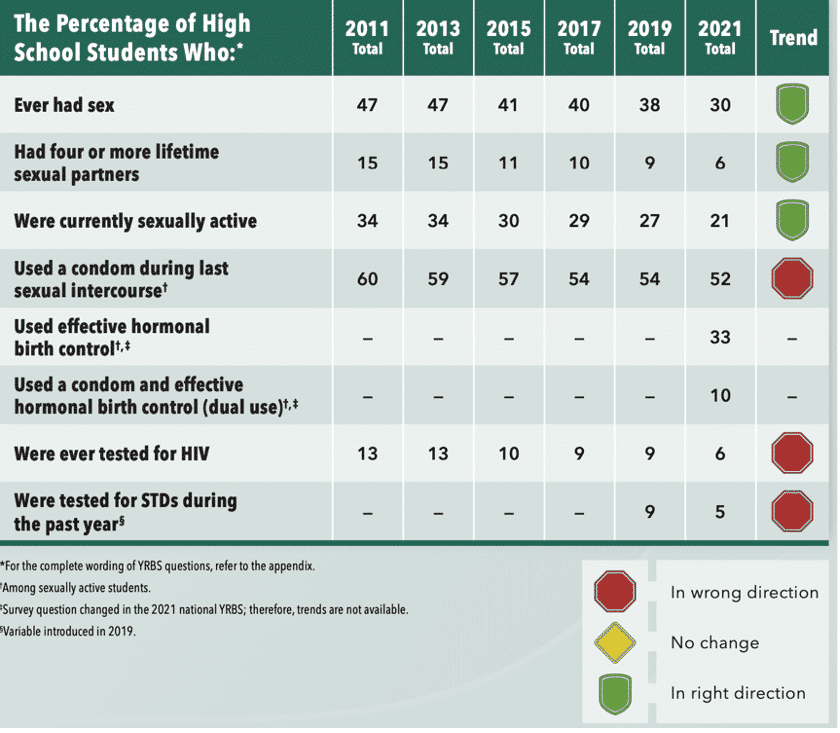
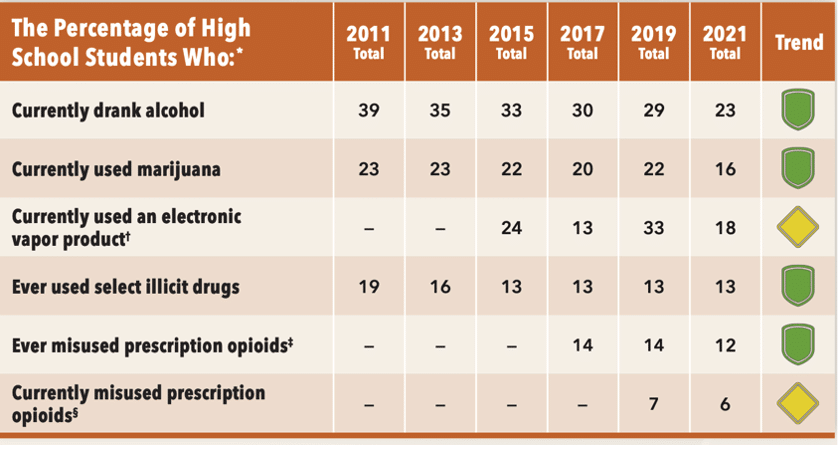
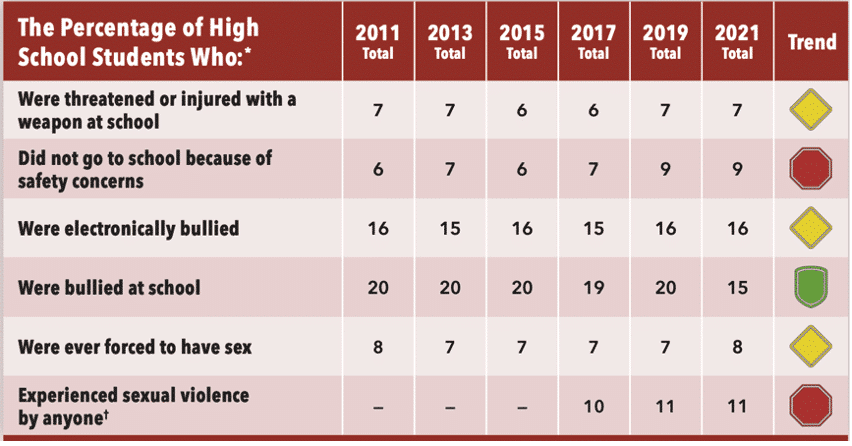
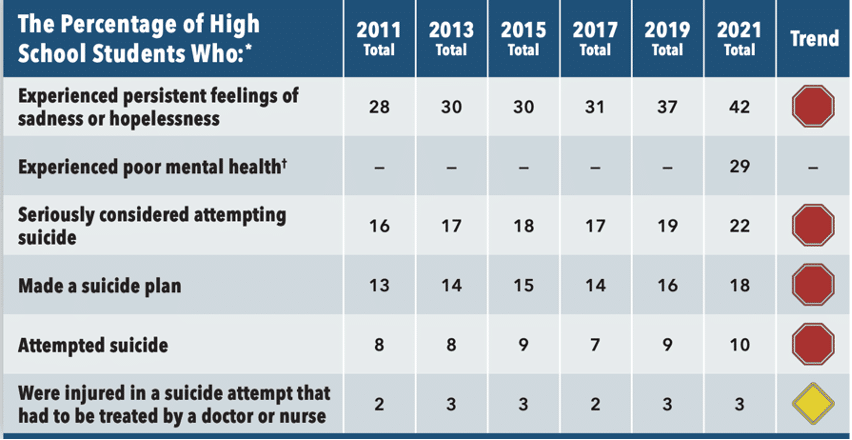
The CDC report data comes from 17,000 U.S. high school students who were surveyed in the fall of 2021 when most schools returned to in-person teaching. The good news is that overall sexual activity, substance abuse, and in-school bullying are down. The bad news is that teen safety concerns due to violence, sadness, hopelessness, and suicidality are up, especially among girls and LGBQ+ students (trans students were not identified for this survey).
Here is the Summary of Findings from The Youth Risk Behavior Survey Data Summary & Trends Report: 2011–2021
Sexual Behavior
Substance Abuse
Experiencing Violence
Mental Health and Suicidality
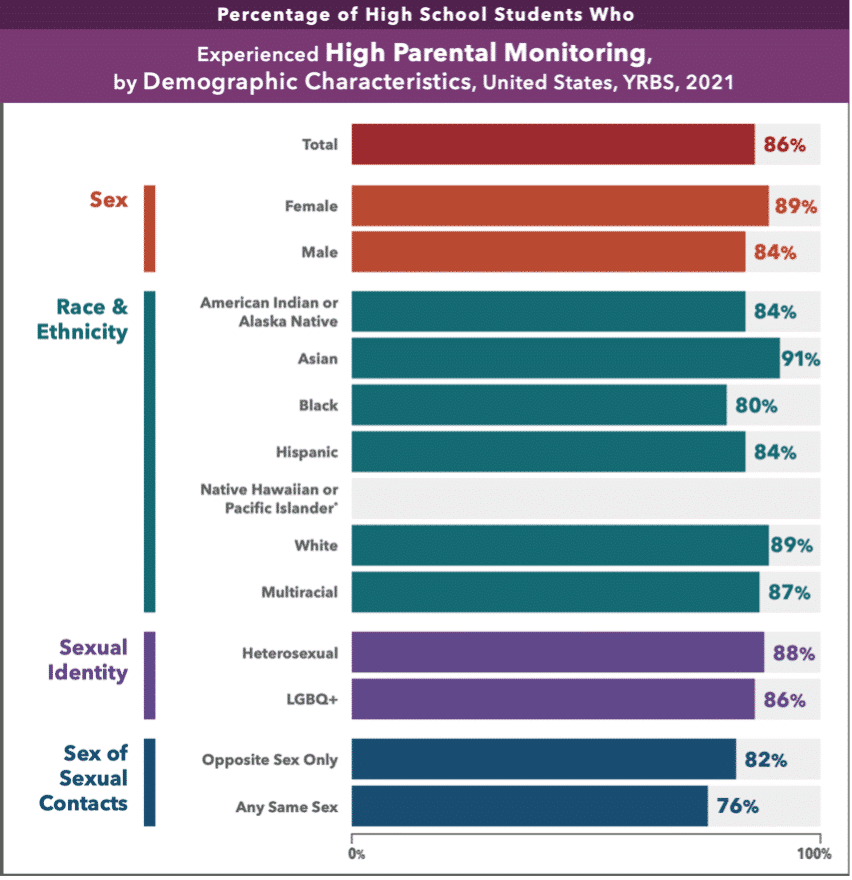
Parental Monitoring
Teen Girls
The survey suggests that nearly 3 in 5 (57%) U.S. teen girls felt so sad or hopeless that they couldn’t engage in regular activities for two weeks or more. Nearly 1 in 3 (30%) seriously considered attempting suicide—up nearly 60% from a decade ago. And 1 in 5 (18%) experienced sexual violence in the past year—up 20% since 2017.
LGBQ+ Youth
Almost 70% of LGBQ+ students said they felt persistently sad or hopeless, and 20% reported attempting suicide. Fifty-two percent of LGBQ+ teens had poor mental health symptoms in the past 30 days compared to 29% of all teens.
Possible Contributors?
It’s important to consider that the survey occurred at the end of the isolation from COVID-19. Although I am still
seeing significant fallout among kids, tweens, and teens, they have recovered somewhat from that dark and frightening time.
We must also consider that this is a survey. Without experiments where we expose one group of teens to possible causal variables (e.g., social media or isolation) and don’t expose a control group, we can’t determine what is causing the distress.
Surveys simply state and analyze subject report. It’s impossible to tell the causes from this type of data. We are left to guess with our observations and experience, forming hypotheses and looking for evidence to support them. As the Founder of GetKidsInternetSafe, a mother, university faculty member, author, and clinician who has treated kids, teens, and families for over 25 years, I have some ideas.
PHONELY: Our kids are phonely. Because we were hunters and gatherers for 90% of human existence, our brains are wired to thrive with face-to-face tribalism. Online relationships just don’t do it for us long-term.
ISOLATION: With the isolation of COVID-19, kids lost friends and confidence and regressed in their social skills.
SOCIAL MEDIA: Social media and the internet offers a constant onslaught of online ads and marketing influencers for kids and teens. This unfiltered exposure can lead to chronic fears of being judged and ridiculed as well as feelings of inadequacy and exclusion. The CDC report demonstrates that there is an epidemic of online bullying and cybersexual violence, especially toward girls and LGBTQ youth.
PARENTING: Parenting strategies have become overly protective based on anxiety and fear resulting in less child independence and more fear of failure. Plus, they spend more time online than with us. It is difficult for parents to overcome the influence of strangers and taking away all screen activities has become nearly impossible.
NEWS: Sensational and divisive news expertly and manipulatively communicates fear-inducing trends like mass shootings, climate change, and inflation. This has got most of us rattled, especially the most vulnerable among us.
FINGER-POINTING: We have tolerated and participated in an ugly, divisive climate of entitlement, bullying, and blame rather than accountability and positive action.
GROUP-THINK: The internet speaks the language of mental health – but this may result in a group-think phenomenon of looping on mental health suffering instead of increasing agency and growth.
LACK OF APPLICABLE EDUCATION: Trauma-informed, evidence-based health and sex education isn’t being offered equitably among out schools. Parents don’t want to leave this important job to schools, but they’re also not doing a great job themselves in many instances.
NOT ENOUGH MENTAL HEALTH SERVICES: There aren’t enough mental health services available to our youth.
LACK OF FAITH AND COMMUNITY: Pulling together as a loving, cooperative team is critical for kids to feel a sense of belonging and community. As our families get smaller and we have fewer extended family to offer support, our kids are left to fend for themselves.
Of course, this is not an exhaustive list. But it does summarize much of the research findings and conjecture that has surrounded these issues. There are more ideas for the list. But for the purpose of solving the problem, how can we take these stressors into consideration as we discuss possible solutions?
Considering the complexity of the question, what can we do to improve the situation? Reverse Engineer!
Reverse engineering refers to the process of looking at possible outcomes (like the causes posited above) and slowly working backward for a solution. Although this is clearly a messy mission, I watch kids regain the mental health ground they lost every day in practice. Despite what some may think, effective psychotherapy isn’t simply listening and reflecting feelings of despair. As a cognitive-behavioral therapist, I employ techniques specifically designed to facilitate positive movement forward. I’ve found that, if I set the tone and get everybody started, parents can take it from there.
Here are some tips for improving mental health and well-being at home:
As a family, negotiate a set of measurable goals and revisit them often for direction and motivation. Praise and reward movement forward and maintain and warm and encouraging tone along the way.
Use storytelling and a sense of humor to normalize failure and encourage curiosity and confidence.
Turn off the news and divisive influencers who are selling toxic ideas and products.
Reassure kids that they are capable and loved and that grit is what matters the most, far more than being attractive or innate skills.
Encourage kids to detox off their phones occasionally and engage more in real-life exploration and socialization.
Stay moderate. Avoid shaming lectures and demoralizing consequences.
Offer mindfulness, problem-solving, and communication strategies to help kids gain independence and confidence.
Offer outcome- and science-based education that empowers informed action rather than create fear.
Support parents in not personalizing child behaviors and help them set fair and reasonable limits with warmth, encouragement, and love.
Lead our kids toward post-traumatic growth rather than feelings of helplessness, hopelessness, and fear with expert mentorship, fun, and opportunity.
How can GetKidsInternetSafe help?
I founded GetKidsInternetSafe so I could be part of the prevention effort – rather than just the treatment effort. If you’re not sure where to get started, we have a comprehensive suite of tools for parents, tweens and teens, educators, paraprofessionals, and professionals who work with families and kids.
Dr. Bennett’s book, Screen Time in the Mean Time, is a comprehensive and easy-to-read parenting guide for families with kids of all ages. Available on Amazon in print, e-book, and audible!
Tighten up parental controls and monitoring with the help of our GKIS Screen Safety Toolkit. This toolkit helps to empower parents and provides them with a resource list of smart tech tools to filter, monitor, and manage online behavior.
For families with younger kids, our home setup Connected Family Course is an awesome place to start.
To help your tween or teen get prepared for safer internet use and social media, help prevent digital injury, and optimize wellness, check out our most popular course, the Social Media Readiness Course.
Want to work for screen safety as a community? We’ve thought of that too! Dr. Bennett offers live presentations and webinars for adults and kids from schools, churches, corporations, and conferences.
If you want all of our supplements and courses at a low cost for parents and kids, tweens, and teens, you’ll want our mega Screen Safety Essentials Course! This online course offers a set of four modules that will help you walk your kids through the essentials of screen safety.
I’m the mom psychologist who will help you GetKidsInternetSafe.

 How We Got Close