True crime is a popular trend that plays off our fascination with the morbid. As popular streaming services produce documentaries and dramatizations to meet the demand for true crime content, these crimes become less of a horrific event and more of a meme or something to live tweet. These exposés also tend to be led by actors who are well known for their looks, like Evan Peters, Zac Efron, and Ross Lynch, adding more to the romanticization of serial killers like Jeffrey Dahmer and Ted Bundy. Today’s article covers why this romanticization is dangerous and how you can keep your child safe from digital injury with our GKIS Screen Safety Toolkit.
Why has true crime skyrocketed in popularity?
Netflix’s recent limited-run Dahmer series has been viewed by 56 million households for a total of 701.37 million hours, putting it as their second most-viewed English Netflix series of all time.[1] In fact, true crime documentaries have covered the Netflix top 10 trending list for a combined total of 232 days, meaning that if your child is logging into Netflix, chances are they will be suggested one of these exposés.[2] There is no denying that true crime is hot content, and it does not seem to be declining in popularity anytime soon. This begs the question of why our society and humans, in general, are so obsessed with the morbid acts of our fellow human beings.
Evolutionary scientists have attributed this obsession to the fact that murder, rape, and theft have been part of our society for as long as humanity has existed. We are fascinated with learning about the facts of true crime as a form of human preservation and how we can protect ourselves and our families from the same fate.[3]
Psychologists agree and add that we also feel a sort of elation at these stories, glad that we are not the victims of such a crime. They also believe that we feel elated that we are not the perpetrator of the crime either.[4] This suggests on some level that we can relate to the perpetrator, a feeling that adds to the romanticization of criminals.
Psychology and Social Effects of Romanticizing Criminals
Movie violence as shown in true crime documentaries and dramatizations has been shown to have real lasting effects on viewers, including overall desensitization to real-life violence. A study found that youth with medium levels of exposure to TV/movie violence had much lower blood pressure when viewing violent media compared to those with low exposure.[5] These results show that sustained exposure to violent media leads to emotional numbing when presented with violence.
Following the release of the 2019 film Extremely Wicked, Shockingly Evil and Vile, in which Ted Bundy is played by Zac Efron, a concerning TikTok trend began of young girls dressing up as Bundy’s victims using makeup to create blood, bruising, and bite marks on their skin.[6]
These exposés create an impression on children and teens that they are not real events, but rather just make-believe, a trend, or a meme. The use of conventionally attractive actors to play these criminals leads to the romanticization of their crimes. This delusion creates hardships for the families of these crimes who watch as the atrocities their family faced are reduced to trends and memes online.
Mother of Dahmer victim Tony Hughes, Shirley Hughes, shared that learning about the series and its content brought her to tears. She told The Guardian, “I shed tears. They’re not tears of sorrow, and it’s not disbelief in the Lord. The tears [are] tears of hurt because it hurts. It hurts real bad.”[7] Not only do these exposés hurt our children, but they hurt the families of these violent crimes and cause them to relieve their trauma publicly over and over.
What Parents Can Do
If your child is interested in true crime, it is important to express to them that is okay and understandable. Notable psychologists believe that interest in crime is healthy and something that is natural, so long as that interest is confined to health habits.[8] Express to your child that these true crime stories are more than just a “limited-run show” but something that has real-life effects on people. Perhaps even share with them the thoughts and feelings of the families of these crimes as an empathy-building exercise.
Another important action you can take is to look at parental guides online for the media your child is consuming so that you can understand exactly what is in it. Also, sit and watch the show together so that you can fast forward through anything inappropriate and have a conversation about it.
To help guide you in these healthy conversations, check out our GKIS Connected Families Screen Agreement to work with your child to create a collaborative, living document.
If you fear your child may be watching these true crime exposés without your knowledge and permission, check out our GKIS Screen Safety Toolkit. This toolkit helps to empower parents and provides them with smart tech tools to filter, monitor, and manage online behavior.
Thanks to CSUCI intern, Katherine Carroll for researching true crime exposés and the romanticization of serial killers. To learn more about true crime and its consequences check out our article, “Is Your Child Following True Crime?”.
I’m the mom psychologist who will help you GetKidsInternetSafe.
I wrote this article for my awesome GKIS Social Media Readiness Course for tweens and teens. I have to admit, I have never worked so hard on an article. Explaining complex psychological principles that big tech bakes into video games in easy-to-understand language for teens is difficult. But this information needs to be understood by everyone who uses screen technology – like a how-to manual.
Why This is Important
Too many of us are addicted to our screens, and it’s not an accident. Programmers intentionally bake hidden brain traps into our devices and onscreen activities to capture our attention. Technology has moved us into a new wildly profitable market where our attention is the commodity. The more attention they can get us to surrender, away from healthy offscreen activities like hanging out in real life, sleeping, being in nature, and anything else that offers us three-dimensional brain enrichment, the more money they make.
Big tech has cracked the code on brain reward. With psychology research and protective laws lagging behind rapidly developing technology, it’s up to us to understand what we’re up against. Learning how to recognize manipulatively designed brain traps can break the spell, interrupting our screen dependence and our spending.
I’ve tested it on gamers in my practice. By teaching them how special features trigger our feel-good chemical (dopamine) in the pleasure center of the brain, gamers can be taught to recognize it as it’s happening. With this new awareness, many of them popped out of autopilot responses and found the games less enticing.
How To Teach Your Kids
If you teach your kids about the hidden brain traps of video games, maybe they too will change their addictive online habits! For younger kids, just cover a few items at a time. Older players may be willing to cover all of these hacks at once. Make the discussion interesting and fun. If your child is getting bored with these fun facts, take a break and return to the discussion later.
Don’t forget to ask them what they think along the way and be willing to listen and learn as well as teach. You’ll find that these ideas pop up again over and over if you keep the cooperative dialogue going.
The application of this learning has endless benefits. Get familiar with the ideas on your own first, then teach these concepts along with your free GKIS Connected Family Agreement. Congrats on being the parent who goes the extra mile for the health and happiness of your family.
What We’re Up Against
There are lots of screen activities that can addict users, but video games are among the strongest. They’re so fun and compelling that some gamers lose control and can’t pull away. Gambling and gaming are the only addictive behaviors officially recognized by the World Health Organization and the mental health community.
Behind gaming is a huge profit. In 2019, 2.5 billion gamers contributed to a gaming market that made 152 billion dollars![1] The most successful game in video game history is Fortnite. First released in July 2017, gamers can download it for free on nearly every gaming platform. In just two months of being on the market, Fortnite was played 2.7 billion hours, the equivalent of 300,000 years.[2] Currently, it boasts 78.3 million players a month.[3]
Under Fortnight’s spell of perfectly programmed brain traps, I’ve had clients drop out of school and isolate themselves from friends and family to play 12+ hours a day. The most addicted can barely sleep, fail school, and become socially isolated and burned out. Some are admitted to pricey screen addiction rehab programs that are often outside of their home states and away from their families!
What makes video games like Fortnite so addictive?
Each brain is unique with over 100 trillion synapses(the spaces between our brain cells where cell communication takes place). Not only does our DNA impact our brain wiring, but so does experience. That makes learning a nature-via-nurture phenomenon. In other words, we seek out certain experiences because of our brain wiring, and our brain wiring changes in response to our experiences.
No two people experience video games alike. Some people may be barely amused by the most addictive video game on the market, while others will forgo eating and sleeping to rack up points.
On the other hand, we are all human. We come from a common ancestry that developed with similar evolutionary triggers in play. As a species, we’ve been hunting and gathering for 200,000 years; that’s 90% of human existence.[4] Atari first introduced Pong in 1971. That means video games have only weighed in for the last .024% of our evolution. Find the triggers that captured the attention of our Neanderthal ancestors, and you’ll find triggers that capture us today. Technology has evolved much faster than our human brains. We simply can’t keep up.
Rewards and Punishments Are Folded into Gameplay
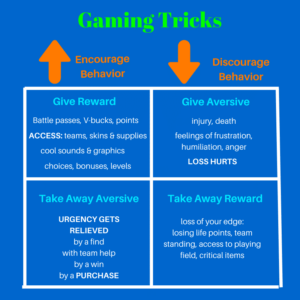
One of the first things college professors teach is the processes behind how we learn. Operant conditioning is a psychological learning method that involves rewards (pleasant) and aversives (unpleasant).
When a behavior increases, it has been reinforced. When a behavior decreases, it has been punished. Programmers use reinforcers and punishers to manipulate player behavior.
Rewards
The most obvious reinforcers in video games include points, prizes, and social likes that are delivered with attaboys in the form of yummy sights and sounds. Cool graphics, pleasing colors, attractive shapes, and amazing sounds stimulate the pleasure centers of our brains. When I asked my son what sounds he finds most appealing, he said the “kill” sounds are particularly attractive in Fortnite, especially the higher-pitched headshot sound and the sound of ammo reloading. My army of client gamers enthusiastically agreed.
Punishments
If we are doing badly in a game, it makes us anxious. Not only are we disappointing ourselves, but others may see we are failing too. Of course, game creators don’t let us feel crappy for long. They offer up relief from that unpleasant stress at mixed intervals (just like slot machines do), and we get double hooked!
Brilliant game builders exploit all four of the operant conditioning boxes on the blue image. Game features that interact with our primitive brains are so sophisticated and so well executed that we don’t even know it’s happening to us.
Remember nature via nurture? Our brain wiring sets us to seek gaming rewards and gaming rewards change our brains. Psychology research has demonstrated that addictive gameplay specifically permanently changes our brain’s interpretation of rewards and losses.[5] The addict’s rewired pleasure center makes recovery very challenging.
Learn these game traps that hack our pleasure centers, and you may be better equipped to make choices about gameplay instead of blindly getting tricked into them.
Expert Video Game Traps Designed to Snare Your Attention & Emotions
Finding Your Tribe & Being a Leader
One of the cornerstones of our survival as humans is our ability to form tribes and have babies. Through attachment and cooperative communication, humans dominate over other Earthly species.
Gaming programmers know what makes us tick. They build games by testing them on themselves and millions of teen players they pay to play for study. By isolating and testing addictive game features, programmers combine the motherload of behavioral reinforcers.
Social feedback is one of those ultimate rewards. The likes and verbal and written comments from other players are like crack cocaine to the human brain. This is why the most popular games allow you to make new friends and invite others. The more influence we have, the more social capital we’ve earned.
Social capital, the good feelings we collect from our interactions with friends, is particularly valuable to teens. It’s during this phase of development that one prepares to leave their family and hone in on attracting your tribe. By finding friends, testing skills, and “versing” each other, kids thrive on the team aspects of play.
But what if you are too shy to fail in front of your friends? No worries, the gaming engineers thought of that too. They allow you to start by playing anonymously or playing against yourself or strangers. That way you slowly gain confidence until you’re ready to show off your new skills with your team.
The emotional stimulation of wins and losses with your friends is extraordinarily captivating. As a young player told me, “Dying sucks and the team gets mad at you because they die too. If your friends are beating you, it makes you mad. So, you work to get more dubs (w for wins) to get bragging rights.”
Standing Out in the Crowd
But what if you become like everybody else in the game? You won’t stand out at all. That’s not fun.
Voila! Game makers thought of that too. They help you stand out with badges, points, and skins that discriminate who’s a newbie and who’s a pro. Sexy curves and muscled skins are valuable game commodities. By crafting the perfect look, players can attract other teammates. How you look, the levels you’ve achieved, and your arsenal of skills and weapons offer the optimal distinctiveness you need to stand out in a crowd. In Fortnite, you can even earn the opportunity to be paired with other high-ranking and even celebrity players.
Brain Candy Learning & Expert Mentorship
Humans love to set, pursue, and reach goals. Learning through trial and error and tracking progress is deeply satisfying to our most primitive selves. We especially love to learn from people we look up to and want to be someday, like celebrities and influencers. Celebrity endorsement as a branding (selling) strategy is illustrated by the popularity of Let’s Play videos (videos of other gamers playing and commenting on gameplay) on streaming sites like Youtube, Twitch, and Mixer.
You don’t want to put in the hours it takes to learn everything? No worries, game creators will let you pay your way to the top by buying up for levels. Even players who haven’t reached celebrity status can make money from expert play. I’ve had clients play an account until they’ve leveled up, then sell these accounts for thousands of dollars to buyers who want expert-level access to features without having to put in the time commitment.
Backchannel deals can also lead to big-earning e-sport tournament play. Some players even win college scholarships in tournaments that boast prize pools as big as 34 million dollars![6]
Hunting & Gathering > Building & Defending Community
Just as our ancestors did, our brains delight in building and defending the community. Being a good seeker, builder, and warrior gave us an evolutionary advantage.
Fortnite taps into these traits by having players forage for and gather useful, rare, and collectible items randomly placed around the map. Excited anticipation paired with finding items triggers our hunting and gathering instincts.
Fortnite also offers community competition and violence to scratch that primitive itch. Although parents are pleased there aren’t blood spatter and guts in Fortnite, developers know that tapping into our human need to protect and survive through violent in-group, out-group protectionism is a sure win.
How They Make Losing Fun
Getting a victory royale in Fortnite is difficult. Players must have the skill and luck to defeat other competitors in battle. Most gamers play multiple, consecutive rounds without getting a victory royale because, in their minds, they are not failing, they are “almost succeeding.”
In psychology, this is known as the near-miss effect. A gambler experiences a near-miss when almost winning a hand in poker. They take it as a sign to continue playing. During a near-miss, the brain’s reward system activates the same way it would during a win.[7] Earlier generation Candy Crush game developers learned that the near-miss effect kept players hooked for hours and willing to spend, and Fortnite adopted this strategy.
Attracting New Players & Keeping Old Players Playing
To stay successful, games need to bring in new players while keeping the attention of seasoned players (must cater to different player populations). Building anticipation for something new and exciting with a free gift is a sure way to hook and keep customers.
Upon signing up for Fortnite (which is free and convenient), players are offered a starter bundle. Once you get tired of that, more anticipation is generated with the promise of another free gift with repeated seasonal battle passes which contain prizes like free skins, a pickaxe, a glider, a rare item, and some XP multiplier to level up in the game. Each season offers a new map and fresh features to avoid burnout.
To reinforce habit and daily use, Fortnite even offers a fee asking for unlocking a majority of weekly challenges (55 of the 70) and cash if you log in on consecutive days! With immediate and long-term rewards, the game traps the immediate-reward players and the work-for-it-reward players.
Making Money From the Game & Within the Game
In 2018, Fortnite made 2.4 billion dollars in revenue.[8] Most of this revenue came from players purchasing skins and emotes. As of January 2020, Fortnite was in its first season of Chapter 2. Chapter 1 had ten seasons.
With each season comes the release of new skins and emotes, as well as the removal of ones from past seasons. Removing products from the marketing creates an impression of scarcity – meaning if you don’t buy now you’ll lose out. This makes collecting and purchasing skins and emotes a high priority to players, as it signifies status within the gaming community. The more fancy tools we collect in our cave, the more leadership we build within our community.
Triggering a sense of urgency in players is highly motivating, anxiety-producing, and builds intensity. Finding that sweet spot of flow between boredom and anxiety is the quest of every gamer. Once again, Fortnite doesn’t disappoint. The sense of urgency while searching and release upon finding creates a feedback loop of needing more, more, more! Being online puts us in a perpetual state of want.
Anxiety When We Leave the Game and Intense Craving to Get Back to Playing
Intensely craving game rewards feels pretty exciting in the short term, but in the long term, it can be stressful and take a toll on our mental health. That is why so many young gamers throw tantrums when they have to get off the game and older gamers feel irritated, frustrated, and depressed. Needing more skills to keep earning points builds what we call tolerance in addiction medicine, and the terrible feeling when we get off is called withdrawal. Just like drugs of addiction, tolerance keeps us using more and more and withdrawal makes us crave more gaming.
It’s Contagious!
Speaking of craving and withdrawal, Fortnite knows that watching friends have fun triggers FOMO (fear of missing out). By jacking up player anticipation with live online events, Fortnite gets players advertising to their friends for free.
To attract big numbers, Fortnite offers exclusive information and items. In other words, gamers must attend to get a chance to see what’s coming and get access to cool stuff. Players prioritize these events to get a leg up on team members.
Earning Your Trust & Upping the Ante
Since we covered the standards in marketing in business like scarcity and urgency, you might as well learn about the upsell. Marketers know that we buy out of habit. If they can get us to use our credit card once, we will be far more willing to use it a second and third time.
To get us into this buying habit, games offer an in-game purchase for cheap. Once we buy that, they then approach us with the pricier items. Since we trust them after liking the first item, we are more likely to purchase from them again.
An example of an upsell in Fortnite is the offer for a common emote or skin costs only $8. Once you buy that, Fortnite entices you with a more expensive and rare emote or skin for a higher $20 price. Fortnite in-game purchases can be very expensive. A father from England found out when his son spent $918 on the game in three days![9] Fortnite is a virtual marketplace that is very enticing to immature brains.
If You Like Them, You’ll Also Like Us!
Fun products that tie into popular brands, like The Avengers, are often integrated with video games. This is called affiliative marketing (meaning if you affiliate with or like another brand, they can entice that brand’s users over to them). By paying an already-popular brand to partner, both brands benefit by sharing each other’s user base. Celebrity skins, affiliation, and team competitions sweeten the offer even more.
Issues Specific to Neurodivergent Players
Neurodivergence simply means players who think differently than the average player. Most commonly, it refers to people who have traits of autistic spectrum disorder (ASD) or attention-deficit hyperactivity disorder (AD/HD). All players have gameplay strengths and weaknesses. But for neurodivergent players, these strengths and weaknesses can be more extreme.
For instance, many neurodivergent players have a tough time making and keeping friends in real life. For them, the opportunity for online mastery and social capital is particularly valuable. And the cool thing is, some strengths typical of neurodivergent players, like pattern recognition, make them awesome gamers. One of my ASD clients describes loving the problem-solving elements of gaming and the thrill of earning accolades from her teammates for her exceptional Jedi skills.
Should we just forbid video games?
Going screen-free is not an option for most because of the extraordinary learning, communication, and socialization benefits that screens bring. Also, the genie is out of the bottle already. If everybody else is doing it, it may be a real loss to your child to not have access to their friends.
Fortnite, which some say is on its way out, is not the only culprit. As long as the video game market continues to pull in a huge profit, developers will continue to build games with increasingly sophisticated brain traps.
By reviewing this article with your gamer tonight, covering the points where you agree or disagree, and asking them for their thoughts and observations, you will empower your child through the parent-child connection. Protecting your kids is less about depriving them of screen time, and more about giving them the tools they need to have informed agency. By equipping our children to be smart problem solvers on- and offline with loving support, we open the bridge to really connect as a family. It’s the connection that our children are looking for, and we are a part of that.
The Next Step
Although this article offers a ton of free information, there’s so much more to learn for long-term mental health and brain enrichment. Also, you want your kids to become increasingly more independent and start to solve problems on their own when you aren’t there for help. For even better coping and psychological resilience, you don’t want to miss our GKIS Social Media Readiness Course. Complete with lessons about digital injury risks and psychological wellness tools and individual lesson mastery quizzes, it’s the perfect prep!
I’m the mom psychologist who will help you GetKidsInternetSafe.
[5] Dong, G. Hu, Y., & Lin, X. (2013). Reward/punishment sensitivities among internet addicts: Implications for their addictive behaviors. Progress in Neuro-Psychopharmacology & Biological Psychiatry, 46, 139–145.
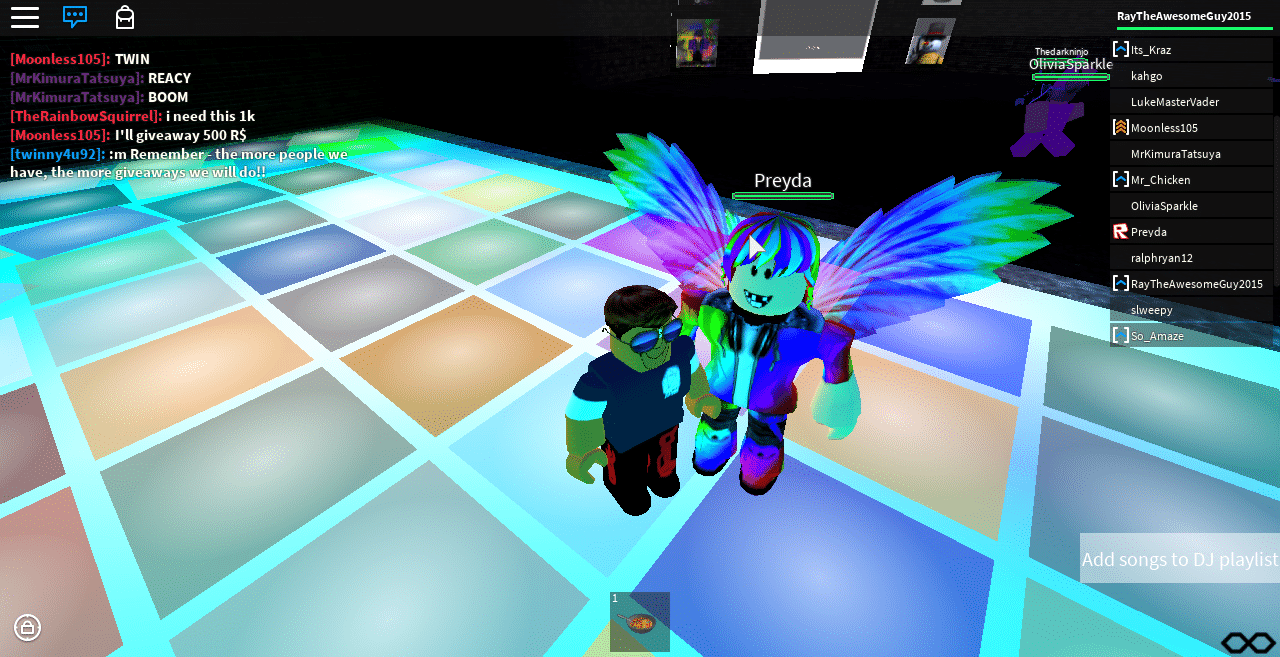
Roblox is a multiplayer entertainment platform where users can create their own 3D environments and game modes. There are literally millions of games on Roblox. Players are able to explore different worlds and interact with other players. The possibilities on Roblox are only limited by the player’s imagination, but this can also leave room for questionable activity. Roblox shares many similarities with other videogames in the same category, namely Minecraft, but there are some very distinct differences. This GKIS Sensible guide will provide you with the information you need to decide if Roblox is right for your child.
How long has Roblox been around and how popular is it?
Roblox was developed by David Baszucki and Erick Cassel and was released in 2006.[1] Through the years the popularity of Roblox has steadily been increasing. It currently boasts more than 100 million monthly players![2] There are no signs of Roblox losing popularity anytime soon.
Getting Started on Roblox
Roblox is free to download on PC, Mobile Phones, and Xbox One
Requires age of 13 or adult to help child sign up
Parental controls may be set to restrict the ways a child may play
You may purchase in-game currency with real-world currency to buy in-game clothing and hairstyles for your avatar.
Features of Roblox
Roblox is always an online multiplayer game with many different game modes, most of which are created by players. The game modes on Roblox are nearly endless, so we will elaborate on some of the most popular.
Meep City
Players are given an empty house and they choose how they want to furnish it.
Players can work to earn in-game currency in order to choose how to furnish the house.
Other players can visit your house and see how you decorated it.
Murder Mystery
You’re put in a game with up to 10 different players.
One person is given the role of the murderer and is given a knife.
One person is given the role of the sheriff and is given a gun.
The sheriff must find out who the murderer is before he murders all of the other players.
Work at a Pizza Place
Players work at a pizza place.
Pizza orders come into the pizza place and the player must fulfill the order.
Once the player has fulfilled enough orders and accumulated enough money.
The player may choose to expand their pizza business and hire non-player employees to fulfill orders.
Jailbreak
You’re put into a prison with other players.
You must work together with other players to break out of prison.
The players must escape the other players who are police officers that have to chase them around the prison.
After escaping the prison, players can enter a city and continue to hide from the police officers.
Obby
Player created platformer style map.
Players must avoid obstacles and jump from one platform to another.
The objective is to reach the end of the map without dying.
After reaching the end, the player is awarded different types of items that can be utilized in that specific obby.
The Benefits of Roblox
Communication Skills
Children can build communication skills, as they are required to interact and collaborate with their fellow players.
Creativity
Players are also encouraged to showcase their creativity by putting together custom maps.
Financial Responsibility
Children may also learn a bit about financial responsibility as they must manage their in-game currency to buy items.
Parental Control
Parents have the ability to moderate how much their child plays. With the parental controls, parents can limit who can message the child, who can chat with them in the app, and who can chat with them in the games. Click Settings > Privacy to adjust parental controls. There is no voice chat, and text chat is set up so inappropriate language is not allowed.
The Risks of Roblox
Distraction
Roblox has relatively few risks involved with it. One of the main risks of Roblox is that children may choose to play it for extended periods of time.
Violence
Roblox also has some instances of violence within it such as
Shooting a player with a gun
Stabbing a player with a knife
Stranger Danger
Another noteworthy risk of Roblox is the risk of interacting with malicious strangers in-game.
Cyberbullying
Some players may choose to cyberbully others through the in-game text chat. Some of the players may be much older in real life, and it is important that children do not share personal information in-game. For further information, please take a look at the GKIS article about The Dangers of Online Multiplayer Video Games.
Roblox Safety Ideas
Stay nearby for supervision.
Play Roblox with your child.
Read and discuss Roblox’s Community Rules.
Use parental controls.
Teach your child about blocking and reporting features.
Track child playing time.
GetKidsInternetSafe rates Roblox as a yellow-light app, because while it is an amazing creative outlet for kids, the online interactions they have with strangers should be closely monitored. Team games like Roblox can be really fun, but they have their risks. If you think your tween or teen is ready to play Roblox or if they are on it and you want to optimize safety and good judgment, YOU WILL LOVE OUR GKIS Social Media Readiness Training Course. It covers social media and gaming risks to digital injury and teaches tweens and teens the psychological wellness tools they need to thrive!
Thanks to CSUCI intern, Jess Sherchan for researching robots/blocks and co-authoring this article. If you would like to learn about other games that promote creativity in kids please check out the GKIS article on The Sims!
I’m the mom psychologist who will help you GetKidsInternetSafe.
[1] Dredge, Stuart (2019) All you need to know about Roblox https://www.theguardian.com/games/2019/sep/28/roblox-guide-children-gaming-platform-developer-minecraft-fortnite
[2] Alexander, Julia (2019) Roblox surpasses Minecraft with 100 million monthly players https://www.theverge.com/2019/8/2/20752225/roblox-100-million-users-minecraft-youtube-twitch-pewdiepie-keemstar
Kids love Twitch! Twitch is a streaming service where expert players play video games while their subscribers watch. It’s a mystery to most adults how this could be entertaining. But with 15 million viewers per day and a $970 million sell price, it has clearly plugged into what kids want. In this GKIS Sensible Guide, we cover what you’ll want to know before letting your kids opt-in.
How long has Twitch been around, and how popular is it?
Twitch was released in mid-2011 as a branch of another streaming service, Justin.tv. Twitch was intended to be the more video game focused platform. Soon Twitch’s popularity surpassed Justin.tv, and it was bought by Amazon for a staggering $970 million.[1] Today, Twitch has around 15 million viewers per day and hosts around 2.2 million streamers.
Getting Started on Twitch
In order to create an account on Twitch, you must be 13 years of age or older. As Dr. Bennett describes in her book, Screen Time in the Mean Time, this age isn’t based on child psychology, but rather the COPPA law which protects kids from having their personal information solicited for marketing reasons. Parents are the best authority to determine the best age of adoption. To sign up, you must also provide an e-mail address, a username, and a password. Once you’ve created your account, you may begin personalizing your profile. It should be noted that there is no way to make your Twitch profile private, so anyone can access it at any time.
Once your profile has been set up, you can decide which of the two roles you want to take in Twitch:
Streamer: You stream the game you are playing so others may join and watch you play.
Viewer: You sit back and watch someone play a game. You can choose to interact with the streamer or other viewers via the text chat. It should be noted that you can view streams without having a Twitch account, but when you do this you may not participate in the text chat. You may also donate money to streamers.
Benefits of Twitch
As a streamer:
It’s a perfect platform to showcase one’s creativity.
You can interact with others who share the same interests.
Being a streamer can become extremely lucrative. For many it becomes a full-time job.
Many times, streamers will land sponsorships from companies and sent free items to utilize in their streams.
As a viewer:
Interacting with streamers and other viewers who have similar interests
Learning new strategies and tips from streamers who are skilled at certain games
Winning in streamer-hosted giveaways
What are the risks of use?
As a streamer:
Doxing: One of the main risks that plague Twitch streamers. This is when individuals find out personal information about a streamer and disseminate it online. Information such as real name, phone number, address, and more may be revealed and used maliciously.
Swatting: This is when a viewer finds out a streamer’s home address and calls the police with a false emergency. If it plays out the way the person who initiated the swatting intends, the police will raid the streamer’s house, visible to viewers through their computer cam. Obviously, this can be very dangerous to the streamer and the law enforcement professionals involved.
Harassment: Many times, streamers will be harassed by their own viewers via the streams text chat. This can be alleviated slightly by having a moderator in the chat who can ban offenders.
As a viewer:
Violence is prominent in many of the games that are streamed on Twitch. This may not be suitable for younger children.
Profanity is frequently used by streamers and also present in most of the text chats.
Harassment and cyberbullying may also occur from other viewers in the text chat.
Distraction is also extremely common among young viewers. They may become so engrossed in the stream that they end up spending more time than they should. This may lead to the neglecting of other responsibilities.
GetKidsInternetSafe rates Twitch as a yellow-light app, due to the possibility of harassment and the ease of communication with strangers. It is recommended that you watch the streams from the content creator before allowing your child to tune into streams. Our How to Spot Marketing Supplement to our free Connected Family Screen Agreement contains valuable information to educate your child to be a smart, informed online consumer.
Thanks to CSUCI intern, Jess Sherchan co-authoring this article. For further information on the possible career opportunities gaming and streaming can provide, please take a look at the GKIS article Is Your Child a “Professional Gamer.”?
I’m the mom psychologist who will help you GetKidsInternetSafe.
[1] Cook, James (2014) The Story of Video Game Streaming Site Twitch https://www.businessinsider.com/the-story-of-video-game-streaming-site-twitch-2014-10
“These games are a waste of time!” Does this parent-rant sound familiar? We are all hooked on our screen activities, but gaming has a particularly addictive quality. We already covered that there are many benefits. One big benefit that we haven’t covered yet is that gaming is a great launch for professional ventures that connect players to other people all over the world. Why is gaming so popular, and what can be accomplished or gained by playing them?
Why Kids Are Hooked
A common belief about video games make us mindless. Many studies have found links to aggression and gamers. However, these studies primarily tested a small subset of games with violent shooters. In contrast, studies from role-playing games have shown benefits for the player.
Specifically, gamers have been shown to demonstrate and build emotional skills like feeling guilt and shame when a character acts immorally.[1] Games also provide a fertile resource for building team play and social skills. For instance, in one study online gamers reported feelings of community and belonging while playing online. They claimed that the social relationships gained while playing provided them with social support and helped them develop a healthy social identity.[2]
Action games, which do include shooters, have also been shown to increase our ability to hold visual information[3], increase the ability to multi-task and manage attention[4], and calm and de-stress.[5]
Games are not simply a means of passing the time. The time spent playing is meaningful. Other exciting benefits include entertainment, identity exploration, and higher-order thinking and problem-solving. Gaming can even launch life-changing educational, entrepreneurial, networking, and earning opportunities!
What game do I want to play?
Each gamer is unique and expresses themselves through the genre or style of gameplay they choose. Each genre requires certain skills and characteristics for the player to succeed. There are five main genres in gaming: Action, Role-Playing, Simulation, Strategy, and Sports.
Action
The player is given challenges that can include climbing obstacles, solving puzzles, defeating enemies, or collecting certain key items.
The player must have fast hand-eye coordination and quick reflexes to succeed.
Popular games include Minecraft, Overwatch, Fortnite, Grand Theft Auto.
Role-Playing
Based on the tabletop game Dungeons and Dragons
The player is tasked with completing missions to progress and strengthen their character(s).
Contains immersive worlds and engaging stories
Popular games include World of Warcraft, Final Fantasy, Pokémon.
Simulation
Utilizes the use of virtual worlds to simulate aspects of reality and fantasy for training purposes
There are no goals the player has to follow.
Popular Games include The Sims, Farming Simulator, Flight Simulator.
Strategy
Gives the player control of multiple characters
Players must use these characters to explore, engage in combat, and gather and utilize economic resources.
To succeed the player must use strategy and great tactics.
Popular Games include StarCraft, Civilization, Age of Empires.
Sports
Allows the player to take control and play as their favorite sports team or player
Some games in the genre try to recreate current sports as realistically as possible, while others create new sports with over-the-top effects and fast gameplay.
Popular Games include Madden, FIFA, Rocket League.
What do I want to do in the game?
Through gaming, children are provided with unique freedoms and communicative abilities. In most games, the first goal is to decide what mission to pursue. Completion of the mission rewards the gamer by furthering the story, giving the gamer new items, or providing the gamer with experience points used to increase the skill of their character.
When deciding how to approach the mission, the gamer is given multiple options. In single-player games, the gamer can choose the look of their character, which missions to pursue, and how they wish to approach each mission. The gamer must decide if they want to take on the mission alone, team up with a friend, or tackle missions online with millions of other players worldwide. Cooperative games offer an intimate, fun experience that can be shared with friends and family on a single TV or in private online sessions. They also have to decide about strategy. For example, they can:
charge straight in taking on all challenges at once,
take a stealthy approach,
scout the area and gather resources along the way, or
create a tactic all their own.
Game Streaming & eSports
Social media sites have become an integral part of a gamer’s identity. They give players the ability to choose their online friends, the style of their home page, and what is posted and commented on their profile. Kids can communicate through private sessions with friends and live streams to a worldwide audience.
Dozens of video streaming sites and their users have taken advantage of this gaming movement. On YouTube and TikTok, popular personalities showcase themselves playing video games to garner more views and make revenue from advertisers.
Twitch TV is a video game streaming site that allow users to live-stream themselves playing games to global online audiences. Streamers are paid through viewer subscriptions, donations, and sponsorships. Sponsorships are given to gamers for unique and appealing personalities and highly acclaimed skills. Many gamers who are sponsored for their skills are also part of a rapidly growing eSports league.
The eSports leagueinvolves teams and tournaments similar to those seen in other professional sports leagues. Funding for tournaments and players comes through sponsorships, endorsements, advertisements, and online donations. Gamers are paid well for winning. For instance, a popular game, Dota 2, had a prize pool of over twenty million in 2016. Each player of the winning team took home $1.8 million.[6]
eSports can also bring fame. The eSports league has become a huge phenomenon spanning the globe, rivaling and even surpassing long-standing professional sports. In 2014, a popular PC game, League of Legends had a tournament that garnered more viewers than game seven of the MLB finals and game seven of the NBA finals combined![7]
Universities have begun to pick up on the eSports trend as well. Robert Morris University recently launched the first sponsored eSports Team. Players of the team are students who receive scholarships for their play just as another student would receive a scholarship to play football or basketball. They train just as another collegiate team would. They are instructed by a coach, study the competition, and practice running drills.[7]
In the past, the word gamer was associated with words like lazy and non-social. Fortunately, these stigmas are changing. Gamers today are seen as entrepreneurial (creating your own business), professional, and globally connected.
Thank you to CSUCI Intern, Dylan Smithson for teaching us about the skill-rich, lucrative world of gaming. If you enjoyed reading this article, feel free to share with friends and family, and give us a like on our GetKidsInternetSafe Facebook page.
I’m the mom psychologist who will help you GetKidsInternetSafe.
[6] Bednarski, S (2016) Top 5 Largest eSports Prize Pools of 2016. http://www.xygaming.com/content/top-5-largest-esports-prize-pools-of-2016/
[3] Blacker, K. J., Curby, K. M., Klobusicky, E., & Chein, J. M. (2014). Effects of action video game training on visual working memory. Journal Of Experimental Psychology: Human Perception And Performance, 40(5), 1992-2004. doi:10.1037/a0037556
[4] Maclin, E. L., Mathewson, K. E., Low, K. A., Boot, W. R., Kramer, A. F., Fabiani, M., & Gratton, G. (2011). Learning to multitask: Effects of video game practice on electrophysiological indices of attention and resource allocation. Psychophysiology, 48(9), 1173-1183. doi:10.1111/j.1469-8986.2011.01189.x
[1] Mahood, C., & Hanus, M. (2017). Role-playing video games and emotion: How transportation into the narrative mediates the relationship between immoral actions and feelings of guilt. Psychology Of Popular Media Culture, 6(1), 61-73. doi:10.1037/ppm0000084
[2] O’Connor, E. L., Longman, H., White, K. M., & Obst, P. L. (2015). Sense of community, social identity and social support among players of massively multiplayer online games (MMOGs): A qualitative analysis. Journal Of Community & Applied Social Psychology, 25(6), 459-473. doi:10.1002/casp.2224
[7] Ravitz, J (2016) Varsity Gamers Making History and Dumbfounding Parents http://www.cnn.com/interactive/2015/07/us/varsity-gamers-american-story/
[5] Reinecke, L. (2009). Games and recovery: The use of video and computer games to recuperate from stress and strain. Journal Of Media Psychology: Theories, Methods, And Applications, 21(3), 126-142. doi:10.1027/1864-1105.21.3.126



 Thanks to CSUCI intern, Katherine Carroll for researching true crime exposés and the romanticization of serial killers. To learn more about true crime and its consequences check out our article, “Is Your Child Following True Crime?”.