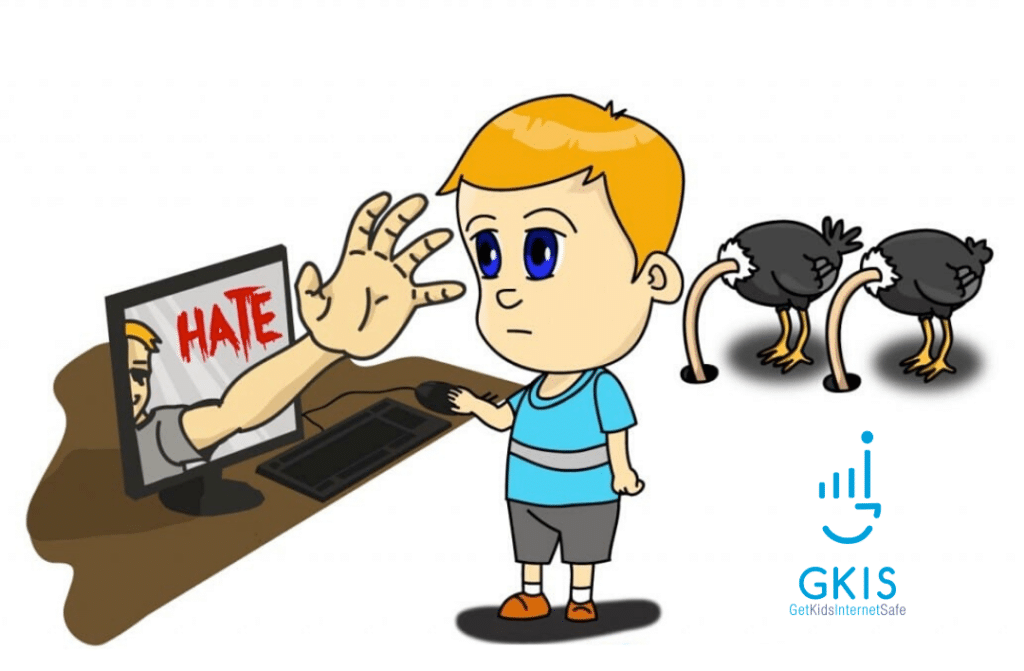
The internet offers virtual neighborhoods to satisfy any interest. For kids and teens, online neighborhoods can be dangerous. The Southern Poverty Law Center estimates that 940 hate groups are operating in the United States. Fueled by the COVID-19 pandemic, immigration fears, an increasingly global economy, troubled race relations, and divisive politics, the number of hate groups in 2021 was more than a 55% increase since 2000. When one considers that the Internet is worldwide, the potential for online hate is staggering. Hate groups and cults have a powerful recruitment tool with the internet. Too many of our mass shooters have been radicalized online, meaning that their opinions have become extreme. Our kids may not only view manipulative recruiting information but they may also be assessed for vulnerabilities. Could your teen be at risk?
Those who commit hate crimes were often radicalized online.
In 2015, 21-year-old Dylann Roof walked into a Charleston church and shot and killed nine innocent people. Like Isla Vista shooter Elliot Rodger, Dylann posted a hateful online manifesto before his rampage detailing his violent and racist beliefs. Along with photos of him standing on and burning an American Flag and aiming his gun, his manifesto titled “an explanation” detailed his “disdain” for blacks, Jews, Hispanics, and patriotism.
“I have no choice. I am not in the position to, alone, go into the ghetto and fight. I chose Charleston because it is the most historic city in my state, and at one time had the highest ratio of blacks to whites in the country. We have no skinheads, no real KKK, no one doing anything but talking on the internet. Well someone has to have the bravery to take it to the real world, and I guess that has to be me.”
His hate crime was not a split-second decision. The shooter had spent months online in white supremacy forums escalating into hate and violence. He didn’t have to look far online for hate.
No longer do hate groups and cults have to rely on interpersonal contact, newsletters, and rallies for recruitment. New members can be recruited and groomed slowly and deceptively from the safety of their bedrooms.
Websites and social media posts are inexpensive and easy to design, offering big reach and control over the content. Internet platforms are the perfect tool for grooming, behavioral manipulation, and coercive thought control. By the time a teen is ready to pack their suitcase to join the group, they may have been expertly brainwashed over months to adopt a radicalized web of beliefs.
The Red Flag Strategies of Hate Groups and Cults
By learning about the strategies hate groups and cults use to attract members, you will be better able to recognize dangerous online sites.
Here are some of the ways bad actors online radicalize their victims.
Attract Your Attention with Sensational Messaging
The bad actor will put up clickbait, which is messaging based on deception and false facts to trigger intrigue, suspicion, and paranoia. An example of a clickbait question is, “Did you know that Martin Luther King Jr. was not a legitimate reverend?”
Attempt to Isolate You by Exploiting Emotional Vulnerabilities and Destabilizing Friend and Family Support
Isolating you from those who look out for you starts with probes that assess if you are being supervised and are willing to engage with them with questions like, “Where is your computer?” “Are you alone?”
Then, the bad actor will attempt to win your trust by pretending to be understanding and friendly with comments like, “I know what that feels like.” “You can trust me.”
Once the victim shows interest and openness, the bad actor will challenge your belief system and attack your trust of family and friends. If the recruiter can tap into your fear and insecurity, they can then start to target blame on the people who protect you with comments like, “Do your parents overlook and dismiss you?” “Do you feel lonely and misunderstood?” “If they loved you, they would not control you as they do.”
Promise a Cure for Emotional Pain
Once they have you sharing private feelings and information, they’ll promise to be the one to help you out with promises of protection, secret intimacy, romantic unconditional love, belonging to a community, wealth, fame, power over others, escape, or a spiritual “answer.”
Intense unrelenting pressure to build trust and a sense of belonging
Once they have you on the hook, they will overwhelm you with manipulative messaging. Online blogs are highly effective in nurturing belief change with long narratives dispersed over time. Cyber communities bond with a sense of special belonging, shared values and practices, and a fierce sense of specialness and pride. The goal is to tempt you into slowly sacrificing your free will and becoming increasingly reliant on the group to do your thinking for you. Members are often encouraged to troll others in support of radicalized beliefs.
Marketing Techniques and Products Targeting Teens
Inducing guilt by providing offers of friendship and gifts leaves subjects feeling that they owe the recruiter and must give back. Hyped meetings, branding, and merchandising support the power and exclusivity of the group (e.g., slogans, symbols, colors, mascots, music, video games, and customized slang).
Tests of Loyalty and Intimidation
Once they have you joined up to their cause, bad actors will demand your blind obedience with ideas like, “We have direct authority from a divine power.”
Invitations and Offers for Wealth and Travel
Once you are engaged with them, they may ultimately try to get you to send them money, recruit others, or travel to meet them in person. They do this by offering you money, gifts, leadership positions, and affection.
Who is susceptible?
If you are thinking that only older teens are susceptible to online recruitment, think again. Many hate group websites include a kids’ page with coloring pages, puzzles, animated mascots, videos, and downloadable music and video games (sometimes with racially intolerant content like torturing or hunting the target populations of their hate) for early grooming. Like with all big brands, the sooner they rope in a customer, the more influence they’ll have and the more profit they’ll make.
Perhaps you’re thinking government surveillance and regulation will keep your family safe. Unfortunately, regulation to block hateful cyber conduct is only in its infancy. With America’s protection of civil liberties, it’s left to parents to police child access to online content.
Even with parent monitoring, it’s difficult to keep up. Digital natives often actively seek causes to get behind in their healthy quest for individual identity, even if it means joining somebody else’s civil war. Rolling Stone Magazine wrote of three Muslim teens who were taken into custody at the airport on their way to join ISIS after a long period of online grooming, all without their parent’s awareness. It’s impossible to know how many young people have been radicalized through Internet content, and those prosecuted are protected by sealed records due to minor status.
Teens are onboarding traits that make them fight for social justice.
To prepare teens to find their own tribes, their brains take on new ways of looking at things. Teens often become idealistic (meaning they over-overestimate positive outcomes without being cautious enough), omnipotent (meaning they think they are more powerful than they are), and more committed to their own way of looking at things (also called egocentrism). They seek simple answers in a confusingly nuanced world and are primed to seek spiritual fulfillment, meaning, and a sense of belonging.
When I was young, I was shy and eager to please. As a tween, sometimes my dad would say sensational comments to provoke me into an argument. We would then engage in heated debates littered with respectful confrontation and presentation of evidence. It wasn’t until I was much older that I realized that he was teaching me assertiveness in the face of authority. Although he required obedience, he made it clear that blind obedience was not acceptable and provided me with a safe place to experiment with critical thinking and speak up with questions and complaints. Most importantly, he taught me that there is no shame in standing up for what’s right and in risking failure. That is the kind of loving, fun, and safe training ground every child needs to build resilience. Love and safety build resilience, not oppression and long lectures.
If you’re a tween or teen taking out Social Media Readiness Course, ask your parents if they’ve ever come across hateful or radical ideas online. Share with them the red flags of manipulation that you learned from this article and ask them if they have any ideas how you can avoid these dangerous ideas online.
I’m the mom psychologist who will help you GetYourKidsInternetSafe.
We all want easy money, especially teenagers. The website OnlyFans.com promises huge profit just by selling their uncovered bodies to men and women prowlers of the internet. This has become a phenomenon to young people all across every social media platform with advertisements to their personal accounts.
What is “OnlyFans.com?”
Onlyfans.com is a social media platform built for sharing nudes, displaying sexual actions live on a webcam, and share private calls with a person who is willing to pay extra[i]. Launched in 2016, it has sky rocketed within the last year, exceeded over 20 million registered users. This website states in terms and agreement that it is marketed for 18+ users, although users of all ages have been seen to be on this website. This website is gloried across twitter where people, young to old, gather and share tweets. It has become a popular topic amongst twitter often being marketed by users leaving their links on their profiles to get directly to their OnlyFans page.
Why create an OnlyFans account?
Money
Social media culture caters to the wealth addicted. We want to show off our nice shoes and fancy cars to prove we are somebody important. Everyone wants to get the next best thing as easy and fast as possible. The way OnlyFans has been marketed makes aspiring users believe they will become wealthy over night.
Fame
Social media influencers have become bigger than many movie stars to the younger generation. Young people crave the idea of becoming an influencer, trying to gain fame any way possible. OnlyFans offers this opportunity to users for their chance to go viral.
Sense of Empowerment
On OnlyFans, account owners charge consumers for services such as sexual actions performed, speaking sexual, and even taking nude photos of themselves to later sell all while being broadcasted live on the webcam. He/she will have to pay a fee according to the account owner’s expense. People who also own an OnlyFans account can gain a false sense of reassurance from other people by getting sucked into this idea that they are better undressed which can be harmful to a young teen who is barely developing their idea of what makes them feel confident.
Is OnlyFans.com safe?
Leaked Information
Many young girls have gotten their what was said to be confidential content leaked to the outside world by hackers who were able to get into their profiles and leak their videos [ii].
This can also help the viewers find out more information about OnlyFans webstars.
Stalking
OnlyFans.com is marketed as a safe pornographic website that has a lot of unsafe precautions when using it. There has been many cases where consumers have obsessively stalked OnlyFans account owners by directly messaging them abusive sexual content, as well as finding out where they live by stalking the specific user, searching their Twitter and Instagram to pin point exactly where they live.
Dangerous
Not only could this be a dangerous website for the user to use it could also be dangerous for the users family. There is a possibility your whole family could be put at risk if a viewer were to reveal where you lived,
Job at Risk
By using OnlyFans you could also be putting your job at risk. If your employer finds out about your use of this website they may not want their company to be represented in such way.
Family Separation
Your family may not be fond of the actions you take when using this website. This can cause there to be tension within the family which can lead to family separation.
While conducting my research on the web, I attempted to start a profile and it did not ask me for much verification regarding my age just a simple email, name, and password to create your account. I navigated through the website to get an insight on what the website looks like.
Why should parents be afraid of this website if typically its an 18+ user website?
Teens are especially prone to the appeal of looking sexy, sophisticated, and in control. OnlyFans preys on this vulnerability by glorifying this type of sex appeal which later down the line this can have a negative affect on a young teens well being by having these videos be linked to them for the rest of their time.
An eighteen year-old OnlyFan member, @xgabyv on twitter whose account is now suspended, reportedly earned $3,000 after having a profile live for only two days. Comments praising her photos included how “sexy she looked with her clothes off.”
While browsing around some more I came across a young girl, Alyssa Scott, age 18 charging for “1 on 1 screen time.” This 1 on 1 screen time meant that Alyssa Scott would be giving her services to one singular customer. She priced this at a much higher rate than her monthly subscription services doubling what she would gain from one monthly subscription.
How do I block sites like OnlyFans.com?
Our GKIS Screen Safety Toolkit [iii] offers easy navigation to parental control settings. It explains how to set up screen time management, filtering and blocking so that way your teen won’t have the ability to come across these when navigating through the web. You’ll be able to learn how to block certain social media platforms and set up alerts just in case your child does venture off into these unwanted websites. You can gain this knowledge and more all for the low cost of $37.
I would like young teens and parents to be more aware of this website and its purpose. I do not in any way have any judgement towards users who are on OnlyFans, but I do want to bring it to the attention of parents and their teenagers that this is not the only way to make money, feel confident, and have stardom. There are more teen friendly ways of doing so and I would hope that this article was able to help guide you into that direction.
A special thank you to Danielle Rivera for researching and co-writing this article. If you liked the article and you’re interested in learning more tips on how to be more aware of new websites developing that your child may be tapping into, check out our Screen Safety Toolkit on GKIS where you can learn what to look out for.
[ii] Harris, Margot (2020) Terabytes of Stolen Porn from ‘OnlyFans’ Was Leaked Online, and Creators Say It Represents a Larger Problem That Could Put Them in Danger
Shallow and manipulative influencers, the toxic culture of materialism and vanity, vulgarity, pranks, and violence have earned YouTube a mixed reputation when it comes to acting in the best interest of young users. Parents talk of wanting to ban it, but they also recognize the benefits it can have on their kids. Plus, kids LOVE it! Beyond the questionable content, the platform offers opportunities for creativity, education, socialization, and entertainment that is safe for young audiences. Many popular influencers create content with their younger audience in mind, censoring their language and actively selecting appropriate topics. Join us in this exploration of some child-and-teen-friendly YouTube creators and their potential to inspire children to explore the world beyond their screens.
YouTube as a Source of Educational Inspiration
With channels featuring art, technology, beauty, music, or the environment, YouTube offers millions of opportunities to explore. Many online communities have gained popularity over the last few years, including those centered around makeup, comedy, cooking, DIY projects, dance, and video games. Shows like Bill Nye the Science Guy and Sesame Street produce videos to educate children about the wonders of the world. Many even inspire kids to explore their interests and experience the potential in the offscreen world around them.
If you haven’t yet allowed your kids access to a browser or haven’t yet put solid safe screen parameters in place, Dr. B is here to help. For help with home setup and sensible rules, you’ll love our GKIS Connected Family Course. For tech tool tips and referrals, our GKIS Screen Safety Toolkit is the course you need. If online courses are still new to you or you just can’t find the time to take one, Dr. B also offers one-to-one coaching for effortless implementation. At the click of a button, she can set up a video or phone call to help you get started. You’re not in this alone anymore. GKIS and Dr B are here to help.
Child-Friendly YouTube Influencers Your Whole Family Can Enjoy
Baking on YouTube
Like the Food Network, a large food-focused community on YouTube has become popular. One popular creator in this community is YouTuber Rosanna Pansino, a creator known for her baking videos. With over 11 million subscribers, Rosanna has the largest baking channel on YouTube and rose to fame with her recipes for making baked goods with various themes based on pop culture. Rosanna has a charming, energetic, and bubbly personality, and provides detailed instructions for her videos. Her content is classified as safe for children and teens. She does not use inappropriate language and is transparent about advertised products that sponsor her content.
Beauty on YouTube
In the beauty community, makeup artist Tati Westbrook is well known for her makeup looks and makeup reviews. Westbrook’s channel, with over 9 million subscribers, publishes videos mainly reviewing various makeup brands and products. Tati has a calm, soft personality and gives detailed and honest reviews and recommendations on the products she discusses. Tati makes sure to put disclaimers in her videos if a personal bias is present in reviews to be as transparent as she can to her viewers. Her content is suggested for older viewers, as there may occasionally be language and topics not suited for young children. Westbrook does promote her personal brand of beauty and wellness products on her channel.
Education through YouTube
In the educational community, the YouTube channel Crash Course, with over 10 million subscribers, has been used by students and teachers as an educational aid to learning different academic subjects. This channel, created by brothers John and Hank Green, produces videos covering various topics in subjects such as math, science, history, psychology, chemistry, and more. Videos are designed to be entertaining and educational and to help new learners better understand the subjects covered. Due to the topics they cover, some of the videos could discuss sexual or violent information not suitable for all ages.
Sports and Humor
YouTube team Dude Perfect, with almost 50 million subscribers, are best known for trick shot videos, or videos where they attempt challenging sports moves that require significant skill and luck to achieve. We at GKIS love how they inspire children to go play outside to reproduce incredible sports tricks of their own. We didn’t see evidence of inappropriate language, and they appear to disclose which of their videos are sponsored.
Gaming and Education
The Game Theorists YouTube channel is unique for creating content discussing different video game theories using research and reasoning. The creator of this channel, who goes by MatPat, has gained over 12 million subscribers by discussing his video game theories using humorous narrations, quality graphics, and his energetic and animated personality. Many of the games covered are popular among kids, such as Minecraft, Five Nights at Freddy’s, Pokémon, and Super Mario Brothers. This creator does occasionally use offensive language. Also, some of the games covered by this channel may have violent and frightening plots not suitable for children. This channel appears to disclose which content is sponsored.
Wilderness Survival on YouTube
YouTube channel Primitive Technology produces videos on how to build in nature for survival without utilizing modern technology. This channel, with over 10 million subscribers, is unique in the sense that it does not provide verbal narration. All instructions and commentary are provided in the closed captions of the video. The videos on this channel are characterized by still frames showing the environment around the creator, with audio of calm nature sounds. The closed captions give detailed descriptions of the materials used, such as the different plant species shown in videos, and give easy instructions for how to build the materials shown. Given that there is no narration in these videos, there is no explicit language or content on this channel. There are currently no identified sponsors, only advertisements for the creator’s book shown after videos.
Dr. Bennett’s Current Fav YouTube Channel
When I presented my idea for this article to our GKIS intern team, Dr. Bennett raved about her current favorite YouTube channel Liziqi. With over 8.96 million subscribers, this 29-year-old Chinese YouTube celebrity is known for creating fascinating food and handicraft preparation videos. Beautifully shot to soothing music, incredibly hardworking and talented Liziqi can be viewed wandering gracefully through the forests and countryside of Pingwu, Mianyang, Sichuan planting and harvesting corn, rice, and cotton (among other things), making handicrafts like colorful weaved clothing and baskets, and creating expertly staged traditional Chinese food. Once you get started watching, it’s easy to be mesmerized.
Although we are excited to share our awesome child-friendly YouTube finds, many of these creators have hours of videos that we did not sample. Please watch and decide for yourself the appropriateness of the creators on this list for your unique child.
How Can You Select and Curate Content for Your Child?
To further protect your child against harmful videos, especially for young children, consider downloading the YouTube Kids app. This version of YouTube was created to show the most family-friendly content offered on YouTube [i]. The app allows parents to have more control over what kind of videos they want to be suggested to their child and gives more options to block certain videos, creators, turn off the search options, and more to protect your child from inappropriate content [1].
If you decide to continue using the regular YouTube app, there are certain settings that can help protect your child from harmful content. In YouTube’s settings, there is a “Restricted Mode” option, which helps hide inappropriate content flagged by users [2]. You can also turn off the “Search” option for YouTube so your child cannot search for inappropriate videos, and can only view content suggested to them or posted by creators they have subscribed to.
With a little time, cooperation, and creativity, you too can explore and discover family-friendly YouTube channels to share. While there are good reasons to be vigilant of the dangers of YouTube, it’s important to remember the positive aspects too.
Thanks to Alexandra Rosas-Ruiz for her research and help with writing this article. Along with the creators listed above, there are many new creators and communities rising to fame on YouTube. Want to know what makes them so popular? Check out GKIS article, “Why Are YouTube Celebrities So Popular?”
I’m the mom psychologist who will help you GetKidsInternetSafe.
Were you the kid with a mohawk in the 70s or pegged pants in the 80s? Maybe you were goth, a skater, or straight-edge. Teens of every era love to experiment with creative expression and explore new philosophical ideas. The internet offers boundless opportunities to follow cool influencers andchat with like-minded others in online forums. Visiting random virtual neighborhoods can be mind-expanding and fun, but it can also be dangerous. Today’s GKIS article explores the world of online counterculture. Being in-the-know is a critical element to great parenting in the digital age.
New Age Counterculture
As adolescents begin to form their unique adult identity, they look to their peer community for ideas for current, creative interests, how they want to come across, and what they want to look like. Especially attractive to teens is anything that their parents ARE NOT. Trends that are new, fresh, and totally different from parents or social norms are aptly named counterculture.[1]
The concept of countercultures isn’t new. From the anarchists in ancient Greece to the punks of the 1970s, countercultures have always influenced trends and fashion. Because kids today form multiple identities in their real world and in various virtual worlds, they love to explore constantly-evolving countercultures.
Fun Curated Online Platforms
These days, online influencers define counterculture for kids and teens. Sometimes that results in harmless fun. Other times, influencers post sexualized and edgy content designed to shock and titillate, engaging their audience in active discussions and
sharing.
To help you become familiar with counterculture online content, we’ve selected some content creators for you to check out and explore. Please keep in mind that because we don’t monitor these sites, we can’t vouch for their choices or the choices of their followers. Only you can best decide what makes sense for your family.
Kathryn Loo, Youtube username@hellobatty, posts videos about crafts, outfits, vlogs, and more. Her gothic Lolita style and love for all things Halloween inspires her viewers to embrace their interests and gives viewers ideas on how to get creative in her own spooky aesthetic.
Alex Weaver, Instagram username@thegothicalice, posts artwork, fashion, and for-sale creations in her goth/punk style. She frequently posts about books she’s interested in, artistic projects she’s working on, and creative outfits she puts together.
Aurel Nelson, Instagram username @phonyghost,is a skilled costume creator who makes amazing images of her cosplays (meaning dressing up and portraying a specific character). Some of her costumes include superheroes. She frequently collaborates with other costume makers to make a spin-off of our favorite Disney princesses as punk rock girls.
Tae-Seon Hall, Tik Tok username@tae.seonrise,posts videos on funny reactions to how her style is perceived by the public, videos of her cat, and quick makeup looks.
Mary Rose, Blog @TheEveryday Goth, creates fun posts relating to counterculture events, fun reads, fashion posts, and references to goth classics such as The Addams Family. She also links goth themed stores and songs she loves.
Pros to Trendy Counterculture Sites
Opportunities to meet and interact with like-minded fans
Exposure to creative ideas and unique ideas that may not be reflected in your community
Encourage your child to develop independent thinking
Help to build self-confidence
Their participation reflects that your child knows your home is a safe place for expression and communication
Cons to Trendy Counterculture Sites
Unregulated, unmonitored messaging boards
Exposure to inappropriate content like sexuality, vulgarity, and cyberbullying
Exposure to hate groups, radicalization, fake news, and conspiracy theories
Conversations of that may encourage serious mental health-related behaviors like depression, anxiety, eating disorders, self-harm, and suicide
Pop up ads and marketing
Tips to Navigating Counterculture Sites
Dr. B offers the following tips to protect your child from inappropriate counterculture sites
Tell your child you’ll be monitoring their online activity and explain why you think that is important.
Have an ongoing, fun, cooperative dialogue to stay current with their interests, challenge their ideas, and teach family values.
Monitor sites your child is interested in by creating a bookmark and following the creators. Be alert for subtle messaging and links to other sites and music.
Insist on having your child’s login credentials to their devices
Review browser searches
Do not save your credit card information on sites you share with your child.
GKIS Parenting & Safety Tools
If you feel overwhelmed when it comes to keeping your kids safe online, we got you covered. Our GKISScreen Safety Toolkit offers tried-and-true tech tools to help with filtering, monitoring, and managing your child’s screen activities. We also share links to apps and social media safety guides for platforms popularly used by influencers. This parenting step is what Dr. B calls protectionism in her bookScreen Time in the Mean Time, an important part of parenting in the digital age.
If you’d love a more comprehensive parenting course to help understand not only how to manage your child’s media, but how to optimize creativity and learning potential, check out our GKIS Connected Family Course. Dr. Tracy Bennett, can even personally guide you through this process during a personalizedworkshop orin-person coaching. Our GKIS CEO is passionate about assisting families with these confusing moments and is available to you at a click of a button. Coaching is an efficient, cost-efficient alternative to in-person psychotherapy. Prevention is always better than treatment.
The Overall Verdict?
The GKIS mission is to help families achieve screen sanity, prevent digital injury, and form deeper, more meaningful relationships. That includes joining them where they’re at in experimenting with identity formation. Just like punk in the 1970s and new wave in the 1980s, online counterculture helps today’s kids discover all that this crazy world has to offer.
Special thanks to Aroni Garcia for researching and co-writing this article. If you want to learn more about the mentioned social media platforms of the GKIS approved counterculture influencers, check out the GKIS parents sensible guides to Instagram and Tik Tok.
[1] CrashCourse. (2017). Cultures, Subcultures, and Countercultures: Crash Course Sociology #11. Retrieved from https://www.youtube.com/watch?v=RV50AV7-Iwc&feature=emb_title
[2]Daschuk, M. (2010). Messageboard Confessional: Online Discourse and the Production of the “Emo Kid”. Berkeley Journal of Sociology,54, 84-107. Retrieved February 6, 2020, from www.jstor.org/stable/40999937
[3] Hawkes, N. (2015). Young goths may be more vulnerable to depression and self-harm, study finds. BMJ: British Medical Journal,351. Retrieved January 31, 2020, from www.jstor.org/stable/26521636
Full disclosure, when Facebook’s Messenger Kids (MK) first came out in 2017, I was skeptical. As a GKIS screen safety expert, I published an article accusing Facebook of branding our kids and introducing them to the world of social media too young. Soon after, Facebook’s Head of Global Safety contacted me to let me in on some things I hadn’t thought about. She said that they’d done the research and found that kids were already using their parents’ messaging apps whether we liked it or not. To increase safety and offer parent management and kid-friendly features, they decided to trial Messenger Kids. They also offered me a volunteer spot on their Youth Advisory Committee for ongoing input. Since I joined in 2017, I’ve enjoyed a monthly collaborative call with about 25 other child development experts from over the world. Messenger Kids has benefitted from some of the most respected experts in the business, including Sesame Street, The Fred Rogers Institute, and the Yale Center for Emotional Intelligence, among many others. Do you want a safe way for your child to message and video chat with friends and family? This GKIS Sensible Guide offers you the information you need to make a competent decision about whether Messenger Kids makes sense for your family.
What is Messenger Kids?
Messenger Kids is a video conferencing app for kids that was released by Facebook in 2017. It was created as a safe alternative to Facebook’s Instant Message.
How old is old enough for adoption?
Messenger Kids is designed for kids ages 6 to 12 as a safe, parent-managed way for children to video chat and message with friends and family.
After downloading the app, you will be prompted to complete the following:
Log into your Facebook account
Once logged in, you will be prompted to enter your child’s name and their birth date.
After the account is created, you will be shown a list of other Messenger Kids accounts, as well as Facebook accounts to add to your child’s friend list.
Add a second parent or guardian who would be able to manage the account as well.
Set a code that your child can give out to their friends which would request your permission to be a contact.
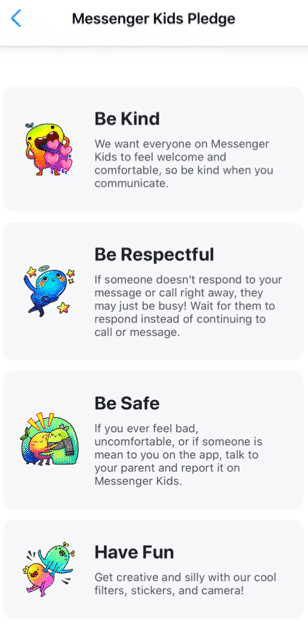
After you have completed all the above steps, your child will be prompted to add a photo of themselves, set a color to decorate the app, and complete “missions” to get to know the functions of the app. Your child will be prompted to read the Messenger Kids Pledge to be kind, be respectful, be safe, and have fun.[i]
What are the main features?
A parent dashboard that displays your child’s activities, contacts, and controls
Provide education to the child about new control features
Blocking a user allows the user to remain in the contact list, but the child will not be able to have individual conversations with that user
The child can use photo filters to send images to their contacts and to video chat
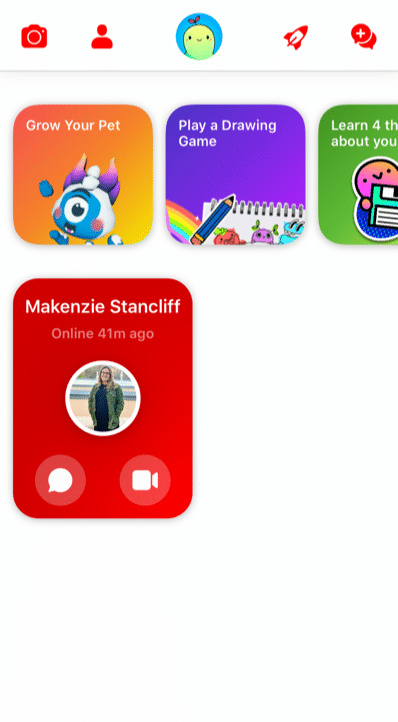
There are several “missions” the child can complete
Grow a pet
Play a drawing game
Learn 4 things about your information
Add a friend
Take a funny photo
Create a group
The Parent Dashboard
Because Facebook gets feedback from kids, parents, and child development experts, Messenger Kids is always changing for the better. For example, the updated parent dashboard is where you can see all of your child’s latest activities, contacts, and controls at a glance in one place. It also shows you
who and what content your child has reported or blocked and why,
a list of recent chats and calls (including how frequently your child is chatting/calling and with whom),
an image gallery of all the images and videos exchanged by your child and their contacts (including whether exchanged in a group).
User Education for Kids
Facebook has also thought through Kids’ digital literacy and privacy needs by notifying child users of the new parental control features in a Data Transparency Flow. Kids are prompted to go through this education with a push notification. It’s also available in the “mission” section of the app for kids. New users engage with this education during the registration process. They’ll get important basic information about how their personal data is used and shared when they use Messenger Kids – a great first step to cyber awareness and privacy issues in general.
Because child friendships need a healthy pause here and there, Facebook has also made blocking easier to use and less permanent. Before, if a child blocked someone, they were automatically removed as a contact. Now when a kid blocks someone, they won’t be able to communicate in a 1:1 chat, but they’ll remain contacts and still be able to be in group chats together. This allows kids to leave or stop individual interactions they no longer want while not having to leave group environments they may share with that contact. The child is always warned when they return to or start a group chat that contains a blocked contact that they have the option to continue to the chat, leave the group, or cancel joining the chat.
What are the privacy and safety options?
There is no minimum age of use outlined in the apps privacy policy. Facebook has a detailed list of what features they collect while using the app on their privacy policy. Here are a few of the features collected while using the app:
Facebook has recently added more controls. In the controls tab, you can see which device your child is logged into on MK, when your child last used MK on those devices and enables you to log your child out of selected devices. Parents also have the ability to remove and report any of these images and videos from the same Dashboard (doing so will remove that content from the child’s thread and notify them that you removed it).
As long as parents stay on top of who’s being friended and the information that is being exchanged, there are few risks associated with using Messenger Kids. The parent has the ability to control what the child can and cannot do as well as who they contact. Parents can also see what has been shared (and deleted).
However, any messaging app has its risks, especially when kids are involved. Here are a few we at GKIS thought you may want to consider
Your child and their friends may post inappropriately or impulsively
Cyberbullying between known contacts, like exclusion.
Too much access to friends and screens (of course, parents can schedule the use and use the sleep feature).
Your child is exposed to the Facebook brand, just as they are other popular American brands like Coca-Cola, Harley Davidson, and Budweiser.
Because parents have so much management opportunity and kids love the socializing, GetKidsInternetSafe rates Messenger Kids as a green-light app. We also love that Messenger Kids offers educational information that helps kids make better decisions with friends onscreen.
Thank you to CSUCI intern Makenzie Stancliff for co-authoring this article. For more information on keeping your child safe on social media, check out the Get Kids Internet Safe Screen Safety Toolkit. Be sure to add Messenger Kids on to the free GKIS Connected Family Agreement as “appropriate.”
I’m the mom psychologist who will help you GetKidsInternetSafe.
[i] Introducing Messenger Kids, a New App For Families to Connect. (2019, November 7). Retrieved from https://about.fb.com/news/2017/12/introducing-messenger-kids-a-new-app-for-families-to-connect/
[ii] (n.d.). Retrieved from https://www.facebook.com/legal/messengerkids/privacypolicy?version=2020
TikTok is a trendy, popular social media app that is controversial amongst parents. On the one hand, explicit language, attention-seeking trends, and cyberbullying on the app give TikTok the potential to be harmful. But kids and teens love it, anxious to join and follow the latest trends, memes, and creators. Like every app, it is important to consider the potential benefits TikTok can offer, not just the dangers. Many TikTok creators take advantage of the app’s popularity to provide inspiration and education to its adolescent audience. If you’ve decided to allow your teens access to TikTok, GKIS has identified some influencers your family may enjoy.
Who’s on TikTok?
Like YouTube and other social media platforms, TikTok users form communities based on popular trends like cooking, makeup, education, and wildlife. While we don’t think of apps like TikTok as a learning resource, many TikTok creators have dedicated their page to making teen-friendly, educational videos that can help your teen learn new things in a fun, accessible way.
Before You Start
As we mentioned in our GKIS Sensible Parents Guide to Tik Tok, it is recommended that kids be over the age of 13 before using TikTok due to its explicit language and content. Also, we strongly advise that you implement our free GKIS Connected Family Agreement before you allow your child a mobile device. With two versions available for kids and teens, our agreement spells out just what you should cover to help keep you family members safer online. All you have to do to get your free agreement delivered directly to your email by entering your name and email address on the GKIS home page. No purchase necessary and, if it’s not for you, you can unsubscribe at any time.
Meet Our Favorite Creators
For this article, we tried to find creators who have a relatively clean act for a teen audience. Please review these creators and decide for yourself whether they are good fits for your family.
Cooking
In the cooking community, creator @salt_to_taste has amassed over 1 million followers with his cooking videos and recipes. With easy recipes made with everyday ingredients and simple directions, this page is a great place for teens to get inspired to start experimenting in the kitchen. Salt to Taste makes a variety of foods, from snacks to smoothies to simple American and East Asian dishes. This creator has been active for almost a year and has been recently nominated for a Shorty Award in the food category. This creator does not seem to use inappropriate language and does not seem to do sponsorships.
Makeup
In the makeup community, creator @mariasgoldenmakeup is known for her bold eye looks and makeup tutorials. Though fairly new to TikTok, Maria has already gained over 61,000 followers with videos showing how she achieves her beautiful makeup looks as well as the products she uses to achieve them. Maria’s page can offer inspiration for teens who want to try their hand at makeup and achieve specific looks. Her looks can be used for everyday makeup and special occasions. She has done some sponsored posts but is transparent about what products are being advertised, using the hashtag #ad to indicate a sponsorship.
Nutrition
In the educational community, there are a few creators who have gained popularity for their educational TikToks in various subjects. In nutritional education, creator @sarahgracemeck, with over 149,000 followers, creates educational TikToks correcting various health myths and promoting tips on healthy eating. In our culture, we are obsessed with being thin and restricting what we eat, and this message unfortunately gets pushed on teens the most. Sarah does a great job using her background as a dietician to spread the message of healthy eating in a nonjudgmental, positive way. Sarah is passionate about spreading accurate information and debunking various unhealthy dieting trends and myths. It does not seem that Sarah offers sponsored content.
Science
In science education, creator @chemteacherphil is a popular user with a background as a high school chemistry teacher. Phillip has amassed over 1.3 million followers on TikTok with his videos exhibiting different chemical reactions and explaining their processes. The reactions he creates in his videos are fascinating to watch, and the information he gives can be useful to any high school student taking a chemistry class. Phillip does not seem to use explicit language or audios in his videos or do sponsorships.
Language
In language education, creator @fresajapomex is a popular multilingual creator who publishes videos in Spanish. With over 2.5 million followers, this creator does a variety of content from vlogs to comedy skits to food reviews. This creator, who goes by Sony on TikTok, has an energetic and kind personality and has a great sense of humor. Her parents are Mexican and Japanese, and therefore she speaks both languages as well as English. As a former Spanish student, one of the ways I improved my Spanish skills was consuming media in my target language. Sony’s content can be a great tool to help your teens improve their skills in a different language in a fun way. Sony does not seem to do sponsored content.
Wildlife
In the wildlife community, The Urban Rescue Ranch, the organization behind the page @ostrichplug, recently joined TikTok in an effort to show the work they do raising animals in an urban area. Their content shows their workers handling a variety of animals like frogs, possums, ostriches, pigs, and most recently, chickens. The creators often include their animals in fun, comedic skits and do frequent updates on the development of a few of their younger animals. This is a fun page for teens to view the different responsibilities of owning animals, and may even be inspired to go volunteer for an organization like the Urban Rescue Ranch themselves. This page does not seem to use any explicit language or audios and also does not seem to do sponsorships.
Fun with Coffee
Lastly, a popular creator among GKIS interns is @morgandrinkscoffee. Morgan is a college student who works as a barista for her local coffee shop, and she has gained over 2.2 million followers since joining in 2019. Her content mainly consists of the work she does as a barista, showing how she makes certain drinks, her day to day responsibilities, and some funny skits on her experience in the food industries. For teens who may be experiencing their first jobs in food services, Morgan’s content can show that it’s possible to enjoy the work that you do, but it also lets teens have a laugh at some of the shared struggles most of us have faced while working in customer services. Morgan is transparent in her sponsorships, labeling her sponsored content with the hashtag #ad.
Making TikTok Safer
As discussed in our previous TikTok article, it can be difficult to control the content suggested by the TikTok algorithm. But with careful decisions on who you allow your teen to follow, TikTok will suggest better, safer content that teens will love and parents can trust. Though it’s important to be cautious of the dangers of TikTok, with a little research, finding teen-friendly creators can help make the app safer and more fun for everyone.
Thanks to Alexandra Rosas-Ruiz for her research and help with writing this article. Want to learn more about how to manage the risks of the internet for your teen? Check out Dr. Bennett’s latest book, “Screen Time in the Meantime.” With a quick read (or listen because it is also offered in audio), you can learn creative, sensible, and family-tested parenting strategies to help protect your teen both online and offline.
I’m the mom psychologist who will help you GetKidsInternetSafe.
Onward to More Awesome Parenting,
Tracy S. Bennett, Ph.D.
Mom, Clinical Psychologist, CSUCI Adjunct Faculty