
Need peaceful screen time negotiations?

Get your FREE GKIS Connected Family Screen Agreement

sleep

Why Good Sleep is Critical for Child and Teen Health

Ask anybody what they need more of – and they’ll say SLEEP! Surveys report that sleep deprivation among Americans is rampant. As a psychologist who treats kids, teens, and adults, I see that those who suffer the most are teens! Teens are burdened with a ton of schoolwork and the temptations of social media, video gaming, and binge-watching YouTube, TikTok, and Netflix. With crazy busy work weeks, we crave “me-time,” especially during those precious moments when we’ve settled in for bed without interruptions and distractions. Unfortunately, most people don’t know why sleep is so important. Without enough sleep, we are at risk for mental illness and overall performance decline. Today’s GKIS article goes over the reasons why sleep is so important and how to preserve your mental health and learning capacity by protecting much-needed restorative sleep.

Why is sleep so important?

During sleep, our brains conduct general housekeeping and memory-strengthening duties. Housekeeping tasks necessary for brain health include the pruning, repair, and new growth of neurons and the removal of toxins.

Memory strengthening, called memory consolidation, occurs by stabilizing memory traces that were collected while awake. Memory consolidation occurs with both declarative (fact-based) and procedural (how-to) information. Rapid-eye-movement (REM) sleep is particularly important for stabilizing complex or emotionally charged memories.[i]When we don’t get enough sleep, our brain’s housekeeping and memory consolidation tasks remain undone, leaving us unable to efficiently acquire (onboard) or retrieve information.

Sleep deprivation not only stunts learning, but it can also cause:

  • mood swings,
  • negative mood states like depression, irritability, and anxiety,
  • fatigue,
  • confusion,
  • attention problems,
  • motor impairment, and
  • overall impaired cognitive performance.[ii]

If people regularly sleep fewer than six hours a night, research has found that they may have:

  • a higher risk of developing Alzheimer’s Disease,
  • a 200% increased chance of having a heart attack or stroke,
  • a 70% reduction in cancer-fighting T-cells, and
  • disrupted melatonin and cortisol which can lead to weight gain and Type 2 diabetes.

For those who stay awake 16 hours straight, they may lower their overall functioning to resemble somebody who is legally drunk. Furthermore, sleep-deprived individuals often fail to recognize impairment. In other words, they don’t realize the costs and keep burning the candle at both ends.

Vamping

Missing out on much-needed sleep and staying up all night on screens is called vamping.

Teens with chronic sleep deprivation have been found to demonstrate:

  • lower achievement motivation,
  • more teacher-child relationship problems,
  • a poorer academic self-concept, and
  • poorer school performance.[iii]

How might you decrease the risk of vamping and encourage healthy sleep?

Stage the room to be restful.

I know it’s nearly impossible to motivate kids to unclutter their rooms. But a soothing environment contributes to a soothed mind. Offer your support by helping your child create a more restful environment with a fresh bedroom makeover. Light paint colors, soft textures, organized closets and bedside tables, soft lighting, white noise makers, and yummy smells can turn a chaotic hovel into a relaxing paradise.

Recognize that nutrition, exercise, and screen content impact the quality of sleep.

Research has demonstrated that young children who watch violent television content have more sleep problems, particularly delayed onset of sleep, than children who view age-appropriate content.[iv] Furthermore, kids who get adequate nutrition and exercise, especially outdoor exercise because of sunlight setting your circadian rhythm, also get better quality sleep. In practice, I find that teens, in particular, benefit from the mood benefits of regular cardio and cooperative team play.

No screens in the bedroom.

Why? Because screens wake up our brains! The blue LED light from the screen stimulates the photosensors in the retina that signal the brain to suppress melatonin production (our sleep-regulating hormone) and makes us more alert. Less melatonin disrupts our natural circadian rhythms, which can lead to sleep during the day and wakefulness during the night.

Using screens before bedtime has been found to cause people to:

  • go to bed later,
  • prolong the time it takes to fall asleep,
  • delay the timing of REM sleep, reduce the amount of REM sleep and sleep overall,
  • reduce alertness in the morning, and
  • cause more daytime sleepiness.[v]

Screens also condition us to be awake in bed. If we are often awake in bed, our bodies will automatically be conditioned to cue, or believe that the bed is an “awake-only” zone.

Alternatively, if we only rest and sleep in bed, our bodies will be conditioned that the bed is a “sleep-only” zone.

In psychology, we call this type of cued learning classical conditioning. By these principles, we must resist the urge to do anything in bed but sleep to develop good expectations and habits.

Make the No Screens in the Bedroom Rule BEFORE it’s necessary. It’s asking a lot to say no TV, video games, tablets, or smartphones in the bedroom, but vamping leads to sleep deprivation. Sleep deprivation leads to impulsivity and risk-taking.[vi] Impulsivity while in intimate spaces leads to intimate gestures like sexting and viewing inappropriate online content.

Also, use alarm clocks with red-lighted numbers in bedrooms rather than screens for timekeeping.

Encourage a soothing nighttime ritual.

We are creatures of habit. Habitual activity during the thirty-minute bedtime wind-down signals the body to anticipate rest. Components of a soothing ritual may include soft lighting; quiet, repetitive, or white noise sounds; and comforting activities. Sticking to a consistent bedtime schedule is also important.

Screens off thirty minutes before lights out.

As our brains sort through our memory caches, information is prioritized to either forget or remember. Because experiences that trigger emotion are typically important, evolution has shaped our brains to prioritize memories infused with emotion. Based on cognitive science theories, looping on a troubling experience is thought to be the cause of nightmares.

Just like the response to fright when we’re awake, stress hormones like cortisol and adrenaline dump into our bloodstream when we have nightmares. If we are troubled upon falling asleep, agitated dreaming and tossing and turning may result, leaving us tired, irritable, and cognitively scrambled the next day. Over time, this can seriously impair mental health.

Although emotionally triggering and arousing screen activities like gaming, texting, or viewing activating content aren’t as troubling as real-life trauma, they still stimulate the same brain regions activated with chronic stress, often for hours at a time. The hangover from chronic stress has been referred to as mental brownout. Limiting activating screen activities at night and giving your children time to soothe prior to bedtime will result in better quality sleep overall and pave the way for healthy learning during the day. Particularly, avoid eating, triggering discussions, video gaming, and intense exercise before bed.

Teach sophisticated self-soothing strategies.

The opportunity to spend time with a relaxed parent is another factor critical to self-soothing. From birth, a child’s brain synchronizes with a responsive parent. Eye contact, narrative moment-to-moment comments with emotion words, and general conversation teach kids what emotions are and how to deal with them.

We cannot provide this kind of synching and teaching if we are focused on screens instead of each other. Also, if you don’t sleep well one night, don’t stress about it. Getting anxious or angry will wake you up more, and most of us get poor sleep here and there and simply make it up later.

If you are reading this because you are taking our Social Media Readiness Course, you’re about to learn cognitive-behavioral exercises like diaphragmatic breathing, progressive muscle relaxation, mindfulness, imagery, and meditation. These skills can prevent even the most persistent sleep disorders.

Exercising one’s mind to relax is critical to self-soothing. Another option for overcoming some of the negative effects of sleep deprivation is napping.

A full cycle of sleep takes about ninety minutes and provides cognitive rejuvenation that improves procedural memory and creativity with no sleep inertia (grogginess). Sixty to thirty minutes is good for slow-wave sleep, which helps with fact memory and retrieval but may still result in grogginess. Twenty to ten-minute power naps are shown to increase alertness and energy. If you have time to nap, it’s best to spend ninety minutes to complete a sleep cycle or just a power nap for ten.

Onward to More Awesome Parenting, 

Tracy S. Bennett, Ph.D.
Mom, Clinical Psychologist, CSUCI Adjunct Faculty
GetKidsInternetSafe

Works Cited

[i] Xie, L., Kang, H., Xu, Q., Chen, M., Liao, Y., Thiyagarajan, M., O’Donnell, J., Christensen, D., Nicholson, C., Iliff, J., Takano, T., Deane, R., &

Nedergaard, M. (2013). Sleep Drives Metabolite Clearance from the Adult Brain. Science 342.6156: 373-77. Web.

[ii] Goel, N., Rao, H., Durmer, J., & Dinges, D. (2009). Neurocognitive Consequences of Sleep Deprivation. Seminars in Neurology 29.04: 320-39. Web.

[iii] Dewald-Kaufmann, J., Oort, F., Bogels, S., & Meijer, A. (2013). “Why Sleep Matters: Differences in Daytime Functioning Between Adolescents with Low & High Chronic Sleep Reduction & Short & Long Sleep Durations.” Journal of Cognitive & Behavioral Psychotherapies, 13, 171-182.

[iv] Garrison, M. & Christakis, D. (2012). The impact of a healthy media use intervention on sleep in preschool children. Pediatrics, 2011-3153; DOI: 10.1542/peds.2011-3153

[v] Chang, A., Aeschbach, D, Duffy, J., & Czeisler, C. (2014). Evening Use of Light-emitting EReaders Negatively Affects Sleep, Circadian Timing, & Next-morning Alertness. Proceedings of the National Academy of Sciences 112.4: 1232-237. Web.

[vi] Killgore, W., Kamimori, G., & Balkin, T. Caffeine Protects Against Increased Risk-taking Propensity During Severe Sleep Deprivation. Journal of Sleep Research 20.3 (2010): 395-403. Web.
GKIS Recommends Some Favorite Mental Health Apps

Surveys reveal that depression and anxiety have increased for adults, teens, and kids. It’s unclear what is causing these increases, but longer workdays and overtasked lives may be strong contributors. Increased screen time on video games, social media, video and movie streaming, texts, and emails can be super fun and even improve productivity. But too much screen time can also lead to a mental brownout, a type of anxious fatigue that we may not even recognize until it leads to mental illness. Giving up screens to avoid it simply isn’t possible for most of us. But the good news is we don’t have to! Learn how smartphone health and wellness apps can benefit you without having to give up screen time!

Mental Health

Did you know that anxiety, depression, self-harm, and suicide is up 78% among teens?[1] In fact, by some estimates 1 in 6 children between the ages of 2 and 8 have a mental, behavioral, or developmental disorder. Left untreated, child symptoms may lead to more issues in adulthood.

Among children ages 3 to 17:

  • 4% or 6.1 million have been diagnosed with ADHD
  • 4% or 4.5 million have been diagnosed with a behavior problem
  • 1% or 4.4 million have been diagnosed with anxiety and
  • 2% or 1.9 million have diagnosed with depression.

Boys are more likely than girls to experience a mental, behavioral, or developmental disorder.[2]

Social Media Impacts on Children’s Mental Health

Sleep Deprivation

Social media has various effects on mental health, especially in children. Dr. Bennett writes in her book, Screen Time in the Mean Time, says that she feels sleep deprivation is the most common contributor to mental health problems today. The blue light on devices interrupts the sleep pattern and makes it more difficult to fall asleep. Many people also develop a compulsive impulse to check notifications which can also delay sleep.[3] Teens with sleep deprivation demonstrate lower achievement motivation, more teacher-child relationship problems, a poorer academic self-concept, and poorer school performance.

Self-Comparison

Too often, we see the best sides of our friends on social media. After all, nobody wants to read about the doom and gloom of a breakup or the fight someone just had with their mother-in-law. Positive posting can lead to friends feeling left out and generally bad about how their lives don’t compare. The GKIS article The FOMO EFFECT: How Fun Friend Posts Can Lead to Clinical Anxiety provides more information on self-comparison.

 Distraction

Social media poses a major risk of distractibility. We tend to go on an endless cycle of content on one social media app or we cycle between multiple social media apps. This causes us to spend a longer amount of time on social media and forget about what we are supposed to do in the “real world”.

Mental Health Apps

Dr. Bennett recommends mental health apps to her clients all of the time. Free and convenient, they can be a great addition to psychotherapy. Even for people who aren’t in treatment, mental health apps can help us get to where we want to be by offering mood-enhancing toolkits, mood monitoring, and breathing and meditation ideas.

Mental health apps are awesome in that they are convenient, inexpensive, and even free, and available. They can be a comfortable first-step to wellness prior to (or even while) seeking out help from a mental health professional.

CAUTION: Keep in mind possible privacy issues due to the risk of data breaching and the release of private information to third parties. Many psychologists also agree that the apps are not as effective as seeing a mental health professional.[4]

Here are some mental health apps that GKIS is happy to share with you:

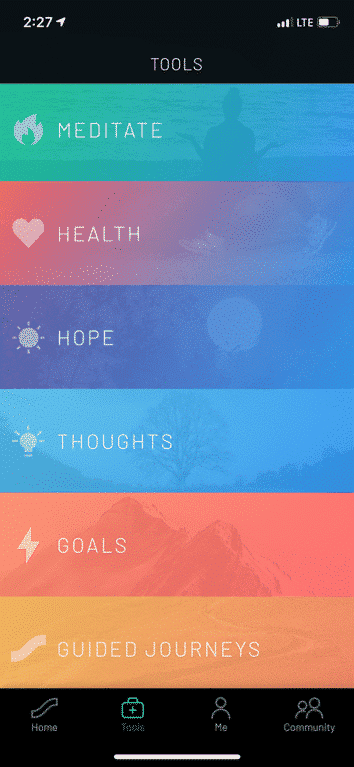
Sanvello

Sanvello is an app that aims to help you relieve symptoms of depression or anxiety by providing a complex toolkit of strategies and resources. It allows you to record your mood and health activities in order to track patterns.

There is also a Sanvello peer community that allows users to share stories, encouragement, and personal insights on any topic. The Terms of Service state “You must be over 13 years of age to use the Services, and children under the age of 13 cannot use or register for the Services.”[5]

The toolkit provided by Sanvello includes:

Meditation: Lessons focus on specific topics like relaxing, mindfulness, stressful situations, and calm down.

Health: Helps you track health habits that may be affecting your moods such as exercise, drug use, and water or caffeine consumption.

Hope: This tool provides the user with a space to save photos, quotes, activities, and community content.

Thoughts: Provides a place for journaling, analyzing events that have occurred, or discovering characteristics that have contributed to a feeling.

Goals: Allows users to select a challenge such as reconnecting with a friend or saying hello to a stranger.

Guided Journeys: A series of journeys that encourage a user to accomplish something they have never done before.

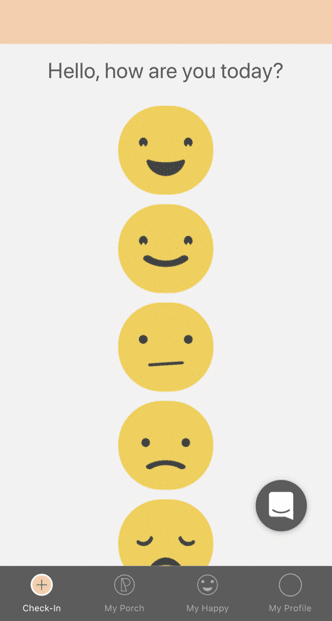
Porchlight: Being There

Porchlight is an app that is designed to allow loved ones to easily check in on each other’s mental health. The app prompts you to “check-in” once you enter the app where you can share your emotions using emoji. Users can connect with others which will send daily check-in notifications to the connected users. Porchlight provides prompts to check in with the connected users depending on what emotion they check in as.

Porchlight’s Terms of Service states “you must be 13 or older to register as a user or to use the app. If you are a minor, you must have your parents’ permission to donate through the App.”[6]

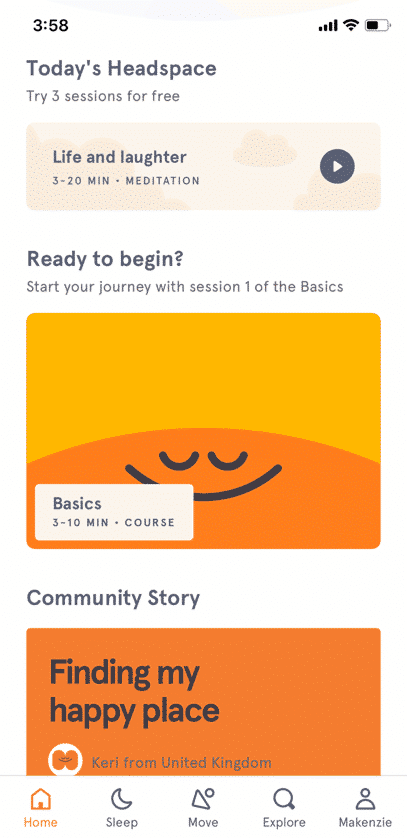
Headspace

Headspace is an app that provides guided meditation exercises to help the user become healthier and happier. Headspace claims that it can increase happiness by 16% with just 10 days of use. It is also a popular app with over 60 million active users.

There are 4 main guides to mindfulness within the app:

The Wake Up: Daily short stories and small meditations to help you start your morning on a good start

Move Mode: Exercises to help strengthen mental and physical well-being

Sleep: Sleepcasts, music, and audio experiences to aid a restful night of sleep

Meditation: Teaches everyday mindfulness to help at any time of the day[7]

According to the Terms of Service for Headspace, “You must be 18 years of age, or the age of majority in your province, territory or country, to sign up as a registered user of the Products. Individuals under the age of 18, or the applicable age of majority, may utilize the Products only with the involvement and consent of a parent or legal guardian, under such person’s account and otherwise subject to these Terms.”[8]

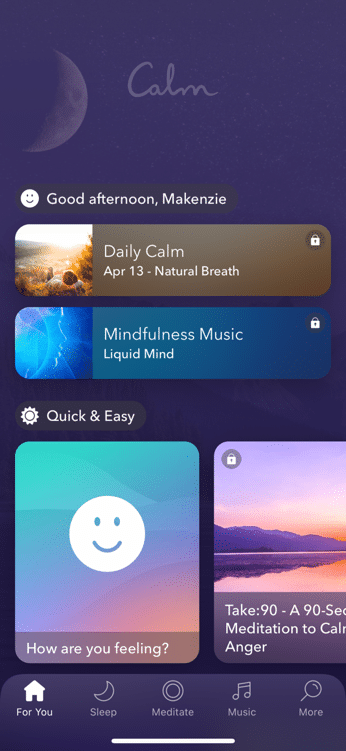
Calm

Calm is an app designed to assist users to develop healthy mental fitness, relax, and good sleep habits. The goal of the app is to introduce people to the benefits of mindfulness through meditation.

There are 6 different items of focus in the app:

Meditate: Teaches the skills of meditation

Sleep: Tools to have a restful sleep

Music: To help you relax, focus, or sleep

Body: Demonstrates mindful movement and stretching

Masterclass: Audio programs taught by experts

Scenes: Nature scenes and sounds to help relax and focus[9]

Calm’s Terms of Service state “you may only use the Services only if you are 13 years or older. To make a purchase via the Services, you must be 18 years or older and capable of forming a binding contract.”[10]

Thank you to CSUCI Intern, Makenzie Stancliff for providing insight on mental health apps. For more information about how electronics can impact our health, check out Dr. Bennett’s GKIS article, Is Wi-Fi Dangerous to Our Health?

I’m the mom psychologist who will help you GetKidsInternetSafe.

Onward to More Awesome Parenting,

Tracy S. Bennett, Ph.D.

Mom, Clinical Psychologist, CSUCI Adjunct Faculty

GetKidsInternetSafe.com

Photo Credits

Photo by Sydney Sims on Unsplash

Photo by Julia Coimbra on Unsplash

Works Cited

[1](n.d.). Retrieved from https://www.ajmc.com/focus-of-the-week/mental-health-issues-on-the-rise-among-adolescents-young-adults

[2]Data and Statistics on Children’s Mental Health. (2019, April 19). Retrieved from https://www.cdc.gov/childrensmentalhealth/data.html

[3] How does social media impact the mental health of young people? (2019, October 28). Retrieved from https://www.internetmatters.org/blog/2017/04/12/social-media-impact-mental-health-young-people/

[4]Technology and the Future of Mental Health Treatment. (n.d.). Retrieved from https://www.nimh.nih.gov/health/topics/technology-and-the-future-of-mental-health-treatment/index.shtml

[5]Home. (n.d.). Retrieved from https://www.sanvello.com/

[6]Being There. (n.d.). Retrieved from https://www.porchlightapp.io/

[7] “Meditation and Sleep Made Simple.” Headspace, www.headspace.com/.

[8] “Terms & Conditions.” Headspace, www.headspace.com/terms-and-conditions.

[9]  “About.” Calm Blog, www.calm.com/blog/about.

[10] “Terms of Service.” Calm, www.calm.com/en/terms.


How to Break Your Phone Addiction and Reconnect to Family

children playing outside

If your family looks anything like the average American family, you’re probably on your screens too much and can use some help. We all want our families to be as healthy as possible. Overuse of our devices can have a negative effect, not only on our health, but on our family dynamic. Our gadgets are causing us to sit rather than move, and swipe rather than speak. Cutting back isn’t easy but has huge benefits. How much screen time is too much, and what can our families do to reduce time spent on devices?

Screen Time Guidelines

In Dr. Bennett’s book, Screen Time in the Mean Time: A Parent’s Guide to Get Kids and Teens Internet Safe, she provides recommendations for kids of different ages, toddlers through teens as well as for adults. When asked about time guidelines, she stresses that, although useful as a guide, time limits are less important than the quality and format of viewed content.

Especially for young children, fast-moving, light-flashing content can be overly arousing to the developing nervous system which can lead to stress and effect brain wiring long term. Compulsive and addictive use patterns driven by notifications and rewarding images and sounds can also have detrimental brain and behavior impact. Sexuality and violence are particularly potent to capture our attention, which means lots of exposure to ads and big profit. For children, inappropriate content can lead to stress, anxiety, fear, and depression. She says, for the first time in 23 years of practice, she is seeing young children with panic disorder. She attributes some of these cases to poorly managed screen use.

Dr. Bennett wrote Screen Time in the Mean Time because simple guidelines aren’t enough to protect healthy development and relationships. Each family member has different communication and information access needs. Personalized content and use patterns matter. Rather than set a hard time guideline and leave it at that, she says parents can teach sensible screen programming, choice, and use strategies for smart screen use. Kids need to know why rules exist and be able to negotiate for reasonable access. Just taking screens away overlooks critical learning opportunities. Our screens provide enormous benefits in entertainment, access to information, communication, skill-building, storage, and safety. Knowing how our screen devices affect us and how to manage them are critical first steps to smart screen use.

Risks of Excess Device Use

Recent studies have shown that too much time on your devices can lead to health problems such as:

Obesity 

Watching television for more than 1.5 hours per day is a risk factor of obesity for children who are between the ages of 4 and 9. You are more likely to watch more TV when having one in the bedroom. Teens and children are 5 times more likely to be obese if they watch 5 or more hours of TV per day, than those who watch 0-2 hours per day (Why to limit your child’s media use, 2016).

Sleep Problems

A high exposure to screen media and sleeping with a phone in your bedroom puts you at a greater risk for sleep interference. The light that emits from your phone, blue light, is particularly harmful to your child’s sleep quality, because it triggers a dip in your sleep regulating hormone, melatonin. Poor quality of sleep can then lead to memory problems, loss of initiative, an inability to prioritized tasks, mood and anxiety symptoms, and poor academic performance overall (Bennett, 2018; Why to limit your child’s media use, 2016). Without sufficient sleep, the brain is unable to do its housekeeping duties, which includes memory consolidation and removal of toxins, Chronic sleep deprivation can lead to learning deficits, cardiovascular risks, buildup of toxic proteins that can lead to increased risk for Alzheimers, and an impoverished immune system. This is why Dr. Bennett believes that sleep deprivation is the number one risk to mental health today.

Poor Learning and School Performance

Children and teens tend to divide their attention between homework, TV, and smartphones. Dr. Bennett calls this “multitasking.” Multitasking can lead to poor quality work, wasted time, and mental brownout, which is irritability, fatigue, and depression (Bennett, 2018).

kids avoiding screen time by playing outside

Tips on how to reduce screen time:

Be a role model and be consistent.

Achieving lifestyle changes as a family brings comradery, accountability, and a greater chance of success.

Get honest, set a goal, and reach it.

Have a clear vision of what you want your lifestyle to look like and plan the steps to get there. Time management apps are helpful to track and manage. screen use. Bennett’s home staging tips can also be life altering. Starting sooner rather than later will help everyone build positive habit with less resistance. The GKIS Family Living Agreement is a comprehensive and easy0-to-use tool that helps with education, goal setting, and learning family values.

No screens in the bedroom, bathroom, or behind closed doors.

Don’t even use your phone as an alarm clock. If you glance at it during the night, you’ll get distracted by social media and lose critical rejuvenating sleep. This can become a habit and lead to long-term sleep problems. Use a GKIS Family Docking Station to resist temptation.

Build screen-free dinners into the schedule.

Make meal time family time. The dinner table is a great place to bond with your family, catch up on how school or work went, and talk about plans for the week. This is the perfect opportunity to pay compliments and give thanks. Let your family know how grateful you are to have them in your life, it is these precious moments that we let slip by looking at our phones rather than truly engaging in our loved ones.

Modify your phones to be less appealing.

Delete apps. Grayscale. Turn off notifications. Put apps with notifications on a backpage of your smartphone. The world won’t end, you’ll be fine. Making your phone less attractive will cut your screen time and transform your phone from entertainment, to utility; the way it was intended.Cut your social media contacts to Dunbar’s number, 150.
Research shows that we have a limited amount of friend slots in our brain, which adds up to about 150. After that, relationship quality deteriorates to acquaintance contact. If you’re hemorrhaging time on relationships that don’t bring something special to your life, trim your friend lists.

Improve the quality of your screen content.

Cut down to one social media app, unfollow fake news sources, and reduce your exposure to ad-rich content like beauty guru videos and celebrity news.

family walking on beach at sunset Screen-free times and activities leads to creativity and enriching three-dimensional play.

Bennett practiced #NoTechTuesday and #NoTechThursday with her family. She says these were her favorite days, because her kids played with their pets, built forts, climbed trees, and got creative. Now that her kids are teens, they sometimes elect screen free leisure activities, which she says is a longterm payoff they’ll always value.

Don’t use screens as a punishment or reward.

It’s important that you become your child’s advocate with screen use rather than their punisher. Although it’s easy to use screens as leverage, don’t do it. If they see you as a screen hater, they’ll quit talking to you about their screen activities. Instead, use practical, smaller consequences like 15 minutes earlier bedtime or an extra chore to do. This is especially important with young children.

selfie As with any lifestyle change, time and practice is necessary for success. Trimming screen time may be difficult, especially for teens. They need you to negotiate slow improvements over time rather than demand lots of changes at once. Don’t expect them to agree at first. The benefits will be revealed over time. That is all part of learning healthy habits, which is not an innate skills and is easier with age. Likes and comments are great, but real connections start with true contact and conversation. Thanks to chad Flores for the valuable information in this article. If these tips were helpful, you can find more in Screen Time in the Mean Time: A Parenting Guide to Get Kids and Teens Internet Safe

Works Cited

Dr. Bennett’s book- Screen Time in the Mean Time: A Parenting Guide to Get Kids and Teens Internet Safe

Why to Limit Your Child’s Media Use 2016

Photo Credits

Photo by Allie Milot on Unsplash

Photo by Jude Beck on Unsplash