Has your child been manipulated and exploited online? Influencing people to send nudes is an example of sexual coercion, and it happens more than you think.[1] A survey found that 36% of participants reported experiencing digital sexual coercion.[2] And too often, it happens to young teens. Statistics say one in 33 kids is approached online, but many don’t report it.[3] Too often when kids come forward, they lose their screen privileges as a result. This punishes kids for seeking help, so they learn to keep scary online problems to themselves. This is my story of being the victim of digital sexual coercion when I was only 13 years old.
He was 17, I was 13
When I was in seventh grade, my PE class overlapped with eleven graders, and that’s where I met Dale. Dale was 17 and new at our school. I was 13, friendly, outgoing, and happy to introduce myself. Dale added me on Facebook, and we began to get close. My mom didn’t even know I had Facebook because I hid it. But honestly, if she had a resource like the GKIS Screen Safety Essentials Course, I wouldn’t have been able to hide it from her. I could have skipped this whole trauma. Nothing like GKIS was around back then. I was a sitting duck.
How We Got Close
Within two weeks, Dale and I were Skyping for hours every night. It was awesome. He’d say things like, “You’re so mature for your age,” “You look a lot older than you are,” and “I wish you were older so we could hang out in public.” He made me feel desired and special. Now I know that using flattery to manipulate younger kids makes them more vulnerable to coercion.[4] But then, Dale hyping me up so much gave me a big head. I felt like I was older, more sophisticated, and smarter than kids my age. I loved the attention. I already felt like a little adult.
Over the next few months, we grew closer and closer and started making plans to hang out. He wanted to meet at a “secret” spot across the street from our school. It was at an outdoor bench in a parking lot surrounded by trees which hid us from the view. He made sure we met at different times so we couldn’t get caught. I felt like he was ashamed to be seen with me, and it hurt my feelings so much. During these hang-outs, I discovered what first and second base were. We even talked about what it would be like to have sex. It was exciting for me.
How It Took a Turn for the Worst
Eventually, Dale coached me on how to pose for provocative pictures and convinced me to email them to him. He promised not to show the pictures to anyone and even sent me some of his own. I thought it was safe because he cared about me, and we loved each other.
Unfortunately, it wasn’t long until I found out that he showed my pictures to the boys in my class because they teased me about the colors they saw me wearing in the pictures. It was absolutely horrifying! I was embarrassed. I felt betrayed. I was so sad and angry. I didn’t know what to do, so I just denied it and worked hard to keep my composure. One guy bullied me about it the whole rest of the year. It never got easy.
I was afraid to lose our relationship, so I did not make it a big deal. But I did ask him not to show the photos to anyone ever again. Some of his friends cautioned him, recognizing the age difference. Most of them were nice to me. They acted like they knew I was a little girl with an almost-man. I think some of them felt sorry for me. That was his wake-up call to how wrong it was to be with me.
When I started to feel him pulling away, I sent more pictures to earn his attention. I was completely attached and “in love.” Inevitably, he broke up with me because he was turning 18 soon and did not want to catch a case. I was shattered. I felt unworthy, unwanted, less-than, and like I was not enough. To make matters worse, he began dating a girl who was 15 years old a month after we separated. Watching him grow close to her broke my heart and left knots in my stomach. I was constantly comparing myself to her thinking I was too fat, ugly, and young. I felt used and discarded. I had a hard time focusing on school, friends, or extracurricular activities. For the next four years, I felt like I’d never be in love again. It took a toll on me and made me feel so self-conscious.
My Why
At the time, I felt so alone and misunderstood. Now I see I needed resources like GKIS. Thirteen years later, I researched “digital sexual coercion” and finally felt seen. I feel better after understanding how common this is and inspired to share my story to help other kids and parents avoid what happened to me.
After reflecting on my experience, I realized that open conversations about online interactions could have equipped me with the awareness to recognize red flags. Had I gone through the GKIS Social Media Readiness Course, I would have understood the risks of social media even among my friends. I encourage all parents to empower their children to navigate the digital world safely. This way, you can prevent your child from reliving my worst experience.
Thanks to CSUCI intern Elaha Q for writing this article. Her courage and vulnerability are so impressive. She said writing the article was a healing experience. And crazily, her older “boyfriend” recently reached out to her and apologized. But she also said that she now recognized who he was still phishing for her affection, and it felt “weird.” It made me wonder, do we ever stop feeling vulnerable after experiences like this? Thanks Elaha for being bold and brave and sharing your story.
I’m the mom psychologist who will help you GetKidsInternetSafe.
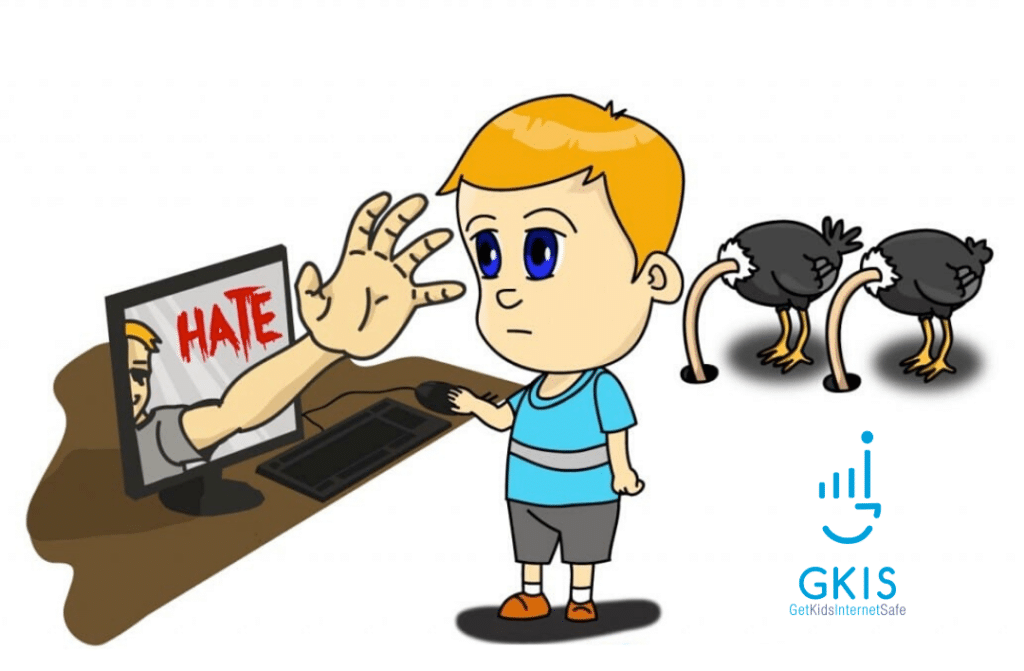
The internet offers virtual neighborhoods to satisfy any interest. For kids and teens, online neighborhoods can be dangerous. The Southern Poverty Law Center estimates that 940 hate groups are operating in the United States. Fueled by the COVID-19 pandemic, immigration fears, an increasingly global economy, troubled race relations, and divisive politics, the number of hate groups in 2021 was more than a 55% increase since 2000. When one considers that the Internet is worldwide, the potential for online hate is staggering. Hate groups and cults have a powerful recruitment tool with the internet. Too many of our mass shooters have been radicalized online, meaning that their opinions have become extreme. Our kids may not only view manipulative recruiting information but they may also be assessed for vulnerabilities. Could your teen be at risk?
Those who commit hate crimes were often radicalized online.
In 2015, 21-year-old Dylann Roof walked into a Charleston church and shot and killed nine innocent people. Like Isla Vista shooter Elliot Rodger, Dylann posted a hateful online manifesto before his rampage detailing his violent and racist beliefs. Along with photos of him standing on and burning an American Flag and aiming his gun, his manifesto titled “an explanation” detailed his “disdain” for blacks, Jews, Hispanics, and patriotism.
“I have no choice. I am not in the position to, alone, go into the ghetto and fight. I chose Charleston because it is the most historic city in my state, and at one time had the highest ratio of blacks to whites in the country. We have no skinheads, no real KKK, no one doing anything but talking on the internet. Well someone has to have the bravery to take it to the real world, and I guess that has to be me.”
His hate crime was not a split-second decision. The shooter had spent months online in white supremacy forums escalating into hate and violence. He didn’t have to look far online for hate.
No longer do hate groups and cults have to rely on interpersonal contact, newsletters, and rallies for recruitment. New members can be recruited and groomed slowly and deceptively from the safety of their bedrooms.
Websites and social media posts are inexpensive and easy to design, offering big reach and control over the content. Internet platforms are the perfect tool for grooming, behavioral manipulation, and coercive thought control. By the time a teen is ready to pack their suitcase to join the group, they may have been expertly brainwashed over months to adopt a radicalized web of beliefs.
The Red Flag Strategies of Hate Groups and Cults
By learning about the strategies hate groups and cults use to attract members, you will be better able to recognize dangerous online sites.
Here are some of the ways bad actors online radicalize their victims.
Attract Your Attention with Sensational Messaging
The bad actor will put up clickbait, which is messaging based on deception and false facts to trigger intrigue, suspicion, and paranoia. An example of a clickbait question is, “Did you know that Martin Luther King Jr. was not a legitimate reverend?”
Attempt to Isolate You by Exploiting Emotional Vulnerabilities and Destabilizing Friend and Family Support
Isolating you from those who look out for you starts with probes that assess if you are being supervised and are willing to engage with them with questions like, “Where is your computer?” “Are you alone?”
Then, the bad actor will attempt to win your trust by pretending to be understanding and friendly with comments like, “I know what that feels like.” “You can trust me.”
Once the victim shows interest and openness, the bad actor will challenge your belief system and attack your trust of family and friends. If the recruiter can tap into your fear and insecurity, they can then start to target blame on the people who protect you with comments like, “Do your parents overlook and dismiss you?” “Do you feel lonely and misunderstood?” “If they loved you, they would not control you as they do.”
Promise a Cure for Emotional Pain
Once they have you sharing private feelings and information, they’ll promise to be the one to help you out with promises of protection, secret intimacy, romantic unconditional love, belonging to a community, wealth, fame, power over others, escape, or a spiritual “answer.”
Intense unrelenting pressure to build trust and a sense of belonging
Once they have you on the hook, they will overwhelm you with manipulative messaging. Online blogs are highly effective in nurturing belief change with long narratives dispersed over time. Cyber communities bond with a sense of special belonging, shared values and practices, and a fierce sense of specialness and pride. The goal is to tempt you into slowly sacrificing your free will and becoming increasingly reliant on the group to do your thinking for you. Members are often encouraged to troll others in support of radicalized beliefs.
Marketing Techniques and Products Targeting Teens
Inducing guilt by providing offers of friendship and gifts leaves subjects feeling that they owe the recruiter and must give back. Hyped meetings, branding, and merchandising support the power and exclusivity of the group (e.g., slogans, symbols, colors, mascots, music, video games, and customized slang).
Tests of Loyalty and Intimidation
Once they have you joined up to their cause, bad actors will demand your blind obedience with ideas like, “We have direct authority from a divine power.”
Invitations and Offers for Wealth and Travel
Once you are engaged with them, they may ultimately try to get you to send them money, recruit others, or travel to meet them in person. They do this by offering you money, gifts, leadership positions, and affection.
Who is susceptible?
If you are thinking that only older teens are susceptible to online recruitment, think again. Many hate group websites include a kids’ page with coloring pages, puzzles, animated mascots, videos, and downloadable music and video games (sometimes with racially intolerant content like torturing or hunting the target populations of their hate) for early grooming. Like with all big brands, the sooner they rope in a customer, the more influence they’ll have and the more profit they’ll make.
Perhaps you’re thinking government surveillance and regulation will keep your family safe. Unfortunately, regulation to block hateful cyber conduct is only in its infancy. With America’s protection of civil liberties, it’s left to parents to police child access to online content.
Even with parent monitoring, it’s difficult to keep up. Digital natives often actively seek causes to get behind in their healthy quest for individual identity, even if it means joining somebody else’s civil war. Rolling Stone Magazine wrote of three Muslim teens who were taken into custody at the airport on their way to join ISIS after a long period of online grooming, all without their parent’s awareness. It’s impossible to know how many young people have been radicalized through Internet content, and those prosecuted are protected by sealed records due to minor status.
Teens are onboarding traits that make them fight for social justice.
To prepare teens to find their own tribes, their brains take on new ways of looking at things. Teens often become idealistic (meaning they over-overestimate positive outcomes without being cautious enough), omnipotent (meaning they think they are more powerful than they are), and more committed to their own way of looking at things (also called egocentrism). They seek simple answers in a confusingly nuanced world and are primed to seek spiritual fulfillment, meaning, and a sense of belonging.
When I was young, I was shy and eager to please. As a tween, sometimes my dad would say sensational comments to provoke me into an argument. We would then engage in heated debates littered with respectful confrontation and presentation of evidence. It wasn’t until I was much older that I realized that he was teaching me assertiveness in the face of authority. Although he required obedience, he made it clear that blind obedience was not acceptable and provided me with a safe place to experiment with critical thinking and speak up with questions and complaints. Most importantly, he taught me that there is no shame in standing up for what’s right and in risking failure. That is the kind of loving, fun, and safe training ground every child needs to build resilience. Love and safety build resilience, not oppression and long lectures.
If you’re a tween or teen taking out Social Media Readiness Course, ask your parents if they’ve ever come across hateful or radical ideas online. Share with them the red flags of manipulation that you learned from this article and ask them if they have any ideas how you can avoid these dangerous ideas online.
I’m the mom psychologist who will help you GetYourKidsInternetSafe.


 How We Got Close