
Need peaceful screen time negotiations?

Get your FREE GKIS Connected Family Screen Agreement

facebook

GDPR, Utah, Facebook, and Google: What Do They Have in Common?

It seems we may have FINALLY reached the tipping point for Internet safety. Governments are paying attention (GDPR), states are paying attention (Utah’s free-range parenting law), and Silicon Valley is paying attention (Google’s Family Link and Facebook’s Parents Portal). Guess why they’re paying attention! Because parents are demanding help. Parents now care, A LOT, about online privacy and preventing digital injury, and we are using our voices to make real change for our families. Today’s post is a quick summary of several things that have happened in the last few weeks that mean BIG THINGS are on the way to achieving screen safety for our kids.

General Data Protection Regulation (GDPR)

Today is GDPR’s implementation date. The new mutually agreed General Data Protection Regulation was adopted by the European Parliament and European Council on April, 2016 after four years of negotiation. The two-year preparation period allowed businesses and public bodies opportunities to prepare for the changes. These new data protection laws were developed to replace the 1995 data protection directive with the objective to “harmonise” data privacy laws and give greater protection and rights to individuals.

After the slew of massive data breaches in the past six months with giants like Yahoo, MySpace, and LinkedIn, we at GetKidsInternetSafe believe this is a very positive move toward customer awareness and overall privacy protection. Under GDPR, the “destruction, loss, alteration, unauthorised disclosure of, or access to” personal data has to be reported to the country’s data protection regulator. Also, companies and organizations who collect customer data are required to document and inform customers about the details behind their data collection practices and systematically monitor processing. For some companies, this may mean hiring a data protection officer (DPO) and obtain consent in some situations. Noncompliance could result in fines. GDPR also gives customers more accessibility to the data collected about them and information about how it’s processed and what it’s used for.

What does this mean for American companies? For most, it means they’re scrambling to get compliant with GDPR. Giants like Facebook and Google have released statements committing to GDPR compliance, while others have gone dark as they block European customers from their sites until they’re confident with their compliance to avoid steep fines.

Utah’s Free-Range Kids

May 8thUtah Governor Gary Herbert signed bill SB65 that allows kids to have some independence from their helicopter parents to earn independent problem-solving skills. Controversial for certain, I commend Utah for taking a stand supporting kids to branch out and walk to school, hang out at the neighborhood park, and wait in the car while mom or dad runs errands. I like the idea of parents making decisions for their kids without fearing law enforcement sanctions. Obviously, safety must be considered, but our kids long for a chance to spend time running and biking outdoors. Let’s give it to them!

Facebook’s Messenger Kids, Youth Portal, and Parents Portal

Facebook has been on the well-deserved hot seat lately. But I also want to commend them for reaching out to the child development expert community for partnership in the development of their Messenger Kids messaging app. Even some of us on their Youth Advisory Council were openly and outspokenly suspect of the potential risks of this child product, yet they are correct in saying that kids are on their parent’s social media platforms and messaging sites already. By developing a platform with kids in mind, they have implemented much-needed parent controls and socioemotional and educational features that enrich development and connection. Their new Parents Portal and Youth Portal promises to provide much-needed information that can help many of us get back on track with safety measures.

It’s a work in process, with testing and tweaks. But now that the bridges have been built, I believe Facebook may open their doors to all types of facilitation for connection. I love that corporate is cooperating with the academic and clinical communities in support of kids and families. I, for one, will continue to be a fierce advocate for family connection and safety and welcome collaborative, creative opportunities.

Google’s Family Link and Apple’s Families Web Page

Google’s Family Link and Apple’s Families Web Page are also newly live. Although there are improvements to be made, the focus is shifting to the potential for digital injury with kids and how to prevent it. That is what I’ve been clamoring for many years now. Good news!

With all the expert portals up, parents are getting the information they need to set controls. However, I also think the main issue is getting missed. It’s not only a corporate issue, or government issue, parent issue, or a kid issue … it’s a family issue. We’ve been helicoptering away to keep our kids safe and too many of us have lost the fun in being a family. It’s possible to limit for safety, be on screens, and be close as a family. That’s what GetKidsInternetSafe is all about.

Thanks for spreading GKIS info to friends and family. Have an awesome Memorial Day Weekend! Mine starts right now!

I’m the mom psychologist who will help you GetKidsInternetSafe.

Onward to More Awesome Parenting,

Tracy S. Bennett, Ph.D.
Mom, Clinical Psychologist, CSUCI Adjunct Faculty
GetKidsInternetSafe.com

Photo Credits

Photo by rawpixel on Unsplash

Screen Impact on Empathy

The Internet can bring out the worst in people. Some say millennials have empathy deficits due to screen communications replacing face-to-face experiences. If that’s the case, what about the younger iGen’s who were born with screens in their hands? Are they doomed? Are we destined to turn into robots with poor empathy skills? Today’s article tells us what empathy is, how it’s learned, and how screen use is impacting its development.

What is empathy?

Empathy is the capacity to understand and share another person’s perspective and emotions. It is the sadness you feel when someone you love is in pain or the joy of watching new parents hold their baby for the first time. Empathy is at the heart of human connection and is key to preventing cruel actions against others.

How do we learn it?

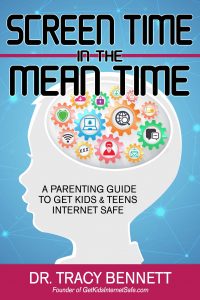
Kids learn empathy by watching their parents. We are prewired to learn it with specialized learning cells in the brain, called mirror neurons. Mirror neurons are part of a motor neuron that allows us to move facial muscles when expressing emotions. In Dr. Bennett’s book, Screen Time in the Mean Time: A Parent Guide to Get Kids and Teens Internet Safe, she says:

Our biology sets us up for success. In the 1980s, Giacomo Rizzolatti and his team of Italian researchers discovered that when macaque monkeys observed the behavior of other monkeys, the same neurons in their brains fired as if they themselves were performing the behavior (Pellegrino, 1992). In other words, the monkeys had specialized brain cells (called mirror neurons) ready to fire by observational learning. They learn and get practice by watching as well as doing.

Researchers now have evidence of similar mirror neurons in humans younger than twelve months old and hypothesize that mirror neurons are not only key in learning specific chains of motor behaviors but may also be what’s behind complex emotional learning like empathy and attachment (Falck, 2006). This genetic advantage means we are neurologically prewired to understand the intentions of others and unconsciously respond (Rizzolatti, 2006). We not only recognize logically what others are doing and feeling, but we also experience it with them. We are prewired to mimic, learn, and connect with each other.

Other factors necessary for the learning of empathy include:

  • the brain chemical oxytocin that sets us up to bond,
  • physical contact and nurture between parent and child,
  • parent-child fit,
  • warmth,
  • consistency, and
  • gently guiding communication.

Kids learn empathy better when it is modeled rather than when it is taught in the classroom.[2] They learn by interacting and watching how their parents respond to the cashier at a retail store or the server at a restaurant.

Empathy is also learned from how parents treat their children. If a parent is kind to their child, then the child will learn to be kind. Skilled caregivers reinforce empathic behavior when they provide an ongoing narrative about activities, validate emotion (confirm that they see and understand the child’s emotion), and praise children for prosocial behaviors like sharing and helping. The more practice and positive feedback kids get, the stronger their empathy skills. Of course, some kids are born with a natural talent to develop empathy based on genetics and personality. But with practice, all kids become less and less egocentric and more and more people-centered.

The Importance of Empathy

Teaching empathy is important because empathy helps us build relationships and adapt to stressful situations and setbacks. Doing a job well not only requires technical skills, but it requires empathy also.

In the professional sphere, empathy helps with negotiations, teamwork, interviews, and customer service.

On the playground, empathic children are good at making friends, keeping friends, and making others feel welcomed and cared for. They make the playground a safer place.

How Screen Time Interferes with Child Empathy

With all of us distracted by the cheaper version of connection from screen time, we are getting less practice with true empathy. Some experts believe that the rate at which young people and children express empathy has declined by as much as 25% in the past 10 years. [3]

Another way screen use interferes with empathy is by encouraging self-centeredness. Social media is believed to promote the obsession with self by allowing the user to edit and correct their image to the point of false perfection.[3] With the “perfect” virtual self to live up to, our nonvirtual selves often fall short of expectations. This can cause us to avoid real-life interactions and prefer screen interactions. We are more “connected” than ever with more and more people, yet we are getting more lonely, anxious, and depressed.

Ways Parents Can Promote Child Empathy

Narrate everyday activities while your kids watch and participate.

Make sure you include “feeling” words and challenge the child to imagine how other people might be feeling. For example, “Ooh this dinner is going to be good! It makes me happy to imagine the smiles on everybody’s faces when they take their first bite!”

Take the time to truly engage with eye contact, hugs, kisses, and tickles. Quiet snuggles count too.

Be sensitive to your child’s needs and let them know you “see” what they’re feeling. For example, “Oh honey, I can see you are getting tired and need a little break because you are frowning and rubbing your eyes. Let’s relax now and read a story.”

Set your child up for success by setting up a variety of playdates with all different ages of kids and adults.

Kids learn empathy by being nurtured, but also by nurturing themselves. Taking care of younger kids and following the instruction of older mentors offers various nuances for socioemotional skill-building.

Monkey see, monkey do.

Keep in mind that your behavior will be scrutinized and mimicked every second. Stay in the present, and practice a well-balanced online and offline activity diet.

Teach your children to “love and protect.”

Teaching your children to nurture animals and younger children is a great practice of empathy. Community service is also an awesome way to bring the family closer and teach kids philanthropy and gratitude.

Opt for interactive screen activities over passive screen time.

Thank you to CSUCI intern Elena Vachon for helping with the research for this article. Wondering how to optimize intellectual development along with socio-emotional development? Check out the article, GKIS Quick Tips for Intellectual Enrichment Through Screen Media for Preschool Age Children.

I’m the mom psychologist who will help you GetKidsInternetSafe.

Onward to More Awesome Parenting,

Tracy S. Bennett, Ph.D.
Mom, Clinical Psychologist, CSUCI Adjunct Faculty
GetKidsInternetSafe.com

Works Cited

[1] Bennett, T. (2017). Screen Time in the Mean Time: A Parent Guide to Get Kids and Teens Internet Safe.

[2] Upright, R. L. (2002). To Tell a Tale: The Use of Moral Dilemmas to Increase Empathy in the Elementary School Child. Early Childhood Education Journal, 30(1), 15-20.

[3] Bonnette, R. (2014). Rethinking Technology’s Impact on Empathy. Loyola University Chicago, School of Law.https://www.luc.edu/media/lucedu/law/centers/childlaw/childed/pdfs/2014studentpapers/Bonnette.pdf.

Falck-Ytter, T., Gredebäck, G. & Von Hofsten, C. (2006). “Infants Predict Other People’s Action Goals.” Nature Neuroscience Nat Neurosci9.7: 878-79. Web.How Parents Can Cultivate Empathy in Children, https://mcc.gse.harvard.edu/files/gse-mcc/files/empathy.pdf

Pellegrino, G., Di, L., Fadiga, L., Fogassi, V., Gallese, & Rizzolatti, G., (1992). “Understanding Motor Events: A Neurophysiological Study.” Exp Brain Res Experimental Brain Research91.1: 176-80. Web.Uhls, Y. T., et al. Five days at outdoor education camp without screens improves preteen skills with nonverbal emotion cues. Computers in Human Behavior (2014), http://dx.doi.org/10.1016/j.chb.2014.05.036

Rizzolatti, G., Fogassi, L., & Gallese, V. “Mirrors in the Mind.” Scientific American295(5) (2006): 54-61 SPECIAL SECTION: NEUROSCIENCE

Photo Credits

Human-Computer Interaction 96/365, Sashanovikova https://flic.kr/p/dpWva7

Photo by rawpixel.com on Unsplash

Photo by Juan Pablo Rodriguez on Unsplash

Is Facebook Spying by Hijacking Your Smartphone Mic?

Have you heard the rumor that Facebook is spying by recording your everyday conversation? Or maybe you’ve had an experience of Facebook offering a friend request after you had lunch with a shared friend? Facebook denies any form of spying. Are they being truthful or are they going behind our backs and hiding in the shadows of the Internet?

Ad Retargeting

Ad retargeting refers to a marketer using data about your browsing or buying history to advertise products you’re likely to buy.

It’s well known that Facebook and other websites participate in ad retargeting. However, stories have arisen that question how that data is being collected. One story that has been widely shared is about a couple talking about getting a cat and then, suddenly, ads for cat food appear on their Facebook profile.[1] Or the one about. a pregnant teen who was targeted for diaper and stroller ads before she even knew she was pregnant.

We’ve all been the victim of ad retargeting on Google or Facebook. For example, the other day I searched for a specific lotion from Bath & Body Works and added it to my cart. Before checking out, I closed the website to go on Facebook. JUST THEN, an ad was presented to me for the exact lotion I was waiting to purchase. Creepy!

Facebook

One of the largest social media outlets under fire regarding the invasion of privacy is Facebook. With over 2.3 billion Facebook users, this social media giant has a responsibility to protect its customers. Or do they?

In response to allegations, Facebook denied spying and claims they do not use microphone technology to listen in on our conversations.[2] Without our consent, that would be illegal.

Maybe there are different reasons why these coincidences are occurring. In psychology, we call the feeling of learning something and then noticing that the same thing appears constantly the Baader-Meinhof phenomenon.[2] In other words, it could be just your imagination and it’s truly a coincidence.

Smart Devices

Perhaps that explanation isn’t persuasive enough. There are smart devices (like televisions, refrigerators, and speakers) and even children’s toys that bend the rules of privacy and know more about us than we’d be comfortable with. Smart devices can use location, data, and even a microphone to gain personal information that is valuable to marketers.[3]

For example, smart connected toys like Talking Barbie are on the market, and parents are becoming concerned.[3] These toys not only record the sounds and conversations you home. They also store that data on a server. The doll can then respond with one of the thousands of canned responses based on an algorithm. If your daughter asks Barbie what outfit she should choose, Barbie may suggest she consider a career in fashion merchandising.

Smartwatches also raise privacy concerns.[3] For example, the Apple Health app on iPhones and Google Fit can track and collect data on your location wherever you take your phone.[4]

Smart speakers like Siri, Alexa, Echo, and Google Home are other examples of smart-connected appliances. Recent estimates are that Alexa has over 10,000 skills available.

Pixel and Digital Exhaust

The ‘liking’ and ‘sharing’ features on Facebook and other social media sites also provide important marketing data that allow those sites to more specifically target you.[5] The more they know about you, the better they can conveniently dish up items you will be compelled to buy.

Even with Facebook’s denial of privacy violations, many are still skeptical. During an episode of the podcast ‘Reply All,’ the hosts informed listeners that Facebook uses a program called Pixel. This program collects data about your online behavior and is installed on millions of websites.[6]

In fact, whenever you surf the Internet, you are followed by trackers, called digital exhaust, that collect data on your activity. This data that is very valuable to those trying to sell you something or learn about your interests and habits.

Is Facebook spying on you?

On the episode of Reply All titled, “Is Facebook Spying on you?” hosts investigated an incident where a listener was convinced Facebook listened in on her private conversation through her smartphone microphone. She reported that the same day she brought up the name of an old friend, Facebook suggested that individual as a contact.[6]

After much discussion, the listener learned that the site uses a shadow profile to access the contacts on your phone if that option is selected. The listener reasoned that since Facebook could determine her location was the same as her lunchmate, also a Facebook user, maybe the site decided they were friends and offered each of them friends from the other’s friends lists. She said it is kind of like a bird-of-a-feather-flocks-together offer.

The bottom line is that it’s almost impossible for us to anticipate how congregated (combined) data can be used to predict future behavior, and how that data might be useful to marketers.

Although most of us willingly sign over our private information in exchange for fun content, here are some ways to minimize risk.

  • Turn off the feature that tracks your location and embeds that data in your photos. For iPhone go to Settings > Privacy > Microphone and then unselect Facebook. On Android, go to Settings > Personal > Privacy > Safety > App permissions > Microphone and unselect Facebook.[2]

  • Turn off location services.

  • Avoid giving away private information.

  • Do not open or click on anything that looks suspicious.

  • Use a password generator, which is a software program or web page that will generate a one-time password for you to strengthen your cybersecurity.[8]

These tips and more can be found in my Cybersecurity and Red Flags Supplement a perfect addition to our free Connected Family Screen Agreement.

Thanks to Allie Mattina for clearing Facebook’s name, and providing us with interesting and accurate information. For more information regarding online tracking, take a look at the GKIS article “Sex Traffickers May Use Social Media to Troll Your Child. Start by Turning Off Geotagging” to learn more about how to protect your teen.

Works Cited

[1] Reply All. “Is Facebook Spying on You?” Gimlet, 2 Nov 2017.

[2] Titcomb, James. ” ‘Facebook is Listening to Me’: Why This Conspiracy Theory Refuses to Die.” The Telegraph, 30 Oct 2017.

[3] Haynes, Jessica. “Ways Your Technology is Already Spying on You.” ABC News, 7 Mar 2017.

[4] Koen, Trudy. “Your Social Media Apps are Spying on You; Here’s How to Get Your Privacy Back.” Blackberry, 20 Jun 2016.

[5] Hern, Alex. “Six Ways Your Tech is Spying On You and How to Turn it Off.” The Guardian, 10 Feb 2015.

[6] Reply All. “Year End Extravaganza.” Gimlet, 21 Dec 2017.

[8] Computer Hope. “Password Generator.” Computer Hope, 26 Apr 2017.

Photo Credits

Photo by Kai Brame on Unsplash

Photo by Oliver Thomas Klein on Unsplash

Photo by William Iven on Unsplash

Investors Urge Apple and Parents Petition YouTube to GetKidsInternetSafe. Has the GetKidsInternetSafe Revolution Begun?

This has been a big week for grassroot efforts to GetKidsInternetSafe. First was the petition urging YouTube to delete the account of wildly successful YouTube celebrity, Logan Paul, after he tastelessly posted a video showing him giggling alongside a suicide victim. Second was an open letter from two investors urging Apple to help parents with screen management due to screen addiction rates among children. Although research is scrambling to get current, there is substantial evidence that kids are being exposed to harmful content and addicted to their mobile screens. These two precedent-setting moves reflect growing concern and awareness about the very aspects that spurred me to create GetKidsInternetSafe; that technology is profoundly changing childhood and even brain development. After her inspiring Golden Globes speech about our influence on kids, we need Oprah to help us get the GetKidsInternetSafe Revolution some momentum!

In the introduction of my book Screen Time in the Mean Time: A Parent Guide to Get Kids and Teens Internet Safe, I describe how childhood and parenting has made a profound shift.

In modern times, child screen use has had a greater impact on the American family than anything since the abolition of child labor in 1938. Parenting has become a full-time preoccupation. Kids don’t labor for parents, parents labor for kids. Because of what we perceive as society’s high expectations of parents, raising healthy, happy kids has become overwhelming. We are expected to faithfully care for and entertain our children most of our waking hours without complaint. Although parents are waiting later to have kids and having fewer kids per family, with both parents working and the disappearance of extended family help, we have fewer supportive resources than ever before.

Even with little support, we have been accused of “helicopter parenting” to keep our kids safe and successful. We too often expect our kids to earn 4.0 GPAs, awards in robotics, and trophies in sports. Cs aren’t “average” anymore, now they’re a mark of parents not helping enough with homework. Our fear that we aren’t doing enough trickles down to our kids in the form of encouraging lectures and, too often, scathing shame and disappointment. We know this is too much pressure. So in between the “enriching” activities we work so hard to provide, we allow them leisure time…more leisure time than any children in history.

Parents are no longer willing to order their kids to go play outside until the streetlights come on. It’s too scary knowing what we do about child predators, bullying, sex, and drugs. To keep kids safe, we shelter them inside our houses to save them from the world’s perils. Instead of running amok like we did with hordes of neighborhood kids creating spontaneous, street-smart missions, they watch screens. And while they’re on their screens, we’re also on ours. Screen time gives us much needed breaks and provides what we hope is enriching content and a primer in digital literacy. But the troubling behaviors our kids demonstrate while compulsively viewing videos, social media, and video games eerily resemble signs of addiction. And we are the dealers, providing screens too often while they’re too young. We are hooked too. We feel guilty, but it’s often the best we can do. Screen technology has transformed childhood and parenting.

Thursday, Universal’s Access Hollywood Live, again hosted me as their parenting expert to talk about America’s concern about the negative impact of inappropriate video content through YouTube. As I stated on the program, the content that gets through is tantamount to child abuse, and kids don’t have insight into their psychological vulnerabilities. It is up to parents to filter and monitor. But we all know that there isn’t a tool strong enough to keep out sneaky algorhythms and celebrities and corporations bent on viral views that translate to big profits. We need help…and soon!

In their open letter to Apple, activist investors Jana Partners and the California State Teachers’ Retirement System (Calstrs), detail how surveys and studies definitively demonstrate that “it is both unrealistic and a poor long-term business strategy to ask parents to fight this battle alone.” They go on to say, “Imagine the goodwill Apple can generate with parents by partnering with them in this effort and with the next generation of customers by offering their parents more options to protect their health and well-being.” With their $2 billion dollar’s worth of Apple shares, their message is bound to get Apple’s attention.

Let’s be honest here. There is a rich clubhouse of companies that share the responsibility of the wellbeing of the world’s screen-watching kids. Youtube and Apple, yes, but grassroots activitists like myself are also reaching out to collaborate with other influential tech-giants like Facebook, Twitter, Instagram, Snapchat, Google, Amazon, and Disney, among others.

Until we come up with technology tools and sensible legislation protecting our kids from destructive violent and pornographic content as well as distracting, brain-changing, addictive use habits, we are stuck to do our best. Like I said on nationally syndicated television Thursday, how about we start by making our voices heard!

Here are the talking points from my AHL visit with fellow concerned moms, Natalie Morales and Kit Hoover:

Logan Paul has 15 million subscribers. He posts a 15-minute video a day, getting 300 million views a month (making 12-15 million dollars off these videos). His eager subscribers are primarily young people. How do you monitor?

With good old-fashioned supervision, location parameters, and rules to start. No screens in bedrooms, bathrooms, or behind closed doors. Dock mobile screens at night and set a Wi-Fi curfew. The GKIS Family Living Agreement helps get parents on-track.

YouTube does have a “safety” mode, but that doesn’t always prevent your child from seeing this content. Is it more about having a conversation as a family? How should you approach this?

There is a YouTube Kids site that also helps, but yes, it is about having conversation as a family, and a lot of it. Recognize that kids don’t yet have the experience to understand psychological vulnerabilities. Use current, fact-based information like that offered for free and delivered weekly on GetKidsInternetSafe to keep the conversation going. Saying “don’t do that” isn’t enough. Follow the specific conversation starters and sex ed tips offered in Screen Time in the Mean Time to ensure your kids know the difference between sensational content designed for profit (fake news) and content that reflects real-life, factual scenarios.

You have to be 13 years or older to use YouTube, but many of his followers are under the age of 13 (including Kit’s son)….

Exactly. We are all guilty of monitoring failure. We simply can’t supervise our kids 24/7, nor is it appropriate to do that. Social media platforms say 13 years old is required for use, but that is based on privacy issues rather than sound psychological reasoning. Accidental exposure is the most common type, but recognize that kids and teens are developmentally curious and bold; they’ll go looking for distressing material.

Is there a problem with kids being desensitized from these type of videos? Some kids who viewed this may have thought nothing of it.

My GetKidsInternetSafe articles detail how desensitization and even PTSD symptoms can result from livestream video viewing by kids and adults! Not only should Logan Paul have had x-generation team members to help him with common sense and compassion in that Japanese “suicide forest,” but our kids need a support team too. The victim ended his life in deep despair and his family members are destined to maintain it in their grief. Parents must specifically teach empathy and  compassion and recognize that viewing violence and flippantly talking about issues like suicide can create real risk, like suicide contagion – a dangerous cry for help.

People are calling for Youtube to suspend Logan Paul’s account after posting this video. Do you think that’s the right move? Are you surprised Youtube hasn’t taken action?

The truth is that YouTube profits from viral videos, and you can’t help but wonder how often does profit get in the way of ethical constraint or human compassion. I think that parents need to advocate for better safety measures on all the livestreaming platforms. In my practice, I treat kids who are commonly viewing violent pornography, imitating life-threatening stunts, and engaging with human traffickers, hate groups, and child predators. The research is showing that seeing hours of livestream news video, like what we saw with the Las Vegas shootings, can be more psychologically distressing than being a live witness to the tragedy! We can prevent this, and more can be done.

What can you do today?

Decide on a course for getting kids Internet safe by advocating with your favorite organization, like GetKidsInternetSafe.

At the time of this publication, the “Delete Logan Paul’s YouTube Channel” petition by an unknown author on Change.org had over 465,000 signatures. I personally wish the petition was addressed to YouTube with a plea to tighten their security measures rather than publicly shame Logan Paul. Although he is on a well-earned break, he took the video down himself. Before he did that, it still got over 6.5 million views and is currently being shown by other YouTubers who are at once shaming him for his judgment while simultaneously rebroadcasting the videos. Really folks? Hypocrisy in action.

Clean up your own screen use habits.

We are all habituated to picking up our phones in the meantime, whether it be waiting in line or during soccer practice. Let’s all make a little more effort to stay in the present with our kids and risk being alone with our thoughts. Remember what that used to be like? 🙂

Get educated by reading books like Screen Time in the Mean Time.

While we all spend the meantime on our phones, the mean time is being fueled. There are online risks to kids that most parents have never dreamed of. The future is here and despite how many of us, like Kit Hoover, wish we could go back to kick-the-can days, digital literacy is necessary for academic progression. Our kids won’t hear of no-screen weeks, nor will we. That means we need to get brave and educated. You may think you’ve heard it all, but I’m certain my information will help you make a more comprehensive and sensible safety plan and bring you closer to your kids. At the end of the day, what matters is that we do a good job raising great kids. Nothing is more important than that.

I’m the mom psychologist who helps you GetKidsInternetSafe.

Onward to More Awesome Parenting,

Dr. Tracy Bennett

Is Facebook Messenger Kids Harmless Fun or a Gateway Drug for Compulsive Social Media Use?

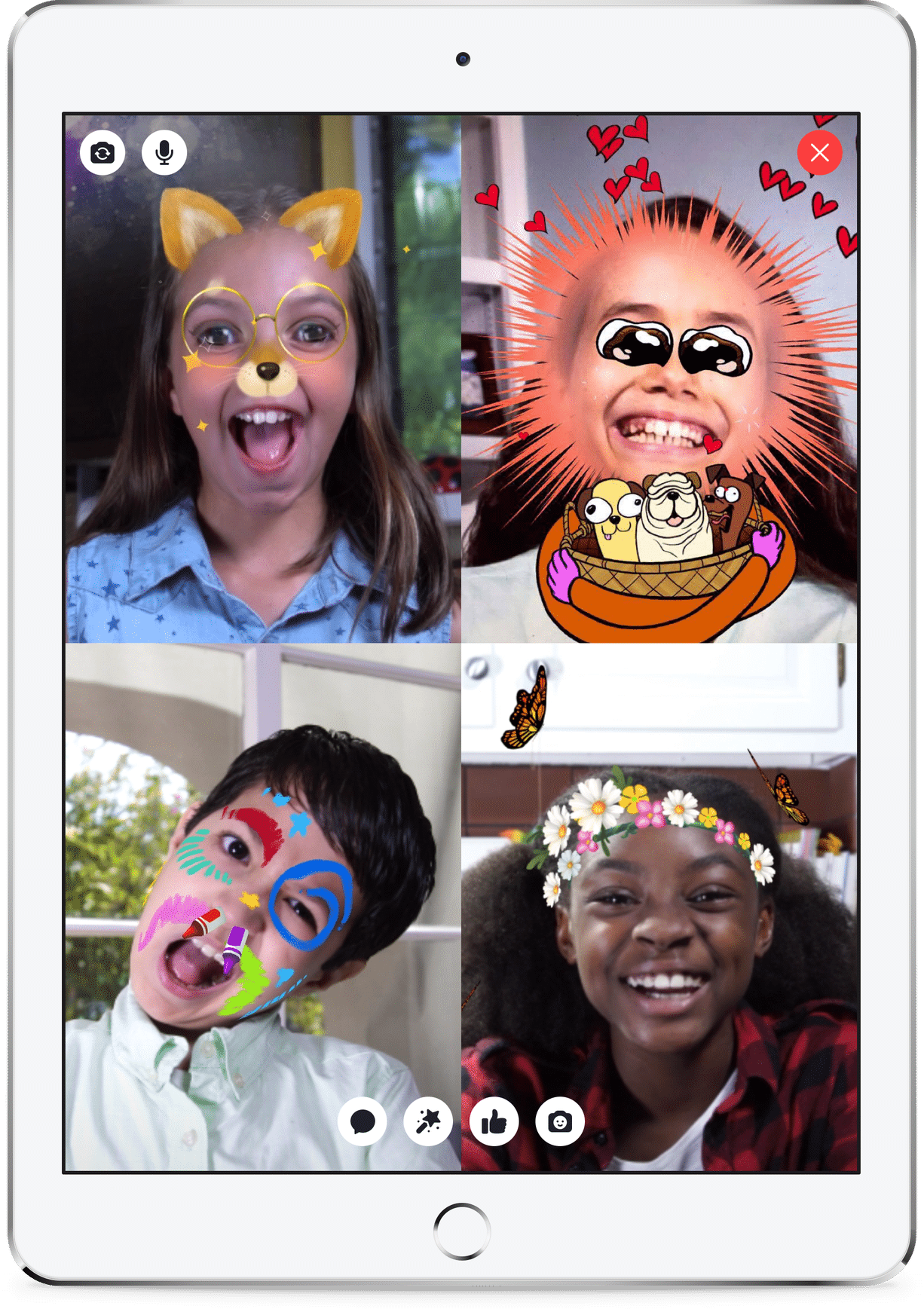
Facebook recently launched Messenger Kids, a free, stand-alone video chat and messaging app for children ages 6 to 12 to “connect with people they love but also has the level of control parents want.” Designed with kid preferences in mind, this app aims to please with one-to-one and group video chat or text thread, fun filters, masks, stickers and GIFs. Facebook says they have integrated features with the consult of a 100-member team with child safety and privacy in mind. Although I welcome the integration of kid-friendly features (finally!) that doesn’t sell to kids or collect information for marketing, introducing young children to a screen activity may be distracting at the least and addictive at the worst. Having participated with a team of experts talking about Messenger Kids, I believe Facebook has developed a much-needed product that can be very positive when used optimally with parent guidance.

Why now?

Historically, kids have been restricted from social media app membership without parental consent because of The Children’s Online Privacy Act (COPPA, 1998). This federal law imposes certain requirements on operators of websites or online services, like not collecting data from or advertising to children under thirteen years of age. Facebook is compliant with COPPA in that Messenger Kids won’t show ads, offer in-app purchases, or collect data for marketing. Also, in order to adopt the app, kids must have parent permission as an extension of the parent’s Facebook profile. Other safety features include parent control over their child’s contact list, child inability to delete messages, and an option to block users and report inappropriate content with parent notification. Kids can be found through Facebook search and parents must ask permission to see kid content to avoid spying. Facebook also says they won’t automatically upgrade users to an adult account when the child reaches 13 years old.

What are the privacy risks?

In response to privacy and security concerns, Democratic Sens. Ed Markey and Richard Blumenthal asked Facebook to specify what data is collected and what they’re planning to do with it, if information about child device location is being collected and stored, and whether Messenger Kids will be walled off from the Internet. Facebook has said collected information will only be used for infrastructure purposes to improve the app.

What are the behavioral risks?

As a clinical psychologist and screen safety expert, I am pleased that Facebook has delivered a product with child safety in mind. After all, surveys reveal that most kids are using apps before age thirteen that don’t have safety features. Messenger Kids offers families an option without the same risk profile as Instagram, Snapchat, Twitter, or KIK. However, there are still some risks to consider before allowing your child to adopt Messenger Kids.

First, we are all well aware of the compulsive nature of social media use. According to Apple, we check our iPhones an average of 80 times a day, 30,000 times a year.[i] Nearly 60% of parents think their teens are addicted to their mobile devices.[ii] With features specifically designed to keep people using, social media can lead to addictive use patterns that distract us from healthier activities and nonvirtual relationships. The younger the brain, the higher the vulnerability to habit formation and brain wiring changes. I’m not entirely satisfied with the argument that without this, kids are going to use less safe social media anyway. It’s kind of like letting your teen drink at your house since they’re going to do it anyway…Maybe the answer is don’t let them drink in the first place.

Do we really want children as young as six years old to have that kind of opportunity?

After all, child screen use is so new we have no idea what kind of long-term impact these kind of use patterns will have. Behavioral conditioning is an intentionally embedded component of  Silicon Valley tech products to increase profits. I believe the old adage, “If you can’t see the product, you are the product” may apply here. Furthermore, just because parents can monitor child behavior doesn’t mean kids won’t impulsively offer or view inappropriate or embarrassing information that can lead to shame and cyberbullying. The younger the child, the higher the risk. As a parent, are you ready for your child to adopt the “training wheels” for social media independence?

On the other hand, we must keep in mind that Messenger Kids is a messaging app, not a social media app. Parents have full monitoring control and must approve the contact list. This app is a fun way for kids to connect to other kids and family members, with playful adjunct features like masks and stickers. Facebook has said that this is not a product designed to profit off of children. Instead, Facebook believes it is good business to build products that people love to use.

Things I learned when Facebook asked me to participate in a working session with child and technology experts:

I believe that the best outcomes are reached through collaboration from people of all different viewpoints. As a result, I was very pleased to accept the invitation of Facebook to participate in a discussion with a panel of experts. I believe that being a part of the solution means getting in there and working with industry, academia, and with front-line teachers and practitioners. Obviously, I am under the restrictions that are typical of nondisclosure agreements when one works with a company about a product. However, it is appropriate to share my impressions having interacted with Antigone Davis, Head of Global Safety for Facebook, and the Facebook employees who have developed and continue to work on Messenger Kids.

I am somewhat unique in that I have lots of day jobs, all relating to psychology and families. I have had a private practice for over 23 years working with kids, teens, and adults. I teach addiction studies, parenting, and clinical psychology at CSUCI and supervise interns writing from a screen-media research perspective, and I’m founder of GetKidsInternetSafe, my love project. I’m fond of saying that I’m the MacGyver of psychology in that I take the theories and research findings from academia and apply them to real people in my practice, adjusting and tweaking as I go. From this perspective, I have a lot of opinions about the benefits and risks of screen activities to the American family.

Having interacted with the impressive panel of experts Facebook invited to the Facebook Global Safety Summit, I came away with the feeling that Facebook is being thoughtful and open about their child products. They are conducting their own research, generously open to feedback, and clearly dedicated to an ongoing dialogue about what families want and need. Let’s face it, they are experts with what they do and have enormous reach. I believe they have the potential to provide positive child and family service, and they’re taking that role seriously. As the company has matured, they seem to realize that they have a precious social responsibility to their customers and were very enthusiastic to hear from those of us who have dedicated our careers to child and family advocacy. I’m feeling pretty good about Messenger Kids, yet believe that kids and parents still need more education and support to best implement this fun communication tool while optimizing learning and connection on screen and off screen.

What should you keep in mind if you want to try out Messenger Kids for interactive digital play?

  • Stay engaged during the on-boarding process and visit the Messenger Kids FAQ page.

  • Recognize that this app was not designed for education, but rather as an alternative to adult social media apps that kids were already using. Not only must parents create a Facebook profile for Messenger Kids setup (another customer?), but Facebook branding has just been launched in your child’s tender consciousness. Ready, set, go!

  • Start a teaching dialogue about privacy, marketing, and balance. Familiarize your kids with the rules at a developmentally optimal level for their age and understanding.

  • Adopt the GKIS Living Agreement digital contract found in my book, Screen Time in the Mean Time: A Parent Guide to Get Kids and Teens Internet Safe.

  • Once on-boarded, your child has launched a dynamic digital footprint within the walled garden of their contact list. This may be their first introduction to digital messaging. Exciting yes, but supervision and building teaching opportunities are important for positive outcome.

  • Set up a creativity kit next to the computer with play props, dress up clothes, art materials, and toys. When you are having a conversation on Messenger Kids, encourage your child to act out a fun, creative activity like pretending to prepare and serve you lunch, writing a poem and presenting it, or choreographing a dance. Augmenting virtual reality with fun nonvirtual reality keep kids engaged with a balanced life of two-dimensional and three-dimensional play. Building relationships and play are still critical learning opportunities for the developing brain.

  • Watch to make sure your child doesn’t exhibits behaviors suggestive of compulsive use or addictive patterns.

  • Encourage your child to attend to the other person’s words, facial expressions, and feelings while chatting. Recognize that fun animations may be distracting, so they need your prompts and teaching narrative to learn social skills and digital citizenship.

  • Most importantly, offer an enriching balance of virtual with nonvirtual activities, a key to healthy development.

For additional information about another popular child app, check out The GKIS Sensible Parent’s Guide to Musical.ly.

I’m the mom psychologist who will help you GetKidsInternetSafe.

Onward to More Awesome Parenting,
Tracy S. Bennett, Ph.D.
Mom, Clinical Psychologist, CSUCI Adjunct Faculty
GetKidsInternetSafe.com

Works Cited

[i] Bajarin, B. (2016). “Apple’s Penchant for Consumer Security.” Tech.pinions, 18 Apr. 2016, techpinions.com/apples-penchant-for-consumer-security/45122.

[ii] Common Sense (2015). The Common Sense Census: Media Use by Teens & Tweens. www.commonsensemedia.org/sites/default/files/uploads/research/census_executivesummary.pdf

Photo Credits

Facebook

Silicon Valley Giants Suspend Alt-Right Social Media Profiles and Funding Campaigns. About Time or Overstepping?

After the Charlottesville violence, Silicon Valley giants, like Facebook, Google, Twitter, Paypal, and GoDaddy, are choking off tech avenues that hate groups use for crowdsourcing, organizing, and funding. This is a reversal of tech companies’ overall “hands off” approach to censorship and raises free speech concerns. In response to the censorship, alt-right organizations are revolting by creating parallel digital services, essentially birthing an alt-right Internet resembling the dark net. Some believe it is the tech companies’ right to cancel accounts that violate their values and membership agreements. Others think a private company using unregulated editorial judgment, with a profound impact on the ability for American citizens to communicate, is overstepping. What do you think?

What does this censorship look like?

Facebook and Twitter have actively suspended the accounts of white supremacists attached to the violence in Charlottesville, like white nationalist Christopher Cantwell and @Millenial_Matt, a social media personality who showcases the Neo-Nazi agenda. Considering that a third of the world’s population has a Facebook account and Twitter boasts 1.6 billion users per month, the power these social media giants wield is substantial.

The 71 million-website host, GoDaddy, has also chosen to censor users who demonstrate hate speech. For example, on Monday GoDaddy delisted the popular Neo-Nazi website The Daily Stormer, after its founder celebrated the murder of Charlottesville counter-protester Heather Heyer. When the Daily Stormer transferred its website registration to Google, Google also cut off the site.

In regard to funding, Paypal stated intent to remove 34 organizations from its customer base who espouse white nationalism. Apple also dropped funding sources for hate groups. GoFundMe, one of the largest crowdsource sites, deleted campaigns for the driver who murdered protesters in Charlottesville (Jan, 2017).

Promoting violent genocide is flat wrong, why are we even having this discussion?

I’m writing this article partly to impart news in case you didn’t hear it, but mostly to challenge you to think through the implications of Silicon Valley giants making decisions about the sharing of information. In this instance, I happen to agree with the policy that threatening violence should not be tolerated by any of us, government, private companies, or American citizens. The Internet spreads ideas like a virus, with hate groups recruiting people with untrue, manipulative, and inflammatory rhetoric. Vulnerable individuals, particularly the mentally ill and children, are at risk for being duped by sophisticated online grooming techniques. Perhaps Silicon Valley CEO’s have a moral obligation to limit their products’ availability as a tool to spread evil. But then there’s this concern…

What if the information they shut down is a cause you believe in? What if some of the censored activists were promoting unpopular ideas rather than threats or violence? What if the man behind the curtain decides to censor the democratic principles key to American freedom? Where does the slope start to get slippery? Should private corporations be making decisions about blocking pedophiles, terrorists, hate groups, and cults or should that be left to the government? Do we still trust a government that secretly surveilles its citizens, like what was revealed by Edward Snowden? Do we still have confidence in elected government leaders who use Twitter to cyberbully those who disagree with them?

“I’m happy to forfeit informational freedom for security”

Have you heard of the Total Information Awareness (TIA) policy? This program was developed in 2003 by the Pentagon under the direction of retired Adm. John Poindexter as a counter-terrorism measure. Under this policy, later renamed to Terrorism Information Awareness, the United States government aimed to integrate private and government intelligence and surveillance programs to be used as a powerful tool for the use of intelligence, counter-intelligence, and law enforcement. Simply put, that means secretly surveilling American citizens to better “detect, classify, and identify potential foreign terrorists” (The Associated Press, 2003).

On its surface, one may think, “Go ahead and track my online activities. It’s worth giving up some freedom for security. I’m not up to anything anyway.” But consider the fact that your personal online information is vast. The scope of the data collected by TIA included, but was not limited to, your browsing history (what you subscribe to, what your read, who you’re friends with, what you “like,” what you don’t like), financial data like purchases, transfers, and deposits, phone, email, and texting content, geolocation data, travel itineraries and passport data, licenses, judicial (driving and divorce) records, medical records, and biological data like fingerprints, DNA, and gait, face, and iris data. With your private information gathered and stored by the US government, your very identity is available to be hacked by any other entity as well. In the wrong hands, your private information could be used toward your personal devastation, whether you’re up to “no good” or not.

Fortunately in the case of TIA, Congress defunded the program after media reports recognized the alarming potential of “the biggest surveillance program in the history of the United States.” Elements of the program were then absorbed by three-letter governmental agencies and are said to be “quietly thriving” at the National Security Agency (NSA) operating with “little accountability or restraint” (Harris, 2012).

Current law requires that suveilling an American citizen or permanent resident is illegal without a court order. The loophole though, is that surveillance is legal if that citizen is communicating with somebody outside of the United States. Don’t worry though, if you were accidentally caught up in the NSA’s surveillance web, your private data is locked securely in a one million square foot facility in the Utah desert. What could possibly go wrong with that?

From Snopes: The film is authentic. “Don’t Be a Sucker” was produced by the U.S. Signal Corps and distributed by Paramount Pictures for viewing in civilian movie theaters in 1943 and again in 1947. This two-minute clip making the Twitter rounds captures the essence of its anti-fascist message:Where do you stand?

Most of us are frogs in the pot, slowly getting used to giving up our digital freedoms to entities like Facebook in order to gluttonously dine on delicious free Internet content. At what point is enough, enough? Will we get concerned when the government oversteps or when private corporations overstep? Or is privacy something that we are willing to give up for safety and security? Maybe we are OK with adult privacy being violated, but what about our kids? If this stirred you up, please comment in the comments below. Or better yet, “like” the GetKidsInternetSafe Facebook page and start up a conversation.

For specific information to discuss with your kids to protect them from hate group and cult recruitment, read this GKIS article.

I’m the mom psychologist who helps you GetKidsInternetSafe.

Onward to More Awesome Parenting,

Dr. Tracy Bennett

Photo Credit

Lock by Andrea Kirkby CC by-NC 2.0

Works Cited

Harris, Shane. “Giving In to the Surveillance State.” The New York Times, 22 Aug. 2012.

Jan, Tracy, and Elizabeth Dwoskin. “ Silicon Valley Escalates Its War on White Supremacy despite Free Speech Concerns.” The Washington Post, 16 Aug. 2017.

The Associated Press. “Pentagon’s ‘Terror Information Awareness’ Program Will End.” USA Today, 25 Sept. 2003.