Need peaceful screen time negotiations?

Get your FREE GKIS Connected Family Screen Agreement

addiction

Is Your Child a “Professional Gamer”?

“These games are a waste of time!” Does this parent-rant sound familiar? We are all hooked on our screen activities, but gaming has a particularly addictive quality. We already covered that there are many benefits. One big benefit that we haven’t covered yet is that gaming is a great launch for professional ventures that connect players to other people all over the world. Why is gaming so popular, and what can be accomplished or gained by playing them?

Why Kids Are Hooked

A common belief about video games make us mindless. Many studies have found links to aggression and gamers. However, these studies primarily tested a small subset of games with violent shooters. In contrast, studies from role-playing games have shown benefits for the player.

Specifically, gamers have been shown to demonstrate and build emotional skills like feeling guilt and shame when a character acts immorally.[1] Games also provide a fertile resource for building team play and social skills. For instance, in one study online gamers reported feelings of community and belonging while playing online. They claimed that the social relationships gained while playing provided them with social support and helped them develop a healthy social identity.[2]

Action games, which do include shooters, have also been shown to increase our ability to hold visual information[3], increase the ability to multi-task and manage attention[4], and calm and de-stress.[5]

Games are not simply a means of passing the time. The time spent playing is meaningful. Other exciting benefits include entertainment, identity exploration, and higher-order thinking and problem-solving. Gaming can even launch life-changing educational, entrepreneurial, networking, and earning opportunities!

What game do I want to play?

Each gamer is unique and expresses themselves through the genre or style of gameplay they choose. Each genre requires certain skills and characteristics for the player to succeed. There are five main genres in gaming: Action, Role-Playing, Simulation, Strategy, and Sports.

Action

  • The player is given challenges that can include climbing obstacles, solving puzzles, defeating enemies, or collecting certain key items.
  • The player must have fast hand-eye coordination and quick reflexes to succeed.
  • Popular games include Minecraft, Overwatch, Fortnite, Grand Theft Auto.

Role-Playing

  • Based on the tabletop game Dungeons and Dragons
  • The player is tasked with completing missions to progress and strengthen their character(s).
  • Contains immersive worlds and engaging stories
  • Popular games include World of Warcraft, Final Fantasy, Pokémon.

Simulation

  • Utilizes the use of virtual worlds to simulate aspects of reality and fantasy for training purposes
  • There are no goals the player has to follow.
  • Popular Games include The Sims, Farming Simulator, Flight Simulator.

Strategy

  • Gives the player control of multiple characters
  • Players must use these characters to explore, engage in combat, and gather and utilize economic resources.
  • To succeed the player must use strategy and great tactics.
  • Popular Games include StarCraft, Civilization, Age of Empires.

Sports

  • Allows the player to take control and play as their favorite sports team or player
  • Some games in the genre try to recreate current sports as realistically as possible, while others create new sports with over-the-top effects and fast gameplay.
  • Popular Games include Madden, FIFA, Rocket League.

What do I want to do in the game?

Through gaming, children are provided with unique freedoms and communicative abilities. In most games, the first goal is to decide what mission to pursue. Completion of the mission rewards the gamer by furthering the story, giving the gamer new items, or providing the gamer with experience points used to increase the skill of their character.

When deciding how to approach the mission, the gamer is given multiple options. In single-player games, the gamer can choose the look of their character, which missions to pursue, and how they wish to approach each mission. The gamer must decide if they want to take on the mission alone, team up with a friend, or tackle missions online with millions of other players worldwide. Cooperative games offer an intimate, fun experience that can be shared with friends and family on a single TV or in private online sessions. They also have to decide about strategy. For example, they can:

  • charge straight in taking on all challenges at once,
  • take a stealthy approach,
  • scout the area and gather resources along the way, or
  • create a tactic all their own.

Game Streaming & eSports

Social media sites have become an integral part of a gamer’s identity. They give players the ability to choose their online friends, the style of their home page, and what is posted and commented on their profile. Kids can communicate through private sessions with friends and live streams to a worldwide audience.

Dozens of video streaming sites and their users have taken advantage of this gaming movement. On YouTube and TikTok, popular personalities showcase themselves playing video games to garner more views and make revenue from advertisers.

Twitch TV is a video game streaming site that allow users to live-stream themselves playing games to global online audiences. Streamers are paid through viewer subscriptions, donations, and sponsorships. Sponsorships are given to gamers for unique and appealing personalities and highly acclaimed skills. Many gamers who are sponsored for their skills are also part of a rapidly growing eSports league.
The eSports league involves teams and tournaments similar to those seen in other professional sports leagues. Funding for tournaments and players comes through sponsorships, endorsements, advertisements, and online donations. Gamers are paid well for winning. For instance, a popular game, Dota 2, had a prize pool of over twenty million in 2016. Each player of the winning team took home $1.8 million.[6]

eSports can also bring fame. The eSports league has become a huge phenomenon spanning the globe, rivaling and even surpassing long-standing professional sports. In 2014, a popular PC game, League of Legends had a tournament that garnered more viewers than game seven of the MLB finals and game seven of the NBA finals combined![7]

Universities have begun to pick up on the eSports trend as well. Robert Morris University recently launched the first sponsored eSports Team. Players of the team are students who receive scholarships for their play just as another student would receive a scholarship to play football or basketball. They train just as another collegiate team would. They are instructed by a coach, study the competition, and practice running drills.[7]

In the past, the word gamer was associated with words like lazy and non-social. Fortunately, these stigmas are changing. Gamers today are seen as entrepreneurial (creating your own business), professional, and globally connected.

Thank you to CSUCI Intern, Dylan Smithson for teaching us about the skill-rich, lucrative world of gaming. If you enjoyed reading this article, feel free to share with friends and family, and give us a like on our GetKidsInternetSafe Facebook page.

I’m the mom psychologist who will help you GetKidsInternetSafe.

Onward to More Awesome Parenting,

Tracy S. Bennett, Ph.D.
Mom, Clinical Psychologist, CSUCI Adjunct Faculty
GetKidsInternetSafe.com

Works Cited

[6] Bednarski, S (2016) Top 5 Largest eSports Prize Pools of 2016. http://www.xygaming.com/content/top-5-largest-esports-prize-pools-of-2016/

[3] Blacker, K. J., Curby, K. M., Klobusicky, E., & Chein, J. M. (2014). Effects of action video game training on visual working memory. Journal Of Experimental Psychology: Human Perception And Performance40(5), 1992-2004. doi:10.1037/a0037556

[4] Maclin, E. L., Mathewson, K. E., Low, K. A., Boot, W. R., Kramer, A. F., Fabiani, M., & Gratton, G. (2011). Learning to multitask: Effects of video game practice on electrophysiological indices of attention and resource allocation. Psychophysiology48(9), 1173-1183. doi:10.1111/j.1469-8986.2011.01189.x

[1] Mahood, C., & Hanus, M. (2017). Role-playing video games and emotion: How transportation into the narrative mediates the relationship between immoral actions and feelings of guilt. Psychology Of Popular Media Culture6(1), 61-73. doi:10.1037/ppm0000084

[2] O’Connor, E. L., Longman, H., White, K. M., & Obst, P. L. (2015). Sense of community, social identity and social support among players of massively multiplayer online games (MMOGs): A qualitative analysis. Journal Of Community & Applied Social Psychology25(6), 459-473. doi:10.1002/casp.2224

[7] Ravitz, J (2016) Varsity Gamers Making History and Dumbfounding Parents http://www.cnn.com/interactive/2015/07/us/varsity-gamers-american-story/

[5] Reinecke, L. (2009). Games and recovery: The use of video and computer games to recuperate from stress and strain. Journal Of Media Psychology: Theories, Methods, And Applications21(3), 126-142. doi:10.1027/1864-1105.21.3.126

Takahashi, D (2016) Worldwide Game Industry Hits $91 Billion in Revenues in 2016, with Mobile the Clear Leader. http://venturebeat.com/2016/12/21/worldwide-game-industry-hits-91-billion-in-revenues-in-2016-with-mobile-the-clear-leader/

Photo Credits

Paris Game Week 2013 James Cao, CC BY-NC-SA 2.0

E3 Patsun, CC BY-SA 2.0

Gaming Day Skokie Public Library, CC BY-NC-SA 2.0
 

Why Screen Use is the New Heroin

blog67tweenonground

When the term “addiction” is used, most people think of drugs or alcohol. But in the digital age, there is a new addiction that is accessible to almost everyone and can start in elementary school. It is the Internet. Parents use the Internet to occupy their children, and teachers use it in the classrooms as a daily educational tool.

Internet addiction does not sound like a big deal, but like other addictive drugs and behaviors, it has undesirable psychological consequences and some of the same withdrawal symptoms. It is also very accessible. No ID is needed to verify age for use, and the Internet is open twenty four hours a day, seven days a week.

I’m Kathleen, Dr. Bennett’s intern from California State University Channel Islands. My eleven year-old daughter once again did not do her chores, so I took her phone and computer use away. Her reaction shocked me. When she could not access her social media sites she became agitated, emotional, restless, and begged and pleaded for me to let her use it for just a minute. She was acting like a drug addict who needed a hit to ease the pain. Was she in the beginning stages of Internet addiction?

Pre-addiction signs to look out for:

Increasing use to achieve satisfaction

This can happen when an adolescent is using gaming or social media to fulfill emotional needs. They will keep logging on to feel close to others if their emotional needs are not being met in real life. These needs are satisfied through maintaining online relationships with gaming (more common among boys) and social media (more common among girls) to give the feeling of pleasure and or escape from what is going on in nonvirtual life. Emotional needs are met through getting a “like” on a picture, a response to a post, or a new friend request rather than a healthy collaborative friend relationship.

Preoccupying thoughts about use

An adolescent may have intrusive thoughts about Internet use such as, “I need to see if anybody commented on my photo,” or “What if I miss out on something important?” These thoughts can distract them from studying and maintaining real life relationships with their friends and family.

Falling grades from overuse

Grades can decline from screen use for social media, gaming, and chatting instead of doing homework and studying. Also if a child has a computer or smartphone in their room, loss of sleep from staying up late to use the Internet contributes to falling grades (Hung et al., 2005).

Other symptoms that may be an indicator that an adolescent’s Internet use has moved from fun to addiction are lying about how much time is spent online, responsibilities get ignored, mood changes from not being able to log on, and relationships become strained. Despite addiction risk, there are many benefits that the Internet provides. It serves as research and study tool and can help maintain relationships between friends and family.

Suggestions to ensure healthy screen use:

Set limits. Filter. Monitor.

One of the best strategies for preventing Internet addiction is making sure your children have limits to what they do and see online and how much time they spend. Make nonschool computer use a reward for helping out and maintaining good grades instead of using the computer to entertain your child.

Prevent boredom by providing enriching activities

Boredom can be alleviated with Internet use, but there are many other things that can as well. Provide and promote books, puzzles, or arts and crafts instead of Internet use. Instead of the computer being used as a tool for relaxing, encourage going for a walk around the block or sign your child up for after school group or sport activities. This will not only help limit computer use but it also provides exercise.

Connect better as a family

Family activities will help strengthen relationships and bring closeness. Have a picnic in the park, go on a hike, or play a board game together. This will not only help limit computer use for your child but for you as well. This can also be a great way to have a ongoing teaching dialogue with your children and family (Lin et al., 2009).

blog67boyinhat

While there are lots of benefits of Internet use, it is important to keep a look out for trouble signs. And if your child’s symptoms are getting in the way of academics and healthy relationships, seek support from your pediatrician or clinical psychologist. For more information on how to limit computer time, check out “Start Fall Fresh with a Cleansing Digital Detox.”

KathleenCongratulations and thank you to Kathleen Gulden, CSUCI intern, for authoring her first GKIS article!

I’m the mom psychologist who will help you GetKidsInternetSafe.

Onward to More Awesome Parenting,

Tracy S. Bennett, Ph.D.
Mom, Clinical Psychologist, CSUCI Adjunct Faculty
GetKidsInternetSafe.com

Works cited:

Lin, C. , Lin, S. , & Wu, C. (2009). The effects of parental monitoring and leisure boredom on adolescents’ Internet addiction. Adolescence, 44(176), 993-1004.

Ko, C. , Yen, J. , Chen, C. , Chen, S. , & Yen, C. (2005). Proposed diagnostic criteria of Internet addiction for adolescents. The Journal of Nervous and Mental Disease, 193(11), 728.


“New” Pot and Why It’s Dangerous for Teens


Teenager Offering Pot to Smoke Originally published by The Good Men Project

Is your child smoking pot? I hope not, but parents are the last to know. Within the last five years, kids are smoking pot sooner and at higher rates. As marijuana becomes increasingly available (and legal), kids perceive the drug to be less risky. With the increasing potency of this addictive drug, marijuana poses a significant risk to the developing brain. Educate your kids now before they try their first pot brownie. That means a heart-to-heart talk with the facts BEFORE middle school!

Marijuana use is UP and smokers are starting younger.

Just as I’m hearing in my suburban psychology practice, five-year trends reflect increasing marijuana use among tenth through twelfth graders, with kids starting to smoke at younger ages than ever before. We haven’t reached the peak use rates of the 1970s, but we may be getting there.

However, there is hope! Teaching kids the facts may hold off experimentation. For instance, when popular media covered the adverse effects of synthetic marijuana (spice, K2, or wax), use rates went down. Educating your kids about the easily available marijuana their friends are smoking optimizes the chance they’ll use good judgment. Here are the facts parents need to know!

Today’s pot is far more potent than pot from the 1970s-1980s.

The average marijuana today contains 20-30% THC versus 1980’s pot which averaged 4% THC. That means that old research conclusions barely apply to today’s pot. Furthermore, as THC potency increases the number of cannabinoids decrease. Cannabinoids are the chemical compounds in marijuana that is responsible for proposed medical benefits.

Cat Sitting Next to Pot Plant

Marijuana is physiologically and psychologically addicting.

Cannabinoids increase dopamine in the pleasure center of the brain. This is the same process that underlies the reinforcing effects of ALL addictive drugs. Because there is a high concentration of cannabinoid brain receptors in many different areas of the brain, marijuana has many effects on the user. This is why marijuana is in a drug class of its own with effects that qualify it as a hallucinogenic, sedative, or analgesic.

Similar to all drugs of abuse, there is clear and consistent evidence of tolerance, withdrawal, and craving resulting from marijuana use. For the benefit of three hours of a high, you have the cost of up to fourteen days of withdrawal. Withdrawal symptoms include irritability, stomach pain, anxiety, loss of appetite, and insomnia.

Starting young and smoking often makes you dumber.

Chronic marijuana smokers younger than 18 years old demonstrate an average IQ decline of eight points and other signs of impaired mental functioning by age 38 years.

Medical Marijuana Sign

Marijuana has legitimate applications for some medical conditions.

The marijuana effects of increased hunger and happiness have been found to be helpful for the nausea, anorexia, and wasting experienced by people with HIV (Bedi et al. 2005; Haney et al. 2007; Lutge et. al. 2013) and chronic neuropathic pain related to HIV, multiple sclerosis, and peripheral neuropathy (Lynch et al. 2011; Ware et al 2010). However, marijuana is rarely recommended as first-line treatment due to side effects. Most studies evaluate the oral forms of marijuana rather than smokable forms.

Marijuana obscures psychiatric presentation and generally makes mental illnesses worse rather than better.

  • Anxiety Disorders: Self-medicating with pot leads to cyclic withdrawal and heightened anxiety that is harder to treat with traditional therapies. Marijuana lowers GABA, natures calming neurotransmitter.
  • Mood Disorders & ADHD: Marijuana dysregulates serotonin, dopamine, and norepinephrine, the neurotransmitters related to mood and attention disorders. In other words, pot makes mood and ADHD symptoms worse.
  • Schizophrenia: Schizophrenia is a psychotic disorder characterized by hallucinations, delusions, and a lack of initiative. It is typically incurable and progressive, often seen among our homeless population.

Here is the most disturbing research outcome I have read in my twenty-year career. The use of marijuana increases the chances of developing schizophrenia by 600% for heavy smokers, 400% for regular smokers, and 200% for any smoking (Andréasson et al. 1987; Stefanis et al. 2013)! This does not mean marijuana causes schizophrenia, but it certainly increases the chances that it will occur. I caution my patients often, why take that kind of risk with your life and brain health just to get high?

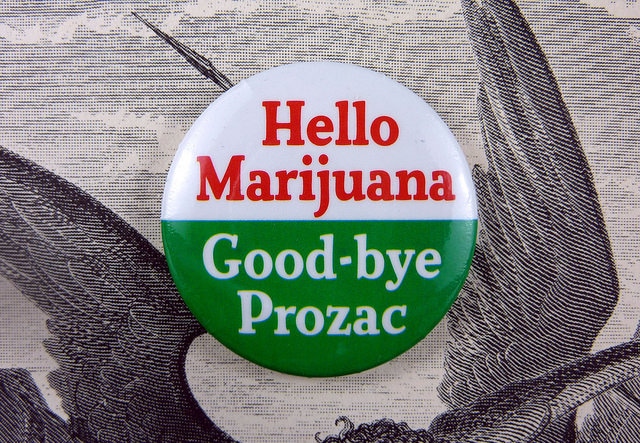
Hello Marijuana, Good-bye Prozac button

You can’t be sure all you’re smoking is marijuana.

Marijuana is often laced with more addictive drugs like cocaine, heroin, or PCP to keep buyers buying. Although adulteration if far less of a risk for marijuana than other drugs, the heavier the drug the higher its price. As a result, adulterants like lead, silicone, Mountain dew, and Windex have been commonly discovered in pot samples. Marijuana is also often treated with pesticides to optimize profitable quantities. So much for organic.

Chronic marijuana use is particularly harmful to the developing brain, because it decreases Brain Derived Neurotrophic Factor (BDNF).

BDNF is a chemical that regulates the birth, survival, and repair of the cells that make up the brain. BDNF is responsible for what scientists call neuroplasticity, the adaptive processes underlying learning and memory.

Pot lowers BDNF levels. So if an adolescent’s brain is not developing normally, pot may make it worse (D’Souza et al. 2009; Zammit 2003). Clinically we have found that if we can get our client clean from marijuana after their first psychotic symptoms, they have a far better chance of recovery rather than suffering a progressive course.

Teen Smoking Pot from Glass Pipe

Chronic marijuana use has been found to have various negative health effects, including:

  • a suppressant effect on immune system (long-term unknown);
  • an adverse effect on the reproductive systems of men and women (lower testosterone and lower sperm count in males and lower LH secretion in females), but there is no evidence of a change in fertility;
  • no identified increase in birth defects, but may contribute to low birth rate and less maternal milk production;
  • problematic behavioral syndromes including lower GPA, more truancy, higher drop out rate, and more delinquency.
    Money and Drugs on Table
  • Marijuana has become BIG BUSINESS.

    Big tobacco money is investing in the marijuana industry. As a result, I anticipate the “mom and pop” head shops will be going bankrupt while even more slick marketing comes on the scene. There’s big money to be made at the expense of the public’s health…again (remember tobacco?).

    As marijuana gets more addictive and capable of generating profit, we are seeing a more diverse product line of smokables and edibles, some of which are packaged to be attractive to children. Although there are no reported cases of death by marijuana overdose, there are increasing numbers of emergency room visits due to marijuana use. Safety groups are advocating for potency limits, better labeling, bans of products packaged to appeal to children, and a regulatory structure for marijuana similar to those that exist with tobacco and alcohol.

    Regardless of your opinions about adult use of marijuana, I think we can all agree that marijuana is harmful for children and teens. I hope these facts inspire you to have a factual discussion with your kids. Although education isn’t all kids need to stay safe from drugs, I am frequently pleased to see my clients alter their course after a factual and reasonable discussion about the risks of marijuana on the developing brain.

    I’m the mom psychologist who will help you GetYourKidsInternetSafe.

    Onward to More Awesome Parenting,

    Tracy S. Bennett, Ph.D.
    Mom, Clinical Psychologist, CSUCI Adjunct Faculty
    GetKidsInternetSafe.com

Works Cited

Andréasson, Sven, Ann Engström, Peter Allebeck, and Ulf Rydberg. “CANNABIS AND SCHIZOPHRENIA A Longitudinal Study of Swedish Conscripts.” The Lancet 330.8574 (1987): 1483-486. Web.

Bedi, Gillinder, Richard W. Foltin, Erik W. Gunderson, Judith Rabkin, Carl L. Hart, Sandra D. Comer, Suzanne K. Vosburg, and Margaret Haney. “Efficacy and Tolerability of High-dose Dronabinol Maintenance in HIV-positive Marijuana Smokers: A Controlled Laboratory Study.” Psychopharmacology 212.4 (2010): 675-86. Web.

D’Souza, Deepak Cyril, Brian Pittman, Edward Perry, and Arthur Simen. “Preliminary Evidence of Cannabinoid Effects on Brain-derived Neurotrophic Factor (BDNF) Levels in Humans.” Psychopharmacology 202.4 (2009): 569-78. Web.

Haney M, Gunderson EW, Rabkin J, Hart CL, Vosburg SK, Comer SD, Foltin RW. “Dronabinol and Marijuana in HIV-Positive Marijuana Smokers: Caloric Intake, Mood and Sleep.” JAIDS 45 (2007): 545–554. [PubMed]

Lutge, Elizabeth E, Andy Gray, and Nandi Siegfied. “The Medical Use of Cannabis For Reducing Morbidity and Mortality in Patients With HIV/AIDS.” Database of Systematic Reviews (2013):4. Web. http://onlinelibrary.wiley.com/doi/10.1002/14651858.CD005175.pub3/abstract

Lynch, Mary E., and Fiona Campbell. “Cannabinoids for Treatment of Chronic Non-cancer Pain; a Systematic Review of Randomized Trials.” British Journal of Clinical Pharmacology 72.5 (2011): 735-44. Web.

“Marijuana.” Marijuana. N.p., n.d. Web. 02 Jan. 2015.

Meier, M. H., A. Caspi, A. Ambler, H. Harrington, R. Houts, R. S. E. Keefe, K. Mcdonald, A. Ward, R. Poulton, and T. E. Moffitt. “Persistent Cannabis Users Show Neuropsychological Decline from Childhood to Midlife.” Proceedings of the National Academy of Sciences 109.40 (2012): E2657-2664. Web.

Stefanis, N. C., M. Dragovic, B. D. Power, A. Jablensky, D. Castle, and V. A. Morgan. “Age at Initiation of Cannabis Use Predicts Age at Onset of Psychosis: The 7- to 8-Year Trend.” Schizophrenia Bulletin 39.2 (2013): 251-54. Web. http://schizophreniabulletin.oxfordjournals.org/content/early/2013/01/10/schbul.sbs188.abstra ct

Ware, M. A., T. Wang, S. Shapiro, A. Robinson, T. Ducruet, T. Huynh, A. Gamsa, G. J. Bennett, and J.-P. Collet. “Smoked Cannabis for Chronic Neuropathic Pain: A Randomized Controlled Trial.” Canadian Medical Association Journal 182.14 (2010): E694-701. Web.

Zammit, S. “Self Reported Cannabis Use as a Risk Factor for Schizophrenia in Swedish Conscripts of 1969: Historical Cohort Study.” Bmj 325.7374 (2002): 1199. Web.

Photo credits

Paff, paff, pass it! By Jon Richter, CC by-NC-SA 2.0

So Young. By Will Bryson, CC by-NC-SA 2.0

Medical Marijuana. By Chuck Coker, CC by-ND 2.0

Prozac Makes Better Christians But Marijuana Makes Better Brownies. By wackystuff, CC by-SA 2.0)

Denver 4/20 Marijuana Rally 2013. By Jonathan Piccolo, CC by-NC-SA 2.0

Money Money Money. By Filipe Garcia, CC by-NC-ND 2.0