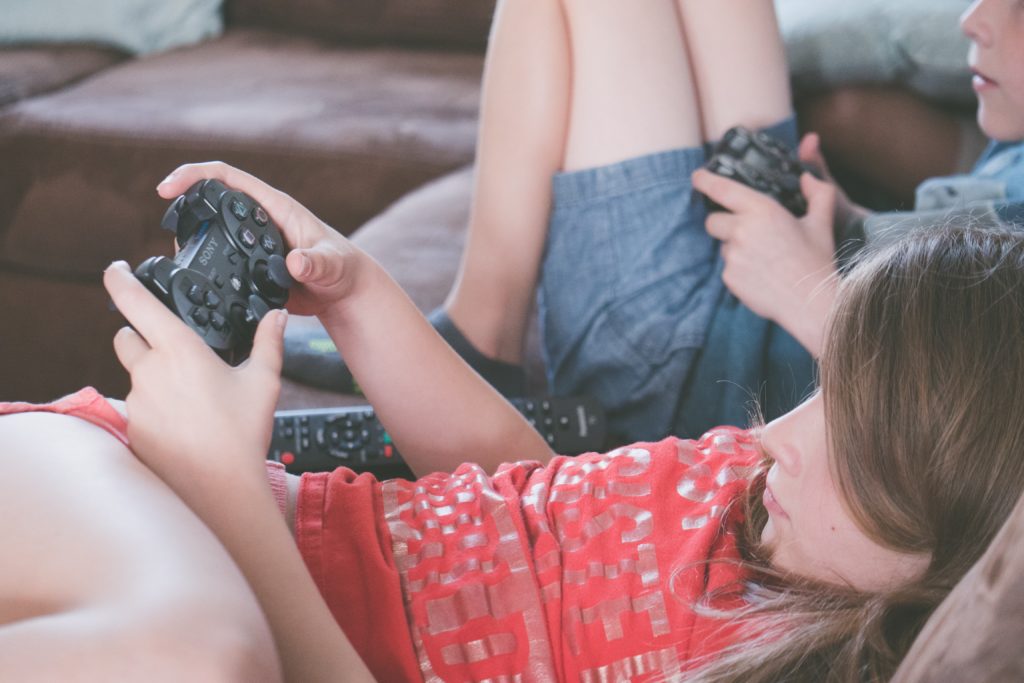
I love playing video games! My first article discussed the benefits of gaming. But the truth is, most popular games aren’t designed for kids. They’re designed to attract us and keep us playing. The more we play, the more money the gaming industry makes. Violence and sex attract gamers. But research has demonstrated that exposure to this content can negatively affect a child’s brain. However, child development experts have not been able to pull violent games off the shelves. The best they’ve done so far is accept the game industry’s offer to develop their own rating system. Today’s GKIS article covers why experts are concerned about child exposure to video game violence and why the research hasn’t been enough to make a dent in the global game industry’s annual $183billion revenue.[1]
Most kids start playing video games before adolescence. Content, time spent playing, ability to be interactive, and player vulnerabilities must be considered when determining effect.[3] This makes for messy factors to control for quality research and controversial opinions about the risks of violent video games.
mental rotation, tracking, and toggling between tasks[5]
problem-solving
strategy building
goal setting
and increased confidence, social connection and networking, cooperation, and self-esteem.
Social benefits are particularly valuable for players who may be isolated in tiny towns or who have disabilities. Gaming can also teach important job skills and offer profitable e-sport tournament competition.
The Risks of Gaming
Research has demonstrated that gamers who play violent video games show more aggression toward others. It has also found that gamers show a decrease in friendliness, positivity, and helpfulness.[6] It’s also been demonstrated that gamers are less likely to emotionally react to violence over time. We call that sensitization to violence.
For example, a 2014 experiment also found that gamers were less likely to help and injured person, rated violent acts as less serious, and were less likely to respond to fights.[7]
Another study found that exposure to violence created the idea in children’s heads that violence is an acceptable form of problem-solving. It can also lead to a mean world syndrome, defined as a belief that the world is dark and dangerous.[8]
Video games are not designed for young kids.
Video game companies develop games for kids, but they amount to a small percentage revenue. The average age of gamers is 32-years-old.[14] Since 2009, the top-selling video games are rated mature.[15] Because of good marketing and pester power, a significant portion of those sales come from parents of young kids.
Young players are so common on video streaming sites and MMORPGs (massively multiplayer online role-playing games), they’re referred to as squeakers due to their child voices. Child predators hunt for victims on gaming platforms.
For example, in PokémonGo, predators have been reported to place lures, which are in-game items that spawn rare catches. Children close by will notice the new location and travel to catch the Pokémon unaware of the trap being set.[16]
Regulating Video Games
Attempts to block violent video game content from kids have been unsuccessful. Since the 1972 release of the first popular video arcade game, Pong, parents have worried about the impact of video gaming on their children. Just like our kids, we have largely become desensitized to its impact. From 1976, when parents succeeded in getting the video game Death Race pulled from the shelf due to the little gravestone that appeared when a character was killed, to now, we’ve come a long way. Or have we?
In response to video game players committing violence, several lawsuits have claimed that game manufacturers were negligent by selling violent content that is harmful to children. Few have succeeded due to first amendment (free speech) rights claims and insufficient evidence.
City ordinances attempting to limit gameplay by unaccompanied minors in public places have also failed. Law professors and psychologists argue that the evidence is too flimsy to make solid claims that video games cause violence. For instance, if video games cause aggression why is the rate of juvenile violent crime is at a thirty-year low?
A particularly impactful blow against state regulation was the United States Supreme Court ruling in Brown v. Entertainment Merchants Association (2011). This ruling concluded that the California law restricting the sale and distribution of violent video games to minors was unconstitutional. The ruling stated that “speech about violence is not obscene” and is “as much entitled to the protection of free speech as the best in literature.”
Video Gaming Rating System
To counteract consumer complaints and stop legislation, the video game industry created the Entertainment Software Rating Board (ESRB) in 1994. This voluntary and self-regulating board rates content and classifies video games based on the appropriate user age.
Most stores refuse to sell video games that don’t have an ESRB rating. Similar rating systems exist in other countries. Overall, ESRB ratings have been somewhat successful in limiting child access.
RP (Rating Pending) – this is placed on games that have not yet received a final ESRB rating
EC (Early Childhood) – suitable for ages 3+, these games tend to be educational and do not contain any inappropriate material
E (Everyone) – suitable for all ages, may contain mild fantasy or cartoon violence
E10+ (Everyone 10+) – suitable for ages 10+, may contain mild language, fantasy, or cartoon violence
T (Teen) – suitable for ages 13+, may contain violence, suggestive themes, crude humor, blood, infrequent use of strong language
M (Mature) – suitable for ages 17+, may contain intense violence, blood and gore, sexual content, strong language
A (Adults) – suitable for ages 18+, may contain prolonged scenes of intense violence, graphic sexual content, gambling with real currency
Tips for Parents
Check the ESRB ratings before purchasing.
Engage in video game play with your child to learn about the game’s content, and to model appropriate play.
Set clear rules as to how long play can be at home and away with your free GKIS Connected Family Agreement.
Monitor your child’s online gaming conversations to make sure there are not taken advantage of or threatened.
Set up gaming stations in a family community area (never the bedroom) to optimize supervision.
Encourage your child to engage in alternative activities for a healthy balance, learning, and enriched learning.
Thank you to CSUCI Intern, Dylan Smithson for providing us with an experienced and balanced perspective about gaming. If you missed his first article, Is Your Child a “Professional Gamer”?, it is well worth the read!
I’m the mom psychologist who will help you GetKidsInternetSafe.
[5] Holfeld, B., Cicha, J. & Ferraro, F. (2014). “Executive Function & Action Gaming among College Students.” Current Psychology Curr Psychol 34.2: 376-88. Web.
[8] Justin C. (2015) The Problem with Exposing Kids to Sexual and Violent Content. https://ifstudies.org/blog/the-problem-with-exposing-kids-to-sexual-and-violent-content/
[9] Laura S. (2013) 8 Ways Violent Games Are Bad for Your Kids http://www.huffingtonpost.com/laura-st-john/8-ways-violent-games_b_3875846.html
[10] Petry, N., & O’Brien, C. (2013). Internet Gaming Disorder & the DSM-5. Addiction 108.7: 1186-187. Web.
[11] Petry, N., Rehbein, F., Gentile, D., et al. (2014). An International Consensus for Assessing Internet Gaming Disorder Using the New DSM-5 Approach. Addiction 109.9: 1399-406. Web.
[12] Kuss, D., Griffiths, M., Karila, L., & Billieux, J. (2014). Internet addiction: A systematic review of epidemiological research for the last decade. Current Pharmaceutical Design, 20, 4026–4052. 10.2174/13816128113199990617
[13] Strittmatter, E., Parzer, P., & Brunner, R. (2016). “A 2-year longitudinal study of prospective predictors of pathological Internet use in adolescents.” Eur Child Adolesc Psychiatry 25(7): 725.
Parents often tell me that they struggle to regulate their children’s screen media use because it’s simply overwhelming. Research and regulations regarding children and television viewing have been firmly in place for many years. It makes sense that this well-traveled path is a good place to start with parenting in the digital age. Once you tackle and implement TV-watching rules, you have developed critical skills necessary to effectively tackle other screen media. Today’s article is designed to help you build mastery and confidence in actively parenting your family’s TV-viewing choices.
How often does your child watch television? If you answered that question with any response other than “never,” you must consider TV as your co-parent. Does that make you shiver? Well it should considering the proliferation of sex, violence, and just plain meanness that is included in even children’s television programming. The truth is, if your child is watching TV (or any screen media for that matter), then they are being affected and parented by what they are watching. The following research findings provide the pros and cons of child TV watching and will help you in your quest to becoming an even more awesome parent.
Parent guidance is necessary to lead kids to the best choices of TV programs.
Children’s programming is designed to attract viewers rather than provide education. As a result, broadcasters guided by profit aren’t great co-parents.
It doesn’t take long flipping through channels to recognize the amount of inappropriate programming available on even daytime TV. Programming channel availability on your television is a great first step to awesome parenting, followed by co-viewing and active guidance. Our family happens to have a kid TV as well as an adult TV. My husband and I deliberately selected the channels (and games) available on the kid TV for quality academic and prosocial content. The kids are only allowed access to the adult TV with permission or for family co-viewing.
Kids learn more when they are interested in the theme of the program and tend to prefer programs with social-emotional themes over programs with academic focus (Calvert, 289). When you are making parenting decisions about channel availability, I suggest you seek your children’s opinions and actively negotiate to reach a happy and productive outcome. And as always, this is a living agreement. In other words, you will need to revisit and renegotiate as your children get older and gain a larger variety of abilities and interests.
Regulation has made a difference in availability and quality of children’s television.
In 1990 the Federal Communications Commission (FCC) enacted the Children’s Television Act (CTA). CTA was designed to give parents better information, more clearly define core educational programming, and increase the amount of children’s television programming. Since CTA was implemented, access to quality children’s television programming in the US has improved with genuinely positive result (Calvert, 324). This regulation was developed due to a grass roots movement by concerned parents like us! This is a hopeful precedent considering the work we still need to do as the Internet continues to encroach unregulated into our children’s lives.
Children as young as a year old can learn to avoid dangerous things from simply watching actors on TV.
In a 2003 study by Mumme and Fernald, 32 12-month olds were recruited from a middle-class, predominantly white community. Four objects that they’d never played with before (a letter holder, a ball with weird bumps, a garden hose adapter, and a plastic valve) were shown on a TV screen along with an actor emotionally responding to those objects (neutral, happy, or fearful) with a simple verbal description (“look at it”). The infants’ parents sat next to them reading a magazine. When later given the objects to play with, it was discovered that the infants avoided the objects to which the actor responded fearfully. They approached the neutral and positive objects the same. Surprisingly, 10-month olds were not affected by what they’d seen on TV. Just two months of development seems to make a huge difference.
Even if your children are passively viewing adult TV shows, they are being affected by the show’s emotional content. Just because your child is young or viewing alongside a parent, doesn’t mean they’re not being negatively affected by inappropriate content.
Preschool children who watch educational TV are often better prepared for school (Wright, 1347) and even better students in high school (Anderson).
It’s not necessary to cut out TV completely to be an awesome parent. In fact, there are some great programs out there that will benefit your children’s overall academic success!
Children who watch prosocial TV programs demonstrate more kindness towards peers and animals.
Not only will quality television make your kids more successful at school, but also with others!
When you’re making TV program selections, remember that age makes a difference in child choice of TV programs and the ability to understand complex plots.
Younger children choose and watch more educational and informational television programs whereas older children prefer entertainment programming. Because broadcasters know this, there is less educational content targeted at older kids. In regard to quality of viewing, older children learn more from all types of programming (Calvert, 318). As cognitive abilities develop, kids are increasingly able to identify factors relevant to the central plot, recognize order as the story scheme, draw inferences about the feelings and motivations of the characters, and recognize cause-effect relationships within the program.
Just as you stock your child’s reading shelf with kid’s books rather than adult novels, it’s important to shelf age-appropriate TV programs. Websites like https://www.commonsensemedia.org can be helpful when evaluating program content.
When parents discuss and support the lessons kids learned from TV viewing, kids are more likely to apply lessons in real life.
In regard to the kinds of lessons kids learn from TV, kids most often report learning social-emotional lessons, then information, physical well-being, and cognitive skills lessons (Calvert, 303).
Although our kids have a kid TV at their disposal, we still regulate viewing time and choice. The babies particularly clamor for “movie night,” because it’s their favorite thing to share a series or TV with us co-viewing. My husband and I like to reinforce the academic and social lessons weaved within what we’ve watched in later discussions. Not only is it a gift to provide enriching programming to your child, but it is particularly valuable to share your thoughts, values, and zany humor with them during family quality time. Our movie nights and later discussions help us really get to know our kids. When we see the kids amped up about certain themes and topics, we often head to the bookstore or library for books that they’ll be more likely to read. Win-win!
At this moment I’m flying to South Carolina with my 20 year-old to move her in for the fall semester. Believe me as I sit here with tears in my eyes marveling at the woman she has become, it’s important to soak in every precious parenting opportunity while you can. Some day sooner than you’d like, they’ll be spreading their wings in pursuit of their own wide open spaces.
I’m the mom psychologist who will help you GetKidsInternetSafe.
Anderson, D.R., Huston, A.C., Schmitt, K.L., Linebarger, D.L. , and Wright, J.C. “Early childhood television viewing and adolescent behavior”. Monographs of the Society for Research in Child Development 66 (2001) (1, Serial No. 264). Web.
Calvert, Sandra L., and Jennifer A. Kotler. “Lessons from Children’s Television: The Impact of the Children’s Television Act on Children’s Learning.” Journal of Applied Developmental Psychology 24.3 (2003): 275-335. Web.
Mumme, Donna L., and Anne Fernald. “The Infant as Onlooker: Learning From Emotional Reactions Observed in a Television Scenario.” Child Development 74.1 (2003): 221-37. Web.
Wright, J.C., Huston, A.C., Murphy, K.C., St. Peters, M., Pinon, M. Scantlin, R.M., and Kotler, J.A. “The relations of early television viewing to school readiness and vocabulary of children from low-income families: The early window project.” Child Development 72 (5) (2001): 1347–1366. Web.
In twenty years of clinical practice and parenting my own children, I’ve seen more and more families in crisis due to Internet safety issues. Parenting in the Digital Age can be so overwhelming! I created GetKidsInternetSafe.com to give parents sensible Internet safety parenting tips that work.
Searched “Dragon”
“Brandon” is a ten-year-old, gifted student. He loves fantasy books and has a few good friends at school. Team sports are not “his thing,” but he is in Tae Kwon Do in the winter and swim team in the summer with his parents’ insistence. Although brilliant, his grades usually slip mid-semester until his parents get after him to better track his homework and limit screen time. Recently, between his usual video games and YouTube surfing, Brandon decided to Google “DRAGON” for sketch ideas. This led him to a sadomasochistic chat room that he compulsively visited for the next two weeks until his parents discovered it. During that time, he made several “friends” with creepy adults who solicited sexual text exchanges and nude photos.
When his parents discovered what was happening they called the police, who then contacted the FBI. By the time they called me for help, they were hoping Brandon wouldn’t be charged with child pornography charges. More importantly, they worried this experience might change his thoughts and feelings about trust and sexuality forever. Brandon’s Internet compulsions left him titillated, ashamed, and confused.
Despite weeks of psychotherapy and increased supervision, Brandon is still distressed and can’t concentrate on his regular activities. He struggles with intrusive images and thoughts about violent sex, feels like he is forever different from his peers, and is worried about how this experience may affect his ability to have “normal” relationships. His symptoms are similar to what I see with children who’ve been molested.
Brandon’s parents, who are excellent parents honestly, are burdened with feeling alone, frightened, and saddened by the loss of their child’s normal pre-adolescent development. Tragedies like these are not often shared outside the walls of therapy, which is why I am sharing it. Brandon’s situation ended better than many other clients I see. In twenty years of clinical practice, I’ve never seen a more epidemic and distressing danger to child psychological health as unfiltered access to the Internet.*
Cognitive Dissonance
The psychological concept, cognitive dissonance, refers to a state of discomfort when one holds beliefs, attitudes, and behaviors that conflict with one another. When we feel this discomfort, we are driven to act in order to return to a state of cognitive consistency or harmony.
Out of my own cognitive dissonance about parenting and technology came GetKidsInternetSafe.com. Simply stated, parenting in the digital age is a difficult and confusing task. It’s time we get busy creating effective solutions rather than reacting AFTER our kids stumble into trouble; trouble that may stick with them forever. Although there are a lot of parents already doing a great job, it’s simply not enough. We need more effective education, intervention, and support on a massive scale. As a mother of three with a large age span in between them, I’m very aware of the dramatic changes in technology just in the last ten years. And just as I had to overhaul my parenting skills and house rules in regard to digital media, you likely do too.
Technology is an excellent tool, and our kids need to be proficient with it to thrive. And proficient they are, resulting in a digital generational divide and shift in power within the home never seen before in history, with our children’s impulsive frontal lobes at the wheel and parents running haphazardly behind trying to put out fires.
What are your fears about online play? How can I help?
Please comment on your concerns below. What are your top three fears? What’s worked for you? What hasn’t worked?
GetKidsInternetSafe.com is designed to help parents get control in an easy, educated, reasonable, effective way, BEFORE the fires are lit. Over the next several weeks, you will receive factual information about screen media and the Internet that will help you make better decisions about child technology use. In addition, I will provide you with tried-and-true parenting techniques to build more positive and cooperative relationships with your kids; no shaming lectures, no expensive and complex systems, just common sense ideas that work. Not only will you be better able to protect your children from inappropriate content, but they will be better prepared and more resilient for the content that leaks past the protective barriers.
I’m Dr. Tracy Bennett, the mom psychologist who will help you get smart about Internet safety. Tell your friends!