
Need peaceful screen time negotiations?

Get your FREE GKIS Connected Family Screen Agreement

video gaming

Green Time Helps us Detoxify From Screen Time

When was the last time you and your teen went on a walk? Or a camping trip? Or simply spent screen-free time in nature? On average, American children only spend 4 to 7 minutes per day outside compared to more than 7 hours per day in front of a screen device.[1] And with young people being more likely than ever to have mental health challenges, solutions to improve physical and mental health are critical. This is why we created the Screen Safety Essentials Course. This comprehensive mega course gives you everything you need to grow closer as a family and get screen safe. Luckily many studies have found that spending time in nature can promote peace and happiness. Today’s GKIS article shares the impacts of green time on teen mental health and explains how you can encourage your child to explore the outdoors!

The Consequences of Regular Screen Use

Compared to past generations, today’s youth spend less time outdoors. According to studies, young people start to spend less time outdoors and more time inside as they become older. As kids age, playing in the yard with neighbors is less enticing than socializing online with peers and playing video games. Kids also become more involved in time-consuming pursuits like homework, athletics, community service, and jobs. The combination of excessive screen time and little green time, along with the everyday pressures that teens face, have a large impact on mental health and overall well-being.

Many studies have examined the effects of adolescent screen use. One study found that excessive screen time was linked to:

  • Mental health problems
  • Increased anxiety symptoms
  • Depression/depressive symptoms
  • Depressed affect (in girls)
  • Health complaints
  • Lower academic accomplishment
  • Lower GPA
  • Poor language and math achievement[2]

Research has also found that playing video games was linked to poorer health, emotional functioning, and quality of life. For boys who played video games more frequently during the school year, it was also linked to unsatisfactory academic performance.[2]

The Effect of Nature on the Brain

In a survey conducted by BMC Public Health, young people felt that being in nature had a positive impact on their mental health, with 52% saying that it made them “feel calm when I am out in nature.” Twenty-two percent said that it reduced their anxiety. Seventeen percent reported that it had a positive impact on their physical health and made them “feel more active and in shape.” The majority of the teens surveyed also reported that they wished to spend more time in nature, yet 22% described difficulties that prevent them from doing so, including hectic schedules, the built environment, and COVID-19.[4]

Programs for outdoor education and hiking camps have been linked to higher levels of life satisfaction, mindfulness, and self-esteem. A schoolyard greening intervention was also correlated to lower stress and increased well-being. Outdoor learning has also been shown to increase math performance.[5]

Spending time in nature can encourage imagination and creativity as kids meaningfully engage with their surroundings through unrestricted styles of play. They have greater creative freedom of thought, the ability to plan their own schedules, and a fresh perspective on the world.[3]

What You Can Do

Although screen time is convenient and fun, to avoid the risks of digital injury it’s crucial to schedule time for outdoor play. Here are simple ways you can get your kids reconnected with nature and unplugged from the digital world:

  • Take walks in your neighborhood
  • Start a family garden in your backyard
  • Go on weekly hikes
  • Visit your local park
  • Bring nature indoors by buying houseplants
  • Plan a camping trip
  • Spend time at the beach
  • Participate in outdoor education programs

For more fun ideas for how to spend quality family time and set up your home for safe and productive screen time, check out our Connected Family Course.

Thanks to CSUCI intern, Liliana Esquivel, for researching the impact of green time on child mental health and overall well-being.

I’m the mom psychologist who will help you GetKidsInternetSafe.

Onward to More Awesome Parenting,

Tracy S. Bennett, Ph.D.
Mom, Clinical Psychologist, CSUCI Adjunct Faculty
GetKidsInternetSafe.com

Works Cited

[1] Cohen, D. (2021). Why Kids Need to Spend Time in Nature. Child Mind Institute.

https://childmind.org/article/why-kids-need-to-spend-time-in-nature/

{2] Oswald, T., et al. (2020). Psychological impacts of “screen time” and “green time” for children and adolescents: A systematic scoping review. PLOS ONE.

https://journals.plos.org/plosone/article?id=10.1371/journal.pone.0237725

[3] Zamora, A., et al. (2021) Exploring the beliefs and perceptions of spending time in nature among U.S. youth. BMC Public Health.

https://www.ncbi.nlm.nih.gov/pmc/articles/PMC6161651/

[4] https://bmcpublichealth.biomedcentral.com/articles/10.1186/s12889-021-11622-x

[5] Bikomeye JC, Balza J, Beyer KM. The Impact of Schoolyard Greening on Children’s Physical Activity and Socioemotional Health: A Systematic Review of Experimental Studies. Int J Environ Res Public Health. 2021 Jan 11;18(2):535. doi: 10.3390/ijerph18020535. PMID: 33561082; PMCID: PMC7827958.

Photo Credits

Photo by Kristina Wagner (https://unsplash.com/photos/PKLoOomB5Cs)

Photo by Anthony Tran (https://unsplash.com/photos/i-ePv9Dxg7U)

Photo by Filip Urban (https://unsplash.com/photos/ffJ8Qa0VQU0)
What You Need To Know About Indie Games

Like movies, video games have contributed to a massive and diverse industry. The video game market place Steam has over thirty-thousand games available for sale and only 47% of developers sell their games using steam. This article will teach you what you need to know about the diversity in the gaming market, the games that came out of home projects, and what you need to know for you young gamers. Here at GKIS we care about the internet safety of your young gamers and we want to protect them from digital injuries. Check out the GKIS Social Media Readiness Course to prepare your tweens and teens for the dangers they will face while playing games and interacting on social media.

What is an indie game?

A video game can be classified into one of two groups based on who produced the game, AAA games and Indie games. AAA games are produced by a major company that can back the game’s production with money, personnel, and any other resources the production may need. Indie games are produced by either a small team or a single developer with minimal resources at their disposal. An indie game developer is typically a single person with a good idea and access to game developing software.

A video game is a large time investment for any developer. Large game developers have teams of experts who each work on the pieces of the game resulting in a short production time. Indie developers, on the other hand, typically have minimal resources. They often crowd-fund projects and make sacrifices to release games in a reasonable amount of time. Indie developers tend to rely on social media for brand awareness and marketing.

Well Known Indie Games

Indie games may start out as small passion projects, but well-made games can gain popularity and become just as popular as AAA games. When an Indie game becomes popular enough, AAA publishers may buy the game from the original developer. This allows the publisher to put their formidable resources behind the project and then reap the rewards of the new and improved game. Here at GKIS, we put the formidable resource of Dr. Bennett’s years of knowledge and experience as a licensed clinical psychologist to work to create the Screen Safety Essentials Course. The Screen Safety Essentials Course provides parents and children with access to a comprehensive program that will help families to create safer screen-home environments and foster open communication.

Here are some Indie games you may recognize:

Minecraft

Minecraft is an incredibly popular Indie title, having sold over 200 million copies to date, and was sold to Microsoft the company behind the Xbox game console in 2014. Microsoft has since updated Minecraft with new content, released two more games under the Minecraft title, and expanded the game into other profitable areas such as toys.

Undertale

Undertale is a game that was crowd-funded and released in 2015 with an estimated 5.8 million users. Created by a single developer, this game has reached a level of acclaim that Nintendo licensed one of the characters to appear in one of their own games. The game also has its own line of merchandise and a much-anticipated sequel currently in development.

Among Us

Among Us is a more recent success story of a small social deception game that rocketed into the public eye, and boasted 60 million active users a day at the peak of its popularity. The game was very popular amongst YouTube and Twitch creators, which acted as a very successful marketing campaign. The game has become so popular that, during Halloween, kids were running around in inflatable costumes of the Among Us space suits.

The Benefits of Indie Games

Without a big corporation behind them forcing big decisions, indie developers can make any game they want. For example, Cup Head is an extremely difficult game with an art style designed to be an homage to the early era of hand-drawn cartoons. Some games are designed off of a single weird concept or a specific labor of love based upon an obscure passion.

Most indie developers try to get the funding they need to produce a game using crowd-funding. Crowd-funding is when a designer puts out a concept of a project online and gets funding from the potential fanbase to make the game through a mixture of donations, pre-purchasing the game before development begins, and additional benefits for backers of the game. Benefits can include anything from your name in the credits of the game as a backer to having input into a part of the game or a character in the game being named for the backer. Crowd-funding allows a developer to pool money for a passion project from people who are excited about the game. Crowd-funding success helps to attract investors because it reflects customer interest.

The Dangers of Indie Games

Indie games have been a source of some of the greatest titles of the last two decades, but that doesn’t mean that every Indie game is going to be like Minecraft. Indie games can be whatever the creator wants, and that’s not always a good thing. For example, some developers push the boundary of horror games and explore themes AAA horror would never touch. For example, The Binding of Isaac is one of the most popular Indie games of all time. The game explores themes of child abuse, religious extremism, and child suicide.

Indie games can explore any theme no matter how dark or twisted and the limit to what can be made is limited only by human imagination. That doesn’t mean all Indie games are horror games. But the range of themes available is significantly more diverse than the AAA scene for games.

What does this mean for your young gamers?

Within the gaming industry, Indie games are incredibly diverse. The diversity of genres and topics can create games that range from poorly made first attempts to truly frightening horror games and all the way to amazing successes like Minecraft.

So, what can you do for your young gamers online?

Read the summary.

If your child wants to get an Indie game it will often come from a website that allows developers to post and sell their games. There is a store page on Steam associated with a game that will give you a description of the plot, gameplay, pictures of the game, and reviews from people who have played the game. This will allow you to make an informed decision if this game is right for your child.

The GKIS Connected Family Course

Our family course is designed to bring your family closer and get your kids working with you to stay safe on the internet. Our connected family course is outcome-based and will help you close screen risk gaps and increase family closeness and cooperation.

YouTube

You can often find YouTube creators that have recorded gameplay of popular new Indie games. If your child wants to play the new game their favorite YouTuber is playing, watch one of their videos with them. It’ll show you what kind of game your child is looking at, and you’ll get to hang out with your kid while you do it.

Thanks to CSUCI intern, Jason T. Stewart for researching advances in the video game industry and co-authoring this article.

I’m the mom psychologist who will help you GetKidsInternetSafe.

Onward to More Awesome Parenting,

Tracy S. Bennett, Ph.D.
Mom, Clinical Psychologist, CSUCI Adjunct Faculty
GetKidsInternetSafe.com

Works Cited

Coble, V. (2021, September 30). 10 most disturbing psychological horror indie games. CBR. Retrieved November 20, 2021, from https://www.cbr.com/indie-games-disturbing-psychological-horror/.

Curry, D. (2021, November 11). Among us revenue and usage statistics (2021). Business of Apps. Retrieved December 4, 2021, from https://www.businessofapps.com/data/among-us-statistics/.

Curry, D. (2021, November 11). Minecraft revenue and Usage Statistics (2021). Business of Apps. Retrieved December 4, 2021, from https://www.businessofapps.com/data/minecraft-statistics/.

Donnellan, J. (2021, June 8). 50 best indie games of all time. Cultured Vultures. Retrieved November 20, 2021, from https://culturedvultures.com/best-indie-games-all-time/.

G., D. (2021, November 1). 45+ video games industry statistics, facts, and trends for 2021. TechJury. Retrieved December 4, 2021, from https://techjury.net/blog/video-games-industry-statistics/.

Lowry, B. (2017, November 29). This is what sets ‘indie’ and ‘AAA’ video games apart. Windows Central. Retrieved November 20, 2021, from https://www.windowscentral.com/indie-vs-aaa-which-type-game-you.

Mikolić, M. (n.d.). Undertale stats by Playtracker Insight. stats by Playtracker Insight. Retrieved December 4, 2021, from https://playtracker.net/insight/game/1122.

Oddo, M. V. (2021, August 2). What’s an indie game anyway? Collider. Retrieved November 20, 2021, from https://collider.com/what-makes-an-indie-game/.

Photo Credits

Photo By: 200 degrees (https://pixabay.com/vectors/programmer-programming-code-work-1653351/)

Photo By: Allinonemovie (https://pixabay.com/illustrations/minecraft-video-game-blocks-block-1106252/)

Photo By: aknologia6path (https://pixabay.com/photos/rollup-dark-close-mood-4639945/)

Photo By: Victoria_Borodinova (https://pixabay.com/photos/video-game-entertainment-boy-6578106/)

Working From Home – Dr. Bennett

COVID-19 has been an unprecedented moment for all of us. Join Dr. Tracy Bennett as she works from home and reminisces about why she founded GetKidsInternetSafe. You’ll see the passion she has for helping children and families avoid risks from the dark web and screen addiction. In over 25 years of practice, Dr. Bennett is seeing more families in crisis due to Internet safety problems. To help families prevent digital injuries, she developed GetKidsInternetSafe.com! When it’s your kids ON-the-LINE GetKidsInternetSafe.com
Link to Screen Safety Essentials Course 👇
Link to Book 👇
Follow Our Social Media:

What Help Is Available for the Screen Addicted? Part 2 of a 2-Part Series.

In our last GKIS article, Is Your Child Screen Addicted? we discussed the definitions of screen addiction, who’s to blame, who is commonly afflicted, and what the brain studies say. Our next question is, OK then what? It turns out that inpatient treatment facilities for screen addiction are popping up all over Asia. We are starting to see the same here in the United States. When should you get help and what does help look like?

When to Get Help

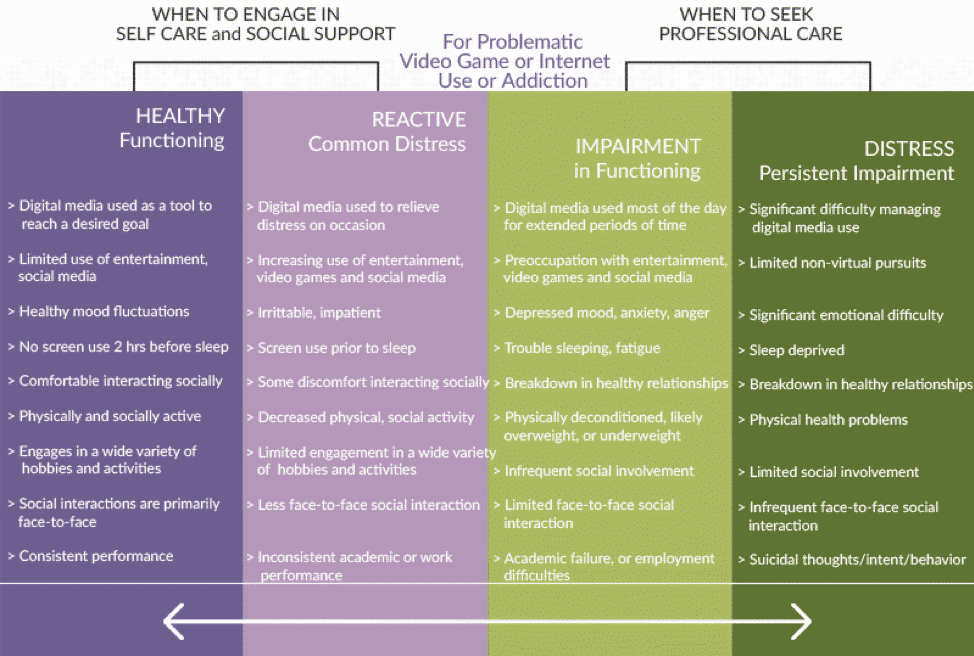
GKIS supports parents to set family rules and promote healthy screen use before digital injury and addictive use occur. If you are concerned about your child’s relationship with their screens, the chart below is a great place to start. Read through each level of functioning and determine which best describes your loved ones.

Fortunately, most kids fall under the reactive category for screen use. To avoid progression into Impairment or Distress, GKIS offers tools like our Screen Safety Essentials Course. If you think you’d like to get outside help as well, here are some facts that will help you navigate as you find the specific help you need.

Where can people with screen addiction go for treatment?

Outpatient Treatment

Outpatient” simply means treatment from an office or clinic rather than admission to a hospital. Youth inpatient treatment programs are more expensive than outpatient and do not typically admit clients until they are at least 12 years old. If your child is young, and it’s early enough that the problem seems resolvable, outpatient services are the best place to start. Find an experienced professional like Dr. Bennett that will work with you and help family members implement follow-up care and make appropriate changes in the home.

Outpatient treatment starts with a comprehensive individual and family evaluation. They will then propose a treatment plan rich in cognitive behavioral coping skills (like those we offer in our Social Media Readiness Course). Usually, the practitioner will see you and your child once a week or twice a week in crisis situations. If your child needs more support, their mental health professional will refer you to extra resources or a partial outpatient or inpatient program. Partial outpatient typically refers to a program with multiple services available more than once a week.

Inpatient Treatment

Inpatient treatment usually involves an overnight stay away from home. Programs are typically offered in timeframes lasting 30, 45, or 90 days and include problem-focused, goal-directed therapies to address the symptoms of the individual’s problematic tech use. Clinicians guide clients through the process of “disconnecting and finding themselves.”

For a long-term stay, you may want to look into programs with accredited education so that your youngster can stay on track in school during treatment. Programs work to encourage a healthy balanced lifestyle while addressing underlying issues contributing to emotional factors (depression, anxiety, ADHD, ASD). Each client’s treatment plan should be individualized and created collectively by the client, their clinicians, and the family. All programs except aftercare should require their clients to be 100% tech-free while in treatment.

The following services have been shown to successfully treat behavioral addiction:

  • Cognitive Behavioral Therapy (CBT)
  • Individual and Group Psychotherapy
  • Nutrition and Fitness
  • Interpersonal Skills Groups
  • Life Skills Psychoeducation
  • Mindfulness-Based Stress Reduction (MPSR) & Meditation
  • Guided Meditation Groups
  • Yoga
  • 12-Step Recovery Groups
  • Relapse Prevention
  • After Care Planning
  • Family Workshops

During inpatient treatment, professionals will work to better understand the complex nature of the individual’s digital media abuse and how it is affecting their development, as well as address the underlying medical and mental health conditions. Patients spend time examining their close interpersonal relationships and how their thoughts, feelings, and behaviors are connected. By exploring patterns of thinking that lead to self-destructive actions and the beliefs that direct these thoughts, patients can modify their patterns of thinking to improve coping skills. Redirecting negative thinking is imperative for self-change, and, due to the immature neural networks in young people, they need more support to achieve lasting cognitive restructuring. Negative thinking patterns also exacerbate anxiety, depression, and compulsive behaviors.

It is important to shop around for quality and fit. Make sure that all treating professionals share an open line of communication with one another, the patient, and the family. As a team, they should help employ a balanced life plan for the client during and post-treatment. They will also go over the risks and benefits of use, potential relapse obstacles and triggers, and help the patient build familial and community connections which are imperative in maintaining a healthy sustainable lifestyle.

Who does the treatment?

Counselors

Counselors focus on overcoming substance abuse and maintaining sobriety. They tend to focus on the here and now and are typically not trained to work with mental health issues directly. Counseling activities include facilitating group therapy and support groups, family counseling for rebuilding and support, and individual counseling to manage symptoms, cravings, and triggers. Counselors work in outpatient and inpatient rehabilitative programs as well as transitional living environments like sober living homes.

Specific types of counselors:

  • Substance abuse and behavioral disorder counselors provide treatment and support for those struggling with addiction. Education and licensing requirements vary by state. However, they typically have an associate degree and a substance abuse counselor certification. Some additionally seek a bachelor’s or master’s degree.
  • School counselors typically have a bachelor’s degree, a teaching credential, and a two-year master’s degree. They specialize in front-line identification of student problems and individual and group counseling about broader issues, like academic and family issues.

Therapists

Therapists focus on mental and emotional health over time, of which substance abuse may be a part. Therefore, they treat mental health issues that co-occur with addiction, including mood and anxiety disorders. Therapists train with a variety of techniques. However, when working with addiction issues they primarily focus on cognitive behavioral therapy, contingency management, motivational enhancement, and individual and family behavioral therapy. Therapists typically work in private practices and outpatient and inpatient rehabilitative programs.

Specific types of therapists:

  • Licensed marriage and family therapists (LMFT) and licensed professional clinical counselors (LPCC) have bachelor’s and master’s degrees. LPCC’s treat a broader scope of mental health issues, while LMFT’s focus on issues that stem from marriage and family relationships.
  • Licensed clinical social workers (LCSW) are part of the mental health counseling branch of social work. They are required to get extra accreditation and training after receiving their master’s in social work (MSW) degree. MSW and LCSW therapies are designed to work with the client to discover what strong natural skills and talents they possess that can be used as a launching point to tackle the issues the client is facing. This process begins with an assessment phase that inventories the strengths and perceived challenges as well as the client’s environment. Then the LCSW works with the client to make and work toward realistic goals (immediate & long term) as well as work to improve the client’s relationship with others and themselves. Social workers can diagnose and provide therapy but cannot prescribe meds.

Licensed Clinical Psychologists

Psychologists typically have a Ph.D. (5-year degree) or PsyD (4-year degree) and are trained for testing and treatment. They have the training to deal with more serious mental illnesses than other treatment providers. Psychologists are often in supervisor and program development and management roles.

Psychiatrists

Psychiatrists are medical doctors that specialize in the diagnosis and treatment referrals for individuals with mental illness. They earn their medical degree and then attend five years of residency specialty training with clients with mental illness. They can prescribe medication and monitor/make dosage adjustments as needed.

Physicians

Physicians with a specialty in addiction medicine are medical practitioners that specialize in chemical and behavioral dependency.

Quick Tips for Parents and Kids in Recovery

Many things will undermine a child’s rehabilitation. One is being too ambitious at the start. Don’t overly focus on each little thing or just the end result. This can lead them to feel defeated from the beginning. Instead, focus on the process one day at a time and acknowledge effort along the way.

Remember that they are doing something important and challenging! Kids making it through childhood and adults doing their best to parent…these are life’s hardest tasks. Blame is not useful, but courage, hope, and love are where it’s at.

“Rehab didn’t cure me of my disorder, but I do consider it to be the cornerstone of my recovery. It gave me a toolbox of coping mechanisms, others to relate to, a safe and open environment, and most importantly, the training to help me understand my specific plight and reframe my thinking. It was the starting point for the long and rigorous process of reclaiming my brain and thought patterns. It still took years after discharge for me to get truly healthy, but I do not believe without serious intervention I would not be where I am today. My disorder robbed me of my ability to connect with the world around me or manage stress without acting out. Today I can say I never imagined my brain to be released from those chains that tethered me to my addiction for so long…. and I owe much of it to the intense work I started in rehabilitation.” 

Thank you to CSUCI Intern, Katherine Bryan for informing parents about screen addiction and where families can go for help. If you want to take steps TODAY to prevent digital injury and addiction, check out our GKIS Screen Safety Toolkit, designed to show parents how to create real preventative change in easy steps.

I’m the mom psychologist who will help you GetKidsInternetSafe.

Onward to More Awesome Parenting,

Tracy S. Bennett, Ph.D.
Mom, Clinical Psychologist, CSUCI Adjunct Faculty
GetKidsInternetSafe.com

Photo Credits

Happy-kids United Way Lower Mainland CC 2.0

The pros and cons of giving an allowance Aaron Snider CC 2.0