
Need peaceful screen time negotiations?

Get your FREE GKIS Connected Family Screen Agreement

video

Do You Know What YouTube Is Showing Your Kids?

Who (or what) makes the content your kids watch on YouTube? In some cases, it’s hard-working creators who strive to make quality videos for entertainment or education. In other cases, it’s a computer program designed to efficiently produce videos for a lot of views and big profit. With this in mind, it is up to parents to ensure that their kids have a safe and fun experience while online. For helpful and empowering tools to establish a safe screen home environment, check out our Screen Safety Essentials Course. Today’s GKIS article tells you what you need to know to make YouTube viewing safer for your kids.

Bots!

Bots are computer programs designed by people or other bots to carry out specific online tasks. Not all bots are bad. However, they can run without any oversight from an actual human being.

One application for bots is creating YouTube videos for kids. More specifically, in this capacity bots combine video segments and post them over and over to test how many views they get. Once the tests are completed, the bot has created and run videos that ultimately make money for the programmer. Now that’s artificial intelligence!

Bot-Made Videos

Bot-made videos can look like a normal kid’s video, but they are typically a bit stranger. They often contain just enough story to string the randomly chosen segments together, but not enough story for everything happening to make logical sense. There are just enough familiar elements to hold a child’s attention but nothing educational or valuable to a child.

These videos distract kids long enough to get them to view ads and may even cause harm. After all, many times a human’s eyes have not viewed the video, and bots can’t discriminate a harmful video from a harmless one. At a glance, parents can’t discriminate either. Plus, most parents simply don’t take the time to preview thousands of videos their kids browse each day – especially from beginning to end.

Using Branded Characters to Bail Kids

One element that gets kids searching and watching are recognizable characters. Although branded characters are used without permission and are placed in a disjointed storyline for the video, kids will select them and stay entrapped expecting entertainment. For example, in her book Screen Time in the Mean Time, Dr. Bennett describes an alarming video portraying popular kid’s cartoon character, Peppa the Pig, screaming while being tortured in a dentist’s chair. The beginning of the video looks like a regular Peppa the Pig story. But near the middle of it, the story takes a confusing, terrible turn. Inappropriate video content make be shocking and even funny to older kids but vulnerable young children don’t have the insight or sophisticated skill set to look away. This can feel like a violent ambush and result in confusion, shame, and trauma.

Auto-play

Kids don’t always view these videos because they searched out the characters. Sometimes it is offered to them automatically in their feed. Auto-play is a YouTube feature where a new video is automatically

started after the one currently playing ends. Auto-play will select a video that is similar to the one you just watched based on tags that content creators mark their videos with when they post them. If auto-play is left on too long, it can lead a viewer down a rabbit hole of similar but stranger and stranger videos until they fall into bot-generated content.

The Algorithm

Unfortunately, bot-made videos and more can slip onto YouTube relatively easily. The huge volume of content uploaded to YouTube every day means that having a human being review every video uploaded to the site would be impossible. Instead, YouTube has another way to filter the content uploaded to its site, a bot of their own.

YouTube’s algorithm is, in essence, a much more advanced form of a bot that can scan through every video as it’s uploaded and automatically flag anything that violates YouTube’s terms of service, or at least that’s what it’s supposed to do. Unfortunately, YouTube’s algorithm can’t detect every inconsistency. It’s looking for the very specific things it was programmed to look for. Videos that don’t contain these specific violations slip by the filters. Many content creators have learned what exactly the algorithm is looking for, and some of them use it to slip inappropriate content past the sensors.

YouTube’s algorithm is also responsible for other features on the site including auto-play. The algorithm is what decides what’s worth showing next after a video, and what isn’t. However, the algorithm is only capable of discerning what videos are similar to others based on the tags assigned to a video. If a bot learns to place all the relevant tags for child content on an automatically generated video, then the algorithm will suggest it as if it were normal child content.
What can you do about bot content?

There are a few things that you as a parent can do to protect your children from bot-generated content:

Check in on your kids when they’re watching YouTube

So you can be sure the algorithm hasn’t drifted too far away from where it started.

Get Help

Monitoring everything your child watches can be a daunting task GKIS is here to help. Our Social Media Readiness Course is designed to teach your tweens or teens how to spot red flags on social media sites and when they’re gaming.

Turn off auto-play

The auto-play feature can be disabled by clicking the auto-play button at the bottom of YouTube videos. The button appears as a small black and white play button and is replaced by a black and white pause button while disabled. By turning off this feature, YouTube will no longer pick the next video your child watches next and instead will wait for you to manually choose the next video.

Limit your child’s time on YouTube

The bot-generated content of YouTube is at the bottom of the algorithm’s list of choices. Children often end up being presented with bot-generated content after spending too much time watching videos on YouTube. Our Connected Family Course has screen management strategies and safe-screen home setup ideas to help you manage your child’s screen time.

If you do catch your kids being exposed to an inappropriate video, report it.

Videos reported to YouTube as inappropriate are reviewed by real people who can catch the video for what it is. An offending video will be deleted permanently and can get the channel it comes from deleted entirely.

Thanks to CSUCI intern, Jason T. Stewart for researching bot-generated content and co-authoring this article.

I’m the mom psychologist who will help you GetKidsInternetSafe.

Onward to More Awesome Parenting,

Tracy S. Bennett, Ph.D.
Mom, Clinical Psychologist, CSUCI Adjunct Faculty
GetKidsInternetSafe.com

Works Cited

Robertson, Adi. “What makes YouTube’s surreal kids’ videos so creepy” The Verge, https://www.theverge.com/culture/2017/11/21/16685874/kids-youtube-video-elsagate-creepiness-psychology

Maheshwari, Sapna. “On YouTube Kids, Startling Videos Slip Past Filters” NY Times, https://www.nytimes.com/2017/11/04/business/media/youtube-kids-paw-patrol.html

Oremus, Will. “Even YouTube’s service for kids is being abused. Can anything control the massive platforms that now shape our lives?” Slate, https://slate.com/technology/2017/11/those-disturbing-youtube-videos-for-kids-are-a-symptom-of-techs-scale-problem.html

Photo Credits

Photo By: Kaufdex (https://pixabay.com/photos/youtube-media-screen-mac-apple-2449144/)

Photo By: Gerd Altmann (https://pixabay.com/illustrations/binary-one-cyborg-cybernetics-1536624/)

Photo By: Gerd Altmann (https://pixabay.com/photos/hacker-attack-mask-internet-2883632/)

Photo By: Markus Trier (https://pixabay.com/photos/homeschooling-school-technology-5121262/)

The GKIS Sensible Parent’s Guide to Tik Tok

Tik Tok is a social media app that allows users to create and discover short videos made and posted by users. It’s popular because it combines teen users’ love for social media, music, and creative shorts. They love the authenticity of sharing and creating Tik Tok offers. Dangers are that kids may post and view sexualized or stunt videos and explicit songs, post videos of others without their permission, users are commonly ridiculed and cyberbullied, they may read lewd comments, and there is potential for public direct messaging. Be aware that popular Tik Tok influencers produce highly sexualized content and the “For You” autofeed commonly offers up content that most parents find inappropriate for child viewing. Plus, it’s so fun it’s addictive. Kids can spend hours scrolling endless content. As always, make sure you have familiarity with Tik Tok before you allow your child to use it. And, of course, add it to your free GKIS Connected Family Agreement as an “OK” or a “not yet,” so parameters, rules and regs, and etiquette issues are understood. (If you haven’t downloaded it yet, enter your name and email on our GetKidsInternetSafe home page and it will be emailed immediately). For a comprehensive tween/teen course on how to stay safe on social media, know what to watch out for, and how to apply amazing psychology wellness strategies, check out our GKIS Social Media Readiness Training Course. It gets the conversations started about the truths of Internet risk,. Also, y\ou won’t want to miss the parent setup tips at the end of this article. Our GKIS Sensible Guide provides information that parents need to know to make an informed decision.

What is Tik Tok?

Tik Tok is an app that allows users to create 15-second videos. It’s based on a previously popular app called Musical.ly, which is no longer available. Tik Tok users can post videos they saved on their phones and add sounds, parts of songs, special effects, and filters. Recently, Tik Tok added a new feature that allows users to record their reactions to other Tik Tok videos. The app also includes a feature that notifies users when they’ve spent more than two hours on the app. Users seem to value creativity and authenticity over likes.

How long has it been around and how popular is it?

Tik Tok is developed by ByteDance, a Chinese Internet technology company. It was first released in September 2016 for IOS and Android. Tik Tok’s global offices are located in Los Angeles, London, Dubai, and Tokyo, among other places. As of October 2018, Tik Tok was downloaded 80 million times in the US and 800 million times globally. It is free to use. ByteDance makes its money through advertisements integrated into the app.

How old is old enough for adoption?

Tik Tok’s Term of Service states, “If you are under age 13, you may only use the Services with the consent of your parent or legal guardian. Please be sure your parent or legal guardian has reviewed and discussed these Terms with you.” As you know from other GKIS Sensible Guides, 13 years old allows social media apps to be in compliance with the U.S.’s Children’s Online Privacy Protection Act (COPPA). It has nothing to do with child psychology. Nobody assessed that 13 years old is a healthy age for app adoption. That is up to you.

Before you make your decision, keep in mind that before 13 years old, kids still have limited ability to understand potential consequences and lack impulse control. In Dr. Bennett’s book, Screen Time in the Mean Time, she recommends no social media app adoption until at least the second semester of sixth grade, when kids have more social experience for creative problem solving and are no longer transitioning into middle school. (If the seventh grade is a transition year in your community, she recommends waiting until spring semester for the introduction). Most parents will find that, even at 13 years old, they are uncomfortable with their kids viewing the sexually explicit and sometimes cruel content easily available on Tik Tok. Follow a few popular Tik Tok influencers to sample what I’m talking about. Of course, every family circumstance is unique. We at GKIS believe that parents are the ultimate authority on your children’s unique traits and “fit” with Tik Tok.

Tik Tok In the News

In December 2019, the U.S. Army and U.S. Navy banned soldiers from using the Tik Tok app on government-owned phones due to concerns that content shared with ByteDance could be used to influence and surveil Americans. ByteDance reports that it stores U.S. user data in the U.S. with backups in Singapore, so it is not subject to Chinese law. But as a security expert told me, “It doesn’t matter where they store the data, it’s how they access it that counts. China is well known for having an excellent ability to steal private data from foreign countries.”

In February 2019, ByteDance was fined $5.7m by the U.S. Federal Trade Commission for illegally collecting personal information from children, like names, emails, addresses, and locations.  in violation of COPPA. The FTC found that Tik Tok failed to delete content from underage children despite receiving thousands of complaints from parents. As a result of the FTC fine, Tik Tok created an experience for underage users which allows them to only access curated, clean videos and not have the ability to comment, search, or post their own videos. Kids can work around this by simply entering a false birthdate.

What are Tik Tok’s popular features?

  • After opening the app through your smartphone, you have the option of looking at the videos of those who you follow, what’s featured, and videos under hashtags.
  • You can follow friends and other Tik Tok users. Those you follow will show up under “following” on the home page of the app. With a simple scroll, you’ll be introduced to the thousands of videos Tik Tok users create. Just because you follow someone doesn’t necessarily mean they follow you back.
  • To make a Tik Tok video, click the square button with the plus sign. Once there, the app will ask you if you want 15 seconds, 60 seconds, or photo templates. You also have the option to add sounds, upload photos or videos, and add effects. Users can also adjust the speed and add filters. Tik Tok provides sound categories like “Trending,” “Country,” “Furry Friends,” “Sweat It Out,” and even “Munchies.”
  • There’s a search feature that allows users to browse through various hashtags. They can also search through categories like “top,” “videos,” “sounds,” and “hashtags.”
  • You can personalize your “For You” feed by ♥︎ing videos you like or choosing “not interested” on those you don’t.
  • Tik Tok nudges its users to go outside of their groups of friends by immediately introducing them to group challenges, theme hashtags, and videos based on a popular song.

What is included in the personal profile?

  • Tik Tok makes signing up to the app simple. You can sign up with an email, name, and phone number or through your Facebook, Google, Instagram, or Twitter accounts or through your Apple ID. From there, you can choose to sync your phone or Facebook contacts with Tik Tok to see if your friends also have an account.
  • Along with a personal profile photo of your choosing, your profile page can also contain your bio, the number of people you follow, who follows you, and how many Tik Tok videos you’ve liked. If you have uploaded Tik Tok videoes, they’re displayed on your profile too.
  • The top left has a button for searching for friends on the app. The top right is a button for the settings. When you click on “edit your profile,” you have the option of adding your Instagram username or your YouTube channel, which will be public to those who can see your profile.

What are the privacy and safety options?

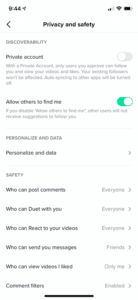
Many Tik Tok users love interacting with a large, global audience to spark creativity and enjoy fun feedback. As a clinical psychologist who sees how some of these collaborations with strangers can turn dangerous, I recommend a private account so you can approve or deny follower requests, and only users you’ve approved as followers can see your content. Of course, we encourage parents to discuss the pros and cons of use with their kids to reach a cooperative agreement.

To do this,

  • Click on the Settings button at the top right corner on your profile page.
  • Click on Privacy and Safety.
  • The first option is “Private Account” or “Allow others to find me.”
  • If you change an already-existing account to private, current followers will not be affected.

You can also remove or block followers at any time. Removing them disables their ability to direct message your teen. Blocking them stops them from interacting with or viewing your teen’s content at all.

Opting for Restricted Mode limits content that may be considered inappropriate. Users can also restrict comments to friends only or block them altogether. The can also disable messaging and disable duets.

Tik Tok offers a Screen Time Management mode with a passcode as one of their Digital Well Being offerings.

If you see inappropriate content while browsing the app, you have the option of reporting it within the app. We noticed that the report button is somewhat difficult to find in that it is hidden among other buttons.

As with most social media apps, the company collects information, including your name, email address, and phone number. They may also collect any messages you send through the app to friends. This is part of their privacy policy.

Tik Tok is rated a 12+ app store rating. This means you can block underage kids from onboarding the app with Gooogle and Apple parental controls. Tik Tok resources for parents include a Top Ten Tips for Parents primer, “You’re in Control,” safety educational videos, a Safety Center, and an ongoing blog series with helpful tips. The videos can be accessed directly in-app @TikTokTips.

What are the risks for use?

Constant Access

When kids are little, parents decide when playdates happen. Once Tik Tok is on board, keep in mind that your kids will have access to their friends whenever they have their device, and other Tik Tok users will have access to your kids. For many, that means 24/7 access. If you’re not OK with that, you’ll have to dock screens consistently or limit their access.

Inappropriate Content

Although the rules state that users younger than age thirteen shouldn’t be on Tik Tok without parental guidance, anyone can simply lie and accept the terms of conditions without informing their parents. Sometimes the content may not be filtered, and any kind of inappropriate content may pop up. Of particular concern is dangerous stunts, hate speech, and sexualized dancing to explicit music lyrics. Imagine watching your 12-year-old dancing sexy to lyrics that include the n-word, the f-word, p&^sy, and worse.

Cyberbullying

A fun video posted today can feel humiliating when viewed tomorrow. Since moderators can’t oversee all comments on the app, there is cyberbullying. Since being creative requires risk, public ridicule now or later is a real concern. Often the ridicule happens when the Tik Tok video is shared on other social media platforms, like Instagram or Twitter. The best way to prevent this would be to keep the account on private and add only people whom you know or are friends with. However, keep in mind that cyberbullies can always screenshot from a private account and share publicly. Users can turn off comments to prevent or stop cyberbullying on their content. Exclusion from posts about friend groups can also be hurtful. Imagine if your child is the one who was left out.

Trends & Attention-Seeking 

Users can produce or view inappropriate Tik Tok’s and often try to attract large numbers of followers with poor posting or comment choices. For example, the trend for “Chop Chop Slide” involves kids filming their parents’ reactions to an unexpected string of very explicit lyrics. Many of these videos of their parents are likely shared without permission. To feed the need for likes, affiliative apps offer the purchase of likes for your posts and to buy more followers.

Stunts & Challenges

Most Tik Tok Challenges are incredibly skillful dance moves. You’ll also see kids singing along with their tongues out and clever facial expressions to vulgar lyrics alone and in groups. Like with the other social media platforms, you’ll also see some winners come up with something like the outlet challenge which involves shoving a penny in a charging cube for sparks. To see what I’m talking about, search YouTube for Best Tik Tok Compilations and prepare to be mesmerized for awhile. The talent Tik Tok inspires is amazing.

Online Predators

If your child’s profile is set to public, anybody signed into the app can view your child’s videos, comment, and message your child. The tech website, Motherboard, reported a large community of adults soliciting young Tik Tok users for nude photos and videos and even sent videos to the children. Lewd and hateful comments have been found on children’s videos. News reports say that, while Tik Tok has attempted to remove those comments after being reported, several inappropriate comments were left on videos. The owners of the accounts that left those comments were not suspended from Tik Tok and were allowed to continue commenting.

It’s Addictive!

Once you test the app, you’ll see how fun it is! It’s hard for users to resist the endless on-demand video content on the Discover page (indexed with hashtags) that is interactive, shocking, funny, creative, musical, and titillating. Be aware that popular Tik Tok influencers produce highly sexualized content and the “For You” autofeed offers up content that is similar to what has been viewed before. Kids spend hours scrolling endless content.

GKIS Parent Checklist for Tik Tok Use:

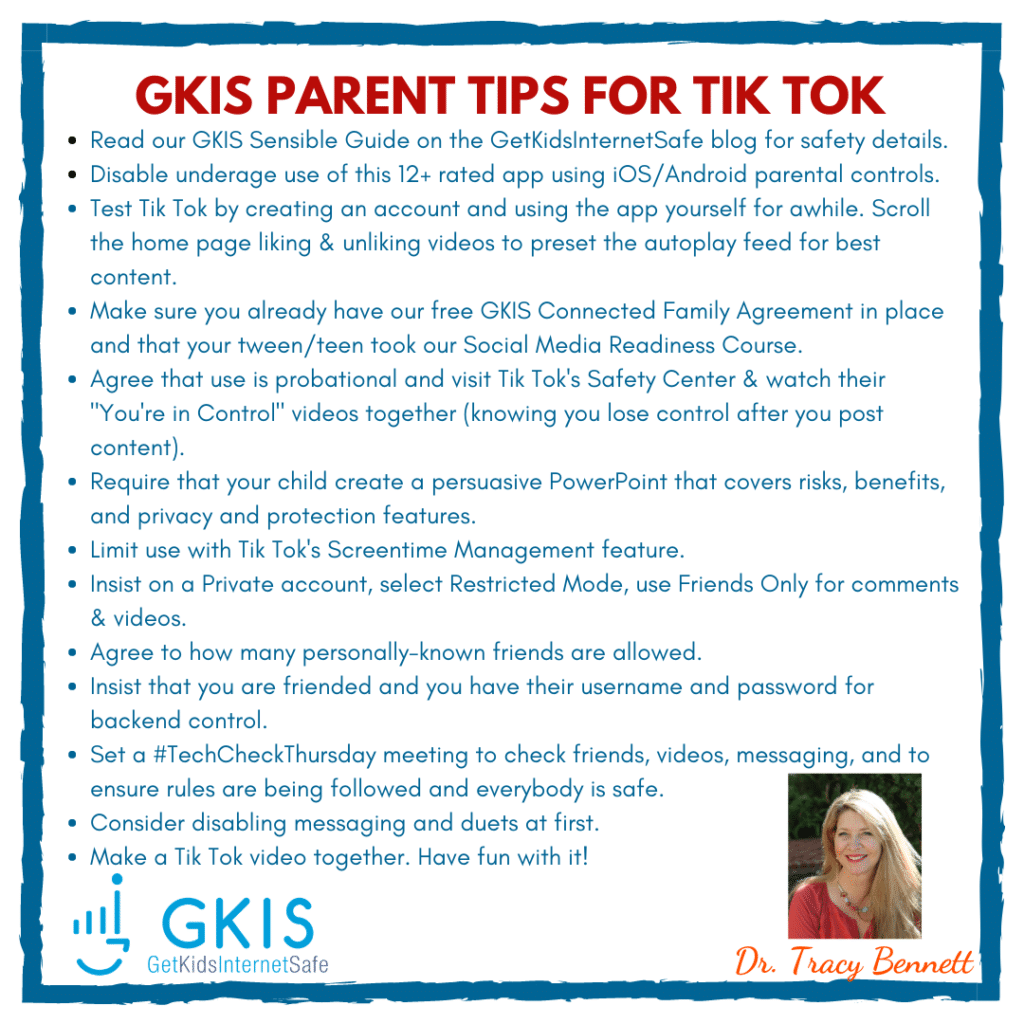
  • Disable underage use of this 12+ rated app using IOS & Android parental controls.
  • Test Tik Tok by creating an account and using the app yourself for awhile. It’s mind-blowing how creative users can be. It’s also helpful to search YouTube for Tik Tok compilations (e.g., “Tik Tok procreate compilations”).
  • Preset your chid’s account for best content by scrolling the home page liking appropriate videos & selecting “not interested” for inappropriate videos. Although it won’t keep them safe from viewing inappropriate content, it does preset the autoplay to a more positive autoplay pattern.
  • It’s also helpful to block influencers who commonly produce inappropriate content, while also “hearting” topics and influencers that match your child’s interests (e.g., singing, dancing, drawing, procreate, etc.).
  • Make sure you already have a digital contract in place (like our free GKIS Connected Family Agreement). Add it to your agreement as an “OK” or a “not yet,” so parameters, rules and regs, and etiquette issues are understood. (If you haven’t downloaded it yet, enter your name and email on our GetKidsInternetSafe home page and it will be emailed immediately.)
  • Agree that use is probational and visit Tik Tok’s Safety Center and watch their “You’re in Control” videos together (recognizing that once the content is posted, you no longer are in control).
  • Require your child to create a persuasive PowerPointthat covers risks, benefits, and privacy and protection features so you both know the in’s and out’s of Tik Tok’s features before you agree to it. For more information about how to create and judge a persuasive PowerPoint about a social media app along with other useful screen safety strategies, check out our Connected Family Online Course. The course was created to optimize healthy screen use while protecting kids and teens from digital injury. The best part about the course is it brings parents and kids closer with more cooperative negotiation around family screen rules. Once you agree on a trial, create a digital poster with a bullet list of the rules you agreed upon and tape it up in your home’s homework or computer space.
  • Limit use with Tik Tok’s Screentime Management feature.
  • Insist on a PRIVATE account so strangers can’t view your child’s posted videos, Select RESTRICTED MODE. Use FRIENDS ONLY for comments and videos.
  • Consider DISABLING messaging and duets at first.
  • Agree to how many personally-known friends are allowed at first to limit exposure while your child is gaining expertise and judgment. Remember, they WILL post, view, and message inappropriately no matter how great you parent. If that’s unacceptable to you, DON’T ALLOW TIK TOK. 
  • Insist that you are friended and you have their username and password for backend control.
  • Set a #TechCheckThursday meeting to check friends, videos, messaging, and to ensure rules are being followed and everybody is safe. This will also keep the cooperative dialogue going.
  • Make a Tik Tok video together. Have fun with it!

GetKidsInternetSafe rates Tik Tok as a red-light app due to the easy access to strangers, inappropriate content, bad judgment while posting or live streaming, and potentially harmful comments. Because the app has millions of users, it is difficult for Tik Tok moderators to weed out all of the unacceptable content. But there is also a legitimate argument for creative and fun sharing with a private profile. If you do opt to allow Tik Tok, be sure and get your child’s username and password and monitor posts. Share our GKIS Parent Tips on your social media for friends and family. HERE’S THE LINK TO THE IMAGE

Thank you to CSUCI intern Makenzie Stancliff for co-authoring this article. For more help with social media. judgment and overall psychological health, you won’t want to miss our GKIS Social Media Readiness Training Course for tweens and teens.

I’m the mom psychologist who will help you GetKidsInternetSafe.

Onward to More Awesome Parenting,

Tracy S. Bennett, Ph.D.
Mom, Clinical Psychologist, CSUCI Adjunct Faculty
GetKidsInternetSafe.com

Live Streaming Can Cause PTSD in Adults and Children

We are vulnerable to dangers previous generations couldn’t even imagine. We are on-demand, world connected – available to watch any horror from any place. Graphic (meaning vivid or realistic) live stream videos can be found on social media platforms such as Facebook Live, Instagram, TikTok, Snapchat, and YouTube. Children are especially vulnerable to getting upset when viewing violence. Today’s GKIS article covers if the mental illness Post Traumatic Stress Disorder (PTSD) can result from viewing violence on screen.

How Graphic Live Streams Affect Children

Accidentally clicking on a violent video would frighten anybody. Children are particularly vulnerable to trauma, including the development of serious mental illness. PTSD is a mental health disorder in which a person struggles to recover from experiencing or witnessing a traumatic event such as an assault, war, natural disaster, or serious accident. People with PTSD often have severe anxiety and panic attacks when reminded of the traumatic event. They feel stressed and frightened even when there is no danger present.

PTSD symptoms include intense nightmares, difficulty sleeping, and flashbacks of the traumatic event (intrusive images like you’re re-experiencing it). Children younger than six years old show signs of PTSD differently than adults. Their symptoms include behaviors like wetting the bed, being unable to speak, acting out the traumatic event in playtime, and clinging to their caregiver. PTSD is a very serious, debilitating disorder that can leave the individual in a nearly constant state of fear and stress.

Being able to discuss the witnessed traumatic event is a necessary step in treatment. In a study with Danish high school students, subjects who had witnessed a school shooting were assessed for PTSD. It was found that the prevalence of PTSD seven months after the incident was 9.5%. Being unable to talk about the incident was found a predictor of those who developed PTSD.[1]

Studies on Videos and the Onset of PTSD

Because violent videos are relatively new, there is little research on how they affect us. One of the earliest studies was conducted after Americans viewed the television coverage of the 9/11 tragedy.

The researchers interviewed 560 adults three to five days after 9/11. Approximately 90% reported one or more stress symptoms. In contrast, 35% of children had one or more stress symptoms, and 47% were worried about their safety or the safety of loved ones. Ten percent of the children had trouble falling asleep or staying asleep.

In another study, researchers surveyed 4,675 adults who viewed the 2013 Boston Marathon bombings on video. They found that people who had repeatedly watched the tragic footage sustained more trauma and stress than people who had witnessed the events in real life!

Those who watched six or more hours per day of media coverage were nine times more likely to report high acute stress than those who viewed less than one hour a day. Symptoms of acute stress included intrusive or troubling thoughts, feeling hyperaware, avoiding anything that reminds one of the traumatic events, and feelings of detachment.

If your children witnessed a traumatic live stream or Internet video, how would you know if they had PTSD? 

Elementary School-Aged Children

“PTSD in children and adolescents requires the presence of re-experiencing and avoidance, numbing, and arousal symptoms. However, PTSD may not present itself in children the same way it does in adults.”[2] For example, young children may not experience flashbacks like adults with PTSD. They are more likely to experience “time skew” and “omen formation,” which are symptoms usually not seen in adults.

Time skew is the mis-sequencing of trauma-related events when remembering the experience.

Omen formation is a belief that there were warning signs that foreshadowed the traumatic event.

Children often believe that if they remain alert, they will recognize the warning signs and avoid another trauma resulting in chronic hypervigilance, anxiety, and sleep disorders.

School-aged children with PTSD often engage in posttraumatic play or reenactment of the trauma in play, drawings, or verbalizations. Post-traumatic play is a literal representation of the traumatic event in which the child repetitively acts out some aspect of the trauma. This often does not relieve anxiety.

An example of post-traumatic play would be a child shaking a playhouse after they’ve experienced an earthquake.

Post-traumatic reenactment, on the other hand, is more flexible and involves behaviorally mimicking some aspects of the trauma. An example would be carrying a toy gun after being exposed to violence.

Adolescents and Teens

PTSD in adolescents more closely resembles symptoms seen in adults. However, some features are unique to teenagers.

As discussed above, children may engage in traumatic play after the onset of trauma. Adolescents are more likely to engage in traumatic reenactment, in which they merge some aspects of the trauma into their lives. Reenactments occur due to psychological vulnerabilities and defensive mechanisms which are characteristic of PTSD survivors.  Adolescents tend to engage in impulsive and aggressive behaviors more than younger children and adults do.

What can parents do?

  • Advocate for better safety protocols including monitoring and filtering with platforms like Facebook, Instagram, Snapchat, TikTok, Periscope, and YouTube.
  • Filter video access to children by using a child-safe browser, refusing requests to adopt livestream social media apps, and using appropriate child sites like YouTube Kids.
  • Maintain an ongoing dialogue about content viewed online to optimize the chance your child will go to you if they happen upon inappropriate content.
  • Let your child know they won’t be in trouble for accidental views.
  • Be alert for changes in behavior that may be reflective of PTSD like fears, anxiety, bathroom accidents, mutism, sleep problems, appetite problems, substance abuse, or school failure.
  • Seek the help of a child psychologist if you have concerns.

Thank you to CSUCI Intern, Mara Pober for writing this important series to inform parents and help them keep their kids Internet safe. For more parenting advice on-screen media and trauma in children, pick up your copy of Dr. Bennett’s book, Screen Time in the Mean Time: A Parent Guide to Get Kids and Teens Internet Safe.

I’m the mom psychologist who helps you GetKidsInternetSafe.

Onward to More Awesome Parenting,

Tracy S. Bennett, Ph.D.
Mom, Clinical Psychologist, CSUCI Adjunct Faculty
GetKidsInternetSafe

Works Cited

A National Survey of Stress Reactions after the September 11, 2001, Terrorist Attacks (2001)

[2] National Center for PTSD

Prolonged viewing of Boston Marathon bombings media coverage tied to acute stress (2013)

[1] The psychological reactions after witnessing a killing in public in a Danish high school

Viewing violent news on social media can cause trauma (2015)

Photo Credits

Don´t let it happen again

classroom-laptops-computers-boy.jpg

Little Boy Bluescreen

Graphic Livestream Horrors

Popular livestream video platforms, like Facebook Live, Twitter, Instagram, and Periscope, can put viewers at psychological risk with graphic content that’s impossible to moderate or filter. Last week we learned the history of news coverage, including livestream during the recent Las Vegas shooting. Today’s article covers how quickly and dramatically easily-accessed video content has changed with a constantly increasing viewing audience. Is violent livestream video detrimental to our psychological wellbeing? #Vegasstrong

How is livestreaming different from news coverage?

We are all disheartened by the unprovoked mass murder of country concert attendees in Las Vegas recently. Constant bombardment with graphic news coverage left many of us reeling. No longer do news outlets need a reporter on-scene to get dramatic live coverage. Private citizens stream photos and videos from their smartphones real time on the Internet, while outlets choose and air the most dramatic content available.

Graphic news coverage is a relatively new phenomenon. Prior to smartphones, network executives edited out content that would upset viewers. Community standard determined the selection process, with ethics and consumer preference in mind. Livestreaming does not undergo this filtration process. It’s raw, authentic, and very real. Viewers can hear, see, and observe the terror of victims real-time without actually being there.

Livestream Horrors

Imagine the horror of watching a mass murder unfold real-time, helpless to do anything about it. This is exactly what happened to hundreds of Internet and television viewers of recent Las Vegas livestreams. As people livestreamed themselves enjoying the concert, the scene quickly changed. Viewers watched on in horror as the chilling events unveiled. This is not the only case of a tragic event captured on livestream.

In April 2017, Steven Stephens livestreamed himself shooting a 74 year old man on Facebook Live in Cleveland. In the video, Steven is seen in his car saying, “Found me somebody I’m going to kill — this guy right here, this old dude.”  Steven then exits the car and kills Robert Godwin Sr. on the spot. The video was on Facebook live for three hours with hundreds of viewers before it was finally taken down.

In a similarly disturbing incident, a man in Thailand livestreamed himself murdering his daughter.  The recording showed Wuttisan Wongtalay hanging his 11 month-old daughter by the neck from the rooftop of a building. The footage was on Facebook Live for twenty-four hours before it was taken down. Wongtalay later committed suicide off camera. Facebook called this “an appalling incident.”

In another criminal event, Obdulia Sanchez, 18, livestreamed herself on Instagram driving under the influence with two 14 year-old girls in the back seat.  After losing control of the vehicle, she shakes her sister, dead in a pool of blood, pleading, “Jacqueline, please wake up.”

Another particularly noteworthy livestreaming event occurred in January 2017, when four people broadcasted a 28-minute livestream video as they tortured a mentally disabled man. They taped his mouth shut and threatened him with a knife as they beat him, made him drink from the toilet, and cut off a part of his scalp. The first perpetrator to be tried, nineteen year-old Brittany Covington, pleaded guilty to the hate crime and received four years probation where she was ordered not to use social media.

Tolerance of Violence?

Information reaching us faster alerts us to a more accurate reality. This can be beneficial when considering the authenticity of news. But at the same time, instant access to unfiltered media may be desensitizing us to violent imagery. According to the World Health Organization, “Rules or expectations of behavior … within a cultural or social group can encourage violence.”

Children and adolescents who are curious and thrill-seeking seek out content to be shocked, scared, or more “in-the-know.” Other times viewers come across this content by accident. Each of us have our own complicated profile of risk. Perhaps the normalization of violent livestreams reduces our sense of safety, even sensationalizing issues like assault, murder, and suicide. Copycat behaviors seeking notice can also be a problem.

The fact that there are thousands of disturbing videos circulating the Internet at any time makes one question how it got this bad. As a nation, we are becoming more tolerant of viewing violence on-screen. Many argue that certain types of violent videos must be publicly available for informational and educational purposes. In response to this, most Internet platforms have specific rules for how violent videos are filtered.

For example, Facebook now has guidelines regarding which violent videos are permitted to stay on the website and which are removed. Videos of violent deaths are not always taken off the site, because they can help bring awareness to issues such as mental illness or war crimes. Videos in this category are instead marked as disturbing content and blocked from minors. Facebook also permits users to livestream themselves attempting suicide or committing acts of self-harm. The justification for doing so is because they do not want to censor freedom of expression or punish someone in distress. If a person does livestream a suicide attempt, the video documenting the incident may not be taken down if it is deemed newsworthy.


Youtube also has challenges filtering inappropriate content. Dr. Bennett was invited as a parenting expert on Access Hollywood Live to discuss the poor judgment of celebrity Youtube Logan Paul after he posted video of a suicide victim hanging in Japan’s notorious “suicide forest.” Although Logan took it down after receiving criticism, over six million of his followers, mostly young people, saw the footage and Logan’s poor taste of giggling uncomfortably throughout. People are increasingly willing to post scandalous content in order for it to go viral. After all, that mean’s BIG profits. Dr. Bennett called for parents to talk to their kids and advocate for better safety monitoring on video and livestream social media sites.

Find out how graphic livestreams may affect mental health in Mara Pober’s last article of her three-part series, “Live Streaming Can Cause PTSD in Adults and Children.”

I’m the mom psychologist who helps you GetKidsInternetSafe.

Onward to More Awesome Parenting,
Dr. Tracy Bennett

Works Cited

4 charged with hate crimes in Facebook Live beating of man with ‘mental health challenges’

How Facebook decides what violent and explicit content is allowed

Jailed woman says she livestreamed aftermath of deadly crash to raise funds for sister’s funeral

Las Vegas shooting FRONT ROW at country music concert live stream

Man livestreams murder of baby daughter on Facebook before committing suicide

Nationwide manhunt for suspect in Cleveland Facebook video murder

Post Traumatic stress disorder

Photo Credits

Eye By Richard Broderick

Girl on Computer Notebook

Gun

From Newspapers to Livestreaming: Is Instant Access to News Good for Americans?

Internet technology has brought us instantaneous access to global information. We see the latest news coverage in seconds with convenient notifications on our smartphones. Personal posts on Facebook delivers everything, including beheadings by ISIS and mass shootings like the tragedy in Las Vegas. Unregulated and increasingly pushing the boundaries of decorum, shocking information and violent images and videos constantly slice into our everyday lives. We at GKIS believe this comes at a grave price to our feelings of security and overall mental health, particularly for kids. Trigger warning: please beware that this post includes graphic news images.

Photojournalism: The First Graphic Images to Reach the Masses

Graphic popular news content is a relatively new phenomenon. Before the Internet, people primarily accessed news from newspapers. The first printed newspaper was written in Germany in 1605. The first newspaper photos in the 1850s were wood-engravings used for printing purposes rather than actual printed photographs. Though these images were not true to life, they still conveyed messages to the masses.

Roger Fenton, one of the first war photographers, captured images of the Crimean War in 1854. His photos revolutionized photojournalism. Due to the limited photo technology of the time, he could only capture stationary objects. As a result, his photos were often staged and depicted landscapes or posed people. He avoided taking pictures of dead bodies and bloodied soldiers.

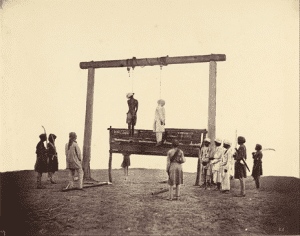
In 1857, photographer Felice Beato pushed the envelope further to more graphically expose the devastation of war. He captured what may be the first popularly published photograph of a human corpse.

In the late 1800s, newspapers developed a more efficient method of printing photos, called half-toning. These are the black and white images many of us are familiar with. By the 1920s this technology was very sophisticated and could produce high quality images which proved vital for eliciting public response.

A poignant example of graphic news coverage evoking public response was the Emmet Till incident in 1955. Emmet was a 14-year-old African-American boy who was senselessly lynched when a white woman claimed that he had disrespected her. Her husband and his brother abducted Emmet and beat and mutilated him before tossing his body into a river. When his body was discovered, Emmet’s mother allowed journalists to photograph his severely disfigured body. These disturbing images outraged the public and brought light to injustice in the South. Emmet became the face to The Civil Rights Movement.


News Video Coverage: A Revolutionary Medium

The introduction of film media added an even more sophisticated layer of interaction between news reports and the public. The first filmed news coverage, called Newsreel, was prominent from the 1910s to the 1960s, before Americans had televisions in their homes. Newsreels were short documentary-style films reporting on current events, most often shown before motion pictures in movie theaters. They tended to be informative and non-graphic in nature, often used as propaganda to influence public opinion on war and politics.

When televisions became common in American homes in the 1960s, TV stations began producing their own newsreels. Soon there would be entire programs dedicated to news, marking the beginning of nationwide news broadcasting stations like CBS.

In the 1970s, innovative technologies emerged that could record audio and video for television broadcasting, called electronic news gathering. With the onset of the unpopular Vietnam war, news broadcasters covered the battlefield in graphic detail. This exposed the world to raw and real depiction of the brutalities of war, fueling anti-war sentiments.

For example, on March 27, 1970, CBS News aired a graphic report with correspondent Richard Threlkeld. In the clip, Richard accompanies several soldiers patrolling the jungles of Vietnam. Suddenly shots fire, and Richard and the soldiers take cover. One of the soldiers, Kregg Jorgenson, is shot in both legs off camera. With gunfire sounds in the background, Richard briefly interviews the heroic soldier who earned his fourth Purple Heart that day.

In more recent memory, the graphic videos of 9/11 traumatized a nation. Millions of television viewers were entranced by the continuous hours of disturbing footage. Particularly horrifying were the images of victims jumping from the burning towers to their deaths. Richard Griffiths, the senior editorial director at CNN, ruminated with his colleges about whether or not to air “The Jumpers.” Ultimately, they decided to show a four-second clip of a person falling before impact. This decision was met with universal disapproval as audiences were shocked and deeply upset. How far is too far in television journalism?

Livestreaming: The New Frontier

With the advent of smartphones, we now have immediate, continuous access to the unregulated Internet. Not only can we conveniently view video coverage, but we also can take and share it real-time. Livestreaming is the ability to transmit live audio and video footage over the Internet. Popular livestream mediums are Facebook live, Twitter, Instagram, and Periscope.

The problem with livestreams is that it’s impossible to moderate and filter graphic content. It’s raw, authentic, and very real. Captured livestreaming incidents have included rape, torture, and murder. Most recently, the world looked on at the horrifying livestreaming videos of victims during the Las Vegas shooting. Viewing livestreamed events can feel like you’re actually there but helpless to do anything to aid victims. Just as we saw with 9/11 coverage, audience response has been emotional and, in some instances, symptomatic of secondary trauma.

Thank you Intern Mara Pober for giving us a great overview of photojournalism and how the tide has turned. Stay tuned for her article next week, “Graphic Livestream Horrors” to learn why  viewing graphic video content can contribute to clinical distress for all of us, particularly children.

I’m the mom psychologist who helps you GetKidsInternetSafe.

Onward to More Awesome Parenting,

Dr. Tracy Bennett

Works Cited

Felice Beato Biography

How “Electronic News Gathering” Came to Be

Newsreel archive

Vietnam War, 1970: CBS camera rolls as platoon comes under fire

https://www.youtube.com/watch?v=89_3DgW_7mg

9/11: ‘Jumpers’ from the World Trade Center still provoke impassioned debate

Photo Credits

Emmet till before and after the incident:

Before:

https://www.flickr.com/photos/11304375@N07/2534273093/in/photostream/

After:

https://www.flickr.com/photos/11304375@N07/2534273097/in/photostream/

Felice Beato

Twin Towers

Iraqi Girl