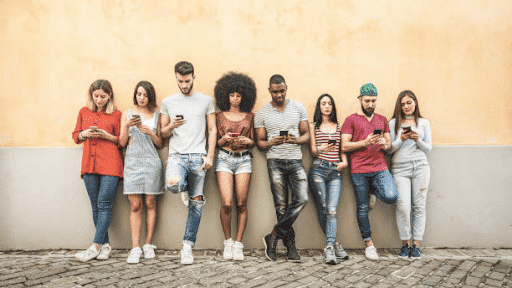
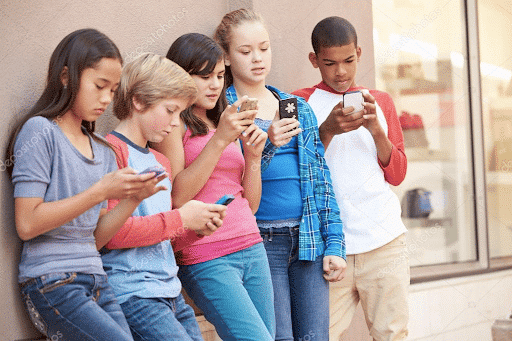
The creation of the Internet has transformed society in every way imaginable, and 84% of us use it every day.[1] The two generations that grew up with the Internet are millennials and generation Z. You may be surprised at how differently these two groups use it, and how it’s affected them as human beings overall. Today’s GKIS article highlights the difference between teens and young adults and those who are 25 and older. If you’d like to help prepare your gen Z’s for healthy Internet media consumption by building good habits and communication, check out our Screen Safety Essentials Course.
What defines a generation?
A generation refers to all people born and living around the same time. The average period of a generation is 20 to 30 years, and the cutoffs are defined by when people become adults and start having children of their own. Although the specific years that group a generation is often up for debate, for our purposes we define millennials to be anyone born between 1981 and 1996 and generation Z to be anyone born between 1997 and 2012. That means millennials are currently between the ages of 26 and 41, and Gen Zs are between the ages of 10 and 25. Millennials were in their teen years when they first started using social media and gen Z’s were still children when they ventured into online neighborhoods independently.
Millennials and the Internet: Jackie’s POV
To gather better insight into how millennials view and interact with the internet, I interviewed Jackie (age 25).
Jackie started using Instagram and Facebook when she was 16 years old. She considers the biggest impact social media had on her was the comparison. Comparing her social media posts to others’ posts was the biggest issue she thinks she faced. It’s an issue for her because when she would compare posts, insecurities often arose. She said that constantly seeing others’ posts of selfies, vacation pictures, and pictures with significant others and friends made her feel inadequate, especially when she was much younger. She overcame those issues by no longer using social media as often.
Gen Z and the Internet: Sophia’s POV
To better understand gen Z’s views and interactions with the internet, I interviewed Sophia (age 12) about her experiences.
Sophia started using social media when she was 10 years old, specifically Snapchat and TikTok. She feels that the biggest impact social media had on her was the concern of appearing ‘cringe’ online and in front of others in real life. Micro-managing one’s appearance and mannerisms is another problem many gen Zs face. Snapchat and TikTok often contain videos of people recording others doing things, sometimes without their knowledge. Certain behaviors are labeled as ‘cringe’ or ‘embarrassing’ by others in comment sections. Nowadays, she says she still uses social media often but not as much as she used to, claiming she used to be glued to her screen 24/7 when she first started.
Compare and Despair
The biggest similarity between the two is the micro-management of what is shared online. Many are concerned with how they’re perceived on social media in addition to comparing their lives to others. Curating the perfect image or life is something that seems to be an issue for many social media users regardless of age.
The negativity and insecurities that come from social media aren’t age-restricted. However, it can have a particularly heavy effect on tweens and teens. Our Social Media Readiness Course can help with that. By teaching kids the red flags of digital injury and clinically tested psychological wellness tools, we can help prepare your kids for safer screen use and prevent feelings of inadequacy, low self-esteem, and the desire to compare online.
More Access and More Influence on Self-Identity
Taking both interviews and research into consideration, it seems that there are both similarities and differences in how both generations interact with the Internet. The biggest difference is that gen Z has been exposed to social media much younger than millennials before they solidly formed self-identity. Further, more social media platforms and sophisticated personal mobile devices were available to them – giving them almost constant, on-demand, mutual contact with peers and strangers.
Parent Replacement
In addition, more parents were inclined to help introduce technology to gen Z children. Smartphones became a sort of transitional object assigned by parents as their substitute.[2] This is something millennial children never experienced because smartphones weren’t around when they were toddlers and young children.
More Competence and Confidence Online
Those exposed to the Internet at younger ages tend to be more savvy and aware of online dangers. Research demonstrates that gen Zs tend to have more confidence protecting themselves online than people who are 25 and older.[1].
Self-Guided Learning Opportunities
Those who love to self-direct their learning argue that early browsing offered opportunities that older generations didn’t have. They say that the internet offered them a tremendous breadth of opportunity and a depth of learning as they directed themselves into deeper and deeper learning.[3]
However, from a developmental stance, gen Z kids who use such advanced technology to assist them in critical thinking and comprehension can have downsides. One is known as the Google Effect, also known as digital amnesia. By using the Internet, we end up storing less information in our biological memory, becoming less knowledgeable overall.[4] Another problem is that gen Zs use advanced search engines and smartphones to cheat by looking up answers to homework and quizzes. Learn more in our GKIS articles, The Google Effect. Because Memorizing is So Yesterday andSiri and Alexa Help Kids Cheat on Homework.
Social Impacts
Internet access at young ages can have developmental effects on social development as well. Positive aspects include convenient social management tools during interpersonal conflicts, like pause or block options for regulation and impulse control, and the creation of virtual identities for experimentation and practice.[2]
Potential negative effects include feelings of social inadequacy and exclusion, increased risk of body dysmorphic disorders, and exposure to cyberbullying and interpersonal exploitation. Insta-Famous Brings Insta-Anxiety is a GKIS blog article that touches on the risks that can arise from using social media.
GKIS Tools That Can Help
Our free GKIS blog articles are an excellent source of information, from parenting tips to media headlines, child development, and much more.
Our Screen Safety Toolkit offers a great resource guide so you can find the tools necessary to implement proper management, monitoring, and supervision to navigate the Internet more safely.
[1] Jiang, M., Tsai, H. S., Cotten, S. R., Rifon, N. J., LaRose, R., & Alhabash, S. (2016). Generational differences in online safety perceptions, knowledge, and practices. Educational Gerontology, 42(9), 621–634. https://doi-org.ezproxy.csuci.edu/10.1080/03601277.2016.1205408
[3] Ransdell, S., Kent, B., Gaillard, K. S., & Long, J. (2011). Digital immigrants fare better than digital natives due to social reliance. British Journal of Educational Technology, 42(6), 931–938. https://doi-org.ezproxy.csuci.edu/10.1111/j.1467-8535.2010.01137.x
[4] Heersmink, R. (2016). The Internet, cognitive enhancement, and the values of cognition. Minds and Machines: Journal for Artificial Intelligence, Philosophy and Cognitive Science, 26(4), 389–407. https://doi-org.ezproxy.csuci.edu/10.1007/s11023-016-9404-3
As a clinical psychologist who works with kids and teens, I’ve seen the landscape of their lives change in a rainbow of ways. These changes provide opportunities for growth and connection with self and others but can also lead them into unhealthy relationships in online and offline communities. For parents to educate and connect (rather than disconnect) with their kids over these issues, we need to know the basics. Today’s GKIS articles allows us to take a look into what sociologists predict to be a “genderless future,” where we will no longer be defining ourselves as “female” or “male.”[9] Newly created identifiers and the generic “they” will replace pronouns “she” and “he.”[9] And major businesses like Amazon, Target, Walmart, and Disney will remove gender from the labels of their products.[12]
Gender Fluidity
Welcome to 2019, where millennials and generation Zers have created “Gender Fluidity.”[3] Being “gender fluid” means that the individual exists on a spectrum between male and female and may shift gender several times a day or throughout their lives with different intensities.[8] A millennial poll of 1,000 people revealed that half believe that gender exists on a fluid spectrum or “outside conventional categories.”[14]
Celebrities like Will Smith’s son Jaden Smith, rapper Young Thug, actress Ruby Rose, and superstar Miley Cyrus have identified themselves as gender fluid.[10] Young Thug and Jaden Smith are known for pushing the boundaries of fashion with crop tops and skirts.[10] Ruby Rose varies in masculinity in photoshoots and TV shows like “Orange Is The New Black.”[10] Miley Cyrus has explained her gender fluidity during interviews, “It’s weird that I’m a girl, because I just don’t feel like a girl, and I don’t feel like a boy.”[4]
The Break Down
Gender and sexuality concepts are difficult to understand. They seem muddled in some way or another. Here’s some clarification:
Gender is biological sex and its cultural associations: male, female, transgender.[1]
Gender Identity is what someone perceives their gender to be: biologically a female but identifies as male.[1]
Gender Expression is how someone shows their gender whether it be through clothing choices, hair style, makeup, and the like.[1]
Sexual Orientation explains what gender someone is attracted to and would like to have sexual relations with (differs from gender identity).[1]
Romantic Orientation explains what gender someone would like to be emotionally and romantically involved with (differs from sexual orientation sometimes).[11]
Gender Stereotypes
With the traditional labels of gender came their stereotypes, with females being sexual objects and males being macho knuckleheads.[5] These stereotypes link to online gender specific characteristics. Women tend to fulfill their sexual stereotype by posting provocative photos. In captions and comments their words are more positive, supportive, emotional, and personal.[5] Men express their masculinity online by posting content related to violence, sex, and alcohol. Their online engagement is more aggressive, negative, and authoritative.[5]
Gender Expression Online
Modern society advocates for the freedom to be yourself no matter what gender you are or what the color of your skin is. Millennials and generation Zers have countered stigmatic barriers (such as stereotypes) that prevent the LGBTQIA (lesbian, gay, bisexual, transgender, queer or question, intersex, or allied) community from thriving.[13]
The internet has granted many a voice to speak their truths as well as a receptive audience who’ll listen. That power is a great confidence booster for those who feel powerless against parent authority and social judgement.
It also makes the gender journey feel less lonely for kids and teens. Social media provides a private place to relate with others, vent about being misunderstood, and express themselves unapologetically. On their own terms, they can gradually reveal discovered parts of themselves.
For example, some may feel comfortable cross dressing online but not walking out the door that way.[7] This is because coming out to strangers online is more manageable than coming out at school or home.[6] According to the LGBT Helpline, more people feel hopeful and positive about coming out online, because they know they’ll get plenty of positive support.[6]
Being Anonymous
Another great benefit of online gender expression is the freedom that anonymity provides. Kids and teens are allowed to explore their identity on their own terms. The ability to stay anonymous gives them control over who they come out to. You can choose to use an actual picture of yourself or an avatar, virtually anything to be your default picture. Usernames have the same range in reality or fantasy. Social media allows you to pick and choose who has access to your content. A powerful tool is the ability to block specific users from having access entirely. These tools allow teens to choose whether they want to interact with specific people in their inner circle or complete strangers. It also reduces the chances of cyber bullying.
The combination of anonymity and a knowledgeable online community creates an accepting venue. There’s less chance for criticism invalidating a teen’s gender identity.[7] When coming out online to strangers, a user’s gender and sexual orientation isn’t judged by their past.[7] Peers tend to think they know where someone is on the spectrum. This is because they refer to stereotypes. They judge this based on someone’s dating and sexual history. What they know about the person’s interests and hobbies, again, gender is fluid. It’s a personal journey that one can only define for themselves.
Online Safety
As explained before on GetKidsInternetSafe, “gender-awareness is one aspect, but sexual awareness is another.”[2] Unfiltered chat rooms for things like webcomics, fandoms, and role-playing games expose children to age inappropriate themes of sex and violence.[2] Predators have the opportunity to manipulate naive and vulnerable kids and teens with explicit content or groom them for exploitive relationships.[2]
If you worry that your kids aren’t quite ready to delve deep into online communities that may put them at risk, you’ll want to check out our GKIS Screen Safety Toolkit. With our family-tested, outcome-based recommendations, you can build your customized digital toolbox for each device your child uses. That translates to filtering and blocking age-inappropriate content and offer parental management tools like location tracking and monitoring. Why wouldn’t you use the free and/or subscription parental controls available to you to help? You don’t even have to waste time and energy figuring out which will fit for you. We did the research for you!
In addition to GKIS products like our free Connected Family Agreement, Screen Safety Toolkit, and Connected Family Online Course, websites like 7 cups can detour dangerous influence. 7 cups offers free 24/7 support chat rooms by volunteers trained to deal with adolescent issues like “depression, anxiety, relationships, LGBTQ+ and more.”[15] Teens can anonymously join monitored chat rooms to relate with others in the community.[15] The website is a great stepping stone for teens who feel like their parents don’t understand. If all of this is overwhelming already, book a coaching session with Dr. B so she can guide you through it. It really is as easy as that.
What else can you do?
Reflect on your ideas and beliefs about gender. It’s important to understand how you truly feel about these issues. Identify what makes you feel or think this way. Is it healthy and supportive for a child emotionally, mentally, and physically struggling to find themselves?[2]
Educate Start the dialogue about sexual education as early as you can. Answer the questions that are commonly answered with, “I’ll tell you when you’re older.” Be the person they turn to when they have questions. Keep an open dialogue. This helps deter any negative influence age inappropriate content may provide.[2]
Still wondering how to start “the talk”? Lucky for you, Dr. Bennett makes the awkward conversation easier with these tips:
Thank you to our GKIS intern Hanna Dangiapo for untangling the ever-evolving definition of gender. Have you had experiences with gender fluidity in your house or community? Let us know what you think about it in the comments below.
I’m the mom psychologist who will help you GetKidsInternetSafe.