
Need peaceful screen time negotiations?

Get your FREE GKIS Connected Family Screen Agreement

lgbtq

Our Youth Mental Health Emergency

The CDC recently released its Youth Risk Behavior Survey reporting that an alarmingly high percentage of American teens, particularly girls and LGBQ+ youth, are suffering from distressing mental health symptoms. With stressors like isolation from the COVID-19 lockdowns, too much screen use, frightening news reports, increasing college pressures, increasing financial strains on families, and the compare and despair dynamics that arise from social media, kids are feeling the pressure. Child experts and advocates have called for the Biden administration to declare a youth mental health emergency and are begging schools to adopt better trauma-informed health and sex education. What are the contributors, and how can we help?

The Highlights

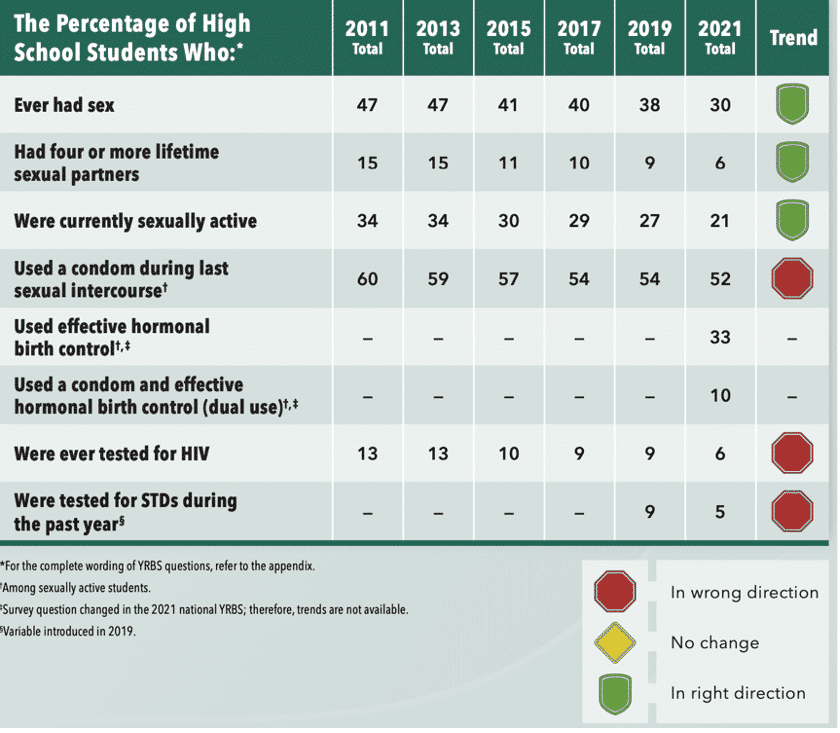
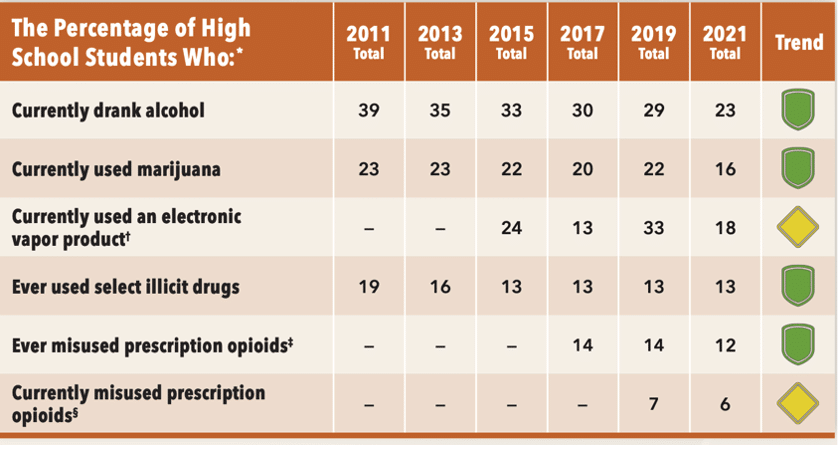
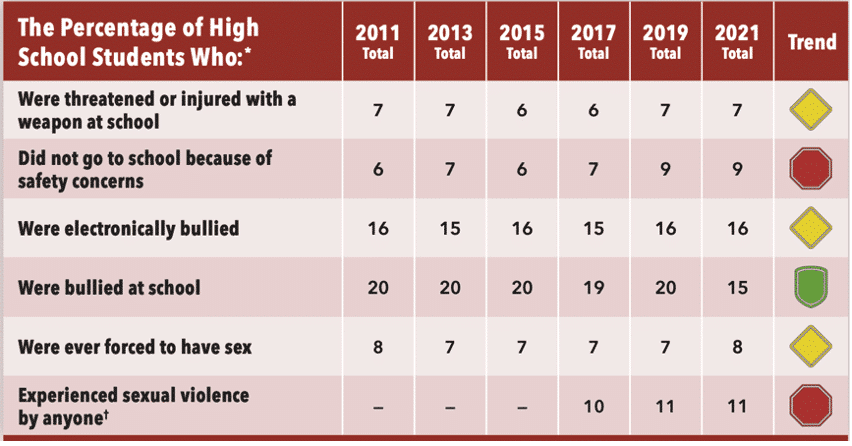
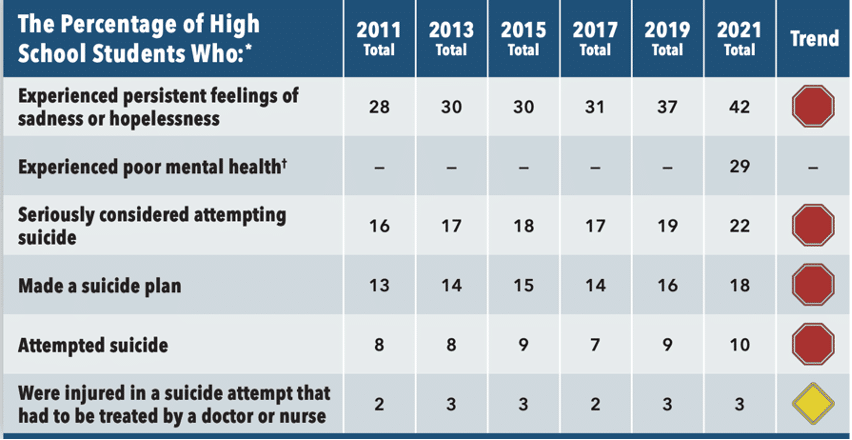
The CDC report data comes from 17,000 U.S. high school students who were surveyed in the fall of 2021 when most schools returned to in-person teaching. The good news is that overall sexual activity, substance abuse, and in-school bullying are down. The bad news is that teen safety concerns due to violence, sadness, hopelessness, and suicidality are up, especially among girls and LGBQ+ students (trans students were not identified for this survey).

Here is the Summary of Findings from The Youth Risk Behavior Survey Data Summary & Trends Report: 2011–2021

Sexual Behavior
Substance Abuse
Experiencing Violence
Mental Health and Suicidality
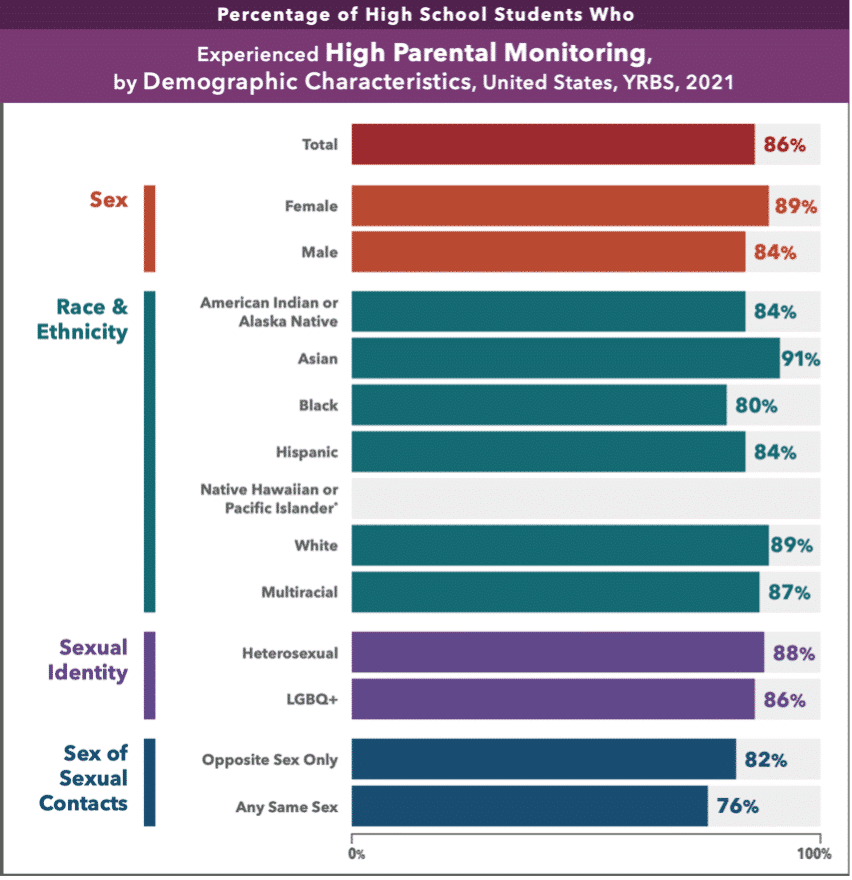
Parental Monitoring
 Teen Girls

The survey suggests that nearly 3 in 5 (57%) U.S. teen girls felt so sad or hopeless that they couldn’t engage in regular activities for two weeks or more. Nearly 1 in 3 (30%) seriously considered attempting suicide—up nearly 60% from a decade ago. And 1 in 5 (18%) experienced sexual violence in the past year—up 20% since 2017.

LGBQ+ Youth

Almost 70% of LGBQ+ students said they felt persistently sad or hopeless, and 20% reported attempting suicide. Fifty-two percent of LGBQ+ teens had poor mental health symptoms in the past 30 days compared to 29% of all teens.

Possible Contributors?

It’s important to consider that the survey occurred at the end of the isolation from COVID-19. Although I am still seeing significant fallout among kids, tweens, and teens, they have recovered somewhat from that dark and frightening time.

We must also consider that this is a survey. Without experiments where we expose one group of teens to possible causal variables (e.g., social media or isolation) and don’t expose a control group, we can’t determine what is causing the distress.

Surveys simply state and analyze subject report. It’s impossible to tell the causes from this type of data. We are left to guess with our observations and experience, forming hypotheses and looking for evidence to support them. As the Founder of GetKidsInternetSafe, a mother, university faculty member, author, and clinician who has treated kids, teens, and families for over 25 years, I have some ideas.

PHONELY: Our kids are phonely. Because we were hunters and gatherers for 90% of human existence, our brains are wired to thrive with face-to-face tribalism. Online relationships just don’t do it for us long-term.

ISOLATION: With the isolation of COVID-19, kids lost friends and confidence and regressed in their social skills.

SOCIAL MEDIA: Social media and the internet offers a constant onslaught of online ads and marketing influencers for kids and teens. This unfiltered exposure can lead to chronic fears of being judged and ridiculed as well as feelings of inadequacy and exclusion. The CDC report demonstrates that there is an epidemic of online bullying and cybersexual violence, especially toward girls and LGBTQ youth.

PARENTING: Parenting strategies have become overly protective based on anxiety and fear resulting in less child independence and more fear of failure. Plus, they spend more time online than with us. It is difficult for parents to overcome the influence of strangers and taking away all screen activities has become nearly impossible.

NEWS: Sensational and divisive news expertly and manipulatively communicates fear-inducing trends like mass shootings, climate change, and inflation. This has got most of us rattled, especially the most vulnerable among us.

FINGER-POINTING: We have tolerated and participated in an ugly, divisive climate of entitlement, bullying, and blame rather than accountability and positive action.

GROUP-THINK: The internet speaks the language of mental health – but this may result in a group-think phenomenon of looping on mental health suffering instead of increasing agency and growth.

LACK OF APPLICABLE EDUCATION: Trauma-informed, evidence-based health and sex education isn’t being offered equitably among out schools. Parents don’t want to leave this important job to schools, but they’re also not doing a great job themselves in many instances.

NOT ENOUGH MENTAL HEALTH SERVICES: There aren’t enough mental health services available to our youth.

LACK OF FAITH AND COMMUNITY: Pulling together as a loving, cooperative team is critical for kids to feel a sense of belonging and community. As our families get smaller and we have fewer extended family to offer support, our kids are left to fend for themselves.

Of course, this is not an exhaustive list. But it does summarize much of the research findings and conjecture that has surrounded these issues. There are more ideas for the list. But for the purpose of solving the problem, how can we take these stressors into consideration as we discuss possible solutions?

Considering the complexity of the question, what can we do to improve the situation? Reverse Engineer!

Reverse engineering refers to the process of looking at possible outcomes (like the causes posited above) and slowly working backward for a solution. Although this is clearly a messy mission, I watch kids regain the mental health ground they lost every day in practice. Despite what some may think, effective psychotherapy isn’t simply listening and reflecting feelings of despair. As a cognitive-behavioral therapist, I employ techniques specifically designed to facilitate positive movement forward. I’ve found that, if I set the tone and get everybody started, parents can take it from there.

Here are some tips for improving mental health and well-being at home:

  • As a family, negotiate a set of measurable goals and revisit them often for direction and motivation. Praise and reward movement forward and maintain and warm and encouraging tone along the way.
  • Use storytelling and a sense of humor to normalize failure and encourage curiosity and confidence.
  • Turn off the news and divisive influencers who are selling toxic ideas and products.
  • Reassure kids that they are capable and loved and that grit is what matters the most, far more than being attractive or innate skills.
  • Encourage kids to detox off their phones occasionally and engage more in real-life exploration and socialization.
  • Stay moderate. Avoid shaming lectures and demoralizing consequences.
  • Offer mindfulness, problem-solving, and communication strategies to help kids gain independence and confidence.
  • Offer outcome- and science-based education that empowers informed action rather than create fear.
  • Support parents in not personalizing child behaviors and help them set fair and reasonable limits with warmth, encouragement, and love.
  • Lead our kids toward post-traumatic growth rather than feelings of helplessness, hopelessness, and fear with expert mentorship, fun, and opportunity.

How can GetKidsInternetSafe help?

I founded GetKidsInternetSafe so I could be part of the prevention effort – rather than just the treatment effort. If you’re not sure where to get started, we have a comprehensive suite of tools for parents, tweens and teens, educators, paraprofessionals, and professionals who work with families and kids.

If you want all of our supplements and courses at a low cost for parents and kids, tweens, and teens, you’ll want our mega Screen Safety Essentials Course! This online course offers a set of four modules that will help you walk your kids through the essentials of screen safety.

I’m the mom psychologist who will help you GetKidsInternetSafe.

Onward to More Awesome Parenting,

Tracy S. Bennett, Ph.D.
Mom, Clinical Psychologist, CSUCI Adjunct Faculty
GetKidsInternetSafe.com

Photo Credits

Photo by Tim Mossholder on Unsplash

Photo by ALMA on Unsplash

Sextortion Scammers Targeting the LGBTQ+ Community

People seeking companionship or romantic connections online are falling victim to internet predators. There has been a dramatic increase in recent reports claiming that LGBTQ+ individuals are being purposely targeted for malicious online sextortion crimes. These crimes have led to devastating and long-lasting repercussions for victims and their families. As a result, the Federal Trade Commission (FTC) issued a warning in response to complaints about dating sites geared towards LGBTQ+ community members being infiltrated by sextortion perpetrators.[1] To help ensure your family has the tools to safely navigate the online world, check out our Screen Safety Essentials Course.

What is Sextortion?

The term sextortion (sexual-extortion) falls under the broader category of sexual exploitation. In many cases, sextortion is a form of blackmail that involves the act of extorting things like money and sexual favors through means of manipulation and coercion. For example, a perpetrator may threaten to reveal or expose personal and sensitive information about the victim to others unless they agree to the perpetrator’s demands.

How are people being victimized?

Despite advancements in societal attitudes towards LGBTQ+ community rights, the world can sadly still be a hostile place. That’s why dating apps geared toward members of the LGBTQ+ community, like Grindr, Feeld, and Her, have become popular.

These sites were designed to provide a safe space for both openly queer and closeted people to meet and make connections with each other without fear of harassment or exposure. Unfortunately, recent reports have indicated that an increasing number of apps and websites marketed toward members of the LGBTQ+ community are being infiltrated by sextortion predators.

Blackmail

A typical sextortion scam begins with a perpetrator creating a fictitious account on a dating app or social media networking site using a fake identity and photos. The perpetrator poses as a potential partner or someone looking to make a connection online and attempts to establish contact with another person under the guise of starting a romantic relationship. This is a process referred to as catfishing.

The perpetrator cultivates the relationship with their target to gain their victim’s trust and make them feel comfortable. The process can last for days, weeks, or even months. After establishing rapport, the perp will send explicit messages, photos, and videos and ask for some in return. Once the target shares their personal images and information, the scammer threatens to release it to the victim’s friends, family, or co-workers, or post it online unless the victim does what they say.

The primary motivations behind these types of romance scams can be financial and sexual. Sextortion predators use various manipulation tactics to not only extort money from victims but also to access sexually explicit photographs and messages, for their own sexual gratification. Recent reports have revealed that minors using the app, despite there being minimum age of use requirements, were targeted specifically by pedophiles hoping to elicit child pornography. In both cases, similar methods of exploitation are used.[2]

The FBI has stated that most victims report that initial interactions with perpetrators are mutual and unsuspicious. However, after a brief period, the extortionist will attempt to transition the interaction away from the app and onto private messaging forums. Without exposing their true identities, these online predators will go to great lengths to convince targets that they are legitimate users of the app.

Scammers often use stolen or fake photographs and may even hire a video model to convince their victims that they are interacting with an authentic person. It is very common for perpetrators to befriend victims on social media to access a list of the victim’s followers which typically include family members, friends, and co-workers.[2]

Why are LGBTQ+ apps being targeted?

Experts suggest that individuals using these dating apps are being specifically targeted by predators for a few different reasons. Given the nature of the apps, which are primarily used to foster romantic connections, online predators have a much greater opportunity to collect private and sexually explicit information from their targets. Additionally, since these apps have been designed for LGBTQ+ community members, predators assume that their targets have an even greater incentive to keep quiet about their victimization and comply with demands.

Because these apps are marketed as a safe space, people who are not openly queer rely on them to make connections with others without fear of exposure. As the thought of public shaming and the potential outing of their sexual orientation or gender identity is so profound, these individuals are more easily subject to victimization.

The Fallout

According to the FBI, the number of these cases has been steadily increasing. Experts speculate that the onset of the COVID-19 pandemic and the emergence of hookup-culture has escalated this trend. As the dating world transitioned largely onto virtual platforms, sextortion predators took advantage of this change.

Last year, the federal agency reportedly received over 16,000 sextortion complaints with financial losses totaling over $8 million.[2] In reality, the repercussions of these crimes extend beyond financial ruin. Sadly, the effects of being targeted and exposed by sextortion predators were overwhelmingly devastating for some victims who felt driven to take their own lives.[1] As a result of the seriousness of these crimes, law enforcement officials have significantly increased their efforts to capture and charge perpetrators.

How to Protect Yourself

It is important to be aware of the potential dangers inherent online in order to prevent yourself and your loved ones from becoming victimized. Dr. Bennett believes that providing our kids and teens with the necessary knowledge and skills to navigate these pitfalls before they arise, is the key to avoiding digital injury. That is why we created the Social Media Readiness Course which is designed to empower families to promote safe and responsible practices while avoiding harmful outcomes online. The internet can be an exciting and helpful tool when we are equipped with the proper skills to use it.

T hanks to CSUCI interns, Mackenzie Morrow and Michael Watson for researching the targeting of LGBTQ+ community members in sextortion scams on popular dating apps and co-authoring this article.


I’m the mom psychologist who will help you GetKidsInternetSafe.

Onward to More Awesome Parenting,

Tracy S. Bennett, Ph.D.
Mom, Clinical Psychologist, CSUCI Adjunct Faculty
GetKidsInternetSafe.com

Works Cited

[1] Skiba, K. (2021). Sextortion plaguing LGBTQ+ dating apps. AARP. https://www.aarp.org/money/scams-fraud/info-2021/lgbtq-dating-apps.html

[2] Petkauskas, V. (2021). The shame game: how sextortion scammers prey on victims’ fear. Cybernews. https://cybernews.com/privacy/the-shame-game-how-sextortion-scammers-prey-on-victims-fears/

Photo Credits

Photo By Sharon McCutcheon (https://unsplash.com/photos/MW7ru0BdTFM)

Photo By Tima Miroshnichenko (https://www.pexels.com/photo/a-man-holding-a-letter-lightbox-6266500/)

Photo By Bruno Aguirre (https://unsplash.com/photos/xw_WBtNEqfg)

Online Teen Slang: Should We Worry?

I’m curled up on a weathered leather couch in a beautiful loft barn we rented for the weekend. A last of summer cozy couples’ retreat in the rolling hills of wine country. We are waking up to soft braying of ponies, early morning foggy walks in vineyards ripe for harvest, and a leisurely breakfast of fresh eggs, hot mint tea, fresh squeezed watermelon and orange juice, and buttery warm banana bread left by our generous hosts. Later we are meeting our friends for a delicious farm to table lunch from local farms and orchards. Best of all…a weekend of fun with old and new friends before a busy school year starts. Crazy grateful for the rejuvenation from the sunshine and laze of summer.

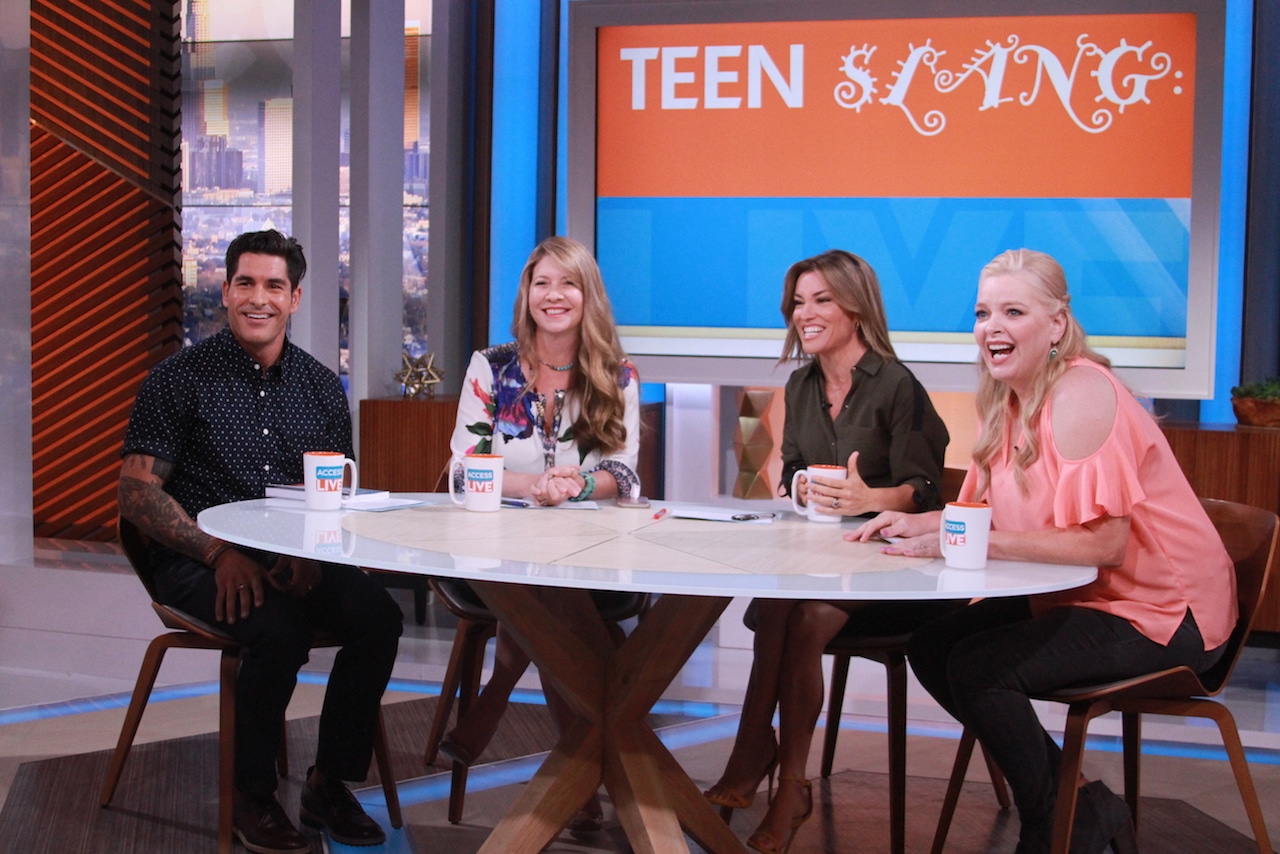
Now that my kids are teens, we are able to sneak away sometimes, guilt-free. If you have little ones and can’t seem to sneak off for weekends yet, don’t despair. It’s coming one day. And when you do, you’ll spend much of it fondly remembering being frazzled and sleep-deprived with your little ones. Each phase of parenting has its challenges and its pleasures. In the spirit of sharing and friendship, I’m taking fifteen minutes out in this sweet little farm kitchen to share the fun content producers of Access Hollywood Live helped me develop for my segment Monday on Online Teen Slang: Should We Worry? I hope you’ve set aside time each week to curl up with steaming hot tea for a moment of solitude to read your GKIS article. They are written to gently pepper you with useful information about tech, parenting, and safety so you can teach during screen-free dinners with you and yours. ❤️ Now on to the basics of teen online slang.

Why is slang always changing? Is it to be ‘cool’ with friends?

Slang is an expression of culture. Youth culture changes rapidly and is based on popular memes, songs, and movies. Part of the excitement is that you have to be an integral part of the culture to keep up. No parents!

Teen Slang: The Bad News

Often reflects and teaches concepts you may not want your child to know.

Can be used to hide from parents and plan secret and even dangerous activities

Can be vulgar, offensive, or cruel.

Teen Slang: The Good News

Young people who use slang are striving to form their own, independent, adult identities.

Sharing slang provides a sense of belonging, and being ‘in-the-know’with friends.

Using slang is a celebration of being young and having fun.

Every generation creates its own slang, but why does it seem so different now? Has it evolved in the age of social media and smartphones?

Slang is not new. But with the web, kids have a bigger, private, more versatile playgroundto live in. They juggle lots of virtual identities, each with its own characteristics, slang, activities, and community on demand with thousands of members of their tribe connected at once. We had our neighborhood buddies and the telephone. Big difference.

Should parents attempt to use their teens’ slang as a way to try to relate to their kids, or is that getting into majorly uncool territory?

If you want them to roll around in agony and openly insult you, you should totally use their slang.

Should parents be worried about the slang their teens are using now, or is it no different than if they think back to when they were younger?

It’s different. It’s more dark and vulgar for sure.But the teens I see in practice and the ones I’m raising are still good people. They’ve just habituated to a more troubling slang culture overall. Parents should be worried if their kids are too “thirsty”to belong, because that would result in being too eager to join in and take risks. They should be worried if they’re too secretive. They should be worried if there’s evidence of sneaking and dangerous defiance. Otherwise, have fun with it. Of course, correct them when they cross over the line, but stay engaged. Allowing them some privacy is also important.

Another topic we want to touch on is the cultural sensitivity issue of using slang — many of the terms originate in African American or LGBTQ communities — how mindful should people of other communities be of this before being quick to just use any term?

In-groups are delicate. If a person intrusively hijacks slang from a group they haven’t earned a place in, it can look aggressive or demeaning. Slang provides information about boundaries and belonging.

How can people make sure it’s appropriate to use a term before they start using it?

Do your research before using slang, like observe and ask others, Google it, err on the side of caution.Teens brutally police each other to follow social morè’s, which may even slip into bullying. Let your teen know you have their back 100%, even when they make stupid mistakes. Even better, teach them that mistakes are part of learning and you expect them often. Rather than shame them when they’re hurting with a lecture, take them for a smoothly, show deep compassion, and share stories about how common and healthy mistakes are. Sometimes providing a fun distraction while it passes is what they need.

How to Spot Red Flags in Teen Slang Use & What to do About it:

  • Talk to your teen often. Let them DJ in the car and share funny videos to stay connected. Keep up on their friends and interests. Be you but with humor. Encourage their independence but reassure them you are being them 100%.
  • Keep an eye out for concerning behavioral changes like increased isolation, poor hygiene, reckless behavior, or darkened moods are things that may signal trouble.
  • Block dangerous websites and monitor screen use.
  • Bookmark helpful websites, like Urban Dictionary, and set google alerts.
  • Look out for defensiveness and changing the browser quickly or erasing it.
  • If you’re worried and they won’t talk to you, consider psychotherapy. It’s shocking the influence I have with teens as they blatantly reject their parents with the same advice. It can really turn the situation around.

Want to know which slang terms to pay attention to and if slang use leads to teens having sex? Check out my earlier article Online Slang That Parents Need to Know.

I’m the mom psychologist who helps you GetKidsInternetSafe.

Onward to More Awesome Parenting,

Dr. Tracy Bennett