
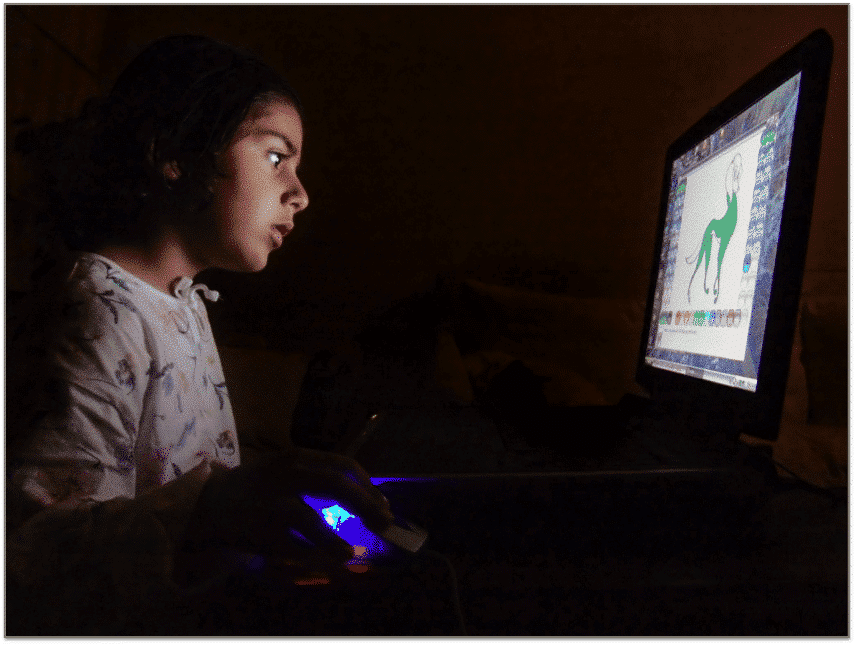
My niece is five years old and lives in a tiny village in Switzerland. You would think that in a cute Alpine village the world is still safe, that kids are playing outside until it gets dark, craft themselves little walkie-talkies from strings and cans, and don’t have any interest in online media. But you would be wrong. Smartphones and tablets and the vast possibilities of online entertainment are all the rage everywhere. With her little eyes fixed on the screen, my niece stays online for hours.
Generation X, Y, Z…and now: Alpha!
Futurist, demographer and TEDx speaker Mark McCrindle distinguished a new cohort of anyone born after 2010. He calls it Generation Alpha. The main characteristic of Generation Alpha is the constant use of screen technology. In his opinion, Alpha kids grow up with screens in hand, able to transfer a thought online in seconds (Sterbenz, 2014). Shocking numbers provide evidence of McCrindle’s observations, with kids from five to 16 years spending an average of 6 1/2 hours a day in front of a screen (Wakefield, 2015). Teenage boys have an even higher average of 8 hours a day (Wakefield, 2015).
Why do children spend so much time online?
Every time I visit my sister, I’m fascinated by how her daughter is able to use a smartphone or tablet at such a fast pace. It’s almost impossible for me to get her attention and convince her that drawing with her aunt can be more fun than styling dolls on her tablet. A reward for her for doing a chore could either be chocolate or smartphone-time. Guess what her choice usually is? And it’s not just my niece that prefers YouTube over Oreos, Disney, and Crayola. In Smarty Pants’ eighth annual Brands Love study with 8,125 kids, YouTube was chosen as the most loved brand for kids aged 6-12 (2016). Number one over 2,285 consumer brands!
Why do kids love screentime? Because browsing for quick, yummy screen content really fun. Interacting with friends, playing games, watching videos or movies, and sharing information and experiences are just a few examples of amusing online activities.
Another major contributor to screen addiction is FOMO (fear of missing out) and peer pressure. It’s hard to pass up online engagement when friends are sharing funny snapshots and their latest filtered selfies. You MUST join in or get left behind. Peer acceptance and forming an identity independent of your parents is just too tempting to turn away from.
Jim and Sandra
Jim is 11 years old and has always been a very shy child. He has an immense fear of meeting new people and feels uncomfortable around others. He is always worried about judgement from others, and when someone is rejecting him, he thinks it’s because he made a mistake and that he is unlikable.
Sandra is 10 years old and is a great soccer player. When she wins, she attributes it to factors outside herself, like the poor skills of the other team or luck. She doesn’t believe that she could be a contributor to her team’s success. Her psychologist recognizes that Sandra attributes success to an external locus of control, which means that she looks at everything around her as part of success or failure rather than herself.
Do you think that Jim and Sandra are at high risk for screen addiction?
Predisposing traits for screen addiction

For shy children online communication and interaction with others is less directly linked to judgments and possible disapproval than it would be in the offline world. That means Jim may be more comfortable and suffer less anxiety from online interactions. Although, that doesn’t mean all shy children will become addicted. But it does mean that parents may benefit from knowing shyness is a risk factor.
This study also suggests that kids like Sandra may be less successful at controlling Internet use and tend to offer external explanations why they stayed online for so long rather than take direct accountability (Chak & Leung, 2004).
When Internet use goes from innocent fun to addiction
Internet Addiction was first defined in 1995 by Young as a use of the Internet for more than 38 hours per week which will lead to clinically significant impairment or distress (Flisher, 2010). However, by these criteria most of America would be considered addicted. Today, experts detail several criteria that must be met in order for a person to be considered “addicted.”
Criteria for clinical addiction include four main features:
- Loss of control
Your child can’t disengage from the Internet even with the understanding that he or she is spending too much time. - Tolerance
Your child needs more and more time to get the same “fix” from their screen use. Once 15 minutes would do, but now your child feels vaguely dissatisfied and chases more and more screen time. - Withdrawal
When your child has to turn her screen off, she demonstrates classical withdrawal symptoms such as restlessness, nervousness, dissatisfaction, irritation, aggressiveness and psychological craving. Dr. Bennett further theorizes that screen-off meltdowns are the result of too much autonomic arousal. This means your child’s brain is overstimulated and tantrums are like coming down off crack rather than trying to express distress or manipulate parent behavior. - Negative social consequences/impairment
Screen time becomes the sole focus of your child’s life. It’s all he/she wants to do, it’s all he/she wants to talk about. It has replaced nonvirtual relationships and activities needed for healthy balance.

I’m the mom psychologist who will help you GetKidsInternetSafe.
Onward to More Awesome Parenting,
Tracy S. Bennett, Ph.D.
Mom, Clinical Psychologist, CSUCI Adjunct Faculty
GetKidsInternetSafe.com
Works Cited
Chak, K. & Leung, L. (2004). Shyness and Locus of Control as Predictors of Internet Addiction and Internet Use. Cyber Psychology & Behavior, Volume 7, Number 5
Flisher, C. (2010). Getting plugged in: An overview of Internet addiction. Journal of Paediatrics and Child Health 46, p. 557–559
http://asksmartypants.com
Sterbenz, C. (2014) Generation Alpha Is Coming And It Will Change The World Forever for Business Insider. Retrieved February 15, 2017 from http://www.businessinsider.com/generation-alpha-2014-7?IR=T
Wakefield, J. (2015). Children spend six hours or more a day on screens for BBC Technology. Retrieved February 18, 2017 from http://www.bbc.com/news/technology-32067158
Photo Credits