Almost everyone has experienced a zombie-like feeling after a night of poor-quality sleep. Research shows that a single night of sleep deprivation can have a negative result on cognition and behavior.[1]Sleep deprivation for children can be particularly costly. Good quality sleep helps children with healthy brain development. That is why Dr. Bennett includes a whole lesson on how to protect your child’s sleep in her Connected Family Online Course. By following research-backed guidelines, setting sensible rules, and setting up your house to optimize learning and safety, your family can avoid costly digital injuries. If you are interested in learning about how to create a safe screen environment at home while discovering ways to promote open and honest communication within your family then check out our GKIS Screen Safety Essentials Course. In today’s GKIS article, you’ll discover how a child’s learning can be negatively affected by lack of sleep and how to avoid it.
How does lack of sleep impact a child’s learning?
Attention and Concentration
A child needs an average of 9 to 11 hours of sleep each night for optimal health and learning performance.[2]Poor sleep affects the functional connectivity of the prefrontal cortex. This means that a sleepy child will experience problems in their ability to focus and sustain attention in a learning environment. Further, a 2009 study demonstrated that sleep may cause the child to become overly sensitized to reward stimuli.[3] An overly sensitized person craves rewards so much that if they can’t get the desired activity immediately, they may resort to acting out and tantrums. To understand more about this process, check out Dr. B’s whiteboard video GetKidsInternetSafe from Sensory Overload on the Dr. Tracy Bennett YouTube Channel.
Memory
Mental lapse refers to a moment of unexplained forgetting, like walking into a room and forgetting what you came in for. A sleepless night slows down brain cell activity, sometimes resulting in impairing daytime mental lapses. A 2017 UCLA study demonstrated that lack of sleep disrupts the brain cells’ ability to communicate with one another, resulting in a mental lapse that negatively affects the way we perceive and react to things around us.[4]
Learning and Information Processing
In Dr. Bennett’s book Screen Time in the Mean Time, she explains that when we don’t get enough sleep our brain’s housekeeping and memory consolidation tasks remain undone, leaving us unable to efficiently acquire or retrieve information. Without good focus, attention, and memory, kids are unable to process information and understand and learn new concepts.
Creativity
Sleep deprivation can also limit planning, creativity, and the ability to think outside of the box. According to a study from the University of Loughborough, sleep deprivation can negatively impact a person’s creativity by impairing one’s ability to create new ideas and change strategies.[5]
How does a lack of sleep impact mood and behavior?
Sleepy Throughout the Day
If your child chronically gets insufficient sleep at night, their body may compensate by falling into a pattern of daytime hypersomnia. This is a condition when someone repeatedly is falling asleep throughout the day.[6]
Mood Swings
Lack of sleep can be a main contributing factor in mood swings.[7] Moodiness and irritability can negatively affect relationships, leading to deeper problems and feelings of hopelessness. If sleep deprivation is habitual, it can contribute to clinical conditions like anxiety, depression, and even psychosis!
Decision-Making
Little to no sleep can also affect how well we make decisions.[8] That means that kids who have sleep deprivation will have a difficult time prioritizing tasks like when to brush their teeth or do homework. If your child seems to get stuck on even the smallest of choices, consider if sleep may be the issue.
How can lack of sleep affect learning in children of different ages?
Teenagers tend to have more sleepless nights than younger children. Not only do parents allow later bedtimes for teens, but they also stay up chatting with friends and playing video games. Without the right amount of sleep, teens have more trouble focusing and learning in class compared to younger children. According to the CDC Healthy Schools, teens ages 13-18 need 8-10 hours of sleep.[9]
How can parents help their children get better sleep and improve their learning?
I am so excited to share this with you! Over the past several months, I’ve been told from overwhelmed parents in my coaching and clinical practices,
“I can’t figure out what to say or where to start with screen safety. Can you PLEASE just do it for me?”
We are all so busy and overwhelmed – and where do you start without sparking resistance from the kids? For some, even a book or a course feels like too much. They’d rather just dive in with me and get the work done. And so we did – during individual sessions that cost $180 an hour. They LOVED it!
With coaching, we got rolling with our:
CONNECTED FAMILY SCREEN AGREEMENT, a digital contract that covers the basics, step-by-step.
tech parental controls from our SCREEN SAFETY TOOLKIT
comprehensive screen setup rules and ideas to optimize balance and screen-based learning based on our CONNECTED FAMILY COURSE.
as well as tons of other great information, including positive parenting strategies, social media readiness, things to look out for with gamers, and information about how to avoid the many digital injuries out there that most parents have never even thought of!
And most valuable of all, socioemotional strategies that help avoid distressing psychological symptoms like anxiety and depression.
But let’s face it, I only have so many coaching hours available and not every family wants to buy in at $180 an hour. Which leads me to my announcement today. After testing my GetKidsInternetSafe App out with volunteer subscribers,
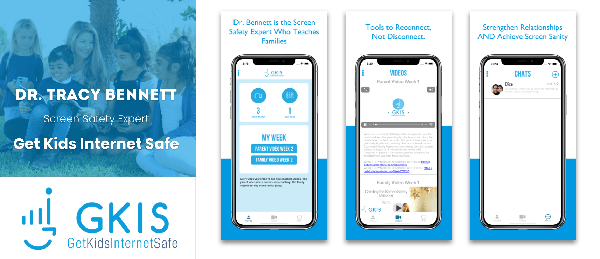
My parent and family coaching videos are ready for smartphone delivery!
By simply registering for the GetKidsInternetSafe App, you get my 5-10 minute coaching videos with easy-to-use downloads delivered directly on your app.
One video is for parents only to help you prepare for the behind-the-scenes maneuvers that optimize success. And with my family coaching video, you can cast it to your TV, tablet, or computer to watch as a family followed by a fun family activity option.
And the great news is that if you sign up now…
YOUR FIRST 30 DAYS ARE FREE!
Also, those that get their GetKidsInternetSafe App by Midnight Thursday (April 1) will be invited to an exclusive, complimentary Live Online Q&A session with me! You can ask questions live, or submit them anonymously prior to the event, and I’ll answer them!
With summer coming up, it’s a perfect time to spend a little time regrouping for safe screen use. Your GKIS Coaching App will show you exactly how to do that. It’s guaranteed for 30 days free! That’s 5 weeks – 10 videos – at no cost to start. After that, you have to option to continue at only $19.99 a month – a deeply discounted price compared to my regular $180/hour. Plus, you get free downloads from every course GKIS offers!