
Need peaceful screen time negotiations?

Get your FREE GKIS Connected Family Screen Agreement

parenting

Ray Rice, Adrian Peterson, and Floyd Mayweather- Your Kids on Violence

BLOGBC5boxing-gloves-hanging-300x200

On the way to school this morning with my kids (ages 10 and 12), I told them I was going to write a piece on how children are affected by viewing TV coverage of athletes committing domestic violence. And as usual, I was fascinated by their response.

The first thing I learned is that they had no idea what I was talking about. My GetKidsInternetSafe filtering is working! The second thing I learned is that kids don’t reason like adults. I know this, but I need to be constantly reminded. Thirdly, their responses confirmed that my participation in their media activities is critical if I want them to learn the right lessons.

Let me tell you a story. When my kids were ages 12, 4, and 2, I agreed to drop them off at the pet store while I went across the parking lot to buy a light bulb. My oldest was a skilled babysitter and volunteered at a different pet store every Saturday. My little ones were easy for her to manage. I thought nothing of it. As we tumbled out of the car laughing from our singing hijinks, I saw a woman in some sort of uniform give me a really dirty look. I didn’t acknowledge it at the time, passing it off as unimportant, until I returned to pick up my kids 10 minutes later. Upon walking through the door the woman aggressively accosted me saying, “What kind of mother just drops off her kids?” Beyond my knee-jerk sophisticated response of “Shut up!” (Yea not proud of that one), her hostility prompted me to frantically find my babies. A few rows back I spotted them, hand in hand, calmly talking to a police officer. I was terrified. The officer assured me nothing was wrong, that he simply responded to a call from a concerned citizen. He also went on to say he was aware my daughter was 12 years old and she did an impressive job handling a difficult situation. Apparently he asked her to accompany him to his squad car so he could retrieve his phone to call me and, just like I taught her, she refused to leave the store. He apologized for asking her to do that in the first place, but went on to say that her judgment demonstrated her younger children were not in danger. Furthermore, when I told him about the aggression of the “concerned citizen” who had reportedly approached my 12 year old directly with criticisms about her mother, he walked me to the car and assured me that he was simply doing his job and agreed that the woman’s intentions were perhaps not entirely motivated by concern about my children’s welfare.

This leads me to my point of “What IS child abuse?” I am challenged by this discrimination in clinical practice often as a mandated reporter. Tell me at what you point you think abuse criteria has been met:

  1. Allowing your child to watch violent news coverage?
  2. Leaving your child unattended at a store?
  3. Yelling at a child and calling him “lazy”?
  4. Yelling at a child and calling her a “brat”?
  5. Slapping a child on the buttocks?
  6. Allowing your child to see you hit his/her other parent?
  7. Hitting a child with a switch or belt?
  8. Punching a child with your fist?

Maybe my quiz sucks because the items are in the wrong order or don’t give enough information, but my objective is to inspire you to form a thoughtful opinion. With 20 years of clinical, teaching, and mothering experience, I am happy to provide my opinion. But you’d be reading a much longer article. Check www.GetKidsInternetSafe.com/blog/ next week to read EXACTLY what I think is child abuse.

Essentially, today’s objective comes down to exploring what values you hold and how important it is to communicate those values to your children. This morning I told my kids about Ray Rice and his elevator knock out video with his then fiancé, Adrian Peterson and his four year-old son with lacerations and bruises from a whoopin’, and Floyd Mayweather’s response to a reporter, “No pictures, just hearsay.” The initial response from my kids was that parents should not let their kids watch that coverage. Upon further discussion, they agreed that parents should front-load their kids with thoughtful discussion in preparation for unexpected exposure. And finally, my twelve year-old left me with a disturbing realization. I asked her, “What do you think kids are learning from watching their idols committing domestic violence and then being interviewed about it?” She responded, “Just don’t get caught.”

I’m the mom psychologist who will help you GetKidsInternetSafe.

Onward to More Awesome Parenting,

Tracy S. Bennett, Ph.D.
Mom, Clinical Psychologist, CSUCI Adjunct Faculty
www.GetKidsInternetSafe.com


If this doesn’t get you thinking, start smelling coffee:

http://uproxx.com/sports/2014/09/floyd-mayweathers-cnn-interview-was-an-absolute-disgrace/

 

Dr. Bennett’s Developmental Psychology Crash Course (Ages 3 to 6 Years).

The developmental phase of 3 to 6 years old marks the progression from parallel play to group interaction in expanding peer and academic settings (preschool through first grade). Learning continues at an explosive rate with rapid brain development (nature) interacting with a protected and enriching environment (nurture). As children become increasingly familiar with and master activities, their cognitive resources are freed up to grasp an increasingly complex understanding of the world around them. During this time our amazing little beings are blossoming and developing initiative, complex communication, and creativity.

This article offers a developmental psychology review/crash course outlining the developmental tasks children master between the ages of 3 to 6 years old. With this information, you can decide for yourself if screen time would enhance, be neutral, or interfere with your child’s development.

Brain Development

Research on brain structure has been difficult with this age group due to the complexities of sedating children for brain research. However, with more sophisticated brain imaging and recording technologies, we have evidence that the preschool developmental period is characterized by the ongoing “remodeling” of brain tissue. More specifically, brain cells (neurons) grow and migrate, only to die off or be “pruned and tuned” later as the child matures and gains experience (Brown). Brain maturation is affected by experience and interactions between nature and nurture. The better the match between children’s capacities and the demands placed on them, the better the learning. If the mismatch is too big, stress and dysfunction may result (Lenroot). Fortunately, loving parents are expert at ratcheting up difficulty level at a customized rate that best fits their child. It is the perfect partnership!

Here are some quick brain facts to help you customize your parenting genius:

  • At 3 years old, your child’s brain has reached 50% of its adult size already and will reach up to 95% of its adult size by 6 years old (Lenroot).
  • The brain remodels from phylogenetically older to newer brain structures. As lower brain regions develop, they perform scaffolding for later developing, higher brain regions. In other words, when performing a cognitive task, young children must enlist more brain regions for a single task, while older children with more specialization use fewer regions to perform the same task (Brown). This progression of mastery frees brain resources for more and more specialized development. Truly magical to behold!
  • Just as we see a spike in surface area growth of the frontal lobes at age 2 years, we see another between 5 to 7 years. This is consistent with the dramatic improvements in executive functioning (attention, concentration, and organization) that we see at these two phases of development.

There’s increasing evidence that frequent and rigorous exercise, good sleep, good nutrition, unstructured play, one-to-one parent and peer interaction, and time with nature play important roles in the healthy development of executive functioning. Parents would be well advised to structure their preschooler’s day with quality stimulation in all of these areas.

Although educational and prosocial screen media activities are a cognitively- and socially-enriching addition to a well-balanced life, limits are necessary. There is also increasing evidence that too much screen time can contribute to attention problems (Christakis).

  • The brain’s auditory system develops rapidly during these ages, consistent with rapid language acquisition.
  • Consistent with the language and motor advances during the preschool period, rapid myelination occurs throughout the brain, particularly in the areas of the hippocampus (memory) and in the fibers linking the cerebellum and cerebral cortex (fine motor skills) (Lenroot).
  • More effective connections are also established between the temporal, occipital, and parietal lobes, which are brain areas critical for the synthesis of information and processing of temporal, visual, and spatial information.
  • Although little research has been conducted regarding screen-media technology use and brain change in young children, there is evidence of brain structure change with older kids. For example, Hong et. al. report evidence that there is a significant relationship between Internet addiction and the thickness of a child’s medial and lateral orbitofrontal cortex (OFC), similar to changes seen due to drug addiction. The medial OFC is affected by choices involving immediate rewards, and the lateral OFC is affected by choices involving delayed rewards. These areas of the brain also demonstrate similar changes among subjects with obsessive-compulsive disorder. In conclusion, it doesn’t take a brain scientist to recognize that even child programs on screen media are expertly designed to encourage compulsive play. It’s up to parents to run a risk/benefit analysis about whether to allow play at all, to choose appropriate content, and to monitor use time. I suggest you keep it conservative for now. There’s plenty of time to develop expert digital literacy.

Cognitive & Motor Development

  • Preschool children are rapidly developing a self-concept, with both concrete and psychological dimensions (e.g., sociability). Preschoolers are wildly curious and often focused on gaining independence and self-control. As they collect new experiences, expect new behavioral patterns to emerge. For instance, it is very normal for preschool age kids to become preoccupied with the classification and grouping of things. Clients sometimes worry their children have a clinical form of obsessive-compulsive disorder (OCD). I assure you, lining up toys and insisting on rigid rules and routines is common among the preschool age group. Go with it, this too will pass.
  • Piaget theorized that children of this age are in the preoperational stage of cognitive development and start to demonstrate precausal/magical thinking:

In other words, they still have a hazy idea of how their ideas and desires relate to the world around them. They tend to accept what can be immediately seen (concrete appearance and reality), yet unable to reason concepts through (precausal thinking). As a result, they are better at grasping the short-term rather than the long-term outcomes. Flaws in thinking during this developmental phase include egocentrism (self-centered thinking), irreversibility (things operate only one way), and animism (ascribes lifelike qualities to inanimate objects).

 Young children are not confident in their opinions and ideas and are easily led astray by the influence of others. Therefore, even if you’ve provided good information and practiced appropriate response, young children should not be expected to be able to make choices about activities and are unable to adequately protect themselves against predatory peers or adults. They simply don’t have the cognitive resources to do it well yet. So as an awesome parent, you must provide deliberately filtered and protected home, school, social, and digital environments. They are not yet ready to go-it-alone.

  • Reaching conclusions/moral reasoning:

Preschoolers tend to be impulsive and unsystematic in their thinking. They show little understanding of the need for rules and instead play games to take turns and have fun (Piaget). Piaget called this the Premoral Period.

At this young age, they are still only able to hold a few things in memory at once. As a result, they have difficulty identifying and keeping in mind the relevant features of a complex problem. They must rely on what they can see or on hard rules rather than on another’s intent, abstract factors, or the spirit of the rule. Outcome counts for little kids, not the intent. I see many parents overestimate their children’s capabilities, thus giving them too much independence. It’s better to go in slow rather than let your children run amuck, get into trouble that can’t be undone, and then react.

  • Movement:

As with other developmental periods, physical play promotes healthy brain development, particularly in the vestibular, proprioceptive, and tactile sensory system, and results in progressive fine-tuning of gross and fine motor skills. Let those preschoolers run and provide them with fun, enriching social and sporting activities!

Language Development

  • During the preschool and kindergarten years, children’s language ability continues to explode in vocabulary and sentence complexity. Children within this age range are actively learning to tailor their language to their audience. Indeed, frequent and rewarding interaction with others is critical to healthy development.

Evidence suggests that excessive screen time, at the expense of conversational interaction, may result in developmental and language delay (Chonchaiya).

Social-Emotional Development

  • Freud famously theorized that gender identity forms during this developmental period, with sexual impulse being the primary source of motivation.

He believed that gender identity comes from identification with and fear of the same-sex parent as the child increasingly tries to covet the opposite-sex parent. For boys, this conflict is called the Oedipal Complex and for girls, it is the Electra Complex. Don’t be surprised when your son tries to take over mom’s attention and your daughter openly battles for dad’s attention. Working through this conflict is entirely normal.

  • Erik Erikson coined this developmental phase Initiative vs. Guilt. In other words, he hypothesized that children ages 3-6 years are starting to launch on their own while still remaining strongly attached to caregivers. Just as toddlers frequently demonstrate separation anxiety, so do preschoolers. It’s perfectly healthy for your preschooler to be emotionally needy and clingy sometimes as well as start to strike out independently. Be encouraging, cuddly, and patient as your children take their two steps forward and one step back. They’re still experimenting.
  • In regard to perspective-taking, preschool children advance from egocentricity (inability to see a situation from another’s perspective) to theory of mind (ability to understand and predict the behavior and feelings of others).

Social learning research has demonstrated that children are more likely to evaluate and regulate their own behavior if they have had lots of playing time with a warm, mutually responsive parent. In contrast, kids who have spent less time with parents will comply due to parent request rather than an eagerness to comply or cooperate (Schaffer, 512-513). That means lots of playtime with parents to build a mutually warm attachment will result in your child having more of conscience outside of your supervision.

Physical and pretend play helps build a theory of mind, social skills, and emotional self-control, as well as creativity and resiliency.

There is evidence that solitary play, as opposed to playing with others, has a significant negative correlation with overall social skills (Newton and Jenvey, 761-73).

Just as too much screen time can cause delay, appropriate technology use can promote individual and cooperative play in children.

  • Children are now school age and interact with a larger variety of people. Caretakers still have a lot of influence over whom children spend time with outside of school. Remain choosy and vigilant. The quality of peer interaction makes a difference.
  • Preschool children’s pretend play is primarily fantasy practice of cultural roles. They spend a lot of time building upon memorized social scripts, progressively becoming increasingly independent (Cole). Preschool is a time of playing house and practicing gender roles. One of the greatest joys of my career is watching how fathers have become more nurturing caregivers while mothers have an increasing choice in areas of achieved excellence. Raising emotionally literate boys and girls means encouraging compassion, nurturance, hard work, and an open mind. You’ll know what kind of job you’re doing by listening to and watching your child act out your parenting role in fantasy play. I encourage you to make the necessary adjustments in your own parenting behaviors as you go, inching closer and closer to your parenting ideal.
    • Social curiosity increasingly develops as preschool children are now able to use social comparison to assess success and failure, as well as individual performance. They are motivated to identify with others, such as parents, caretakers, siblings, and peers, and learn through modeling and operant conditioning continues (reward and punishment).
    • Based on the theory of Kohlberg, kids this age choose “the right” for self-gratification and in order to avoid punishment (Kohlberg). Don’t be surprised if they use mild aggression or unfair fighting techniques to get their way with family and peers. This is part of the learning process. It’s important that parents don’t retaliate with toxic parenting reactions like belittling, ridiculing, teasing, mocking, or discounting your child. Responding with patience, understanding, and emotional neutrality is key to preserving a positive, hard-earned attachment. Inquiring about their strategy and validating their feelings will help your child learn from the experience rather than avoid you or internalize shame. If they feel your acceptance and celebration of failures that lead to important new learning and skills, they will be more transparent and come to you when they run into challenges.
    • During this developmental phase, little ones learn how to hold a grudge. We see aggression move from simply trying to get ahold of an object to knowingly being aggressive toward a person who’s done them wrong (Cole).

Watch out, parents! Around three-years-old kids start to experiment with name-calling, and tantrums blossom from physical outbursts to verbal ones! I’ve always counseled that the tantrums of three-year-olds are far more impressive (and embarrassing) than the tantrums of two-year-olds. With burgeoning developmental ability comes more impressive tantrums. Wait until you see what your adolescents will be capable of! I celebrate a child’s ability to brilliantly manipulate others while supporting parents on how to stay a step ahead.

BLOGPRESCHOOLWhat Awesome GKIS Parents Provide

  • Children are better adjusted and become increasingly autonomous when parents set standards and provide guidance that is warm, encouraging, and praising without being overly critical of occasional missteps. A sense of humor is EVERYTHING! Enjoy it, mistakes and all.

Theorists call this authoritative parenting, and evidence demonstrates it is better than permissive (i.e., uninvolved) or authoritarian (i.e., overly controlling) styles.

  • Children from stimulating home environments not only achieve better in school, but they also demonstrate a stronger willingness to seek out and master challenges for personal satisfaction.

In order to feel confident providing GetKidsInternetSafe screen media guidelines, I felt it important to provide a crash course review of developmental progression and needs during this developmental phase as they relate to technology use. By reflecting on the stimulation and environmental enrichment your child needs to successfully meet developmental milestones, I hope you feel more confident in your family’s technology decisions as well. If you know other caregivers who may like a brush-up, do me a favor and pass it on! To get the free article download “The Top Ten Mistakes Parents Make With Internet Safety (and How to Recover!)“, click here. I’m the mom psychologist who will help you GetKidsInternetSafe. Onward to More Awesome Parenting, Tracy S. Bennett, Ph.D. Mom, Clinical Psychologist, CSUCI Adjunct Faculty GetKidsInternetSafe.com

Works Cited

Brown, Timothy T., and Terry L. Jernigan. “Brain Development During the Preschool Years.” Neuropsychology Review 22.4 (2012): 313-33. Web.

Christakis, D. A., F. J. Zimmerman, D. L. Digiuseppe, and C. A. Mccarty. “Early Television Exposure and Subsequent Attentional Problems in Children.” Pediatrics 113.4 (2004): 708-13. Web.

Cole, Michael, and Sheila Cole. The Development of Children. New York, NY: Scientific American, 1993. Print. Chonchaiya, Weerasak, and Chandhita Pruksananonda. “Television Viewing Associates with Delayed Language Development.” Acta Paediatrica 97.7 (2008): 977-82. Web.

Erikson, Erik H. Childhood and Society. New York: Norton, 1964. Print. Freud, S. “An Outline of Psychoanalysis.” The Standard Edition of the Complete Psychological Works of Sigmund Freud. London: Hogarth, 1940. Vol 23. Print.

Hong, S. “Reduced Orbitofrontal Cortical Thickness in Male Adolescents with Internet Addiction.” 9.11 (2013). Print. Kohlberg, Lawrence. The Psychology of Moral Development: The Nature and Validity of Moral Stages. San Francisco: Harper & Row, 1984. Print.

Lenroot, Rhoshel K., and Jay N. Giedd. “Brain Development in Children and Adolescents: Insights from Anatomical Magnetic Resonance Imaging.” Neuroscience & Biobehavioral Reviews 30.6 (2006): 718-29. Web.

Newton, Emma, and Vicki Jenvey. “Play and Theory of Mind: Associations with Social Competence in Young Children.” Early Child Development and Care 181.6 (2011): 761-73. Web.

Piaget, Jean. The Child’s Conception of Number. London: Routledge & Kegan Paul, 1952. Print. Shaffer, David R. Developmental Psychology: Childhood and Adolescence. 9th ed. Pacific Grove, CA: Brooks/Cole, 1989. Print

Walker, Lawrence J., Karl H. Hennig, and Tobias Krettenauer. “Parent and Peer Contexts for Children’s Moral Reasoning Development.” Child Development 71.4 (2000): 1033-048. Web. Photo Credit First Day of Preschool by Andrew Dawes, CC by-SA

2.0   Some excellent points made!

Beheadings, Shootings, and Lightning Strikes: What Every Parent Needs to Know

tv

School has started! And as a mother of three, I have to admit I’m delighted. Not just for my favorite fall weather, comfort food, and structured bedtime, but with the hope of a mellower trauma season on television news.

Cynical? Perhaps, but watch the news for a minute. Just four months ago, my daughter witnessed and lost a college friend in the senseless and terrifying Isla Vista shooting. Two months later, another close friend was freakishly struck by lightning and killed at Venice Beach. Even our sheltered suburban bliss was rocked to its core. It was so sad to watch my baby girl painfully grieve her losses, when her only worries should be about weekend plans and dorm decorating. Our family was only secondarily involved. My heart breaks for the families directly affected, leading me to fantasize about sanctuary from it all on a private island somewhere.

There seems to be a never-ending loop of tragedy on our television screens every day, not to mention the Internet. And the coverage doesn’t stop at a news report. Investigative coverage makes a 3-minute broadcast a week-long series! Just yesterday a friend shared his concern about how access to sensational Internet coverage may be affecting his teenage boys. Recently he had to force them to stop repetitively watching videos of the Isla Vista shooter’s sick rants, and then spent time helping the boys process what had happened and why. Imagine how even younger children without parent support are being affected, especially when the news reports are as graphic as motor vehicle accidents, fires, shootings, and beheadings!

Of course it is unrealistic to assume you can protect your children from all violence portrayed on screen media. However, as parents, we have an obligation to give it an ambitious try. The stress that results from watching or hearing about the trauma experience of another person is called secondary trauma. As a clinical psychologist, I can assure you that secondary trauma is a significant concern. And not just for young children, teenagers and adults as well!

Let’s talk turkey about how to protect your kids (and yourself) from secondary trauma that may result from screen media:

Ages 0-2: Simply don’t allow little ones to watch the news AT ALL. Educational programming only is acceptable, and even then only when the content is appropriate for toddlers and with severe time restrictions consistently imposed. Research is clear that babies benefit most from one-to-one human interaction and 3D play experiences. Furthermore, it has been demonstrated that children as young as a year-old are able to learn complex behavioral sequences from television. Don’t be so naïve as to think little ones are not emotionally triggered by frightening images…or that you would recognize it was happening and help them though it. Simply protect them from inappropriate programming. Period.

Ages 3-6: Preschoolers should also be blocked from violent programming. They simply do not have the cognitive or emotional skills in place yet to understand what a real threat is and what isn’t, even with your intervention. Feeling safe and secure is a far higher priority at this age than an accurate understanding of “the world out there.” As parents, it is your job to provide that security.

Ages 7-11: School age is when parental judgment becomes key. Every family and every child is unique. Based on the characteristics of your individual child, it is therefore critical that you educate yourself about what we know from psychological research and what you are comfortable with as a parent. My best advice here is USE DISCRETION. If you worry that your child may be frightened by screen media content, play it conservative and block it. There is no question that access to violent video games, for example, can change perception and behavior. School-aged kids still need to be protected and parents are the best sources for soothing and counsel. If your child is exposed to disturbing coverage, TAKE THE TIME to talk it out. Ask him about his opinions and emotional reactions. Self-disclose how the content made you feel and provide information about how to better understand and cope with situations that may be threatening or frightening. REASSURE HIS PERSONAL SAFETY. Relying on the “school of hard knocks” is not a reasonable strategy for parenting.

Ages 12-18: If you thought your job of filtering and protection is over now that your child is a teenager, you are wrong. Reasoning skills continue to develop all the way to our mid-20s! Just because your teen is sophisticated enough to talk you into a smoothie shop before you know what hit you, doesn’t mean she has the judgment to select reasonable screen media content. Trust me, I hear of screen media content traumatizing young people on a daily basis. And it’s not just predatory adults that seduce young people to participate in tragic activities, peers, websites, and videos are equally culpable. Connect, Filter, and Protect as long as your offspring are in your home.

Ages 19+: It’s all about B-A-L-A-N-C-E. Staying informed is important, but so is staying emotionally healthy. If you find something disturbing, limit your exposure and talk to somebody about how it makes you feel. Psychologists call this “debriefing, “and we employ it often to help us process particularly difficult therapy material. Watching frightening coverage is optional. I personally opt-out if viewing is going to upset me.

If your initial reaction to my suggestions is to debate or blow it off, I invite you to reflect why you aren’t printing up a banner and joining me in my GetKidsInternetSafe cause. If it’s fear, poor knowledge of technology, or simply a lack of time and energy, there are resources there to help (like my blog page at www.GetKidsInternetSafe.com/blog/). Nothing in your life will be as important as good parenting. Therefore your time and effort at being awesome will pay off for a long time to come.

I’m the mom psychologist who will help you GetKidsInternetSafe.

Onward to More Awesome Parenting,

Tracy S. Bennett, Ph.D.
Mom, Clinical Psychologist, CSUCI Adjunct Faculty
GetKidsInternetSafe.com

For a FREE ARTICLE “COPING SKILLS FOR PARENTS & CHILDREN IN RESPONSE TO TRAGEDY, click this link:

child coping skills

From Safe to Extraordinary—5 Most Excellent GKIS Tips for Preschoolers

jaycee2-768x1024

#3 of a 3-Part Series  Sensible GetKidsInternetSafe Screen Media Guidelines for Children Ages 3 to 6 Years

In this GetKidsInternetSafe (GKIS) preschool series, we have covered setting the stage for safe use and launching smart and healthy use habits. Now it’s time to set a course for beginning brilliant technology mastery. Fun for the whole family, no matter what the ages!

OPTIMIZE THE POSITIVES:

  • Use technology to support and complement other avenues of creativity rather than as an isolated activity in and of itself.

    For example, take pictures of Lego and block creations, sculpture, and drawings and share them with loved ones and teachers. Build stories with images and videotape of dramatic play and karaoke.

  • Be amazing and create with them! Help your children create digital stories incorporating video, pictures, and auditory files. 

    Encourage your children to explore lots of roles including screenwriter, director, producer, camera operator, set narrator, and the “talent.” Lights! Camera! Action! A friend of mine even made a pretend movie camera with a workable red light!Introducing your preschooler to movie-making software for beginners will set the stage for the creation of more sophisticated video compilations popular with school-age kids.

  • Screen media provides access to the world your child may otherwise not have.

    Supplement discussion with images and video of new and historic places, people, animals, and objects. Multimodal learning has been well demonstrated to be more effective and more fun!

  • Encourage video conferencing with family and friends. 

    Your village no longer has to live in your town. The more humans delighted with everything your babies do, the better! Pair up with your child to create a family blog on a free site like http://www.blogger.com. And don’t forget to share their artwork and keep them in your personal folder. One day you’ll cherish them.

ASK DUMB QUESTIONS:

  • When in doubt, consult the experts.

    Real-life and online experts, such as your child (ha-ha), early childhood educators, psychologists, and pediatricians, are available on- and off-line to help guide your technology decisions. Don’t be afraid to ask; you’re not alone. And please share what you’ve learned with other parents (like www.GetKidsInternetSafe.com)!

Trying out any of these tips qualifies you as a GKIS awesome parent. I thank you, your kids thank you, and the world thanks you.

I’m the mom psychologist who will help you GetYourKidsInternetSafe.

Onward to More Awesome Parenting,

Tracy S. Bennett, Ph.D.
Mom, Clinical Psychologist, CSUCI Adjunct Faculty
GetKidsInternetSafe.com

GO-TO RESOURCES:

American Academy of Pediatrics Policy Statement: Children, Adolescents, Obesity, and the Media.
http://pediatrics.aappublications.org/content/128/1/201.full?sid=76ab%208514-4aef-4a0c-820f-5fc58436d50b

American Psychological Association Public Policy Update: Shaping Technology’s Impact.
http://www.apa.org/monitor

Commonsense Media Mission Statement: https://www.commonsensemedia.org/about-us/our-mission

Let’s Move.gov Let’s Move Child Care Initiative. 5 Simple Steps for Parents  http://www.letsmove.gov/reduce-screen-time-and-get-active

National Association for the Education of Young Children and the Fred Rogers Center for Early Learning and Children’s Media at Saint Vincent College joint position statement: Technology and Interactive Media as Tools in Early Childhood Programs Serving Children from Birth through Age 8.
http://www.naeyc.org/content/technology-and-young-children

Scholastic: Home of Parent & Child Magazine
http://www.scholastic.com/parents/life-and-learning/what-to-know/ages-6-7

All kids deserve love from all directions. Treasure the teachers who give it and spread yours to the kids who aren’t so easy to love. They need it the most.

6 Awesome GKIS Habits for Preschoolers

jacey-744x1024

2 of a 3-Part Series  Sensible GetKidsInternetSafe Screen Media Guidelines for Children Ages 3 to 6 Years

Now that last week’s article helped you set the stage for smart GetKidsInternetSafe parenting, the following tips will help you create safe use habits. It’s all about filtering, monitoring, participating, and healthy balance.

6 AWESOME GKIS HABITS:

  • Children should not be allowed to view unfiltered content unmonitored.

    Exposure to violent or sexualized images is harmful to children in ways that parents can’t imagine. It is our responsibility as parents to protect them just as we do with other environmental hazards. There is no replacement for supervision, although a child browser may be helpful.

  • Co-viewing and co-media engagement are excellent learning opportunities.

    Technology can provide an adaptive scaffold for your children’s learning and initiative. And, as an awesome parent, you can provide an adaptive scaffold for learning technology.

  • Observe your children’s use of the media for a probationary period before your mind is made up.

    Don’t forget to let your kids know “you’re just trying it out.” And don’t be afraid to make adaptations or discontinue use if you see something you don’t like (e.g., frustration, fatigue, or over-stimulation). Even if they have you convinced that disappointment is permanently disabling, it isn’t. Learning to cope with an unexpected change of plans is a critical life lesson. Remember, your GKIS plan is a living agreement. That means it changes as your family’s needs change.

  • An enriching, sensible balance between active play, interactive engagement with others, and time-limited, age-appropriate technology use is essential for healthy development.

    Say no to violent content, background television, and mature themes.
    Media material that includes slower-paced narratives with less intensity and novelty is better for the young brain.

    Opt for interactive and problem-solving games when possible.

    Don’t cave when your kids say “but everybody else is doing it.”

    Good parenting needs to start within your home and once you cave to pester power it’s a slippery slope. Kids learn quickly what will make you cave and will escalate to impressive heights when challenged. Don’t let them control the parenting playbook.

  • Children 3 to 6 years old still have immature judgment and are incapable of complex reasoning. Therefore it’s still too soon for them to own a smart phone or open their own social media accounts.


  • No more than 2 hours/day of screen media on weekdays.

How does it feel to be on the road to mastery rather than burying your head and crossing your fingers? Believe me, you are giving your kids a warm and brilliant start in a landscape fraught with peril! Thanks for being incredible.

I’m the mom psychologist who will help you GetYourKidsInternetSafe.

Onward to More Awesome Parenting,

Tracy S. Bennett, Ph.D.
Mom, Clinical Psychologist, CSUCI Adjunct Faculty
GetKidsInternetSafe.com

So cute AND a great lesson. Enjoy!

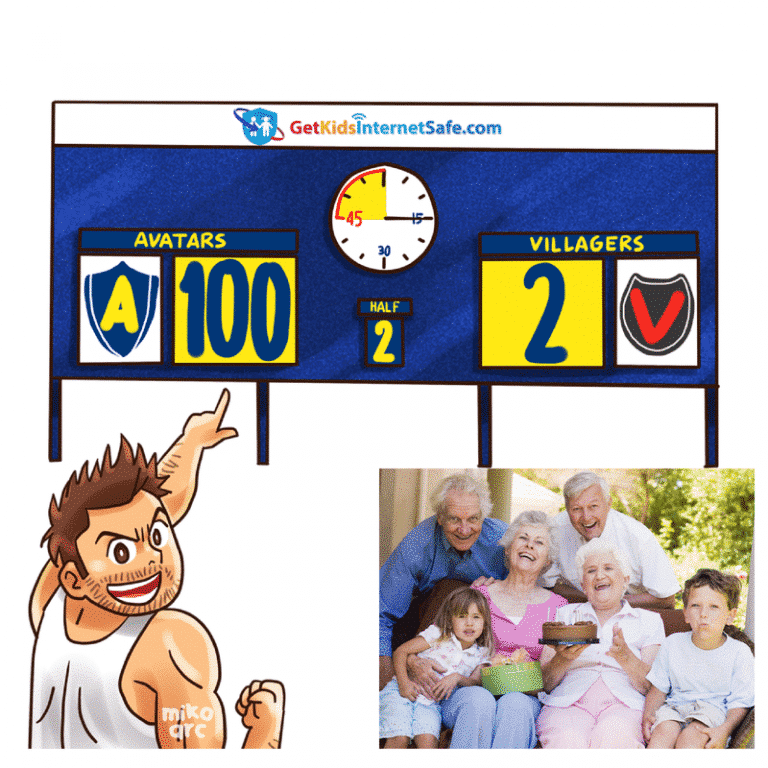
Has Protective Parenting Put Your Child at Risk? Avatars 100 vs. Villagers 2

Blog20scoreboard-768x768

Good parenting can be overwhelming, and we need all the support we can get to do it well. Being pulled in all directions while trying to provide the safest home for our children is leading to problems like isolation and the overuse of screen media. It’s time to address the problems and build a better village. Less screen time, more active parenting, praise, and validation and facilitation are critical! I’ll show you how to get that done in this week’s GetKidsInternetSafe (GKIS) article.

Reflective Listening & Validation

Corbyn* is my ten-year-old son. Yesterday he woke up on a frantic mission to get a Play Station game he wanted. First thing in the morning he hopped out of bed, gathered up his wrinkled dollars and scattered quarters, and counted out $19. Thinking he had $36 saved, he was bitterly disappointed. So naturally, he turned to Sidney*, his 12-year-old sister and BFF, and accused her of stealing $17. Then, still frantic, he turned to the next nearest lightning rods, Mom and Dad, and accused us of not following through when we owe him chore money. He wasn’t attacking in a deliberate, organized way, but rather with a more pained and desperate tone.

I heard of this drama first when Sidney marched into the bathroom while I was putting on my makeup and staged an impressive protest dripping with indignation. When I told her to bring in the offender for a discussion, she sheepishly said, “No, Dad handled it.” (We really get on them for splitting between us when there’s an issue.)

Next, my husband arrived with Corbyn in a body lock trying to tickle the offender into submission. From the tears threatening in my son’s eyes, my heart knew this was not going to do the trick. I understand my son like a lime knows a lemon; we speak the same emotional language. So I broke the offender from his hug prison and attempted good parenting; validation and facilitation of problem-solving.

I know, stop with the shrink talk already. Essentially this means I let Corbyn know that I saw his feelings and heard his plea, then encouraged him to seek a better strategy than attacking his support system one by one. Although tempted, I didn’t yell and threaten, shame, or abandon him to his frenzy. I let my heart do the talking. And it worked.

It went something like this: “Corbyn, I hear you really want that PlayStation Game, and you are disappointed you only have $19. Attacking your best friend and us, your best supporters probably isn’t your best strategy. Maybe you should apologize and ask us for help instead.” Of course, this initially made him more emotional because he let down his guard. But it also gave him the hope and support he needed. Within a few minutes, Corbyn had the plan to collect his birthday money, pick up dog poop, and collect the cash he needed to get his prize. Crisis averted, everybody was happy, and my husband complimented me for being awesome. Most importantly, Corbyn learned an important lesson in problem-solving: chill out, seek your village, and get it done!

My parenting strategy in this instance isn’t groundbreaking, nor am I the perfect parent. But psychology research has demonstrated that validation and facilitation raise emotionally healthy kids. And the lack of it may lead to significant emotional issues.

blogsadgirl

In today’s frenzied digital age with parents working more hours than ever and distractions at every turn, we aren’t doing enough good parenting. When I was little, kids were set loose in the neighborhood until a porch light came on. There’s a useful debate to be had about if this was better for children or not. But that aside, what we are inarguably failing at is providing the “It takes a village” sentiment.

Our generation is so afraid of child predators that we have swaddled our children at home. They get bored and drift in front of screens for too many hours; ironically connecting to the very portal that child predators have expertly learned to exploit. YouTube, video games, social media, and the Internet cannot provide the critical parenting skills our kids need to thrive. Keeping them home with unlimited use of technology is neither protection nor providing parental guidance.

I embedded Margaret Heffernen’s brilliant TED talk “Dare to Disagree” at the end of this blog. Her inspiring message is that openly addressing conflict is critical to learning. That we must create an environment for our children that encourages open information, active problem-solving skills, and the moral courage to tackle challenges. That means being too permissive with our kids, or alternatively shutting them down because it takes too much time to parent will leave them vulnerable, without the affection and guidance they need.

As a clinician, I fully agree with Ms. Heffernen. Throughout my career, I have repeatedly seen that a common factor among my most distressed patients is an attachment disruption; a parent who, for a multitude of reasons, wasn’t present for the child. And among those without a strong parenting presence, those that were gifted an attachment from an extended family member, a coach, a teacher, or somebody in the village who cared about them and spent time were saved.

When I was a teenager my father would bait me into fierce debates by saying something mildly offensive. By the end of the discussion, he would skillfully slide into a moderate position on which we could both agree. It wasn’t until I was much older that I recognized he was coaching his sensitive, anxious daughter to confidently defend a position, a skill critical to my happiness and success. And, in an entirely different way, my mother served as a role model for developing important life skills like grit, ambition, and assertiveness. I didn’t get to spend a ton of time with my hard-working parents, but these quality moments were crucial to my development. And beyond my immediate family, I can identify many adults who provided meaningful guidance along the way.

Here are today’s GetKidsInternetSafe TIPS:

  • Spend time and listen:

    • Validate your child’s emotion (“I can see you’re feeling sad”)

    • Identify the problem (“What happened?” “What needs to be solved?”)

    • Facilitate problem-solving (“What’s your goal?” “What steps can get you to your goal?”)

    • Praise (“I love how you talked that through” “You really know how get things done!” “I love how you speak from your heart”)

  • Get your kids involved in activities and with other trusted adults who happily support them.

  • Limit screen media time.

I love the enthusiasm of GetKidsInternetSafe subscribers and can feel the GKIS Revolution building. Thanks for being courageous by facing these issues and taking the extra steps to be more awesome and, rather than pointing fingers at each other, coming together in a commitment to our best parenting. Ironically, the Internet is helping us find our village. Now go out and build it for the kids directly in your community! And don’t forget to forward this article to those who may share your passion.

I’m the mom psychologist who will help you GetKidsInternetSafe.

Onward to More Awesome Parenting,

Tracy S. Bennett, Ph.D.
Mom, Clinical Psychologist, CSUCI Adjunct Faculty
GetKidsInternetSafe.com

*name changed to protect child privacy

Photo Credit

Child of the pure, unclouded brow by Nick Kenrick, CC by-NC-SA 2.0