It’s hard to ignore the huge influence social media has on our society. There’s reasonable concern with how much our kids are engaged on their screens, that use of social media is ego-inflating and of little value. But this concern may be overgeneralizing. Younger generations have found ways to use social media for good, some gathering followers by the thousands. One of these beneficial ways is gathering support for social change.
Twitter is shaping up to be a platform worth something beyond memes and humorous one-liners. It’s proving capable of being a reliable source that many young people look to for news about current events. “74% of Twitter users say they use the network to get their news.”[1] Twitter offers the unique ability for protestors to organize together with a speed, efficiency, and reach that has previously been unheard of. Localized protest becomes national overnight; global protest is accessible to all.
Parkland Florida Students Viralize Their Cause
The students who survived the Parkland, Florida school shooting were left grieving, confused, and angry. Their hearts were broken, wanting justice for their friends and other kids like them. As a result, they organized the “March for our Lives” protest in Washington that attracted 108,000 protesters to their cause.[2] Not only did a genius use of social media attract live protestors, but by March 2018, two of the Parkland survivors had a total of over 1.5 million social media followers.[3]
They made their opinions known to a vast like-minded audience who wanted to see gun laws reformed. Not only did they draw thousands to their cause, they also had impact on legislation. A bill was passed in Florida which limits the sale or ownership of guns for a year to anyone determined to be a threat.[4]
Twitter Becomes a Platform for Social Movements
Traditionally, people have assumed that social media platforms like Twitter only talk of trivial topics. Current and critical social issues are taking form, turning Twitter into a powerful platform for social justice. And it’s not a mistake that this is happening. A 2015 study published in the InternationalJournal of Consumer Studies looked at the link between social media and its ability to make people feel connected. This study compared desire to be involved in a particular social movement formed through social media with how often the desire resulted in social movement participation. They concluded that social media users are more inclined to follow through with social movement aspirations if they are both avid users and feel socially involved within a group.[5]
Climate as the Next Frontier
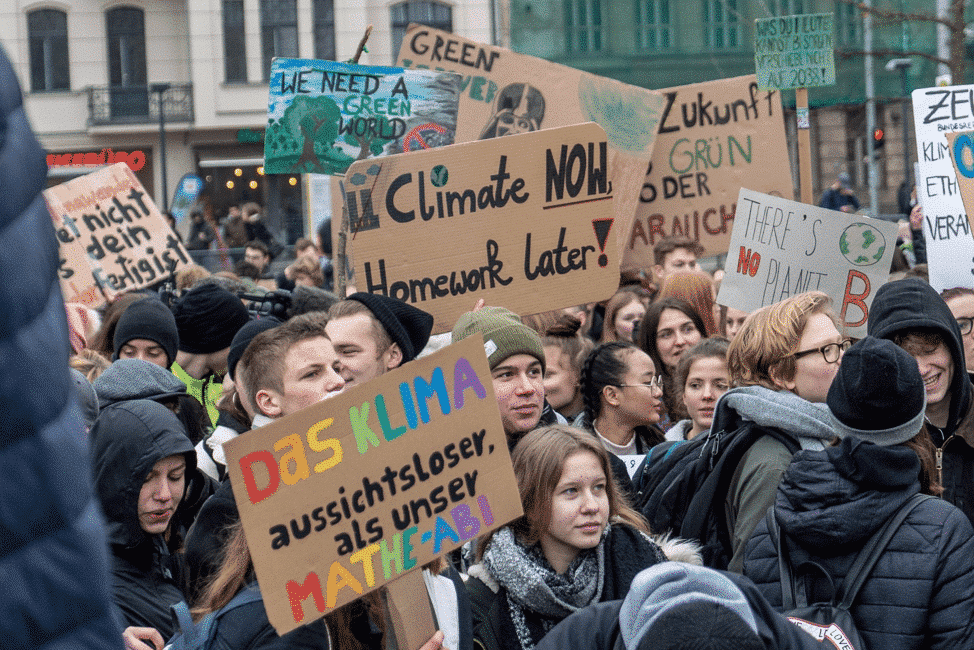
An annual survey by the World Economic Forum shows millennials ranked climate change as the number one world issue for the third year in a row.[6] Gen Z kids are equally as likely to see climate change as the most pressing global issue currently.[7] Like the gun reform protests of this last year, students are again staging mass protests to fight against leaders of government –this time on a global scale. For instance, the rapidly-building March 15 2019 “School Strike 4 Climate” movement resulted in a massive protest, with 1.4 million young young people from twelve countries banding together to skip school.[8] These kids were seeking global government attention to reduce carbon emissions.
There is an urgency to climate change protests inspiring kids all over the world to act. Hitting headlines globally is a young girl from Sweden, Greta Thunberg. She has a Twitter account with 540,600 followers, which she uses to mobilize her cause.[9] Greta reported that she became impassioned with the global threat of climate change at only 8 years old. On April 23, 2019, she spoke in front of parliament in the UK at only 16 years old.[10] Greta is the face of generation Z’s climate change protest representing an entire generation demanding change, and they’re using social media to do it.
Interested in how to get your kids mobilized to do good? Check out these organizations:
[1] https://www.omnicoreagency.com/twitter-statistics/
[2] Shear, M.D. (2018, March 24). Students lead huge rallies for gun control across the U.S. The New York Times. Retrieved from https://www.nytimes.com/2018/03/24/us/politics/students-lead-huge-rallies-for-gun-control-across-the-us.html?module=inline
[3] Bromwich, J.E. (2018, March 7). How the Parkland students got so good at social media. The New York Times. Retrieved from https://www.nytimes.com/2018/03/07/us/parkland-students-social-media.html?module=inline
[4] Kramer, M. & Harlan, J. (2019, February 13). Parkland shooting: where gun control and school safety stand today. The New York Times. Retrieved from https://www.nytimes.com/2019/02/13/us/parkland-shooting.html
[5] Hwang, H., & Kim, K. (2015). Social media as a tool for social movements: The effect of social media use and social capital on intention to participate in social movements. International Journal of Consumer Studies, 39(5), 478-488. doi: 10.1111/ijcs.12221
[6] Loudenback, T. & Jackson, A. (2018, February 26). The 10 most critical problems in the world, according to millennials. Business Insider. Retrieved from https://www.businessinsider.com/world-economic-forum-world-biggest-problems-concerning-millennials-2016-8
[7] Parker, K., Graf, N., & Igielnik, R. (2019, January 17). Generation Z looks a lot like millennials on key social and political issues. Pew Research Center. Retrieved from https://www.pewsocialtrends.org/2019/01/17/generation-z-looks-a-lot-like-millennials-on-key-social-and-political-issues/
[8] Kaplan, S. (2019, February 16). How a 7thgrader’s strike against climate change exploded into a movement. The Washington Post. Retrieved from https://www.washingtonpost.com/national/how-a-7th-graders-strike-against-climate-change-exploded-into-a-movement/2019/02/15/e20868e2-2fb4-11e9-86ab-5d02109aeb01_story.html?utm_term=.a97cad4efa4d
[9] https://mobile.twitter.com/GretaThunberg
[10] (2019, April 23). Greta Thunberg: Teen activist says UK is ‘irresponsible’ on climate. BBC News. Retrieved from https://www.bbc.com/news/uk-48017083
Imagine the sensation of someone you know running their fingernails lightly down your arm. Light touch chills or all-over body tingles are the focus of the latest Internet trend, autonomous sensory meridian response, or ASMR. ASMR is shaping up to be Gen Z’s answer to handling stress. Videos are popping up everywhere promising stress relief. What is ASMR, and how can it work for you?
Watching an ASMR video for the first time is a weird experience, so viewing with an open mind is key. Instead of relying on touch to create a sensation of chills through your body, ASMR uses sound. Whispers, scraping noises, teeth clicks– nothing is off-limits to try to create this effect.
First-time viewers describe feelings of absurdity and intrigue, as the videos often show close-up shots of the person with their mouth or other object meant to make noise extremely close to a high-quality microphone perfect for picking up soft sounds.
If it seems too silly at first, close your eyes as you listen. Once immersed in the experience, one of two things will happen – nothing and you’ll feel like you wasted three minutes of your life, or you’ll be hooked like millions of others.
Where ASMR Comes From
ASMR is not entirely new. Before its popularity on the Internet, the research uncovered that some people have a greater sensitivity to sounds. Not only are they more sensitive, but they may get a physical feeling from sounds as well.[1]
ASMR is enjoyable to some because resulting chills and tingles are typically pleasurable.Synesthesiais the experience of having more than one sense triggering another in unexpected ways, such as seeing color when you hear a word or tasting sour when looking at a circle.[2] ASMR is similar in that you hear a sound and instantly get a physical sensation. The best way to compare is to think about the feeling you sometimes get when a singer hits a really high note and it sends chills down your body. That’s what viewers of ASMR are trying to capture. At first glance, this may seem like an elaborate joke everyone else is in on, but you don’t get the punchline. But those watching ASMR videos have a goal in mind, they’re trying to relax and relieve stress.
What the Research is Saying
A 2018 study conducted at the University of Sheffield foundthat for some people, watching ASMR videos can lead to a reduction in stress. People who experienced a sensation of “head tingles” and chills when exposed to ASMR videos felt more relaxed after the viewing.[3]
There is the key difference between feelings brought on by ASMR versus more commonly experienced chills that you or me experience at random intervals throughout our lives. In a common scenario, getting the chills brings about a feeling of excitement. But in ASMR, these sensations cause a sense of calm and well-being.
ASMR can also be a sleep aid. But there’s a catch. ASMR appears to only work for people who have an exquisite sensitivity to sounds. If you do not, these types of videos may produce no feelings at all or have the opposite effect and cause mild discomfort.
ASMR can benefit you!
A clear takeaway in choosing to explore ASMR is that there is no risk in trying. Either you will hate it or love it. If you love it and can now count yourself in the number of people with an autonomous sensory meridian response, consider incorporating a video or two into your weekly routine. It can be a quick 5–minute de-stress at the end of the day or a unique solution for those nights when you just can’t seem to fall asleep.
The weirdness of ASMR is also the beauty of it. It’s a good way to embrace the unusual and is something for when you want to relax but also not take yourself too seriously. For all that is out there online, ASMR is one of those positive surprises with no risks involved.
Thank you to GKIS intern, Chelsea Letham for helping us discover ASMR and untap its potentials. Finding ways to unwind is not always easy so taking advantage of what is at our disposal online is important. Would you like to share your experiences with ASMR or your opinions about what your read in our articles? Please comment below and “like” our GetKidsInternetSafe Facebook page so other parents can find us.
I’m the mom psychologist who will help you GetKidsInternetSafe.
PS. Want to try an ASMR video yourself? Chelsea recommends this one:
Works Cited
Roberts, N., Beath, A., & Boag, S. (2018). Autonomous sensory meridian response: Scale development and personality correlates. Psychology of Consciousness: Theory, Research, and Practice doi:10.1037/cns0000168
Poerio G. Could Insomnia Be Relieved with a YouTube Video? The Relaxation and Calm of ASMR. In: Callard F, Staines K, Wilkes J, editors. The Restless Compendium: Interdisciplinary Investigations of Rest and Its Opposites. Basingstoke (UK): Palgrave Macmillan; 2016. Chapter 15. Available from: https://www.ncbi.nlm.nih.gov/books/NBK453209/ doi: 10.1007/978-3-319-45264-7_15
Poerio GL, Blakey E, Hostler TJ, Veltri T (2018) More than a feeling: Autonomous sensory meridian response (ASMR) is characterized by reliable changes in affect and physiology. PLoS ONE 13(6): e0196645. https://doi.org/10.1371/journal.pone.0196645