
Need peaceful screen time negotiations?

Get your FREE GKIS Connected Family Screen Agreement

children and technology

Dr. Bennett’s Developmental Psychology Crash Course (Ages 7-11 Years)

Child Playing with Father

From 7 to 11 years old, children are starting to function on their own in a variety of settings. They are running with friends, completing their classwork, and even doing simple household chores. As a result, adults expect more independence and responsibility from them than ever before. Yet even with their rapidly developing skills, school age kids need warm, supportive, and engaged parents in order to develop sophisticated information processing skills, an independent work ethic, secure emotional attachments, high self esteem, and a strong sense of morality. No longer do parents need to chase school-age kids for physical safety, we now must transition to coaching psychological safety. As you read this crash course, keep in mind how your family’s technology use guidelines may interfere with, or enhance, blossoming developmental skills.

As school age kids become more sophisticated in their cognitive and language skills, adults may be inclined to view them as “little adults.” This is a mistake. Seven to 11 year old kids are still in a stage of rapid development and need active parental supervision and guidance.

Developing Brain

Brain Development

These facts provide a sophisticated understanding of anatomical brain development that allow new developmental abilities. Perhaps this will help you keep your perspective as you customize your parenting genius:

  • In general, brain development is less like building and more like “remodeling.” It involves both neuronal growth AND demolition. As a result, we often see brain volume increases and decreases in particular areas as children age and reach increasing brain specialization. Just because parts of the brain reach maximal volume does not mean the brain is finished developing.
    • For example, as children’s executive functioning becomes increasingly sophisticated (attention, concentration, and organization), frontal lobe gray matter reaches its maximal volume in girls at 11 years old and in boys at 12.1 years old (Lenroot, 2006).
  • In regard to brain cell demolition, by the age of 10 some cortical regions begin to show decreases in volume, especially within occipital and superior parietal lobes (Brown, 2012). This is called regulatory pruning and follows the “use it or lose it” principal.
    • Brain lateralization means that certain mental processes specialize in either the left or the right hemisphere. This specialization continues to occur during this age, allowing more subtle and coordinated motor activity and complex thought (Lenroot, 2006).
    • The efficiency of thinking improves as myelination continues during infancy and throughout adolescence (Brown, 2012). Myelination is the process of sheathing axons (brain cells) with white matter to insulate them and allow them to conduct the electrical impulses that create “thinking.”
  • The caudate nucleus is a brain structure found in the area of the brain called the basal ganglia, which plays a role in the control of movement and muscle tone and is involved in circuits mediating higher cognitive functions, attention, and emotional states. The caudate nucleus reaches its largest size at age 7 years old in girls and 10 years old in boys before it declines in volume (Lenroot, 2006).
    • White matter and corpus collosum volumes continue to increase as well (Lenroot, 2006). The most prominent white matter structure is the corpus callosum, consisting of approximately 200 million myelinated fibers. The corpus callosum integrates the activities of the left and right cerebral hemispheres, including functions related to the unification of sensory fields (Berlucchi, 1981; Shanks et al., 1975), memory storage and retrieval (Zaidel and Sperry, 1974), attention and arousal (Levy, 1985), and enhancing language and auditory functions (Cook, 1986).

Cognitive & Motor Development

  • By now children have lost their first baby tooth and continue increase in size and strength. The average American 7 year old is 50 lbs., 48 inches tall and by 12 years old is 90 lbs., 59 inches tall (CDC.gov). Around ten years old, the onset of puberty begins for many kids, with girls starting slightly ahead of the boys.
  • Due to increased size, strength, and coordination, school age kids often become involved in team and individual sports. With these activities, parental roles shift from being caretakers to providers of transportation, coaches, and cheerleaders. These role changes significantly impact family dynamics and can strengthen or strain the parent-child connection.
    • Watch out! I’ve found in clinical practice that parents must surrender the fantasy of who they thought their child would become and accept the child they’ve actually got. Engineers learn to embrace their cheerleaders and football coaches support their chess players. The ease of this transition can profoundly impact ongoing attachment. Lucky for us all, by the time children are school age most parents have fallen madly in love and, with this burgeoning new chapter of acceptance, comes a celebration that the real child is preferable to the fantasy child anyway. Accepting the unique qualities of your child may be more challenging for some parents than it is for others. The key is to have fun in your parenting role rather than becoming a drill instructor.

Skiing to Symbolize Cognitive and Motor Development

  • With increased memory capacity and knowledge stores, children ages 7 to 11 years can now follow instruction without as much supervision. Therefore, they can now spend time and be productive on their own with tasks like chores, homework, and play-dates. Erikson (1964) called this stage industry versus inferiority, meaning that as kids master skills, they develop a sense of pride.
    • Watch out! School age, technology native kids can now read and have a working knowledge of technology (often even better than their parents). They are able to seek new activities without adult help and can employ sophisticated work-arounds to parent monitoring, filtering, and blocking efforts. Study up Moms and Dads! With so much to know and changes occurring every day, you need GetKidsInternetSafe (GKIS) support more than ever!
    • Piaget (1952) considered middle childhood the period of concrete operations, meaning that mental operations (ideas held in memory) can better structure thought process. Now children can think flexibly and solve problems, organize ideas, understand social and moral rules, and interpret people’s intentions.
  • Kids this age are also developing metacognitive skills, meaning they gain a more abstract and complex idea of who they are, what they like, and what they want. We also see children’s interests swaying away from parental influence.
      • Watch out! Pester power becomes more difficult to dissuade as your child’s arguments and strategies get more sophisticated. Internet marketers are experts at developmental psychology and use these concepts to imbed neuromarketing strategies into child screen media activities. As a result, I am seeing kids wearing down their parents to purchase games, apps, and devices that are outside of their appropriate age rating. GKIS was developed to help parents recognize and better manage child screen media choices, despite the pressures of marketers and your unrelentingly pestering kids.

Child Speaking

Language Development

  • As egocentrism wanes, school age children are rapidly gaining metalinguistic awareness: the ability to think about language and to comment on its properties (Cole, 1993). Now kids can adjust the content of their communications to the listeners’ needs with more sophisticated detail.
    • Watch out! With these new abilities kids are increasingly able to form complex relationships with adults outside of the family and better able to manipulate caretakers. This is the age that sexual predators often target, because kids are highly vulnerable for Internet grooming. GKIS was developed to help parents block online portals to danger and teach kids resiliency skills so they don’t fall victim. The GKIS Home QuickStart Kit is an excellent tool to be preventative rather than reactive.

Social-Emotional Development

  • As they get better at incorporating social comparison, school age kids begin to develop a complex, but relatively stable, sense of self based on increasing cognitive, social, and physical competence (Cole, 1993).
    • As school age kids recognize that effort and ability contribute to academic performance, they become more firmly at risk for developing negative academic self-concepts. GKIS’s efforts to support the parent-child connection and best access technological enrichment can help buffer them from this risk.
  • Kids within this developmental phase spend increasingly more time with peers than parents, both on- and off-line. Socializing with other children is essential for learning to assertively negotiate conflict. The closer the friend, the more effort your child will put forth to reach a solution (Shaffer, 1989). It is important for parents to provide their children the time and opportunity to develop healthy peer relationships so they can develop social resiliency. The challenge is that kids this age will now choose friends outside of their parents’ influence for personality reasons, rather than simply proximity. As a result, they are exposing, and being exposed to ideas that parents are unaware of and may not approve of.
    • Watch out! As a clinician, it is glaringly evident that socialization and guidance during this period is critical to learning the skills necessary for social and partnering success later in life. Based on the problems families bring to my office, I am seeing more and more situations that interfere with unstructured peer group play time like excessive screen time, overload of academic tasks, online relationships that compete with face-to-face friend time, and misguided attempts to protect that instead isolate. These obstacles often cause developmental delay that is difficult, if not impossible, to remedy later. It is more important than ever for parents to spend time with their kids AND their kids’ buddies. Your influence will not only have an impact on your child’s decision-making, but also on the judgment of their friends. Keep a balance between allowing your child social privacy while also staying engaged in the process. GKIS is an excellent forum to discuss “how much is too much?”

Children Playing

    • Watch out! As kids become more socially competitive, they often experiment with cyber bullying strategies. As more social media platforms pop up, parents have to be more on-the-ball than ever before. Staying plugged in to breaking tech news is a big part of keeping your kids Internet safe.
  • Kids move from playing imaginary roles with social scripts to rule-based games. The objective now is not just play to have fun, but play to win. This progression bumps kids directly in the path of conflict negotiation and management of aggression. Girl play is typically more intimate with less direct competition, whereas boy play is in larger groups with more direct competition. Parental encouragement and support of a variety of social activities, including team sports, is awesome for social development.
  • School age kids start to segregate by gender during school age, become more interested in gaining popularity, and play often takes on sexual overtones (e.g., kiss tag and teasing). As kids near middle school age and puberty, they may also start being interested in experimenting with intimate partnerships.
    • Watch out! Research surveys demonstrate that sexting and posting sexually provocative pictures are common, even among healthy, educated kids and teens. It starts earlier than people think and parents are typically the last to catch on. GKIS will assist you in setting up an honest, transparent system that will help your child avoid scary pitfalls.
  • Young children have a difficult time imagining anything outside of their own perspective. Psychologists call this egocentrism. However, during the 7 to 11 year old phase of development, children become less egocentric and are better able to recognize that others have different perspectives, opinions, and intentions than they have. With this new insight, kids can now anticipate how others may react to what they say or do and better “get” potential dangers posed by strangers on the Internet. More specifically, at school age children can imagine that others may have malicious intent and that we all must protect ourselves by not disclosing personal information or unflattering images or actions online.
    • Watch out! It’s time to teach your children about the consequences of digital footprints, digital citizenship, and online posting.

7 Year Old Child with Mother

  • Parents expect more of elementary school children and tend to change their discipline strategies from spanking or time out to withdrawal of privileges and reward.
    • Maccoby (1984) described parent-child cooperation in managing behavior “coregulation.
    • This increased self-regulation is consistent with Freud’s (1940) assertion that middle childhood is when the superego (attending to community values and standards) becomes dominant.
  • Middle childhood marks the development of conventional morality. Kids this age tend to choose “the right” in order to or do what they think is fair or to fulfill the role of a “good person” (Kohlberg, 1984).
    • Piaget (1952) posited that kids ages 5 to 10 years develop a strong respect for rules and enter a stage called heteronomous morality. In this stage kids make decisions based on if there’s a consequence rather than considering the intent of the transgressor. By 10 years old, kids enter the stage of autonomous morality. This means they come to understand that rules can be challenged and even changed if there’s good reason to do so, like intent.

Phew! That’s a lot of developing right there. I tried to keep it short and simple, but that’s difficult due to the massive skill-building that school age kids are developing everyday. Most importantly, it’s critical for parents to recognize that their kids are no longer babies, but not yet adults. They need us now more than ever before!

I’m the mom psychologist who will help you GetYourKidsInternetSafe.

Onward to More Awesome Parenting,

Tracy S. Bennett, Ph.D.
Mom, Clinical Psychologist, CSUCI Adjunct Faculty
GetKidsInternetSafe.com

Photo Credits

Scream and Shout, Mindaugas Danys, CC by 2.0
Playing in MUND West, ubarchives, CC by 2.0

Works Cited

Brown, Timothy T., and Terry L. Jernigan. “Brain Development During the Preschool Years.” Neuropsychology Review 22.4 (2012): 313-33. Web.

CDC, http://www.cdc.gov/nchs/data/series/sr_11/sr11_246.pdf

Christakis, D. A., F. J. Zimmerman, D. L. Digiuseppe, and C. A. Mccarty. “Early Television Exposure and Subsequent Attentional Problems in Children.” Pediatrics 113.4 (2004): 708-13. Web.

Cole, Michael, and Sheila Cole. The Development of Children. New York, NY: Scientific American, 1993. Print.

Erikson, Erik H. Childhood and Society. New York: Norton, 1964. Print.

Freud, S. “An Outline of Psychoanalysis.” The Standard Edition of the Complete Psychological Works of Sigmund Freud. London: Hogarth, 1940. Vol 23. Print.

Hesketh, Kylie D., Trina Hinkley, and Karen J. Campbell. “Children′s Physical Activity and Screen Time: Qualitative Comparison of Views of Parents of Infants and Preschool Children.” International Journal of Behavioral Nutrition and Physical Activity 9.1 (2012): 152. Web.

Kohlberg, Lawrence. The Psychology of Moral Development: The Nature and Validity of Moral Stages. San Francisco: Harper & Row, 1984. Print.

Lenroot, Rhoshel K., and Jay N. Giedd. “Brain Development in Children and Adolescents: Insights from Anatomical Magnetic Resonance Imaging.” Neuroscience & Biobehavioral Reviews 30.6 (2006): 718-29. Web.

Maccoby, E. E. “Middle Childhood in the Context of Family.” Development during Middle Childhood: The Years from Six to Twelve. Washington D.C.: National Academy, 1984. Print.

Perry, David G., Louise C. Perry, Kay Bussey, David English, and Gail Arnold. “Processes of Attribution and Children’s Self-Punishment Following Misbehavior.” Child Development 51.2 (1980): 545-51. Web.Piaget, Jean. The Child’s Conception of Number. London: Routledge & Kegan Paul, 1952. Print.

Piaget, Jean. The Child’s Conception of Number. London: Routledge & Kegan Paul, 1952. Print.

Robinson, T. N. “Reducing Childrens Television Viewing to Prevent Obesity: A Randomized Controlled.” JAMA 282 (1999): 1561-567. Web.

Shaffer, David R. Developmental Psychology: Childhood and Adolescence. 9th ed. Pacific Grove, CA: Brooks/Cole, 1989. Print.

Schmidt, Marie Evans, Jess Haines, Ashley O’brien, Julia Mcdonald, Sarah Price, Bettylou Sherry, and Elsie M. Taveras. “Systematic Review of Effective Strategies for Reducing Screen Time Among Young Children.” Obesity (2012). Web.

Sigman, A. “Time for a View on Screen Time.” Archives of Disease in Childhood 97.11 (2012): 935-42. Web.

Swing, E. L., D. A. Gentile, C. A. Anderson, and D. A. Walsh. “Television and Video Game Exposure and the Development of Attention Problems.” Pediatrics 126.2 (2010): 214-21. Web.

Walker, Lawrence J., Karl H. Hennig, and Tobias Krettenauer. “Parent and Peer Contexts for Children’s Moral Reasoning Development.” Child Development 71.4 (2000): 1033-048. Web.

An Awesome Teacher, An iPad, and a Herd of Little Entrepreneurs

girls_on_ipad-817x1024

Even if you are the parent who wants to wait to introduce technology to your child, America’s elementary school system has embraced technology in the classroom. Despite the risks that GetKidsInternetSafe highlight in covering this very important topic, it is irrefutable that technology is an incredibly rich resource when interfaced with traditional teaching methods. Today’s blog is an acknowledgement that when done well, technology’s interface with elementary education is a great thing!

One thing I’ve learned as a business owner, and in life, is the importance of knowing the limitations of my scope of expertise, and to outsource to those who are experts when I have an unanswered question. One of my favorite parts of the GetKidsInternetSafe project is consulting with a multidisciplinary team of experts in order to best inform you about the challenging topic of kids and Internet safety. It’s impossible for one person to be an expert in all of it. So I’m pooling the best there is so you don’t get lost in the search, like my husband and I did at first when trying to get our kids Internet safe.

For the record, I have a doctorate in clinical psychology, not education. All it took to learn my limitations was a few volunteer field trips as a parent when the teachers gave me the little ones who were a “hand-full.” The teachers and I laughed as I thanked them for their everyday expertise. Phew! An hour of clinical session is a WHOLE different ballgame than an hour with 20 little rugrats!

My admiration for educators is one of the reasons I’m so excited to watch my oldest daughter pursue her lifelong dream of being a kindergarten teacher. Although she is still in college and thus still in the exploratory process, she is starting to dive deep now and recently volunteered in a second grade classroom. She was so jazzed by the experience; she told me all about it in an hour-long phone call yesterday. It was inspiring to learn how technology is being resourced in those classrooms where the teacher goes the extra mile. I want to share some of what I’ve learned with you so you too can celebrate what opportunities technology is creating for our kids. Astounding really!

The second-grade class Morgan observed has integrated iPads in their everyday learning. For example, in a lesson about business and finance the teacher tasked her students to come up with a business idea, a product, a budget, and a public relations campaign. Throughout the month they were able to earn dollars for academic tasks that they could spend in a student store during “shopping week.” Morgan said their creativity and enthusiasm was amazing, with one boy selling Lego classes and another girl painting nails. She said the variety of products was awesome and the kids were super into it. She particularly loved how the dollars were kept in a pile on the teacher’s desk and the children would simply walk up and collect their dollar for each task with total accountability. That day, she observed the kids had each made a sales page collage and emailed the product to their teacher for grading. All on the iPad!! Second grade!!

Another task Morgan observed was language arts and reading comprehension. Each day the teacher would read a book aloud to her students. For those who preferred to read alone or with a partner, they simply left the room and went into the library to check out a book at their reading level on their individual iPad. After completing the story, they would answer five reading comprehension questions from the book. The next story, customized to their reading level, would then be made available for checkout. That means each child was reading and tracking at their individual reading level with independence. Morgan was amazed to see children that ranged from first grade reading level to eighth grade reading level all engaged in the task. No kids left behind indeed!

And the third task I wanted to share doesn’t even involve technology, but simply good citizenship. Morgan was delighted to see how the teacher provided facilitation, but required the kids to do their own social problem solving. The example she shared was when one boy left a game for his friend to cleanup, the teacher simply brought the boys together and challenged them to negotiate a solution. Morgan said the teacher didn’t lead them, but would simply reinforce skills with comments like, “That’s excellent sharing from your heart Johnnie,” and “Now what can Michael do to make it up to you so you’re not resentful and your friendship can be as good as ever?” Morgan said the boys worked it out and left with a clear and mutually agreed upon solution. Oh my gosh! As parents we can take a page from this teacher’s playbook for sure.

In closing, I wanted to sprinkle some positives into this week. Just remember when you get discouraged about the dangers of technology use, don’t forget that the benefits are transformative as well. Black and white thinking is not the answer to a complex problem. Please join the dialogue with comments after this blog and on our GetKidsInternetSafe Facebook page! How has technology helped your students in the classroom?

Thanks for your support and, as always, please share this blog link with anybody else you think has an opinion about kids and Internet safety.

I’m the mom psychologist who will help you GetYourKidsInternetSafe.

Onward to More Awesome Parenting,

Tracy S. Bennett, Ph.D.
Mom, Clinical Psychologist, CSUCI Adjunct Faculty
GetKidsInternetSafe.com

Watch this TED talk that demonstrates how technology helps kids learn better and helps us better track their process!

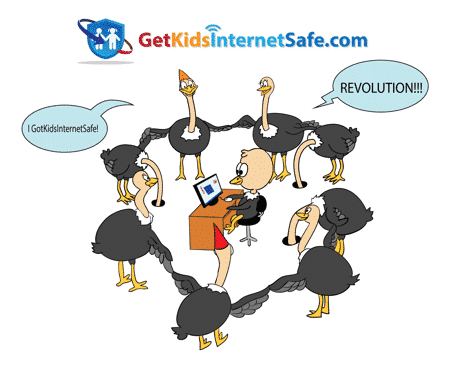
Opportunity, Concern, Hard Work, Leadership. Time For a GetKidsInternetSafe Revolution!

blog17ostrichrevolution

Like Tracy Chapman crooned, “Talking about a revolution sounds like a whisper.” Each day I am inspired by experiences that seem divinely connected. I hope today’s article, which includes some TED talks and a wacky story about how I met my husband, triggers in you the inspiration to be a smarter parent in the digital age and join the GetKidsInternetSafe (GKIS) Parenting Revolution. It is time!

You know those days when the universe hands you experiences that somehow connect? And when that happens, you feel compelled to DO SOMETHING? It’s as if you’ve just received a gift and must decide whether to unwrap it and delve into something deliciously important or simply fold laundry and carry on with your day?

This morning the universe handed me two TED talks, a psychology ethics and law conference, and a scary clinical story of the week. Morgan referred me to the first TED talk after she saw it in a college education course (embedded at the bottom of this article). In this award winning presentation (2013 TED Prize), educational researcher, Sugata Mitra, describes his brilliant experiment where he placed a computer in a hole in the wall facing a slum in India with no instruction and no supervision. After a few weeks, researchers returned to the computer to find that groups of children had taught themselves, and each other, complex theory, even when it wasn’t in their own language! When he repeated this experiment with an adult standing by to provide praise (still no instruction), the children performed even better! He argues that our education system is outdated and argues for reform. Mr. Mitra’s experiment highlighted some important variables discussed within GetKidsInternetSafe. Specifically, technology is an excellent motivator and learning tool for our children, and adult affection and supervision remains essential for our children’s healthy cognitive and emotional development. He also highlights the need for analysis and redesign to educate our children in the digital age. OPPORTUNITY.

In regard to the clinical situation that struck me this week, ethics restraints inhibit me from describing it in detail. But let me just say it involves two vulnerable adolescents who acted out sexually at school in a way that was clearly inspired by pornography exposure. These types of situations are extremely distressing for all involved and happening at a frequency I’ve never before seen in my 20-year clinical career. CONCERN.

I also attended a law and ethics conference this week. Although my colleagues and I sometimes dread these conferences due to the discussions about informed consent and computer firewalls, I always leave energized make a difference as a psychologist. HARD WORK.

The second TED talk I included illuminates the courage needed to start a movement and touches upon the importance of, not just the movement’s creator, but also the first follower. As a get-to-know-each-other piece, I’ll tell you a story about how I learned that my most comfortable role is first follower and why, although initially irritated about it, I eventually learned to embrace this aspect of my personality (and snag my awesome husband). After all, my leadership style is what pushed me to start a much-needed revolution in parenting in the digital age when I wasn’t seeing enough of us was stepping up to lead. I’m hoping that it will inspire you to analyze what leadership role best fits you and to join the GKIS PARENTING REVOLUTION!

Blog17drumette

In the early 1990s, with four years of clinical psychology coursework out of the way, I started my hard-won internship at the local Veterans Administration (VA) Hospital. Within the first month, I signed up to participate in a 4-day Tavistock conference. The mission of this conference was to join an assortment of other mental health professionals to learn about group process. Essentially, the conference participants were tasked to form small groups and interact with each other while trained staff interpreted unconscious process. With this structure, participants learned what role(s) they took in a group by analyzing their own and other’s behaviors during prescribed tasks.

People often ask my husband and me how we met. It is always a fun story to tell them that we met and fell for each other during this weird and wonderful conference. (This is also where my husband says it was a nude conference – which it wasn’t.)

The attended with my friend, Pam, who was a mother of two and the wife of a fundamentalist minister. Being in graduate school, she was exploring all parts of her personality and impulsively attended the conference wearing a leather jacket and smoking cigarettes. (Graduate school made us all a little crazy, ha-ha.) She and I ended up in the same small group as a tall, bearded psychiatry resident from UCLA named Dan. It wasn’t long into the first day when I found myself seeking him out during the breaks. I remember becoming intrigued by his rebellious spirit and when he made some sort of Greek mythology reference, I swooned because I found him brilliant, sexy, and Tracy-level nerdish.

So to make a long story short, despite my efforts to pretend I was a consummate professional and not lusting on this mysterious psychiatry resident, Dan and I ended up co-leaders to the weirdest assortment of characters at the conference. Normally, I would have bailed on this group of wacky strangers in favor of joining friends, but I didn’t want to leave Dan, and he didn’t want to leave me. So fresh out of the Navy and disgusted with our hippy ideas, Dan shook his head as we voted for a “tribal leadership” style. This meant we took turns leading based on the group we were meeting, including my friend Pam’s group who wore crowns of leaves, called themselves “Athena,” and would only acknowledge the women in our group. See? Crazy town.

Just to touch on some highlights of our weird conference, let me say that many people dropped out from the stress. Our group took double lunches and was the only group to refuse staff support. By the end the conference, our group was voted the most in need of psychological intervention. (I exaggerate, but it’s mostly true.) Also by the end of the four days, Dan and I were half out of our minds with weird psychology process and attraction for each other. We learned so much about how we tend to lead as individuals, and this knowledge inspires me to step up when I see a need and to enlist support to make a real difference. As Dan and I walked to our cars to go home the last day, he became the first (and last) man I ever actually asked out. And, true to what we learned in the conference, we teach our three kids that being a leader is a gift that must be developed.

My anxiety about what I was seeing in practice and in my own home inspired me to start www.GetKidsInternetSafe.com. It is evident from the feedback I am getting and the learning along the way that we more than education, WE NEED A GetKidsInternetSafe PARENTING REVOLUTION!

The “Hole in the Wall” TED talk pointed out that our kids have mind-blowing learning opportunities if we embrace it with them! My clinical experiences tell me that some real damage is being done because we aren’t doing our best parenting, and the time to act is NOW! And the ethics conference reminded me that putting work into a new project is intimidating and sometimes difficult, but doing the right thing always outweighs the easy thing. And finally, the “How to Start a Movement” TED talk confirmed that it is time we take the reins in this Wild West time of unsupervised/unregulated technology. I’m up dancing people, grab your jazz hands and run to the grassy knoll. We have some real work to do!

There are lots of inspiring posts on my GetKidsInternetSafe Facebook page. Please give me some “likes” by connecting with the grey social media buttons on the side bar and recommend www.GetKidsInternetSafe.com to those you would grab by the hand to join you for an inspired interpretive dance! Time to get the GKIS PARENTING REVOLUTION launched!

I’m the mom psychologist who will help you GetKidsInternetSafe.

Onward to More Awesome Parenting,

Tracy S. Bennett, Ph.D.
Mom, Clinical Psychologist, CSUCI Adjunct Faculty
GetKidsInternetSafe.com

Photo credits:

Trambourmajor by Niels Linneberg, CC by-NC-SA 2.0

GKIS Prevents Digital Injuries Like This: Brandon’s Story

blog1dragon

In twenty years of clinical practice and parenting my own children, I’ve seen more and more families in crisis due to Internet safety issues. Parenting in the Digital Age can be so overwhelming! I created GetKidsInternetSafe.com to give parents sensible Internet safety parenting tips that work.

Searched “Dragon”

“Brandon” is a ten-year-old, gifted student. He loves fantasy books and has a few good friends at school. Team sports are not “his thing,” but he is in Tae Kwon Do in the winter and swim team in the summer with his parents’ insistence. Although brilliant, his grades usually slip mid-semester until his parents get after him to better track his homework and limit screen time. Recently, between his usual video games and YouTube surfing, Brandon decided to Google “DRAGON” for sketch ideas. This led him to a sadomasochistic chat room that he compulsively visited for the next two weeks until his parents discovered it. During that time, he made several “friends” with creepy adults who solicited sexual text exchanges and nude photos.

When his parents discovered what was happening they called the police, who then contacted the FBI. By the time they called me for help, they were hoping Brandon wouldn’t be charged with child pornography charges. More importantly, they worried this experience might change his thoughts and feelings about trust and sexuality forever. Brandon’s Internet compulsions left him titillated, ashamed, and confused.

Despite weeks of psychotherapy and increased supervision, Brandon is still distressed and can’t concentrate on his regular activities. He struggles with intrusive images and thoughts about violent sex, feels like he is forever different from his peers, and is worried about how this experience may affect his ability to have “normal” relationships. His symptoms are similar to what I see with children who’ve been molested.

Brandon’s parents, who are excellent parents honestly, are burdened with feeling alone, frightened, and saddened by the loss of their child’s normal pre-adolescent development. Tragedies like these are not often shared outside the walls of therapy, which is why I am sharing it. Brandon’s situation ended better than many other clients I see. In twenty years of clinical practice, I’ve never seen a more epidemic and distressing danger to child psychological health as unfiltered access to the Internet.*

Cognitive Dissonance

The psychological concept, cognitive dissonance, refers to a state of discomfort when one holds beliefs, attitudes, and behaviors that conflict with one another. When we feel this discomfort, we are driven to act in order to return to a state of cognitive consistency or harmony.

Out of my own cognitive dissonance about parenting and technology came GetKidsInternetSafe.com. Simply stated, parenting in the digital age is a difficult and confusing task. It’s time we get busy creating effective solutions rather than reacting AFTER our kids stumble into trouble; trouble that may stick with them forever. Although there are a lot of parents already doing a great job, it’s simply not enough. We need more effective education, intervention, and support on a massive scale. As a mother of three with a large age span in between them, I’m very aware of the dramatic changes in technology just in the last ten years. And just as I had to overhaul my parenting skills and house rules in regard to digital media, you likely do too.

Technology is an excellent tool, and our kids need to be proficient with it to thrive. And proficient they are, resulting in a digital generational divide and shift in power within the home never seen before in history, with our children’s impulsive frontal lobes at the wheel and parents running haphazardly behind trying to put out fires.

What are your fears about online play? How can I help?

Please comment on your concerns below. What are your top three fears? What’s worked for you? What hasn’t worked?

GetKidsInternetSafe.com is designed to help parents get control in an easy, educated, reasonable, effective way, BEFORE the fires are lit. Over the next several weeks, you will receive factual information about screen media and the Internet that will help you make better decisions about child technology use. In addition, I will provide you with tried-and-true parenting techniques to build more positive and cooperative relationships with your kids; no shaming lectures, no expensive and complex systems, just common sense ideas that work. Not only will you be better able to protect your children from inappropriate content, but they will be better prepared and more resilient for the content that leaks past the protective barriers.

I’m Dr. Tracy Bennett, the mom psychologist who will help you get smart about Internet safety. Tell your friends!

Onward to more awesome parenting,

Tracy S. Bennett, Ph.D.
Mom, Clinical Psychologist, CSUCI Adjunct Faculty
GetKidsInternetSafe.com

*details and names are changed to preserve client confidentiality.

I love Ken Robinson’s take on creatively thinking outside of the box to help kids. Watch his TED talk.