Need peaceful screen time negotiations?

Get your FREE GKIS Connected Family Screen Agreement

bonding

Off the Phone and On the Soccer Field: My Cure for Digital Disconnection

Kids crave connection. Face-to-face interaction and emotional closeness are vital for healthy development—particularly for adolescents.[1] Screen time offers shallow connections and distracts kids from those unpleasant cravings. It also keeps kids so busy that they don’t seek the connection they so desperately need. What if they didn’t have to be so lonely? What if there was a way they could be off their screens, doing something good for their health, and making friends at the same time?  For me, that was playing sports.

The Seed Was Planted

As a child, I was most excited to hang out with my friends, be on my phone, watch TV, or eat sweets, in that order. That was until I joined a team sport.

It all started when my mother asked me if I wanted to join the local soccer team. I was nine years old and against the idea because I didn’t want it to cut into cartoon time on the weekends, and had we gone through the Screen Safety Essentials Course, we wouldn’t have worried so much about the impact of screens on us. But she insisted. I only agreed because my favorite cousins were on the team.

I learned from the first practice that I loved the intense physical activity of soccer, and after a while, I began to really get the hang of it. I felt proud and accomplished. I made great friends on the team. We loved team bonding activities and even began to hang out outside of practice. I loved it so much, I gave it my all and looked forward to it all week.

By high school, I had won medals and genuinely felt like I was good at the sport. I received praise and encouragement for all of my efforts and hard work. It also inspired me to work hard in other aspects of my life. I tried harder in school, was friendlier with classmates, more obedient in class, and more eager to participate in the learning process. According to Project Play, high school athletes are more likely to further their education and even receive higher grades in college.[2] I started seeing everything in the world as a skill waiting to be attained, something that required courage, effort, and training.

Having that view of the world helped me when I sprained my ankle right before the start of my freshman season. While recovering, I could have easily scrolled through Snapchat and Instagram endlessly. But I wanted to make sure I continued to build the bond with my teammates for when I returned. It taught me to wait my turn, keep a positive attitude, remain patient, and support others as they shine. As soon as I recovered, my teammates were more than happy to catch me up to speed, and I rebuilt my strength.

Core Memories That Last

One of my most memorable moments taught me something I will never forget. It was my junior year; we were tied 0-0, with a minute left in the game. My team was exhausted, but as captain, I knew this is where my job was most important. I dribbled the ball up the center, dodging two midfielders and one defender, set it up for my left forward, and yelled, “SHOOT!” She shot and sent it straight into the upper right corner of the goal. Everyone who was there to support us was on their feet, our coaches were throwing their clipboards in the air and hugging each other, and our teammates ran to us for a celebratory hug and a jump around. We spent the last 15 seconds of that game with tears in our eyes and joy in our hearts. We had just beaten a 40-year record for our school!

This is when I realized this would have a lifelong impact on me. It was one of those moments that I’ll look back on happily. It was a lifetime of preparation to become someone people could rely on when things got tough and hope felt lost. It was the moment I truly understood what being a leader meant to me and the impact it had on others.

I hugged and thanked my mother for signing me up for soccer at nine years old. She introduced me to the first love of my life, and I would forever be grateful for that. From then on, I never doubted my abilities to get something done, never lost confidence in myself, and never hurt someone without apologizing or broke something without trying to replace it.

The Impact of The Beautiful Game

Project Play reports that sports, in particular, can positively impact aspects of personal development among young people, keep them away from harmful substances, and encourage cognitive, educational, and mental health benefits.[2] I believe my experience of playing soccer was so much more than just a fun sport or a way to stay active, although both are tried and true. It was a refinement of my character, it was a positive shift in how I viewed the world and myself in it, it was what taught me that rejection was just redirection, and it was a way to build and maintain connections with people I am still close to, at 27 years old.

Why Everyone Should Play Sports

Participation in sports can protect against the development of mental health disorders.[4] These benefits include lowering stress levels, rates of anxiety and depression.[5]Lifelong participation in sports leads to improved mental health outcomes and even immediate psychological benefits which continue long after participation is over with. The improve self-confidence, encourage creativity, and nurture a higher self-esteem. Statistically, adolescents who play sports are eight times more likely to be physically active at age 24.[3]


Thanks to CSUCI intern, Elaha Qudratulla, for sharing an important story about how beneficial playing sports were for her then and how it still helps her today.

I’m the mom psychologist who will help you GetKidsInternetSafe.

Onward to More Awesome Parenting,

Tracy S. Bennett, Ph.D.
Mom, Clinical Psychologist, CSUCI Adjunct Faculty
GetKidsInternetSafe.com


Works Cited:

[1] https://www.uvpediatrics.com/topics/alone-together-how-smartphones-and-social-media-contribute-to-social-deprivation-in-youth

[2] https://projectplay.org/youth-sports/facts/benefits

[3] https://odphp.health.gov/sites/default/files/2020-09/YSS_Report_OnePager_2020-08-31_web.pdf

[4] https://baca.org/blog/does-playing-organized-youth-sports-have-an-impact-on-adult-mental-health/

[5] https://pce.sandiego.edu/child-development-through-sports/

Photos Cited:

[Header] Eva Wahyuni on UnSplash

[2] Olivia Hibbins on UnSplash

[3] Elaha Qudratulla

[4] Jeffrey F Lin on UnSplash

[5] Elaha Qudratulla

https://unsplash.com/

Gaming Together Increases Family Bonding

Although a lot of parents let their kids play video games, not many co-play. Parents are busy! And for many, video games are unknown territory. Trust me, I’ve seen my mom try to play new video games, and she was beyond lost. But as a kid’s interest in video games increases, your relationship with them may seem to decrease, as if screen time replaces relationship-building. And with newer games like Fortnight, God of War, and Call of Duty, the complexities can drive a wedge between digital immigrants and digital natives. But it doesn’t mean they should! Many games offer teamwork and cooperation and can be fun for the whole family. Gaming might not be as scary as you think. Using hobbies your kids already enjoy is a great start to strengthening family bonds. Check out Dr. Bennett’s Connected Family Course for a guide on balancing screen time, like gaming, with family time. Read on to learn what co-playing has to offer, and why you might want to start gaming with your kids.

What makes co-play important?

The “fear of the unknown” can cause parents to separate themselves from their children’s virtual activities. As a result, kids can become isolated. Parents see this and either reprimand the kid for playing too much or guiltily allow the distance.

When I grew up, my mom provided me with interactive video games that offered entertainment and learning experiences. As a digital native, I started playing more and more online games and would even search some out in hopes that my parents would play with me. But because they were digital immigrants, they never did.

In 2013, researchers Hayes and Siyahhan found that “parents miss a huge opportunity when they walk away from playing video games with their kids.” They elaborated that parents don’t realize that there are many games designed to teach problem-solving, science, or literature. Not only can you learn alongside them, gaming with your kids can also offer countless ways to interact and have teaching moments. Gaming together offers new lines of communication and give them a reason to want to bond with you.[1]

Teaching and Bonding

In 2018, Bingqing Wang’s research on video games and family cooperation showed that family members who play video games together have better family satisfaction and family closeness. They also showed that families with poor family communication can benefit from co-playing.[2]

One benefit of co-play is the opportunity to work together to achieve a common goal. Strategizing and reflecting on executed choices encourages sportsmanship and the value of failure. Rather than the child walking away from a failure disheartened, parents can teach them to analyze the loss and improve on strategy with enthusiasm rather than defeat. Co-play also allows parents to set good examples for setting limits. Ending a gaming session together seems better than being “forced” or “made” to stop playing.[3] Shared experiences are more fun, wins are more fulfilling, and cooperation is much better than isolation.

You may be concerned that, even with effort, you’ll look stupid and won’t “get it.” But if you both played and had fun, they’ll recognize you took the effort to get close to them and better understand why they love to play. You’re not just an outsider trying to limit something they enjoy. Growing up, I had multiple friends who got to play with their parents and bond over the games they liked. They loved talking about it and became even closer, something I missed out on.

What to Play

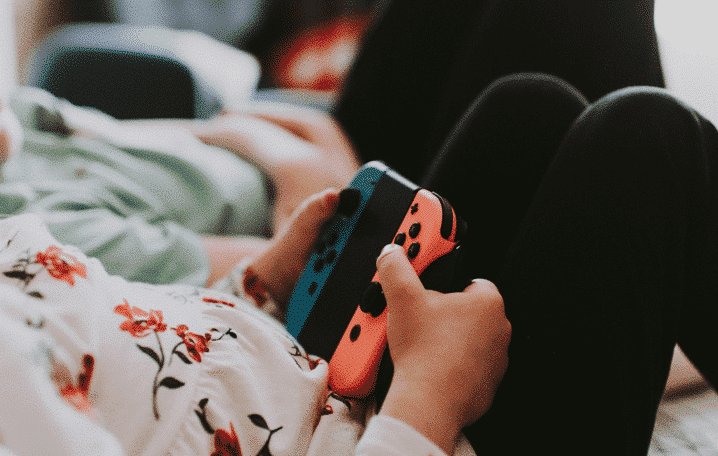
Which games are family-friendly? Dr. Bennett said her kids asked for a Nintendo Switch so they could return to games they used to play together on the Wii. There are many options that are rated E(for everyone). It also offers parent controls and time limits that allow parents to manage what and how much their kids are playing.

Some fun and family games we at GKIS recommend are:

Mario Kart is a competitive driving game with lots of cute levels, fun characters, and a ton of quality. Race against friends and family in different beloved Mario worlds. Dr. Bennett cautions to start with the cow land…she says she’s spent many hours screeching in agony trying to stay on the slippery Rainbow Road while her kids roared. She says kids can’t get trusted to pick the level…

Just Dance is another Nintendo Switch game that Dr. B says provided hours of fun family co-play. With many popular and even old hits, everybody finds their favorite games to competitively dance to. She says her youngest was delighted by this game, because even when he was little, he could out score her and his older sisters! Plus, everybody worked up a sweat and got a little exercise. No pain, all gain.

Super Mario Party is a game designed for group play and loads of fun. With 80 mini-games, like Bumper Brawl and Croosin’ for a Broosin’, everybody has a favorite. Play with or against your kids with the large board game style platform.

Yoshi’s Island is an fun and simple game for the whole family. Jump around as the adorable Yoshi solving creative puzzles and collecting all the hidden items.

Snipperclips has great games for the whole family don’t have to cost an arm and a leg. This game is designed for communicating and working together to snip your cute little paper characters into the perfect shape for each unique and entertaining puzzle.

Knock ‘Em Down Bowling is a fun one with many game modes like split screen, team matches, and no gutters. With a variety of traditional bowling games and party modes, team work is always a fun possibility.

Forza Motorsport Games for Xbox offers lots of options for fun family car racing in professional-style track racing events.

Scribblenaughts for the Nintendo DS is a fun, emergent puzzle action video game where the players must solve puzzles in order to collect Starlites. Warner Bros. Active Entertainment published this game with the goal of promoting emergent game play by challenging the player through systematically more difficult puzzles.

I’m Jack Riley a GKIS intern. I hope you find the courage to carve the time and try co-play now that you see the pros in family gaming. My parents were never able to do any of this with me and as my interest in games increased, I felt as if our family relationship decreased. Interested in learning about other benefits of video game play? Check out the GKIS article Is Your Child a “Professional Gamer”?

I’m the mom psychologist who will help you GetKidsInternetSafe.

Onward to More Awesome Parenting,
Tracy S. Bennett, Ph.D.
Mom, Clinical Psychologist, CSUCI Adjunct Faculty

Works Cited

[1] (July 2013). Move over, Monopoly: ASU researchers find families bond over video game play, Arizona State University.edu

[2]Wang, B. (April 2018). Families that play together stay together: Investigating family bonding through video games. Sage Journals.com

[3]Shapiro J.( December 2014). Research Says Parents And Kids Should Play Video Games Together. Forbes.com

Photo Credits

Photo By Kelly Sikkema

“My mini on our PS4” photo by Samantha Sophia

“Two people playing Sony PS4 game console” photo by JESHOOTS

“Nintendo Switch Joy-Cons” photo by Aleks Dorohovich