Is your child smoking pot? I hope not, but parents are the last to know. Within the last five years, kids are smoking pot sooner and at higher rates. As marijuana becomes increasingly available (and legal), kids perceive the drug to be less risky. With the increasing potency of this addictive drug, marijuana poses a significant risk to the developing brain. Educate your kids now before they try their first pot brownie. That means a heart-to-heart talk with the facts BEFORE middle school!
Marijuana use is UP and smokers are starting younger.
Just as I’m hearing in my suburban psychology practice, five-year trends reflect increasing marijuana use among tenth through twelfth graders, with kids starting to smoke at younger ages than ever before. We haven’t reached the peak use rates of the 1970s, but we may be getting there.
However, there is hope! Teaching kids the facts may hold off experimentation. For instance, when popular media covered the adverse effects of synthetic marijuana (spice, K2, or wax), use rates went down. Educating your kids about the easily available marijuana their friends are smoking optimizes the chance they’ll use good judgment. Here are the facts parents need to know!
Today’s pot is far more potent than pot from the 1970s-1980s.
The average marijuana today contains 20-30% THC versus 1980’s pot which averaged 4% THC. That means that old research conclusions barely apply to today’s pot. Furthermore, as THC potency increases the number of cannabinoids decrease. Cannabinoids are the chemical compounds in marijuana that is responsible for proposed medical benefits.
Marijuana is physiologically and psychologically addicting.
Cannabinoids increase dopamine in the pleasure center of the brain. This is the same process that underlies the reinforcing effects of ALL addictive drugs. Because there is a high concentration of cannabinoid brain receptors in many different areas of the brain, marijuana has many effects on the user. This is why marijuana is in a drug class of its own with effects that qualify it as a hallucinogenic, sedative, or analgesic.
Similar to all drugs of abuse, there is clear and consistent evidence of tolerance, withdrawal, and craving resulting from marijuana use. For the benefit of three hours of a high, you have the cost of up to fourteen days of withdrawal. Withdrawal symptoms include irritability, stomach pain, anxiety, loss of appetite, and insomnia.
Starting young and smoking often makes you dumber.
Chronic marijuana smokers younger than 18 years old demonstrate an average IQ decline of eight points and other signs of impaired mental functioning by age 38 years.
Marijuana has legitimate applications for some medical conditions.
The marijuana effects of increased hunger and happiness have been found to be helpful for the nausea, anorexia, and wasting experienced by people with HIV (Bedi et al. 2005; Haney et al. 2007; Lutge et. al. 2013) and chronic neuropathic pain related to HIV, multiple sclerosis, and peripheral neuropathy (Lynch et al. 2011; Ware et al 2010). However, marijuana is rarely recommended as first-line treatment due to side effects. Most studies evaluate the oral forms of marijuana rather than smokable forms.
Marijuana obscures psychiatric presentation and generally makes mental illnesses worse rather than better.
Anxiety Disorders: Self-medicating with pot leads to cyclic withdrawal and heightened anxiety that is harder to treat with traditional therapies. Marijuana lowers GABA, natures calming neurotransmitter.
Mood Disorders & ADHD: Marijuana dysregulates serotonin, dopamine, and norepinephrine, the neurotransmitters related to mood and attention disorders. In other words, pot makes mood and ADHD symptoms worse.
Schizophrenia: Schizophrenia is a psychotic disorder characterized by hallucinations, delusions, and a lack of initiative. It is typically incurable and progressive, often seen among our homeless population.
Here is the most disturbing research outcome I have read in my twenty-year career. The use of marijuana increases the chances of developing schizophrenia by 600% for heavy smokers, 400% for regular smokers, and 200% for any smoking (Andréasson et al. 1987; Stefanis et al. 2013)! This does not mean marijuana causes schizophrenia, but it certainly increases the chances that it will occur. I caution my patients often, why take that kind of risk with your life and brain health just to get high?
You can’t be sure all you’re smoking is marijuana.
Marijuana is often laced with more addictive drugs like cocaine, heroin, or PCP to keep buyers buying. Although adulteration if far less of a risk for marijuana than other drugs, the heavier the drug the higher its price. As a result, adulterants like lead, silicone, Mountain dew, and Windex have been commonly discovered in pot samples. Marijuana is also often treated with pesticides to optimize profitable quantities. So much for organic.
Chronic marijuana use is particularly harmful to the developing brain, because it decreases Brain Derived Neurotrophic Factor (BDNF).
BDNF is a chemical that regulates the birth, survival, and repair of the cells that make up the brain. BDNF is responsible for what scientists call neuroplasticity, the adaptive processes underlying learning and memory.
Pot lowers BDNF levels. So if an adolescent’s brain is not developing normally, pot may make it worse (D’Souza et al. 2009; Zammit 2003). Clinically we have found that if we can get our client clean from marijuana after their first psychotic symptoms, they have a far better chance of recovery rather than suffering a progressive course.
Chronic marijuana use has been found to have various negative health effects, including:
a suppressant effect on immune system (long-term unknown);
an adverse effect on the reproductive systems of men and women (lower testosterone and lower sperm count in males and lower LH secretion in females), but there is no evidence of a change in fertility;
no identified increase in birth defects, but may contribute to low birth rate and less maternal milk production;
problematic behavioral syndromes including lower GPA, more truancy, higher drop out rate, and more delinquency.
Marijuana has become BIG BUSINESS.
Big tobacco money is investing in the marijuana industry. As a result, I anticipate the “mom and pop” head shops will be going bankrupt while even more slick marketing comes on the scene. There’s big money to be made at the expense of the public’s health…again (remember tobacco?).
As marijuana gets more addictive and capable of generating profit, we are seeing a more diverse product line of smokables and edibles, some of which are packaged to be attractive to children. Although there are no reported cases of death by marijuana overdose, there are increasing numbers of emergency room visits due to marijuana use. Safety groups are advocating for potency limits, better labeling, bans of products packaged to appeal to children, and a regulatory structure for marijuana similar to those that exist with tobacco and alcohol.
Regardless of your opinions about adult use of marijuana, I think we can all agree that marijuana is harmful for children and teens. I hope these facts inspire you to have a factual discussion with your kids. Although education isn’t all kids need to stay safe from drugs, I am frequently pleased to see my clients alter their course after a factual and reasonable discussion about the risks of marijuana on the developing brain.
I’m the mom psychologist who will help you GetYourKidsInternetSafe.
Andréasson, Sven, Ann Engström, Peter Allebeck, and Ulf Rydberg. “CANNABIS AND SCHIZOPHRENIA A Longitudinal Study of Swedish Conscripts.” The Lancet 330.8574 (1987): 1483-486. Web.
Bedi, Gillinder, Richard W. Foltin, Erik W. Gunderson, Judith Rabkin, Carl L. Hart, Sandra D. Comer, Suzanne K. Vosburg, and Margaret Haney. “Efficacy and Tolerability of High-dose Dronabinol Maintenance in HIV-positive Marijuana Smokers: A Controlled Laboratory Study.” Psychopharmacology 212.4 (2010): 675-86. Web.
D’Souza, Deepak Cyril, Brian Pittman, Edward Perry, and Arthur Simen. “Preliminary Evidence of Cannabinoid Effects on Brain-derived Neurotrophic Factor (BDNF) Levels in Humans.” Psychopharmacology 202.4 (2009): 569-78. Web.
Haney M, Gunderson EW, Rabkin J, Hart CL, Vosburg SK, Comer SD, Foltin RW. “Dronabinol and Marijuana in HIV-Positive Marijuana Smokers: Caloric Intake, Mood and Sleep.” JAIDS 45 (2007): 545–554. [PubMed]
Lynch, Mary E., and Fiona Campbell. “Cannabinoids for Treatment of Chronic Non-cancer Pain; a Systematic Review of Randomized Trials.” British Journal of Clinical Pharmacology 72.5 (2011): 735-44. Web.
Meier, M. H., A. Caspi, A. Ambler, H. Harrington, R. Houts, R. S. E. Keefe, K. Mcdonald, A. Ward, R. Poulton, and T. E. Moffitt. “Persistent Cannabis Users Show Neuropsychological Decline from Childhood to Midlife.” Proceedings of the National Academy of Sciences 109.40 (2012): E2657-2664. Web.
Stefanis, N. C., M. Dragovic, B. D. Power, A. Jablensky, D. Castle, and V. A. Morgan. “Age at Initiation of Cannabis Use Predicts Age at Onset of Psychosis: The 7- to 8-Year Trend.” Schizophrenia Bulletin 39.2 (2013): 251-54. Web. http://schizophreniabulletin.oxfordjournals.org/content/early/2013/01/10/schbul.sbs188.abstra ct
Ware, M. A., T. Wang, S. Shapiro, A. Robinson, T. Ducruet, T. Huynh, A. Gamsa, G. J. Bennett, and J.-P. Collet. “Smoked Cannabis for Chronic Neuropathic Pain: A Randomized Controlled Trial.” Canadian Medical Association Journal 182.14 (2010): E694-701. Web.
Zammit, S. “Self Reported Cannabis Use as a Risk Factor for Schizophrenia in Swedish Conscripts of 1969: Historical Cohort Study.” Bmj 325.7374 (2002): 1199. Web.
Parenting will probably be the hardest thing we ever do. If you don’t think that yet … buckle in it’s probably coming. With screens, parenting has gotten even harder. I also think it’s gotten more difficult to be a teen. Normal developmental mistakes are broadcast and shared among too many immediately and the sharing of dangerous “coping” methods happen too often. This article is about my oldest daughter, who graduated in 2012. This was even before the scary social media platforms came on-scene. Here’s a story about a road trip with a teen, texting, and a perimenopausal mother; what could possibly go wrong?
My oldest daughter, Carly, is amazing. She has always had the kind of vibrancy that makes everybody in her presence buzz. She’s smart, funny, and beautiful, and I’m beyond smitten with her. (I know, duh, I’m her mom). She and I have a close and complex relationship. She was my only for eight years and my mini-mom for her younger brother and sister after that. We complete each other’s sentences, yet have totally different ideas of “clean.” Nobody knows me better or gets to me quicker. Just as she puts sparkle in my soul, she can make me simmer with frustration.
During the summer between her sophomore and junior years, I panicked that she was not intending to pursue the future of my dreams. Yes, I said MY dreams. Since I loved her so much, I dreamed her future would be pre-paved by my hard-earned experience. No failures and frustrations for my child. She’d accept my wisdom and effortlessly make her way.
You’d think I’d know better being a shrink. Of course kids don’t accept parent influence like that. Once they become teens, it’s the healthy course for them to be hell-bent on stumbling into their own mistakes. As they hitch their own wagons, we can only look on wide-eyed and trembling. It is then that parents must grieve the children they expected (fantasy) and accept the children they got (reality).
Lucky for me, Carly’s true self is way better than my fantasy of who she would be. I had to learn that by coursing through many parenting challenges along the way. Don’t judge, you will too. 🙂
One of those challenges happened with my brilliant idea to inspire Carly’s academic goals with a college visit road trip. Well, technically it wasn’t all my idea. At the time, we were hanging with the coolest parents we know, at the coolest backstage concert venue we’ve ever been, when we were treated with the story of how their college road trip inspired their son into four-year university. Convinced at that moment I was failing to inspire as a parent, I rushed home and frantically mapped out a last minute, end-of-the-summer college road trip throughout Central and Northern California. Just Carly and I on a life adventure! It’s an understatement to say that Carly was NOT happy with my impulsive announcement. It was honestly nothing less than a cultish abduction inspired by maternal enthusiasm. I dismissed her pleas to let her spend the remaining two weeks of summer hanging with her friends and packed us up to go, snacks and sodas in the cooler, playlists on the iPod. Carly affectionately calls me BOSS LADY for a reason.
We launched on a beautiful sunny day; me at the wheel chirping excitedly with agenda in hand, Carly beside me rolling her eyes wearing a hoodie, earphones, and scowling contempt. At 15 years old, her love-hate for me ran deep and boiling, just as mine did for my mother when I was 15. I understood it completely and considered myself impervious, saintly if you will. After all, in my panic it was evident I had few opportunities left to land amazing feats of perfect mothering. And damn it we were going to go down ablaze tryin’!
Carly and I were no strangers to mother-daughter togetherness. As cheer mom of her high school cheer squad, I drove her and her friends to every home and away game for all football, basketball, and volleyball seasons for two years running; her little brother and sister clutching their Nintendo DS’s in tow. She and I were like a well-oiled machine fueled by smoothies and silver hair bows.
Upon pulling out of the driveway, Carly immediately hijacked the stereo for hip-hop, knowing that in an hour I’d pull rank to soak in my achingly sad singer-songwriter dirges. I was afire with anticipation.
It was as soon as the second hour of driving when my eager delight began to wane. At this point, I had exhausted my most inspired questions to entice her into conversation. She occasionally placated me with a forced nod or two-word response, most the time texting madly to her army of fascinating friends. When she did talk to me, she would give me that dead-eyed stare only teenage girls can give their mothers, then look with adoration at her iPhone, throwing her head back giggling at times with true delight. It was beyond annoying.
By the fifteenth dead-eyed stare, I was sulking and angry, or more accurately, self-righteously furious. How could she be so entitled when I had given up EVERYTHING to pave this path of college educational awesomeness? Kids these days and their entitlement…my head abuzz with indignation.
Now I could drag you through some entertaining tales about this road trip that would make you LOL and recoil in empathy for us both, but I won’t. Let’s just say she had little interest in navigating, and I had little interest in being compassionate. Overall, we rescued a pretty good trip.
Reflecting Back . . .
A credit to Carly’s innate kindness, she somehow forgave my epic tantrum stemming from my perceived rejection the first three hours. And over the next ten days we braved a historical B&B full of rose-colored wallpaper and creepy staring dolls, had a whirl through San Francisco with my two best college buddies in a convertible Mini Cooper, and hobnobbed with drag queens in the Castro district. We drove along beautiful pine mountain roads, ate lots of cheeseburgers, and splashed our feet in a gurgling stream. I even backed into a pole in a parking lot, which was awesome modeling in crisis management considering she was logging driving permit hours.
Oh and the college tours! Despite my efforts to entice her into the campus of my dreams, Carly soundly vetoed every campus visited, ultimately choosing what turned out to be the perfect local alternative. No pine woods and darling river guide co-eds for Carly. She opted for a slower academic transition closer to home with beaches and frat boys. True to our special connection, we ultimately negotiated a choice that honored her individuality while soothing my fears of academic slacking. She even saved us loads of cash along the way, while kicking tail to a bachelor’s degree earned in only four years! Unheard of in today’s impacted college campuses. She had an awesome college experience…and I learned that I should have listened to her better…and sooner.
On this riot of a road trip, I learned more from Carly than she will ever know. Not only did I recognize that she is worthy of profound trust, but also that my fears that she would no longer need me were only partly true. And that army of texters that kept her distracted from my neediness? They wanted what was best for her too. Ultimately I had to learn to trust them as well.
From the proud heartbreak of watching my little girl become her own woman, I gathered the serenity I needed to help other families negotiate the loaded landscape of adolescence. The truth is, no matter how much we want to rescue them from life’s tragedies, they must experience their own failures to find success.
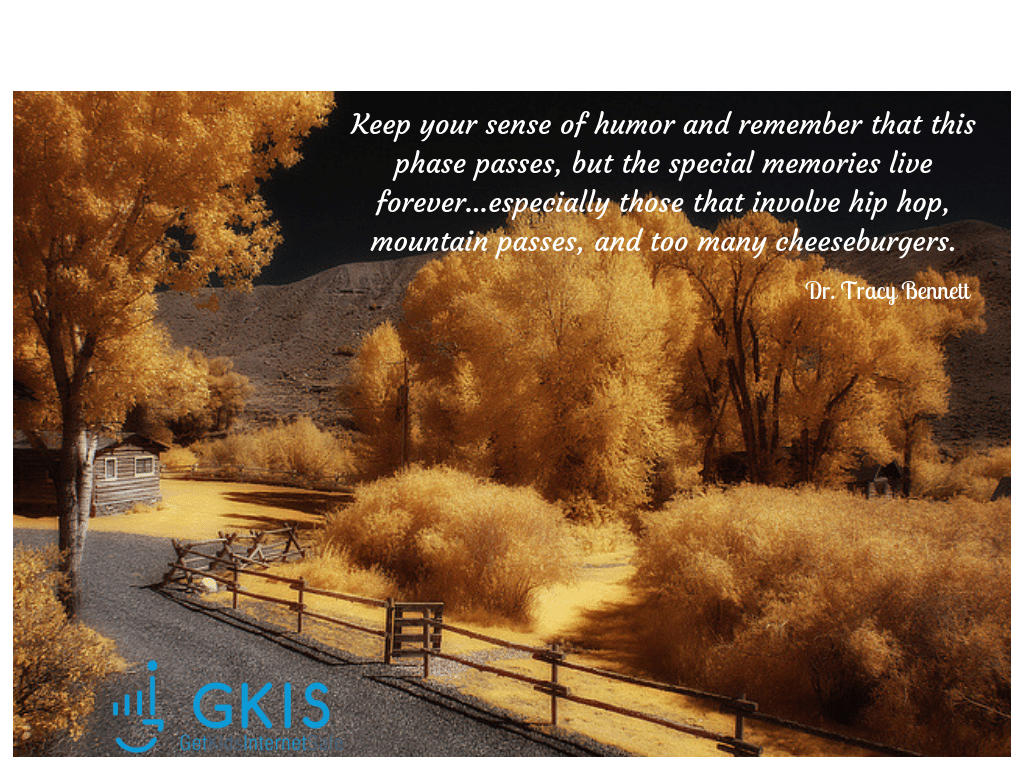
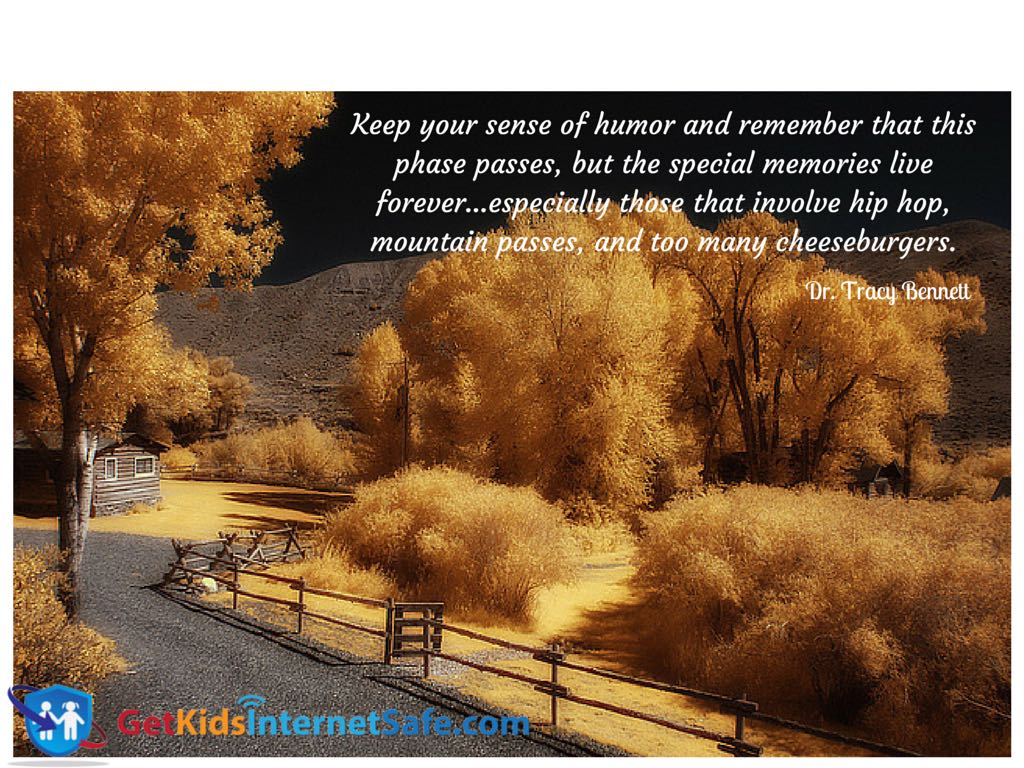
As we hide our faces in fear, we must not forget to peek through and be impressed by their gritty adolescent ferocity, because that is exactly what is necessary to carve adult resilience. To preserve sanity during your occasionally terrifying parenting journey, keep your sense of humor and remember that each challenging phase passes. But the special memories live forever…especially those that involve hiphop, mountain passes, and too many cheeseburgers. Enjoy your frantic, panic-inspired road trips.