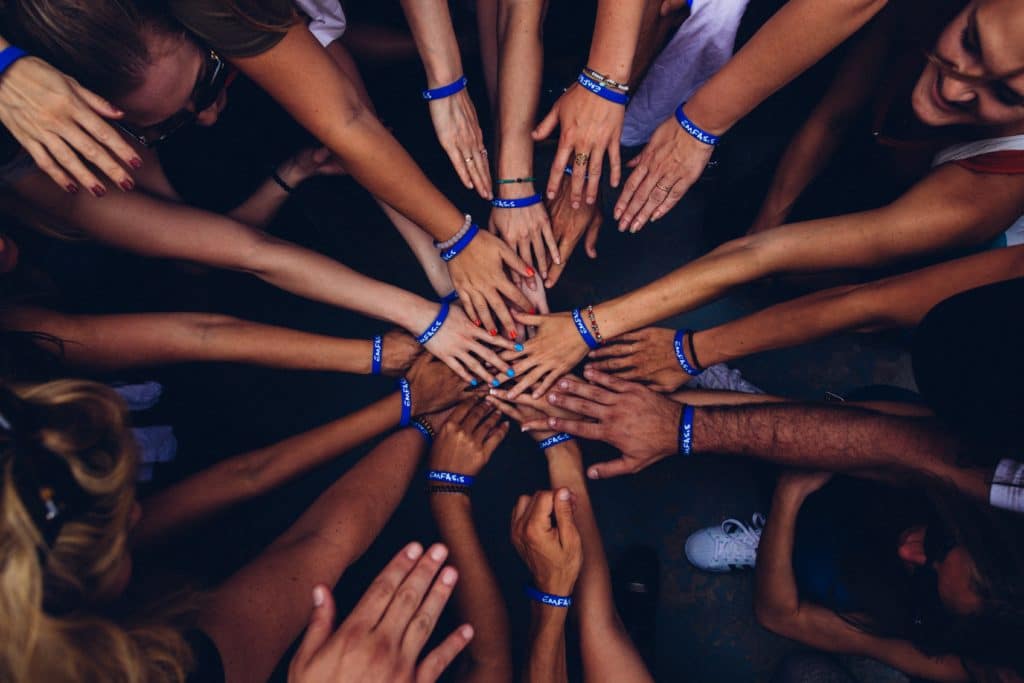
Martin Seligman, the father of Positive Psychology, emphasized the strength of social influence and how it can create meaning in life. We all need purpose. Despite its challenges, sometimes social media can help spread positive influence. Today’s GKIS article highlights some beautiful bright spots on GoFundMe and in the Twitter community. I hope you find it inspiring to join the joyful fray!
Paying it Forward: GoFundMe
GoFundMe.com is a popular website used for personal fundraising. For example, Dana Barrett’s tragic story of suffering from a traumatic spinal injury left her unable to breathe on her own. She’d already suffered a great loss with the death of both of her parents when she was only twenty-one years old. Now, after her accident, she was left struggling with quadriplegia. Dana is a loving, positive, and strong individual who is mightily loved and appreciated by her community. Her medical expenses will cost over $500,000. GoFundMe offered a platform for her loving community to come together for support. At the time of this writing, her fund was nearing $300,000 and growing!
Recent updates say that, with the support and money coming in from GoFundMe.com, Dana has been able to eat and drink on her own! She was told those goals were outside of her reach. The online community has consistently promoted events since her accident via social media, attracting the attention of singer-songwriter Gloria Estefan, comedian Amy Schumer, and actor Adrian Grenier.
The Ripple Effect
It doesn’t take a celebrity to spread generosity and joy; it can begin straight from your social media feed.
Recently I experimented with the ripple effect meaning one good deed spreads and encourages others. By offering thoughtful comments of appreciation and support on Instagram to friends and acquaintances, I let them know I read their captions and enjoyed their photos rather than mindlessly scrolling and clicking the heart eyes emoji. I took Martin Seligman’s active listening techniques and applied them to social media posts.
I saw a positive return on my posts almost immediately. I felt connected in an online world where connection is sometimes lost. Soon I started messaging people I wanted to be friends with just by watching their Instagram stories and saying something nice about the content. In a short time, I felt like I had a whole tribe of new friends eager to connect and share the joy.
Social media isn’t all about distraction. With a little bit of authentic, mindful effort, it is a tool for a fun and convenient connection.
The Positive Impact of Twitter Influencers
Twitter is, in my opinion, the fastest way to find hilarious memes, political content, and trolling. Trollingrefers to the act of intentionally fighting with someone online, often in a joking manner, just to spark a reaction.
My favorite Twitter account right now is that of rapper @lilNasX. He’s used his charismatic online presence to create the longest-leading Billboard No.1 track “Old Town Road.” He takes Twitter harassment and comments from “trolls” as gracefully as anyone I’ve ever seen.
In response to his brushing a mean comment off his shoulders recently, comedian Chris D’elia tweeted, “We love you, kid.” The music industry seems to have welcomed LilNas silly endless remixes of “Old Town Road” (ft. Billy Ray Cyrus, Diplo, Young Thug & popular meme “yodeling kid” Mason, Seol Town Road K pop version, and Cupcakkke) with open arms.
In response to lilNasX’s release“C7osure (you like)” on the last day of Pride month, Twitter went wild for LilNas’s came out as a full-time African American rapper LGBTQ representative with a country NO.1 hit and a hilarious Twitter account. The LGBTQ community loved it, adopting it as a new theme song, a voice spreading positivity, energy, and love.
Thank you LilNas for your positive representation. I found it so positive and inspiring. It’s time to use social media as a tool for positivity. The first step starts with your online footprint!
I’m Kaitlin Hoover, GKIS intern. Paying it forward is a great way to feel connected to the world and finding representatives that make you laugh is a great start. Check out GKIS article Gaming Together Increases Family Bonding for more ways to incite spontaneous joy and connection!
I’m the mom psychologist who will help you GetKidsInternetSafe.
Onward to More Awesome Parenting,
Tracy S. Bennett, Ph.D.
Mom, Clinical Psychologist, CSUCI Adjunct Faculty
After the Charlottesville violence, Silicon Valley giants, like Facebook, Google, Twitter, Paypal, and GoDaddy, are choking off tech avenues that hate groups use for crowdsourcing, organizing, and funding. This is a reversal of tech companies’ overall “hands off” approach to censorship and raises free speech concerns. In response to the censorship, alt-right organizations are revolting by creating parallel digital services, essentially birthing an alt-right Internet resembling the dark net. Some believe it is the tech companies’ right to cancel accounts that violate their values and membership agreements. Others think a private company using unregulated editorial judgment, with a profound impact on the ability for American citizens to communicate, is overstepping. What do you think?
What does this censorship look like?
Facebook and Twitter have actively suspended the accounts of white supremacists attached to the violence in Charlottesville, like white nationalist Christopher Cantwell and @Millenial_Matt, a social media personality who showcases the Neo-Nazi agenda. Considering that a third of the world’s population has a Facebook account and Twitter boasts 1.6 billion users per month, the power these social media giants wield is substantial.
The 71 million-website host, GoDaddy, has also chosen to censor users who demonstrate hate speech. For example, on Monday GoDaddy delisted the popular Neo-Nazi website The Daily Stormer, after its founder celebrated the murder of Charlottesville counter-protester Heather Heyer. When the Daily Stormer transferred its website registration to Google, Google also cut off the site.
In regard to funding, Paypal stated intent to remove 34 organizations from its customer base who espouse white nationalism. Apple also dropped funding sources for hate groups. GoFundMe, one of the largest crowdsource sites, deleted campaigns for the driver who murdered protesters in Charlottesville (Jan, 2017).
Promoting violent genocide is flat wrong, why are we even having this discussion?
I’m writing this article partly to impart news in case you didn’t hear it, but mostly to challenge you to think through the implications of Silicon Valley giants making decisions about the sharing of information. In this instance, I happen to agree with the policy that threatening violence should not be tolerated by any of us, government, private companies, or American citizens. The Internet spreads ideas like a virus, with hate groups recruiting people with untrue, manipulative, and inflammatory rhetoric. Vulnerable individuals, particularly the mentally ill and children, are at risk for being duped by sophisticated online grooming techniques. Perhaps Silicon Valley CEO’s have a moral obligation to limit their products’ availability as a tool to spread evil. But then there’s this concern…
What if the information they shut down is a cause you believe in? What if some of the censored activists were promoting unpopular ideas rather than threats or violence? What if the man behind the curtain decides to censor the democratic principles key to American freedom? Where does the slope start to get slippery? Should private corporations be making decisions about blocking pedophiles, terrorists, hate groups, and cults or should that be left to the government? Do we still trust a government that secretly surveilles its citizens, like what was revealed by Edward Snowden? Do we still have confidence in elected government leaders who use Twitter to cyberbully those who disagree with them?
“I’m happy to forfeit informational freedom for security”
Have you heard of the Total Information Awareness (TIA) policy? This program was developed in 2003 by the Pentagon under the direction of retired Adm. John Poindexter as a counter-terrorism measure. Under this policy, later renamed to Terrorism Information Awareness, the United States government aimed to integrate private and government intelligence and surveillance programs to be used as a powerful tool for the use of intelligence, counter-intelligence, and law enforcement. Simply put, that means secretly surveilling American citizens to better “detect, classify, and identify potential foreign terrorists” (The Associated Press, 2003).
On its surface, one may think, “Go ahead and track my online activities. It’s worth giving up some freedom for security. I’m not up to anything anyway.” But consider the fact that your personal online information is vast. The scope of the data collected by TIA included, but was not limited to, your browsing history (what you subscribe to, what your read, who you’re friends with, what you “like,” what you don’t like), financial data like purchases, transfers, and deposits, phone, email, and texting content, geolocation data, travel itineraries and passport data, licenses, judicial (driving and divorce) records, medical records, and biological data like fingerprints, DNA, and gait, face, and iris data. With your private information gathered and stored by the US government, your very identity is available to be hacked by any other entity as well. In the wrong hands, your private information could be used toward your personal devastation, whether you’re up to “no good” or not.
Fortunately in the case of TIA, Congress defunded the program after media reports recognized the alarming potential of “the biggest surveillance program in the history of the United States.” Elements of the program were then absorbed by three-letter governmental agencies and are said to be “quietly thriving” at the National Security Agency (NSA) operating with “little accountability or restraint” (Harris, 2012).
Current law requires that suveilling an American citizen or permanent resident is illegal without a court order. The loophole though, is that surveillance is legal if that citizen is communicating with somebody outside of the United States. Don’t worry though, if you were accidentally caught up in the NSA’s surveillance web, your private data is locked securely in a one million square foot facility in the Utah desert. What could possibly go wrong with that?
From Snopes: The film is authentic. “Don’t Be a Sucker” was produced by the U.S. Signal Corps and distributed by Paramount Pictures for viewing in civilian movie theaters in 1943 and again in 1947. This two-minute clip making the Twitter rounds captures the essence of its anti-fascist message:Where do you stand?
Most of us are frogs in the pot, slowly getting used to giving up our digital freedoms to entities like Facebook in order to gluttonously dine on delicious free Internet content. At what point is enough, enough? Will we get concerned when the government oversteps or when private corporations overstep? Or is privacy something that we are willing to give up for safety and security? Maybe we are OK with adult privacy being violated, but what about our kids? If this stirred you up, please comment in the comments below. Or better yet, “like” the GetKidsInternetSafe Facebook page and start up a conversation.
For specific information to discuss with your kids to protect them from hate group and cult recruitment, read this GKIS article.
I’m the mom psychologist who helps you GetKidsInternetSafe.