Millennial parents are constantly looking for ways to “life-hack” their parenting and make parenthood a breeze. YouTube channel ‘Ms. Rachel’ is the newest of the tools parents are utilizing, and the results are astonishing. Parents all over social media are praising ‘Ms. Rachel’ for teaching their children to talk (along with teaching skills like sign language). Virtual learning tools are a great way to help supplement the education your child receives, but with screen time comes burnout. To prevent screen time burnout for your child, try our safe-screen home setup and management with our GKISConnected Family Course, suitable for parents with toddlers to teens.
Who is ‘Ms. Rachel’?
‘Ms. Rachel’ is a teacher who created “Songs for Littles,” a YouTube channel that has 3.03 million subscribers and 1.7 billion views despite only having 102 videos made since its creation in early 2019.[1] Rachel Griffin Accurso (Ms. Rachel) creates educational videos that are backed by research and learning standards important for babies, toddlers, and preschoolers with the help of a large team. Accurso has a masters degree in music education from NYU and is currently working on her second masters in early childhood education.[2]
Accurso was motivated to create the channel after her own son was diagnosed with a speech delay. Her son inspired her to create a show to encourage language development and help children reach important learning milestones.[3] Accurso employs psychological principles like mirroring and encourages viewers to follow along with her sign and body language to build speech and language skills. Mirroring involves the mimicry of reflecting speech or behavior to help children learn to develop skills on their own.[4]
Social Media Praise
Parents all over social media have sung high praise for Ms. Rachel, even crediting her for being the reason their children say their first words. Beyond just speaking, users have also shared videos of their kids expressing themselves using sign language.
TikTok user Cw1908 shared a video of her 2-year-old daughter signing and saying, “I want more milk, I want more.”[5] The comments of the video are filled with parents sharing their experiences with Ms. Rachel as well. TikTok user Yesys13 writes, “OMG! My daughter is almost 3 and has a speech delay. Mrs. Rachel has helped her communicate with us a lot easier without frustration!”[6] User Sweetness.103 writes, “I play Ms. Rachel and my baby can read for my grandbaby.”[7]
Even parents who are cautious about screen time in infanthood share their praise for Ms. Rachel and share that the benefits outweigh their anxieties. TikTok user Nataliaa_calles shared, “I was very hesitant to allow screen time with Ivy. I heard many kids’ shows become addictive. I researched a lot of different YouTubers to help my daughter’s brain development, and Ms. Rachel was the best. Ivyanah has now learned ‘momma’ (6 months old). She’s been saying it for weeks now.”[8]
Ms. Rachel’s videos seem to help both children who are just developing their language skills and those who are developmentally delayed. Comment by user Irisloc112 on the aforementioned video states, “My son has no word at almost 3. We started watching Ms. Rachel, and now he doesn’t stop talking 5 months later.”[9]
It is not just moms on TikTok who are praising Ms. Rachel. Jasmin, 27, shared with GKIS all about how her child has learned to talk with the help of Ms. Rachel’s videos. “I started playing Ms. Rachel for my son when he was about 3 months old. I heard good reviews about Ms. Rachel and how she teaches kids important skills such as speech, movements, and emotions. I thought it was a great way for my son to learn at an early stage. From watching Ms. Rachel’s videos my son has learned how to say ‘Mama’ and ‘Dada’. His first word was ‘Mama’ at 7 months old. He always laughs and talks while I have Ms. Rachel playing on the TV. I would recommend Ms. Rachel’s videos because I believe they can help many kids who are behind in speech development or any kids who are struggling to express their feelings and emotions.”
It turns out that grandparents are crazy for Ms. Rachel too! Dr. Bennett shared that she just returned from a weekend vacation with her first grandchild and said that is the one show that keeps his attention the whole time. She found herself singing along and repeating Ms. Rachel along with him. He too is signing as well as talking and singing.
Benefits of Teaching Language Early
Most infants begin babbling around 4 months of age and say their first recognizable word around 12 to 18 months old.[10] Babies learn speech through socialization and the world around them. They closely watch their parents’ reactions to sounds and conversations with others. Through this observation, babies begin to mimic and mirror the people around them.[11] The most effective way to help your child learn to speak is by spending time talking and interacting with them. However, all parents need a break, so having an occasional virtual “co-parent” can help a lot.
Delayed speech development is associated with developmental risks down the line such as academic difficulties, learning disabilities, social difficulties, anxiety, and behavioral problems.[12] By teaching your child to learn language early, you can help to avoid these risks and reap all the benefits of early language development. Research has shown that developing a large vocabulary increases creativity.[13] Language development also helps children understand and process their emotions, analyze ideas, develop critical thinking skills, and set the foundation for most future learning.[14]
If you are worried about your child developing a digital injury such as screen addiction while utilizing virtual learning tools, check out our GKISScreen Safety Essentials Course. Co-viewing the content your child is consuming and using to learn can help your child avoid burnout. When you’re tired of watching a screen, they probably are too!
[5] Watkins, C. [@cw1908]. (2023). Its time for songs for littlessss!! #MrsRachel #songsforlittles #signlanguage #Shadybaby @Ms Rachel [Video]. TikTok. https://www.tiktok.com/t/ZTRWNRVM4/
[6] Rico, Yesi. [@yesys13]. (2023). Re: Its time for songs for littlessss!! #MrsRachel #songsforlittles #signlanguage #Shadybaby @Ms Rachel [Video]. TikTok. https://www.tiktok.com/t/ZTRWNRVM4/ [7] Ronnie. [@sweetness.103]. (2023). Re: Its time for songs for littlessss!! #MrsRachel #songsforlittles #signlanguage #Shadybaby @Ms Rachel [Video]. TikTok. https://www.tiktok.com/t/ZTRWNRVM4/
Children deserve the best possible education and the brightest future opportunities. What parent doesn’t want their child to succeed in life? Many view education as the gateway to success. At the same time, COVID-19 has caused a challenge for our school systems providing quality virtual education. How are our children faring?
The Negatives of Virtual Learning
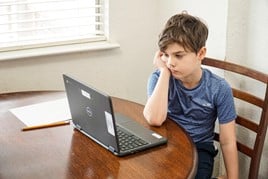
For younger children, this transition has proved to be difficult and stressful for both students and teachers. Young children have a tough time staying engaged on-screen for long. As a result, their education is likely suffering and they may not be learning the basics they will need for later in life.
There is also a large lack of social interaction for children in this age range. The impact of this might be seen for generations to come, perhaps a rise in social anxiety may be discovered?
What about the older students? The California Department of Education has reported that 2020 had 3,000 fewer high school graduates than 2019.[1] In addition to this shortage of expected graduates, 2021 prospective graduates are enduring their entire senior year virtual. Many students report feeling less optimistic about their future, less motivated to learn, and less confident in their academic abilities. Time will tell how the 2021 graduation rate will be, but it will likely be lower than even the 2020s’ was.
The Positives of Virtual Learning
There are some upsides to virtual learning. First, it’s the safest means of learning during the era of COVID. Education can be redone, learning can happen later, but continuing to protect our children and their teachers from one of the most destructive events in our time is the number one priority. In addition to just the health benefits, the drop-out rate for California has also decreased, with 800 fewer drop-outs than in 2019.[1] This is likely due to the opportunity to learn from home. Virtual learning allows for more flexible learning and more self-responsibility for one’s learning, something that may benefit high school students as they transition to higher education.
Virtual Learning and Parents
If you are ever feeling overwhelmed by virtual learning, pause and try to think about the following points:
It’s temporary! Virtual learning is only temporary. Before too long, our children will be back into the classroom and off of the screens. Don’t let yourself get too upset about something that isn’t going to last forever.
You’re not alone. Almost every parent is experiencing the same frustrations that you are. If you need someone to vent or talk to, reach out to one of your fellow parents. The shared experiences will likely help you both feel better about what is going on.
Don’t blame the teachers. Many of them were thrown into this unprepared and unwarned, just like you and your children were. Some teachers are struggling through this time with their kids just like you. They want to be back in the classroom as soon as it is viably safe to do so too.
Don’t blame your children. They didn’t ask for any of this to happen, and they are likely doing the best they can. They want to be back with their friends on the playground, it might be difficult for them to understand why they aren’t allowed to. Try and remind them, in an age-appropriate way, that this is for their safety and the safety of those around them.
Finally, don’t blame yourself. You have no power over this unprecedented situation. Remind yourself that you are only human and that you are giving it your absolute best. It’s okay to feel out of patience from time to time. Giving yourself and others grace is critical to wellness.
More Resources on Virtual Learning and Online Safety




 Thanks to CSUCI intern, Katherine Carroll for researching Ms. Rachel and language development.